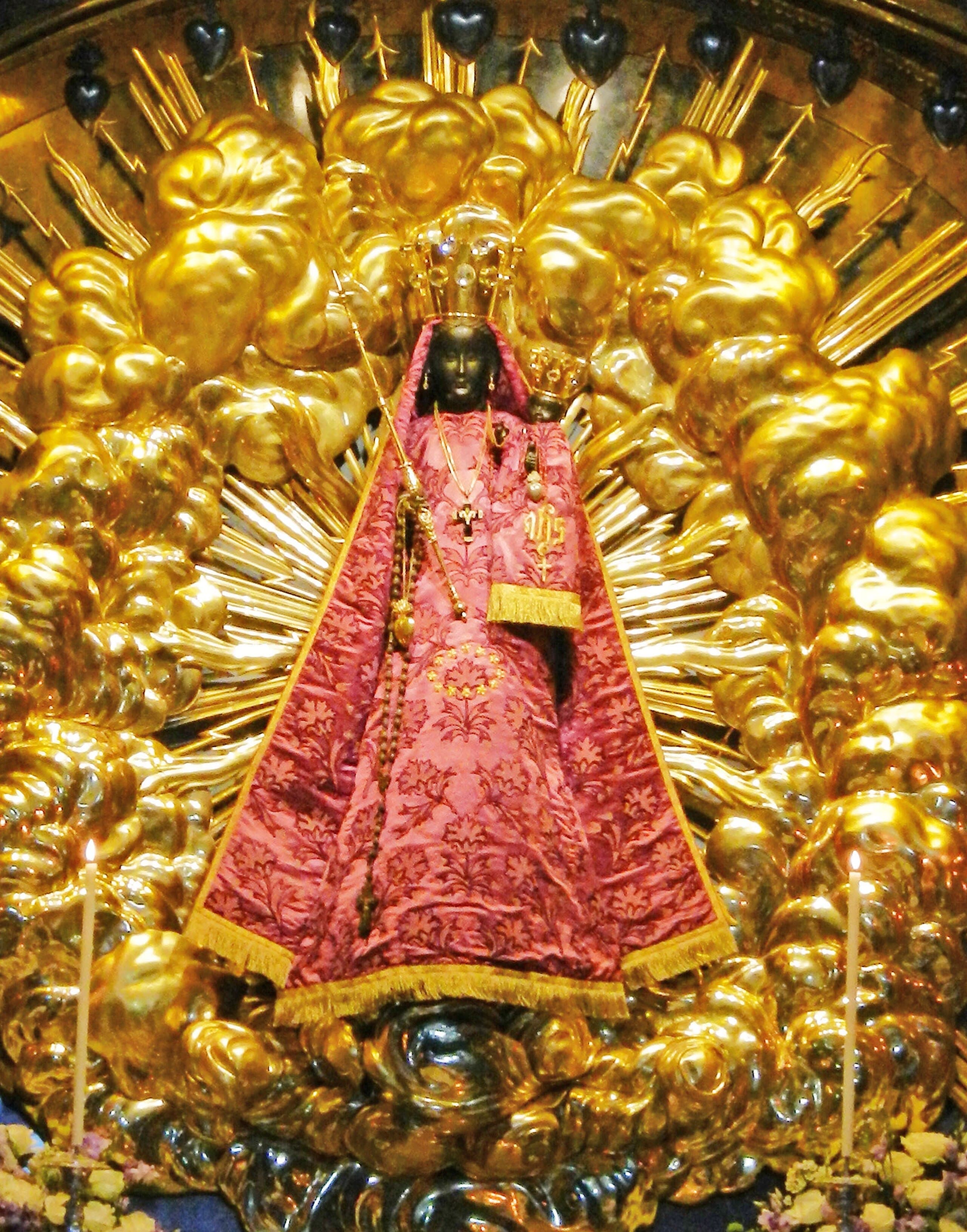
Our Lady of Einsiedeln
Where the Black Madonna has welcomed pilgrims for a thousand years, and the monks still sing
Einsiedeln, Canton Schwyz, Switzerland
At A Glance
- Coordinates
- 47.1278, 8.7431
- Suggested Duration
- A minimum of one to two hours allows time to visit the church and Chapel of Grace. Half a day is recommended for a fuller experience including services. Those walking the Via Jacobi often spend a full day or overnight. For serious pilgrimage engagement, multiple visits or an extended stay in the area allows the place to reveal itself more completely.
- Access
- By train from Zurich, travel to Einsiedeln takes approximately 50 minutes via Biberbrugg. From Lucerne, the journey takes about an hour. The train station is a fifteen-minute walk from the monastery. By car, Einsiedeln is approximately 40 kilometers southeast of Zurich; parking is available in town. The site lies on the Via Jacobi, the Swiss portion of the Way of St. James, for those arriving on foot.
Pilgrim Tips
- By train from Zurich, travel to Einsiedeln takes approximately 50 minutes via Biberbrugg. From Lucerne, the journey takes about an hour. The train station is a fifteen-minute walk from the monastery. By car, Einsiedeln is approximately 40 kilometers southeast of Zurich; parking is available in town. The site lies on the Via Jacobi, the Swiss portion of the Way of St. James, for those arriving on foot.
- Dress modestly, covering shoulders and knees. This is standard for Catholic churches and should be observed. No specific colors or styles are required—simply clothing that shows respect for the sacred character of the space. Comfortable shoes are recommended as the church and grounds involve considerable walking.
- Photography is generally permitted inside the church, including the Chapel of Grace. Exercise discretion—flash may disturb others and is restricted near the Madonna. Do not photograph during services. Be mindful of pilgrims in prayer; they did not come to appear in your images. Consider putting the camera away for periods to experience the space directly.
- Einsiedeln is an active place of worship. The services are not performances for tourists but prayer that happens to be public. Maintain appropriate silence and respect, particularly in the Chapel of Grace and during liturgical services. Photography is generally permitted but should be practiced with discretion. Do not photograph individuals without permission. Avoid flash near the Madonna. Consider whether documenting the experience might be preventing you from having it. The monastery grounds include areas private to the monastic community. Respect closed doors and marked boundaries. The monks' willingness to share their church and their prayer does not extend to all aspects of their life.
Overview
In the Swiss Alps, a dark-faced Madonna has drawn seekers since the ninth century. The Chapel of Grace stands where a hermit once prayed, where legend says Christ himself descended to consecrate the space. Eight hundred thousand pilgrims come each year to this place where Benedictine monks have sung the Salve Regina every afternoon for nearly five centuries.
There is a particular quality of attention in the Chapel of Grace at 4:30 in the afternoon. The baroque splendor of the great abbey church gives way to something more intimate—a small chapel of black marble where a dark-faced Madonna and Child look out from centuries of candlelight and prayer. When the Benedictine monks begin the Salve Regina, their voices weaving through the space as they have done every day since 1547, something shifts. Time folds.
The Black Madonna of Einsiedeln is one of the most venerated images in Catholic Europe, patroness of Switzerland, destination of the faithful for over a thousand years. She stands in the place where St. Meinrad built his hermitage in the ninth century, where he prayed in solitude for twenty-six years before two robbers murdered him and his faithful ravens pursued them to justice. According to tradition, when the chapel was to be consecrated in 948, Christ himself appeared and completed the ceremony—a miracle confirmed by papal bull.
Pilgrims still drink from the fourteen spouts of St. Meinrad's fountain before entering, still kneel before the dark face that has witnessed centuries of petition and thanksgiving. The Madonna's blackness—whether from candle smoke accumulated over centuries or something more intentional—has become inseparable from her power. When restorers tried to return her to her original coloring in 1799, the faithful demanded she be darkened again. Whatever the darkness means, the people knew they needed it.
This is not a museum of devotion but a living shrine. The monks still pray the Liturgy of the Hours. Mass is celebrated multiple times daily. The Madonna still receives her pilgrims, dressed in different robes according to the liturgical season, as she has been dressed since the seventeenth century. What drew St. Meinrad to this dark forest, what drew the faithful after him, what draws eight hundred thousand visitors each year—it continues to draw.
Context And Lineage
Einsiedeln's history begins with a ninth-century hermit seeking God in the Dark Forest and continues through legendary miraculous consecration, medieval pilgrimage prominence, baroque reconstruction, Revolutionary suppression, and restoration to the living shrine it remains today. Through all changes, the continuity of Benedictine monastic life and Marian devotion has persisted.
The story begins with St. Meinrad, a Benedictine monk from the monastery of Reichenau on Lake Constance. Around 835, seeking deeper solitude for contemplative prayer, he withdrew to the Finsterwald—the Dark Forest—building a hermitage and small chapel. Abbess Hildegard of Zurich gave him a statue of the Virgin Mary for his chapel. For twenty-six years he lived there in prayer, becoming known for hospitality to travelers despite his solitude.
According to tradition, Meinrad raised two ravens from chicks after rescuing them from hawks. These birds became his companions in the forest. On January 21, 861, two men named Richard and Peter came to the hermitage. Though Meinrad had foreseen his death during that morning's mass, he received them with the hospitality he offered all guests. They murdered him for what little he possessed. As they fled toward Zurich, the ravens followed, screeching and circling above them until the townspeople became suspicious and the killers were captured and executed. The ravens remain on Einsiedeln's coat of arms to this day.
After Meinrad's death, others came to pray at his hermitage. In 934, a Benedictine named Eberhard formalized what had become an informal community, founding the monastery that would grow into one of the great Benedictine houses of Europe. The naming follows the German Einsiedelei—hermitage—honoring what Meinrad had begun.
The monastery has maintained continuous Benedictine life since 934—interrupted only briefly during the French Revolutionary period when monks were expelled from 1798 to 1803. Throughout wars, Reformations, and the upheavals of modernity, the community has persisted in its founding purpose: the opus Dei (work of God) expressed through liturgical prayer and the hospitality of welcoming pilgrims.
Approximately forty monks currently reside at Einsiedeln, following the Rule of St. Benedict as Meinrad did before them. The monastery has maintained various apostolates over the centuries—the abbey school, scholarly work, publishing—but the core remains the daily round of prayer. Seven times a day, as Benedict prescribed, the monks gather for the Liturgy of the Hours. This rhythm has continued for over a thousand years.
The Black Madonna herself represents a different kind of lineage—the succession of images and the continuity of devotion. The first Madonna came from Abbess Hildegard; she was lost to fire in 1465. The current statue was carved anonymously in the late Gothic period. Each image has received the same devotion, heard the same prayers. The lineage is not of blood or office but of accumulated attention.
St. Meinrad
founder
The hermit whose twenty-six years of prayer in the Dark Forest established Einsiedeln as a sacred site. Known as the 'Martyr of Hospitality' for receiving his murderers as guests despite foreknowledge of his death. His hermitage became the location of the Chapel of Grace.
Abbess Hildegard of Zurich
historical
The abbess who gave St. Meinrad the original statue of the Virgin Mary in 853 for his hermitage chapel. This first Madonna was venerated for over six hundred years before being destroyed in the 1465 fire.
St. Konrad of Konstanz
saint
The bishop who came to consecrate the Chapel of Grace in 948 and experienced the vision of Christ consecrating it himself. His witness to the miraculous consecration established the chapel's unique spiritual status.
Eberhard
founder
The Benedictine priest who formalized the monastic community at Einsiedeln in 934, transforming Meinrad's hermitage into a monastery that has continued to the present day.
The Black Madonna
sacred_object
The dark-faced statue of Mary and the Christ Child that has been the focus of pilgrimage for centuries. The current statue dates to c. 1450-1466, replacing one destroyed by fire. Her darkness—from candle smoke or intention—has become integral to her veneration.
Why This Place Is Sacred
Einsiedeln's sacredness emerges from layered history and continuous presence: a ninth-century hermit's prayers, a legendary miraculous consecration, centuries of reported healings and answered petitions, and the unbroken devotion of Benedictine monks who have kept vigil here for over a millennium. The Black Madonna herself has become a focal point where the accumulated weight of human longing meets something that seems to respond.
What makes a place thin? At Einsiedeln, the answer arrives in layers. Begin with the location itself—the Dark Forest, the Finsterwald, dense enough that a hermit seeking God's presence and nothing else might find the solitude he needed. St. Meinrad withdrew here around 835, already a monk formed by the Rule of St. Benedict at Reichenau, already seeking something beyond what community could offer. He stayed for twenty-six years.
That kind of sustained attention leaves traces. When a person prays in one place for decades, something accumulates—or so the Christian contemplative tradition holds. The place becomes marked by the practice. When Meinrad was martyred in 861, his hermitage did not empty. Others came. By 934, a formal monastery had formed. The prayer continued.
The legend of the miraculous consecration adds another dimension. In 948, St. Konrad of Konstanz came to consecrate the chapel. The night before, he experienced a vision: Christ and angels descending to consecrate it themselves, the Queen of Heaven enthroned in glory. When Konrad attempted to proceed the next morning, a heavenly voice stopped him—the work was already done. Pope Leo VIII confirmed the miracle in 964. Whether one takes this literally or symbolically, it speaks to how the early community understood this place: as already claimed by the sacred, already set apart.
Then there is the Madonna herself. The current statue dates to around 1450-1466, replacing an earlier image destroyed by fire. Her darkness developed over time—centuries of votive candles, oil lamps, incense. But the darkness accumulated meaning as well as soot. When French Revolutionary forces damaged the chapel in 1798 and the evacuated statue was restored to its original coloring, the returning faithful rejected the pale Madonna. She was darkened again, by popular demand. The blackness had become part of what she was.
Black Madonnas throughout Europe carry particular associations. Some interpreters connect them to pre-Christian goddess traditions, to the dark earth, to aspects of the divine feminine that official theology does not always acknowledge. Others see in the darkness a representation of suffering, endurance, or the mystery beyond easy understanding. At Einsiedeln, the darkness seems to hold space for whatever pilgrims bring—grief, hope, desperation, gratitude. The miracle books kept by the monastery record centuries of answered prayers and healings. Crutches and braces left by those who no longer needed them testify to something happening here.
And through it all, the monks continue. Every day at 4:30 PM since 1547, the Salve Regina. Every day, multiple masses. Every day, the Liturgy of the Hours marking the turning of time toward God. This continuity matters. Whatever thinness exists at Einsiedeln has been tended for over a thousand years. The veil does not thin by accident. It thins where attention persists.
The site's sacred character predates the formal monastery. St. Meinrad chose this location for his hermitage—whether drawn by the forest's isolation, by some quality he sensed in the place, or by practical considerations lost to history. His purpose was contemplative prayer in solitude, the seeking of God beyond distraction. The hermitage he built was a cell for encounter with the divine.
When the monastery formed after his death, the purpose expanded but retained its contemplative core. Einsiedeln became a place where the monastic life—prayer, work, hospitality—could be lived in community while honoring what Meinrad had begun. The Chapel of Grace marks the spot where he prayed; the Madonna he received from Abbess Hildegard of Zurich became the focus of devotion. The site existed to maintain relationship with God through sustained practice and to offer that relationship to others who came seeking.
From hermitage to monastery to international pilgrimage center, Einsiedeln has grown while remaining remarkably continuous in purpose. The medieval period saw its importance recognized across Catholic Europe; the Way of St. James (Via Jacobi) brought pilgrims through on their way to Santiago de Compostela. The baroque reconstruction of 1704-1735 gave the abbey its current magnificent form without displacing the Chapel of Grace at its heart.
The French Revolutionary period tested this continuity severely. In 1798, invading forces destroyed the original Chapel of Grace and forced the evacuation of the Black Madonna. The monastery was suppressed. Yet within five years, the statue had returned, the chapel was rebuilt, and the pilgrims resumed their coming. What had been disrupted was restored—not as historical preservation but as living practice continuing.
Today, Einsiedeln receives approximately 800,000 visitors annually—some as pilgrims in the traditional sense, some as tourists drawn by baroque architecture, some as seekers less certain what they are looking for. The monks continue their work of hospitality, welcoming all who come. The boundaries between pilgrim and tourist, believer and seeker, may be less clear than they once were. But the Madonna still waits in her chapel, and the monks still sing.
Traditions And Practice
Einsiedeln offers rich opportunities for participation in Catholic worship: multiple daily masses, the monks' Liturgy of the Hours, and the distinctive daily Salve Regina at 4:30 PM. Traditional pilgrimage practices include drinking from St. Meinrad's Fountain and praying before the Black Madonna. The site welcomes visitors of all backgrounds to attend services and engage as their conscience guides.
The traditional pilgrimage begins at St. Meinrad's Fountain in the square before the abbey church. Pilgrims drink from each of the fourteen spouts, fed by the spring the hermit once used. This ritual purification prepares the body and mind for entering sacred space. Inside the church, pilgrims proceed to the Chapel of Grace to kneel before the Black Madonna, offering prayers, petitions, and thanksgiving. Many light votive candles in the church.
The Salve Regina at 4:30 PM represents the culmination of traditional devotion. This Marian hymn—Hail Holy Queen, Mother of Mercy—has been sung before the Black Madonna at this hour since 1547. Attending this brief service connects pilgrims with nearly five centuries of continuous practice.
Historically, pilgrims traveled long distances to reach Einsiedeln, often on foot as part of the Way of St. James. The journey itself was devotional practice. Many still walk portions of the Via Jacobi, the Swiss section of this ancient pilgrimage route, arriving at Einsiedeln after days of walking meditation.
Today's visitors can participate in the liturgical life of the abbey at multiple levels. Mass is celebrated several times daily in the Abbey Church and Chapel of Grace; schedules are posted at the entrance and online. The monks' Liturgy of the Hours—vespers, compline, and other offices—is open to those who wish to pray alongside the community. The daily schedule brings the opportunity to join prayer that has continued here for over a millennium.
Guided tours offer historical and architectural context for those seeking understanding alongside experience. The monastery complex includes museums and exhibitions on the site's history and Benedictine spirituality.
For those seeking formal spiritual direction or retreat, the monastery offers hospitality to guests. Programs vary; those interested should contact the abbey directly. The tradition of welcoming pilgrims extends to those seeking deeper engagement than a day visit allows.
If you come seeking something more than sightseeing, consider these invitations.
Arrive with time to be present. Rush undermines what Einsiedeln offers. Plan to spend at least half a day, ideally arranging your visit to include the 4:30 PM Salve Regina.
Begin at the fountain. Take each of the fourteen spouts deliberately. This is not superstition but attention—a way of marking the transition from the world outside to the space within.
In the Chapel of Grace, stay. Let the crowds flow around you. Find a seat or kneeling place where you can remain with the Madonna. What draws eight hundred thousand people a year? Not the answer but the question is worth holding.
If you come from a prayer tradition, pray. If you do not, simply be present. The space does not require credentials. Meinrad welcomed all who came to his hermitage; the tradition continues.
Attend at least one liturgical service—a mass, vespers, or the Salve Regina. Let the experience of prayer-in-community, even as observer, inform your understanding of what this place is and does.
Before leaving, sit quietly somewhere in the church or grounds. What arose during your visit? What questions emerged? You need not resolve them. Simply notice what stirred.
Roman Catholic
ActiveOur Lady of Einsiedeln ranks among the most important Marian shrines in Catholic Europe and holds particular significance as the patroness of Switzerland. The Black Madonna is venerated as a miraculous image with documented history of healings and answered prayers. The site represents continuous Catholic pilgrimage tradition since the tenth century, with roots in St. Meinrad's ninth-century hermitage. The papal confirmation of the miraculous consecration in 964 established the chapel's unique sacred status.
Daily masses are celebrated in the Abbey Church and Chapel of Grace. The Benedictine monks sing the Salve Regina before the Black Madonna at 4:30 PM daily, a tradition unbroken since 1547. The Madonna is dressed in different liturgical robes according to the church calendar—a tradition begun in the early seventeenth century. Pilgrims traditionally drink from the fourteen spouts of St. Meinrad's Fountain before entering and pray before the Black Madonna in the Gnadenkapelle. The Feast of the Miraculous Consecration on September 14 draws major pilgrimage.
Benedictine monasticism
ActiveEinsiedeln Abbey represents one of the longest continuous Benedictine foundations in Europe, maintaining monastic life since 934. The community of approximately forty monks continues the ora et labora (prayer and work) tradition established by St. Benedict in the sixth century. The monks are custodians of the Black Madonna and the site's spiritual heritage, maintaining the daily rhythm of prayer that gives Einsiedeln its particular character.
The monks pray the Liturgy of the Hours seven times daily, as prescribed by the Rule of St. Benedict. Gregorian chant is sung at vespers and other services. The daily Salve Regina at 4:30 PM is a distinctively Einsiedeln practice maintained by the community for nearly five centuries. The monastery extends hospitality to pilgrims, offers spiritual direction, and maintains various apostolates including education and publishing while keeping prayer as the center of communal life.
Experience And Perspectives
Visitors to Einsiedeln consistently report a sense of deep peace in the Chapel of Grace, emotional impact during the monks' singing of the Salve Regina, and a feeling of connection across centuries with the countless pilgrims who have knelt before the Black Madonna. The contrast between the intimate chapel and the grand baroque church, the encounter with the dark-faced Madonna, and the living monastic tradition create an experience that reaches beyond typical religious tourism.
The approach matters. Pilgrims traditionally begin at St. Meinrad's Fountain in the square, drinking from each of its fourteen spouts fed by the hermit's spring. This is not empty ritual—the physical act of approaching through water, the small discipline of drinking from each spout, shifts something. You arrive at the church door differently than if you had simply walked across the square.
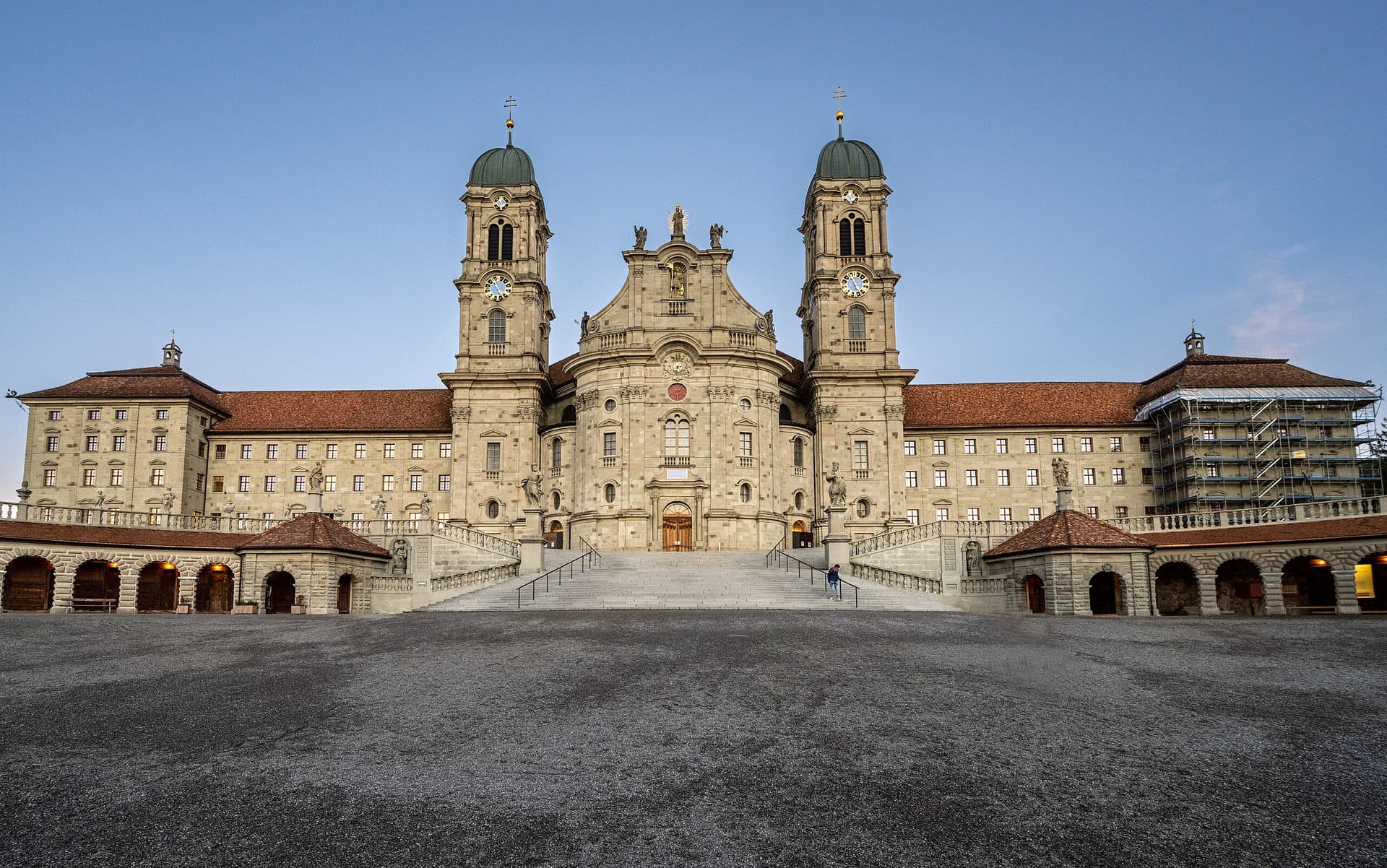
The abbey church itself is overwhelming in the baroque manner—soaring ceilings, gilded ornamentation, frescoed domes depicting heavenly hosts. It is designed to lift the gaze upward, to create an earthly approximation of glory. But the Chapel of Grace, standing within the nave like a church within a church, offers something different. Enter its black marble interior and the scale shifts to human. The Madonna looks out from her shrine, her dark face above an elaborate robe that changes with the liturgical season. The space is small enough that you cannot avoid her gaze.
Visitors describe a stillness here that seems distinct from ordinary quiet. The silence feels inhabited. Some find tears coming unexpectedly, without understanding why. Others speak of feeling welcomed, as though the Madonna's attention rests specifically on them among the crowds. The tradition calls her the Patroness of Switzerland, but in the chapel she seems entirely personal—present to whoever kneels before her.
The Salve Regina at 4:30 PM distills something essential about Einsiedeln. When the monks process into the chapel and their voices rise—Salve Regina, mater misericordiae—you are witnessing a tradition unbroken since 1547. The same words, the same time of day, the same place, for nearly five centuries. The polyphonic arrangement creates a web of sound that seems to fill the space from within rather than from the voices. Those present often describe feeling held by something larger than the moment—a sense of joining centuries of prayer rather than merely observing a performance.
Many visitors return. First visits tend to be exploratory—taking in the baroque splendor, locating the chapel, perhaps catching the Salve Regina by chance. Second visits are often more intentional. Those who have felt something come back to find out what it was. They stay longer in the chapel. They attend mass. They walk the grounds slowly. What seemed like tourism becomes something closer to pilgrimage.
If you come seeking something beyond photographs, consider your approach. Arrive early enough to attend the Salve Regina at 4:30 PM—this is the moment when Einsiedeln most fully reveals itself. Begin at St. Meinrad's Fountain. The fourteen spouts are not arbitrary; take the time to drink from each. Let the ritual shift your attention from tourist mode to something more receptive.
In the church, resist the urge to photograph everything immediately. Let your eyes adjust to the baroque abundance. Then enter the Chapel of Grace and stay. Sit or kneel. Let the Madonna's gaze meet yours without hurrying past. What you are looking at has been looked at by millions seeking help, healing, comfort, transformation. You stand in a current of longing that spans a millennium.
Bring your own questions, your own needs. The tradition holds that the Madonna intercedes—that prayers offered here have power. You need not share Catholic theology to offer something genuine to the space. What are you seeking? What brought you here? Let the question be present without demanding an answer.
If possible, attend mass in the chapel itself. The Eucharist celebrated on the site of Meinrad's hermitage, before the image that has received so much devotion, carries particular weight. Even if the liturgy is unfamiliar, there is value in joining a practice so continuous, so insistent that this particular place and these particular words matter.
The Black Madonna of Einsiedeln invites interpretation from multiple angles—art historical, theological, psychological, devotional. Each perspective illuminates aspects others may miss. A site that has drawn pilgrims for over a thousand years cannot be reduced to a single explanation.
Art historians date the current statue to approximately 1450-1466, carved in late Gothic style, likely by a Northern Swiss or Southern German craftsman whose identity is lost. The blackness is generally attributed to centuries of candle smoke and oil lamp soot darkening the wood—a process common to many medieval Madonnas. The statue's preservation and the development of the elaborate vestments tradition reflect evolving devotional practice.
Historically, Einsiedeln functioned as a major node in medieval Catholic pilgrimage networks, particularly as a stop on the Way of St. James. The miracle of the angelic consecration, confirmed by Pope Leo VIII in 964, established the chapel's unique spiritual status early in its history. The site's significance grew through the medieval period; the baroque reconstruction of 1704-1735 reflected its continuing importance in the Counter-Reformation era.
The continuity of Benedictine presence—unbroken except for the brief Revolutionary suppression—represents one of the longest continuous monastic foundations in Europe. This institutional stability has preserved both physical site and spiritual practice through transformations that disrupted many comparable sites.
Catholic teaching holds the Black Madonna of Einsiedeln as a miraculous image with genuine intercessory power. The tradition is not merely that the statue represents Mary but that devotion offered here reaches her with particular efficacy. The miracle books maintained by the monastery record healings, answered prayers, and spiritual transformations attributed to the Madonna's intercession.
The legend of the miraculous consecration—Christ descending with angels to consecrate the chapel himself—establishes the space as set apart, already claimed by the divine before any human dedication. This is not understood as metaphor but as event. Whether contemporary Catholics interpret this literally or symbolically, the tradition treats the Chapel of Grace as uniquely sacred ground.
Marian devotion at Einsiedeln participates in the broader Catholic understanding of Mary as intercessor, advocate, and spiritual mother. The Madonna's darkness, however it originated, has accumulated theological resonance—associations with the beloved in the Song of Songs ('I am black but beautiful'), with the mysterious aspects of divine mercy, with a feminine face of God that comforts those in darkness.
Some interpreters connect the Black Madonna to pre-Christian traditions of goddess worship, seeing in the dark earth mother a figure older than Christianity that the Church incorporated rather than eliminated. Carl Jung and his followers have understood Black Madonnas as representing the integration of shadow—the dark, rejected, unconscious aspects of psyche—into wholeness. The dark forest setting (Finsterwald) and the imagery of blackness add resonance to these psychological and esoteric readings.
Others place Black Madonnas within broader patterns of earth-based spirituality, suggesting they maintain connection to chthonic powers that official religion may not fully acknowledge. The faithful's insistence on re-darkening the restored statue in 1799 suggests the darkness carries meaning beyond accident—meaning the people intuited even if they could not articulate it.
These interpretations are not endorsed by the Church but may illuminate why Black Madonnas across Europe draw devotion with particular intensity. Something in the darkness speaks to what the light alone cannot address.
Genuine mysteries remain. The exact nature of St. Meinrad's experience in his twenty-six years of forest prayer cannot be recovered—what did he encounter in that sustained solitude? The identity of the sculptor who carved the current Madonna is unknown; so is the appearance of the original statue Hildegard gave to Meinrad. Whether the first statue was dark, and whether the current statue was already dark when installed or darkened over centuries, remains debated.
The mechanism by which the faithful so consistently report meaningful experience at Einsiedeln—peace, healing, encounter—resists easy explanation. Placebo effect cannot be dismissed, but neither can it account for the intensity and specificity of many reports. Something happens here. What precisely remains open.
Visit Planning
Einsiedeln is easily accessible from Zurich by train (about 50 minutes). Entry to the church and Chapel of Grace is free. The most meaningful visits include the 4:30 PM Salve Regina. The main pilgrimage season runs Easter through October, with the Feast of the Miraculous Consecration on September 14 being the principal feast day.
By train from Zurich, travel to Einsiedeln takes approximately 50 minutes via Biberbrugg. From Lucerne, the journey takes about an hour. The train station is a fifteen-minute walk from the monastery. By car, Einsiedeln is approximately 40 kilometers southeast of Zurich; parking is available in town. The site lies on the Via Jacobi, the Swiss portion of the Way of St. James, for those arriving on foot.
The monastery offers limited pilgrimage hospitality for those seeking spiritual retreat; contact the abbey in advance. The town of Einsiedeln has hotels and guesthouses at various price points. For those walking the Via Jacobi, pilgrimage-specific accommodations exist along the route.
Standard Catholic church etiquette applies: modest dress, respectful silence, and mindful behavior. The site welcomes visitors of all faiths but asks that all honor its character as an active place of worship. During services, remain quiet and avoid disruption. Photography is permitted with discretion.
Einsiedeln is simultaneously a major tourist destination and one of Europe's most significant pilgrimage sites. Both realities must be honored. The baroque architecture and cultural significance attract visitors of all backgrounds; the living monastic community and continuous Catholic worship deserve the respect such things require.
Enter as you would enter any place of active devotion. This is not a museum but a space where people pray, where monks have prayed continuously for over a thousand years, where pilgrims bring their deepest needs. Your behavior either supports or disrupts this reality.
In the Chapel of Grace, particular reverence is appropriate. This small space within the great church is the heart of Einsiedeln—the location of Meinrad's hermitage, the site of legendary miraculous consecration, the home of the Black Madonna. Keep your voice low or silent. If others are praying, do not interrupt. Let your presence be unobtrusive.
During services—masses, the Liturgy of the Hours, the Salve Regina—observers are welcome but should remain still and quiet. Do not enter or exit during prayers if avoidable. If you are unfamiliar with Catholic liturgy, simply sit or stand with the congregation and observe respectfully. Participation in responses and singing is not expected of visitors.
The monks are not tourist attractions. If you encounter them outside of services, a simple greeting is appropriate; requesting photographs or extended conversation is not. Their life is ordered around prayer, not hospitality to individuals.
Dress modestly, covering shoulders and knees. This is standard for Catholic churches and should be observed. No specific colors or styles are required—simply clothing that shows respect for the sacred character of the space. Comfortable shoes are recommended as the church and grounds involve considerable walking.
Photography is generally permitted inside the church, including the Chapel of Grace. Exercise discretion—flash may disturb others and is restricted near the Madonna. Do not photograph during services. Be mindful of pilgrims in prayer; they did not come to appear in your images. Consider putting the camera away for periods to experience the space directly.
Votive candles may be lit in the church; receptacles for monetary offerings are provided. Some pilgrims leave painted votive plaques (ex-votos) as thanksgiving for answered prayers; this is a traditional practice with specific conventions. If you wish to make such an offering, inquire at the monastery shop about proper procedure.
Some areas of the monastery complex are private and closed to visitors. Respect marked boundaries. During services, remain seated or standing in appropriate areas; do not wander the church. Food and drink are not permitted inside the church. Silence or quiet voices should be maintained throughout, particularly in the Chapel of Grace.
Sacred Cluster
Nearby sacred places create the location cluster described in the growth plan. This block is intentionally crawlable and links into the wider regional graph.