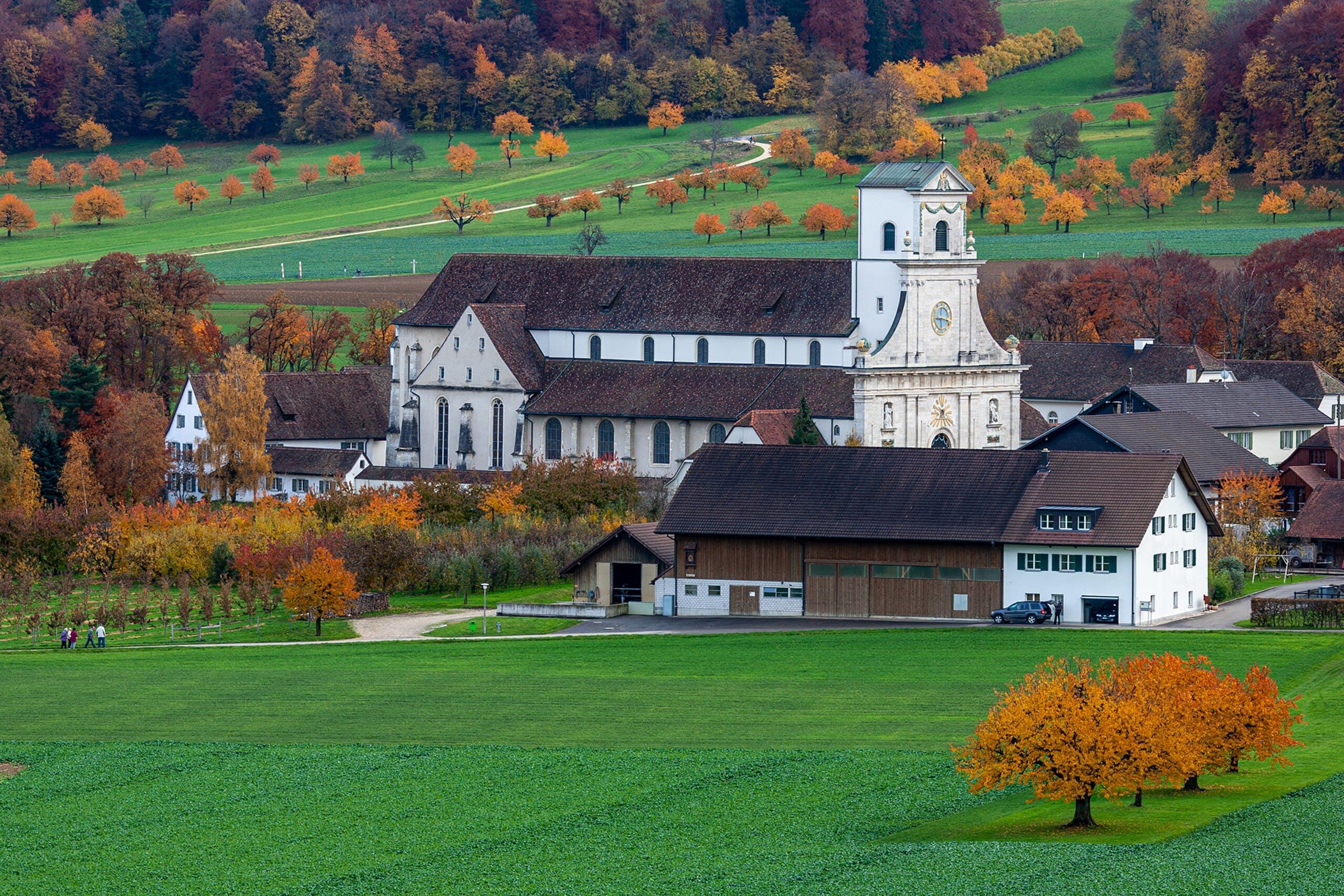
Mariastein Abbey
Where pilgrims descend into the rock to meet the Madonna in her stone dwelling
Metzerlen-Mariastein, Solothurn, Switzerland
At A Glance
- Coordinates
- 47.4723, 7.4887
- Suggested Duration
- One to two hours allows for the basilica, the descent to the Gnadenkapelle, and time on the monastery grounds. Attending a monastic prayer service extends the visit. Those participating in retreats or programs will spend considerably longer.
- Access
- Located in Metzerlen-Mariastein, Canton Solothurn, Switzerland, near the French and German borders. Accessible by public transport from Basel, approximately twenty kilometers to the north. The cave chapel is reached by descending fifty-nine steps from the basilica level. There is no step-free alternative to the descent.
Pilgrim Tips
- Located in Metzerlen-Mariastein, Canton Solothurn, Switzerland, near the French and German borders. Accessible by public transport from Basel, approximately twenty kilometers to the north. The cave chapel is reached by descending fifty-nine steps from the basilica level. There is no step-free alternative to the descent.
- Modest attire appropriate for a Catholic monastery and basilica. Shoulders and knees should be covered. There is no strict dress code enforcement, but respectful dress reflects awareness of the site's sacred character.
- Photography may be restricted in the Gnadenkapelle. Check posted guidelines upon arrival. In the basilica and on monastery grounds, photography is generally permitted but should not interfere with worship or monastic life.
- The fifty-nine steps to the Gnadenkapelle may present difficulties for visitors with mobility limitations. The descent is not especially steep, but the passage narrows and there is no alternative route. Visitors who cannot manage the stairs should be aware of this before planning their visit.
Overview
Fifty-nine steps lead down into the earth beneath a late Gothic basilica in northwest Switzerland, where a miraculous image of the Virgin Mary stands free in the rock face of a natural cave. Mariastein Abbey, Switzerland's second most important pilgrimage site after Einsiedeln, draws approximately 250,000 visitors each year to the Gnadenkapelle carved into the cliff where two miraculous rescues shaped centuries of devotion. A Benedictine community that has survived revolutionary sacking, three exiles, and Gestapo closure continues to welcome pilgrims of all backgrounds, including Hindu Tamil devotees who recognize the cave's spiritual power through their own tradition.
Something happens on those fifty-nine steps. The daylight fades. The walls close in. Votive tablets line the descent, each one a compressed story of suffering or gratitude, hundreds of them pressed into the stone by centuries of hands reaching toward the same hope. At the bottom, the cave opens to a chapel where the Madonna stands not on an altar but in the rock itself, surrounded by the soft glow of candlelight and the silence of earth.
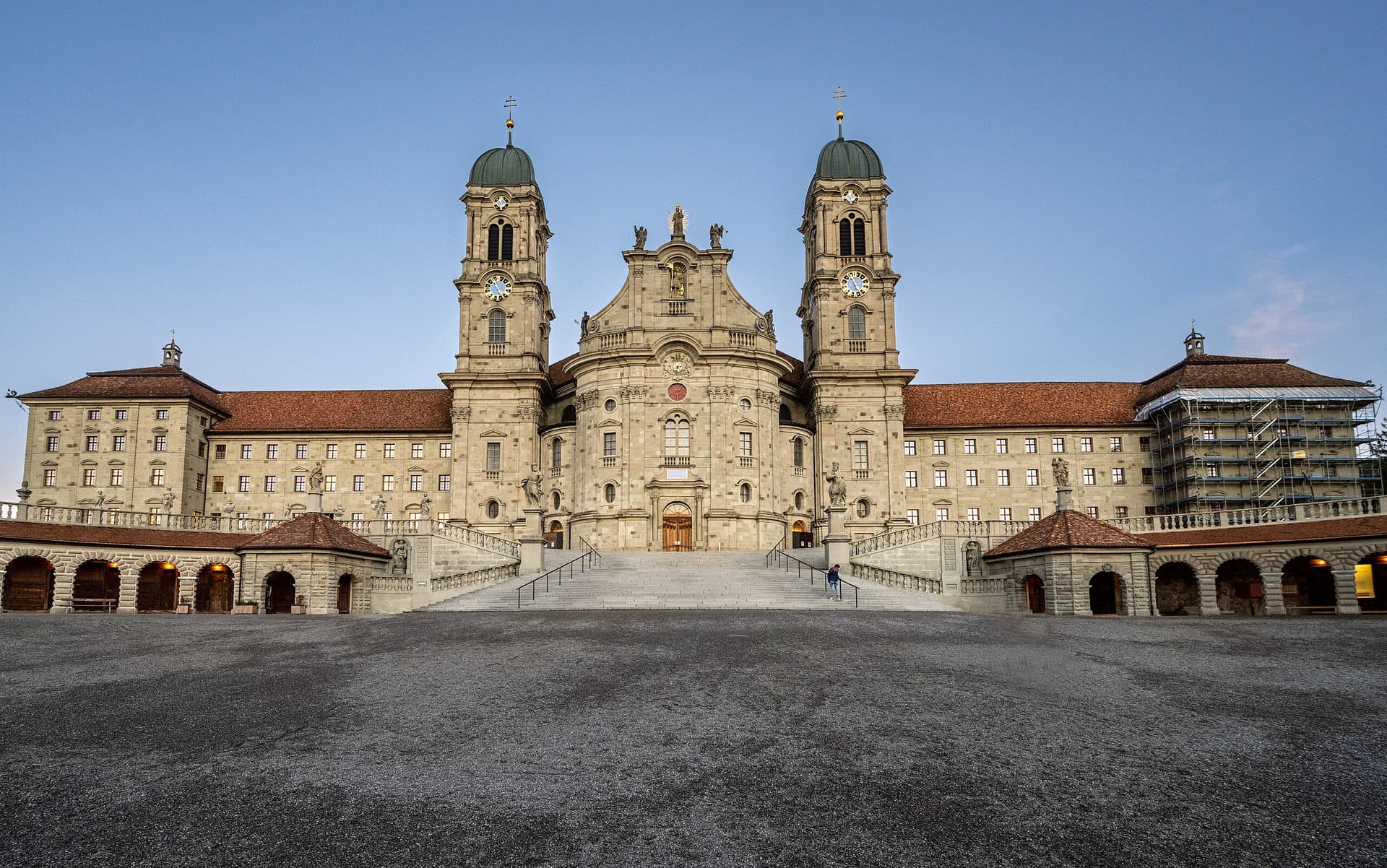
Mariastein, Mary of the Rock, draws its identity from the descent into its Gnadenkapelle, the defining experience of Switzerland's second most significant pilgrimage destination. The name is literal. The Virgin stands in stone. The chapel occupies a natural cave beneath a cliff in Canton Solothurn, twenty kilometers south of Basel, near where Switzerland meets France and Germany. Above the cave rises a late Gothic basilica with Baroque interior and classicist entrance facade. Below, the earth holds something older.
The pilgrimage began with a fall. In the late fourteenth century, a child tumbled from the cliff above the cave and survived, a rescue attributed to the intervention of the Virgin Mary. A stone chapel was first mentioned in 1434, tended by Augustinian hermits from Basel. Then in 1541, nobleman Hans Thuring of the Reichenstein family survived the same fall from the same cliff, and the pattern of miraculous protection became impossible for the faithful to ignore.
What stands today is the result of that intensifying devotion. Benedictine monks from Beinwil Abbey took charge of the site in 1636, and by 1648, their abbot Fintan Kiefer had relocated the entire monastery to Mariastein, merging one of Switzerland's oldest monastic communities with the pilgrimage cave. The church was consecrated on October 31, 1655. Pope Pius XI elevated it to Basilica Minor status in 1926.
The community that maintains this place has endured more than most. French Revolutionary forces sacked the monastery in 1798. The monks were exiled to France in 1874, then expelled from France in 1902 and relocated to Austria, first to Durrnberg, then to Bregenz. The Gestapo closed their Austrian refuge in 1941. They returned to Mariastein that same year but did not officially reopen until 1971. Each displacement strengthened rather than dissolved the community's bond to its cave chapel and its Madonna in the rock.
Context And Lineage
Mariastein's history spans from a late fourteenth-century miraculous rescue to a Benedictine monastery that survived revolution, exile, and Nazi persecution. The Gnadenkapelle has been a pilgrimage destination for over six centuries.
The founding narrative begins with gravity and grace. In the late fourteenth century, a child fell from the cliff above the cave and was found alive at the bottom, the rescue attributed to the intervention of the Virgin Mary. The cave became a chapel, first mentioned in written records in 1434, where Augustinian hermits from Basel tended the growing stream of pilgrims.
A century later, the pattern repeated. In 1541, nobleman Hans Thuring of the Reichenstein family survived a fall from the same cliff. The second miracle transformed the chapel into a family shrine, the Reichensteiner Chapel, and pilgrimage to the site intensified considerably.
The decisive transformation came in 1636 when Benedictine monks from Beinwil Abbey, one of Switzerland's oldest monastic foundations dating to the twelfth century, took charge of the pilgrimage site. In 1648, Abbot Fintan Kiefer made the radical decision to merge the two institutions entirely, relocating Beinwil Abbey to Mariastein. The ancient monastic tradition of Beinwil fused with the pilgrimage tradition of the cave, creating an institution greater than either predecessor. The new monastery church was consecrated on October 31, 1655.
What followed tested the community beyond what most institutions could survive. French Revolutionary forces sacked the monastery in 1798, part of the broader anti-clerical violence that swept through Europe. The community was exiled from Switzerland in 1874, finding refuge in France. When France expelled religious orders in 1902, the monks moved to Austria, first to Durrnberg near Salzburg, then to Bregenz in Vorarlberg. The Gestapo closed their Austrian monastery in 1941 during the Nazi suppression of religious communities.
The monks returned to Mariastein in 1941, but the site did not officially reopen as a functioning monastery until 1971. The community that exists today carries the memory of each displacement and each return, a resilience that has become part of Mariastein's spiritual identity.
The Benedictine community at Mariastein traces its origins to Beinwil Abbey, founded in the twelfth century. Beinwil had fallen into decline by the seventeenth century, and the merger with Mariastein under Abbot Fintan Kiefer in 1648 effectively saved the monastic lineage by binding it to a living pilgrimage tradition. The community follows the Rule of Saint Benedict, maintaining the Liturgy of the Hours, daily mass, and the disciplines of communal monastic life.
Abbot Fintan Kiefer
Merged Beinwil Abbey with the Mariastein pilgrimage site in 1648, creating the monastery in its modern form
Hans Thuring of Reichenstein
Nobleman whose 1541 survival of a cliff fall confirmed the site's miraculous reputation and led to the Reichensteiner Chapel
Why This Place Is Sacred
A natural cave beneath a cliff, two miraculous rescues from the same precipice, centuries of votive offerings lining the descent, and cross-religious recognition by both Catholic and Hindu Tamil pilgrims create conditions of pronounced thinness at Mariastein.
The cave came first. Before the child fell, before the hermits tended their chapel, before the Benedictines built their monastery above, there was a cave facing the rising sun in a limestone cliff. Some scholars suggest this orientation indicates pre-Christian ritual use, though no archaeological evidence has been cited to confirm this. What is certain is that the cave possesses the qualities that human beings have recognized as sacred across cultures and millennia: enclosure within the earth, darkness giving way to filtered light, the sense of crossing a threshold between the surface world and something deeper.
The two miraculous rescues from the cliff add a specific charge to this general quality. The late fourteenth-century child and the sixteenth-century nobleman both fell from the same precipice and survived. Whether understood as divine intervention or extraordinary fortune, the repeated pattern at a single location concentrates attention. The cliff becomes not merely a geological feature but a place where the normal rules appear to bend.
The votive tablets that line the fifty-nine steps of the descent function as a physical record of this concentrated attention. Each tablet represents a human being who came to this cave in need, who prayed, and who returned to give thanks. The cumulative effect of hundreds of these tablets, pressed close together on the walls of the descending passage, creates something more than decoration. It is a visible sediment of prayer, centuries of human longing made material.
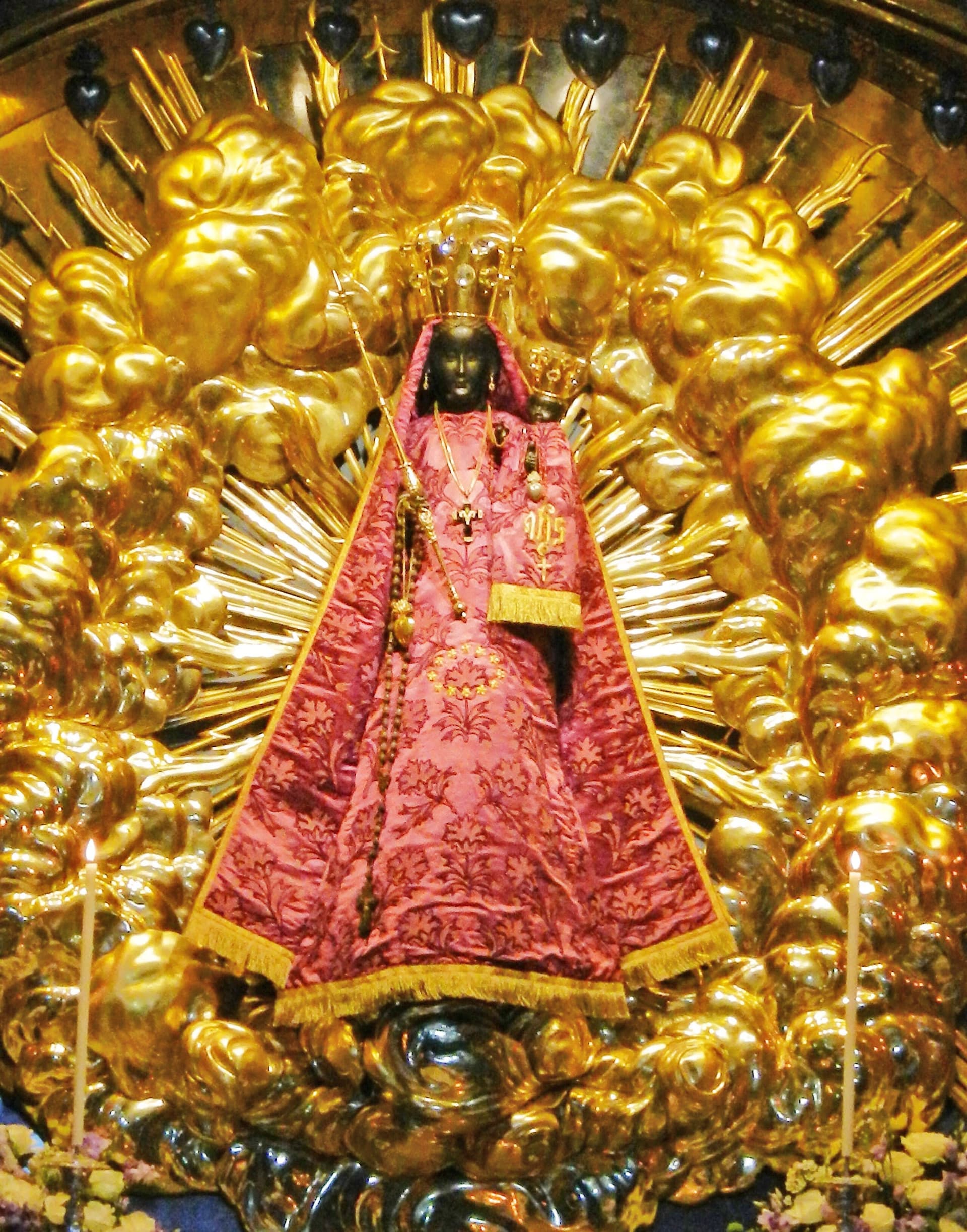
The miraculous image itself deepens the encounter. Our Lady of Consolation does not stand on an altar or in a niche. She stands free in the rock face, carrying the Child in her right arm, surrounded by six putti with candlesticks. The current form of the image dates to the seventeenth century. The effect is of a figure emerging from the stone, or perhaps retreating into it, caught in the moment between the earthly and the hidden.
Perhaps the most striking testament to the cave's spiritual power comes from an unexpected direction. Hindu Tamil immigrants living in Switzerland have adopted Mariastein as a sacred site within their own tradition. They interpret the dark cave as representing the goddess Kali, the dark life-in-death goddess, and recognize in the Madonna a form of the divine feminine familiar to their own cosmology. This cross-religious recognition, arising independently of any theological dialogue, suggests qualities in the site that transcend the framework of any single tradition.
The cave appears to have been a natural formation that became a site of veneration after a child's miraculous rescue from the cliff above in the late fourteenth century. A stone chapel was first documented in 1434.
From a hermit-tended cave chapel, Mariastein grew into a Benedictine monastery (1636-1648), survived revolutionary violence and multiple exiles, and was elevated to Basilica Minor status in 1926. The twentieth-century addition of Hindu Tamil pilgrimage expanded its spiritual significance beyond its Catholic origins.
Traditions And Practice
Benedictine monastic worship structures the daily rhythm of Mariastein, while pilgrimage to the Gnadenkapelle and veneration of Our Lady of Consolation define the devotional heart of the site. Hindu Tamil pilgrims bring their own practices to the cave chapel.
The Benedictine Liturgy of the Hours governs the monastery's daily rhythm, as it has since the monks arrived from Beinwil in the seventeenth century. The community gathers multiple times each day for prayer, their voices filling the basilica in a pattern that connects Mariastein to every other Benedictine house in the world and to fifteen centuries of monastic tradition.
Daily mass is celebrated in the basilica, open to all who wish to attend. The liturgical calendar marks the progression of the church year with varying emphasis and ceremony, each season offering a different quality of worship.
The pilgrimage descent to the Gnadenkapelle is the site's most distinctive practice. Pilgrims descend the fifty-nine steps, passing the votive tablets that record centuries of prayer, to reach the cave chapel where Our Lady of Consolation stands in the rock. The traditional acts of devotion include prayer before the miraculous image, the lighting of candles, and the placement of votive tablets by those whose prayers have been answered. The sheer number of existing tablets testifies to how deeply this practice is woven into the site's spiritual life.
The monastery offers spiritual retreats and programs for visitors seeking more than a brief pilgrimage. Guided tours provide historical and spiritual context for the basilica and the Gnadenkapelle. Community worship remains open to visitors who wish to experience Benedictine monastic prayer firsthand.
The Hindu Tamil pilgrimage represents the most notable contemporary development in the site's spiritual life. Tamil immigrants living in Switzerland come to the cave chapel to pray according to their own tradition, interpreting the dark cave and its Madonna as manifestations of the divine feminine familiar from Hindu cosmology. This practice has developed organically, without institutional coordination, and the monastery's openness to it reflects a hospitality consistent with the Benedictine tradition of welcoming all who come.
Cultural events and community gatherings complement the devotional activities, making the monastery a center of regional life as well as a pilgrimage destination.
The descent to the Gnadenkapelle is the essential experience. Take the fifty-nine steps slowly, allowing your eyes to adjust as the light dims. Read the votive tablets on the walls. Let the transition from basilica to cave register in your body. At the bottom, sit or stand in the chapel for as long as feels right. The candlelight, the stone, and the quiet create conditions for an encounter that does not require any particular belief to be felt.
Attending one of the monastic prayer services adds a layer of experience that the cave alone cannot provide. The Benedictine liturgy, with its centuries of refined practice, offers a different mode of encounter with the sacred, one shaped by community, discipline, and the human voice. Check the monastery's posted schedule for prayer times.
For those with time, the monastery grounds and the surrounding landscape of Canton Solothurn reward exploration. The region's proximity to France and Germany gives it a border-country quality, a meeting of cultures that echoes the interfaith character of the pilgrimage itself.
Christianity (Roman Catholic — Benedictine Monastic Life and Marian Pilgrimage)
ActiveMariastein is Switzerland's second most important Catholic pilgrimage site, centered on the miraculous image of Our Lady of Consolation in the cave chapel beneath the basilica. The Benedictine community, descended from the twelfth-century Beinwil Abbey, maintains daily monastic prayer and welcomes pilgrims year-round. Pope Pius XI elevated the monastery church to Basilica Minor status in 1926.
Benedictine Liturgy of the Hours, daily mass, pilgrimage descent to the Gnadenkapelle via fifty-nine steps, veneration of Our Lady of Consolation, candle lighting, placement of votive tablets, spiritual retreats, community worship.
Hindu Tamil Pilgrimage
ActiveHindu Tamil immigrants in Switzerland have adopted Mariastein as a sacred site within their own tradition, interpreting the dark cave chapel as a dwelling of Kali and recognizing the Madonna as a form of the divine feminine. This cross-religious pilgrimage demonstrates how the site's spiritual qualities transcend any single tradition.
Pilgrimage to the cave chapel, prayer and offerings in the Hindu tradition, recognition of the Madonna as an aspect of the divine feminine.
Experience And Perspectives
The descent of fifty-nine steps into the Gnadenkapelle, past votive tablets and into the candlelit cave chapel, offers Mariastein's most direct encounter with the sacred. Above, the late Gothic basilica with Baroque interior provides a contrasting experience of institutional beauty.
The approach begins in the ordinary world. The village of Metzerlen-Mariastein sits in the rolling landscape of Canton Solothurn, close to where Switzerland meets France and Germany. The monastery buildings and basilica present themselves as solid, well-maintained, European. Nothing in the exterior prepares you for what waits below.
The basilica itself deserves attention before the descent. A late Gothic three-aisled structure with a Baroque interior and a classicist entrance facade added between 1830 and 1834, it carries the weight of an institution that has survived extraordinary adversity. The space is formal and vertical, lifting the eye upward. Light enters through tall windows. The architecture speaks of order, theology, community.
Then you find the stairs, and everything reverses. Instead of up, down. Instead of light, diminishing light. Instead of institutional grandeur, the intimacy of a passage growing narrower as it descends. The votive tablets appear on the walls almost immediately, small rectangular offerings bearing images, dates, and inscriptions. Some are centuries old, their paint faded. Others are recent. Each records a moment when a human being turned toward this cave in hope or gratitude. Reading them as you descend, you absorb something of the accumulated weight of centuries of prayer.
Fifty-nine steps. The number is precise because pilgrims count them. The descent takes only minutes, but the transition it accomplishes is complete. By the time you reach the Gnadenkapelle, you have left the basilica's world of doctrine and architecture for something older. The cave is not large. The air is cool and still. Candlelight plays over the rock walls. And there, standing free in the stone, is Our Lady of Consolation, the miraculous image that has drawn pilgrims since the late fourteenth century.
The Madonna holds the Child in her right arm. Six putti bearing candlesticks surround her. The current form of the image dates to the seventeenth century, but the tradition it embodies is older. She stands in the rock. Not on it, not before it, but in it, as though the boundary between figure and stone has dissolved.
The contrast between the basilica above and the cave below mirrors a contrast visitors often feel within themselves. The upper church engages the intellect and the aesthetic sense. The cave engages something less easily named. Visitors describe a quality of stillness, a sense of being held within the earth, a feeling that the surface concerns of daily life cannot follow them down those fifty-nine steps.
The presence of Hindu Tamil pilgrims alongside Catholic devotees adds an unexpected dimension. On certain days, you may encounter offerings and prayers from two entirely different religious traditions directed at the same cave, the same darkness, the same sense of the sacred feminine dwelling in stone. The fact that this convergence arose spontaneously, without institutional coordination, speaks to something in the site that precedes and exceeds any single tradition's claim upon it.
The monastery complex sits in Metzerlen-Mariastein, Canton Solothurn. The basilica occupies the upper level, with the Gnadenkapelle accessible by descending fifty-nine steps into the cave beneath. The monastery grounds include additional buildings and outdoor spaces. The surrounding landscape of the Basel region provides a pastoral setting.
Mariastein sits at an intersection of documented history, Catholic devotion, possible pre-Christian significance, and contemporary interfaith practice. Each perspective illuminates different qualities of the site.
Historical and cultural scholarship places Mariastein firmly within the landscape of Swiss Catholic pilgrimage, second only to Einsiedeln in importance. The Swiss Federal Office of Culture has recognized the pilgrimage to Mariastein as part of Switzerland's living traditions, a formal acknowledgment of the site's cultural as well as religious significance. The abbey's extraordinary history of exile and return, spanning three countries over more than a century, provides a well-documented case study of monastic resilience under political persecution. The late fourteenth-century origin of the pilgrimage is accepted by historians, though the exact date and circumstances of the original child rescue cannot be independently verified. The Hindu Tamil pilgrimage dimension has drawn scholarly attention as an example of how immigrant communities integrate into their host country's sacred landscape, finding points of connection between radically different religious traditions.
Within Catholic understanding, Mariastein is a place of confirmed Marian intercession. Two miraculous rescues from the same cliff, separated by more than a century, establish the Virgin Mary's protective presence at this specific location. The votive tablets lining the descent to the Gnadenkapelle represent centuries of answered prayers, each one a testimony to the Madonna's continued activity. The Benedictine community's survival through revolution, exile, and Nazi persecution is understood as further evidence of divine protection over the site. Our Lady of Consolation, standing in the rock, is not merely an image but a presence, the point where heaven touches earth in a cave beneath Swiss soil. For Hindu Tamil pilgrims, the cave chapel holds a different but complementary significance. The dark cave facing the rising sun resonates with the worship of Kali, and the Madonna is recognized as a form of the divine feminine familiar from Hindu tradition.
The cave's orientation toward the rising sun has led some to propose pre-Christian sacred use. Caves facing east are a common feature of prehistoric ritual sites across Europe, and the suggestion that this particular cave served as a cult place before Christianity is consistent with broader patterns, even if no specific archaeological evidence has been cited for Mariastein. The cross-religious recognition by both Catholic and Hindu Tamil traditions may indicate a quality inherent to the site itself, something that precedes and exceeds any single religious framework. The descent into the earth to encounter the divine feminine connects to universal underworld mythology found across cultures, from the Greek descent of Persephone to the Sumerian descent of Inanna.
The pre-Christian history of the cave remains genuinely uncertain. The claim that it served as a cult place before Christianity rests on typological comparison rather than specific evidence. The exact date and circumstances of the original child rescue in the late fourteenth century are not precisely documented. The process by which Hindu Tamil immigrants came to recognize Mariastein as compatible with their own tradition, and the specific theological reasoning that equates the cave chapel with a dwelling of Kali, deserves fuller documentation than currently exists. These gaps do not diminish the site's significance; they acknowledge the limits of what can be known about a place whose power may always exceed the categories available to describe it.
Visit Planning
Mariastein Abbey is located in Metzerlen-Mariastein, Canton Solothurn, approximately twenty kilometers south of Basel. The site is accessible by public transport and open year-round.
Located in Metzerlen-Mariastein, Canton Solothurn, Switzerland, near the French and German borders. Accessible by public transport from Basel, approximately twenty kilometers to the north. The cave chapel is reached by descending fifty-nine steps from the basilica level. There is no step-free alternative to the descent.
The monastery and surrounding village offer limited accommodations. Basel, twenty kilometers to the north, provides the full range of lodging options and serves as a practical base for visiting Mariastein.
Mariastein is an active Benedictine monastery and pilgrimage site. Modest dress, respectful silence in the Gnadenkapelle, and awareness of the monastic community's schedule are the essential courtesies.
Mariastein welcomes visitors of all backgrounds, including those outside the Catholic tradition. The abbey's hospitality extends to Hindu Tamil pilgrims and to secular visitors drawn by history or curiosity. This openness does not diminish the expectation of respect for a place where worship continues daily.
The Gnadenkapelle is the most sensitive space. The cave chapel is small, intimate, and sacred to those who come to pray before Our Lady of Consolation. Maintain quiet here. Speak in whispers if at all. Allow others the space and silence they need for their devotion. The atmosphere of the cave amplifies sound, and even casual conversation can disrupt the contemplative quality that makes the space meaningful.
The basilica is a functioning church where mass and the Liturgy of the Hours are celebrated regularly. During services, visitors should observe the same courtesies they would in any active house of worship. Between services, the basilica is open for quiet exploration and personal reflection.
Monastic areas of the complex may have limited access. The monks' living and working spaces are not part of the public site, and boundaries should be respected. Posted signs or guidance from monastery staff will indicate where visitors are welcome.
Photography may be restricted in the Gnadenkapelle. Even where permitted, the use of flash and the intrusion of camera equipment into a small sacred space should be approached with sensitivity. The cave chapel is better experienced than documented.
Modest attire appropriate for a Catholic monastery and basilica. Shoulders and knees should be covered. There is no strict dress code enforcement, but respectful dress reflects awareness of the site's sacred character.
Photography may be restricted in the Gnadenkapelle. Check posted guidelines upon arrival. In the basilica and on monastery grounds, photography is generally permitted but should not interfere with worship or monastic life.
Votive tablets and candles are the traditional offerings at Mariastein. Candles can be lit in the Gnadenkapelle. Donations to the monastery are welcome and support the community's continued presence at the site.
{"Maintain quiet in the Gnadenkapelle at all times","Respect the monastic community's schedule and private areas","The 59-step descent to the cave chapel may not be accessible for all visitors","Follow posted photography guidelines, especially in the cave chapel","Do not disturb pilgrims engaged in prayer or devotion"}
Sacred Cluster
Nearby sacred places create the location cluster described in the growth plan. This block is intentionally crawlable and links into the wider regional graph.