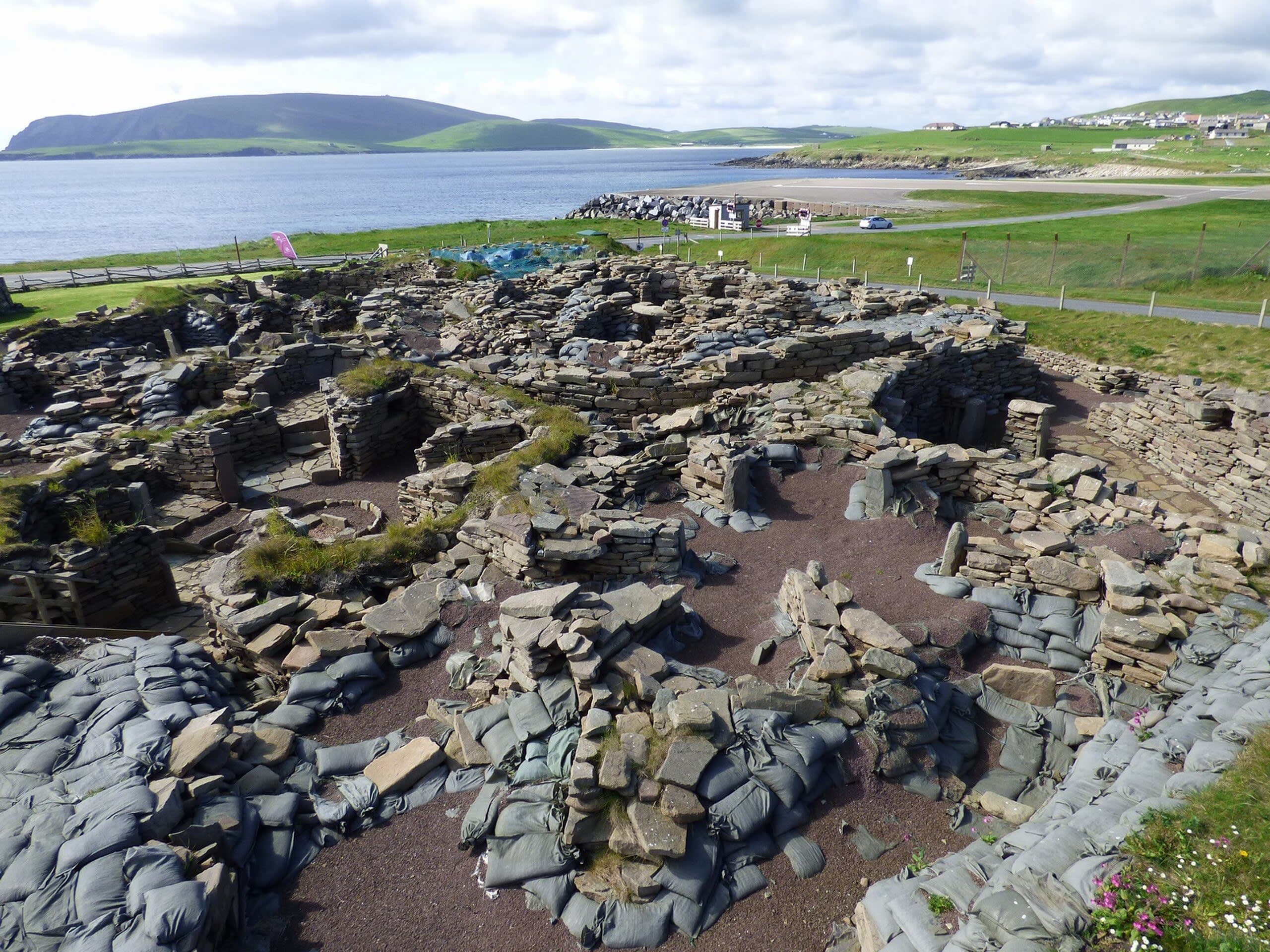
Old Scatness Broch and Iron Age Village
Over two thousand years of community life unearthed beside a Shetland runway, from Iron Age broch to Pictish village to Norse occupation
Virkie, Shetland, United Kingdom
At A Glance
- Coordinates
- 59.8737, -1.3057
- Suggested Duration
- One to one and a half hours including the tour and time to explore the replica buildings.
- Access
- Located adjacent to Sumburgh Airport at the southern tip of Mainland Shetland. Follow the A970 south from Lerwick, approximately 25 miles. The site is signposted. Guided tours on Fridays during summer season. Free admission. Bus services run from Lerwick to Sumburgh. The site is very convenient for travellers arriving or departing via Sumburgh Airport. Check current tour times with the Shetland Amenity Trust.
Pilgrim Tips
- Located adjacent to Sumburgh Airport at the southern tip of Mainland Shetland. Follow the A970 south from Lerwick, approximately 25 miles. The site is signposted. Guided tours on Fridays during summer season. Free admission. Bus services run from Lerwick to Sumburgh. The site is very convenient for travellers arriving or departing via Sumburgh Airport. Check current tour times with the Shetland Amenity Trust.
- No specific requirements beyond warm, waterproof outdoor clothing suitable for exposed Shetland conditions.
- Photography is permitted throughout the site.
- The site is exposed to Shetland weather. Warm, waterproof clothing is essential. The excavated areas include uneven ground.
Overview
In 1975, construction workers building a road to Sumburgh Airport cut through what appeared to be a natural grassy mound at the southern tip of Mainland Shetland. Beneath the turf lay a pristine, undisturbed multi-period settlement spanning over two thousand years. Old Scatness would prove to be one of the most significant archaeological discoveries in Scotland, revealing an Iron Age broch at its centre, surrounded by a village of aisled roundhouses, which later gave way to Pictish wheelhouses adorned with carved symbols, and finally Norse occupation. A bear carved on a standing stone, painted pebbles, and moulds for bronze casting speak to a community that invested meaning and craft into every aspect of their dwelling place.
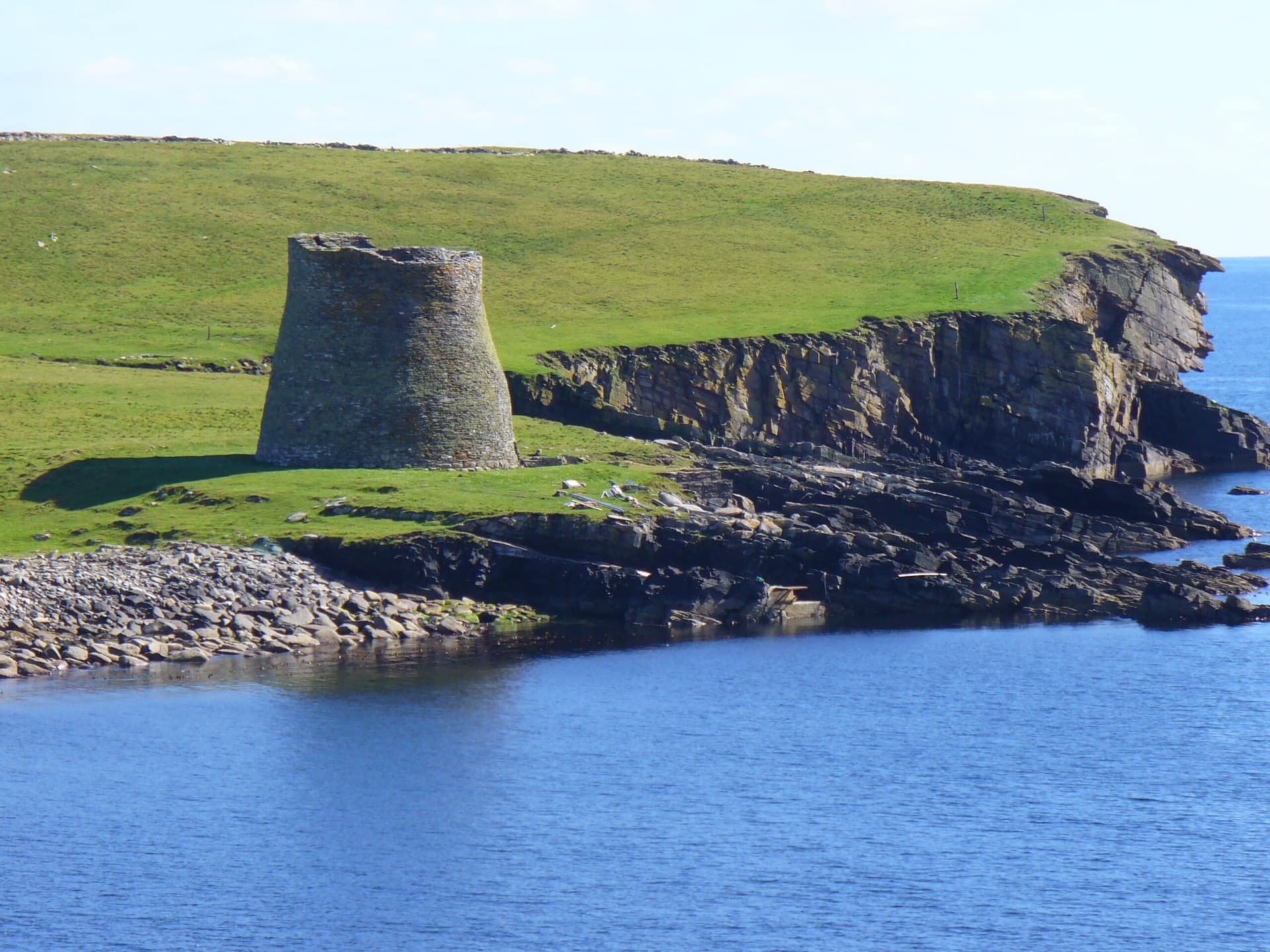
Old Scatness sits at the exposed southern tip of Mainland Shetland, where the land narrows toward Sumburgh Head and the Atlantic extends in every direction. The broch at its centre was built between 400 and 200 BCE, dated by radiocarbon analysis of a barley grain trapped in the construction debris and bone from the first course of the tower walls. With walls five metres thick, the tower dominated a settlement that grew around it over centuries.
During the Iron Age, a village of aisled roundhouses clustered around the broch. These substantial dwellings had stone piers supporting upper storeys, creating multi-level living spaces. The community was agricultural, growing barley and raising livestock on the surrounding land, engaged in the daily work of sustaining life at the edge of the habitable world.
The Pictish period transformed the settlement. The Iron Age roundhouses were replaced by wheelhouses and cellular buildings, their rooms covered with corbelled stone roofs. The broch itself was remodelled: a seven-leafed clover-shaped building was inserted into its interior, connected to the wider Pictish village by a passage. Most remarkably, one of the wheelhouse orthostats bore a carved bear, and a boar carving known as the Grice was also found. These animal symbols raise questions about totemic beliefs, household identity, and the role of carved images in Pictish daily life.
Painted pebbles and moulds for copper alloy casting attest to a community of craft specialists and artists. The bear carving, now in the Shetland Museum, is one of the most evocative Pictish finds in the Northern Isles. Was the bear a guardian figure for the household? A clan totem? A symbol of power or protection? These questions cannot be definitively answered, but they illuminate the rich symbolic world of the people who lived here.
The Norse arrived and adapted what they found. At least three Pictish buildings were reused, including one as a weaving shed where soapstone loom weights were found still in the line they would have been when weighting the warp threads of an upright loom. This continuity of habitation, Iron Age to Pictish to Norse, all on the same ground, makes Old Scatness uniquely valuable for understanding how cultures succeed and transform one another.
Eleven summers of excavation by the University of Bradford, from 1995 to 2006, produced three published monograph volumes and transformed understanding of Iron Age and early medieval Shetland. In 2012, the site was added to the UK's UNESCO World Heritage Tentative List alongside Mousa Broch and Jarlshof, collectively described as representing the zenith of Iron Age Shetland.
Context And Lineage
Old Scatness belongs to the dense concentration of archaeological sites at the southern tip of Mainland Shetland. Together with Mousa Broch and Jarlshof, it forms a group nomination on the UK's UNESCO World Heritage Tentative List, recognised as representing the zenith of Iron Age Shetland.
The site lay hidden beneath a grassy mound until 1975, when a road being built to Sumburgh Airport cut through the mound, unexpectedly revealing an undisturbed multi-period settlement. The discovery was accidental, but the archaeological significance was immediately apparent. Formal excavation did not begin until 1995, led by the University of Bradford under Stephen J. Dockrill and Julie M. Bond.
The settlement sequence at Old Scatness represents at least three distinct cultural traditions: Iron Age broch culture, Pictish settlement, and Norse occupation. No continuous tradition of practice connects these phases, though the physical continuity of habitation on the same ground suggests that the site's practical advantages, shelter, water, and proximity to the sea, remained valued across cultural boundaries.
Stephen J. Dockrill
Julie M. Bond
Why This Place Is Sacred
Old Scatness holds its thinness in layers. The physical stratification of two thousand years of habitation on a single piece of ground creates a tangible density of human experience. The Pictish carvings, the bear and the boar, introduce symbolic meaning that suggests the inhabitants understood their dwelling place as something more than functional shelter.
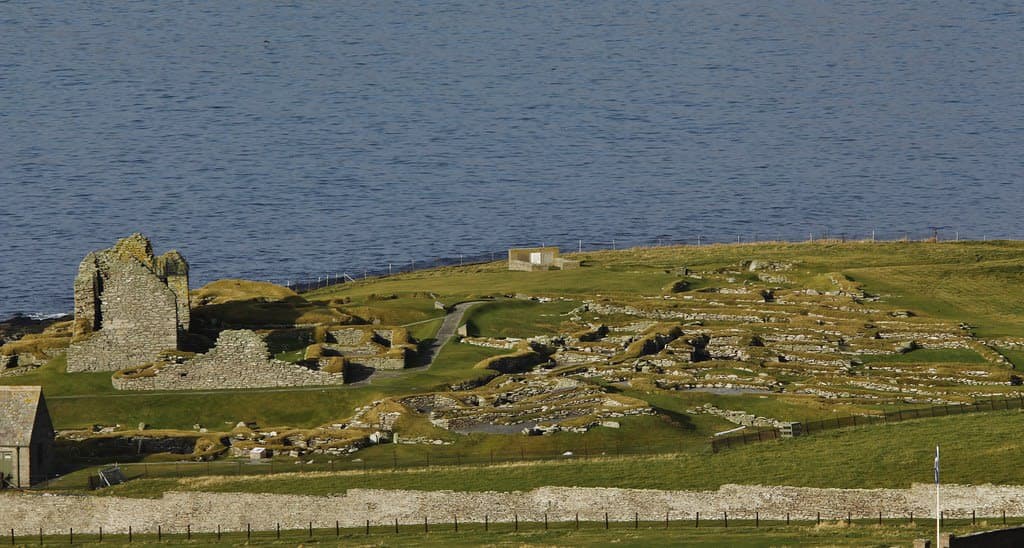
The concept of thin places often refers to locations where the boundary between the ordinary and the sacred seems permeable. At Old Scatness, this permeability is archaeological rather than metaphysical. The layers are visible. You can stand at the edge of the excavation and see, in the cross-section of the ground, the distinct strata of Iron Age, Pictish, and Norse occupation. Each layer represents generations of lives lived on this same patch of earth.
The Pictish bear carving adds a dimension that purely domestic archaeology does not usually offer. An animal carved on a standing stone within a wheelhouse is not a casual decoration. It represents intention, meaning, and possibly belief. Whether the bear served as a household totem, a protective symbol, or an expression of identity within the wider Pictish cultural system of symbols, its presence transforms our understanding of the building it adorned. This was not merely a house. It was a statement.
The painted pebbles found at the site further suggest a community engaged with symbolism and perhaps ritual. Similar objects from other Northern Isles sites have been variously interpreted as ritual objects, decorative items, or practical tools. Their precise function remains debated, but their presence indicates a community that marked objects with meaning.
The site's position at the edge of Shetland, exposed to the full force of the Atlantic, amplifies its contemplative quality. Every community that lived here chose to remain at this exposed headland despite easier options elsewhere. Something about this ground held them, generation after generation, through cultural transformations that changed their language, their architecture, and presumably their beliefs. That persistence is itself a form of devotion.
The broch at Old Scatness served as the architectural and social centre of an Iron Age community. The surrounding village provided housing for the wider settlement. The Pictish remodelling suggests the site continued to function as a community centre through the early medieval period. The Norse reuse indicates that the settlement retained its importance even as the culture changed.
The site evolved continuously for over two thousand years. The Iron Age broch and aisled roundhouses gave way to Pictish wheelhouses and cellular buildings. Norse settlers adapted the Pictish structures for their own purposes. Each phase involved both demolition and preservation, each generation building on and into the works of its predecessors.
Traditions And Practice
No formal spiritual practices are conducted at Old Scatness. The site functions as a heritage attraction with guided tours and living history demonstrations during the summer season.
Iron Age practices included communal life centred on the broch, barley cultivation, and craft production. Pictish practices included symbol carving, metalworking, and the creation of painted pebbles. Norse practices included weaving, farming, and the adaptation of existing buildings to Scandinavian domestic patterns.
The site's primary contemporary function is as a heritage attraction managed by the Shetland Amenity Trust. Guided tours with costumed interpreters, living history demonstrations, and replica buildings provide an interactive visitor experience.
Engage with the guided tour to understand the settlement phases. Pay particular attention to the locations of the Pictish carvings within the wheelhouses. After the tour, allow time to absorb the site's position in the landscape, its exposure to the Atlantic, and its proximity to Jarlshof. The combination of these two sites, 1.5 kilometres apart, offers a comprehensive encounter with Shetland's deep past.
Iron Age Broch and Village Settlement
HistoricalThe broch was built between 400 and 200 BCE as the centre of a substantial Iron Age settlement. Aisled roundhouses clustered around the tower, housing a community engaged in barley cultivation, livestock rearing, and craft production. The broch represented both a dwelling and a statement of communal identity and power.
Communal life centred on the broch tower. Agricultural subsistence included barley cultivation. The settlement complex included multiple dwellings and shared spaces.
Pictish Settlement and Symbolic Culture
HistoricalThe Pictish period at Old Scatness produced some of the most remarkable finds in Northern Isles archaeology. The bear and boar carvings, painted pebbles, and metalworking moulds attest to a community engaged in symbolic expression, craft production, and cultural identity. The seven-leafed clover-shaped building inserted into the broch represents sophisticated architectural adaptation.
Pictish inhabitants built wheelhouses with corbelled roofs, carved animal symbols on standing stones, produced painted pebbles, and cast copper alloy objects. These practices suggest a community of craft specialists serving a population invested in symbolic and material culture.
Norse Occupation
HistoricalNorse settlers adapted Pictish buildings for their own purposes, including converting at least one wheelhouse into a weaving shed. The continuity of habitation from Pictish to Norse periods on the same ground makes Old Scatness uniquely valuable for understanding the cultural transition that reshaped Shetland.
Norse inhabitants practised weaving on upright looms with soapstone weights, farming, and domestic craft production. They reused and adapted existing Pictish structures rather than demolishing them entirely.
Experience And Perspectives
Old Scatness is a managed heritage site with guided tours during summer months. Costumed interpreters bring Iron Age and Pictish life to life. Replica buildings beside the excavated remains allow visitors to step inside reconstructions of the very structures whose ruins lie adjacent. The experience combines archaeological exploration with living history demonstration.
Visiting Old Scatness typically begins with a guided tour led by costumed interpreters who provide context and bring the settlement phases to life. The tours move through the excavated remains, explaining the transitions from Iron Age to Pictish to Norse occupation.
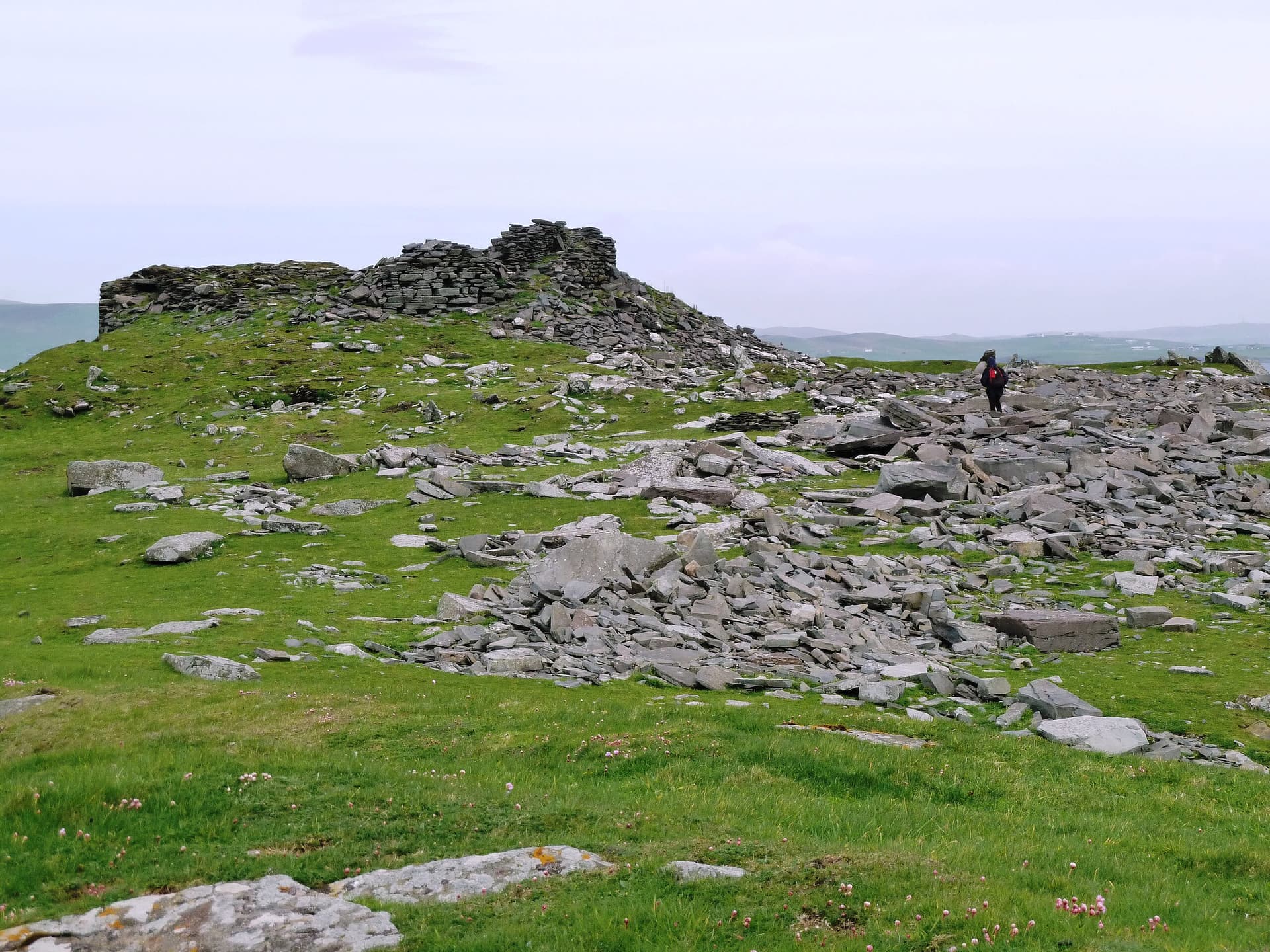
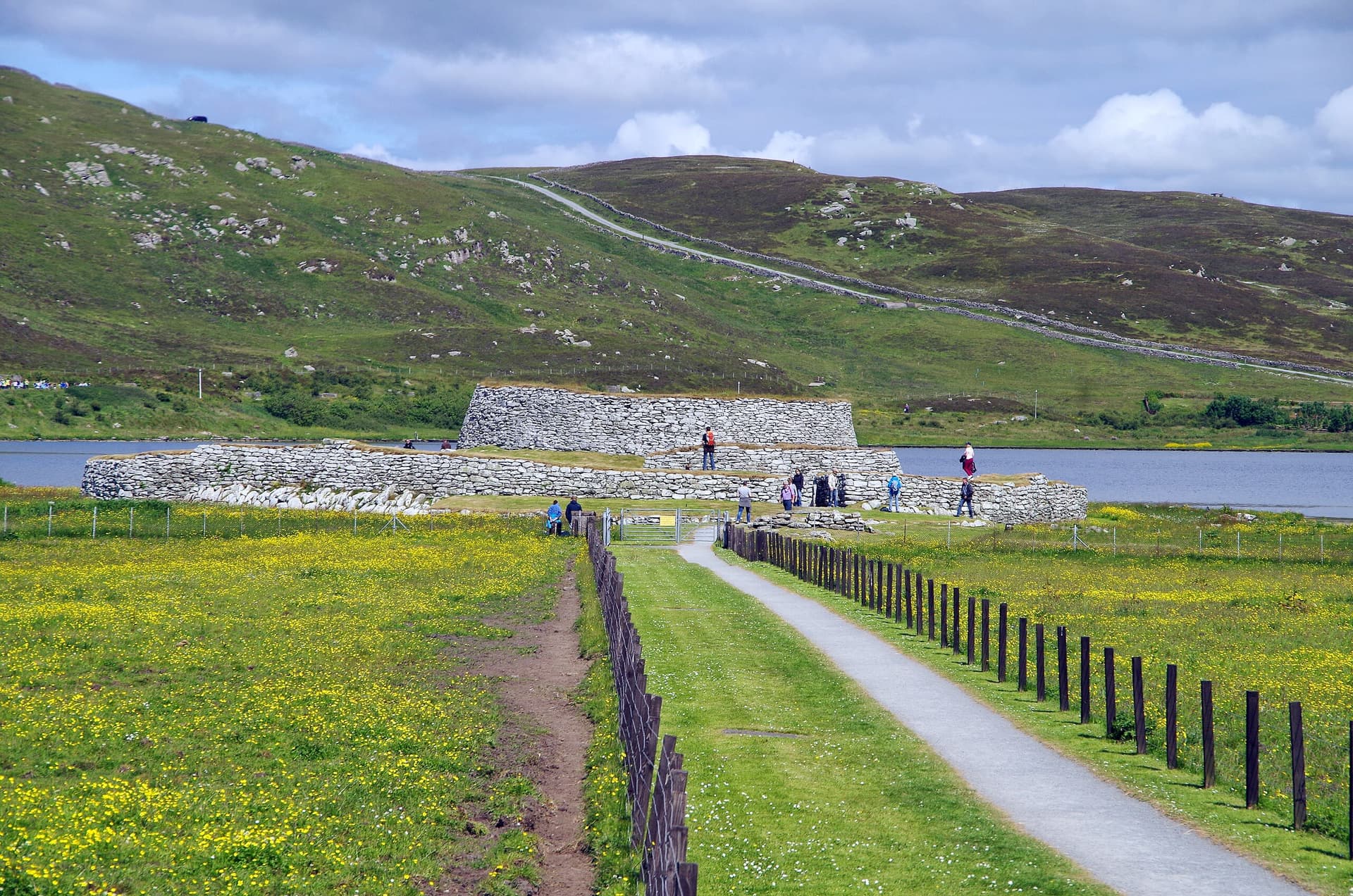
The broch stands at the centre, its walls surviving to nearly four metres, its two doorways and massive construction immediately impressive. Around it, the remains of roundhouses and wheelhouses create a complex pattern of overlapping walls and connecting passages. The layering is visible: earlier walls incorporated into later structures, floor levels built up over centuries.
Replica Iron Age and Pictish buildings have been constructed beside the excavated remains, allowing visitors to step inside reconstructions and experience the scale and character of the original structures. These replicas, built using the same materials and techniques as the originals, provide a visceral understanding of what it was like to live within these walls.
The Pictish carvings are not on site but can be seen in the Shetland Museum in Lerwick. However, the location of the bear carving within the wheelhouse is pointed out during tours, and the connection between the carved stone and the building it adorned becomes vivid in context.
The proximity to Sumburgh Airport means that aircraft occasionally pass overhead, a surreal juxtaposition of Iron Age archaeology and modern aviation that somehow works. The airport road that accidentally uncovered the site in 1975 passes within metres of the excavation, a reminder that Old Scatness lay hidden for centuries, waiting beneath a grassy mound to be revealed.
From the site, views extend toward Sumburgh Head and across the sea. The coastline of southern Shetland is visible, and on clear days the sense of being at the edge of the land is palpable.
Old Scatness is located adjacent to Sumburgh Airport at the southern tip of Mainland Shetland. The site is clearly signposted from the A970. Guided tours operate on Fridays during the summer season, typically May to October, at 10:15am, 12:15pm, and 2:30pm. Admission is free. The site can be combined with Jarlshof, 1.5 km south, for a comprehensive exploration of Shetland's multi-period archaeology.
Old Scatness offers a rare opportunity to understand the full arc of Shetland's ancient past in a single place. The site's significance extends beyond its individual phases to the unique insight it provides into cultural transitions, from Iron Age to Pictish to Norse, that shaped the identity of the Northern Isles.
Archaeologists regard Old Scatness as one of the most important multi-period settlement sites in Scotland and the North Atlantic. The eleven-summer excavation by the University of Bradford revealed the full settlement sequence from Iron Age broch construction through Pictish wheelhouse settlement to Viking occupation. The site is exceptional for its undisturbed stratigraphy, the quality of artefacts recovered, and the light it sheds on the poorly understood Pictish-Viking transition. The three published monograph volumes are major contributions to Iron Age and early medieval archaeology. The 2012 UNESCO tentative list nomination alongside Mousa and Jarlshof describes these sites as representing the zenith of Iron Age Shetland.
No continuous oral tradition spans the settlement's full history. The Pictish bear and boar carvings have attracted interest from those exploring Celtic animal symbolism, but no traditional interpretation of these specific carvings survives.
The Pictish animal carvings have attracted attention from practitioners interested in totem animals and guardian spirits. The painted pebbles are sometimes compared to similar objects from other sites where ritual or protective functions have been proposed. These interpretations remain speculative.
The precise function of the painted pebbles remains debated. Whether the Pictish bear carving indicates a household totem, clan symbol, or personal identity marker is unknown. The nature of the Pictish-Norse transition at Old Scatness, violent or cooperative, is not established. Why the broch had two doorways, and why one was subsequently blocked, is unexplained.
Visit Planning
Old Scatness is open for guided tours during the summer season, typically on Fridays from May to October. Admission is free. The site is adjacent to Sumburgh Airport at the southern tip of Mainland Shetland.
Located adjacent to Sumburgh Airport at the southern tip of Mainland Shetland. Follow the A970 south from Lerwick, approximately 25 miles. The site is signposted. Guided tours on Fridays during summer season. Free admission. Bus services run from Lerwick to Sumburgh. The site is very convenient for travellers arriving or departing via Sumburgh Airport. Check current tour times with the Shetland Amenity Trust.
Accommodation available in the Sumburgh area and more extensively in Lerwick.
Old Scatness is a managed heritage site with guided access. Follow the instructions of tour guides, respect the excavated remains, and dress appropriately for Shetland weather.
Access is by guided tour during the summer season. Admission is free. Tours are led by knowledgeable guides, sometimes in period costume. Follow the tour route and do not enter restricted excavation areas.
The site is a nationally significant archaeological monument. Do not climb on, disturb, or remove any stones or material. Photography is permitted throughout.
Warm, waterproof clothing and sturdy footwear are essential. The site is exposed to Atlantic winds.
No specific requirements beyond warm, waterproof outdoor clothing suitable for exposed Shetland conditions.
Photography is permitted throughout the site.
Do not leave offerings or objects at the monument.
Access by guided tour only during opening hours. Do not enter restricted excavation areas. Do not climb on or disturb any structures.
Sacred Cluster
Nearby sacred places create the location cluster described in the growth plan. This block is intentionally crawlable and links into the wider regional graph.