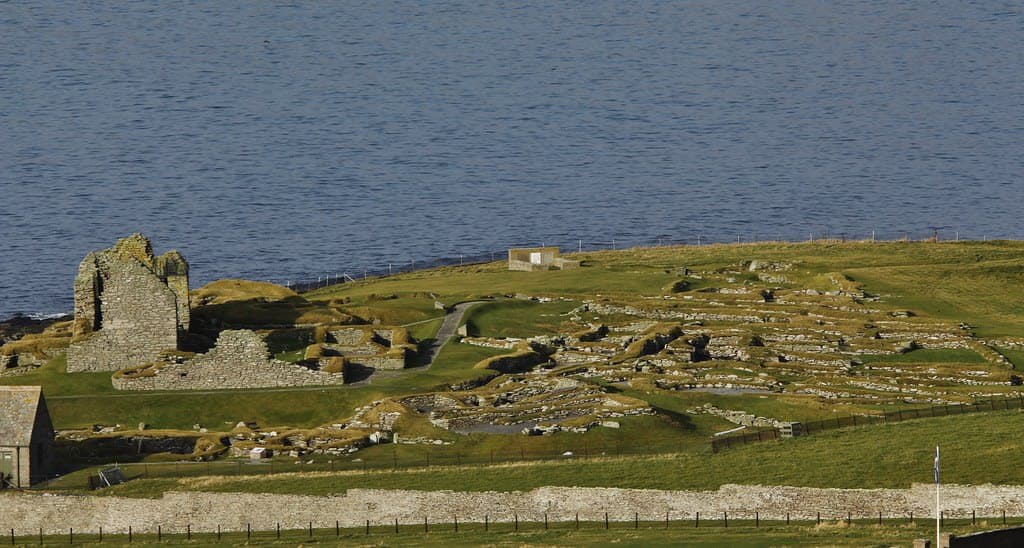
Jarlshof Prehistoric and Norse Settlement
Four thousand years of continuous human habitation laid bare on a Shetland headland, from Bronze Age homes to a medieval laird's house
Sumburgh, Shetland, United Kingdom
At A Glance
- Coordinates
- 59.8688, -1.2929
- Suggested Duration
- Ninety minutes to two hours for a thorough exploration of all settlement phases.
- Access
- Located at Sumburgh, adjacent to Sumburgh Airport, at the southern tip of Mainland Shetland. Follow the A970 south from Lerwick, approximately 25 miles. The site is clearly signposted. Opening hours: April to September, daily 9:30am to 5pm (last entry 4:30pm). October to March, daily except Sunday and Monday, 10am to 4pm (last entry 3pm), closed for lunch. Admission charged. To reach Shetland: NorthLink Ferries from Aberdeen or flights from Aberdeen, Edinburgh, Glasgow, and other Scottish airports to Sumburgh Airport. The site is a short drive from the airport.
Pilgrim Tips
- Located at Sumburgh, adjacent to Sumburgh Airport, at the southern tip of Mainland Shetland. Follow the A970 south from Lerwick, approximately 25 miles. The site is clearly signposted. Opening hours: April to September, daily 9:30am to 5pm (last entry 4:30pm). October to March, daily except Sunday and Monday, 10am to 4pm (last entry 3pm), closed for lunch. Admission charged. To reach Shetland: NorthLink Ferries from Aberdeen or flights from Aberdeen, Edinburgh, Glasgow, and other Scottish airports to Sumburgh Airport. The site is a short drive from the airport.
- No specific requirements beyond warm, waterproof clothing suitable for Shetland weather. Sturdy footwear advisable for uneven ground.
- Photography is permitted throughout the site. The overlapping ruins, with the sea as backdrop, make for compelling images.
- The site is exposed to Shetland weather. Wind, rain, and rapid weather changes are normal. Dress warmly and bring waterproof clothing. The ruins include uneven ground and low walls that can be tripping hazards.
Overview
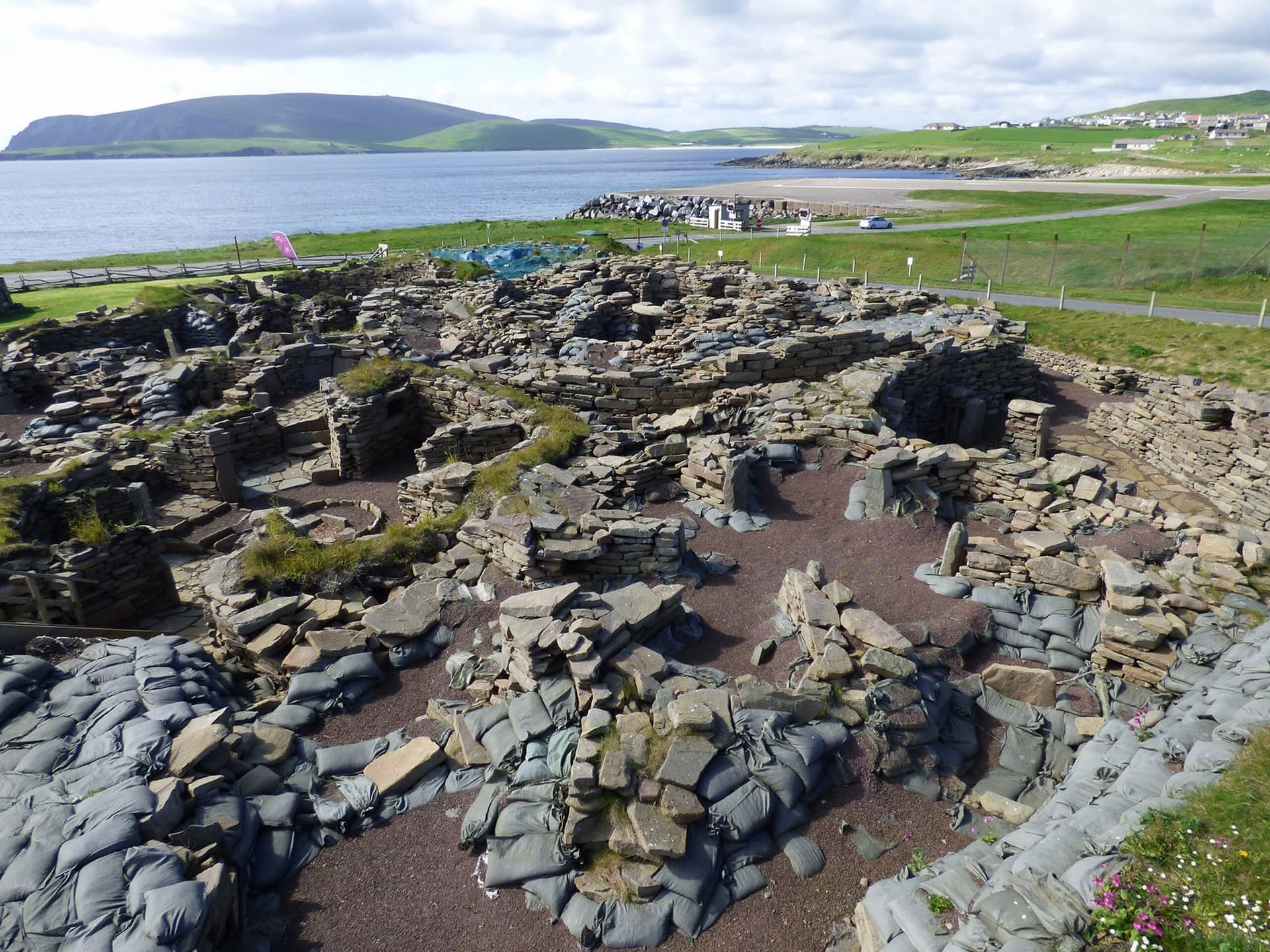
At the southern tip of Mainland Shetland, where the land narrows to a low promontory above the sea, the ruins of Jarlshof spread across a headland that humans have called home for over four thousand years. This is not a single monument but a palimpsest of settlement: Bronze Age oval houses lie beneath Iron Age wheelhouses, which in turn were built around and into by Pictish and then Norse communities. A medieval farmstead crowns the sequence, and a sixteenth-century laird's house, the only structure visible before storms revealed the rest, gave Walter Scott the name by which the whole complex is now known. To walk through Jarlshof is to walk through time itself, each step crossing centuries.
The story of Jarlshof begins around 2700 BCE, when Neolithic and early Bronze Age people established the first settlement on this sheltered headland. Their oval houses, with thick stone walls designed to withstand Shetland's ferocious weather, mark the beginning of a sequence of habitation that would continue, with modifications and rebuilding, for over four millennia.
Bronze Age settlers expanded the settlement, leaving evidence of several small oval houses and a smithy dating to around 800 BCE. The Iron Age brought the most architecturally distinctive additions: wheelhouses, so called because their roofs were supported on radial stone piers arranged like spokes in a wheel. The wheelhouses at Jarlshof are among the best preserved anywhere, complete with original room layouts, connecting passages, and corbelled roofs. They represent a building tradition that was sophisticated, practical, and beautifully adapted to the Shetland climate.
The Pictish period added its own layer. A symbol stone and painted pebbles found at the site attest to the distinctive artistic tradition of the Picts, while new buildings were constructed into and around the earlier structures. Then came the Norse. Viking settlers arrived sometime around 850 CE and established a farmstead that grew into the largest Norse settlement visible anywhere in Britain. Their longhouses, with central hearths and timber-framed walls, overlay the earlier buildings in a pattern of reuse and adaptation that characterises the entire site.
A medieval farmstead succeeded the Norse settlement. Finally, in the late sixteenth century, the Earl Robert Stewart built the substantial laird's house whose ruins were the only visible structures when Walter Scott visited in 1814 and coined the name Jarlshof, meaning Earl's Mansion. It was not until violent storms at the end of the nineteenth century tore into the headland that the earlier settlements began to emerge, revealing a depth of human habitation that few sites in Europe can match.
Excavations in the 1890s, 1930s, and 1950s uncovered the remarkable sequence of structures that visitors see today. The site is now managed by Historic Environment Scotland, with a visitor centre housing artefacts from the excavations.
Context And Lineage
Jarlshof sits within one of the most archaeologically rich landscapes in northern Europe. The southern tip of Mainland Shetland concentrates evidence of human settlement spanning over four millennia, from the earliest agricultural communities to the Norse earldom and beyond. The site's multi-period character makes it uniquely valuable for understanding the cultural transitions that shaped Shetland and the wider North Atlantic world.
The site's modern discovery is a story of revelation by natural forces. The earlier settlements lay hidden beneath sand and turf until violent storms at the end of the nineteenth century eroded the headland, exposing walls and artefacts that had been buried for centuries. The name Jarlshof was coined by Walter Scott during his 1814 visit to Shetland, when only the sixteenth-century laird's house was visible. Scott adapted the word from Scots, meaning 'the laird's house,' though his fictional earl in The Pirate gave the name its romantic Norse flavour.
No single cultural tradition connects the site's earliest inhabitants to its latest. The settlement sequence represents multiple peoples, languages, and belief systems: Bronze Age farmers, Iron Age wheelhouse builders, Pictish craftspeople, Norse settlers, medieval Scots, and a post-Reformation laird. Each left their mark in stone, creating the layered landscape visitors encounter today.
Walter Scott
J. R. C. Hamilton
Why This Place Is Sacred
Jarlshof's quality as a thin place derives from the visible accumulation of human lives across four millennia on a single piece of ground. The layering is physical, tangible, walkable. Each generation built upon the ruins of the last, and the resulting landscape of overlapping walls and intersecting buildings creates a space where past and present are not separated by a clean boundary but interpenetrate in stone.
The thinness at Jarlshof is temporal rather than spatial. The site does not occupy a dramatic mountaintop or a remote island. It sits on a low headland beside the sea, adjacent to a functioning airport, within sight of modern houses. What makes it extraordinary is the depth of time made visible in a way that no museum or reconstruction can replicate.
Walking among the ruins, you cross from Bronze Age to Iron Age in a few steps, from Pictish to Norse in a few more. The transitions are not clean. Walls of one period are incorporated into structures of the next. Doorways lead from one era into another. The wheelhouse piers, standing two thousand years after they were placed, support nothing now but air and imagination, yet their arrangement still communicates the intention of their builders.
The Norse presence is particularly evocative. The longhouses are substantial, their floor plans clearly readable, their central hearths still defined by stone settings. To stand in a Viking longhouse at the southern tip of Shetland, looking out over the sea toward Norway, is to encounter a moment of Norse expansion that transformed the culture of the North Atlantic. These were not raiders passing through. They were settlers who made this headland their home for centuries.
The weather at Jarlshof contributes to the experience. Shetland wind is a constant companion. Rain sweeps in from the sea without warning. The sky changes continuously, light shifting across the ruins in patterns that no two visits replicate. This exposure to the elements connects visitors to the fundamental challenge that every occupant of this headland faced: surviving and thriving in a landscape of extraordinary beauty and unrelenting weather.
The fact that the earlier settlements were hidden for centuries, buried beneath sand and turf, revealed only by storms, adds a quality of emergence to the site. Jarlshof was literally uncovered, pulled from concealment by the same forces of wind and sea that the original settlers contended with daily.
Each phase of settlement served the fundamental purpose of providing shelter and community in one of Europe's most exposed locations. The Bronze Age houses, Iron Age wheelhouses, Norse longhouses, and medieval farmstead all represent responses to the same challenge: how to live well at the edge of the habitable world.
The site evolved through continuous adaptation. Bronze Age structures were incorporated into Iron Age buildings. Iron Age wheelhouses were adapted by Pictish and Norse settlers. The medieval farmstead reused earlier walls. The sixteenth-century laird's house was the final major construction phase. After abandonment, the earlier levels were buried by windblown sand until storms exposed them in the late nineteenth century.
Traditions And Practice
No formal spiritual practices are conducted at Jarlshof. The site is managed as a heritage monument by Historic Environment Scotland. Visitors explore the ruins with the aid of the visitor centre displays and interpretive panels.
Each period of settlement brought its own practices. Bronze Age inhabitants farmed and fished. Iron Age communities built wheelhouses and practiced craft production. The Pictish period is attested by a symbol stone and painted pebbles suggesting symbolic or ritual activity. Norse settlers farmed, fished, and maintained the cultural traditions of Scandinavian society including sagas, feasting, and eventually Christian worship.
No established spiritual community maintains practice at Jarlshof. The site functions as a heritage attraction with managed access, a visitor centre, and interpretive information.
Allow the chronological sequence to guide your visit. Begin with the Bronze Age structures and move forward through time, noting how each generation built upon and adapted the works of those who came before. At the wheelhouses, consider the ingenuity of their design and the comfort they would have provided against Shetland weather. At the Norse longhouses, imagine the firelight, the stories told around the central hearth, the world of the sagas. The site rewards both systematic exploration and simple presence.
Bronze Age Settlement
HistoricalThe earliest settlement at Jarlshof dates to approximately 2700 BCE. Bronze Age communities built oval stone houses and established the pattern of habitation that would continue for millennia. A smithy dating to around 800 BCE provides evidence of metalworking, indicating technological sophistication and possible trade connections.
The Bronze Age inhabitants practiced farming and fishing, supplemented by craft production including metalworking. Their oval houses, with thick stone walls and low doorways, were designed to withstand Shetland weather while providing comfortable domestic spaces.
Iron Age Wheelhouse Culture
HistoricalThe Iron Age phase at Jarlshof includes some of the best-preserved wheelhouses in Scotland. These distinctive structures, with radial stone piers supporting corbelled roofs, represent a building tradition that was unique to the Scottish islands and the northern mainland. The wheelhouses at Jarlshof are unusual in not being subterranean.
The wheelhouse communities practiced farming, fishing, and craft production. The radial layout of the wheelhouses created partitioned living spaces around a central hearth, providing both privacy and communal warmth. The corbelled roofs, built without mortar, demonstrate sophisticated understanding of stone construction.
Norse Settlement
HistoricalThe Viking settlement at Jarlshof, established around 850 CE, grew into the largest Norse settlement visible anywhere in Britain. The longhouses and outbuildings represent a community of Norse settlers who adapted Scandinavian building traditions to the Shetland environment. Their presence transformed the culture, language, and social organisation of Shetland.
Norse settlers practiced mixed farming and fishing. The longhouses had central hearths for cooking and warmth, with benches along the walls for living and sleeping. Evidence of weaving, ironworking, and other crafts indicates a largely self-sufficient community. The Norse period eventually brought Christianity to Shetland.
Experience And Perspectives
Jarlshof is a managed heritage site with a visitor centre, clear pathways, and interpretive information. The experience begins in the visitor centre, where artefacts and displays provide context, then moves outside to the ruins themselves. Walking among the overlapping structures of four millennia requires imagination but rewards it richly.
The visitor centre introduces the site's chronology and displays artefacts recovered during excavation. From here, you step outside into the ruins, which spread across the low headland in a complex pattern of overlapping walls and intersecting floor plans.
The Bronze Age structures are the oldest: small oval houses with thick walls and low doorways. Their modest scale belies their age. These are among the oldest visible dwellings in Shetland, built when this corner of the British Isles was home to small farming and fishing communities at the edge of the known world.
The Iron Age wheelhouses are the architectural highlight. Their radial stone piers, like the spokes of a wheel, supported corbelled roofs that enclosed snug, partitioned living spaces. The craftsmanship is remarkable: each pier is carefully constructed, each cell thoughtfully proportioned. These were not primitive shelters but sophisticated dwellings, designed with an understanding of structure and space that commands respect.
The Norse longhouses dominate the central area. Their scale is immediately apparent: long, rectangular structures with central hearths, stone-lined walls, and evidence of timber framing. The largest represents a substantial household, a seat of local power and wealth. Walking through these ruins, you can trace the daily patterns of Norse domestic life: the hearth for cooking and warmth, the benches along the walls for sleeping and sitting, the byres at the ends for livestock.
The medieval farmstead and the sixteenth-century laird's house complete the sequence. The laird's house, the most recent and most complete structure, stands as a reminder that this headland remained inhabited into the modern era.
Throughout the visit, the sea is present. Waves break on the rocks below the headland. Seabirds wheel overhead. The wind, ever-present, carries the salt smell of the Atlantic. Sumburgh Head lighthouse is visible to the south, marking the very tip of Mainland Shetland.
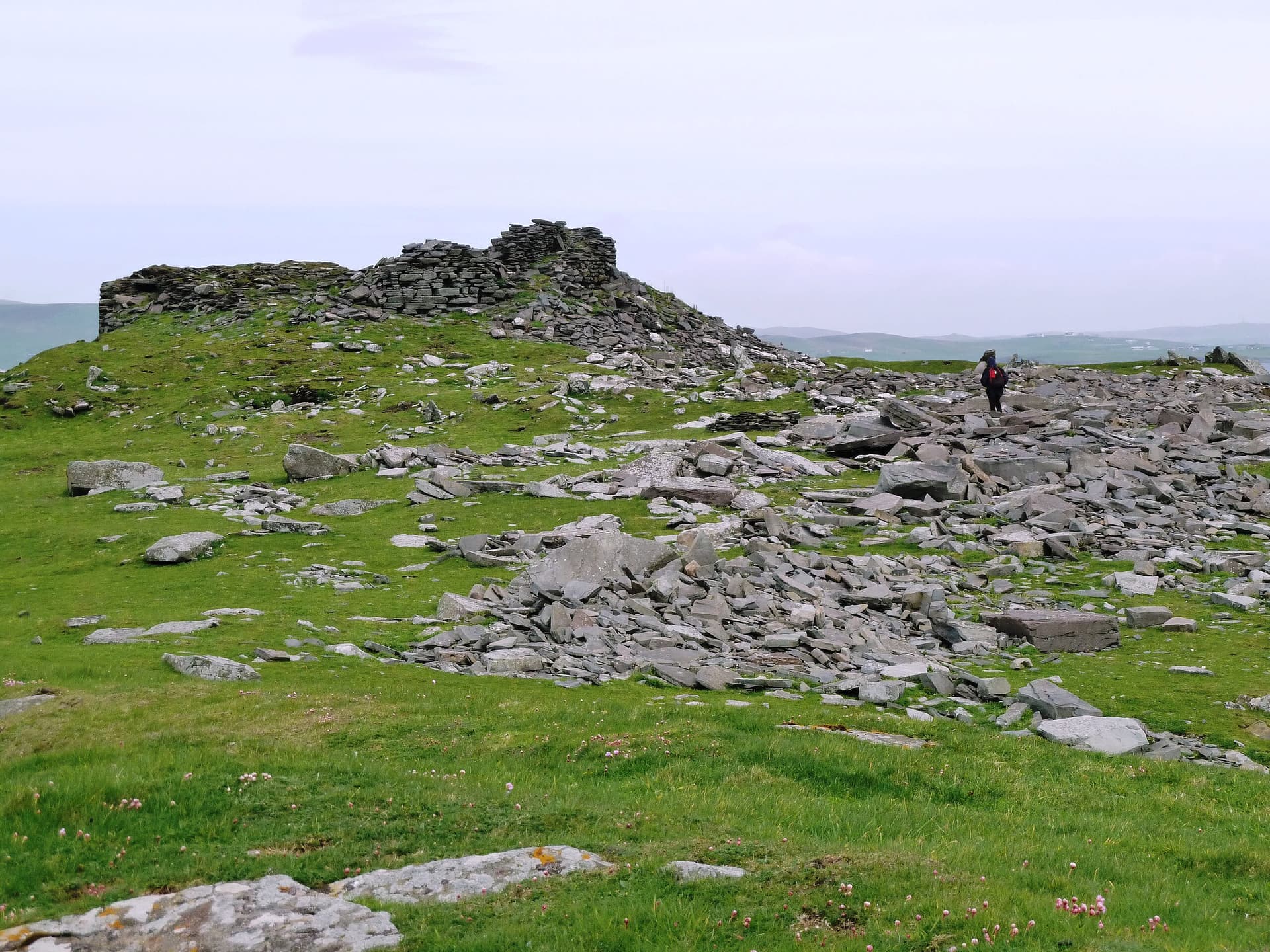
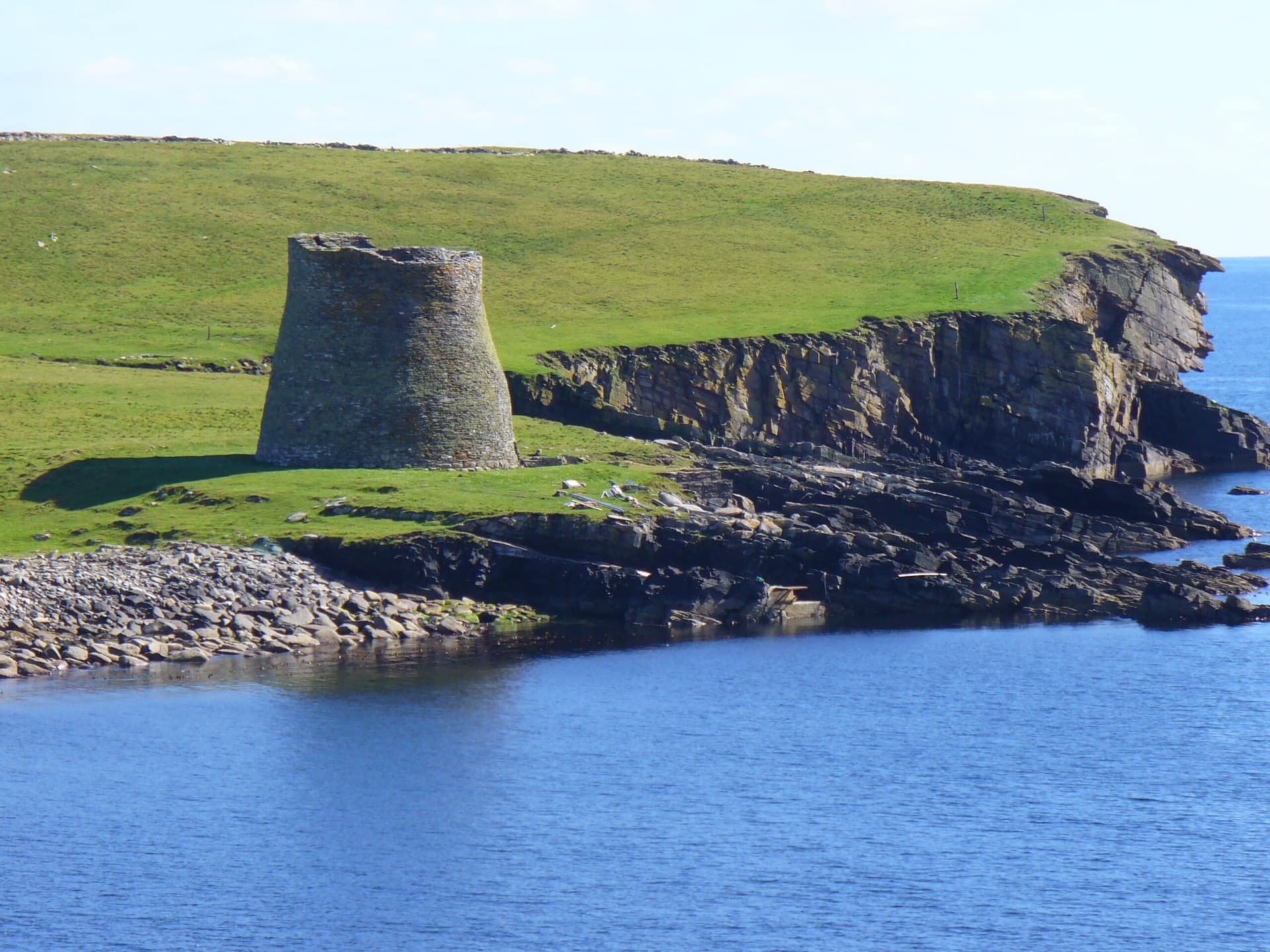
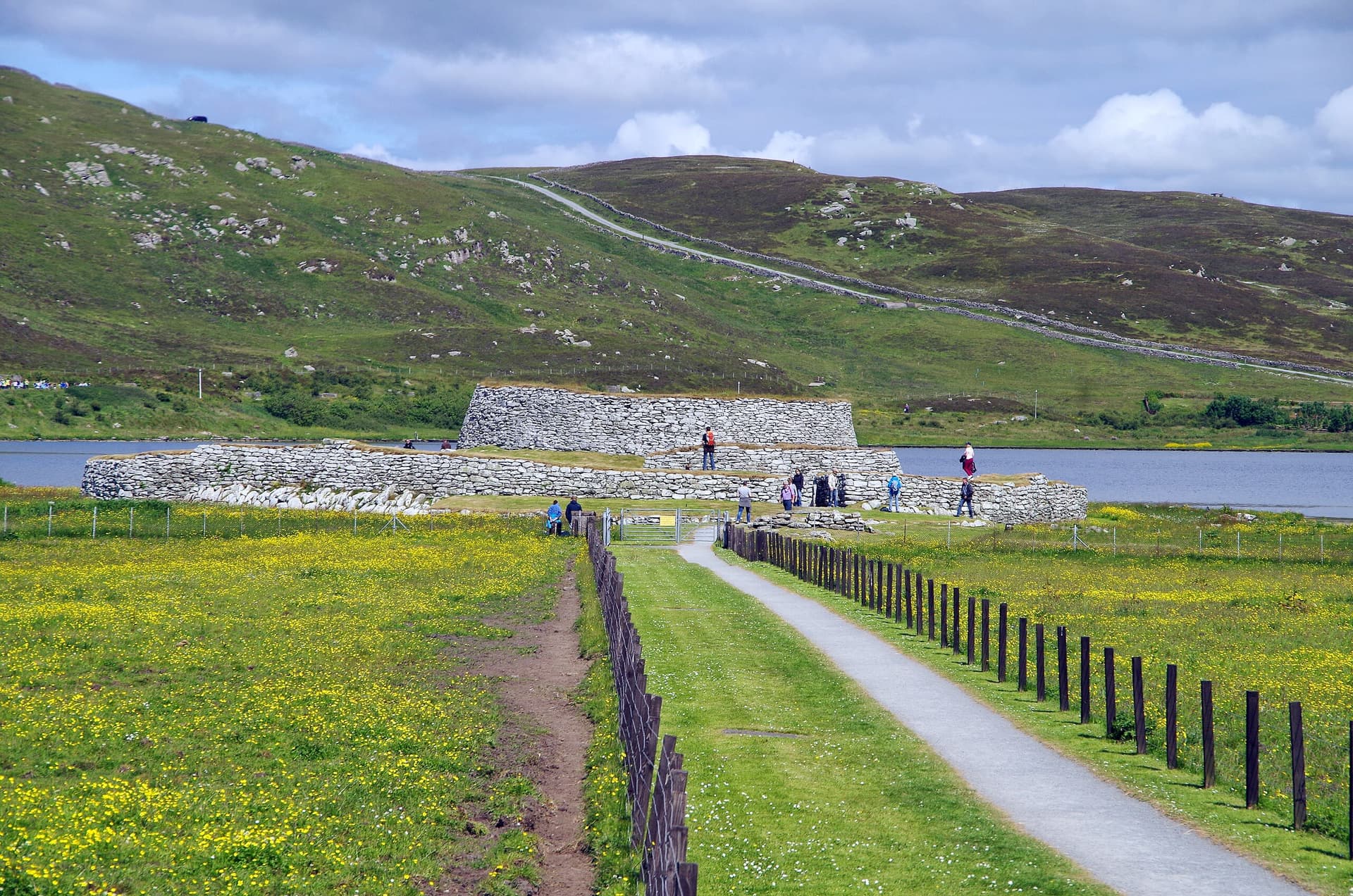
Jarlshof is located at Sumburgh, at the southern tip of Mainland Shetland. The site is clearly signposted from the A970 and is adjacent to Sumburgh Airport. The visitor centre provides orientation and displays artefacts. Allow at least ninety minutes for the visit. The site can be combined with Old Scatness Broch and Iron Age Village, approximately 1.5 kilometres to the north, and with Sumburgh Head, immediately to the south.
Jarlshof has been described as one of the most remarkable archaeological sites ever excavated in the British Isles. Its significance lies in the visible, walkable sequence of four thousand years of settlement on a single headland, a record of human adaptation and persistence that is without parallel in Scotland.
Archaeologists regard Jarlshof as a site of national and international importance. The excavations of the 1890s, 1930s, and 1950s revealed a settlement sequence spanning from the Bronze Age through the Norse period and into the post-medieval era. The Iron Age wheelhouses are among the best preserved in Scotland. The Norse settlement is the largest of its kind visible in Britain. The site is part of the UNESCO World Heritage Tentative List nomination alongside Mousa Broch and Old Scatness, recognised as representing the zenith of Iron Age Shetland. J. R. C. Hamilton's excavation report from the 1950s remains a foundational text in Scottish archaeology.
No single oral tradition spans the full period of Jarlshof's occupation. Norse saga tradition provides context for the Viking settlement but does not specifically reference this site. The earlier periods, Bronze Age, Iron Age, and Pictish, are represented only by their material remains.
The multi-period character of Jarlshof has attracted attention from those interested in the idea of places that draw successive cultures to the same location. Whether this reflects practical considerations such as shelter, fresh water, and access to the sea, or something less tangible about the character of the place itself, is a question that the archaeology alone cannot answer.
Key questions remain about the transitions between settlement phases. Whether each change of culture was gradual or sudden, peaceful or violent, is not clearly established in the archaeological record. The relationship between the Jarlshof settlement and the contemporary settlement at Old Scatness, 1.5 kilometres away, is not fully understood. The beliefs and social organisation of the earlier inhabitants are largely unknown.
Visit Planning
Jarlshof is located at Sumburgh, at the southern tip of Mainland Shetland. The site is managed by Historic Environment Scotland with a visitor centre, interpretive displays, and an admission charge. It is open year-round with seasonal hours.
Located at Sumburgh, adjacent to Sumburgh Airport, at the southern tip of Mainland Shetland. Follow the A970 south from Lerwick, approximately 25 miles. The site is clearly signposted. Opening hours: April to September, daily 9:30am to 5pm (last entry 4:30pm). October to March, daily except Sunday and Monday, 10am to 4pm (last entry 3pm), closed for lunch. Admission charged. To reach Shetland: NorthLink Ferries from Aberdeen or flights from Aberdeen, Edinburgh, Glasgow, and other Scottish airports to Sumburgh Airport. The site is a short drive from the airport.
Accommodation available in the Sumburgh area and more extensively in Lerwick, approximately 25 miles north. Hotels, guest houses, and self-catering options throughout Shetland.
Jarlshof is a managed heritage site with clear visitor protocols. Admission is charged. Visitors should follow marked paths, respect the ruins, and not climb on or disturb any structures.
Jarlshof is managed by Historic Environment Scotland. An admission fee is charged. The visitor centre provides context and displays artefacts. Interpretive panels throughout the site explain the different phases of settlement.
Visitors should follow the marked paths and not climb on walls or enter restricted areas. The ruins are fragile despite their age, and visitor behaviour directly affects their preservation. Photography is permitted throughout.
The site is exposed to weather. Warm, waterproof clothing and sturdy footwear are essential. The wind can be strong, particularly at the exposed seaward edge of the headland.
No specific requirements beyond warm, waterproof clothing suitable for Shetland weather. Sturdy footwear advisable for uneven ground.
Photography is permitted throughout the site. The overlapping ruins, with the sea as backdrop, make for compelling images.
Do not leave offerings at the site.
Do not climb on walls, remove stones, or disturb any part of the ruins. Follow marked paths. Dogs should be kept on leads.
Sacred Cluster
Nearby sacred places create the location cluster described in the growth plan. This block is intentionally crawlable and links into the wider regional graph.