Nine Stones Close Stone Circle, Youlgreave
Where Bronze Age stones frame the Moon's descent between ancient pillars
Derbyshire Dales, England, United Kingdom
At A Glance
- Coordinates
- 53.1604, -1.6644
- Suggested Duration
- A brief visit to view the stones from the roadside takes only minutes. A meaningful visit, including the walk across the moor and time spent with the stones, requires at least an hour. Those combining the visit with Robin Hood's Stride and other nearby sites should allow half a day. Extended exploration of the Harthill Moor prehistoric landscape could fill a full day.
- Access
- The stones stand on private farmland approximately 1.5 miles southeast of Youlgreave. They can be seen from the road between Elton and Alport. For closer access, park at the Cratcliffe layby on the B5056 where the Limestone Way meets Dudwood Lane, beneath Cratcliffe Tor and Robin Hood's Stride. From there, footpaths cross Harthill Moor to the vicinity of the stones. The walk takes 20 to 40 minutes each way over uneven terrain. The site is not accessible for wheelchairs or those with significant mobility impairments.
Pilgrim Tips
- The stones stand on private farmland approximately 1.5 miles southeast of Youlgreave. They can be seen from the road between Elton and Alport. For closer access, park at the Cratcliffe layby on the B5056 where the Limestone Way meets Dudwood Lane, beneath Cratcliffe Tor and Robin Hood's Stride. From there, footpaths cross Harthill Moor to the vicinity of the stones. The walk takes 20 to 40 minutes each way over uneven terrain. The site is not accessible for wheelchairs or those with significant mobility impairments.
- No formal requirements, but dress for the Peak District. Sturdy waterproof footwear is essential, as the moor can be boggy in any season. Layers accommodate changeable weather. The site is exposed, so wind and rain protection is wise even on apparently clear days.
- Photography is permitted and encouraged as a way of engaging with the site without physical contact. The stones are particularly atmospheric at sunrise, sunset, and the winter solstice. No restrictions apply to personal photography from public viewpoints. Professional or commercial photography may require additional permissions.
- The site is on private farmland. Unless you have permission from the landowner, view the stones from public rights of way. The nearby roads and footpaths offer adequate views for most purposes. Do not touch, climb on, or interfere with the stones. They are a Scheduled Ancient Monument, legally protected and physically fragile. The cup marks are particularly vulnerable to damage from handling. Be wary of those who claim definitive knowledge of what the site meant or how to 'activate' it. The honest position is uncertainty. Anyone asserting secret knowledge should be met with skepticism. The moor can be boggy and exposed. Check weather conditions before visiting and dress appropriately. Mobile signal is limited in places. Tell someone where you are going.
Overview
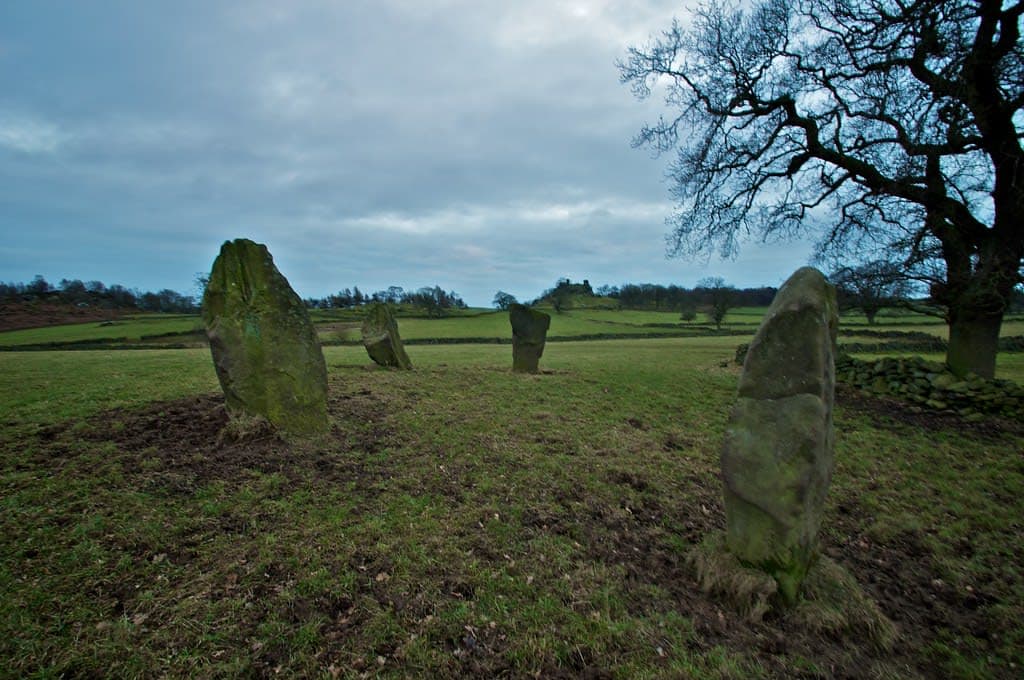
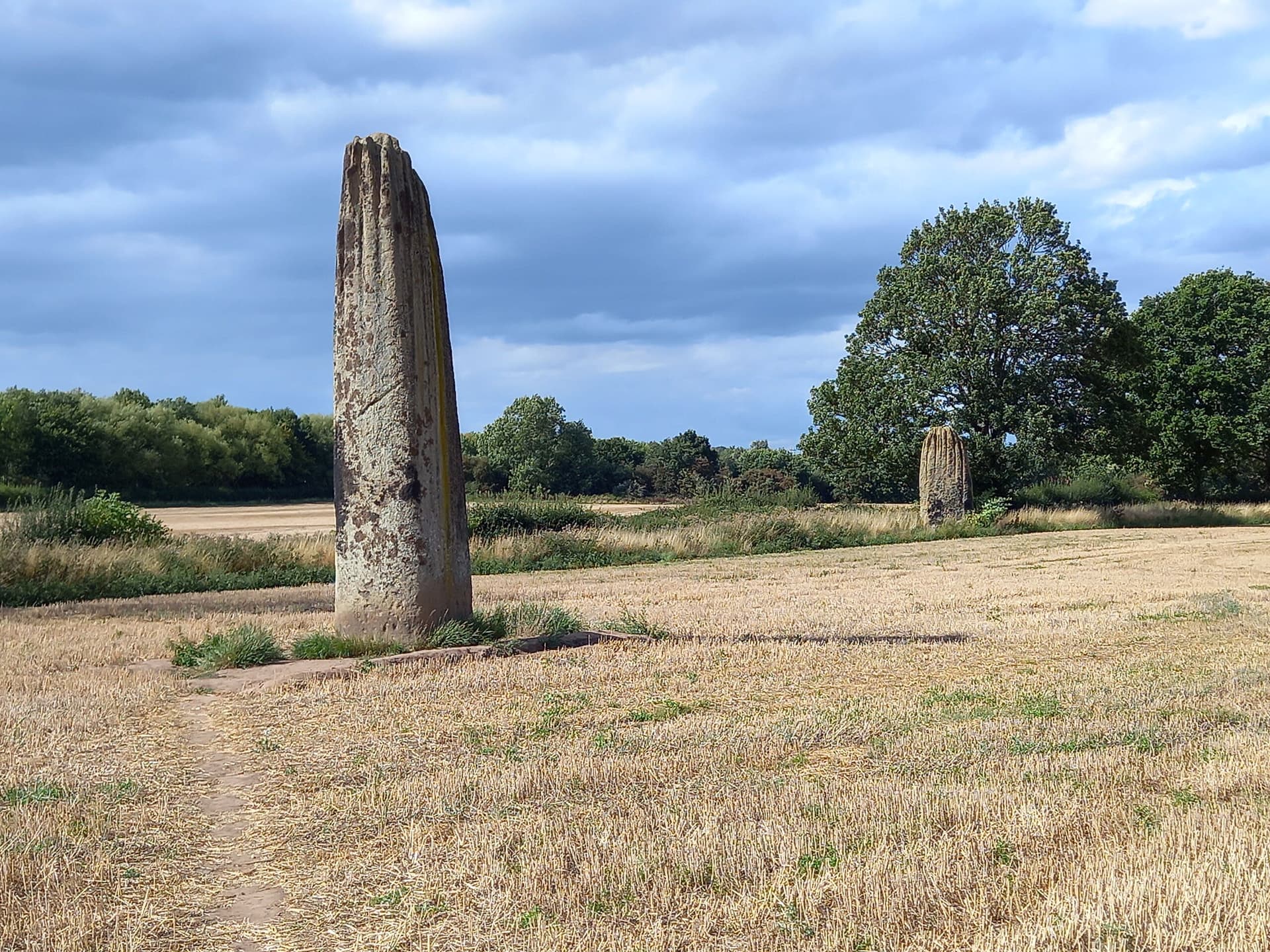
Four weathered stones stand sentinel on Harthill Moor, remnants of a Bronze Age circle that once framed the setting Moon between the twin pillars of Robin Hood's Stride. Known locally as the Grey Ladies, these are Derbyshire's tallest standing stones, rising from a farmer's field in the Peak District with an imposing quiet that suggests purposes we have forgotten.
Something about Nine Stones Close refuses to yield its meaning. The four remaining stones stand in a farmer's field on Harthill Moor, silent witnesses to four millennia of changing skies and shifting human understanding. They are tall, weathered, almost defiant in their persistence.
The Bronze Age people who raised them chose this location with evident care. To the south-southwest, the distinctive twin pillars of Robin Hood's Stride break the horizon. At the major lunar standstill, every 18.6 years, the full Moon descends between those pillars when viewed from the circle. Whether this alignment was the primary purpose or one among many, it speaks to a people who paid attention to the sky in ways we have largely forgotten.
Local folklore remembers the stones as women turned to stone for dancing at forbidden times. The name Grey Ladies carries this memory, even as the historical basis dissolves under scrutiny. Such stories accumulate at mysterious places, attempts by later generations to explain what earlier ones understood differently.
Today the stones draw those who seek connection with ancient sacred landscapes. Quieter than the nearby Nine Ladies circle on Stanton Moor, Nine Stones Close offers a more contemplative encounter. The moor stretches in all directions, the stones rise from the grass, and whatever moved Bronze Age communities to haul and erect them remains present in their enduring silence.
Context And Lineage
Nine Stones Close was erected during the Late Neolithic or Early Bronze Age, between approximately 3300 and 900 BCE, as part of a ceremonial landscape on Harthill Moor. The circle originally held more stones, with the remaining four among Derbyshire's tallest standing stones. Antiquarian documentation began in 1782, with excavations in the 19th century yielding Bronze Age artifacts. Restoration in 1936 re-erected two fallen stones. The site is now a Scheduled Ancient Monument.
No written record preserves the intentions of those who built Nine Stones Close. What we know comes from archaeology, comparative study, and the stones themselves.
The circle arose during a period when stone circles were being erected throughout Britain, Ireland, and Brittany. These communities invested enormous effort in hauling, shaping, and erecting stones, creating monuments that would outlast any building they might have made. The effort speaks to the importance of what they were creating, even if the specific meaning remains beyond recovery.
Harthill Moor was already a significant landscape when the circle was built. Bronze Age barrows dot the area. Robin Hood's Stride, with its distinctive pillar-like outcrops, dominated the southern horizon then as now. The circle's placement appears to integrate with this existing sacred geography, adding a new node to a network of meaningful places.
The astronomical alignment suggested by Aubrey Burl implies that those who built here understood the Moon's complex cycle. The major lunar standstill occurs every 18.6 years, when the Moon rises and sets at its most extreme positions on the horizon. To track this cycle requires observation across generations, the transmission of knowledge from those who witnessed one standstill to those who would witness the next. If the alignment is intentional, Nine Stones Close is evidence of sophisticated astronomical tradition.
The name 'Nine Stones Close' itself may preserve memory of more stones than currently survive. Or it may derive from 'Noon Stones,' reflecting folklore about the stones dancing at midday. The Grey Ladies name connects to the petrified dancers tradition found at many British stone circles. Whatever the original name was, it died with those who gave it.
The lineage of Nine Stones Close is one of forgetting and rediscovery. Built by communities whose names, language, and specific beliefs are lost, the circle outlasted them by millennia. Medieval and early modern generations encountered the stones without understanding and generated folklore to explain them. Antiquarians of the 18th and 19th centuries began systematic documentation, projecting their era's fascination with Druids onto a monument that predated Celtic culture by thousands of years.
Modern archaeology has corrected the Druid error and established the Bronze Age date, but much remains unknown. The 1936 restoration preserved the site but introduced concrete bases that ancient builders never used. Contemporary visitors add another layer, approaching the stones through frameworks ranging from heritage tourism to neo-paganism to personal spiritual seeking.
Through all these changes, the stones have stood. Whatever meaning they held for those who erected them, whatever meanings have accumulated since, the physical reality of gritstone standing in a Derbyshire field persists. This persistence may itself be the deepest continuity the site offers.
The Grey Ladies
folkloric
According to local legend, the stones are women who were turned to stone for dancing at forbidden times. The tale may preserve distorted memory of female ritual practitioners, or it may simply reflect a common folklore motif applied to mysterious standing stones.
Robin Hood
folkloric
The nearby rock formation bears his name, and local legend connects him to the stones with a ribald tale of transformation. In this context, Robin Hood likely represents an older giant or supernatural figure who shaped the landscape, later overlaid with the medieval outlaw's identity.
Hayman Rooke
historical
The first known scholarly documentor of the site, Rooke described it in 1782 as a 'Druid temple' and recorded six stones still present.
Thomas Bateman
historical
Conducted excavations in 1847 that yielded Bronze Age pottery and flints, and documented seven stones. Published his findings in 'Vestiges of the Antiquities of Derbyshire' in 1848.
Aubrey Burl
scholarly
Archaeologist who proposed the lunar alignment between the circle and Robin Hood's Stride, suggesting the site was positioned to observe the major southern Moon setting during the lunar major standstill.
Why This Place Is Sacred
Nine Stones Close occupies a carefully chosen position within a prehistoric sacred landscape. Its alignment with the major southern moonset behind Robin Hood's Stride, the presence of cup-marked stones, and its situation among Bronze Age barrows and ceremonial sites suggest this was a place where earth and sky converged in meaningful ways. The rituals performed here remain unknown, but the intention that shaped this place persists in the stones themselves.
The Bronze Age communities of Harthill Moor did not scatter their monuments randomly. Barrows punctuate the landscape. Enclosures suggest settlement or ceremony or both. Robin Hood's Stride, a natural gritstone crag with two pillar-like outcrops, dominates the southern horizon. Amid all this, Nine Stones Close sits with apparent intentionality.
Archaeologist Aubrey Burl proposed that the circle was positioned specifically to observe the major southern Moon setting between the pillars of Robin Hood's Stride. This event occurs at the lunar major standstill, a point in the Moon's 18.6-year cycle when it rises and sets at its most extreme positions on the horizon. If Burl is correct, the circle functioned as an observatory for a celestial event that occurred only once in a human generation.
The cup marks carved into the south-west stone add another layer of meaning. These small artificial depressions appear on Bronze Age stones throughout Britain, their purpose debated but clearly deliberate. Some interpret them as offerings, others as astronomical records, others as symbols whose meaning died with their makers. Their presence here indicates that the stones were not merely structural but carried significance in themselves.
Mike Parker Pearson has argued that in Neolithic Britain, stone was associated with the dead while wood was associated with the living. Stone circles may have been monuments to ancestors, places where the living could commune with those who had passed. If so, Nine Stones Close was not merely an observatory but a threshold, a place where different orders of existence met.
Historian Ronald Hutton notes that many stone circles show little evidence of human activity after their construction. They may have been deliberately left as silent and empty monuments, sacred spaces whose power came from their very isolation and stillness. Whether ceremonies were regularly performed here or whether the site was meant to stand untouched between rare astronomical events, something about it demanded attention across generations.
Visitors today still report a quality that resists easy description. The stones feel present in a way that goes beyond their physical dimensions. Whether this reflects geology, accumulated human intention, or something that Bronze Age builders understood better than we do, the effect is consistent enough to take seriously.
Archaeological evidence places Nine Stones Close within the Late Neolithic or Early Bronze Age, roughly 3300 to 900 BCE. The circle's original diameter of approximately 13.7 metres and its unusually large stones suggest it held significant importance, perhaps greater than smaller circles in the region. The astronomical alignment with Robin Hood's Stride implies ceremonial use connected to lunar observations, though whether this was the primary purpose or one function among many remains uncertain. The Bronze Age artifacts found in the surrounding area, including flints, pottery, stone axes, and a bronze axe, indicate sustained activity on Harthill Moor over centuries.
The circle's history is one of gradual diminishment and rediscovery. By the time antiquarian Hayman Rooke documented it in 1782, only six stones were visible. He called it a 'Druid temple,' reflecting the popular but historically inaccurate theory of his era. Thomas Bateman's excavations in 1847 recorded seven stones and yielded Bronze Age pottery and flints. Sometime in the 18th century, one stone was removed and repurposed as an oversized field gatepost, where it remains today.
By the early 20th century, only four stones stood or lay on the ground. In 1936, the Derbyshire Archaeological Society undertook restoration, re-erecting two fallen stones with guidance from Alexander Keiller, known for his work at Avebury. The two restored stones now rest in concrete bases, a compromise between preservation and authenticity that marks many such sites.
Modern understanding has moved beyond the Druid interpretation to recognize the circle's Bronze Age origins and astronomical significance. Contemporary seekers, drawn by interest in prehistoric sacred sites and earth-based spirituality, continue to visit, adding their attention to millennia of human regard.
Traditions And Practice
No formal ceremonies take place at Nine Stones Close today. The site is managed as a heritage monument on private farmland rather than an active worship space. However, visitors seeking meaningful engagement find ways to practice presence and attention within the constraints of access and preservation.
The rituals performed at Nine Stones Close in the Bronze Age are unknown. If the lunar alignment suggested by Burl is correct, ceremonies may have marked the major lunar standstill, an event occurring once every 18.6 years. Such ceremonies might have involved the community gathering to witness the Moon descending between the pillars of Robin Hood's Stride, perhaps accompanied by offerings, chants, or observances we cannot reconstruct.
The cup marks on the south-west stone indicate that ritual marking of the stones themselves was practiced. Whether these marks recorded astronomical observations, represented offerings to spirits, or served purposes entirely different, they were made deliberately and likely held significance.
Mike Parker Pearson's theory that stone was associated with the dead suggests the circle may have been a place for ancestor veneration or communication with the spirit world. Ronald Hutton's observation that many stone circles show little evidence of activity after construction raises the possibility that the site was meant to stand silent, a monument whose power came from its emptiness rather than regular ceremony.
The honest answer is that we do not know what was practiced here. The stones preserve form but not meaning.
Nine Stones Close does not host organized ceremonies. Its location on private farmland and relative obscurity compared to nearby Nine Ladies circle mean it rarely gathers groups of practitioners.
Individual visitors with spiritual interests do come. Some identify with modern paganism, druidry, or earth-based spirituality and approach the site as a place of connection with ancient traditions. Others come without any framework, simply seeking encounter with something old and mysterious.
The winter solstice draws those aware of the solar alignment reported at the site. Watching the sunset along the sloped top of the stone nearest Robin Hood's Stride offers a moment of connection with astronomical traditions, even if we cannot know whether this alignment was intentional.
Photographers and heritage enthusiasts visit regularly, their attention another form of practice. The act of looking carefully, of documenting and preserving, maintains relationship with the site across time.
If you come seeking more than scenery, consider these approaches:
Arrive with time and without agenda. The stones do not perform on command. Settle into the space before expecting anything from it. Walk around the circle. Notice the spacing, the heights, the way each stone differs from the others. Let your body orient to the geometry before your mind tries to interpret it.
Face south-southwest toward Robin Hood's Stride. Regardless of season or time of day, the alignment becomes apparent from the circle. Consider what it meant to build here, to position stones so that one event every 18.6 years would appear framed between distant pillars. What quality of attention does such building require? What kind of relationship with time?
If you find the cup marks, spend time with them. These small carved depressions are physical evidence of intention, someone making marks that have lasted four thousand years. You cannot know what they meant. You can only witness that they exist.
Offer nothing physical. The site is protected, and any objects left will be removed. If you wish to offer something, make it internal: attention, respect, silence. The stones have received the elements for four millennia. They do not need your tokens, but they may benefit from your regard.
Prehistoric Bronze Age
HistoricalNine Stones Close was created as a ceremonial monument during the Late Neolithic or Early Bronze Age, part of a widespread tradition of stone circle construction across Britain and beyond. Its position within the ritual landscape of Harthill Moor, its astronomical alignment with Robin Hood's Stride, and its unusually large stones suggest significant importance within Bronze Age sacred geography. The cup marks indicate ritual treatment of the stones themselves.
Historical practices are unknown. If the lunar alignment was intentional, ceremonies may have marked the major lunar standstill approximately every 18.6 years. The presence of Bronze Age artifacts in the surrounding area suggests sustained activity, though whether this involved regular ceremony or occasional pilgrimage cannot be determined. The cup marks may have been created as offerings or records, though their specific function is lost.
English Folklore
ActiveLocal folklore provides the name Grey Ladies and interprets the stones as women turned to stone for dancing at forbidden times. Tales of fairy gatherings and supernatural music connect the site to broader British traditions about prehistoric monuments as thresholds to the Otherworld. The connection to Robin Hood ties the stones into the legendary landscape of the Peak District.
Folklore does not prescribe practices but provides frameworks for encounter. Those who know the Grey Ladies story experience the stones differently than those who do not. The tales invite imagination and interpretation, allowing each generation to find its own relationship with the monument.
Modern Paganism and Earth-Based Spirituality
ActiveContemporary pagans, druids, and spiritual seekers approach Nine Stones Close as a sacred site connected to ancient traditions and earth energies. Though less documented at this location than at nearby Nine Ladies circle, the site attracts those seeking connection with prehistoric sacred landscapes, lunar cycles, and ancestral wisdom.
Practices include meditation at the stones, observation of astronomical alignments, personal ritual work, and pilgrimage combining multiple sacred sites in the Peak District. The winter solstice and full moons may draw practitioners seeking to connect with celestial cycles.
Antiquarian and Archaeological
ActiveFrom Hayman Rooke's 1782 documentation through modern archaeological interpretation, scholarly traditions have sought to understand Nine Stones Close through systematic study. This tradition has corrected earlier errors, established Bronze Age dating, proposed astronomical alignments, and preserved the site for future generations.
Scholarly engagement involves documentation, excavation where appropriate, publication, and conservation. The 1936 restoration by the Derbyshire Archaeological Society, guided by Alexander Keiller, exemplifies this tradition's commitment to preservation.
Experience And Perspectives
Nine Stones Close offers a contemplative encounter with prehistoric mystery. Visitors describe an atmosphere of remote stillness, the imposing presence of the tall stones, and a sense of connection to ancient purposes that resist full comprehension. The relative obscurity of the site compared to nearby monuments allows for quieter, more personal engagement.
The approach across Harthill Moor sets the tone. This is not a site with visitor centers and interpretive panels. The path crosses farmland, sometimes muddy, always exposed to Peak District weather. The stones appear gradually, rising from the grass of a farmer's field, and the first impression is often one of unexpected scale. These are Derbyshire's tallest standing stones, and photographs rarely capture their presence.
Visitors speak of a quality of silence that feels almost physical. The moor is quiet anyway, but at the stones themselves something stills further. The tallest stone, over two metres high, anchors the southern side of the circle, facing across the moor toward Robin Hood's Stride. The alignment becomes apparent in the body before the mind fully grasps it.
The cup marks on the south-west stone reward patient attention. These small carved depressions connect Nine Stones Close to a tradition of rock art found throughout Bronze Age Britain, a visual language whose meaning we have lost. To trace them with the eyes is to encounter something deliberately made by human hands four thousand years ago.
Rickman and Nown called this 'Derbyshire's most magical ancient site.' Whether or not one uses such language, the stones do produce something. Perhaps it is the accumulated weight of centuries of attention. Perhaps it is the isolation, the lack of crowds that often gather at better-known monuments. Perhaps it is the alignment itself, the sense that this location was chosen for reasons that mattered deeply to those who chose it.
Those who visit at midwinter solstice report the sun setting along the sloped top of the stone nearest Robin Hood's Stride. The alignment, whether intentional or coincidental, creates a moment of connection across four millennia. The Bronze Age builders may have gathered here to witness the same event, to mark the turning of the year with rituals we cannot reconstruct.
The Grey Ladies folklore adds another dimension for those who know it. The stones as dancing women turned to stone, the fairy gatherings, the music said to be heard at certain times. These stories are likely not authentic oral tradition from prehistory, but they reflect how later generations attempted to explain what they encountered here. The mystery outlasted the original understanding and generated new explanations.
A visit to Nine Stones Close is rarely a single destination. Robin Hood's Stride lies less than 400 metres to the south-southwest, its twin pillars framing the sky just as they framed the Moon for Bronze Age observers. The Nine Ladies circle on Stanton Moor, Arbor Low henge, and other prehistoric monuments are within easy reach. Together they form a landscape of ancient meaning that rewards extended exploration.
Nine Stones Close asks something different from visitors than many sacred sites. There are no designated practices, no rituals to perform, no expectations to meet. The invitation is simply to arrive and attend.
Come with unhurried time. The walk across the moor is part of the experience, not merely access to it. If possible, visit when others are unlikely to be present. The stones respond to solitude in ways they cannot when observers cluster.
Bring no expectations of what should happen. Some visitors feel moved; others feel only the wind. Both responses are legitimate. The stones have stood here for four thousand years without demanding anything from those who encounter them.
If you know something of the lunar alignment, face south-southwest and consider the horizon. Robin Hood's Stride stands there, its pillars framing the sky. Imagine the full Moon descending between them. Even without witnessing the event itself, the geometry becomes apparent, and with it a glimpse of what mattered to those who built here.
Notice the cup marks if you can find them on the south-west stone. Do not touch them, as they are fragile and protected. But let your eyes trace what hands carved millennia ago. Someone made these marks deliberately. Why? The answer is lost, but the question remains vital.
Nine Stones Close invites multiple interpretations, and honest engagement means holding them in productive tension. Archaeology provides dating and context but cannot recover meaning. Folklore preserves memory in distorted form. Contemporary spiritual seekers bring frameworks unknown to the builders. Each perspective illuminates something while leaving much in shadow.
Archaeological consensus places Nine Stones Close in the Late Neolithic or Early Bronze Age, approximately 3300 to 900 BCE. The site is part of a wider tradition of stone circle construction that spread across Britain, Ireland, and Brittany during this period. The unusually large stones compared to other Derbyshire circles may indicate greater significance or an earlier date.
Aubrey Burl's suggestion of a lunar alignment with Robin Hood's Stride places the circle within a tradition of astronomical monument building, similar to claims made for Stonehenge and other sites. This interpretation remains credible but unproven. The alignment exists geometrically; whether it was intentional and central to the site's purpose cannot be established with certainty.
The 1877 excavations by Jewitt and Greenwell recovered Bronze Age flints and pottery sherds, confirming the site's antiquity. The cup marks connect Nine Stones Close to the widespread tradition of rock art found on monuments throughout the British Isles. Their meaning remains debated.
Modern scholars increasingly emphasize the importance of stone circles within ritual landscapes rather than as isolated monuments. Nine Stones Close makes most sense as part of the broader Harthill Moor complex of barrows, enclosures, and natural features like Robin Hood's Stride.
The Grey Ladies folklore represents how later communities explained monuments whose original meaning had been lost. The tale of dancing women turned to stone for breaking prohibitions appears at multiple British stone circles, suggesting a widespread explanatory motif rather than site-specific memory. Whether any authentic oral tradition connects to the Bronze Age builders cannot be established.
Folklore researcher J.P. Heathcote suggested in 1947 that the dancing stones tales were not authentic tradition but inventions of early guidebook writers. This may be true for their published form, though underlying folk beliefs about the stones' supernatural nature likely have deeper roots.
The fairy lore associated with the site, describing gatherings of little people and unearthly music at certain times, connects to broader Celtic and British traditions about prehistoric monuments as entrances to the Otherworld. For those who hold such views, the stones mark a boundary between ordinary reality and something beyond.
The connection to Robin Hood, a figure who accumulated folklore from many older sources, may preserve memory of an earlier giant or supernatural being associated with shaping the landscape.
Contemporary spiritual seekers interpret Nine Stones Close through various frameworks. Modern pagans and druids approach it as an ancient sacred site connected to earth energies and ancestral wisdom, though the historical druids had no connection to Bronze Age monuments.
Some describe the site as lying on a ley line connecting it to Arbor Low and other monuments. The ley line concept, developed in the 20th century, lacks archaeological support but reflects genuine intuitions about landscape connections that may have different explanations.
Energy-sensitive visitors report unusual sensations at the site, though no measurements have detected anything anomalous. Whether these reports reflect geology, psychology, expectation, or something else, they add to the site's accumulated significance.
These interpretations lack scholarly support but often emerge from genuine experiences. The language of energy and power may be attempts to describe something real that resists conventional vocabulary.
Genuine mysteries persist. The original number of stones is uncertain, with historical accounts recording between six and nine at various times. Were there ever actually nine? The circle's name may preserve memory or may derive from other sources entirely.
The cup marks' purpose is unknown. They may represent offerings, astronomical records, territorial markers, or something entirely different. Their presence indicates intentional marking; their meaning is lost.
Whether the lunar alignment was intentional or coincidental cannot be determined with current evidence. The alignment exists, but alignment alone does not prove purpose.
The reason for the circle's construction, the ceremonies performed here, the beliefs that motivated such enormous effort, the identities of those who built and used it: all remain beyond recovery. This uncertainty is not a failure of research but an honest acknowledgment of what four thousand years erases.
Visit Planning
Nine Stones Close stands on Harthill Moor in the Peak District, viewable from public roads and footpaths. Access is free but the site is on private farmland. The walk from available parking crosses uneven moorland terrain. A car is strongly recommended as public transport is limited. The site is exposed and can be muddy in any season.
The stones stand on private farmland approximately 1.5 miles southeast of Youlgreave. They can be seen from the road between Elton and Alport. For closer access, park at the Cratcliffe layby on the B5056 where the Limestone Way meets Dudwood Lane, beneath Cratcliffe Tor and Robin Hood's Stride. From there, footpaths cross Harthill Moor to the vicinity of the stones. The walk takes 20 to 40 minutes each way over uneven terrain. The site is not accessible for wheelchairs or those with significant mobility impairments.
No accommodation exists at the site itself. Nearby villages offer options at various price points. Birchover, approximately one mile away, has the historic Druid Inn and occasional bed and breakfast accommodation. Youlgreave, about 1.5 miles, offers more options including guest houses and holiday cottages. The larger towns of Bakewell and Matlock provide full tourist infrastructure. For those seeking immersive experience, camping and glamping options exist in the wider Peak District.
Nine Stones Close requires respectful behavior befitting both a protected heritage site and private farmland. View from public rights of way unless you have the landowner's permission. Do not touch or disturb the stones. Leave no trace of your visit.
The most important principle is restraint. The stones have survived four millennia; careless visiting threatens what time has preserved.
The site stands on private farmland. Unless you have explicitly obtained permission from the landowner, remain on public rights of way. The stones can be seen from nearby roads and footpaths, and this viewing respects both heritage and property. If you wish to approach more closely, seek permission first.
Do not touch the stones. Human hands transfer oils and cause cumulative erosion. The cup marks are especially vulnerable, fragile carvings that cannot be repaired once damaged. Photography captures what touching would erode.
Leave nothing behind. No offerings, no tokens, no cairns of small stones. These must be removed by those who maintain the site, and their presence encourages others to leave more. The site's power does not require your contributions; it requires your restraint.
Maintain an atmosphere appropriate to the site's age and mystery. Loud conversation, music, and performative behavior diminish what others may be seeking. If you encounter other visitors, offer them space and silence.
Close all gates behind you. Keep dogs on leads around livestock. These are basic countryside courtesies that preserve the access we currently enjoy.
No formal requirements, but dress for the Peak District. Sturdy waterproof footwear is essential, as the moor can be boggy in any season. Layers accommodate changeable weather. The site is exposed, so wind and rain protection is wise even on apparently clear days.
Photography is permitted and encouraged as a way of engaging with the site without physical contact. The stones are particularly atmospheric at sunrise, sunset, and the winter solstice. No restrictions apply to personal photography from public viewpoints. Professional or commercial photography may require additional permissions.
Physical offerings are not appropriate at the site. Do not leave flowers, crystals, candles, coins, ribbons, or any other objects. These become litter that others must remove, and they risk damage to the protected monument. If you wish to offer something, make it internal: attention, gratitude, silence. The stones have stood for four thousand years without human gifts. They do not need them now.
The site is a Scheduled Ancient Monument. It is illegal to damage, deface, or remove any part of it. The stones are on private farmland; access beyond public rights of way requires the landowner's permission. No excavation or metal detecting is permitted without official authorization.
Sacred Cluster
Nearby sacred places create the location cluster described in the growth plan. This block is intentionally crawlable and links into the wider regional graph.
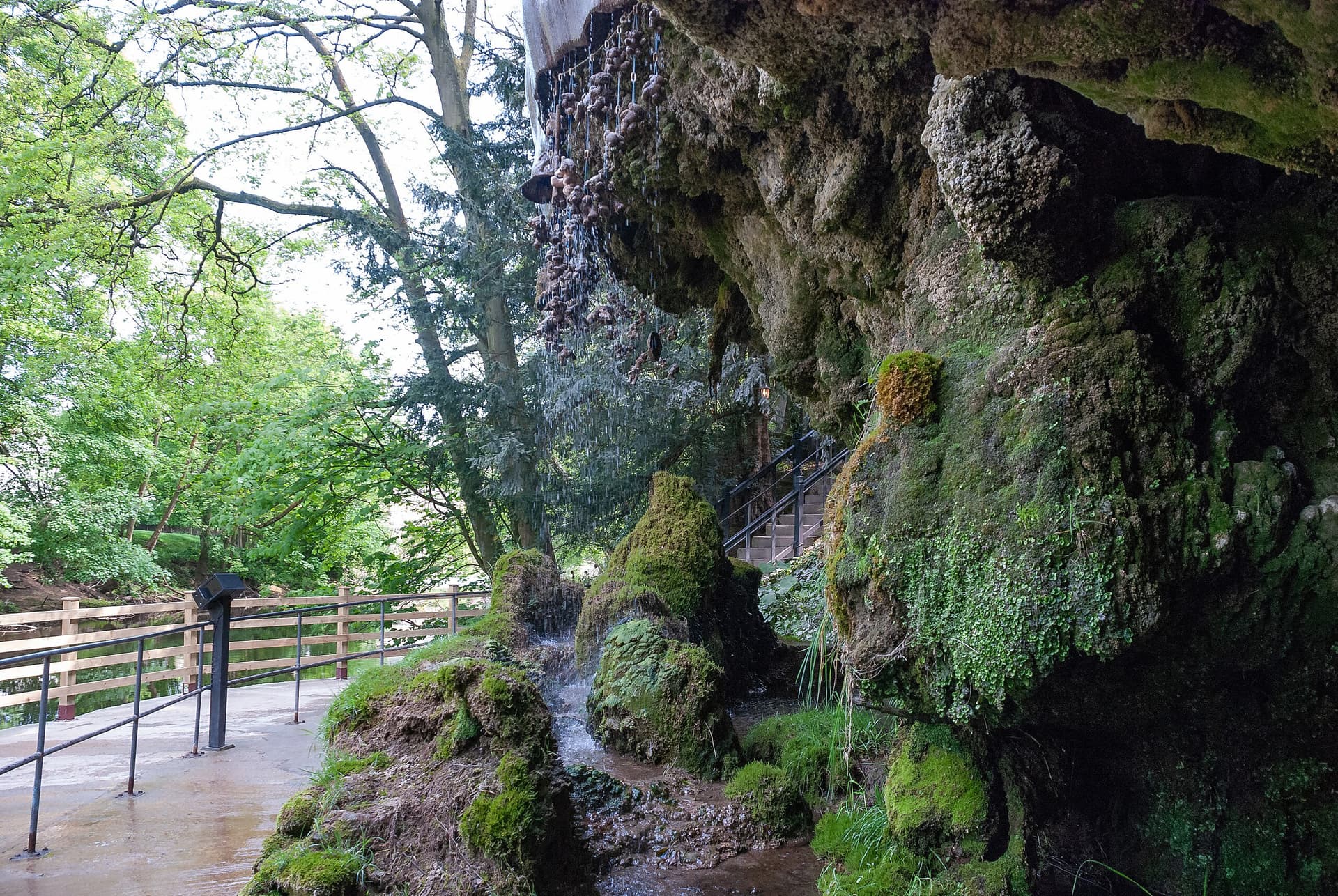
Mother Shipton’s Cave, Knaresborough, England
Knaresborough, England, United Kingdom
95.1 km away
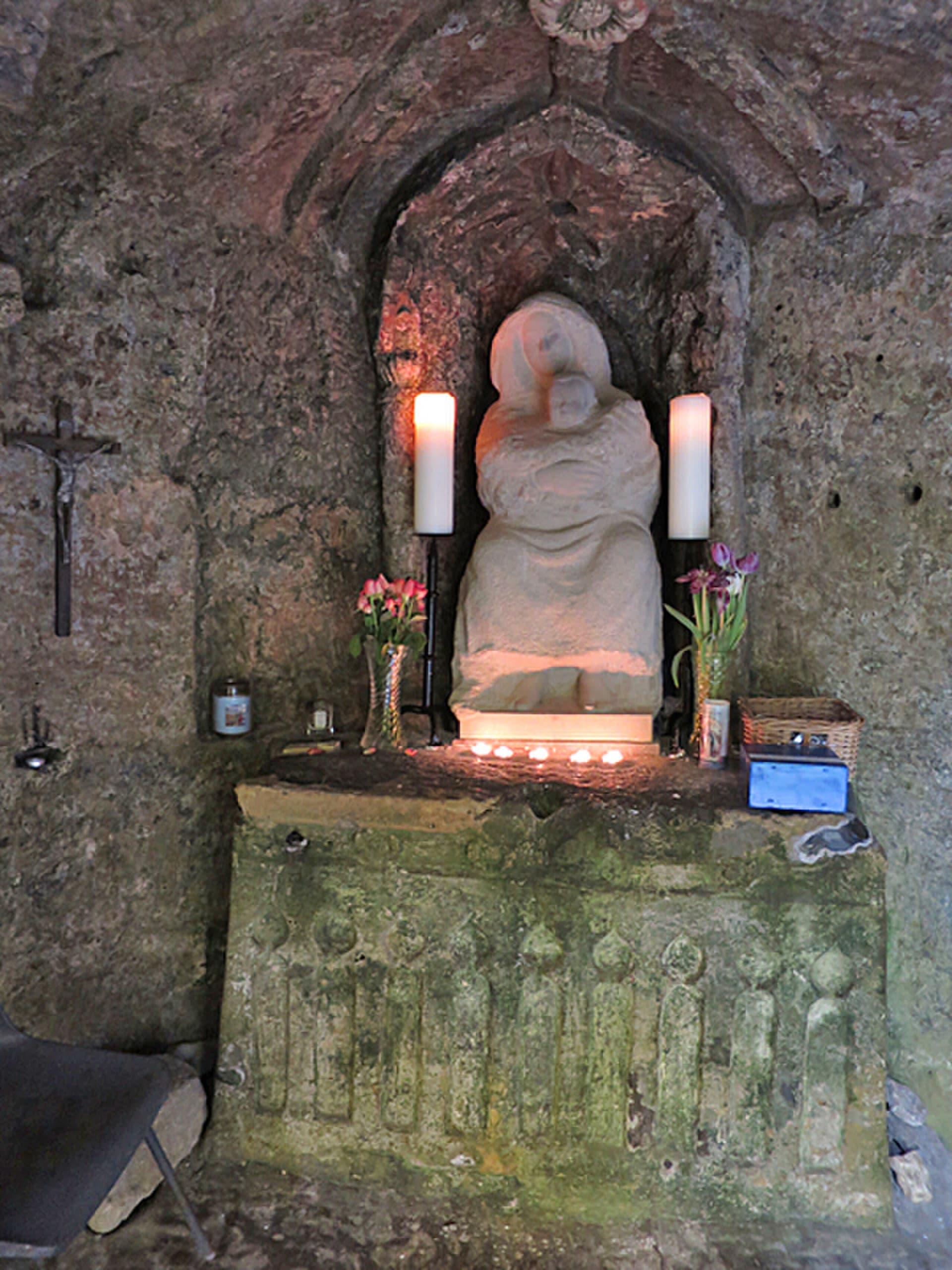
Chapel of Our Lady of the Crag, Knaresborough, England
Knaresborough, England, United Kingdom
95.2 km away
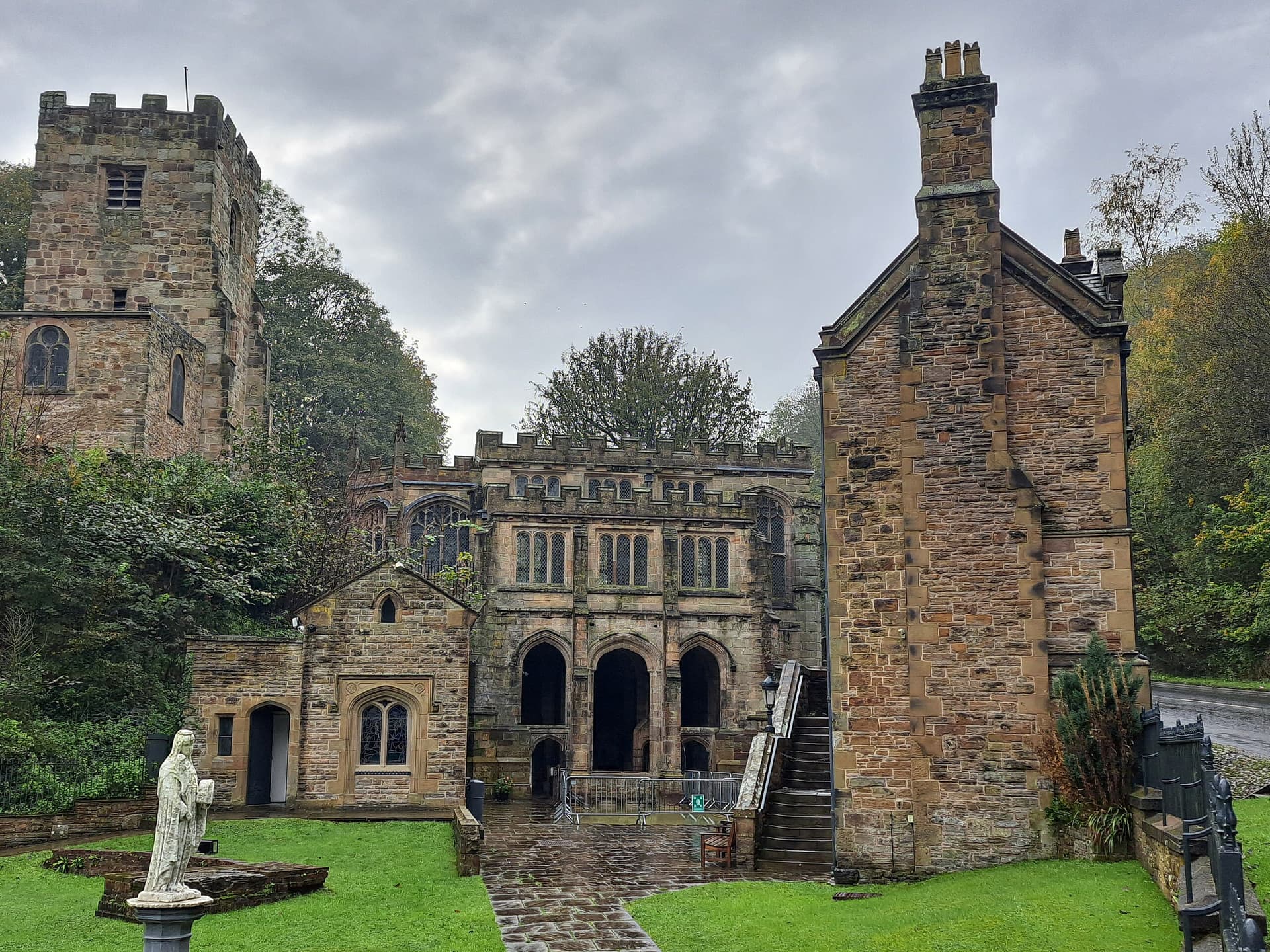
St. Winefride’s Well
Holywell, Wales, United Kingdom
104.6 km away
The Devils Arrows
Boroughbridge, England, United Kingdom
104.8 km away