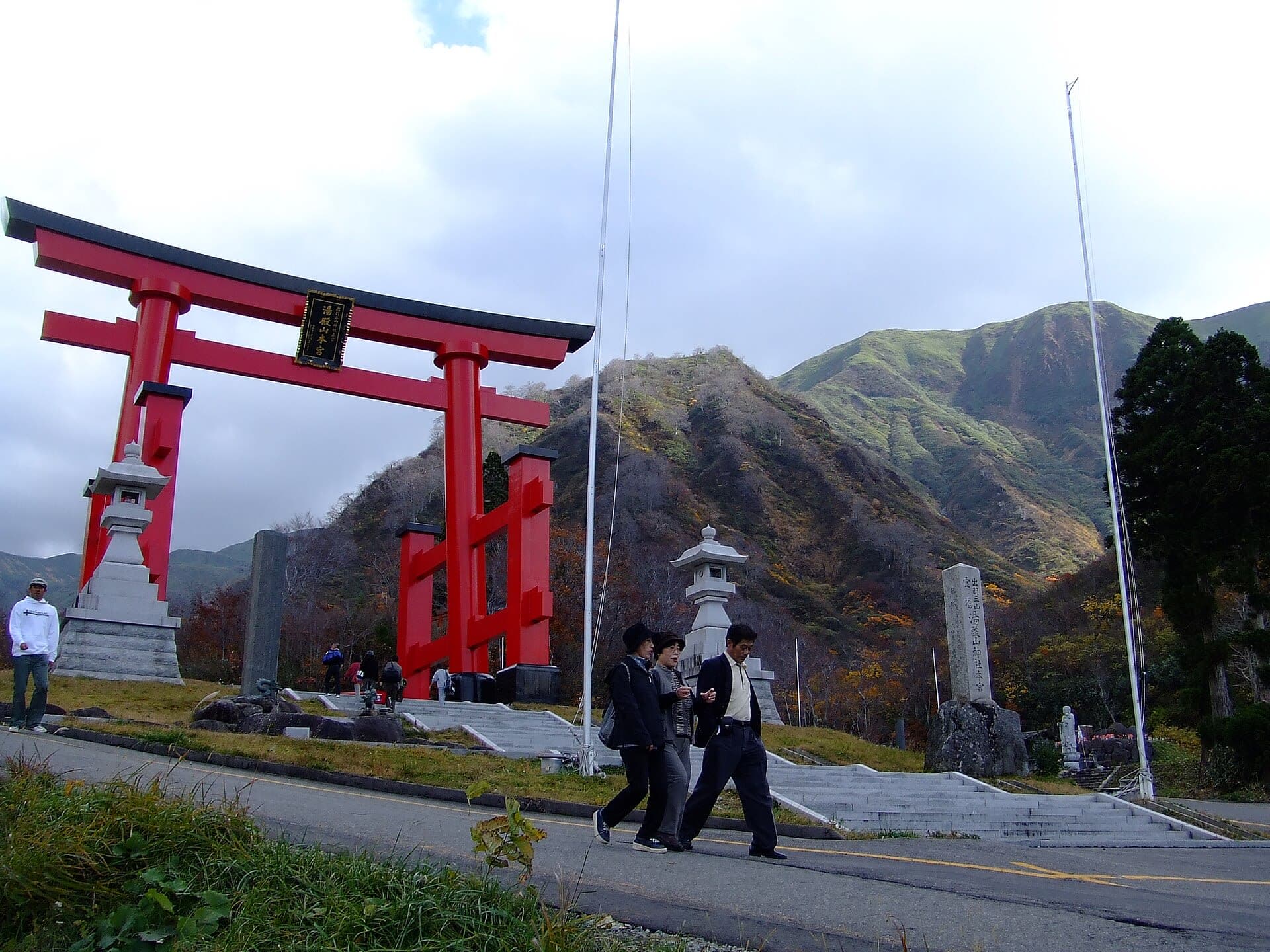
Mount Yudono
The mountain of rebirth, where secrets are kept and pilgrims emerge transformed
Tsuruoka, Yamagata Prefecture, Japan
At A Glance
- Coordinates
- 38.5333, 139.9833
- Suggested Duration
- A focused visit to Yudono requires a half day including transport. The full Dewa Sanzan pilgrimage typically takes 2-4 days, depending on pace and depth of engagement at each mountain.
- Access
- From Tsuruoka City: Take the bus to Senninzawa (仙人沢). From Senninzawa, a shuttle bus runs to the shrine area. Private cars cannot access the shrine directly; use the parking at Senninzawa and take the shuttle. The Dewa Sanzan are interconnected by hiking trails for those undertaking the full pilgrimage on foot. This route connects Yudono to Gassan, allowing completion of the traditional sequence by walking. Public transport to Tsuruoka includes JR lines and highway buses. Tsuruoka is the primary base for Dewa Sanzan visits.
Pilgrim Tips
- From Tsuruoka City: Take the bus to Senninzawa (仙人沢). From Senninzawa, a shuttle bus runs to the shrine area. Private cars cannot access the shrine directly; use the parking at Senninzawa and take the shuttle. The Dewa Sanzan are interconnected by hiking trails for those undertaking the full pilgrimage on foot. This route connects Yudono to Gassan, allowing completion of the traditional sequence by walking. Public transport to Tsuruoka includes JR lines and highway buses. Tsuruoka is the primary base for Dewa Sanzan visits.
- Practical mountain clothing is appropriate for the approach. At the sacred rock, shoes must be removed; you will walk barefoot. Serious pilgrims often wear shiroshozoku, white pilgrim garb, especially if completing the full Dewa Sanzan pilgrimage. This is not required but expresses commitment.
- Photography is strictly prohibited at Yudonosan Shrine and the sacred rock area. This is actively enforced. Photography is permitted in other areas of the mountain complex and on the approach.
- Mount Yudono is open only from June 1 to early November. The mountain is inaccessible outside this period. Check exact closing dates before planning visits in late season. The prohibition on photography at the sacred rock is strictly enforced. Do not attempt to photograph the sacred area. The prohibition on speaking of the experience is traditional expectation rather than enforced rule, but honoring it respects the tradition and protects your own experience. The shrine area involves walking barefoot on wet rock. Those with mobility limitations should inquire in advance about accessibility.
Overview
At the culmination of the Dewa Sanzan pilgrimage, where seekers symbolically die and are reborn across three sacred mountains, Mount Yudono guards the final mystery. The shrine has no building because the sacred object needs no shelter: a massive rust-red rock from which hot spring water perpetually flows. What happens when barefoot pilgrims walk across this warm, wet stone is protected by a tradition of strict secrecy maintained for over a millennium: speak not, hear not.
Mount Yudono represents the culmination of one of Japan's most ancient mountain pilgrimages, a journey designed to transform those who complete it. The three mountains of Dewa, known as Dewa Sanzan, map a cosmological journey across birth, death, and rebirth. Mount Haguro embodies the present, birth into this life. Mount Gassan embodies the past, the realm of the dead through which pilgrims travel. Mount Yudono embodies the future, the moment of rebirth when pilgrims emerge transformed.
This mountain holds no shrine building. What it holds instead is a massive natural rock, turned rust-red by mineral deposits, from which hot spring water continuously flows. This is the goshintai, the sacred object of worship, and it is so sacred that for over a millennium visitors have been forbidden to speak of their experience here. 'Kataru nakare, kiku nakare,' the tradition says: speak not, hear not.
This secrecy is not mystification but protection. Whatever occurs when pilgrims remove their shoes, receive purification, and walk barefoot across the warm, wet rock belongs to them alone. No description can substitute for direct encounter. No narrative can prepare or contaminate the experience. Each pilgrim meets the mountain's mystery fresh.
Yamabushi, the mountain ascetics of the Shugendo tradition, have trained in these mountains since the 6th century. Their practices include waterfall meditation in the Bonji River that flows beside the sacred rock, and extended periods of mountain austerity. The most extreme practitioners of previous centuries chose to end their lives here through sokushinbutsu, self-mummification achieved through years of extreme fasting and meditation. Several of these mummified monks remain enshrined at temples in the surrounding region, their bodies preserved as proof of spiritual attainment.
Context And Lineage
Mount Yudono forms the culmination of the Dewa Sanzan, three sacred mountains opened according to tradition in 593 CE by Prince Hachiko. The site has been central to Shugendo practice for over 1,400 years and remains one of Japan's most important centers of mountain religion.
Prince Hachiko, son of Emperor Sushun, fled after his father's assassination in 592 CE. According to tradition, he made his way to the remote northern regions of Honshu, where a three-legged crow, a divine messenger in Japanese mythology, guided him to three mountains. He established religious practice on each: Haguro, Gassan, and Yudono. The prince remained in the region, and his tomb is still honored at Haguro.
This founding narrative connects Dewa Sanzan to the imperial line while establishing its character as a place of refuge and transformation. A prince fleeing violence found mountains where he could establish new life. The pattern of crisis leading to renewal through mountain encounter has repeated for every pilgrim since.
Dewa Sanzan represents one of the most important continuing centers of Shugendo, the syncretic mountain religion that combines Buddhist, Taoist, and indigenous Japanese practices. Yamabushi training continues here, with practitioners undertaking austerities that have been maintained for over a millennium.
The relationship between the three mountains creates a cosmological system: Haguro as present/birth, Gassan as past/death, Yudono as future/rebirth. This mapping transforms geography into spiritual curriculum. The lineage is not merely institutional but experiential, passed from mountain to pilgrim through direct encounter.
Prince Hachiko
Traditional founder of Dewa Sanzan in 593 CE
Sokushinbutsu practitioners
Monks who achieved self-mummification through extreme austerity
Why This Place Is Sacred
Mount Yudono embodies the moment of transformation, the boundary between one state of being and another. The mountain of rebirth stands at the culmination of a pilgrimage designed to carry seekers through death and back to new life.
The thinness of Mount Yudono operates differently from sites where a veil between worlds grows permeable. Here, the thinness is within the pilgrim. The boundary that dissolves is between who one was and who one becomes.
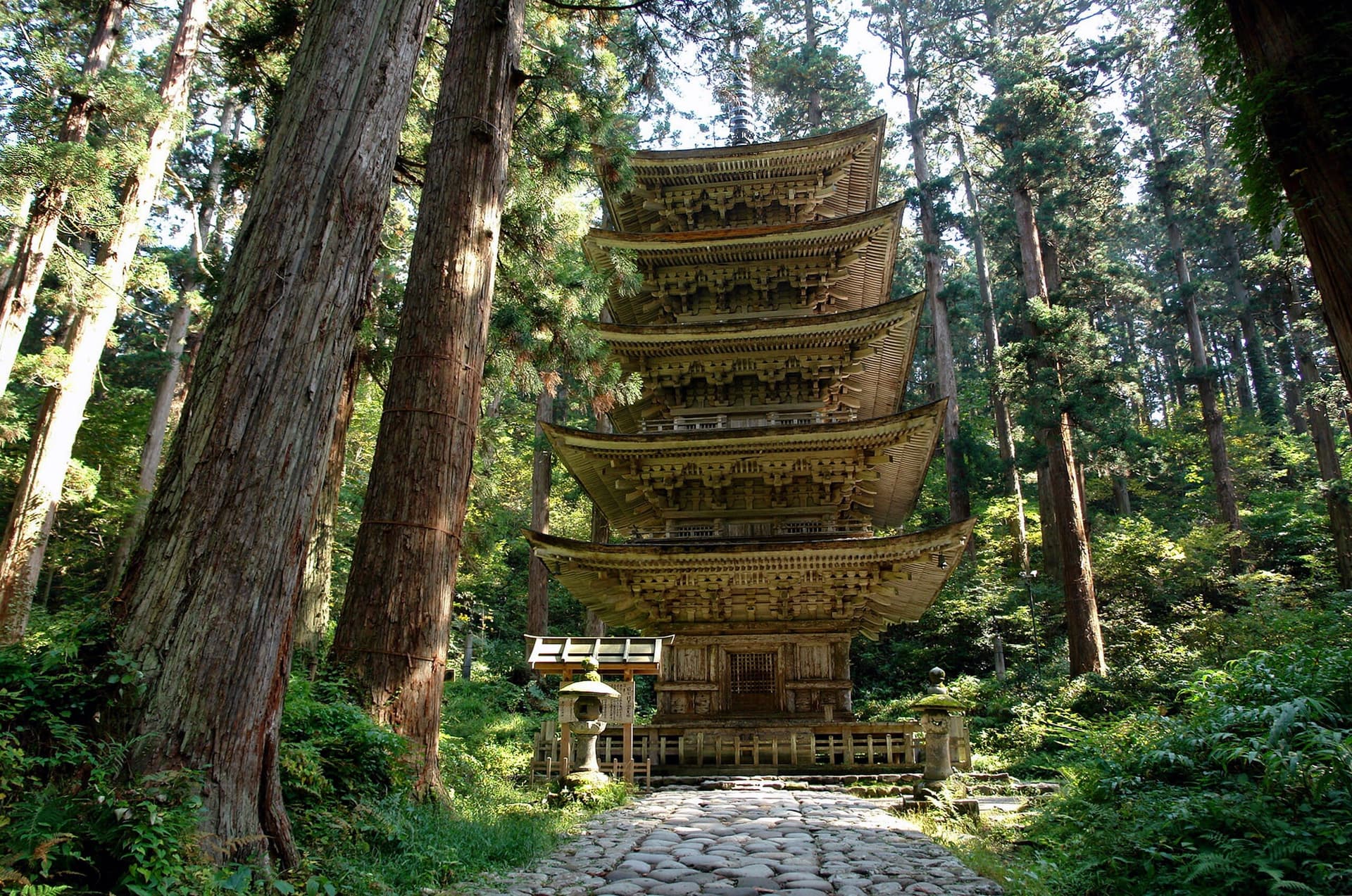
The three-mountain structure of the Dewa Sanzan pilgrimage creates this interior transformation through exterior journey. At Mount Haguro, pilgrims climb the 2,446 stone steps through ancient cedar forest to the summit shrine, enacting their entry into the sacred realm. At Mount Gassan, they traverse the highest and most austere of the three peaks, dwelling temporarily in the realm of the dead. The mountain's name literally means 'Moon Mountain,' associated with death and ancestors. Having symbolically died, pilgrims descend to Mount Yudono for rebirth.
The sacred rock itself, with its perpetually flowing hot water, suggests the womb of the earth. The rock's reddish color, the warmth, the wet: these sensory qualities create correspondence with birth. Walking barefoot across this surface, pilgrims contact the mountain's living body directly. The traditional prohibition on speaking of this experience protects its transformative potential; explanation would reduce mystery to concept.
The sokushinbutsu tradition adds another dimension to Yudono's thinness. These monks who achieved self-mummification crossed the boundary between life and death while remaining in the world as 'living Buddhas.' Their preserved bodies, displayed at nearby temples, demonstrate that the boundary between states can be transgressed permanently. Mount Yudono, where these practitioners trained, is thin not just between worlds but between conditions of existence.
Prince Hachiko is traditionally credited with opening the Three Mountains of Dewa in 593 CE after fleeing his father's assassination. According to legend, a three-legged crow guided him to these mountains. The religious purpose from the beginning was transformation through mountain austerity, synthesizing Buddhist, Taoist, and indigenous Japanese practices into the Shugendo tradition.
The Dewa Sanzan developed over centuries as one of Japan's most important Shugendo centers. Unlike many mountain religious sites that lost their syncretic character after the Meiji government's forced separation of Buddhism and Shinto in 1868, this area preserved its integrated practice. The 2016 designation as Japan Heritage under the title 'Journey of Rebirth' formally recognized what practitioners had always known: this pilgrimage is about transformation.
Traditions And Practice
Traditional Shugendo practices including pilgrimage, purification, encounter with the sacred rock, and waterfall meditation continue actively. The prohibition on speaking of the Yudono experience is itself a practice, protecting the mystery's power.
The full Dewa Sanzan pilgrimage follows a prescribed sequence: Haguro, then Gassan, then Yudono. At each mountain, specific practices apply. Haguro involves the climb of 2,446 stone steps through cedar forest. Gassan requires traversing high mountain terrain and may involve visiting the inner shrine. Yudono completes the journey with purification and barefoot encounter with the sacred rock.
Yamabushi practice includes extended mountain retreats, waterfall meditation, sutra recitation, and fasting. The most extreme historical practice was sokushinbutsu, in which monks prepared for death through years of restrictive diet, drinking urushi lacquer tea, and finally entering meditation in a stone tomb to await death, their bodies preserved through the practices they had undertaken.
The prohibition on speaking of the Yudono experience has been maintained for over a millennium. This practice of secrecy protects the experience from reduction to mere information while ensuring that each pilgrim encounters the mountain fresh.
All traditional practices continue at Mount Yudono. Yamabushi training remains active; the sight of practitioners in their distinctive garb or performing waterfall meditation connects visitors to centuries of tradition. The pilgrimage sequence remains the recommended approach, though individual visits to Yudono are permitted.
Multi-day yamabushi training programs are available for visitors seeking deeper engagement. These programs offer guided experience of mountain practices under the supervision of practitioners. Participants undertake austerities adapted to modern capabilities while connecting to the tradition's essence.
If drawn to serious engagement, consider undertaking the full Dewa Sanzan pilgrimage over multiple days, ideally staying in shukubo, temple lodgings, at Haguro. This allows the symbolic journey to unfold with appropriate pacing.
For those visiting Yudono alone, approach with awareness that you are entering a culminating experience whose preparatory stages you have not undertaken. This is not disqualifying but shapes the encounter differently. Honor the protocols fully. The purification and barefoot walk across the sacred rock are not tourist activities but genuine practice.
After, honor the prohibition on speaking. Process internally rather than through social media or conversation. Let the experience settle in its own time.
Shugendo
ActiveMount Yudono represents the culmination of the Dewa Sanzan pilgrimage and one of Japan's most important Shugendo sites. The three-mountain cosmology maps birth, death, and rebirth across the sacred landscape, with Yudono embodying the transformative moment of new life. Yamabushi have trained here since the 6th century, maintaining practices including waterfall meditation, mountain austerity, and the famous secrecy surrounding the sacred rock encounter.
Pilgrimage completing the three mountains in sequence. Harae purification before the sacred rock. Barefoot encounter with the hot-spring rock. Waterfall meditation in the Bonji River. Extended mountain retreats. Maintenance of strict secrecy about the sacred rock experience.
Shinto
ActiveYudonosan Shrine enshrines Oyamatsumi-no-kami, Okuninushi-no-kami, and Sukunahikona-no-kami. The shrine is distinctive in having no main hall, instead using the sacred rock as natural goshintai. This represents ancient Shinto practice before shrine architecture developed, where natural features served directly as divine presence.
Shrine worship directed toward the sacred rock. Pilgrimage as part of the Dewa Sanzan circuit. Seasonal opening and closing ceremonies. Purification rituals before sacred rock encounter.
Experience And Perspectives
Visitors approach through mountain forest by shuttle bus, then walk to the shrine area. Shoes are removed, purification is received, and the sacred rock is encountered directly. The experience is protected by strict prohibition on speaking of details.
The journey to Mount Yudono begins before the mountain itself. From Tsuruoka, the route leads into increasingly remote mountain territory. At Senninzawa, where the road ends, pilgrims board shuttle buses that wind further into the forest. This approach, requiring transfer and delay, strips away the ordinary world gradually.
The walk from the shuttle drop-off to the shrine area continues this process. Mountain air, forest sound, the awareness of leaving accessible territory behind: all prepare for what comes next. For those who have completed Haguro and Gassan, this final approach carries the weight of journeys already made, symbolic deaths already died.
At the shrine entrance, a profound transition occurs. All visitors must remove their shoes and receive harae, ritual purification. This is not optional; it is the condition of encounter. What follows cannot be described in detail due to the traditional prohibition, which this text honors. The sacred rock exists. Hot water flows. Pilgrims walk barefoot across it. What this means to each person is their own.
Visitors emerge from the experience into ordinary space again, but the tradition holds that they are not the ordinary people who entered. The prohibition on speaking ensures that each person processes the experience internally rather than through external narrative. One cannot compare notes, cannot check one's impression against others' reports. The experience remains purely personal.
Near the sacred rock, the Bonji River offers another dimension of practice. Yamabushi perform takigyo, waterfall meditation, in its waters. Visitors may witness this austerity practice, observing the tradition's continuing vitality.
If completing the full Dewa Sanzan pilgrimage, experience Haguro and Gassan before Yudono, allowing the symbolic birth-death-rebirth sequence to unfold. For those visiting Yudono alone, understand that you are entering the rebirth phase of a journey whose earlier stages you have not traveled. Either approach is valid, but the framing differs.
Prepare for the protocols. You will remove your shoes. You will receive purification. You will walk barefoot across warm, wet stone. Beyond this, no preparation is possible or appropriate. The prohibition on prior description is protection of the experience's freshness.
Mount Yudono can be understood as the culmination of a transformative pilgrimage, as a center of continuing Shugendo practice, as a site of extreme spiritual discipline including sokushinbutsu, or as a natural feature whose geothermal character and protected secrecy create unique encounter with the sacred.
Scholars recognize Dewa Sanzan as one of Japan's most important centers of mountain religion, preserving Shugendo practices that were suppressed elsewhere after the Meiji government's forced separation of Buddhism and Shinto. The synthesis of Buddhist, Taoist, and indigenous Japanese elements visible here represents remarkable religious creativity.
The sokushinbutsu phenomenon associated with this region has attracted significant scholarly attention. These self-mummified monks, several of whose preserved bodies remain viewable, represent an extreme form of religious discipline with few parallels. The relationship between their practice and Mount Yudono's sacred character continues to be studied.
The combination of natural sacred features, hot spring rock, mountain landscape, with sophisticated cosmological mapping, the birth-death-rebirth sequence across three mountains, demonstrates how landscape and meaning can reinforce each other in religious systems.
In Shugendo belief, mountains are themselves sacred realms where ordinary and divine reality interpenetrate. Mount Yudono's flowing hot spring rock is a direct manifestation of the mountain kami's power, earth's living warmth made tangible. The pilgrimage physically enacts spiritual transformation; one does not merely believe in rebirth but experiences it through the body.
The secrecy tradition protects the mystery's power. If the experience could be described, it could be anticipated, evaluated, compared. The prohibition ensures that each encounter remains immediate and personal. This is not obscurantism but preservation of transformative potential.
Mount Yudono is widely considered one of Japan's most powerful sacred sites among contemporary spiritual seekers. The combination of geothermal energy, ancient practice, and profound secrecy tradition creates what many experience as an exceptionally charged location. The sokushinbutsu tradition draws those interested in extreme spiritual discipline and the boundaries of human possibility.
The full details of what occurs at the sacred rock remain protected by the secrecy tradition. The specific practices that enabled sokushinbutsu are not fully documented; modern attempts at replication are neither possible nor desirable. Why this particular location developed such profound significance, what drew Prince Hachiko here, why the three-mountain structure emerged, these origins lie beyond historical recovery.
Visit Planning
Mount Yudono is accessible from Tsuruoka City via bus and shuttle during the open season (June 1 to early November). The shrine area cannot be reached by private car; the shuttle from Senninzawa is required.
From Tsuruoka City: Take the bus to Senninzawa (仙人沢). From Senninzawa, a shuttle bus runs to the shrine area. Private cars cannot access the shrine directly; use the parking at Senninzawa and take the shuttle.
The Dewa Sanzan are interconnected by hiking trails for those undertaking the full pilgrimage on foot. This route connects Yudono to Gassan, allowing completion of the traditional sequence by walking.
Public transport to Tsuruoka includes JR lines and highway buses. Tsuruoka is the primary base for Dewa Sanzan visits.
Shukubo (temple lodgings) at Mount Haguro offer traditional pilgrim accommodation, including vegetarian meals and opportunity to participate in morning services. This is the recommended option for those undertaking the full pilgrimage. Tsuruoka city offers conventional hotels and ryokan for those preferring more standard accommodation.
Strict protocols govern the sacred rock encounter: shoe removal, purification, no photography. The prohibition on speaking of the experience is traditional expectation. Overall reverence and seriousness appropriate to a major Shugendo site.
Mount Yudono requires more specific etiquette than most sacred sites because of its active Shugendo character and the nature of the sacred rock encounter.
Upon entering the shrine area, visitors must remove their shoes. This is mandatory, not optional. Staff will direct you to shoe storage. You will receive harae, ritual purification, before approaching the sacred rock. Follow the guidance of shrine staff throughout.
The prohibition on photography applies absolutely within the sacred rock area. Do not attempt to take photographs, even discretely. This prohibition protects the sacred character of the site and ensures that each visitor encounters it without prior visual preparation. Shrine staff enforce this actively.
The traditional prohibition on speaking of what one experiences at the sacred rock is expressed as 'kataru nakare, kiku nakare': speak not, hear not. This means one should neither describe one's experience nor seek to hear others' descriptions. This text honors this prohibition by declining to describe the experience in detail. Visitors are expected to honor it as well.
General shrine etiquette applies throughout the complex. Approach with clean hands and clear intentions. Maintain quiet and reverent atmosphere. The yamabushi practitioners you may encounter are engaged in serious religious practice; observe them respectfully without intrusion.
Practical mountain clothing is appropriate for the approach. At the sacred rock, shoes must be removed; you will walk barefoot. Serious pilgrims often wear shiroshozoku, white pilgrim garb, especially if completing the full Dewa Sanzan pilgrimage. This is not required but expresses commitment.
Photography is strictly prohibited at Yudonosan Shrine and the sacred rock area. This is actively enforced. Photography is permitted in other areas of the mountain complex and on the approach.
Shrine offerings are appropriate. Pilgrims receive items during the purification ritual. Standard monetary offerings at the shrine are customary.
Remove shoes at the sacred rock area. Receive harae purification. Do not photograph the sacred area. Do not speak in detail about what you experience at the sacred rock. Open only June 1 to early November.
Sacred Cluster
Nearby sacred places create the location cluster described in the growth plan. This block is intentionally crawlable and links into the wider regional graph.