Midhowe Chambered Cairn
The Great Ship of Death: Orkney's largest stalled cairn, where twenty-five ancestors were placed in stone compartments five thousand years ago
Rousay, Orkney Islands, United Kingdom
At A Glance
- Coordinates
- 59.1573, -3.0970
- Suggested Duration
- One to two hours to explore both the cairn and the adjacent Midhowe Broch.
- Access
- Rousay is reached by Orkney Ferries from Tingwall Terminal (approximately thirty-minute crossing). From the pier, the site is about five miles west on the B9064. A car or bicycle is recommended. The final approach involves walking across steep agricultural ground. The protective building shelters the cairn but the site is not wheelchair accessible.
Pilgrim Tips
- Rousay is reached by Orkney Ferries from Tingwall Terminal (approximately thirty-minute crossing). From the pier, the site is about five miles west on the B9064. A car or bicycle is recommended. The final approach involves walking across steep agricultural ground. The protective building shelters the cairn but the site is not wheelchair accessible.
- No specific requirements beyond practical outdoor clothing. Sturdy, waterproof walking boots are essential. Wind and waterproof outer layers advisable.
- Photography is permitted throughout. The elevated walkway provides excellent angles for documenting the cairn's internal structure.
- Remain on the elevated walkway. Do not enter the cairn structure or touch the stonework. The approach requires walking across steep agricultural ground in potentially challenging weather.
Overview
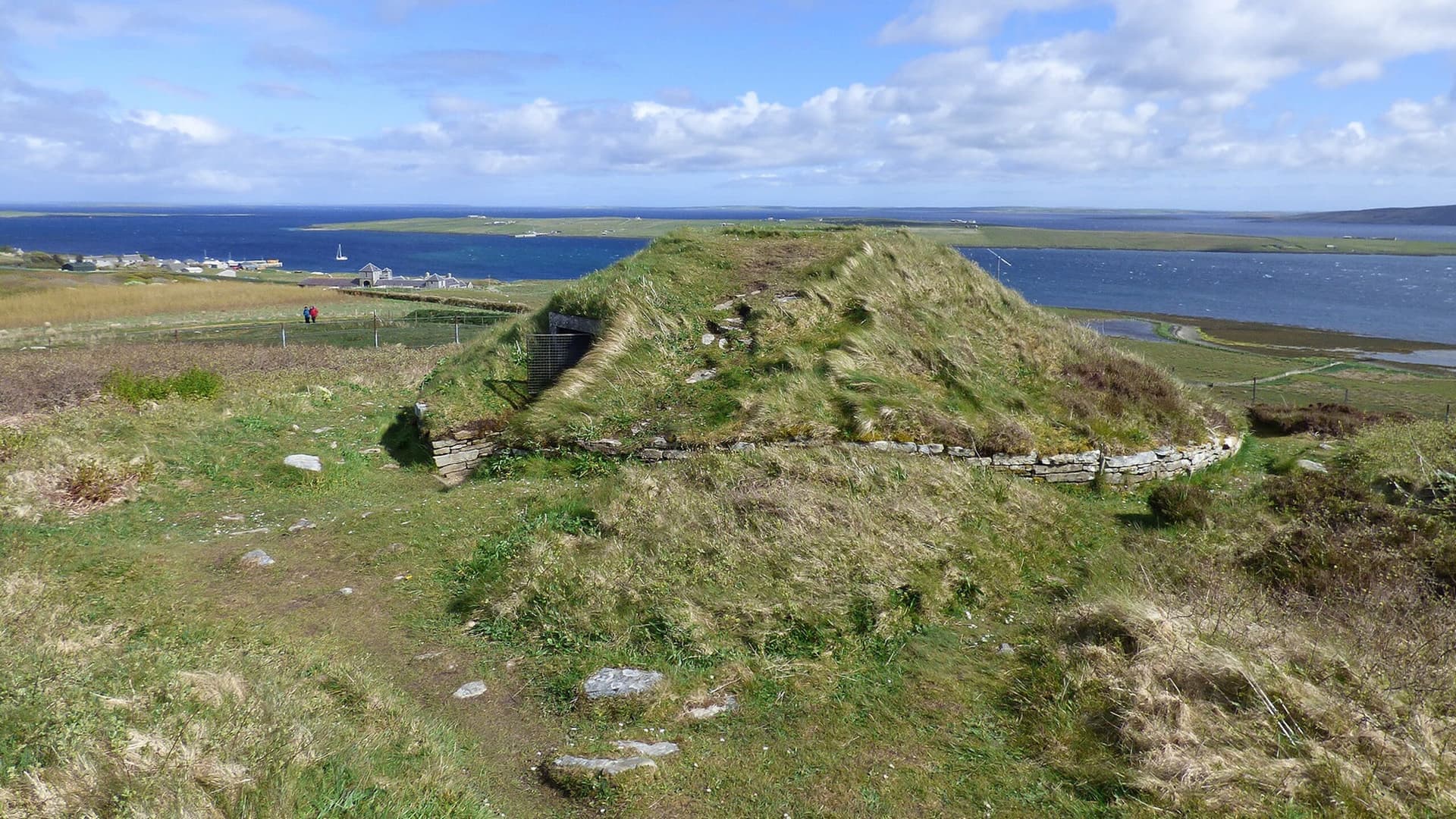
On the western shore of Rousay, sheltered beneath a modern protective roof, lies the largest stalled cairn in Orkney. Twenty-three metres long and divided into twelve stone compartments, Midhowe Chambered Cairn held the remains of at least twenty-five individuals when it was excavated in 1934. The cairn's elongated form, stretching like a vessel along the coast, earned it the name the Great Ship of Death. It is a Neolithic communal tomb of extraordinary scale, built approximately 3500 BCE by farming communities who invested generations of labour in housing their dead.
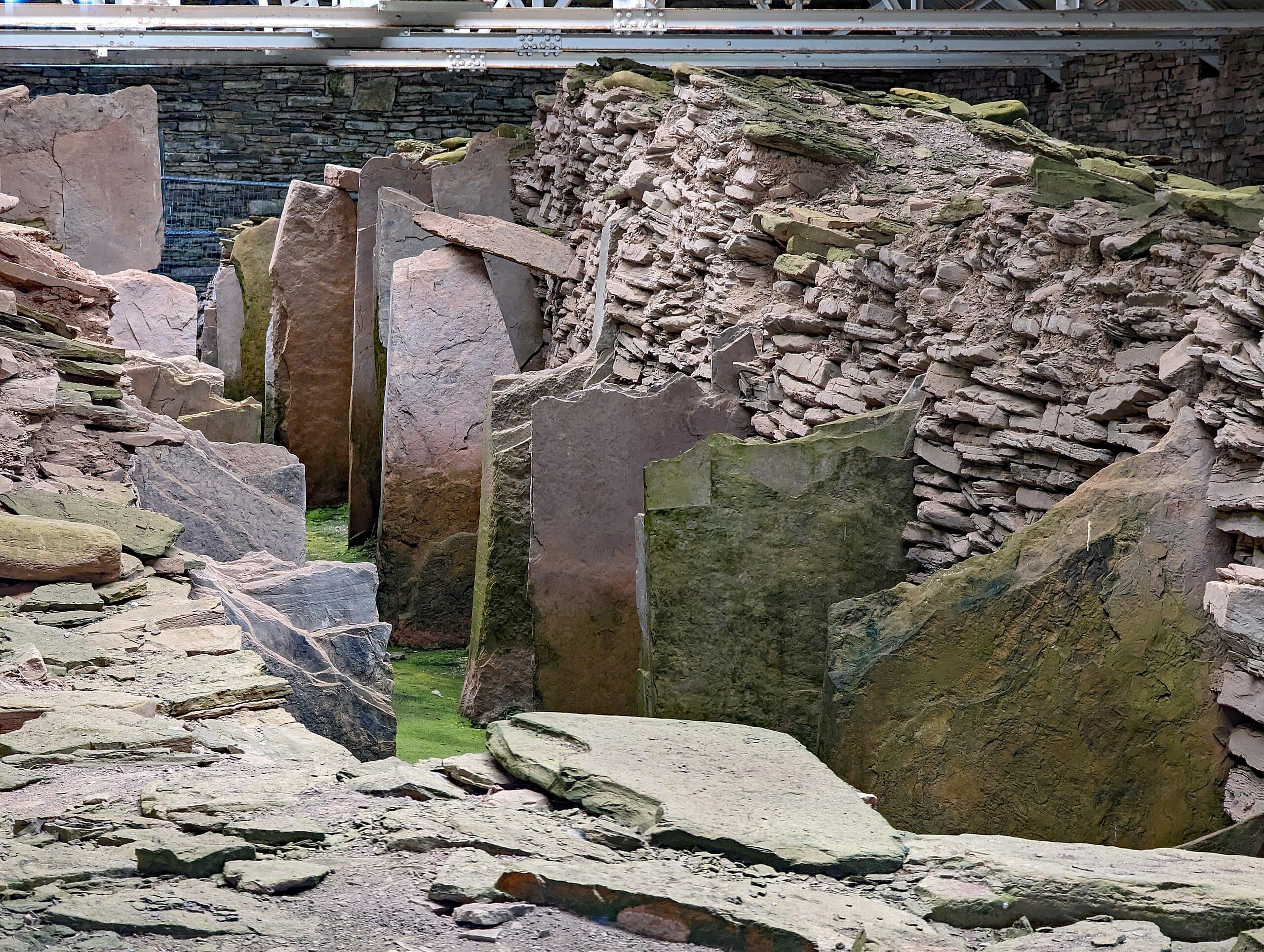
To enter the protective building that shields Midhowe Chambered Cairn is to step into a space designed for the dead five and a half millennia ago. The cairn stretches before you, its internal structure fully exposed by the 1934 excavation: twelve compartments divided by pairs of upright stone slabs, each compartment once holding the remains of the community's ancestors.
The scale is striking. At 23 metres long internally (over 32 metres including the outer structure), Midhowe dwarfs most other Orkney cairns. The stone slabs that divide the interior rise like the ribs of a ship, their regular spacing creating a rhythm of enclosed spaces. Within these compartments, the dead were placed in crouched positions on stone benches, their backs against the outer wall, their heads resting against the dividing slabs. As bodies decomposed, bones were gathered into neat piles to make room for subsequent burials. This was not a single act of interment but an ongoing relationship between the living and the dead, maintained over centuries.
The 1934 excavation by Walter Grant and J. Graham Callander recovered the remains of at least twenty-five individuals. Physical analysis revealed people of relatively short stature, with well-worn teeth consistent with a diet including stone-ground grain. Animal bones found alongside the human remains, particularly cattle, suggest funerary offerings or ritual feasting.
The cairn belongs to the Orkney-Cromarty tradition of stalled cairns, a regionally distinctive architectural form found across northern Scotland. Its positioning on the coast of Eynhallow Sound, within sight of Mainland Orkney, places it at the boundary between land and sea. Rousay's concentration of at least fifteen Neolithic chambered cairns on a single small island has earned it the name the Egypt of the North, and Midhowe stands as the island's most imposing funerary monument.
Context And Lineage
Midhowe Chambered Cairn represents the burial traditions of Neolithic farming communities on Rousay, dating to approximately 3500 BCE. These communities invested enormous labour in constructing monumental tombs for communal burial, reflecting a society in which the dead held central importance. The cairn belongs to the Orkney-Cromarty tradition of stalled cairns, an architectural form found throughout northern Scotland.
The Neolithic communities who built Midhowe left no written records. Their motivations must be inferred from what they constructed. The scale of the cairn, over thirty-two metres long, indicates that housing the dead was among the most important activities a community could undertake. The design, allowing repeated entry and the sequential placement of bodies, suggests the dead were not merely deposited and forgotten but remained part of the community's ongoing life. Rousay's extraordinary concentration of fifteen chambered cairns on a small island suggests it held special significance as a burial landscape, though why this particular island was chosen remains unknown.
No continuous tradition connects present-day communities to the Neolithic builders. Their language, beliefs, and social organisation are irrecoverable. The cairn passed through unknown centuries before antiquarian interest recovered it for modern understanding. The 1934 excavation marked its emergence as a comprehensible archaeological monument. The construction of the protective building ensured its long-term preservation. Today the site is managed as heritage, not as an active sacred space, though individual visitors may engage with it according to their own traditions.
Walter Grant
J. Graham Callander
Why This Place Is Sacred
Midhowe Chambered Cairn achieves its quality as a contemplative space through the combination of deep antiquity, monumental scale, and the intimate visibility of burial practices. The elevated walkway allows visitors to look directly into the compartments where bodies were placed, creating an encounter with Neolithic mortality that few sites in Britain can match. The coastal setting, the silence within the protective building, and the knowledge that this space was engineered specifically for the dead all contribute to a liminal atmosphere.
The concept of thin places finds particular expression at Midhowe in the directness of encounter. Unlike many ancient sites where burial practices must be imagined from interpretive panels, here the compartments are open and visible. The stone benches where bodies were placed, the dividing slabs that created individual chambers, the progression from entrance to innermost compartment, all remain legible. The visitor stands above, looking into spaces designed for the dead.
This visibility is possible because of the modern walkway that runs above the cairn, an intervention that transforms the experience. From this elevated perspective, the full length of the interior is comprehensible: twelve compartments stretching in sequence, each a discrete space within the larger whole. The effect is simultaneously archaeological and visceral. You understand the architecture and feel its purpose.
The protective building creates its own contribution to the atmosphere. Within its walls, the cairn exists in a controlled silence, separated from the wind and weather that characterise Orkney. Light enters but the space feels enclosed, meditative. The contrast between the massive ancient stonework and the functional modern shelter heightens awareness of time's passage.
The coastal setting amplifies the liminal quality. Eynhallow Sound stretches beyond the building's walls. The tidal island of Eynhallow, whose Norse name means Holy Island, lies visible across the water. Whether that name preserves a memory of sanctity older than the Norse period cannot be determined, but the coincidence is suggestive.
Visitor accounts consistently describe the experience as moving. The combination of scale, age, and the tangible evidence of how Neolithic communities treated their dead creates a space where ordinary time seems to thin. This is a place built for relationship with ancestors, and even five millennia later, that intention remains palpable.
Archaeological consensus identifies Midhowe as a communal burial monument for Neolithic farming communities. The design of the stalled interior, with its stone benches and dividing slabs, was engineered for the sequential deposition of the dead. Bodies were placed in crouched positions and allowed to decompose; bones were then rearranged and consolidated to make room for new burials. This practice suggests the tomb functioned not merely as a repository but as a ritual space where the living maintained ongoing relationship with the dead.
The cairn was constructed around 3500 BCE and used over an extended period. Initial construction created the stalled interior with its twelve compartments. The cairn's exterior was progressively elaborated, though the precise sequence is debated. The site fell out of active use before the Bronze Age. It remained largely undisturbed until Walter Grant's 1934 excavation exposed the interior. The protective building was subsequently constructed to preserve the exposed stonework. The site came under the care of what is now Historic Environment Scotland.
Traditions And Practice
No formal ceremonies are conducted at Midhowe Chambered Cairn today. The site functions as a heritage monument. The intimate scale of the compartments and the evidence of careful burial practices invite personal reflection on mortality and the human relationship with the dead.
Neolithic burial practices at Midhowe involved placing the dead in crouched positions on stone benches within the compartments, with their backs against the outer wall and heads resting against dividing slabs. Over time, decomposed remains were gathered into neat bone piles to accommodate new burials. Animal bones, particularly cattle, were placed with the human remains, suggesting funerary offerings or ritual feasting. The progressive elaboration of compartments from entrance to rear suggests either chronological sequence or hierarchical organisation.
No established spiritual communities maintain practice at Midhowe Chambered Cairn. Visitors engage with the site as an archaeological monument. Some visitors with interests in ancestral connection or earth-based spirituality may practice personal contemplation.
The elevated walkway invites a slow, careful traversal of the cairn's full length. Pause at each compartment and consider the individuals who were placed there. The physical evidence of how Neolithic communities treated their dead, with care, over centuries, returning to tend and rearrange, speaks across the millennia without need for translation.
Neolithic Orkney-Cromarty Burial Tradition
HistoricalMidhowe represents the pinnacle of the stalled cairn tradition in Orkney, a communal burial practice in which the dead were placed in stone compartments within elongated cairns. The tradition reflects a society that invested enormous labour in honouring the dead, maintaining physical spaces where the boundary between living and dead could be crossed over centuries of use.
The dead were placed in crouched positions on stone benches within compartments. Over time, decomposed remains were gathered into bone piles to accommodate new burials. Animal bones were deposited alongside human remains. The tomb was designed for repeated access, allowing ongoing interaction between the living community and its ancestors.
Experience And Perspectives
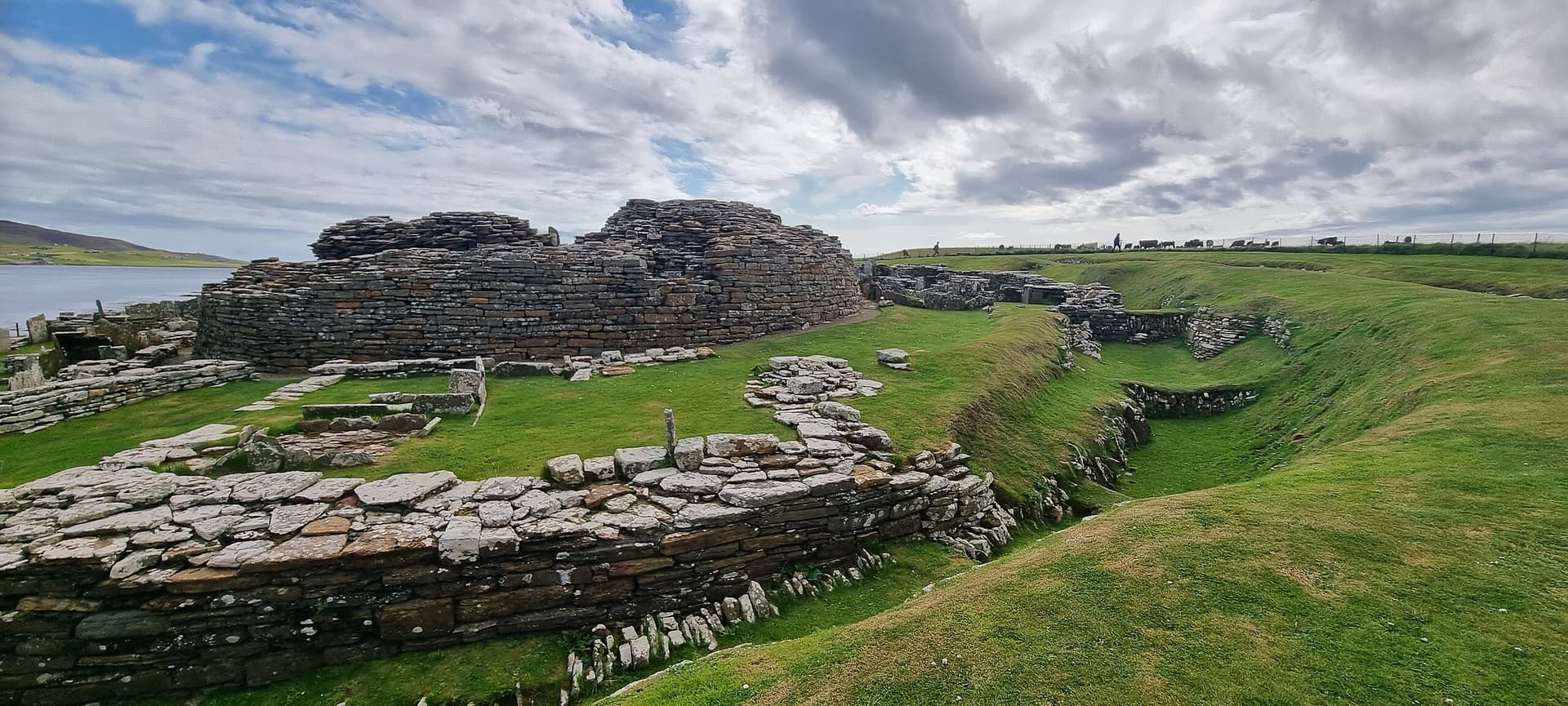
Visitors reach Midhowe Chambered Cairn via a walk along the western coast of Rousay. The protective building appears before the cairn itself is visible. Inside, an elevated walkway runs the length of the monument, allowing visitors to look down into each of the twelve compartments. The stone benches, dividing slabs, and overall layout are remarkably intact. The adjacent Midhowe Broch, just a hundred metres away, offers an Iron Age counterpoint to this Neolithic burial place.
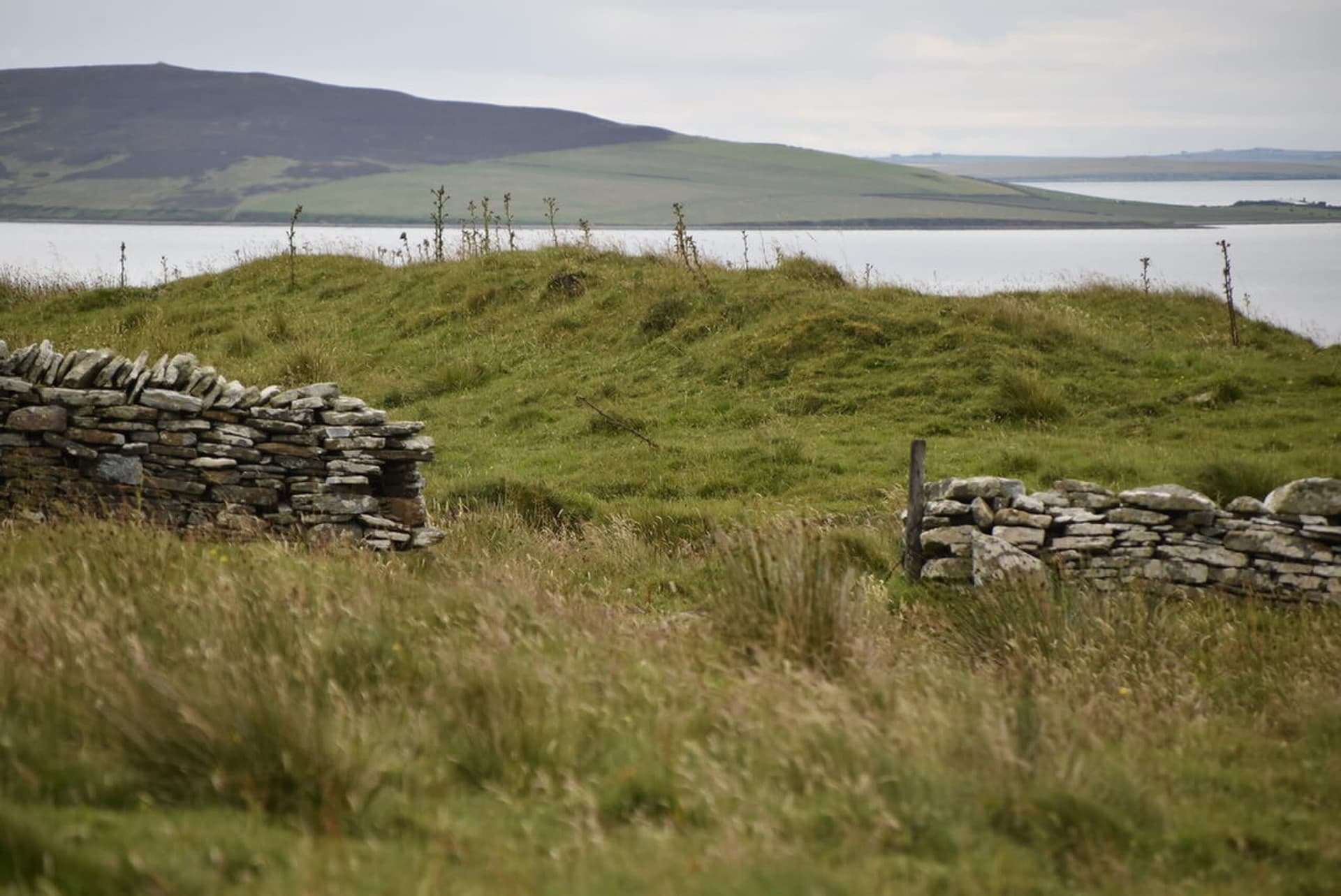
The approach follows the same coastal path that leads to Midhowe Broch, crossing agricultural land above Eynhallow Sound. The protective building appears in the landscape as a functional modern structure, its purpose evident only upon entry.
Inside, the cairn reveals its full extent. The walkway runs above the monument, and from this vantage point the internal architecture is comprehensible in a way that ground-level viewing could not achieve. Twelve compartments extend in sequence, divided by pairs of upright stone slabs. The regularity is architectural, deliberate, and speaks to careful planning.
The stone benches within the compartments are clearly visible. Here, bodies were placed in crouched positions over centuries of use. The progressive refinement of the compartments from entrance to rear end is a characteristic feature of stalled cairns, possibly reflecting a hierarchy in burial placement or a chronological sequence.
Light within the building is even but subdued. The silence is notable, insulated from the Orkney wind. This combination of controlled light and quiet creates conditions well-suited to contemplation. You are inside a space built for the dead, viewing it from a perspective the builders never intended but that serves understanding.
The exit leads back into the Orkney weather, and a short walk southeast brings you to Midhowe Broch, where Iron Age life replaced Neolithic death on the same stretch of coast. The juxtaposition is powerful: a burial place and a living settlement, separated by three thousand years but sharing the same relationship with Eynhallow Sound.
Most visitors arrive on Rousay by ferry from Tingwall on Mainland Orkney. From the pier, the site is approximately five miles west along the B9064. A car or bicycle is strongly recommended. The cairn and broch can be visited together in one to two hours. The broader Westside Walk connects several archaeological sites along this coast.
Midhowe Chambered Cairn speaks with particular clarity about Neolithic attitudes toward death and community. The evidence, twenty-five individuals placed with care in stone compartments over centuries, invites interpretation while resisting definitive answers. We can see what the builders did. Why they did it, in its full complexity, remains genuinely unknown.
Archaeologists classify Midhowe as the largest and one of the finest examples of the Orkney-Cromarty type stalled cairn. Construction is dated to approximately 3500 BCE. The 1934 excavation by Grant and Callander revealed twenty-five individuals across twelve compartments. Physical anthropological analysis showed the Neolithic occupants were relatively short (men approximately 5 feet 5 inches, women approximately 5 feet) and dolichocephalic. Their teeth were in good condition but heavily worn, consistent with a diet including stone-ground grain. Both crouched inhumation and bone consolidation were practiced, indicating complex and sustained mortuary rituals. Animal bones, particularly cattle, accompanied the human remains. The cairn's position within Rousay's extraordinary concentration of fifteen Neolithic cairns suggests the island held special significance as a burial landscape.
No indigenous oral tradition survives from the Neolithic builders. The specific beliefs and worldview of those who constructed and used Midhowe are lost to history. Comparative archaeology suggests ancestor veneration was central to Neolithic society in Britain. The dead were likely understood as present in a different mode, accessible through the tombs built to house them. But these are inferences from material evidence, not transmitted knowledge.
The cairn's elongated form and its coastal setting have attracted symbolic interpretations. The name Great Ship of Death, while modern, captures an association between the cairn's shape and maritime imagery that some visitors find resonant. Writers interested in death-and-rebirth symbolism across ancient cultures have noted parallels with other traditions where boats carry the dead to the otherworld. The concentration of tombs on Rousay has attracted interest from those who perceive the island as a sacred landscape.
The social organisation of the community that built and used Midhowe remains unclear. Whether the twenty-five individuals represent a single family, a social elite, or a broader community sample cannot be determined. The criteria for inclusion in the cairn, while others presumably were not interred here, are unknown. Why Rousay, a relatively small island, holds such an extraordinary concentration of chambered cairns compared to other Orkney islands remains an open question. The original external appearance of the cairn is uncertain due to erosion and the passage of time.
Visit Planning
Midhowe Chambered Cairn is freely accessible year-round on Rousay, reached by ferry from Mainland Orkney. The site lies about five miles west of the pier. It is best combined with the adjacent Midhowe Broch.
Rousay is reached by Orkney Ferries from Tingwall Terminal (approximately thirty-minute crossing). From the pier, the site is about five miles west on the B9064. A car or bicycle is recommended. The final approach involves walking across steep agricultural ground. The protective building shelters the cairn but the site is not wheelchair accessible.
Limited accommodation on Rousay including the Taversoe Hotel and local bed and breakfasts. More options in Kirkwall on Mainland Orkney.
Midhowe Chambered Cairn is a publicly accessible heritage site under the care of Historic Environment Scotland. Visitors should remain on designated walkways and treat the monument with awareness that it was a burial place where human remains were interred.
The site welcomes visitors during daylight hours throughout the year, though the protective building may have seasonal access arrangements. No admission fee is charged.
As a place where at least twenty-five individuals were once buried, the cairn deserves respect for the dead even though remains were removed during the 1934 excavation. The elevated walkway provides excellent views without the need to enter the cairn itself.
The approach involves walking across agricultural land. Sturdy footwear is essential. Weather can change rapidly on Rousay's exposed western coast.
No specific requirements beyond practical outdoor clothing. Sturdy, waterproof walking boots are essential. Wind and waterproof outer layers advisable.
Photography is permitted throughout. The elevated walkway provides excellent angles for documenting the cairn's internal structure.
As a heritage monument, leaving offerings is not appropriate.
Remain on the walkway. Do not enter the cairn structure, climb on stonework, or remove any material. Dogs should be kept under control on the approach.
Sacred Cluster
Nearby sacred places create the location cluster described in the growth plan. This block is intentionally crawlable and links into the wider regional graph.