Medinet Habu (Mortuary Temple of Ramesses III), Luxor
Where the Bronze Age ended and ancient Egypt's best-preserved colors still glow on temple walls
Al Baairat Village, Luxor, Egypt
At A Glance
- Coordinates
- 25.7187, 32.6005
- Suggested Duration
- Allow minimum 2 hours for a thorough visit. This provides time for the mortuary temple, the small temple of Amun, and detailed examination of the Sea Peoples reliefs. Combined West Bank tours typically allocate 1-2 hours, which is sufficient but not leisurely.
- Access
- Located on the West Bank of the Nile, approximately 5 kilometers south of central Luxor at the southern end of the Theban necropolis. Accessible by taxi, organized tour, or bicycle from the West Bank ferry landing. Entry fee approximately $5 USD, payable by credit card. The site is less accessible for wheelchairs due to uneven ancient flooring and thresholds. Opening hours typically 6:00 AM to 5:00 PM; confirm before visiting.
Pilgrim Tips
- Located on the West Bank of the Nile, approximately 5 kilometers south of central Luxor at the southern end of the Theban necropolis. Accessible by taxi, organized tour, or bicycle from the West Bank ferry landing. Entry fee approximately $5 USD, payable by credit card. The site is less accessible for wheelchairs due to uneven ancient flooring and thresholds. Opening hours typically 6:00 AM to 5:00 PM; confirm before visiting.
- Light, practical clothing suitable for sun protection. No specific religious dress requirements apply at this archaeological site, though modest dress is appropriate throughout Egypt. Comfortable walking shoes for uneven surfaces.
- Photography is generally permitted throughout the temple complex. Tripods may require special permission. Be mindful of flash photography near painted surfaces, as light can contribute to deterioration.
- The site offers limited shade. Sun protection is essential. The temple is relatively large, requiring walking across uneven stone floors and through chambers with varying light levels. Some doorways and passages are low. The reliefs, though relatively well-preserved, are fragile; do not touch them. Site guards are present but the site receives fewer visitors than major monuments, creating opportunities for intimate encounter but also meaning less infrastructure.
Overview
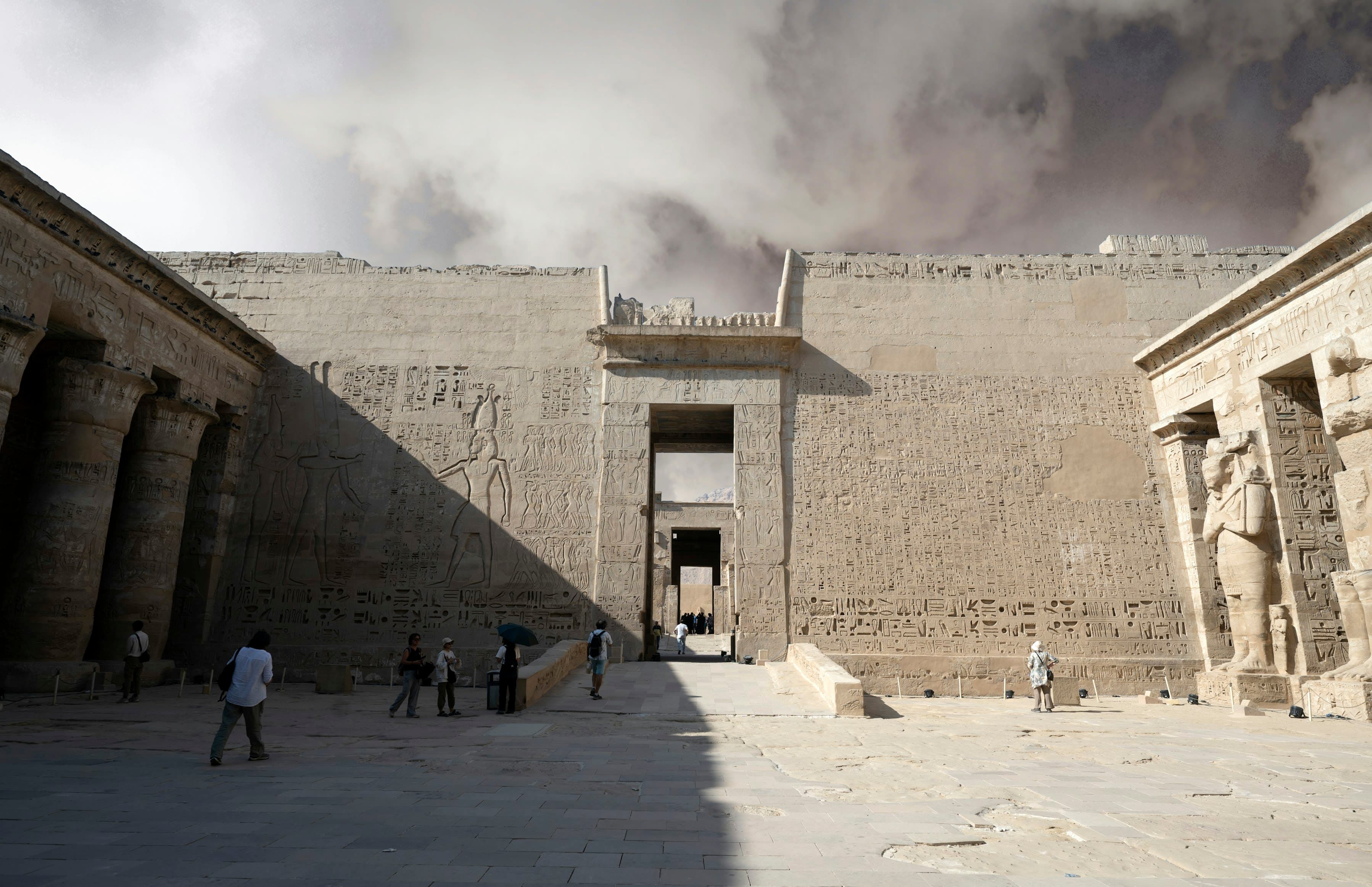
Medinet Habu holds what other Egyptian monuments have lost. The mortuary temple of Ramesses III preserves over 7,000 square meters of wall reliefs still bearing their original painted decoration. Here you can see colors that faded to dust elsewhere millennia ago. And carved into these walls is the only detailed record of the Sea Peoples invasion that collapsed the Bronze Age Mediterranean.
Most visitors to Egypt's West Bank pass by Medinet Habu on their way to more famous destinations. This is their loss. The mortuary temple of Ramesses III is the best-preserved temple in Egypt, retaining painted decoration that time has stripped from Karnak and Luxor. The blue of lapis, the red of ochre, the gold that highlighted the reliefs still glow in chambers that were painted over three thousand years ago.
But Medinet Habu offers something beyond aesthetic preservation. Carved into the temple's exterior walls is the primary historical source for the Bronze Age Collapse, the mysterious catastrophe that destroyed civilizations across the eastern Mediterranean around 1200 BCE. The Sea Peoples reliefs name the invading groups and depict their defeat in graphic detail. Without these walls, we would know far less about one of history's greatest transformations.
The location was sacred long before Ramesses III chose it. An 18th Dynasty temple honoring Amun marks the spot where the primordial creator god was believed to have first appeared. The Egyptians called this place the birthplace and burial place of the ancestral deities. Ramesses III positioned his mortuary temple at the edge of eternity.
Context And Lineage
Ramesses III was the last great pharaoh of the New Kingdom, successfully defending Egypt against the Sea Peoples invasion that collapsed the Bronze Age Mediterranean. His mortuary temple documents this defense and preserves his cult for eternity at a site sacred since the earliest dynasties.
The location's sacredness preceded Ramesses III by over a thousand years. According to Egyptian cosmology, this was the mound where Amun first appeared at creation. The eight primordial deities, the Ogdoad, were born here and buried here, their tombs receiving offerings during an annual festival. A temple to Amun had stood at this site since at least the Middle Kingdom. When Ramesses III sought a location for his mortuary temple, he chose ground already charged with cosmological significance. He would be buried at the site of creation itself, his eternal existence sustained where existence began.
The small temple of Amun was dedicated to Amun-Ra Djeser-Set, 'one whose place is sacred.' During the Festival of the Decade in the Theban calendar, the cult statue of Amun was brought from Luxor to this temple, where the god paid respects to his ancestor Kematef and renewed himself through contact with his primordial origins. This ritual network connected Karnak, Luxor Temple, and Medinet Habu across the Nile.
The mortuary temple of Ramesses III follows the architectural model established by his predecessor Ramesses II at the Ramesseum, which in turn drew on the Temple of Hatshepsut at Deir el-Bahri. The royal palace attached to the temple reflects practices seen in earlier New Kingdom mortuary complexes. The small temple of Amun participates in a different lineage, connecting to the great Amun temples at Karnak and Luxor through festival processions and theological concepts. The site's cosmological significance as Amun's birthplace linked it to Heliopolis and the broader solar theology that shaped Egyptian religious thought.
Ramesses III
Hatshepsut and Thutmose III
Sneferu
Why This Place Is Sacred
The site's thinness operates on multiple levels: cosmological significance as Amun's primordial birthplace, exceptional preservation creating visceral connection to the ancient past, and its role as witness to civilization's fragility through the Sea Peoples records.
Before Ramesses III laid his temple's foundations, this ground was already sacred. The ancient Egyptians called the site Djamet and understood it as the primordial mound where Amun first appeared at creation. Here the eight ancestral deities, the Ogdoad, were both born and buried. A temple to Amun had stood here since the Middle Kingdom, serving as the destination for an annual festival when the god's cult statue was brought from Luxor to visit his primordial birthplace and renew himself.
Ramesses III positioned his mortuary temple at this cosmologically charged location deliberately. His temple would stand where creation began, at the threshold between the world of the living and the realm of the dead. The western orientation aligned with the setting sun and the entrance to the netherworld. From here, Ramesses III would pass into eternity with the blessing of Amun at the very site of creation's origin.
The temple's preservation adds another dimension to its thinness. While other Egyptian temples show traces of their original decoration, Medinet Habu still displays the colors that ancient artisans applied. Walking through the hypostyle halls, you see blue ceilings studded with yellow stars, red and ochre borders framing relief scenes, gold highlighting the gestures of gods and kings. This is not reconstruction or imagination but survival. You stand where ancient Egyptians stood, seeing what they saw.
The Sea Peoples reliefs transform the temple into a time capsule of catastrophe. Carved into the exterior walls are scenes of naval and land battles against the mysterious confederation that swept through the eastern Mediterranean around 1200 BCE. The Hittite Empire fell. Mycenaean Greece collapsed. Cities from Ugarit to Ashkelon were destroyed. Only Egypt survived, and only Ramesses III's temple tells the story in detail. The five groups named in the inscriptions remain subjects of scholarly debate, but their impact is beyond question. Standing before these walls, you confront the fragility of civilizations that seemed permanent.
The temple served as Ramesses III's mortuary complex, where his cult would be maintained after death through daily rituals, offerings, and festivals. Priests performed ceremonies to sustain his ka, ensuring his continued existence in the afterlife. The royal palace attached to the south wall allowed the living pharaoh to participate in ceremonies and appear at the Window of Appearances to reward loyal followers. The complex also functioned as an administrative center for the Theban necropolis and a place of refuge during times of unrest. Workers from the nearby village of Deir el-Medina came here during the Libyan invasions and, famously, staged history's first recorded labor strike here in 1158 BCE when their rations failed to arrive.
The site's sacred history spans nearly three thousand years. The earliest foundations of the small temple of Amun date to the 11th Dynasty, around 2100 BCE. Hatshepsut and Thutmose III rebuilt this temple during the 18th Dynasty. Ramesses III constructed his mortuary temple between 1186 and 1155 BCE. The Ptolemaic and Roman periods saw additions to the Amun temple, including forecourts and pylons. By late antiquity, a thriving Coptic Christian town called Djeme occupied the fortified precinct, with an estimated population nearing 19,000. Churches were constructed within the temple, including a substantial five-aisled basilica in the second court. This community flourished until approximately 800 CE, when residents relocated due to security concerns. Modern archaeological work began in the 19th century, though early excavations unfortunately destroyed the Byzantine church without documentation. The University of Chicago Oriental Institute has conducted systematic surveys since 1924.
Traditions And Practice
The rituals that once animated this temple, sustaining Ramesses III's ka and celebrating the primordial Ogdoad, ceased long ago. The Coptic Christian community that later worshipped here has also departed. What remains is contemplative encounter with exceptional preservation and the historical record of civilizational collapse.
The mortuary temple hosted daily rituals to sustain Ramesses III's ka. Priests performed offerings and ceremonies in the sanctuary dedicated to the Theban triad of Amun, Mut, and Khonsu. The pharaoh's continued existence in the afterlife depended on these regular observances. The Window of Appearances served ceremonial functions where the living Ramesses III appeared to reward loyal commanders with gold collars, a ritual depicted in the palace reliefs.
The small temple of Amun hosted the Festival of the Decade, when the cult statue of Amun traveled from Luxor to visit his primordial birthplace. This ritual connected the contemporary god with his origins at creation, renewing his power through contact with the ancestral mound. The temple also served the cult of the primordial Ogdoad, the eight deities who preceded and produced Amun.
The temple protected the Theban population during times of unrest. Workers from Deir el-Medina sought refuge here during the Libyan invasions. It was here, in 1158 BCE, that these same workers staged history's first documented labor strike when their rations failed to arrive, recording their grievances on ostraca that survive today.
No active religious practices occur at Medinet Habu. The University of Chicago Epigraphic Survey continues scholarly documentation that has been ongoing since 1924, but this is academic rather than devotional work. The site functions as an archaeological monument and tourist destination.
Visit in late afternoon. The golden light that reaches the western walls in the hours before closing illuminates the reliefs in ways that reveal colors invisible at midday. This timing also means smaller crowds and cooler temperatures.
Spend time with the Sea Peoples reliefs on the exterior north wall. You are looking at the only detailed record of the Bronze Age Collapse, the catastrophe that destroyed civilizations from Greece to Anatolia to the Levant. These inscriptions are primary historical sources. The feathered headdresses, the overturned ships, the processions of captives tell a story that changed the ancient world.
Explore the small temple of Amun, which most visitors overlook. This older structure marks the cosmological heart of the site, the mound where the primordial deities were born and buried. The Ptolemaic and Roman additions create an architectural conversation across centuries.
Ancient Egyptian Religion
HistoricalMedinet Habu served as the mortuary temple of Ramesses III, designed to perpetuate his worship after death and ensure his eternal existence. The temple was dedicated to Amun-Ra and the deified Ramesses III. The location held additional cosmological importance as the primordial mound where Amun first appeared, the birthplace and burial place of the Ogdoad. This made the location sacred long before Ramesses III chose it.
Daily rituals sustaining Ramesses III's ka. Offerings and festivals honoring Amun-Ra. Annual Festival of the Decade when the cult statue of Amun was brought from Luxor to the Small Temple. Worship of the Primeval Ogdoad. Rituals at the Window of Appearances where the pharaoh rewarded loyal commanders.
Coptic Christianity
HistoricalDuring the Late Antique and Byzantine periods, a thriving Coptic Christian town called Djeme developed within the fortified walls of Medinet Habu, with an estimated population nearing 19,000. The temple complex was adapted for Christian worship, with several churches built within the precinct. The most significant was a five-aisled basilica constructed in the second court, its north-south orientation cutting across the temple's original axis.
Regular Christian worship services at the Holy Church of Djeme and other churches within the complex. The Osiris pillars and pharaonic reliefs were plastered over with mud to create appropriate Christian sacred space. Baptisms performed at the font.
Experience And Perspectives
The approach through the massive migdol gateway announces entry into a protected realm. Beyond lies a mortuary temple that rewards slow exploration, with detailed reliefs still bearing original colors, the primary record of the Bronze Age Collapse, and an atmosphere markedly quieter than Luxor's more famous monuments.
The first impression is of walls. The migdol gateway, modeled on Syrian fortress architecture, rises like a defensive keep, its ten-meter thickness and once twenty-meter height demonstrating that this was a protected precinct. Passing through creates the physical sensation of leaving the ordinary world behind. Whatever happened within these walls was meant to be separated from what lay outside.
The first courtyard opens onto a colonnade where Osiris pillars once bore Ramesses III's image. Some of these remain; others are fragments. The Window of Appearances in the south wall, though sealed, marks the location where the pharaoh once stood to reward loyal commanders with gold collars, a ceremony depicted in the palace reliefs beyond.
The second courtyard holds what remains of the Coptic church that once stood here. The transformation from pharaonic temple to Christian basilica is visible in the architecture. Mud plaster once covered the pagan reliefs; now both layers are exposed, centuries overlapping in a single space.
The interior chambers reward patient attention. The hypostyle halls retain blue ceilings with yellow stars, a vision of the night sky as it would remain for eternity. Painted borders frame the reliefs in colors that have endured three millennia. In late afternoon, when the golden light reaches the western walls, the decoration glows with an intensity that photography cannot capture.
The exterior walls hold the temple's most historically significant reliefs. The Sea Peoples scenes on the north wall depict in extraordinary detail the naval and land battles that saved Egypt from the confederation that destroyed every other Bronze Age power. The Peleset, Tjeker, Shekelesh, Danuna, and Weshesh advance in their feathered headdresses, their ships overturned by Egyptian forces, their defeat recorded for eternity. These are the only detailed accounts of the catastrophe that ended the Bronze Age.
The small temple of Amun, earlier in date and more intimate in scale, sits northeast of the mortuary temple. This structure marks the cosmological heart of the site, the primordial mound where Amun first appeared. Ptolemaic and Roman additions frame the 18th Dynasty core, creating an architectural palimpsest that reflects the site's continuous sacred significance.
Medinet Habu occupies the southern end of the Theban necropolis on Luxor's West Bank, approximately 5 kilometers from central Luxor. The mortuary temple of Ramesses III faces east, as all Egyptian mortuary temples did, toward the Nile and the rising sun. The complex includes the massive migdol gateway, two great courtyards, a hypostyle hall, and inner sanctuary chambers. A royal palace once attached to the south wall. To the northeast stands the smaller 18th Dynasty temple of Amun, with Ptolemaic and Roman additions. The enclosure wall, once 35 feet thick and 60 feet high, defined the sacred precinct that later became the Coptic town of Djeme. Modern facilities include a visitor center and parking area outside the enclosure.
Medinet Habu invites engagement as architectural achievement, as historical document, as cosmological marker, and as testimony to preservation's possibilities. Each angle reveals something the others miss.
Egyptologists recognize Medinet Habu as the best-preserved mortuary temple in Egypt and a crucial historical source. The University of Chicago Oriental Institute Epigraphic Survey has documented the temple systematically since 1924, producing definitive publications on its reliefs and inscriptions. The Sea Peoples reliefs constitute the primary source for the Bronze Age Collapse, naming groups whose origins scholars still debate: Peleset, Tjeker, Shekelesh, Danuna, Weshesh. These inscriptions provide evidence for understanding the catastrophic transformations around 1200 BCE that ended the Hittite Empire, collapsed Mycenaean Greece, and destroyed coastal cities from Ugarit to Ashkelon.
The temple's exceptional color preservation offers insight into how Egyptian monuments originally appeared. Where Karnak shows bare stone, Medinet Habu displays the blues, reds, and golds that once covered all major temples. This survival is partly accidental, due to the temple's location at the quieter end of the necropolis, but also reflects the temple's use as Coptic town, which protected its interior while burying but preserving its exterior decoration.
The small temple of Amun provides crucial evidence for Egyptian cosmology and ritual geography. Lucia Gahlin's research on the temple as birthplace and burial place of the primordial deities illuminates the location's selection by Ramesses III and its role in the broader Theban festival calendar.
In ancient Egyptian understanding, Medinet Habu was not merely commemorative but functionally necessary for Ramesses III's eternal existence. The daily rituals performed by priests sustained his ka in the afterlife. Without these observances, the pharaoh would cease to exist. The location's identification as Amun's primordial birthplace gave it cosmic significance. The temple connected contemporary Egypt to the moment of creation itself.
The massive fortifications were both practical defense and symbolic demonstration of royal power protecting cosmic order. When workers from Deir el-Medina sought refuge here during the Libyan invasions, they were literally entering a fortified sanctuary where order held against chaos. The Window of Appearances, where Ramesses III rewarded loyal commanders, enacted the pharaoh's role as source of justice and abundance.
Some contemporary spiritual practitioners view Medinet Habu as a significant energy site on the West Bank of Luxor. The site's function in mortuary cult practices connects to broader interest in ancient Egyptian concepts of the afterlife and ka energy. The temple's exceptional preservation is sometimes interpreted as evidence of special spiritual protection.
The Sea Peoples reliefs attract those interested in lost civilizations and catastrophic transitions. The Bronze Age Collapse represents a pivot point in human history, when complex societies that seemed permanent collapsed within decades. Some interpreters see parallels to contemporary civilizational fragility. Others focus on the mystery of the Sea Peoples themselves, whose origins remain debated despite the detailed records Ramesses III left behind.
Several mysteries persist around Medinet Habu. The exact identity and origins of the Sea Peoples remain debated. The Peleset are often identified with the biblical Philistines, but the homelands of the Tjeker, Shekelesh, Danuna, and Weshesh are uncertain. Whether the battle scenes represent actual historical events or ritualized commemorations of Egyptian power is debated.
The circumstances of Ramesses III's assassination are documented in the Judicial Papyrus of Turin but the details remain unclear. His mummy shows his throat was cut, confirming violent death, but the motivations and full extent of the harem conspiracy are imperfectly understood.
Much of the Coptic town of Djeme was destroyed without documentation during 19th-century clearing. The Byzantine church in the second court was demolished with minimal recording. What was lost in that destruction, and what the community's religious life looked like within the adapted pharaonic structures, we can only partially reconstruct.
Visit Planning
Located on Luxor's West Bank, Medinet Habu receives fewer visitors than the Valley of the Kings or Karnak, offering intimate encounter with one of Egypt's best-preserved temples. Late afternoon visits provide optimal lighting on the western reliefs.
Located on the West Bank of the Nile, approximately 5 kilometers south of central Luxor at the southern end of the Theban necropolis. Accessible by taxi, organized tour, or bicycle from the West Bank ferry landing. Entry fee approximately $5 USD, payable by credit card. The site is less accessible for wheelchairs due to uneven ancient flooring and thresholds. Opening hours typically 6:00 AM to 5:00 PM; confirm before visiting.
Full range of accommodations available in Luxor on both East and West Banks. East Bank hotels are more numerous; West Bank options offer proximity to archaeological sites. Day trips from Luxor are the most common way to visit Medinet Habu.
Standard archaeological site protocols apply. This is preserved heritage rather than living sacred space, but the site's historical importance warrants careful treatment.
Medinet Habu is an archaeological monument managed by Egypt's Ministry of Tourism and Antiquities. No religious community maintains it; no services occur within its walls. The protocols are those of heritage preservation.
Do not touch the reliefs or painted surfaces. The survival of original colors is exceptional and fragile. Even light contact accelerates deterioration. The temptation to reach out is understandable, but the oils from human hands damage what has lasted three millennia.
Do not climb on structures or enter areas marked as restricted. The site's relative obscurity means less security presence than at Karnak or the Valley of the Kings, but this is not license to explore prohibited areas.
Site guards may offer to show you hidden details or take photographs in exchange for small tips. This is acceptable if you wish to engage. They may also unlock doors or provide access to areas that otherwise remain closed.
Light, practical clothing suitable for sun protection. No specific religious dress requirements apply at this archaeological site, though modest dress is appropriate throughout Egypt. Comfortable walking shoes for uneven surfaces.
Photography is generally permitted throughout the temple complex. Tripods may require special permission. Be mindful of flash photography near painted surfaces, as light can contribute to deterioration.
Not applicable. This is an archaeological site with no active religious practice.
Do not touch reliefs or painted surfaces. Do not climb on structures. Stay on designated paths. Follow directions from site guards. Protect the ancient painted decorations from contact.
Sacred Cluster
Nearby sacred places create the location cluster described in the growth plan. This block is intentionally crawlable and links into the wider regional graph.