Temple of Karnak
The largest ancient religious site on Earth—where thirty pharaohs built for two thousand years to house the king of gods
Old Karnak, Luxor, Egypt
At A Glance
- Coordinates
- 25.7188, 32.6573
- Suggested Duration
- Allow 2-3 hours minimum to walk through the Precinct of Amun, including the Great Hypostyle Hall, Sacred Lake, and Hatshepsut's obelisk. Add time for the Open Air Museum (separate ticket). A full day allows exploration of the Precinct of Mut, walking the Avenue of Sphinxes to Luxor Temple (2.7 km), and returning for the evening Sound and Light Show.
Pilgrim Tips
- Modest dress with shoulders and knees covered is recommended and may be required. Comfortable walking shoes are essential—the complex involves extensive walking on uneven stone surfaces. A hat and sunscreen are necessary for visits during sunny hours. Bring water.
- Photography using mobile phones is permitted at no additional charge. Professional camera equipment and tripods may require permits, available at the ticket office. Flash photography is prohibited in enclosed spaces with painted reliefs. Drone photography is not permitted. The Great Hypostyle Hall photographs best in early morning or late afternoon light.
- The complex covers 247 acres, much of it exposed to sun without shade. Summer heat is extreme; early morning or late afternoon visits are essential in warm months. The ground is uneven throughout. Touching the reliefs damages them. Some areas remain closed for conservation or safety. The Open Air Museum requires a separate ticket. The Precinct of Montu is not accessible to the public.
Overview
Karnak Temple Complex covers 247 acres of accumulated sacred architecture—the work of approximately thirty pharaohs over two millennia. At its heart stands the Great Hypostyle Hall, a forest of 134 columns representing the primordial papyrus marsh from which creation emerged. This was not built for human admiration but for divine habitation: the earthly dwelling of Amun-Ra, king of the gods, where heaven met earth and pharaohs renewed their divine mandate.
Karnak defies ordinary categories of scale. The complex covers 247 acres—the Precinct of Amun alone could contain ten average European cathedrals. For over two thousand years, from the Middle Kingdom through the Ptolemaic period, approximately thirty pharaohs added to what their predecessors built, each contributing pylons, courts, halls, and obelisks without replacing what came before. The result is not a single temple but accumulated millennia of sacred architecture, layer upon layer of stone devotion.
At Karnak's heart stands the Great Hypostyle Hall: 134 columns rising up to 24 meters, creating a stone forest that photographs cannot convey. The twelve central columns, capped with open papyrus blossoms, represent the primordial marsh from which creation emerged. This was architecture as cosmology—walking through the hall meant moving through the landscape of creation itself.
For ancient Egyptians, Karnak was not a monument but a functioning dwelling place of Amun-Ra, king of the gods. The rituals performed here maintained cosmic order. The pharaoh's participation renewed his divine authority. The annual Opet Festival, processing from Karnak to Luxor Temple along the now-restored Avenue of Sphinxes, ritually recharged royal power and ensured the continuation of all existence. What visitors encounter today is not ruins but the solidified faith of a civilization that built for eternity.
Context And Lineage
Karnak's construction spanned approximately thirty pharaohs over two thousand years, from the Middle Kingdom through the Ptolemaic period. What began as a modest shrine to the local deity Amun became the largest religious complex in the ancient world as Thebes rose to prominence and Amun merged with Ra to become king of the gods. Each pharaoh added to predecessors' work rather than replacing it.
The theology that made Karnak sacred centers on Egyptian creation mythology. Before anything existed, there were only the dark, limitless waters of Nun—primeval chaos. From these waters emerged a mound of earth, the first land, upon which the creator god Atum brought himself into existence and then created all other gods and the world. This primordial mound became the model for Egyptian sacred architecture.
Recent geoarchaeological research has revealed that the Egyptians chose Karnak's location deliberately to embody this mythology. The site occupies a natural rise—the only high ground in the Thebes region that would have been surrounded by Nile floodwaters during the annual inundation. The temple sat on an island, a physical primordial mound emerging from waters just as the first land emerged from chaos at creation.
This cosmological significance intensified as Amun rose from local Theban deity to king of the gods. His name means 'the hidden one'—the invisible force behind creation. Merged with the sun god Ra during the New Kingdom, Amun-Ra became the supreme deity whose power was inseparable from that of the pharaoh. Karnak was his earthly dwelling, the place where the hidden god became manifest, where the boundary between divine and mortal realms grew thin enough to cross.
Karnak represents the accumulated sacred investment of Egyptian civilization. The earliest significant structures date to Senusret I during the Middle Kingdom, when Thebes first rose to prominence. The New Kingdom transformed the site into Egypt's preeminent religious complex as Amun-Ra became king of the gods and the Eighteenth Dynasty pharaohs conquered an empire whose tribute funded construction. Thutmose III's military campaigns brought wealth that expanded the complex dramatically. The Nineteenth Dynasty's Seti I and Ramesses II created the Great Hypostyle Hall. Even after Egypt's political decline, Ptolemaic rulers and Roman emperors added structures. The temple's 2,000-year construction history represents a scale of continuous sacred building unmatched anywhere on Earth. The Avenue of Sphinxes, completed by Nectanebo I around 380 BCE and ceremonially reopened in 2021, connects this accumulated millennia of devotion to Luxor Temple in a processional unity that the ancients walked and modern visitors can now experience again.
Amun-Ra
Deity
Hatshepsut
Pharaoh and builder
Seti I
Pharaoh and builder of the Great Hypostyle Hall
Ramesses II
Pharaoh who completed the Great Hypostyle Hall
Amenhotep III
Pharaoh and builder
Why This Place Is Sacred
Karnak was chosen and built to embody Egyptian creation mythology. Recent geoarchaeological research confirms the site occupies a natural rise that would have been surrounded by floodwaters—the physical manifestation of the primordial mound emerging from chaos. The architecture recreates this cosmology: outer courts represent the created world, the hypostyle hall the original papyrus marsh, and the dark inner sanctuary the moment of creation itself.
The thinness of Karnak was not accidental but deliberate—engineered through site selection and architectural design to recreate the moment of cosmic origin. Egyptian creation mythology described the emergence of the first land from the dark, limitless waters of Nun. Upon this primordial mound, the creator god Atum brought himself into being and then created all other gods and the world itself.
Recent geoarchaeological research has revealed that Karnak sits on the only known high ground in the Thebes region that would have been surrounded by Nile floodwaters. The ancient Egyptians chose this specific location because it physically embodied their creation theology—an island of solid ground emerging from water, mirroring the primordial mound of myth.
The temple's architecture extended this cosmological recreation inward. Visitors entering from the bright outer courts moved through increasingly dark and enclosed spaces until reaching the innermost sanctuary. The progression recreated the journey backward through creation: from the sunlit created world, through the hypostyle hall representing the primordial papyrus marsh (each of its 134 columns carved to resemble papyrus stems), into the dark sanctuary representing the moment before creation when only the god existed.
This was not metaphor but literal theology. The ancient Egyptians believed the rituals performed in the innermost sanctuary actually maintained cosmic order—that without the daily awakening, feeding, and honoring of Amun-Ra, the sun might not rise. Karnak was the axis around which the universe turned.
Karnak served as the primary earthly dwelling of Amun-Ra, king of the gods, and the religious heart of ancient Egypt. Unlike mortuary temples built for posthumous pharaonic cults, Karnak was a living divine residence where the god was believed to actually dwell. The temple complex functioned as a self-contained city: not just shrine space but residences for the priesthood, granaries, workshops, administrative buildings, and sacred lake. At its height, Karnak owned vast agricultural lands, gold mines, and employed tens of thousands of workers. The pharaoh's relationship with Amun-Ra—demonstrated through building at Karnak and participating in its festivals—legitimized royal authority. The annual Opet Festival, processing from Karnak to Luxor Temple, ritually renewed the pharaoh's divine mandate to rule.
Karnak grew by accumulation over two millennia. The earliest significant structures date to Senusret I (c. 1971-1926 BCE) during the Middle Kingdom, when Amun was still a local Theban deity. With the rise of the Eighteenth Dynasty and Thebes's political ascendancy (c. 1550 BCE), Amun merged with the sun god Ra to become Amun-Ra, king of the gods, and Karnak became the most important temple in Egypt. Successive pharaohs added to their predecessors' work: Thutmose I built the first pylons, Hatshepsut contributed obelisks and the Red Chapel, Thutmose III added the Festival Hall, Amenhotep III built the Third Pylon and the sacred scarab statue. The Great Hypostyle Hall was constructed by Seti I and decorated by Ramesses II. Only the Amarna period under Akhenaten briefly interrupted construction when Amun worship was suppressed. Even the Ptolemaic period and Roman era saw additions. The temple's 2,000-year building history ended only when Egypt converted to Christianity. The site was gradually buried by sand and settlement until European excavation began in the 19th century. The Avenue of Sphinxes, connecting Karnak to Luxor Temple, was excavated over decades and ceremonially reopened in November 2021.
Traditions And Practice
Karnak served as the venue for the annual Opet Festival, when priests carried the sacred barques of Amun, Mut, and Khonsu in procession to Luxor Temple to renew the pharaoh's divine power. Daily rituals maintained Amun-Ra's cult statue—awakening, purifying, dressing, and feeding the god. Today no active religious practice occurs, though the folk tradition of circling the giant scarab for luck persists.
The Opet Festival was ancient Egypt's most important annual celebration, held during the second month of Akhet (flood season) and lasting eleven to twenty-seven days depending on the era. The festival enacted the renewal of cosmic and royal power. Priests carried the cult statues of Amun, Mut, and Khonsu in sacred barques from Karnak to Luxor Temple—either along the Avenue of Sphinxes with its 1,300 sphinx statues or by ceremonial boat on the Nile. The procession included musicians, dancers, acrobats, and crowds of celebrants. Along the way, Hatshepsut's six way-stations allowed priests to rest their burden. At Luxor Temple, secret rituals in the inner sanctuary renewed the pharaoh's ka (spiritual essence) through mystical union with Amun-Ra, recharging his divine mandate to rule. Public celebrations included music, dancing, food distribution, and oracular pronouncements. The festival's success ensured that cosmic order—Ma'at—would continue for another year.
Within Karnak itself, priests conducted daily rituals for Amun-Ra's cult statue in the innermost sanctuary. At dawn, the high priest broke the sanctuary seal, awakened the statue with hymns, purified it with sacred water from the lake, dressed it in fresh linen, adorned it with gold and silver jewelry, and presented offerings of food and incense. At sunset, the statue was returned to rest and the sanctuary resealed. Only the pharaoh and highest priests could enter this holiest space. The rituals were not symbolic but functional—the ancient Egyptians believed that without these daily ministrations, the sun might not rise.
The Beautiful Festival of the Valley occurred annually when Amun crossed the Nile to visit the mortuary temples and tombs on the West Bank, reuniting with ancestral spirits. Families gathered at their ancestors' tombs to feast together, the living and dead joined in celebration.
No active religious practice occurs at Karnak. The site functions as an archaeological monument and one of Egypt's most visited tourist attractions. The Sound and Light Show, held on evenings, presents the temple's history through theatrical lighting and narration, guiding visitors through the complex as recorded voices speak for the pharaohs. Some spiritual seekers report powerful experiences in the Great Hypostyle Hall or at the Sacred Lake, though these are personal rather than organized practices.
For contemplative engagement, enter Karnak early when crowds are sparse and light enters the Hypostyle Hall from the east. Move slowly through the columns, letting your eyes adjust, feeling the shift in acoustic quality as the stone forest absorbs sound. Pause at the Sacred Lake to watch the morning light on the water, recalling that priests purified themselves here daily for millennia. The giant scarab invites circumambulation—walking circles around it follows a folk tradition older than tourism, though its origins are unclear. Walking the Avenue of Sphinxes to Luxor Temple recreates the ancient Opet Festival procession and offers perspective on both temples as paired sacred spaces. The evening Sound and Light Show, while theatrical, provides orientation to the complex's history that enhances subsequent daytime visits.
Ancient Egyptian Religion
HistoricalKarnak served as the religious heart of ancient Egypt for over two millennia—the primary national cult center during the New Kingdom and beyond. Known as 'Ipet-isut' (The Most Selected of Places), the complex housed not just temples but a self-contained sacred city with residences for the priesthood, granaries, workshops, and administrative buildings. The wealth accumulated here was legendary: at its height, Karnak owned vast agricultural lands, gold mines, and employed tens of thousands of workers. The temple's growth over 2,000 years reflects Amun-Ra's theological importance and the political necessity for pharaohs to demonstrate devotion through building. The annual Opet Festival ritually renewed royal power and cosmic order.
The Opet Festival was the most important annual celebration, lasting 11-27 days. Priests carried the sacred barques of Amun, Mut, and Khonsu in procession from Karnak to Luxor Temple along the Avenue of Sphinxes or by Nile boat. The festival renewed the pharaoh's divine mandate through ritual union with Amun-Ra. Within the temple, priests conducted daily rituals for the cult statue: awakening at dawn, purification with sacred water, dressing in fine linen, presentation of offerings, and returning to rest at sunset. These rituals maintained cosmic order—Ma'at—and were understood as literally necessary for the sun to rise. The Beautiful Festival of the Valley saw Amun cross the Nile annually to visit West Bank mortuary temples and tombs.
Amun-Ra Cult
HistoricalAmun began as a local Theban deity whose name means 'the hidden one'—the invisible creative force behind all existence. With the rise of the Eighteenth Dynasty and Thebes's political ascendancy, Amun merged with the sun god Ra to become Amun-Ra, supreme deity of Egypt. Karnak was his primary earthly residence, growing from modest shrine to the largest religious complex in the ancient world as the god's importance increased. The temple's wealth and priestly power eventually rivaled that of the pharaohs themselves. The brief suppression of Amun worship under Akhenaten, who promoted the Aten instead, was rapidly reversed by his successors, who restored and expanded Karnak with renewed vigor.
The cult statue of Amun-Ra resided in the innermost sanctuary, accessible only to the pharaoh and highest priests. Daily rituals awakened, purified, dressed, fed, and returned the statue to rest—functions understood as maintaining the god's presence on earth. The Opet Festival annually renewed the pharaoh's ka (spiritual essence) through mystical union with Amun-Ra, recharging divine authority. Oracles were delivered through the temple's processional statue, whose movements were interpreted as divine communication. The cult's power was inseparable from royal authority: pharaonic legitimacy depended on Amun-Ra's favor, demonstrated through temple construction and ritual participation.
Experience And Perspectives
Visitors enter through the First Pylon into a progression of courts and halls that seem to expand impossibly. The Great Hypostyle Hall—134 columns in a stone forest that swallows sound and scale—remains the overwhelming centerpiece. Beyond it, quieter spaces reveal Hatshepsut's obelisk, the Sacred Lake with its giant scarab statue, and eventually the restored Avenue of Sphinxes leading 2.7 kilometers to Luxor Temple.
The experience of Karnak begins before you enter. The First Pylon rises forty meters against the sky, a sloped wall of stone that announces you are approaching something built for scale beyond human measure. The avenue of ram-headed sphinxes leading to the entrance—sacred to Amun, each protecting a small pharaoh statue between its paws—establishes the processional rhythm that will carry you through the complex.
Passing through the First Pylon, you enter the Great Court, an open expanse that seems designed to make you feel small before making you feel smaller still. The temple of Ramesses III stands to one side, the Kiosk of Taharqa with its single surviving column in the center. Ahead, the Second Pylon draws you forward.
Then you enter the Great Hypostyle Hall, and everything changes.
One hundred thirty-four columns rise around you in sixteen rows. The twelve central columns soar 24 meters to capitals carved as open papyrus blossoms; the 122 outer columns stand 14 meters with closed bud capitals. In antiquity, a roof covered this space, plunging it into a spooky twilight even at midday, with light entering only through clerestory windows above the central nave. Even without the roof, the effect is profound. Sound changes. Scale shifts. You become aware of the columns not as individual pillars but as a forest, a marsh, a recreation of the primordial papyrus swamp from which creation emerged.
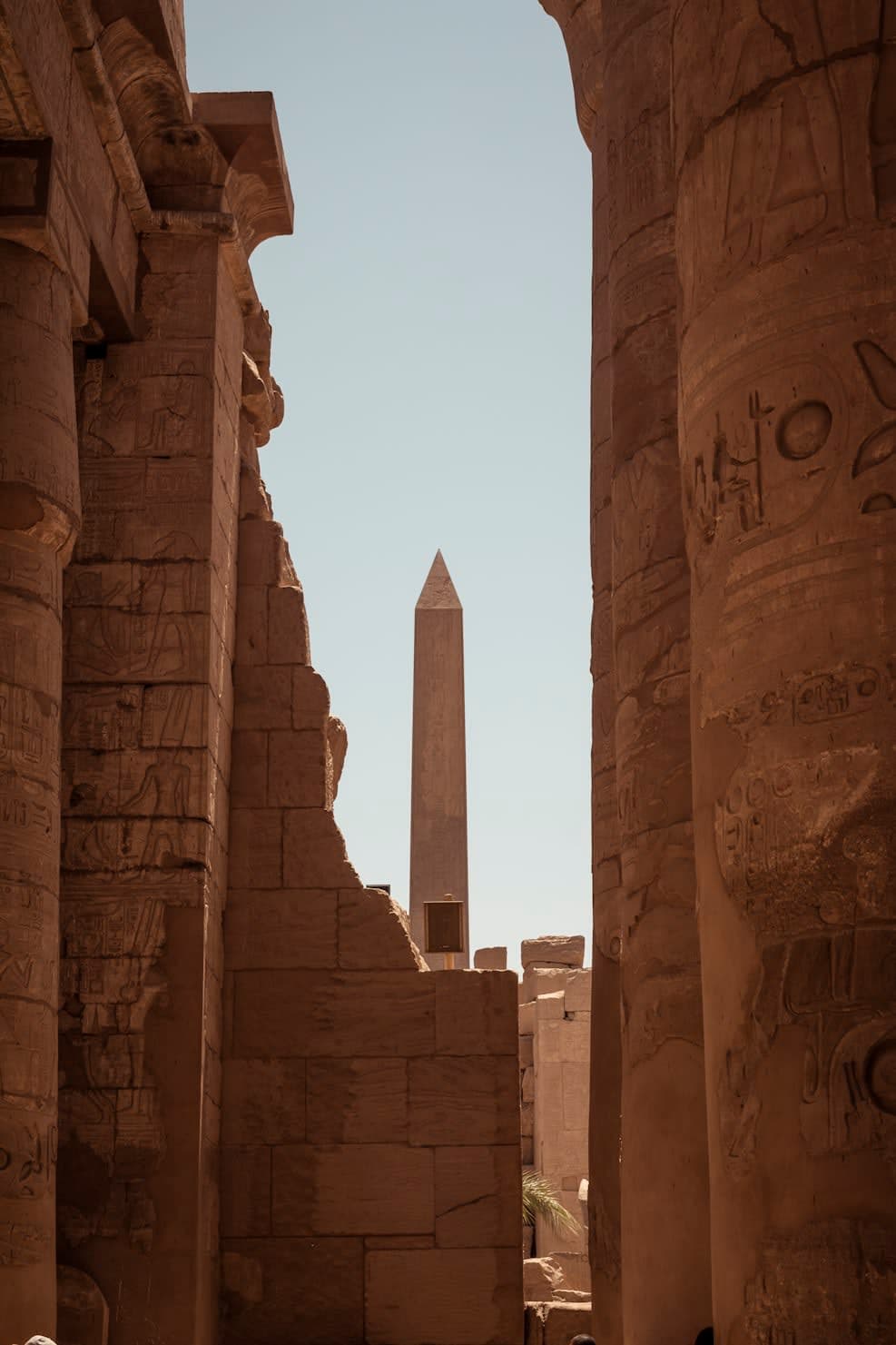
Beyond the Hypostyle Hall, the temple narrows and darkens as you approach the inner sanctuaries. Hatshepsut's obelisk—the tallest surviving ancient obelisk on Earth at approximately 30 meters—stands where she placed it over 3,400 years ago. Nearby, her second obelisk lies toppled. Further still, the Sacred Lake spreads its 120-by-77-meter expanse, where priests once purified themselves and sacred geese of Amun swam. At the lake's edge, the giant granite scarab of Amenhotep III draws visitors who walk circles around it—three times for luck, seven for love, nine for fertility—a folk tradition that persists despite Karnak's conversion to archaeological site.
If time allows, walk the restored Avenue of Sphinxes south toward Luxor Temple. The 2.7-kilometer processional way, lined with human-headed sphinxes, was the route of the annual Opet Festival when priests carried the sacred barques of Amun, Mut, and Khonsu from Karnak to Luxor. Walking it today recreates the ancient pilgrimage, watching the temples of Luxor emerge from the distance as they did for festival crowds thirty-three centuries ago.
Enter from the west through the modern visitor center and approach along the avenue of ram-headed sphinxes toward the First Pylon. The main processional axis runs west to east through the Great Court, Great Hypostyle Hall, and inner temples. The Sacred Lake lies to the south of this axis, with the giant scarab nearby. Hatshepsut's standing obelisk is visible from the Hypostyle Hall and stands between the Fourth and Fifth Pylons. The Open Air Museum, requiring a separate ticket, lies to the north and contains reconstructed structures including Senusret I's White Chapel and Hatshepsut's Red Chapel. The Precinct of Mut, recently opened to visitors, lies to the south. The Avenue of Sphinxes extends from the temple's southern axis toward Luxor Temple, 2.7 kilometers away. Early morning light enters the Hypostyle Hall from the east; late afternoon light illuminates the western faces of the columns most dramatically.
Karnak invites multiple ways of understanding: as architectural achievement, as theological statement, as accumulated millennia of human devotion. Scholarly analysis reveals sophisticated cosmology embedded in stone. The ancient Egyptian perspective saw not a monument but a functioning divine residence where cosmic order was maintained. Alternative interpretations, though lacking scholarly support, have been attracted by the scale of construction. Each perspective illuminates something; none exhausts what this place was and continues to be.
Egyptologists view Karnak as the most important religious complex of ancient Egypt and one of the world's most significant archaeological sites. The 2,000-year construction history provides an unparalleled record of Egyptian religious architecture's evolution—from the modest Middle Kingdom shrine of Senusret I to the colossal New Kingdom additions of Seti I and Ramesses II. The Great Hypostyle Hall is recognized as New Kingdom architecture at its peak, its papyrus-form columns representing the primordial marsh of creation mythology. Recent geoarchaeological research has revealed that the site's location was deliberately chosen to mirror this mythology—Karnak sits on a natural rise that would have been surrounded by floodwaters, physically embodying the primordial mound from which creation emerged. The 2021 restoration and reopening of the Avenue of Sphinxes has renewed scholarly interest in processional architecture and the Opet Festival's role in Egyptian religion and royal ideology.
For ancient Egyptians, Karnak was not a monument but the functioning earthly dwelling of Amun-Ra, king of the gods. The rituals performed here were not ceremonial but operational—without the daily awakening and feeding of the cult statue, the sun might not rise. The pharaoh's participation in Karnak's rituals, particularly the annual Opet Festival, renewed his divine mandate to rule. Building at Karnak demonstrated devotion to Amun-Ra and established legitimacy; the approximately thirty pharaohs who contributed did so not for posterity but for cosmic necessity. Modern Egyptians regard Karnak with national pride as evidence of their ancestors' achievements. The 2021 Avenue of Sphinxes reopening ceremony explicitly connected contemporary Egypt to this pharaonic heritage, recreating the Opet Festival with processions, music, and spectacle.
Karnak's massive scale has attracted alternative interpretations, including claims about sacred geometry, astronomical alignments, and acoustic properties. Some proponents of alternative ancient history have pointed to the Great Hypostyle Hall's 134 columns as evidence of lost construction technologies. These interpretations lack scholarly support and conflict with well-documented archaeological evidence for Egyptian construction methods, including the use of ramps, levers, and organized labor forces. The temple's genuine mysteries—how the Egyptians organized construction over such extended periods, the precise theological meanings of many relief scenes, the original painted appearance now largely lost—are more interesting than speculative alternatives.
Genuine mysteries remain at Karnak. The precise sequence of daily rituals performed in the innermost sanctuary is only partially understood from surviving texts. The original painted appearance of the reliefs—known from surviving fragments to have included vivid colors—can only be imagined for most surfaces. How the ancient Egyptians organized the labor force for construction spanning millennia, maintaining consistency across generations, is not fully understood. The theological significance of many carved scenes remains debated among scholars. The extent of underground structures and passages not yet excavated is unknown. Why certain pharaohs chose to build at specific locations within the complex, and what determined the sequence of construction, involves elements of royal psychology and theological reasoning that sources do not fully explain.
Visit Planning
Karnak lies on Luxor's east bank, 3 km north of Luxor Temple, connected by the Avenue of Sphinxes. Open 6am-5pm daily; entry approximately 600 EGP (~$15-20 USD) for foreign adults. Allow 2-3 hours minimum. The Sound and Light Show runs evenings.
Luxor offers a full range of accommodation from budget hostels to luxury hotels. The east bank (Karnak side) has most hotels and is more convenient for Karnak visits. The west bank offers quieter options closer to the Valley of the Kings and mortuary temples. Felucca rides and motorboat ferries cross the Nile between banks. Many visitors base in Luxor for several days to explore both banks thoroughly.
Standard archaeological site etiquette applies. Dress modestly with shoulders and knees covered. Photography with phones is permitted; professional equipment may require permits. Do not touch reliefs or climb on monuments. Respect barriers and closed areas.
Karnak is an archaeological site of immense historical significance, not an active religious space—but this makes respectful behavior more important, not less. What survives here represents the accumulated devotion of approximately thirty pharaohs over two thousand years. The reliefs and inscriptions are irreplaceable records of Egyptian civilization. A single careless touch accelerates erosion that has already claimed much.
The site's vast scale invites wandering, but barriers exist for reasons. Some areas are closed for ongoing conservation; others present safety hazards. The Precinct of Montu remains off-limits to the public. Site guardians may offer to show you special features or unlock normally closed areas; modest tips are customary and appropriate for such services.
Karnak attracts both organized tour groups and independent visitors. In the Great Hypostyle Hall, the acoustic properties that made ancient rituals effective also carry modern voices surprisingly far. Awareness of your impact on others' experience—particularly in the more intimate inner spaces—enhances everyone's visit.
Modest dress with shoulders and knees covered is recommended and may be required. Comfortable walking shoes are essential—the complex involves extensive walking on uneven stone surfaces. A hat and sunscreen are necessary for visits during sunny hours. Bring water.
Photography using mobile phones is permitted at no additional charge. Professional camera equipment and tripods may require permits, available at the ticket office. Flash photography is prohibited in enclosed spaces with painted reliefs. Drone photography is not permitted. The Great Hypostyle Hall photographs best in early morning or late afternoon light.
Not applicable. Karnak is an archaeological site with no active religious practice. The folk tradition of circling the giant scarab is secular rather than religious.
Do not touch reliefs, inscriptions, or carved surfaces. Do not climb on monuments. Stay within designated visitor areas. The Precinct of Montu is closed to the public. Some conservation areas may be temporarily restricted. Follow guidance from site guardians.
Sacred Cluster
Nearby sacred places create the location cluster described in the growth plan. This block is intentionally crawlable and links into the wider regional graph.