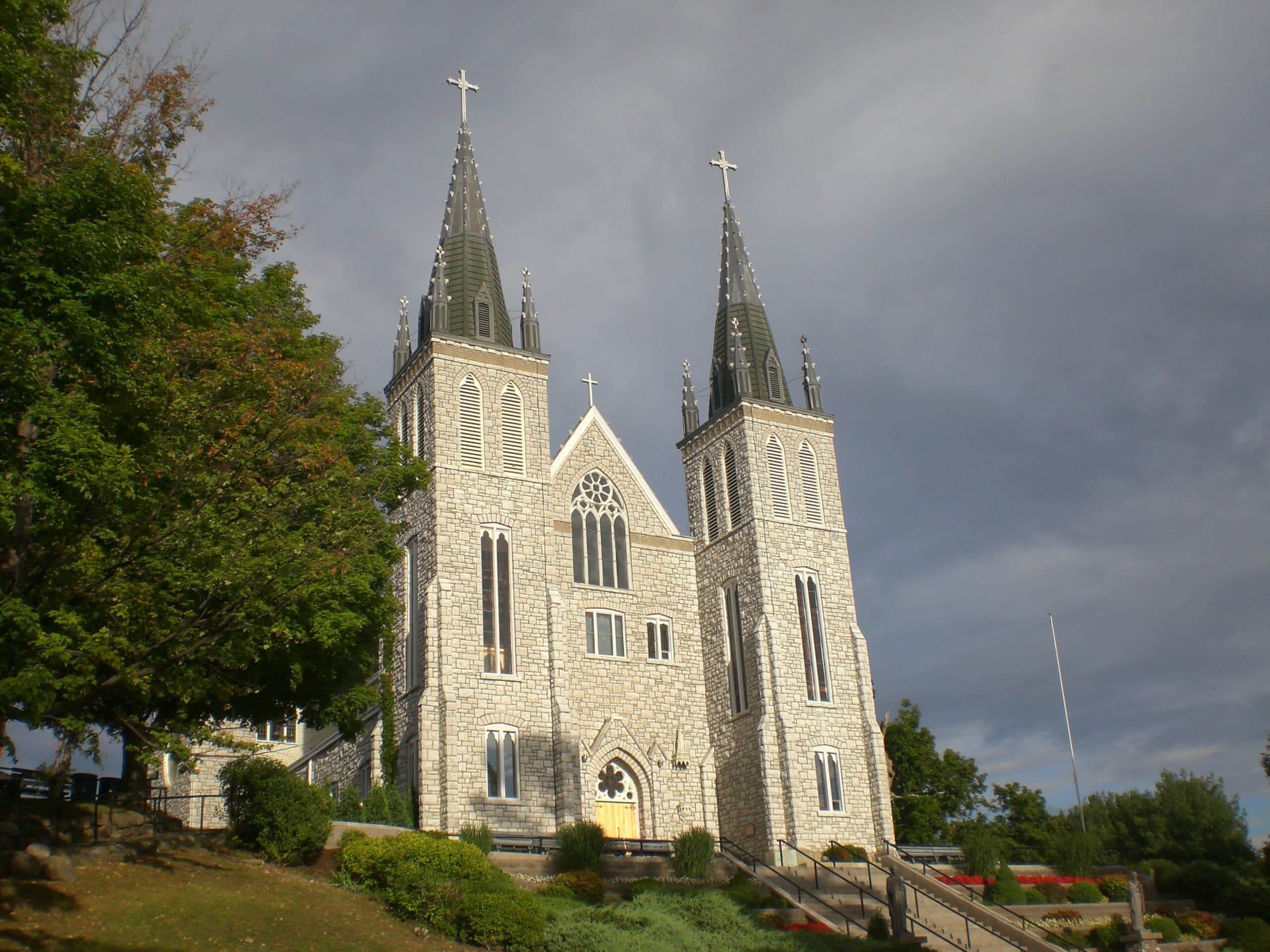
Martyrs' Shrine
Where Jesuit sacrifice and Wendat memory converge on the hills above Georgian Bay
Tay, Ontario, Canada
At A Glance
- Coordinates
- 44.7373, -79.8410
- Suggested Duration
- A focused visit to the shrine church and relics takes approximately one hour. Two to three hours allows exploration of the full grounds including the outdoor Stations of the Cross, gardens, Education Centre, and gift shop. A full day is recommended for combining the shrine with Sainte-Marie among the Hurons (two to three hours) and optionally the Wye Marsh Wildlife Centre.
- Access
- The shrine is located at 16163 Highway 12 West, Midland, Ontario, approximately 150 km (1.5 to 2 hours by car) north of Toronto. It sits on Ontario Highway 12, about 2 km from Midland town centre. No direct public transit serves the shrine; the nearest intercity bus connects to Barrie or Orillia, from which taxi or rideshare would be needed. Free parking is available on the property after paying the gate fee. Sainte-Marie among the Hurons is directly across the road, connected by a trail. Mobile phone signal is generally available in the Midland area; no signal concerns have been reported at the site. Contact the shrine at +1 705-526-3788, toll-free 1-855-526-3788, or visit martyrs-shrine.com for current visitor information. Gate fee is approximately CAD $6 per vehicle (verify current pricing for the 2026 centennial year).
Pilgrim Tips
- The shrine is located at 16163 Highway 12 West, Midland, Ontario, approximately 150 km (1.5 to 2 hours by car) north of Toronto. It sits on Ontario Highway 12, about 2 km from Midland town centre. No direct public transit serves the shrine; the nearest intercity bus connects to Barrie or Orillia, from which taxi or rideshare would be needed. Free parking is available on the property after paying the gate fee. Sainte-Marie among the Hurons is directly across the road, connected by a trail. Mobile phone signal is generally available in the Midland area; no signal concerns have been reported at the site. Contact the shrine at +1 705-526-3788, toll-free 1-855-526-3788, or visit martyrs-shrine.com for current visitor information. Gate fee is approximately CAD $6 per vehicle (verify current pricing for the 2026 centennial year).
- Modest dress appropriate for a Catholic place of worship is expected inside the shrine church. Shoulders and knees should be covered. On the grounds, casual but respectful clothing is acceptable. Comfortable walking shoes are essential for the 150-acre property.
- Photography is generally permitted on the grounds and exterior. Inside the shrine church, quiet, respectful photography is acceptable, but flash photography near the relics may be discouraged. Do not photograph during Mass or other services. During multicultural pilgrimages, photograph from a respectful distance unless invited closer. Check with shrine staff for any current restrictions.
- The narrative of martyrdom is a specifically Catholic framing of events that are understood very differently by the Huron-Wendat Nation and other indigenous peoples. The missionaries honored here were agents of a colonial enterprise that devastated indigenous communities through disease, cultural disruption, and the destruction of the Wendat Confederacy. Visitors should engage with the shrine's account while remaining aware that it represents one perspective on a layered history. During major pilgrimage events, crowds can be substantial. Plan accordingly and respect the devotional practices of communities whose traditions may differ from your own. The shrine is seasonal, open approximately May through October. Arriving outside this window will find the church and facilities closed.
Overview
Martyrs' Shrine stands on a hill near Midland, Ontario, honoring eight Jesuit missionaries and companions killed between 1642 and 1649 during the encounter between French Catholicism and the Wendat people. One of Canada's six national shrines, it holds the skull of St. Jean de Brebeuf and draws some 100,000 pilgrims each summer to a landscape shaped by faith, colonialism, and unresolved history.
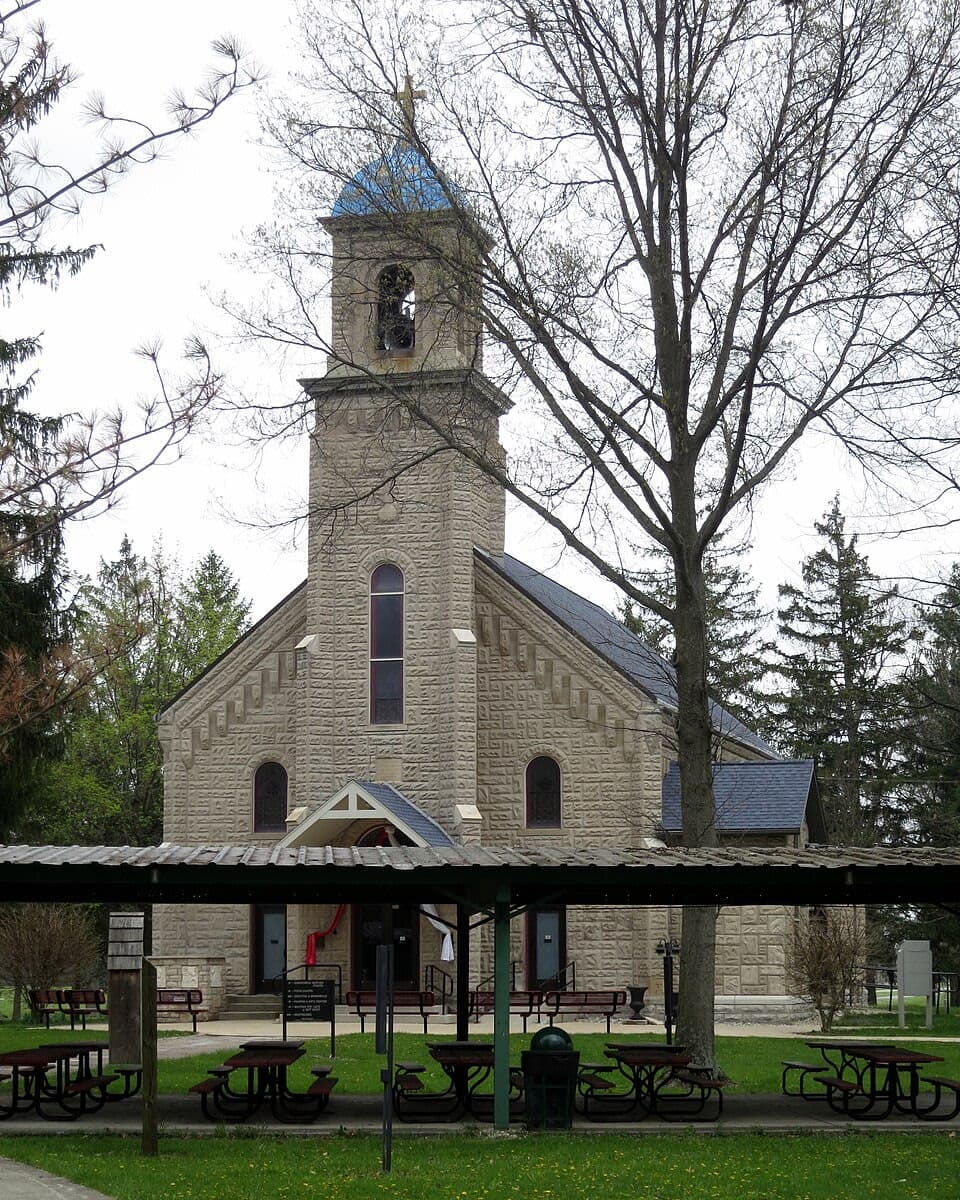
The twin Gothic spires rise above the Ontario countryside like a signal, visible from the highway long before you arrive. But what waits inside those towers is not quite what the exterior suggests. Step through the doors and the vaulted ceiling curves overhead in the shape of an overturned bark canoe, the proportions recalling a Wendat longhouse more than a European cathedral. This is the central paradox of Martyrs' Shrine: a Catholic church built to honor French missionaries who died among the Wendat people, designed to contain both worlds in a single structure.
The eight Canadian Martyrs — six Jesuit priests and two lay companions — were killed between 1642 and 1649 during one of the most consequential encounters in North American history. Jean de Brebeuf spent 23 years among the Wendat, learned their language, composed Canada's first Christmas hymn in it, and died under prolonged ritual torture rather than renounce his faith. His skull rests in the shrine church, a first-class relic that draws the faithful to this place as it has for a century.
But this is not only a Catholic story. The land around the shrine was Wendat territory — Huronia — home to a confederacy of some 20,000 people with their own spiritual traditions, their own ceremonies, their own relationship to the sacred. The missionaries who came to convert them also carried diseases that killed thousands. The faith they offered arrived entangled with colonial power. The shrine has begun to acknowledge this complexity, entering into reconciliation dialogue with indigenous communities.
In 2026, Martyrs' Shrine marks two anniversaries: one hundred years since its consecration and four hundred years since Brebeuf first set foot in Huronia. For pilgrims and seekers willing to hold contradictions without resolving them, this is a place where devotion, history, and honesty meet on common ground.
Context And Lineage
Martyrs' Shrine was consecrated in 1926 on a hilltop overlooking the site where French Jesuit missionaries and the Wendat people encountered each other between 1626 and 1649. The eight Canadian Martyrs, canonized in 1930, are collectively the secondary patron saints of Canada. The shrine holds the only surviving relics of three of the eight.
In 1625, French Jesuit missionaries arrived in New France with a mandate to bring Christianity to the indigenous peoples of the continent. Jean de Brebeuf was sent to the Wendat near Georgian Bay in 1626, entering a sophisticated confederacy of some 20,000 to 30,000 people whose world he would spend the next two decades attempting to convert. He learned the Wendat language — the first European to do so — wrote a dictionary, and composed a Christmas hymn in it that is still sung in Canadian churches today.
In 1639, Brebeuf and Jerome Lalemant established Sainte-Marie among the Hurons, the first European settlement in what is now Ontario, as a base for the mission. For a decade, it served as the nerve center of an ambitious and deeply contested project. The Wendat were not passive recipients of the Jesuits' message. Some converted; others resisted; many debated. The epidemics that followed European contact — especially the devastating 1636 smallpox outbreak — killed thousands and split communities over whether the missionaries were healers or sorcerers.
Between 1642 and 1649, all eight missionaries and companions were killed. The violence was bound up with the Haudenosaunee-Wendat conflicts over the fur trade, intensified by the pressures of European colonial economics. Brebeuf and Lalemant were captured on March 16, 1649, at the village of Saint-Louis and subjected to prolonged ritual torture. Brebeuf endured stoning, burning, a collar of red-hot tomahawks, and a mock baptism of scalding water. He showed such endurance that, according to the Jesuit accounts, his captors ate his heart after his death — an act some ethnohistorians interpret as a mark of respect for extraordinary courage rather than simple cruelty.
In 1907, a small chapel was built near the martyrdom site. In 1925, Fr. John M. Filion, S.J., purchased a farm across from Sainte-Marie and began construction of the present shrine. It was consecrated on June 25, 1926. Four years later, Pope Pius XI canonized all eight as saints.
The shrine draws on a lineage that runs back through four centuries of Jesuit presence in North America to the founding of the Society of Jesus by Ignatius of Loyola in 1540. The Ignatian charism — finding God in all things, being sent to the frontiers, the willingness to risk everything for the greater glory of God — is the framework within which the martyrs' deaths are understood by the Jesuits who still operate the shrine.
The Canadian Martyrs were canonized in 1930 and named secondary patron saints of Canada in 1940, after St. Joseph. Their feast day, September 26, is celebrated across the country. The shrine itself became one of six national shrines designated by the Canadian Conference of Catholic Bishops, alongside institutions such as Saint Joseph's Oratory in Montreal and the Basilica of Sainte-Anne-de-Beaupre in Quebec.
But the lineage is not only ecclesiastical. The multicultural pilgrimages that now define the shrine — Tamil, Filipino, Korean, Polish, Portuguese, and dozens of other communities — have created a living tradition of layered devotion. The Tamil Pilgrimage alone draws 12,000 to 15,000 faithful each July, making it one of the largest Tamil Catholic gatherings outside Sri Lanka. Each community brings its own devotional forms, its own hymns, its own relationship to the martyrs' witness. The shrine has become a place where Canadian Catholicism sees its own diversity reflected.
St. Jean de Brebeuf
saint
The principal figure among the Canadian Martyrs. French Jesuit missionary who arrived in Huronia in 1626, spent 23 years among the Wendat, learned their language, and composed Canada's first Christmas hymn. Captured and killed under prolonged ritual torture on March 16, 1649. His skull is the shrine's principal relic.
St. Gabriel Lalemant
saint
French Jesuit captured alongside Brebeuf at the village of Saint-Louis. Endured approximately 15 hours of torture before dying on March 17, 1649. His bones are among the shrine's relics.
St. Isaac Jogues
saint
French Jesuit who worked among the Wendat and was captured by the Mohawk in 1642. After escape and return, he was killed on October 18, 1646, at Ossernenon (present-day Auriesville, New York). A companion shrine stands at the site of his death.
Fr. John M. Filion, S.J.
historical
Jesuit provincial superior who purchased the Standin farm in Midland in 1925 and initiated construction of the shrine church, bringing the long-discussed project of a national martyrs' memorial to completion.
Ildege Bourrie
historical
Designer and builder of the shrine church interior, who shaped the distinctive canoe-vault ceiling and longhouse proportions that give the building its unique fusion of European and Indigenous architectural vocabularies.
Why This Place Is Sacred
Martyrs' Shrine occupies land that was already sacred — the heartland of the Wendat Confederacy, where ceremonies, clan gatherings, and the Feast of the Dead shaped the spiritual landscape for centuries before European contact. A century of Catholic pilgrimage has layered prayer and devotion onto ground already dense with meaning, creating a site where multiple sacralities coexist in unresolved tension.
The hills around Georgian Bay were not empty when the Jesuits arrived. The Wendat people had lived in this region — they called it Wendake — for generations, cultivating corn, beans, and squash, governing through a sophisticated clan system, and maintaining a spiritual life centered on dream interpretation, healing ceremonies, and the Feast of the Dead. This last practice, Yandatsa, was the most significant communal ritual: the periodic reburial of community members in shared ossuaries, an act that bound the living and the dead into a single community. The landscape the Jesuits entered was already thick with sacred meaning.
What makes this ground thin is not a single tradition but the collision of two. When Jean de Brebeuf arrived in 1626, he entered a world that had its own understanding of the divine, its own practices of encounter with what lies beyond ordinary perception. He spent years learning the Wendat language and recording their customs — his accounts of the Feast of the Dead remain among the most detailed ethnographic documents of the period. He came to convert, but he could not help also bearing witness.
The violence that followed — the epidemic diseases, the fracturing of Wendat communities over conversion, the Haudenosaunee raids that destroyed the confederacy in 1648-1649, the torture and death of the missionaries — saturated this ground with a particular intensity. The shrine was built on that intensity. Since 1926, approximately 100,000 pilgrims have come each summer, adding their own prayers, their own griefs, their own seeking to the accumulated weight of the place. More than 35 cultural communities make pilgrimage each year — Tamil, Filipino, Korean, Polish, Portuguese, and many others — each bringing their own devotional energy.
The architecture itself speaks to this layering. Gothic towers contain a canoe-shaped interior. European stonework rises from Ontario timber. The relics of European saints rest in the homeland of the Wendat. Nothing here resolves neatly, and that irresolution may be precisely what gives the site its charge.
The shrine was built to honor the Canadian Martyrs and to provide a place of Catholic pilgrimage and devotion. Fr. John M. Filion, S.J., purchased a farm across from the site of Sainte-Marie among the Hurons in 1925 and erected a church that was consecrated in 1926, five years before the eight martyrs were canonized. The stated mission was, and remains, to offer a place where pilgrims can encounter the faith witness of the martyrs and deepen their own spiritual lives through the sacraments, prayer, and reflection.
The shrine began as a modest church on a hilltop farm. Its growth mirrors the expansion of the Canadian Catholic community. The canonization of the eight martyrs by Pope Pius XI in 1930 transformed the site from a local devotional chapel into a national pilgrimage destination. Pope John Paul II celebrated Mass here in 1984 at an outdoor Papal Altar built expressly for his visit, elevating the shrine's international profile. The grounds have expanded to encompass approximately 150 acres, incorporating outdoor Stations of the Cross, gardens, pavilions, statues representing dozens of cultural communities, an Education Centre, and ample space for the large-scale pilgrimages that now define the summer season. The 2024-2025 national relic tour — the first time Brebeuf's skull and the other relics traveled across Canada — marked a new chapter in the shrine's outreach. The 2026 centennial and quadricentennial celebrations represent the most ambitious programming in the shrine's history.
Traditions And Practice
The shrine offers a full Catholic sacramental program during its May-to-October season, including weekend Masses, the Sacrament of Reconciliation, and Eucharistic Adoration. More than 35 ethnic and cultural pilgrimage events take place each summer, alongside walking pilgrimages from across Ontario.
The core devotional practices at Martyrs' Shrine follow Catholic sacramental tradition. The celebration of the Eucharist (Mass) stands at the center, offered multiple times on weekends throughout the pilgrimage season. The Sacrament of Reconciliation (Confession) is available for those seeking spiritual renewal. Eucharistic Adoration offers extended periods of contemplative prayer in the presence of the Blessed Sacrament.
The veneration of relics — the skull of St. Jean de Brebeuf, the bones of Sts. Gabriel Lalemant and Charles Garnier — follows the ancient Catholic practice of honoring the physical remains of saints. Pilgrims pray near the reliquaries, touch them, or simply sit in their presence. The 2024-2025 national relic tour carried these relics across Canada for the first time, extending access to the faithful in every province.
The outdoor Stations of the Cross invite the traditional devotional walk through fourteen episodes of Christ's passion and death, transposed here into a landscape of gardens and forest that adds a contemplative dimension to the prayers. Walking pilgrimages from six Ontario cities follow the centuries-old Christian pilgrimage tradition, adapted to the Canadian geography, covering the route on foot over several days.
The contemporary pilgrimage season at Martyrs' Shrine is defined by its multicultural character. More than 35 ethnic and cultural pilgrimage events take place each summer. The Tamil Pilgrimage, now in its late thirties as an annual event, draws 12,000 to 15,000 faithful each July — a gathering that transforms the grounds into a sea of color and devotion. The Filipino Pilgrimage, the Korean Pilgrimage, the Polish Pilgrimage, and many others each bring their own devotional styles, music, and communal meals.
The Living Rosary Sunday Pilgrimage, sponsored by the Catholic Women's League and Knights of Columbus, anchors the September calendar. The feast day of the Canadian Martyrs on September 26 is the liturgical high point of the year, with special Masses and programming.
In 2026, the centennial celebrations add a distinctive layer: a Centennial Mass, an academic colloquium, a concert with book launch, and a centennial gala in Toronto. These events mark both the hundred years since the shrine's consecration and the four hundred years since Brebeuf's arrival in Huronia.
Begin with the shrine church. Enter through the main doors and let your eyes adjust to the interior, following the upward curve of the canoe-vault ceiling. Notice how the proportions shift your sense of the space compared to the Gothic exterior. Spend time near the relics — not to venerate them in any prescribed way, but simply to sit with the fact of their presence, the physical trace of lives given over completely.
Walk the outdoor Stations of the Cross. The path takes you through gardens and along wooded margins, and the pace it invites is slower than what you would give a church interior. Let the walking itself become part of the experience.
Cross the road to Sainte-Marie among the Hurons. The reconstructed mission provides the physical and human context that the shrine alone cannot supply. Walk through the longhouses. Stand in the small chapel. Consider what it meant for two utterly different peoples to occupy this space together.
If you visit during one of the multicultural pilgrimages, allow yourself to be drawn in by the devotional energy even if the tradition is not your own. The Tamil Pilgrimage in July and the Filipino Pilgrimage in August offer particularly vivid encounters with living faith.
Roman Catholic Devotion to the Canadian Martyrs
ActiveThe eight Canadian Martyrs — six Jesuit priests and two lay companions — are collectively the secondary patron saints of Canada. Canonized in 1930, they are venerated as saints who gave their lives in witness to their faith. The shrine houses the only surviving relics of three of the eight: the skull of St. Jean de Brebeuf and bones of Sts. Gabriel Lalemant and Charles Garnier. As one of six national shrines designated by the Canadian Conference of Catholic Bishops, Martyrs' Shrine holds a distinctive place in Canadian Catholic life.
The shrine celebrates Mass on weekends throughout the pilgrimage season (May-October), offers the Sacrament of Reconciliation, and provides opportunities for Eucharistic Adoration. Pilgrims walk the outdoor Stations of the Cross, venerate the relics, and participate in devotional prayers. The feast day of the Canadian Martyrs (September 26) is the liturgical high point of the year. More than 35 ethnic and cultural pilgrimage events take place each summer, and walking pilgrimages depart from six Ontario cities.
Jesuit (Ignatian) Spirituality
ActiveThe shrine is operated by the Jesuits of Canada, and Ignatian spirituality permeates its ministry. The Society of Jesus, founded by Ignatius of Loyola in 1540, emphasizes finding God in all things, discernment, service, and the Spiritual Exercises. The eight martyrs were all members of or associated with the Society, and their missionary zeal is understood within the Ignatian tradition of being sent to the frontiers of faith and culture.
The shrine offers programs grounded in Ignatian spirituality, including retreats, spiritual direction, and guided reflection on the martyrs' lives as models of Ignatian 'magis' — the pursuit of the greater glory of God. The Examen, a daily contemplative practice central to Jesuit life, informs the shrine's approach to spiritual formation. Educational programs on Jesuit history and spirituality are offered through the Education Centre.
Multicultural Catholic Pilgrimage
ActiveThe more than 35 ethnic and cultural pilgrimages that take place each summer reflect the diversity of Canadian Catholicism. Tamil, Filipino, Korean, Polish, Portuguese, and many other communities have made Martyrs' Shrine a gathering point for their devotional traditions, creating an annual cycle of multicultural encounter that has become one of the shrine's defining characteristics.
Each community organizes its own pilgrimage, bringing specific devotional forms, music, prayers, and communal meals. The Tamil Pilgrimage draws 12,000 to 15,000 faithful each July. The Filipino Pilgrimage in August and the Living Rosary Sunday Pilgrimage in September are among the largest gatherings. Walking pilgrimages from Toronto and other cities follow multi-day routes through the Ontario countryside.
Wendat (Huron) Spiritual Traditions
HistoricalThe Wendat people maintained a rich spiritual tradition centered on Aataentsic (Sky Woman), Iouskeha (a culture hero), the Feast of the Dead (Yandatsa), dream interpretation, healing societies, and seasonal ceremonial cycles. These traditions were severely disrupted by epidemic disease, the fracturing of communities over Christian conversion, and the destruction of the Wendat Confederacy by Haudenosaunee raids in 1648-1649. The Huron-Wendat Nation, now based at Wendake near Quebec City, is engaged in cultural revitalization.
The Feast of the Dead was the central communal ceremony — the periodic reburial of community members in shared ossuaries that bound the living and the dead. Dream interpretation guided individual and community decisions. Healing ceremonies involved specialists called arendiwane. Seasonal agricultural ceremonies honored the Three Sisters (corn, beans, squash). These practices were disrupted at this particular site but elements are being revitalized by the Huron-Wendat Nation today.
Experience And Perspectives
Visitors report a profound sense of peace in the shrine church, particularly near the relics. The expansive grounds invite extended contemplation, while the juxtaposition with adjacent Sainte-Marie among the Hurons creates a layered historical and spiritual encounter that deepens with time and willingness to engage complexity.
The approach matters less than the arrival. You drive along Ontario Highway 12 through rolling farmland and mixed forest, and then the twin spires appear above the treeline — incongruously Gothic for rural Simcoe County, deliberately monumental for what began as a farm purchase. The gate fee paid, you park on the expansive property and walk toward the church.
Inside, the shift is immediate. The canoe-shaped ceiling draws the eye upward along curves that feel organic rather than architectural. Stained glass panels depict the martyrs and scenes from the mission. And then there are the relics: the skull of Jean de Brebeuf, the bones of Gabriel Lalemant and Charles Garnier, housed in reliquaries that concentrate attention like a lens. Pilgrims pray here in sustained silence. Visitors who came expecting a museum often find themselves standing still, affected by something they had not anticipated.
The grounds open the experience outward. The outdoor Stations of the Cross trace a path through gardens and along wooded edges, offering the kind of slow, ambulatory contemplation that architecture alone cannot provide. Statues representing cultural communities from around the world — Huronia, Slovakia, Albania, Korea, Spain, Mexico, Ireland, Portugal, and many others — create an unexpected diversity of devotional imagery. The outdoor Papal Altar, built for John Paul II's 1984 visit, occupies a hillside with long views.
But the fuller encounter requires crossing the road to Sainte-Marie among the Hurons, the reconstructed Jesuit mission that is now a National Historic Site and living history museum. There, the daily reality of the 17th-century encounter becomes tangible: the longhouses, the chapel, the fortifications, the space where European and Wendat worlds overlapped. Visiting both sites in a single day transforms each: the shrine gains historical depth, and the mission gains devotional resonance. Together, they hold a story that neither can tell alone.
What pilgrims report most consistently is a quality of stillness that the place seems to generate. Whether this arises from a century of accumulated prayer, the physical beauty of the setting, the weight of the history, or something less easily named, it is noted across denominational lines and across levels of belief.
Come prepared to hold complexity. This is a site of Catholic devotion and a site of colonial encounter. The missionaries honored here gave their lives for their faith; the people among whom they lived lost a civilization. Both of these things are true simultaneously.
If you are Catholic, the shrine offers what you would expect: Mass, Confession, the presence of relics, the devotional infrastructure of a century of pilgrimage. If you are not, the site still has much to offer — the architecture, the landscape, the history, the questions that arise when you stand at the intersection of radically different understandings of the sacred.
Allow time. The shrine church alone can be visited in under an hour, but the grounds deserve extended walking, and the adjacent Sainte-Marie among the Hurons doubles both the time and the depth of the experience. A full day permits the kind of unhurried engagement that this place rewards.
Martyrs' Shrine sits at a crossroads where Catholic hagiography, colonial history, indigenous memory, and ongoing reconciliation converge. No single narrative encompasses what happened here or what it means. The perspectives below reflect different ways of engaging with a site that asks its visitors to think carefully about faith, power, sacrifice, and the encounter between peoples.
Historians situate the Canadian Martyrs within the broader context of the French colonial enterprise in North America. The Jesuit Relations — the detailed annual reports the missionaries sent to France — are invaluable primary sources for 17th-century Wendat and Haudenosaunee history, though they were written from a Eurocentric and evangelizing perspective that shapes what they record and how.
Modern scholarship recognizes Brebeuf's genuine ethnographic contributions. His accounts of the Wendat language, customs, and the Feast of the Dead are among the most detailed 17th-century European observations of indigenous life. At the same time, scholars acknowledge the disruptive effects of the mission: the social fractures caused by conversion, the devastating mortality from epidemic disease (especially the 1636 smallpox outbreak), and the role of European colonial economics in intensifying the Haudenosaunee-Wendat conflicts that destroyed the confederacy.
The shrine itself is recognized as an important example of early 20th-century Catholic devotional architecture in Canada. Its fusion of Gothic and Indigenous design elements — the canoe-vault ceiling within Belgian-Gothic towers — represents a deliberate, if complex, attempt at cultural synthesis. Architectural historians note the unusual all-timber construction behind the monumental facade, reflecting the northern Ontario lumber donations that made the building possible.
Within Catholic teaching, the eight Canadian Martyrs are saints who bore extraordinary witness to their faith through suffering and death. Their example is held up as a model of the Ignatian ideal of radical self-offering for the greater glory of God. Brebeuf, in particular, is venerated for his 23 years of missionary dedication, his learning of the Wendat language, and his endurance under torture.
The shrine is understood as a place where the 'blood of the martyrs is the seed of the Church' — where sacrifice bore fruit in the growth of Canadian Catholicism. The presence of first-class relics makes it one of the most significant repositories of sacred remains in North America. For the faithful, the relics are not artifacts but points of contact with the saints' ongoing intercessory power.
The Jesuits who operate the shrine understand their ministry within the Ignatian tradition of being sent to the frontiers. The multicultural pilgrimages are seen as evidence that the martyrs' witness continues to draw people to encounter with the divine across cultural boundaries.
From Huron-Wendat and broader indigenous perspectives, the narrative of martyrdom is a specifically Catholic framing of events inseparable from colonization. The missionaries were not neutral spiritual visitors but agents of a colonial power. Their conversion efforts disrupted Wendat social structures, clan relationships, and spiritual practices. The requirement for baptized Wendat to separate from unbaptized family members fractured communities. The epidemics that followed European contact killed thousands.
The Huron-Wendat Nation, now centered at Wendake near Quebec City, maintains its own oral histories and perspectives on these events. The term 'martyrs' itself reflects a Catholic interpretation that elides the broader destruction the missionary enterprise accompanied.
The shrine has begun engaging with indigenous communities toward reconciliation. Fr. Michael Knox, a recent director, stated that reconciliation requires 'an unclouded view of the past.' Some spiritual seekers experience the site as a place where the intensity of human suffering and devotion — from both Wendat and Catholic traditions — has left an imprint that transcends any single interpretive framework.
Genuine mysteries persist around the events that gave rise to this shrine. The full extent of Wendat oral traditions relating to the Jesuit mission period is largely lost, much of it destroyed alongside the communities that carried it. Whether Wendat spiritual practices continued covertly alongside Christian conversion during the mission period remains an open question.
The precise meaning of the ritual treatment of Brebeuf — including the reported eating of his heart — is filtered through Jesuit hagiographic accounts that may not fully represent the Haudenosaunee perspective. Some ethnohistorians suggest it was an act of respect for extraordinary courage rather than a simple act of cruelty, but certainty is beyond reach.
The specific beliefs and motivations of Wendat converts versus those who resisted Christianity, the full scope of Wendat agency in their encounters with the Jesuits beyond what the Relations record, and the undiscovered archaeological remains in the broader landscape all represent territories of knowledge that remain largely unexplored.
Visit Planning
Martyrs' Shrine is open approximately May through October on the outskirts of Midland, Ontario, about 150 km north of Toronto. It is primarily accessible by car. A gate fee applies. Combining the visit with Sainte-Marie among the Hurons across the road is strongly recommended.
The shrine is located at 16163 Highway 12 West, Midland, Ontario, approximately 150 km (1.5 to 2 hours by car) north of Toronto. It sits on Ontario Highway 12, about 2 km from Midland town centre. No direct public transit serves the shrine; the nearest intercity bus connects to Barrie or Orillia, from which taxi or rideshare would be needed. Free parking is available on the property after paying the gate fee. Sainte-Marie among the Hurons is directly across the road, connected by a trail. Mobile phone signal is generally available in the Midland area; no signal concerns have been reported at the site. Contact the shrine at +1 705-526-3788, toll-free 1-855-526-3788, or visit martyrs-shrine.com for current visitor information. Gate fee is approximately CAD $6 per vehicle (verify current pricing for the 2026 centennial year).
Hotels and motels are available in Midland and nearby Penetanguishene. Bed-and-breakfasts operate in the surrounding Georgian Bay region. The broader area — including Wasaga Beach, Collingwood, and Barrie — offers additional options. Advance booking is recommended during peak pilgrimage season and for the 2026 centennial events.
Martyrs' Shrine is an active place of Catholic worship. Modest dress, quiet reverence inside the church, and respect for pilgrims in prayer are expected. Photography is permitted but should be exercised with discretion, particularly near the relics and during services.
The shrine church is a living place of worship, not a museum. Mass is celebrated on weekends throughout the season, and pilgrims are often in prayer near the relics throughout opening hours. Move through the church with awareness of those who are in devotion. If Mass is being celebrated, remain quietly at the back unless you intend to participate.
The grounds are more informal, but the same principle of awareness applies. The outdoor Stations of the Cross are devotional spaces; the multicultural statues represent communities whose offerings they embody. Treat the entire property as what it is: a place where many people come to do serious spiritual work.
When visiting during one of the large cultural pilgrimages, you are entering another community's devotional space. Observe, be present, but do not intrude on ceremonies or practices that are not addressed to you as audience.
Modest dress appropriate for a Catholic place of worship is expected inside the shrine church. Shoulders and knees should be covered. On the grounds, casual but respectful clothing is acceptable. Comfortable walking shoes are essential for the 150-acre property.
Photography is generally permitted on the grounds and exterior. Inside the shrine church, quiet, respectful photography is acceptable, but flash photography near the relics may be discouraged. Do not photograph during Mass or other services. During multicultural pilgrimages, photograph from a respectful distance unless invited closer. Check with shrine staff for any current restrictions.
Monetary donations support the shrine's operations and are welcomed. Prayer candles are typically available for purchase. The gift shop offers religious items and souvenirs. No food or material offerings are expected at the relics or altars.
Silence or quiet reverence is expected inside the shrine church. No food or drink inside the church. A gate fee is required for vehicle entry. Large groups and organized pilgrimages should coordinate with the shrine office in advance. Dogs may be restricted in certain areas — check current policy before bringing animals.
Sacred Cluster
Nearby sacred places create the location cluster described in the growth plan. This block is intentionally crawlable and links into the wider regional graph.
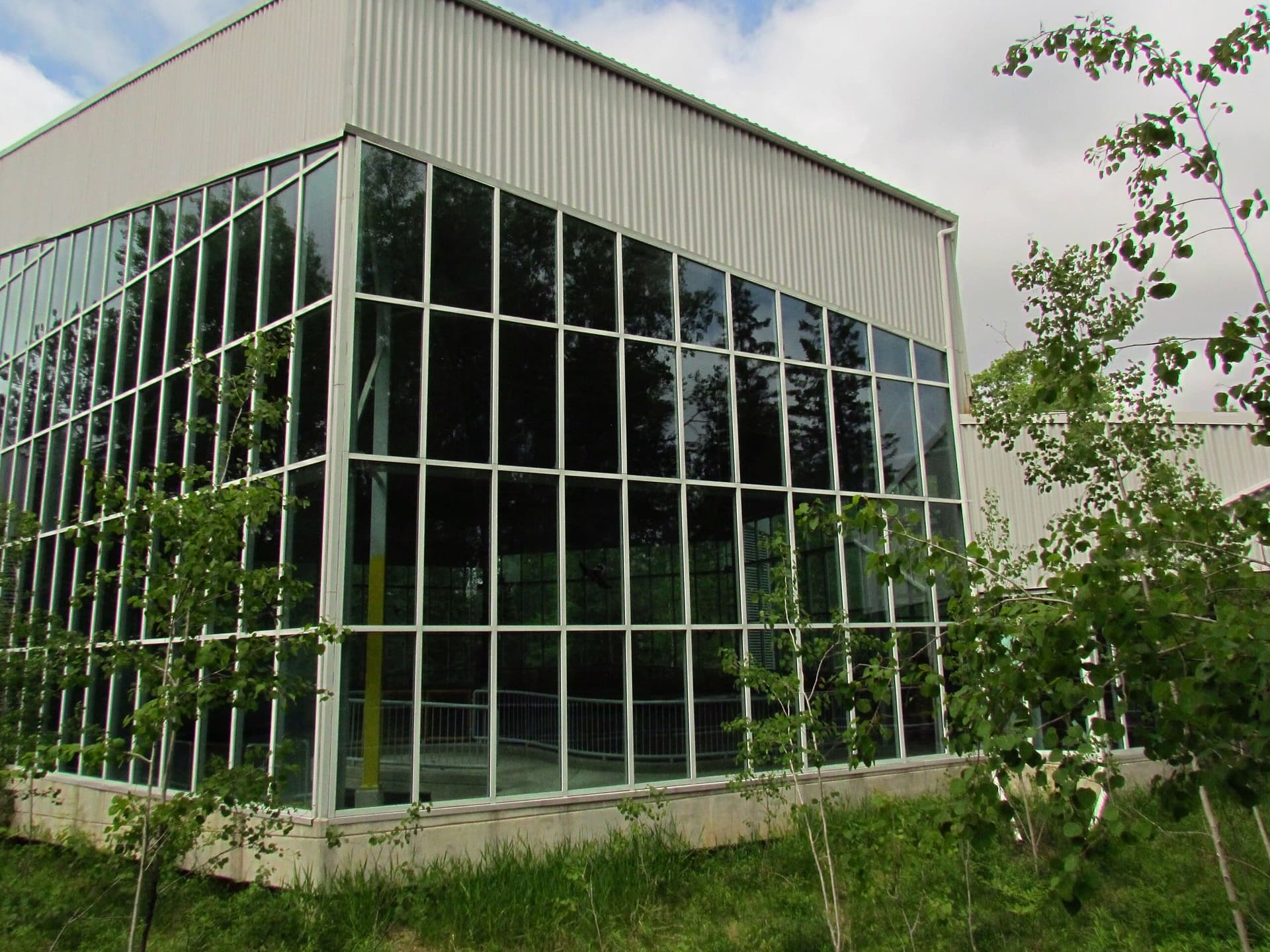
Petroglyphs Park
North Kawartha, Ontario, Canada
141.6 km away
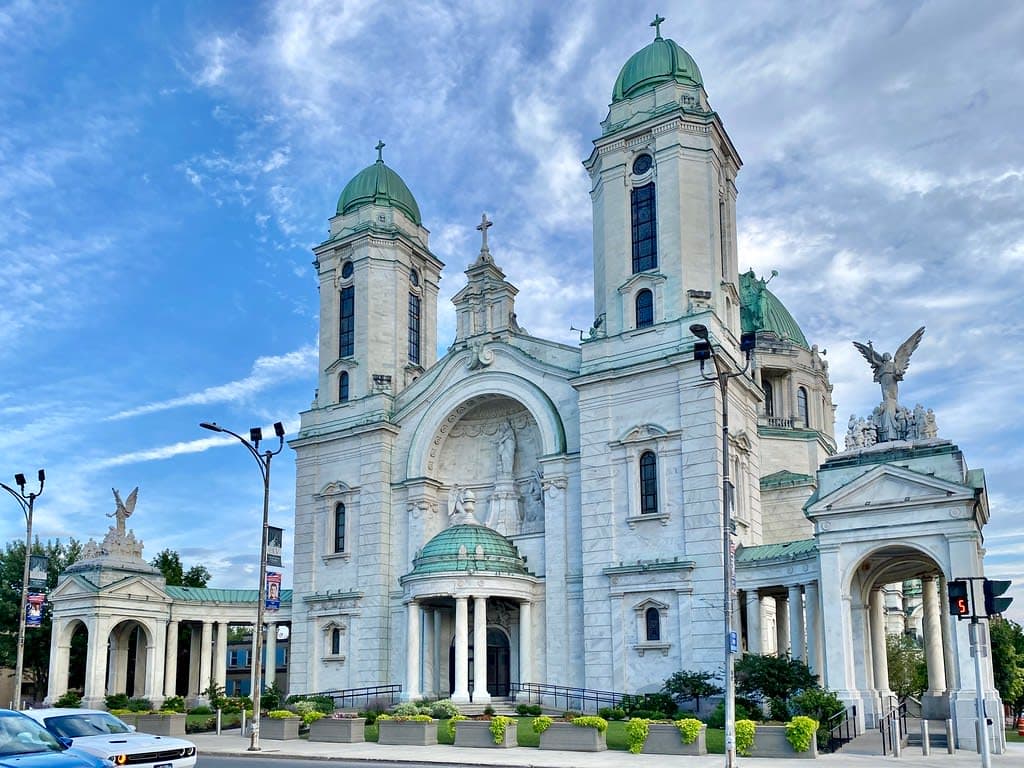
Our Lady of Victory Basilica, Lackawanna, New York
City of Lackawanna, New York, United States
227.8 km away
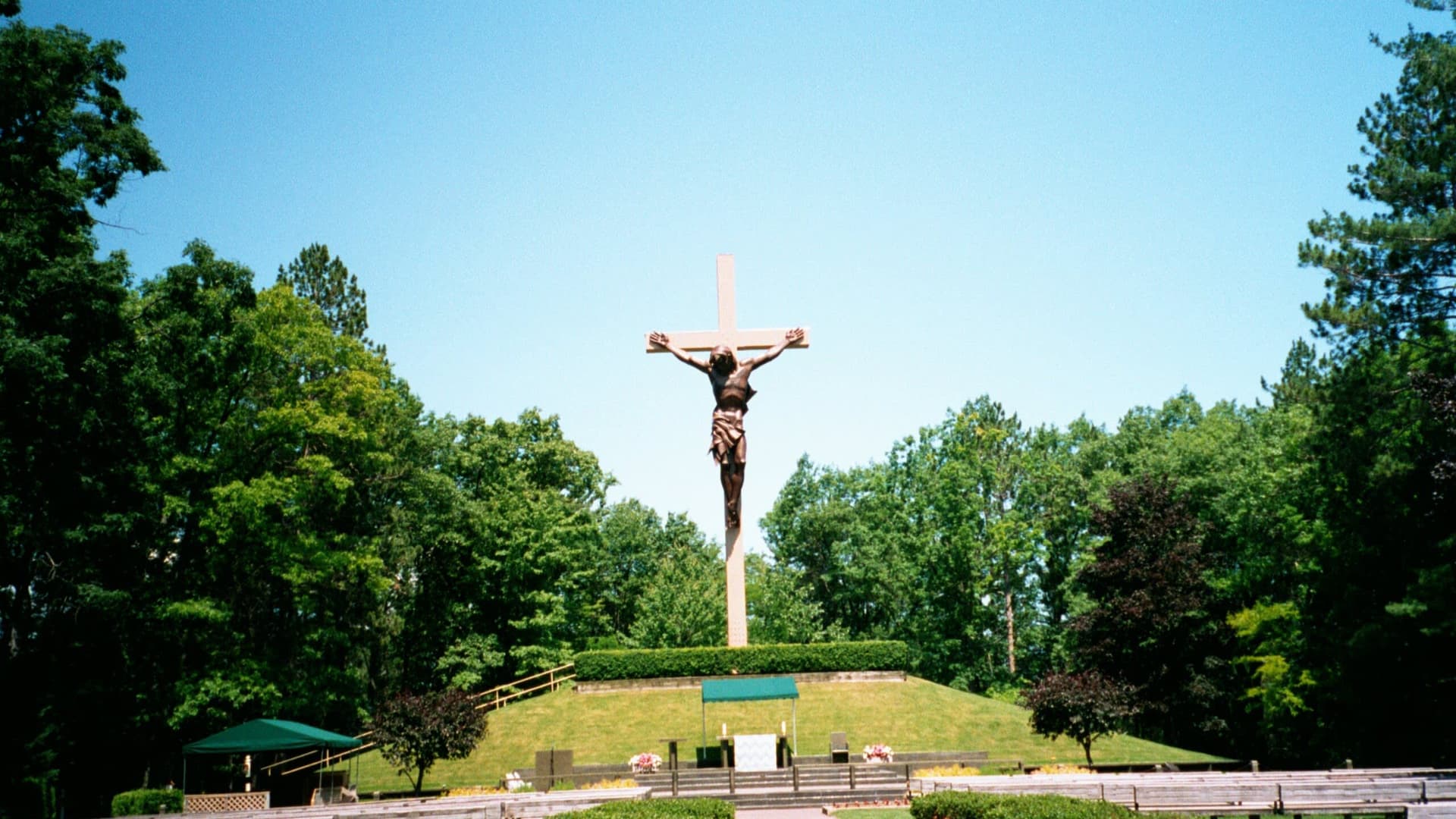
National Shrine of the Cross in the Woods, Indian River, Michigan
Indian River, Michigan, United States
380.3 km away
The Sorrowful Mother Shrine
Bellevue, Ohio, United States
456.7 km away