Malik Ajdar Palwan Tomb
Where a legendary warrior's tomb draws Turkmen pilgrims seeking blessing and connection across centuries
Kaka District, Kaka etraby, Turkmenistan
At A Glance
- Coordinates
- 37.1484, 60.0266
- Suggested Duration
- Allow one to two hours for the mausoleum itself. A half-day permits combining the visit with exploration of Ulug Depe, one kilometer to the north. Those using the guesthouse for overnight stays can deepen their engagement with the site.
- Access
- The site is located near Dushak in Kaka District, Ahal Province, approximately 175 km east of Ashgabat. Turn right off the main road at a turning signposted to the shrine. A guesthouse for pilgrims is available on site. As a foreign visitor to Turkmenistan, you will likely need to arrange your visit through a licensed tour operator, as independent travel in the country is restricted.
Pilgrim Tips
- The site is located near Dushak in Kaka District, Ahal Province, approximately 175 km east of Ashgabat. Turn right off the main road at a turning signposted to the shrine. A guesthouse for pilgrims is available on site. As a foreign visitor to Turkmenistan, you will likely need to arrange your visit through a licensed tour operator, as independent travel in the country is restricted.
- Modest dress is required. Men: long trousers, covered shoulders. Women: covered shoulders and knees, head covering advisable. Remove shoes when entering covered sacred spaces.
- Ask permission before photographing pilgrims or religious activities. Do not photograph people in prayer. The architecture may be photographed respectfully, but remember that this is a place of worship, not a photo opportunity.
- This is an active pilgrimage site. Do not treat ceremonies or prayers as spectacle for photography. If you are not Muslim, approach with the humility of a guest in someone else's sacred space. The reconstruction and heritage designation do not make this a museum; people come here for spiritual purposes that deserve respect.
Overview
Rising from the desert near the ancient Bronze Age mound of Ulug Depe, the Melik Ajdar Mausoleum honors a 12th-century wrestler and warrior-hero whose legendary size and strength made him a figure of veneration. Turkmen pilgrims have journeyed here for centuries, seeking the baraka that flows from the graves of the great, finding in this tomb a living connection between heroic ancestor and divine blessing.
The tomb is built for a giant. Visitors approaching the Melik Ajdar Mausoleum are struck first by its scale—a greyish-green marble sarcophagus comfortably large enough to accommodate a man of legendary proportions. This is no accident. Malik Ajdar Palwan was, according to Turkmen tradition, a 12th-century wrestler of extraordinary size and strength, a hero whose exploits became the stuff of stories passed down through generations.
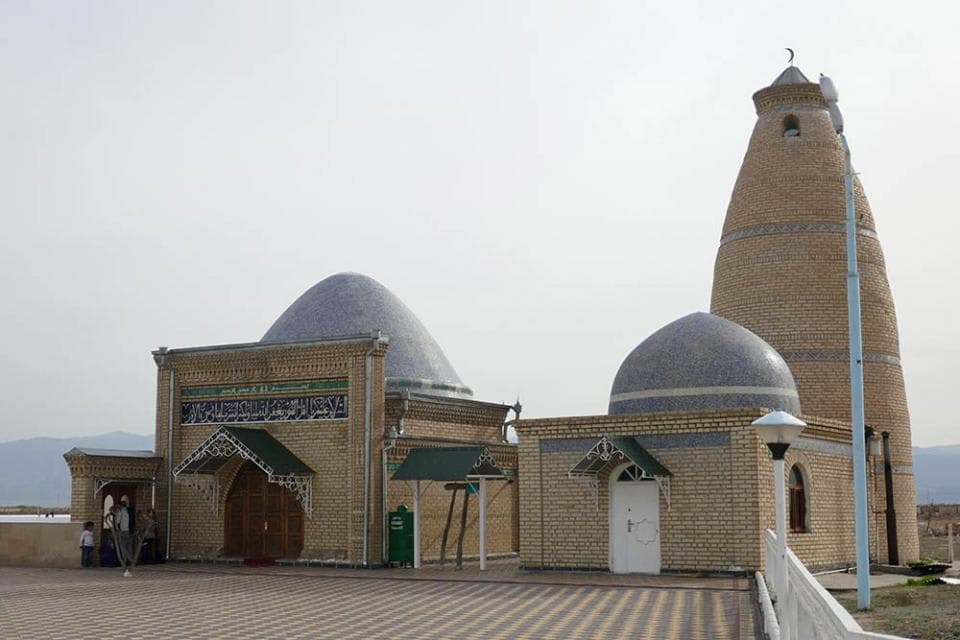
Behind the tomb rises an arcade of tiled columns crowned with five turquoise domes, the distinctive colors of Turkmen sacred architecture marking this as a place where the ordinary gives way to something else. Carved into the marble are the symbols of his identity: sword, shield, arrows. Here lies a warrior, a defender, a champion.
But the pilgrims who come here are not seeking history lessons. They come for what flows from such graves in Turkmen understanding—baraka, spiritual power that the great retain even in death. They come to drink from the sacred well, to offer prayers, to eat ceremonial meals in the designated area, to sleep in the pilgrimage guesthouse. They come, as Turkmen Muslims have come for centuries, to touch the accumulated blessing of a life lived greatly.
Context And Lineage
The mausoleum honors Malik Ajdar Palwan, a 12th-century wrestler and warrior-hero whose legendary exploits made him a figure of ongoing veneration in Turkmen culture. The site has been recently reconstructed and designated as a national heritage site, indicating its continued importance to both popular piety and state recognition.
Malik Ajdar Palwan lived, according to tradition, in the 12th century—a time of Turkic migrations and shifting empires across Central Asia. The details of his life have become legend: a wrestler of extraordinary strength and size, a defender of his people, a hero whose greatness demanded commemoration. The tomb built to honor him was constructed to match his proportions, a physical testament to legendary stature.
The original construction date is unknown, lost in the centuries between his death and the present. What stands now is reconstruction—modern marble and tilework honoring an ancient pattern of veneration. But the site's significance lies not in architecture but in continuity: Turkmen pilgrims have come here across the generations, maintaining the connection between living community and legendary ancestor.
The mausoleum exists within the Turkmen tradition of owliya veneration, influenced by Sufism and rooted in pre-Islamic practices of ancestor respect. This tradition has survived multiple empires, the Russian conquest, the Soviet period's restrictions on religion, and independence. The site's recent reconstruction and national heritage designation speak to its ongoing vitality.
Malik Ajdar Palwan
historical/legendary
A 12th-century wrestler and warrior-hero whose legendary size and strength made him a figure of veneration. His tomb, built to accommodate his giant proportions, draws pilgrims seeking the blessing that flows from the graves of the great.
Why This Place Is Sacred
The mausoleum's sacredness emerges from the Turkmen tradition of owliya veneration, where the graves of heroic figures and saints retain spiritual power accessible to the living. The site sits at the edge of Ulug Depe, an ancient Bronze Age settlement—millennia of human presence concentrated in one location, the legendary warrior's tomb marking the most recent layer of sacredness on ground that has drawn people for thousands of years.
In Turkmen spirituality, death does not end the power of the great. Those who lived with exceptional strength, piety, or heroism become owliya—figures whose graves serve as conduits between the living and the divine. The practice of ziyarat, pilgrimage to such tombs, represents one of the most enduring expressions of Central Asian Islam, a tradition that intensified during the Soviet period when pilgrimage to Mecca was forbidden.
Malik Ajdar Palwan embodies this tradition. His legendary status as a wrestler and defender has made his tomb a place where pilgrims seek intercession, blessing, and healing. The sacred well on site—covered with a large blanket between visitors—draws those seeking its waters for their curative properties. The very size of the tomb speaks to his greatness: here lies someone larger than ordinary life.
The location adds another dimension. One kilometer north rises Ulug Depe, one of Central Asia's most significant archaeological sites, with continuous human occupation from the Neolithic through the pre-Achaemenid period—over four thousand years. The mausoleum is described as the last construction in or around this ancient settlement. Whether by intention or coincidence, the warrior's tomb continues a pattern of human presence at this spot that stretches back to the Bronze Age.
The tomb honors a 12th-century wrestler and hero whose legendary exploits made him a figure worthy of veneration. In Turkmen tradition, such burial sites serve multiple purposes: they mark the resting place of the great, provide a location where their baraka can be accessed, and offer pilgrims a destination for ziyarat—the practice of seeking blessing through proximity to the holy dead.
The current structures are modern reconstructions, the greyish-green marble and tiled colonnade representing recent investment in the site's preservation as a national heritage site of Turkmenistan. What stands before the warrior's imagery was built in the modern era; what lies beneath carries the weight of centuries. The reconstruction indicates continuing official and popular commitment to this tradition of veneration.
Traditions And Practice
The mausoleum hosts active pilgrimage practices including prayer at the tomb, seeking water from the sacred well, communal meals, and overnight stays in the guesthouse. These practices reflect the broader Turkmen tradition of ziyarat—pilgrimage to the tombs of saints and heroes.
Ziyarat to the tombs of owliya traditionally involves several elements: prayer and recitation of Quranic suras at the grave, ritual circumambulation around the tomb, animal sacrifice and communal feasting, the leaving of votive offerings, and seeking intercession through the saint. Pilgrims approach the holy dead as they might approach a living elder—with respect, with requests, with offerings of gratitude.
Modern pilgrims continue these traditions with some adaptations. The guesthouse allows overnight stays, deepening the encounter beyond a single visit. The area designated for ceremonial meals facilitates the communal aspect of pilgrimage. The sacred well draws those seeking its waters for blessing and healing. Prayer at the tomb remains central.
If you come seeking more than sightseeing, consider these approaches: Arrive with intention. Sit quietly near the tomb and offer silent prayer or reflection, regardless of your tradition. If you wish to drink from the sacred well, do so with reverence. If ceremonial meals are being shared, and you are invited to participate, this is an honor. Allow time—the guesthouse exists because some encounters require more than an afternoon.
Turkmen Sunni Islam
ActiveThe mausoleum represents the Turkmen tradition of venerating warrior-saints and heroic figures. Malik Ajdar Palwan, a 12th-century wrestler and hero, embodies the integration of heroic ancestor veneration with Islamic devotion. His tomb serves as a place where baraka (spiritual blessing) can be accessed by pilgrims.
Ziyarat (pilgrimage) to seek blessings and intercession, prayer at the tomb, ceremonial meals at the designated area, seeking blessings from the sacred well on site.
Sufi-influenced folk Islam
ActiveThe practice of visiting the tombs of saints (owliya) is central to Turkmen spirituality and reflects deep Sufi influence on Central Asian Islam. Shrine pilgrimage (ziyarat) represents one of Sufism's most enduring manifestations in the region, providing access to blessing through the intercession of those who achieved spiritual greatness.
Seeking intercession (tawassul) from the saint, votive offerings and gifts, ritual circumambulation, reading Quranic suras at the grave.
Experience And Perspectives
Pilgrims report being moved by the tomb's unusual scale, the visual impact of warrior symbols against polished marble, and the quiet purposefulness of the shrine complex. The presence of guesthouse and ceremonial meal area speaks to a site built for extended encounter, not brief visit.
The mausoleum makes an immediate impression. The tomb itself, built to accommodate legendary proportions, sits within its arcade of turquoise domes like a warrior at rest—the sword, shield, and arrows carved into marble testifying to identity even now. The greyish-green stone catches light differently throughout the day, and pilgrims often spend considerable time simply sitting with what lies before them.
The sacred well draws its own seekers. Covered between uses with a large blanket, the well is believed to offer water carrying blessing and healing. Those who drink or wash from it do so with intention, seeking what the spring provides.
The infrastructure of pilgrimage shapes the experience. A guesthouse receives those who wish to stay overnight, allowing the encounter to deepen beyond a single visit. The designated area for ceremonial meals near the car park facilitates the communal feasting that often accompanies ziyarat—the sharing of food blessed by proximity to the holy.
Many visitors combine their pilgrimage with exploration of nearby Ulug Depe, walking from the mausoleum northward to encounter the Bronze Age ruins. The juxtaposition is striking: ancient mounds speaking of four thousand years of human presence, and the warrior's tomb continuing that presence into the present day.
This is a site that rewards slow approach. Pilgrims traditionally come not to photograph but to pray, to seek blessing, to participate in the living tradition of owliya veneration. If you are not Muslim, you may still visit respectfully—the site receives seekers of various backgrounds. But approach as guest rather than tourist. The people you encounter here are engaged in something real.
The Melik Ajdar Mausoleum exists at the intersection of history and legend, where a 12th-century warrior becomes a saint whose blessing continues to flow. Understanding the site requires holding together what scholarship can verify and what tradition holds sacred—without forcing either to yield to the other.
The mausoleum represents the widespread Turkmen tradition of owliya (saint) veneration, which combines Islamic piety with respect for heroic ancestors. Scholars note that this practice has roots predating Islam, drawing on Turkic and Central Asian traditions of ancestor veneration that were absorbed into Islamic frameworks. The practice of ziyarat to such sites has been central to Turkmen religious life for centuries and intensified during the Soviet period when pilgrimage to Mecca was forbidden. The site's national heritage designation reflects its cultural importance within independent Turkmenistan.
In Turkmen understanding, Malik Ajdar Palwan was a legendary 12th-century wrestler and hero whose spiritual power continues to bless those who visit his tomb. The practice of hatira (honoring ancestors) and ziyarat (pilgrimage) represents a sacred duty and a means of accessing divine blessing through the intercession of revered figures. The grave is not merely a memorial but an active site where the great dead can be approached, petitioned, and thanked.
Much about Malik Ajdar Palwan remains legendary rather than documented. Little is known about his actual life beyond the stories passed down through oral tradition. The original construction date of the shrine is unknown, and the current structures are reconstructions. Perhaps most intriguing is the relationship between the mausoleum and Ulug Depe—the shrine described as the last construction at or near a site continuously occupied for over four thousand years. Whether this represents intentional continuity of sacred significance or coincidence remains unexplored.
Visit Planning
Located near Dushak in Kaka District, approximately 175 km east of Ashgabat, the mausoleum is accessible by road and offers pilgrimage infrastructure including a guesthouse. Spring and autumn provide the most comfortable visiting conditions.
The site is located near Dushak in Kaka District, Ahal Province, approximately 175 km east of Ashgabat. Turn right off the main road at a turning signposted to the shrine. A guesthouse for pilgrims is available on site. As a foreign visitor to Turkmenistan, you will likely need to arrange your visit through a licensed tour operator, as independent travel in the country is restricted.
A guesthouse for pilgrims is available on site. For more extensive accommodations, Ashgabat offers hotels of various standards. Given Turkmenistan's travel restrictions, most foreign visitors will be traveling with arranged tours that include accommodation.
As an active pilgrimage site, the mausoleum requires modest dress, respectful behavior, and sensitivity to those engaged in prayer and ritual. Remove shoes before entering covered sacred spaces. During Ramadan, avoid eating or drinking in public during daylight hours.
Your presence here is a privilege extended by a living tradition. Pilgrims come to seek blessing, to pray, to fulfill spiritual obligations. This context shapes what respect requires.
Modest dress is expected at all Turkmen religious sites. Men should avoid shorts. Women should cover shoulders and knees, and bring a head covering—even if not strictly required, it demonstrates respect. Shoes must be removed before entering any covered sacred spaces.
Move quietly. If pilgrims are engaged in prayer or ritual, do not approach closely, do not photograph, do not interrupt. You are witnessing something that is not for your consumption. Keep your voice low and your presence unobtrusive.
During Ramadan, be mindful of those fasting. Do not eat or drink in public during daylight hours. This is not merely politeness but participation in the rhythm of the community you are visiting.
Modest dress is required. Men: long trousers, covered shoulders. Women: covered shoulders and knees, head covering advisable. Remove shoes when entering covered sacred spaces.
Ask permission before photographing pilgrims or religious activities. Do not photograph people in prayer. The architecture may be photographed respectfully, but remember that this is a place of worship, not a photo opportunity.
Gifts and offerings are traditionally brought to the saint and received by site caretakers. Small monetary donations may be appropriate. If you are unsure what is customary, observe what others do.
{"Modest dress required at all times","Shoes removed in covered sacred spaces","No photography of pilgrims in prayer without permission","Avoid eating or drinking in public during Ramadan daylight hours","Maintain quiet and respectful behavior throughout"}
Sacred Cluster
Nearby sacred places create the location cluster described in the growth plan. This block is intentionally crawlable and links into the wider regional graph.