Lato
A Dorian city-state named for a goddess, set between twin peaks above Mirabello Bay
Agios Nikolaos Municipal Unit, Region of Crete, Greece
At A Glance
- Coordinates
- 35.1790, 25.6553
- Suggested Duration
- Sixty to ninety minutes for a thorough exploration of the accessible central area. Allow additional time for the uphill walk from the parking area (approximately fifteen minutes) and for enjoying the panoramic views from the acropolis peaks. Visitors with a strong interest in ancient architecture or Dorian civic planning may wish to spend two hours or more.
- Access
- Located approximately 3 km north of the village of Kritsa and 13 km southwest of Agios Nikolaos, in the Lasithi regional unit of eastern Crete. A paved road from Kritsa leads to a parking area at the base of the hill. No public bus service runs directly to the site; the nearest bus stop is in Kritsa, from which it is a 3 km walk along the road. A rental car is the most practical option. GPS coordinates: approximately 35 degrees 10 minutes 40 seconds N, 25 degrees 39 minutes 13 seconds E, at an elevation of 300-400 meters. Admission: approximately 5 EUR full price, 2.50 EUR reduced (2025 prices; verify current rates). Free admission days include March 6, April 18, May 18, the last weekend of September, and October 28. Hours: 08:30-15:30 (may vary seasonally; confirm with local authorities). Contact: +30 28410 22462 or efalas@culture.gr. The site has uneven, rocky terrain with no wheelchair-accessible paths. Mobile phone signal may be limited.
Pilgrim Tips
- Located approximately 3 km north of the village of Kritsa and 13 km southwest of Agios Nikolaos, in the Lasithi regional unit of eastern Crete. A paved road from Kritsa leads to a parking area at the base of the hill. No public bus service runs directly to the site; the nearest bus stop is in Kritsa, from which it is a 3 km walk along the road. A rental car is the most practical option. GPS coordinates: approximately 35 degrees 10 minutes 40 seconds N, 25 degrees 39 minutes 13 seconds E, at an elevation of 300-400 meters. Admission: approximately 5 EUR full price, 2.50 EUR reduced (2025 prices; verify current rates). Free admission days include March 6, April 18, May 18, the last weekend of September, and October 28. Hours: 08:30-15:30 (may vary seasonally; confirm with local authorities). Contact: +30 28410 22462 or efalas@culture.gr. The site has uneven, rocky terrain with no wheelchair-accessible paths. Mobile phone signal may be limited.
- No formal dress code. Sturdy, closed-toe walking shoes with good grip are essential — the terrain is rocky, uneven, and includes significant uphill sections. Sun protection is critical: the exposed hillside offers almost no shade. A hat, sunscreen, and lightweight long sleeves are strongly recommended, particularly in summer. In cooler months, a wind-resistant layer is advisable, as the ridge is exposed.
- Photography is permitted throughout the accessible areas of the site for personal use. The combination of well-preserved stone architecture against the Cretan mountain landscape and Mirabello Bay makes Lato a particularly photogenic site. No special permits are required for non-commercial photography.
- Lato is an archaeological site with no facilities. There is no shade, no water, and no food available at the ruins. The terrain is rocky and uneven, with steep sections on the approach to the acropolis peaks. Stay within the fenced accessible area. Do not climb on or move any stones. Outlying areas and unexcavated sections are off-limits.
Overview
High on a mountain saddle in eastern Crete, the ruins of Lato spread across a ridge overlooking the Gulf of Mirabello. Named after Leto — rendered as Lato in the Doric dialect — the mother of Apollo and Artemis, this city-state wove divine motherhood into its very identity. Abandoned around 200 BCE, its agora, temples, and prytaneion remain among the best-preserved examples of Classical-Hellenistic civic architecture in Crete.
Some cities are named for their founders. Some for geographic features. Lato was named for a goddess. The Doric form of Leto — the Titaness who wandered the earth in labor, seeking a place to give birth to Apollo and Artemis — became the name of an entire community, an act that placed divine motherhood at the foundation of civic life.
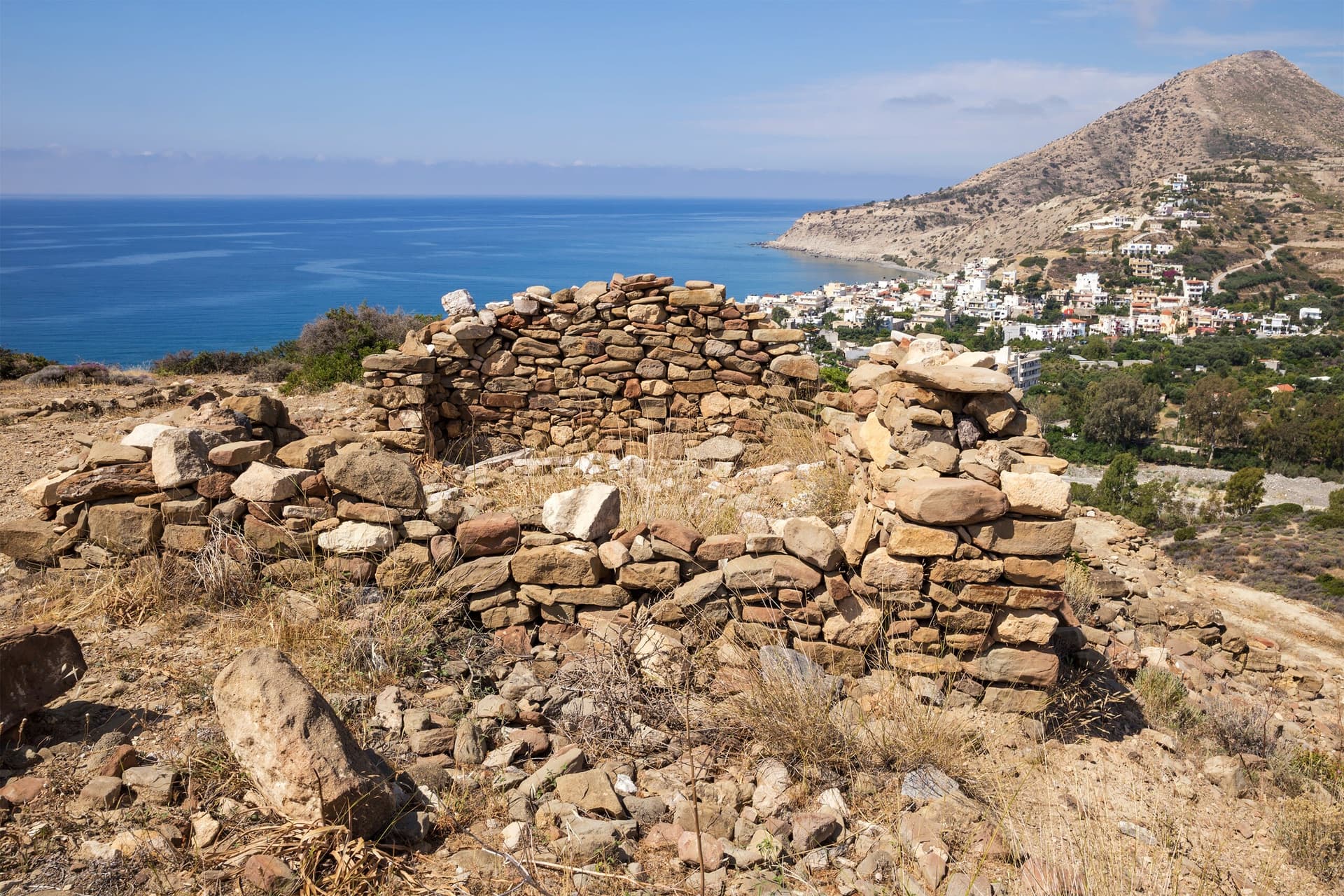
The city occupies a saddle between two acropolis peaks in the mountains above what is now the village of Kritsa, roughly thirteen kilometers southwest of Agios Nikolaos. From the agora, the Gulf of Mirabello opens to the north, a sweep of blue water that the citizens of Lato would have watched for approaching ships, allies, and threats. The twin peaks that bracket the settlement rise like shoulders, giving the city a natural amphitheatre of stone and sky.
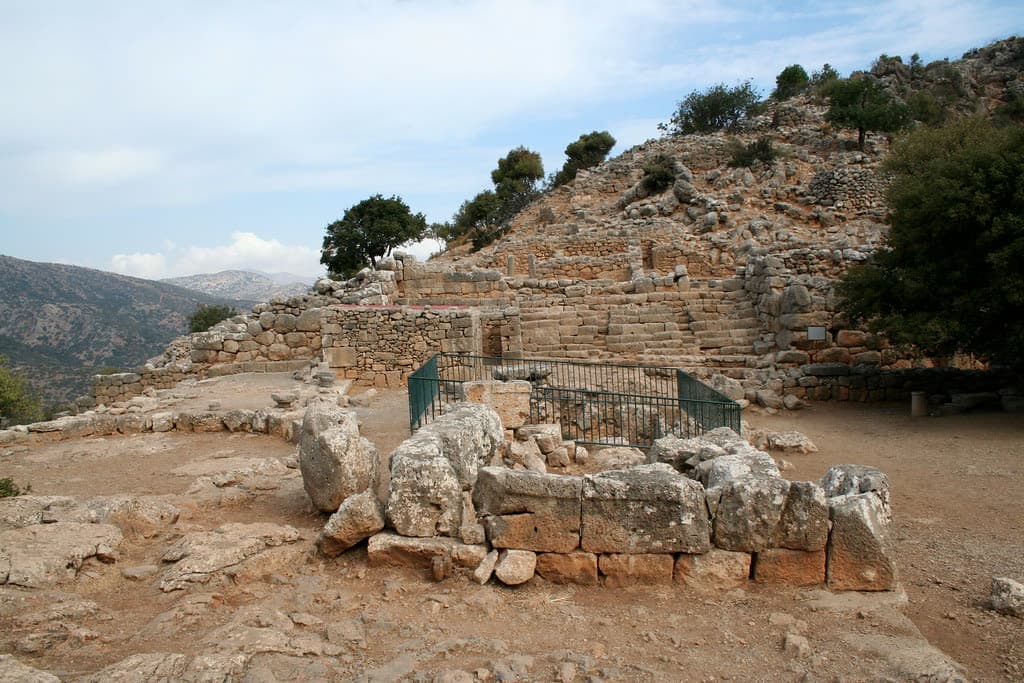
What remains is remarkably legible. The stepped main street ascends through the residential quarters to the civic heart, where the agora, the great temple, the prytaneion with its perpetual hearth, and the theatral assembly area cluster together in an arrangement that reveals how thoroughly the Dorian Greeks integrated worship, governance, and community life. An enormous rock-cut cistern speaks to the practical ingenuity required to sustain a hilltop city. The temple of Apollo, with its altar and statue base, commands the southern acropolis.
Lato flourished from the seventh to the third century BCE, then its inhabitants migrated to the port settlement of Lato pros Kamara — the area of modern Agios Nikolaos — and the hilltop city fell silent. French archaeologists excavated the civic center in 1899 and again in the 1960s, but much of the city remains unexcavated beneath the scrub and stone. What is visible today carries the particular authority of an ancient place that has never been rebuilt or restored to satisfy modern expectations.
Context And Lineage
Lato was a major Dorian city-state in eastern Crete, its religious life centered on the goddess Leto and her divine family. The city's archaeology reveals how the Dorian Greeks integrated worship into every aspect of civic architecture, and its worship of Eileithyia may preserve echoes of pre-Dorian Cretan goddess traditions stretching back to the Bronze Age.
The city's name tells its origin story. Lato is the Doric form of Leto, the Titaness daughter of Coeus and Phoebe, whom Zeus loved and Hera persecuted. Pregnant with the divine twins Apollo and Artemis, Leto wandered the earth seeking a place to give birth, refused by every land that feared Hera's wrath. Only the barren island of Delos finally received her, and there she delivered the twin gods who would become central to Greek religion. Her veneration in Crete may reach deeper than the Olympian pantheon, reflecting older traditions of mother-goddess worship that the Dorian settlers absorbed when they arrived on the island.
The possible reference to the site as 'ra-to' in Linear B tablets from Knossos, dating to approximately 1400 BCE, hints at a Bronze Age precursor to the Dorian city. If the identification is correct, the settlement's roots extend into the Minoan world, centuries before the Dorians arrived. The nearby site of Kastellos hill preserves a Late Minoan settlement from the thirteenth to twelfth centuries BCE, suggesting continuous human activity in this landscape across the transition from the Bronze Age to the Iron Age.
What emerged in the seventh century BCE was not merely a settlement but a city-state that carried a goddess's name as its identity, that built temples to her and her children at its civic center, and that minted coins bearing the images of its divine patrons. To be a citizen of Lato was to belong to Leto.
Lato belongs to the tradition of Dorian city-states that reshaped Cretan civilization after the collapse of the Minoan and Mycenaean worlds. The Dorians arrived between approximately 1100 and 900 BCE, establishing fortified hilltop settlements across the island. Lato's religious life connected it to a broader Cretan pattern of Leto worship — she was also venerated at Phaistos as Leto Phytia — and to the pan-Cretan tradition of Apollo worship that linked cities like Dreros, Prinias, and Gortyn. The worship of Eileithyia at Lato may represent an even older strand, a continuity of Minoan goddess worship absorbed into the Dorian religious framework. The city's conflict with Olous and Hierapytna in the Hellenistic period placed it within the volatile political landscape of eastern Crete, where city-states competed not only for territory but for control of sacred sites. The French School of Archaeology's excavations in 1899-1901 and 1967-1972 established the site's scholarly importance, and ongoing protection by the Greek Ministry of Culture ensures its preservation.
Nearchus (Nearchos)
The most famous native of Lato, Nearchus served as admiral of Alexander the Great's fleet and commanded the historic voyage from the Indus River to the Persian Gulf between 326 and 324 BCE. Born in Lato to a family that later settled in Amphipolis, he represents the reach of this Cretan mountain city into the wider Mediterranean and Asian world.
Joseph Demargne
French archaeologist who conducted the first systematic excavations at Lato in 1899-1901 under the French School of Archaeology at Athens. His work revealed the civic center and established the site's significance as one of the best-preserved Dorian city-states in the Greek world.
Pierre Ducrey
French archaeologist and historian who resumed excavations at Lato from 1967 to 1972, publishing detailed studies of the prytaneion that illuminated how Dorian civic governance and sacred practice were architecturally intertwined.
Olivier Picard
French archaeologist and numismatist who co-directed the 1967-1972 excavations alongside Ducrey. His expertise in ancient coinage helped establish the significance of Lato's coins, which depicted Eileithyia, Artemis, and Hermes Lation and revealed the city's religious priorities.
Vana Chatzimichali
Greek archaeologist who collaborated with Ducrey and Picard on the resumed excavations, contributing essential local scholarly knowledge to the French-led project and helping to situate Lato within the broader context of Cretan Dorian archaeology.
Why This Place Is Sacred
Lato's sacredness derives from its elevation between earth and sky, the convergence of multiple deity cults in a single civic space, shrines that predate the city itself, and the layering of Bronze Age origins beneath Dorian settlement — a palimpsest of human aspiration against Cretan stone and wind.
The quality that sets Lato apart from other archaeological ruins arises from the convergence of several conditions that the ancient world consistently recognized as sacred.
The first is elevation. The city sits at roughly 300 to 400 meters above sea level on a mountain saddle between two peaks, exposed to wind and light from every direction. The Dikti Mountains rise behind, and the Gulf of Mirabello stretches below. Ancient peoples across the Mediterranean built sanctuaries in high places, understanding elevation as proximity to the divine. Lato did not merely build a temple on a high place. It built an entire city there, a community that lived its daily life in the space between earth and sky.
The second is the density of sacred presence. Multiple deities received worship within the city walls. Leto, the city's namesake and patroness. Eileithyia, the goddess of childbirth, described as the most important goddess of the city, whose worship may reach back to pre-Dorian, possibly Minoan traditions. Apollo, son of Leto, with his own two-room temple and altar on the southern acropolis. Artemis, Zeus, Demeter, and Hermes Lation all received recognition, their images appearing on the city's coinage. The convergence of so many cults in a single settlement suggests the Latians experienced their location as a nexus of divine attention.
The third is temporal depth. The shrines at Lato appear to predate the city itself, with activity at these sacred locations reaching back to the eighth or seventh century BCE before the major civic construction began. A possible reference to the site as 'ra-to' in Linear B tablets from Knossos, dating to around 1400 BCE, would push the settlement's origins into the Late Bronze Age Minoan world. People recognized something sacred about this ridge before they chose to build a city around it.
The fourth condition is the particular atmosphere of abandonment. Unlike sites that have been continuously occupied or extensively restored, Lato was left to the wind and the wild herbs when its people moved to the port. The ruins have the quality of an interrupted conversation — walls still standing to window height, doorways still framing views of the sea, a cistern still holding the shape of the water it once contained. The silence is not empty. It is the silence of a place remembering.
Lato was established as a Dorian city-state, likely in the seventh century BCE, building upon a site with possible Bronze Age antecedents. Its founding purpose was simultaneously civic and religious. The city was named after the goddess Leto in her Doric form, placing divine patronage at the center of community identity. The placement of temples, altars, and the sacred hearth of the prytaneion within and around the central agora demonstrates that religion, governance, and daily civic life were architecturally and conceptually inseparable. The shrines at the site predate the major construction phase, suggesting that the location's sacred associations motivated the urban settlement rather than the other way around.
From its establishment as a Dorian city-state, Lato grew through the Archaic and Classical periods into one of the most powerful cities in eastern Crete. The well-preserved ruins date primarily from the fifth to third centuries BCE, the period of greatest construction. The city's port, Lato pros Kamara, developed on the coast near modern Agios Nikolaos as a commercial center. Around 200 BCE, the hilltop city was abandoned — whether through sudden destruction connected to the Cretan wars or through gradual depopulation as civic life shifted to the port remains debated. The port settlement continued to thrive into the Roman period. In the second century BCE, Lato engaged in a bitter conflict with neighboring Olous over the administration of a sanctuary and possession of the islet of Pyrrha, suggesting that sacred geography remained politically vital even after the hilltop city was empty. French archaeologist Joseph Demargne conducted the first systematic excavations in 1899-1901. Pierre Ducrey, Olivier Picard, and Vana Chatzimichali resumed work in 1967-1972. The site is now a protected archaeological monument managed by the Greek Ministry of Culture.
Traditions And Practice
Lato's religious practices centered on temple worship of Leto, Eileithyia, Apollo, and other deities, with the prytaneion's perpetual hearth blending governance and the sacred. No active practices continue today. Visitors engage through walking the ancient city and contemplating the integration of the divine and the civic.
The religious life of Lato was inseparable from its civic life, an arrangement made architecturally explicit by the placement of temples and altars within and around the central agora. The Great Temple in the agora served as the focal point for the community's collective worship, its altar the site of sacrifice and offering that sustained the relationship between the citizens and their gods.
The prytaneion was both a political and a sacred building. At its center burned a perpetual fire, the eschara, maintained day and night as a symbol of the city-state's continuity and vitality. Around this hearth, the kosmioi — the elected magistrates who governed Lato — dined and conducted the business of the city. The distinction between a government building and a temple simply did not apply. Governance was a sacred act performed in the presence of a sacred fire.
On the southern acropolis, a two-room temple dedicated to Apollo housed an altar and a cult statue of the god. As the son of the city's namesake goddess, Apollo occupied a central position in Lato's religious identity. The presence of a separate sanctuary complex near the agora, with its own temple and altar, suggests a hierarchy of worship spaces serving different functions and perhaps different deities.
The worship of Eileithyia, goddess of childbirth, was particularly significant. Described as the most important goddess of the city, her image appeared on Lato's coinage alongside Artemis and Hermes Lation. The veneration of Eileithyia in Crete has deep pre-Greek roots — she was worshipped at the sacred cave of Amnisos near Knossos from at least the Minoan period — and her cult at Lato may represent the survival of indigenous Cretan goddess traditions within the Dorian religious framework.
Public assemblies and religious performances took place in the theatral area adjacent to the agora, where the broad steps provided seating for citizens gathering to witness ceremonies, debates, and festivals. The integration of performance space with religious and civic architecture reflects the Dorian understanding that public life was inherently ceremonial.
No worship or ritual activity takes place at Lato today. The city has been an uninhabited ruin since approximately 200 BCE. The site functions as a protected archaeological monument, and finds from the excavations are displayed in the Archaeological Museum of Agios Nikolaos.
Approach Lato as its citizens approached their agora: by ascending. The walk up the stepped main street is not merely transit but preparation, a passage from the modern world into the ancient civic space. Walk slowly. Notice how the street narrows and widens, how doorways frame the sea, how the city reveals itself incrementally.
At the agora, stand where the Great Temple altar once received offerings. Face the prytaneion and try to hold in mind that the hearth within once burned continuously — a fire that embodied the life of the community. When it burned, the city lived. When the city was abandoned, the fire died.
Climb to the southern acropolis and Apollo's temple. The altar base and statue platform remain. Consider that the people who worshipped here could see the ships entering Mirabello Bay from this vantage point, that their prayers and their practical concerns shared the same horizon.
If the wind is strong — and on this exposed ridge it often is — let it be part of the experience. The citizens of Lato lived with this wind every day. It carried the scent of thyme from the hillsides and salt from the sea below. It was the breath of a place that the ancients considered inhabited by gods.
Cult of Leto (Lato) — Dorian Greek Worship
HistoricalThe city bore the goddess's name in its Doric form, making Leto's worship inseparable from civic identity. At Phaistos she was venerated as Leto Phytia, overseeing growth and generation, and at Lato her cult likely carried similar associations with motherhood and fertility. Her appearance on the city's coinage confirmed her civic-religious importance. To name a city after a goddess was to declare that every act of citizenship occurred under her gaze.
Temple worship and votive offerings to Leto within the sanctuary complexCivic coinage bearing the goddess's imageIntegration of Leto's worship into the civic calendar and public ceremonies
Cult of Eileithyia — Goddess of Childbirth
HistoricalEileithyia was described as the most important goddess of Lato, her image appearing on the city's coinage. Her worship in Crete has deep pre-Greek roots, possibly extending to the Minoan period, and her veneration at Lato may represent a rare case of religious continuity across the Dorian arrival — indigenous Cretan goddess traditions absorbed into and preserved within the new cultural framework.
Temple worship at a dedicated shrine within the cityDepiction on civic coinage alongside Artemis and HermesLikely prayers and offerings by expectant mothers and families, a practice well-attested at other Eileithyia shrines in Crete
Cult of Apollo — Dorian Greek Worship
HistoricalApollo, son of Leto and twin brother of Artemis, was worshipped at a two-room temple on the southern acropolis that housed an altar and cult statue. As the child of the city's namesake goddess, Apollo's presence completed the divine family at the heart of Lato's identity. The nearby rival city of Dreros also maintained a major temple to Apollo Delphinios, reflecting the god's widespread importance across Dorian Crete.
Temple worship at the two-room temple on the southern acropolis with altar and cult statueReligious observances connected to the broader Cretan Dorian tradition of Apollo worship
Civic Sacred Hearth — The Prytaneion
HistoricalThe prytaneion housed a perpetual fire, the eschara, that burned day and night as a symbol of the city-state's vitality and continuity. Around this sacred hearth, the kosmioi — Lato's elected magistrates — dined and governed. The prytaneion was simultaneously the most important political and the most important religious building in the city, embodying the Dorian understanding that governance was inherently a sacred act.
Maintenance of the perpetual sacred fire (eschara)Communal dining of the kosmioi (magistrates) around the hearthCivic governance conducted in the presence of the sacred flameReception of official guests and envoys
Experience And Perspectives
Visiting Lato is an ascent through an ancient city that rewards slowness. The walk from the entrance gate up the stepped main street to the agora unfolds the city's logic, culminating in a civic center that still communicates the integration of worship, governance, and community life, all set against one of the most commanding views in Crete.
The road from Kritsa winds north through olive groves and scrubland before reaching a parking area at the base of the hill. From here, the city is not yet visible. The path begins modestly, passing through the site's entrance gate and ascending along the ancient main street — a stepped road that climbs through what were once residential quarters, with house foundations visible on either side.
This ascent is the first essential experience of Lato. The city was designed to be approached from below, each step carrying the visitor higher above the coastal plain and deeper into the civic space. House walls still stand to considerable height in places, their doorways opening onto views that have not changed in twenty-five centuries. The stone underfoot is worn smooth by the passage of Dorian citizens — merchants, magistrates, mothers bringing offerings to Eileithyia, sailors returning from the port.
The street delivers you to the agora, and the scale shifts. This was the civic heart of Lato, and its arrangement still speaks clearly. The great temple stands at one edge, its altar base marking where the community gathered for collective worship. Nearby, the prytaneion — the civic hall where elected magistrates dined around a perpetual sacred fire — communicates the Dorian understanding that governance was a sacred act. The hearth at the center of the prytaneion, the eschara, burned continuously as a symbol of the city-state's vitality. To let it die was to let the city die.
Adjacent to the prytaneion, the theatral area opens as a set of broad steps where citizens assembled for public debate and religious performances. The design is modest compared to the great theatres of Athens or Epidaurus, but it has a directness that those larger structures lack. Here, every citizen could see every other citizen's face.
The enormous rock-cut cistern nearby is an engineering feat that strikes many visitors as powerfully as the temples. Carved into the living rock to collect and store rainwater for the hilltop community, it represents the practical ingenuity that made sacred city life possible in this arid, elevated landscape.
From the agora, paths lead to both acropolis peaks. The southern acropolis holds the remains of Apollo's temple — a two-room structure with altar and a base where the god's cult statue once stood. The northern acropolis offers the most expansive views. To the north, Mirabello Bay unfolds in a sweep of light. To the south and west, the Dikti Mountains rise. On clear days, the sense of exposure — of standing where the city's watchmen stood, scanning the horizon — is vivid.
What most visitors report is the solitude. Lato receives a fraction of the traffic that passes through Knossos or Phaistos. On many days, especially in the shoulder seasons, you may have the city largely to yourself. This solitude is itself an experience of the site's meaning. The wind carries the scent of thyme and sage. Lizards sun themselves on the prytaneion walls. The silence is not the silence of emptiness but of a place that has been listening for a very long time.
Allow sixty to ninety minutes for a thorough exploration of the accessible central area, plus additional time for the uphill walk from the parking area and for lingering at the viewpoints. The site has limited signage, so reading about the agora, prytaneion, and temple layout beforehand significantly deepens the visit. Bring water — there is no shade and no refreshment available at the site. Sturdy footwear is essential for the rocky, uneven terrain. Morning or late afternoon visits in spring and autumn offer the most comfortable conditions and the best light. The site is closed on Tuesdays.
Lato can be understood as an archaeological site, as evidence of Dorian civic design, as a window into how the ancient Greeks integrated religion and governance, or as a place where the layered presence of vanished worshippers gives the ruins a quality that exceeds their physical remains.
Archaeological and historical scholarship recognizes Lato as one of the best-preserved examples of a Classical-Hellenistic Cretan city-state, providing invaluable evidence for understanding Dorian urban planning, civic architecture, and the integration of religious and political life. The French School excavations established the site's significance, revealing a civic center whose arrangement — temples in and around the agora, the perpetual fire in the prytaneion, the theatral assembly area — demonstrates how religion was woven into every aspect of Dorian governance. The worship of Eileithyia is considered particularly significant as possible evidence of pre-Dorian religious continuity on Crete, suggesting that the Dorian settlers absorbed indigenous goddess traditions into their own religious framework. Only a portion of the site has been excavated; the residential quarters, cemeteries, and outlying sanctuaries remain largely unexplored, promising significant future discoveries. The Harvard Center for Hellenic Studies has published research on Lato's political relationships with neighboring city-states, particularly the conflicts with Olous and Hierapytna that shaped eastern Crete's sacred and political geography.
No living religious tradition claims Lato. The Dorian polytheism that animated the city's temples and hearth died with the end of the ancient world. Yet the site's position in the landscape — a hilltop city dedicated to a goddess of motherhood, overlooking a bay that carried the city's commerce and connections — speaks to patterns of sacred geography that recur across Mediterranean cultures. The worship of Eileithyia, with its possible roots in Minoan goddess veneration, connects Lato to the deepest stratum of Cretan religious experience, a tradition that may predate the Greek language itself.
For visitors attuned to the contemplative dimensions of archaeological sites, Lato offers something that more famous ruins often cannot: solitude and atmospheric integrity. Without reconstruction, without crowds, without the interpretive apparatus that distances visitors from direct encounter, the ruins stand in their landscape much as they have stood for two millennia. The wind, the herbs growing between the stones, the sea visible through doorways that once framed domestic life — these sensory elements create an experience that some visitors describe as deeply meditative. The convergence of multiple deity cults in a single civic space, and the shrines that predate the city itself, suggest that the ancient Latians experienced this ridge as a place where the divine was unusually present. Whether that presence persists in the landscape or only in the imagination of sympathetic visitors is a question the site leaves open.
Several aspects of Lato resist resolution. The precise relationship between Bronze Age activity at the site and the later Dorian religious institutions remains unclear — was there genuine religious continuity across the centuries of disruption that separated the Minoans from the Dorians, or did the newcomers independently recognize a sacred quality in the landscape? The exact circumstances of the city's abandonment around 200 BCE are debated, with some scholars pointing to sudden destruction and others to gradual decline. The full extent of the city is unknown, as only the central civic-religious core has been excavated. The nature of Eileithyia worship at Lato — whether it represents a Minoan survival or a Dorian innovation — is an open question with implications for understanding religious continuity across one of the ancient world's most significant cultural transitions. And the conflict with Olous over a sanctuary's administration, occurring decades after the hilltop city was abandoned, raises the unresolved question of what sacred site was being contested and why it mattered so deeply.
Visit Planning
Open daily except Tuesdays, located 3 km north of Kritsa village in eastern Crete. Accessible by car with parking at the base. Allow 60-90 minutes. Spring and autumn offer the best conditions. Admission approximately 5 EUR.
Located approximately 3 km north of the village of Kritsa and 13 km southwest of Agios Nikolaos, in the Lasithi regional unit of eastern Crete. A paved road from Kritsa leads to a parking area at the base of the hill. No public bus service runs directly to the site; the nearest bus stop is in Kritsa, from which it is a 3 km walk along the road. A rental car is the most practical option. GPS coordinates: approximately 35 degrees 10 minutes 40 seconds N, 25 degrees 39 minutes 13 seconds E, at an elevation of 300-400 meters. Admission: approximately 5 EUR full price, 2.50 EUR reduced (2025 prices; verify current rates). Free admission days include March 6, April 18, May 18, the last weekend of September, and October 28. Hours: 08:30-15:30 (may vary seasonally; confirm with local authorities). Contact: +30 28410 22462 or efalas@culture.gr. The site has uneven, rocky terrain with no wheelchair-accessible paths. Mobile phone signal may be limited.
Kritsa village, 3 km south of the site, offers guesthouses and small hotels with a traditional Cretan character. Agios Nikolaos, 13 km northeast, provides a full range of accommodation from budget to boutique, along with restaurants, markets, and the Archaeological Museum where finds from Lato are displayed. Staying in Kritsa allows for an early-morning visit to the ruins before the heat builds.
Standard archaeological site etiquette applies. Stay on paths, do not climb ruins or remove materials, and respect access restrictions. No formal dress code, but sturdy shoes and sun protection are essential for this exposed hilltop site.
Lato carries no religious etiquette in the contemporary sense — its temples have been silent for over two thousand years. What it asks of visitors is the attentiveness that any place of deep human history deserves, combined with the practical caution that an exposed, rocky hillside demands.
The fenced accessible area encompasses the excavated civic center. Stay within it. Unexcavated areas and outlying sections of the city are off-limits, both for visitor safety and for the protection of buried archaeological deposits. Do not climb on walls, sit on temple foundations, or move any stones. The ruins have survived twenty-two centuries of wind and weather, but they are fragile in ways that are not always visible.
The site's isolation is part of its value. Visitors who speak quietly, move slowly, and refrain from playing music or making excessive noise will find that Lato rewards a contemplative approach. The wind, the birdsong, the silence between them — these are the sounds that belong to this place.
No formal dress code. Sturdy, closed-toe walking shoes with good grip are essential — the terrain is rocky, uneven, and includes significant uphill sections. Sun protection is critical: the exposed hillside offers almost no shade. A hat, sunscreen, and lightweight long sleeves are strongly recommended, particularly in summer. In cooler months, a wind-resistant layer is advisable, as the ridge is exposed.
Photography is permitted throughout the accessible areas of the site for personal use. The combination of well-preserved stone architecture against the Cretan mountain landscape and Mirabello Bay makes Lato a particularly photogenic site. No special permits are required for non-commercial photography.
Not applicable. Lato is an archaeological site with no active worship. Do not leave offerings, coins, or any objects at the ruins.
Stay within the fenced accessible area. Do not climb on ruins, walls, or temple foundations. Do not remove stones, pottery fragments, or any material from the site. A limited portion of the city is open to visitors; outlying and unexcavated areas are off-limits. The site is closed on Tuesdays.
Sacred Cluster
Nearby sacred places create the location cluster described in the growth plan. This block is intentionally crawlable and links into the wider regional graph.