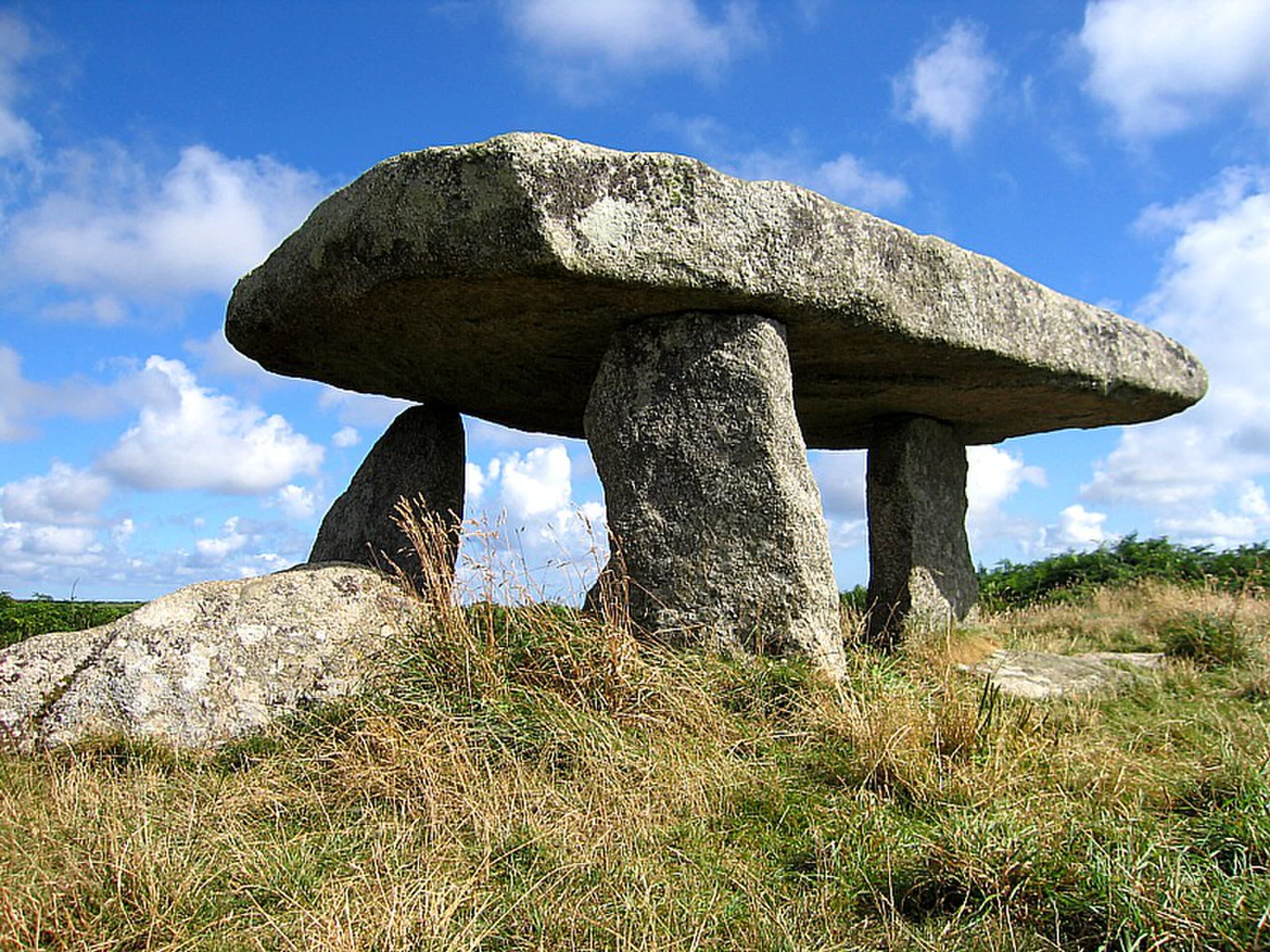
Lanyon Quoit
A massive capstone resting on granite uprights, where Neolithic dead have lain for five thousand years
Madron, Cornwall, United Kingdom
At A Glance
- Coordinates
- 50.1581, -5.5900
- Suggested Duration
- 30-60 minutes for contemplation
Pilgrim Tips
- No special requirements. Practical clothing for the area.
- Photography welcomed. The quoit is one of Cornwall's most photogenic monuments.
- Do not climb on the stones. The structure, though massive, has already collapsed once.
Overview
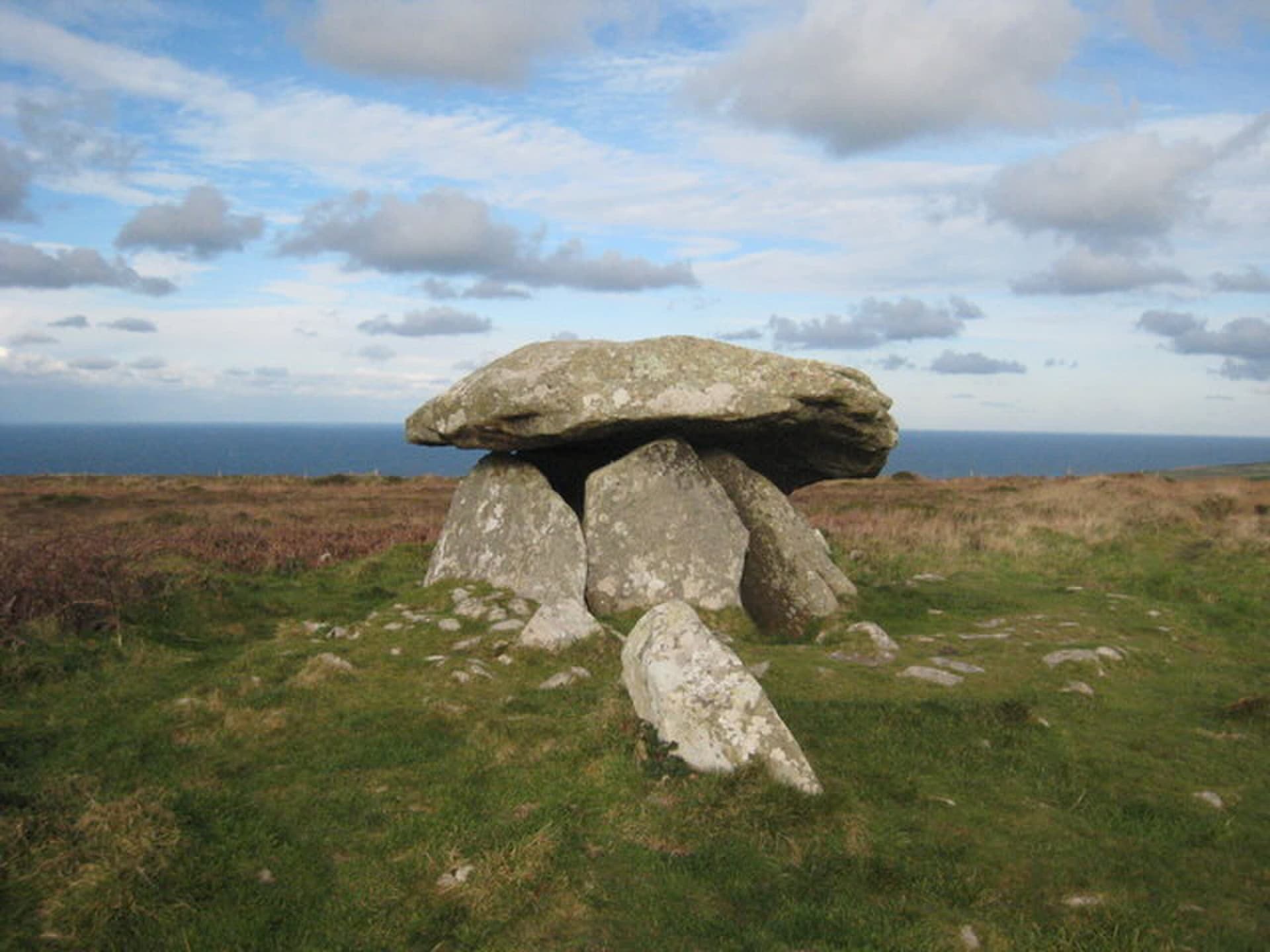
Lanyon Quoit rises from the West Penwith landscape like a statement from another age. A capstone weighing more than twelve tonnes rests on three granite uprights, the whole structure an unmistakable presence visible across the open moorland. This is a tomb—a chambered burial site where Neolithic communities placed their dead five thousand years ago. The bones are gone, the rituals forgotten, but the stone persists, speaking of a time when death meant something different, when the dead remained present in the landscape, their monuments marking the connection between the living and those who came before.
Approach Lanyon Quoit from any direction and the impression is immediate: something ancient, massive, and intentional rises from the grass. The capstone—5.5 metres long, weighing over twelve tonnes—rests on its three supports with an inevitability that speaks of deep time. This is what five thousand years of presence looks like. The quoit was not always as it appears today. In the eighteenth century, four uprights held the capstone high enough for a mounted rider to pass beneath. Then, on a stormy October day in 1815, the structure collapsed. Nine years later, local inhabitants raised funds for reconstruction, but one upright was too damaged to reuse. The others had to be shortened, the capstone repositioned at ninety degrees to its original orientation. What stands now is authentic in its stones but altered in its form—a fact that matters for archaeology but perhaps less for the encounter. Whatever the quoit looked like before, it remains what it has always been: a tomb. Neolithic people brought their dead here, laid them out perhaps on the capstone itself for carrion birds to strip the flesh, then gathered the bones into the chamber beneath. The practice sounds strange to modern ears, but it expressed a particular relationship with death: the dead were not hidden away but made present, their monument a landmark on the horizon, their bones mingling with those of generations. To stand before Lanyon Quoit is to stand before evidence of how differently humans have understood mortality. The stone makes no argument, offers no doctrine. It simply is—massive, enduring, marking a place where the dead once rested and the living once came to honor them.
Context And Lineage
Built in the Neolithic period, collapsed in 1815, reconstructed in 1824—the stones persist through five thousand years of change.
Between 3500 and 2500 BCE—before the pyramids, before metal tools—Neolithic people on this Cornish moor constructed a chambered tomb. They shaped massive granite blocks, positioned them as uprights, and raised a capstone weighing more than twelve tonnes to rest upon them. The chamber formed part of a larger long barrow stretching twenty-six metres. Here they brought their dead. The practice may have involved excarnation—laying bodies on the capstone for carrion birds to strip the flesh—before placing bones in the chamber beneath. Over generations, communities returned to add new burials to old. The dead accumulated. The monument stood as a visible presence on the landscape, marking the ongoing relationship between living and dead. Millennia passed. The original users were forgotten. The site acquired new stories: giants had built it, King Arthur had dined at this table before his final battle. Then, on 19 October 1815, a severe storm brought the structure down. Nine years later, local people raised funds for reconstruction. Captain Giddy of the Royal Navy supervised the work, but one upright was too damaged to reuse, and the others had to be shortened. The reconstructed quoit, rotated ninety degrees from its original position, is what we see today.
Lanyon Quoit belongs to the tradition of chambered tombs built across Britain during the Neolithic period. In West Penwith alone, multiple quoits survive: Chun Quoit, Zennor Quoit, Mulfra Quoit. These monuments represent a shared understanding of how to honor the dead and maintain connection with ancestors. The tradition extended across the British Isles and into continental Europe, part of a widespread Neolithic sacred architecture.
William Borlase
Captain Giddy
Why This Place Is Sacred
A threshold between the living and the dead, where massive stones mark a relationship with mortality that differs from our own but still speaks.
Chambered tombs like Lanyon Quoit occupy a distinctive place in the sacred imagination of Neolithic Britain. They were not hidden burial grounds but public monuments, visible across the landscape, announcing the presence of the dead within the world of the living. Communities returned to these sites across generations, adding new bones to old, maintaining the connection between present and past. The dead were not gone but gathered, not distant but present. This understanding of death creates a particular kind of thin place. The boundary crossed is not spatial but temporal—between now and then, between those who live and those who have died. The stones themselves embody this crossing: shaped by hands five thousand years dead, they persist into our present, unchanged by the passage of millennia. The capstone that rests on its uprights is the same stone that Neolithic people positioned; only we have changed. For contemporary visitors, the encounter with Lanyon Quoit becomes meditation on mortality and persistence. The tomb confronts us with the fact of death while simultaneously demonstrating that something survives: the stone, the structure, the evidence of human care for the dead. We will die. The quoit suggests that this need not mean disappearance—that marks can be left, that presence can persist, that the dead can remain among the living in some form.
Lanyon Quoit functioned as a chambered tomb within a larger long barrow (26 metres long, 12 metres wide). Neolithic communities likely used it for collective burial over generations, possibly practicing excarnation (exposure of bodies for carrion birds) before placing bones in the chamber. The monument served both practical funerary function and ritual significance as a point of connection between living communities and their ancestors.
The quoit's appearance changed dramatically in 1815 when a storm caused its collapse, and again in 1824 when reconstruction shortened the uprights and rotated the structure. The Neolithic community that built it would not recognize its current form, yet the essential character—massive capstone on granite uprights marking a burial site—persists. In 1952, the National Trust assumed ownership, ensuring preservation for future generations.
Traditions And Practice
The original funerary rites are lost. Contemporary visitors come for contemplation, connection with antiquity, and meditation on mortality.
Neolithic funerary practices likely included excarnation (exposure of bodies for carrion birds to remove flesh), collective burial over generations, and ceremonies connecting living communities to their ancestors. The monument functioned as a visible landmark marking the presence of the dead within the world of the living. Specific rituals cannot be reconstructed.
Contemporary visitors come for contemplation and connection with ancient presence. Some incorporate the quoit into broader pilgrimage through West Penwith's sacred landscape. Photography is common given the site's dramatic form. No specific ceremonies are associated with the site, but personal meditation and ancestor reverence are appropriate.
Approach with awareness that you are visiting a tomb. The dead once rested here. Allow that knowledge to shape your encounter. Walk around the quoit, observing it from different angles. Touch the stones. Notice the weight, the texture, the presence. Consider what it meant to build such a monument with Neolithic tools—the labor, the intention, the belief that the dead deserved such marking. Let the quoit do what it has done for five thousand years: remind us that we too will die, and that marks can persist beyond our dying.
Neolithic funerary practice
HistoricalThe quoit functioned as a chambered tomb for collective burial over generations, part of a tradition spread across Neolithic Britain.
Likely included excarnation and collective burial. The monument served as connection point between living communities and their ancestors.
Cornish folklore
HistoricalGiant and Arthurian legends attached to the site represent folk interpretation of the monument's impressive presence.
Storytelling and oral tradition. No specific ritual practices.
Contemporary spiritual practice
ActiveModern visitors recognize Lanyon Quoit as a site for contemplation, ancestor connection, and meditation on mortality.
Personal meditation. Photography. Integration into pilgrimage through West Penwith. No organized ceremonies.
Experience And Perspectives
Visible from the road, the quoit requires no pilgrimage to reach—it is simply there, demanding attention. Approach across the grass to encounter five thousand years of presence.
You might drive past without stopping. The quoit stands just fifty metres from the road between Madron and Morvah, behind a hedge that partially screens it from traffic. But once you notice it, you cannot unnotice it: the massive horizontal capstone, the uprights bearing its weight, the whole structure rising from the grass with an authority that exceeds its height. Park in the small lay-by if there is room. Cross to the field gate. The quoit reveals itself fully as you approach—larger than expected, more present. The capstone stretches 5.5 metres, weighing more than twelve tonnes. The three uprights that bear this weight stand only 1.5 metres high, lower than the original four that allowed riders to pass beneath. Yet even in its altered state, the structure impresses. Walk around the quoit. Touch the stones if you feel moved to do so. The granite is cold, rough, real. These same stones were positioned by people who lived five thousand years ago, whose names are lost, whose beliefs we can only guess, but whose labor persists. The space beneath the capstone is too low to enter now—a consequence of the 1824 reconstruction. But you can crouch beside it, look into the shadowed interior, imagine the bones that once rested there. The quoit lies at the north end of a long barrow, though the barrow's outline is difficult to see beneath grass and bracken. At the southern end, additional stones may be remains of cists. This was not a simple grave but a complex monument built and used over generations.
Lanyon Quoit stands beside the B3312 between Madron and Morvah, approximately 2 miles southeast of Morvah. The quoit is visible from the road, 50 metres across a field. A small National Trust sign marks the site.
Lanyon Quoit speaks of death, persistence, and the human need to mark the places where the dead rest. Each perspective illuminates different aspects of this need.
Archaeologists classify Lanyon Quoit as a much-altered Portal Dolmen dating to the Neolithic period (approximately 3500-2500 BCE). John Barnatt's survey describes a rectangular box burial chamber with possible antechamber. The site lies at the north end of a long barrow. The current appearance differs significantly from the original due to the 1815 collapse and 1824 reconstruction. Early excavation found a grave-shaped pit with black earth beneath the capstone.
Cornish folklore names the site Giant's Table or Giant's Tomb, imagining that only giants could have moved such massive stones. Arthurian tradition places King Arthur's last meal here before his final battle. These stories represent authentic folk responses to the monument's presence, even if historically unfounded.
Contemporary spiritual practitioners recognize Lanyon Quoit as a place of earth energy and ancestral connection. The funerary associations support practices of ancestor reverence. Some identify the site as a node in ley line networks connecting West Penwith's monuments. The confrontation with mortality that the tomb invites aligns with various spiritual practices.
The specific individuals buried within the tomb, the exact ceremonies performed, and the beliefs of those who built and used the site cannot be recovered. The original form of the monument before 1815 is only partially documented. These unknowns are not failures of research but features of sites that predate recorded history.
Visit Planning
Beside the B3312 between Madron and Morvah. Free access, very limited parking. The quoit is visible from the road and requires only a short walk to reach.
Penzance (4 miles) offers full range of accommodation. B&Bs in surrounding villages serve visitors exploring West Penwith.
This is a tomb. Approach with appropriate gravity. Do not climb the stones or disturb the site.
Lanyon Quoit is a burial site. Whatever its current function as heritage attraction and photographic subject, it was built to house the dead. This origin deserves respect. Approach with awareness rather than tourism. The drama of the structure invites photography, and photography is welcomed. But take time beyond the camera. Sit with the quoit. Consider the dead who rested here, the living who placed them, the generations who returned. Consider your own mortality. The stones have outlasted everyone who ever touched them. They will outlast you.
No special requirements. Practical clothing for the area.
Photography welcomed. The quoit is one of Cornwall's most photogenic monuments.
Not traditionally associated with offerings. The best offering is contemplation.
Do not climb on the stones. Do not dig or remove anything from the site.
Sacred Cluster
Nearby sacred places create the location cluster described in the growth plan. This block is intentionally crawlable and links into the wider regional graph.