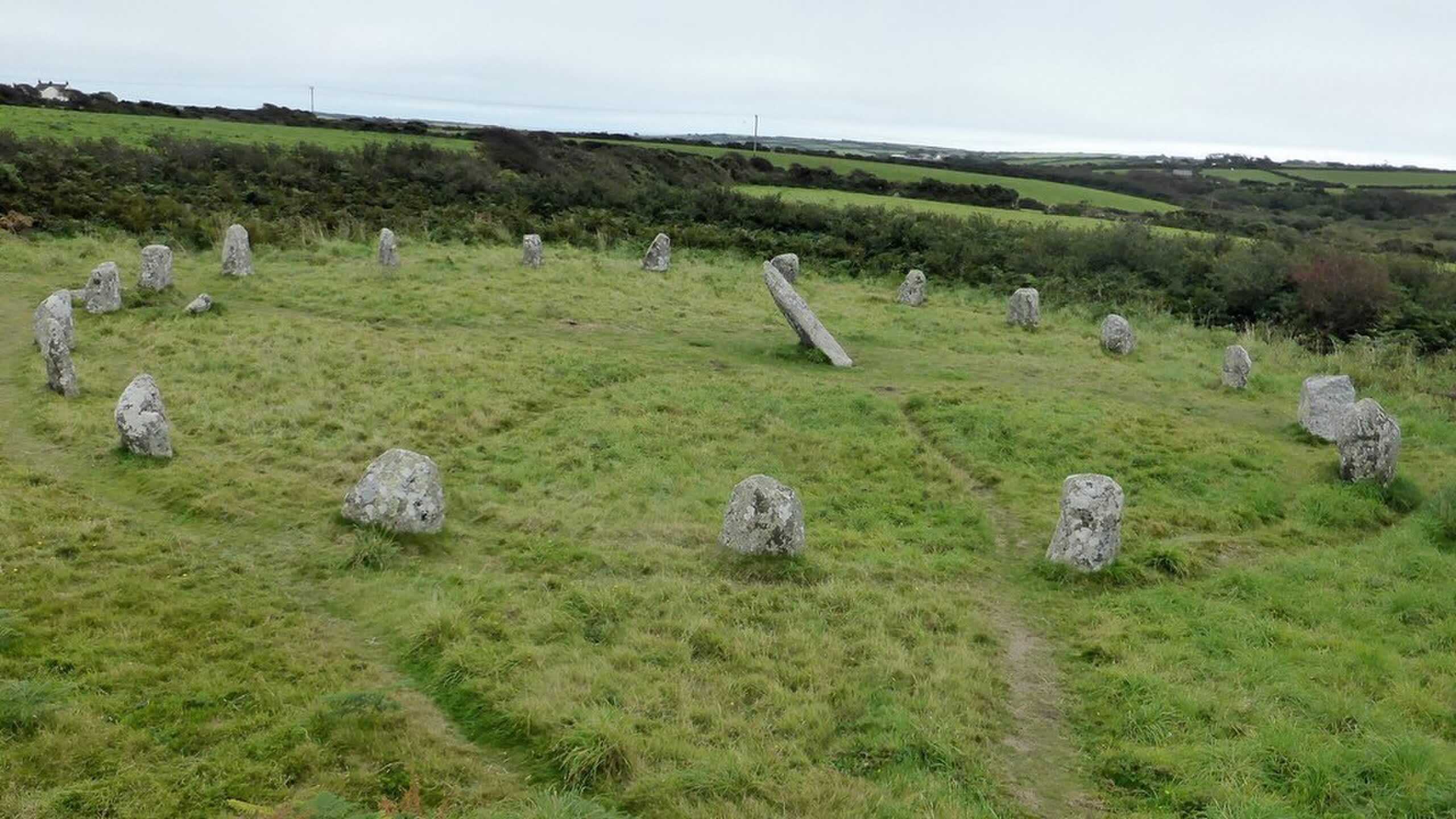
Boscawen-un Stone Circle
Where Bronze Age stones still gather bards, as they have for four thousand years
St Buryan, Cornwall, United Kingdom
At A Glance
- Coordinates
- 50.0898, -5.6188
- Suggested Duration
- A focused visit takes thirty minutes to an hour. Those wishing to meditate, practice, or wait for particular light may stay longer. The site rewards extended time more than most.
- Access
- The circle lies north of St Buryan, off the A30. There is no formal car park; visitors typically park on the roadside near the footpath sign. A short walk through fields leads to the stones. The path is not wheelchair accessible.
Pilgrim Tips
- The circle lies north of St Buryan, off the A30. There is no formal car park; visitors typically park on the roadside near the footpath sign. A short walk through fields leads to the stones. The path is not wheelchair accessible.
- No specific dress code applies. Wear appropriate footwear for field walking, which may be muddy. Dress for weather; the site is exposed to Cornish winds.
- Photography is permitted and encouraged. Be mindful of other visitors and especially of any ceremonies in progress. Ask permission before photographing people.
- Do not touch, climb on, or lean against the stones. Do not leave offerings that are not fully biodegradable. Do not damage vegetation or disturb wildlife. If you encounter a ceremony in progress, observe from outside the circle unless invited to participate.
Overview
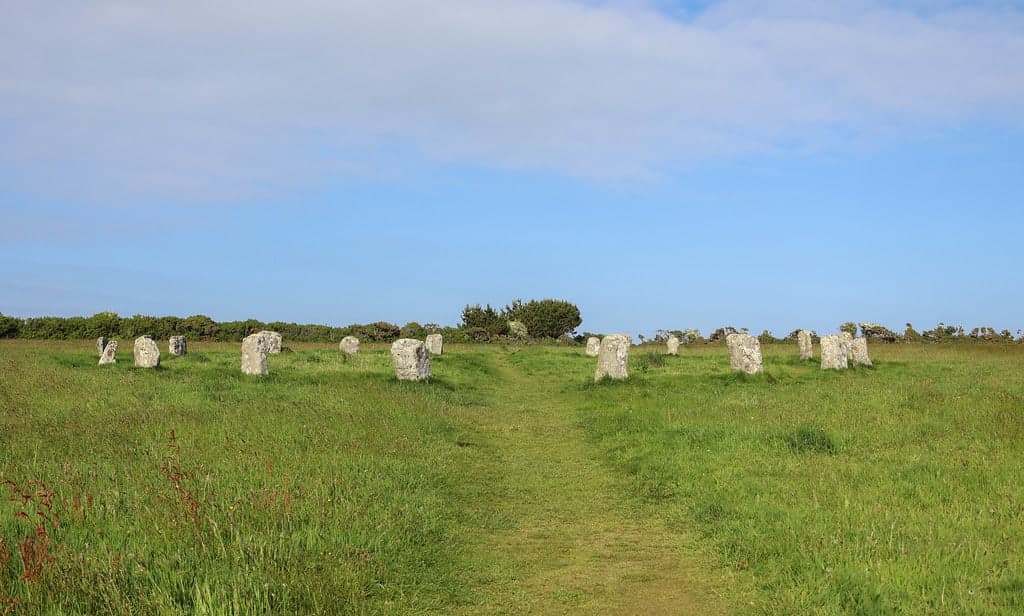
In the fields near St Buryan in Cornwall, nineteen granite stones form an ellipse around a leaning central pillar bearing axe carvings found nowhere else in Britain. Medieval Welsh texts name this as one of three great Bardic assembly places of the island. The Gorsedh Kernow, reviving Cornish Bardic tradition, was inaugurated here in 1928, and ceremonies continue to this day.
There is a quality of listening at Boscawen-un. The nineteen stones lean inward like figures gathered in council, the leaning central pillar presiding like an elder about to speak. Four thousand years of such gatherings have left their mark on this place.
What sets Boscawen-un apart from Cornwall's many stone circles is documentation. The Welsh Triads, medieval texts recording traditional knowledge, name 'Boskawen of Dumnonia' as one of the three great Gorsedds of Poetry of the Island of Britain. This is remarkable: a prehistoric monument still recognized as ceremonially significant in the early medieval period, a thread of continuity that most circles have lost.
The stones themselves carry mysteries the records cannot explain. The central pillar, tilted at a dramatic angle, bears carvings of stone axes, the only known examples on any British standing stone. Among the eighteen grey granite uprights of the circle, one stands out: a block of bright quartz, deliberately placed among its darker companions. Whether these features held astronomical, ritual, or symbolic significance, no one now can say with certainty.
But the Bardic tradition did not end with the medieval texts. In 1928, the Gorsedh Kernow, the Cornish Bardic assembly, was inaugurated at Boscawen-un, consciously reviving what the Welsh sources recorded. Ceremonies continue here. The stones that witnessed Bronze Age rituals now witness their distant descendants, carrying forward something that has never quite been broken.
Context And Lineage
Boscawen-un was constructed during the late Neolithic or early Bronze Age, around 2500-1500 BC. Medieval Welsh texts record it as one of three great Bardic assembly places of Britain. The Gorsedh Kernow was inaugurated here in 1928, reviving the Bardic tradition that the medieval sources documented.
No founding narrative survives for Boscawen-un, as it was built before writing reached these shores. The folk name 'Nine Maidens,' though the circle actually contains nineteen stones, reflects the common pattern of explaining mysterious monuments through stories of petrifaction, of dancing figures frozen to stone for breaking sacred law.
The Welsh Triads provide the earliest written reference, naming 'Boskawen of Dumnonia' alongside two Welsh sites as the Gorsedds of Poetry of the Island of Britain. Dumnonia was the Romano-British name for the southwest of England, the region that would become Devon and Cornwall. The Triads may preserve memory reaching back centuries before their compilation.
The lineage at Boscawen-un spans four millennia. Bronze Age peoples built the circle for purposes we can only partly reconstruct. Through the Iron Age and into the early medieval period, the site retained significance, earning mention in Welsh Bardic tradition. After centuries of obscurity, the Cornish cultural revival of the 20th century recognized the site's importance and re-established ceremonial use.
Today, the Gorsedh Kernow continues to honour the connection. Druidic groups also use the site for ceremonies. The lineage is not unbroken in the sense of continuous identical practice, but something has been remembered, lost, and remembered again at this place for longer than most human institutions endure.
The Gorsedh Kernow Founders
founders
The founders of the Cornish Gorsedd chose Boscawen-un for their 1928 inauguration specifically because of the Welsh Triad reference, consciously connecting modern Cornish cultural revival to documented Bardic precedent.
Why This Place Is Sacred
Boscawen-un draws its power from exceptional continuity. Bronze Age construction, medieval Bardic recognition, and modern ceremonial revival create a thread of sacred use spanning four millennia. The unique features of the stones themselves, the axe carvings and quartz inclusion, suggest this place was marked as special from the beginning.
What makes a place sacred? At Boscawen-un, the answer seems to be: continuous recognition across vastly different cultures and eras. Something about this location was deemed significant by Bronze Age builders, by medieval bards, and by modern revivalists. Each group saw what they saw through their own lens, yet all agreed: this place matters.
The elliptical shape of the circle, measuring roughly 25 by 22 metres, suggests careful planning rather than casual arrangement. The stones are not tall by megalithic standards, mostly between three and four feet, but their placement creates a sense of enclosure, of being held within a defined space. The central stone, dramatically tilted, dominates without overwhelming. If you stand at the centre looking out, the ring of stones frames the horizon in all directions.
The axe carvings on the central pillar are unlike anything else in Britain. Stone axes held immense significance in Neolithic and Bronze Age cultures, both as tools and as symbols. That this stone should bear their image, and bear it alone among all British standing stones, suggests Boscawen-un held special status even among its contemporary monuments.
The single quartz stone among eighteen granite companions presents another mystery. Quartz has photoluminescent properties, glowing faintly when struck, which may have given it magical significance to ancient peoples. Its deliberate inclusion here was not accidental.
When the Welsh bards named this as a Gorsedd, they recognized something that had not been forgotten. The thread was worn thin but unbroken. When the Gorsedh Kernow chose this site for their 1928 inauguration, they were not inventing tradition but reviving it.
The original purpose of Boscawen-un remains uncertain, as with all prehistoric monuments. The elliptical shape and astronomical alignments suggest possible use as a calendar or observatory. The central stone and gathering-space design suggest ritual assembly. The axe carvings point to the cult of the stone axe, important across Bronze Age Europe. Most likely, the circle served multiple interconnected purposes that Neolithic culture did not separate as we might.
For perhaps two thousand years after construction, the circle served purposes we can only guess at. The Bronze Age gave way to Iron Age, Romans came and went, Christianity arrived. Through all this, something about Boscawen-un remained recognized. The Welsh Triads, compiled perhaps in the 6th century AD from older material, record the site as a major Bardic assembly place, a centre of poetic and possibly religious authority.
This recognition faded but never entirely disappeared. Local people knew the circle; antiquarians recorded it. When the Cornish cultural revival of the early 20th century sought to re-establish Bardic tradition, Boscawen-un was the obvious choice for inauguration. The 1928 ceremony explicitly connected modern practice to medieval precedent and, through the medieval texts, to prehistoric origins.
Today the site serves both as heritage attraction and as living ceremonial ground. The Gorsedh Kernow continues to gather here, alongside Druidic groups and solitary visitors drawn by what the stones still hold.
Traditions And Practice
Boscawen-un is used for Gorsedh Kernow ceremonies, Druidic rituals, and solstice/equinox gatherings. Individual visitors practice meditation, circumambulation, and quiet contemplation. The site has no formal programme but welcomes respectful engagement.
We cannot reconstruct Bronze Age rituals with confidence. The elliptical shape suggests astronomical observation, the central stone perhaps serving as a gnomon for tracking solar or lunar positions. The gathering-space design implies assembly for ceremony. The axe carvings connect the site to the widespread cult of the stone axe, possibly indicating this as a place of transition or transformation.
Medieval Bardic practice at Gorsedds involved poetic competition, the awarding of honours, and the transmission of traditional knowledge. Whether religious ceremony accompanied these functions is uncertain, though the separation of cultural and sacred would have seemed strange to medieval minds.
The Gorsedh Kernow holds ceremonies at Boscawen-un and other Cornish sites, celebrating Cornish language and culture in the Bardic tradition. These gatherings are open to observation by the public. Druidic groups, part of the broader contemporary Pagan revival, also use the site for solstice and equinox ceremonies.
Individual visitors practice in various ways: meditation within the circle, circumambulation of the stones, offerings of flowers or other biodegradable items, and simply sitting in the presence of the stones. The site has no single correct practice but responds to genuine attention.
Approach the circle slowly, allowing the transition from ordinary to sacred space to happen naturally. Walk the perimeter before entering. Notice how the landscape is framed through the gaps between stones.
Once inside, find a comfortable position and allow yourself to settle. The stones have witnessed four thousand years of human presence. There is no hurry.
If the central stone calls you, approach with attention. The axe carvings on the south face are subtle but visible. Consider what it might mean to mark a stone with the symbol of the primary tool of transformation for your culture.
Before leaving, take a moment of gratitude. You are part of a lineage of visitors stretching back to prehistory.
Cornish Bardic Tradition
ActiveBoscawen-un is one of the foundational sites of the Cornish Bardic tradition, recognized in medieval Welsh texts as a Gorsedd of Poetry and chosen for the 1928 inauguration of the Gorsedh Kernow. The site represents the intersection of prehistoric heritage, medieval recognition, and modern cultural revival.
The Gorsedh Kernow holds periodic ceremonies at Boscawen-un and other Cornish sites. These gatherings celebrate Cornish language, literature, and culture through Bardic ritual, including the awarding of honours to those who have contributed to Cornish heritage.
Contemporary Druidry
ActiveFor contemporary Druidic practitioners, Boscawen-un is a power site where ceremonies marking solstices, equinoxes, and other festivals may be performed. The site's attested Bardic significance and its well-preserved structure make it an important gathering place.
Druidic groups gather for seasonal ceremonies, particularly at solstices and equinoxes. Practices may include ritual, meditation, chanting, and offerings. The ceremonies typically take place within the stone circle, with the central stone serving as a focal point.
Bronze Age Religion
HistoricalThe builders of Boscawen-un practiced a religion we can only partially reconstruct. The elliptical form, central stone, axe carvings, and quartz inclusion all suggest a coherent cosmology that saw certain places, shapes, and materials as sacred. Stone circles across Britain suggest widespread beliefs about the importance of marking and celebrating particular locations.
We cannot reconstruct Bronze Age rituals with confidence. The site likely served astronomical observation, seasonal ceremony, and community gathering. The axe carvings suggest connection to the pan-European cult of the stone axe, possibly involving rites of transformation or transition.
Experience And Perspectives
Visitors to Boscawen-un report a sense of entering a conversation already in progress. The stones seem gathered rather than merely placed. The Cornish landscape stretches to the sea in the distance, and the wind carries a quality of expectation, as though something is about to be spoken.
The approach matters. Boscawen-un requires a walk through fields, a gradual transition from modern Cornwall to something older. The circle does not announce itself from a distance but emerges from the landscape as you approach, the stones resolving from scattered shapes into deliberate form.
Once inside the circle, the proportions shift. The outside world, visible over the low stones, recedes in importance. Attention draws inward toward the centre, toward the leaning pillar with its mysterious carvings. Many visitors describe a settling quality, a calming of mental noise that seems to happen automatically rather than through effort.
The quartz stone often draws particular attention. Against its grey companions, the white block seems almost to glow, especially in afternoon light. Whether this reflects the stone's actual properties or simply the effect of contrast, visitors frequently report it as the most 'active' presence in the circle.
Those who come at sunrise or sunset describe how light and shadow transform the space. The stones cast long shadows that shift minute by minute. The horizon, visible through the gaps between stones, takes on ceremonial significance, as though the circle were designed precisely to frame it.
The Bardic associations add another dimension for those aware of them. To stand where bards gathered before the Norman Conquest, where they may have gathered since the Bronze Age, is to feel oneself part of a lineage that stretches beyond individual life.
Boscawen-un rewards time and quietness. A quick visit misses what the circle offers. Consider arriving early or late, when other visitors are fewer and the light has character.
Circumambulate the circle before entering, moving around the outside of the stones. This was likely how ancient visitors approached, and it allows the space to reveal itself gradually. Enter when you feel ready, not before.
The central stone deserves extended attention. The axe carvings, though worn, are visible on the south face. Sit with them. These are the only such carvings in Britain. Whatever they meant to their makers, they mark this stone as singular.
If you feel called to leave an offering, choose something that will not damage the site or disturb other visitors. Biodegradable materials, left discreetly, continue ancient practice without modern harm.
Boscawen-un invites interpretation from archaeological, cultural, and spiritual perspectives. Each reveals aspects the others cannot reach. The site's unique documentation in medieval sources adds a dimension that most stone circles lack.
Archaeologists classify Boscawen-un as a late Neolithic or early Bronze Age ritual monument, likely constructed between 2500 and 1500 BC. The elliptical shape, central standing stone, and possible astronomical alignments suggest ceremonial and calendrical functions. The unique axe carvings indicate special status within the broader megalithic culture.
The Welsh Triad reference provides rare documentary evidence of post-prehistoric ritual use. Scholars debate how continuous this use was and what form it took, but the mere survival of the site's name in Bardic tradition is significant. It suggests that even as religious frameworks changed, the recognition of this place as significant persisted.
The inclusion of a quartz stone among granite companions has attracted archaeological interest as evidence of deliberate material selection for ritual purposes.
For practitioners of Cornish cultural tradition, Boscawen-un is a touchstone of identity. The Welsh Triad reference validates Cornish claims to ancient Bardic heritage. The 1928 inauguration of the Gorsedh Kernow here was not antiquarian nostalgia but cultural reclamation, asserting that Cornwall's traditions were as ancient and legitimate as those of Wales or Brittany.
This perspective sees the site as a place where Cornish identity is not merely remembered but actively maintained. The ceremonies that occur here are not reenactment but continuation.
Contemporary Druidic and Pagan perspectives understand Boscawen-un as an energy site, a place where earth forces concentrate and can be accessed. The axe symbolism is interpreted as representing the world tree or axis mundi, connecting earth and sky. The quartz stone is seen as an activating presence, focusing or amplifying the site's inherent power.
Astronomical interpretations propose alignments with solar or lunar events. Some see the elliptical shape as a deliberate deviation from the circle, encoding knowledge about celestial mechanics. These interpretations lack scholarly consensus but emerge from genuine engagement with the site's mysteries.
Significant questions remain unanswered. The meaning of the axe carvings, unique in Britain, is unknown. The purpose of the quartz inclusion is uncertain. The exact nature of Bronze Age rituals performed here cannot be reconstructed. How the site maintained Bardic significance through the centuries between construction and medieval documentation is unclear. These mysteries are not problems to be solved but dimensions of a depth that certainty would diminish.
Visit Planning
Boscawen-un is located near St Buryan in the Penwith district of Cornwall, accessible by a short walk through fields. The site is open at all times and free to visit. Solstices and equinoxes often see gatherings.
The circle lies north of St Buryan, off the A30. There is no formal car park; visitors typically park on the roadside near the footpath sign. A short walk through fields leads to the stones. The path is not wheelchair accessible.
St Buryan and the surrounding villages offer bed and breakfast accommodation. Penzance, the nearest town, has hotels and hostels. No retreat facilities exist at the site, but several meditation and retreat centres operate in the Penwith area.
Boscawen-un is an open-access Scheduled Monument requiring respectful treatment. The stones should not be touched or climbed. Ceremonies, when in progress, should not be interrupted. Natural materials only should be left as offerings.
The site is protected as a Scheduled Monument, making any damage a criminal offence. This protection exists because the stones are irreplaceable evidence of prehistoric culture and because the site holds ongoing significance for Cornish identity.
Visitors should treat the circle as sacred space regardless of personal beliefs. Keep voices low. Move slowly and deliberately. Do not allow children or dogs to climb on the stones. If a ceremony is taking place, observe quietly from outside the circle unless participants invite you to join.
The site exists in an agricultural landscape. Access requires walking through fields. Stay on paths where they exist. Close gates behind you. Respect the working farm whose land you are crossing.
No specific dress code applies. Wear appropriate footwear for field walking, which may be muddy. Dress for weather; the site is exposed to Cornish winds.
Photography is permitted and encouraged. Be mindful of other visitors and especially of any ceremonies in progress. Ask permission before photographing people.
If you wish to leave an offering, use only natural, biodegradable materials: flowers, seeds, water. Do not leave candles, crystals, coins, or other non-degradable items. Place offerings discreetly, not prominently on the stones themselves.
Do not damage, touch, or climb on the stones. Do not dig or remove anything from the site. Do not leave non-biodegradable materials. Camping is not permitted.
Sacred Cluster
Nearby sacred places create the location cluster described in the growth plan. This block is intentionally crawlable and links into the wider regional graph.