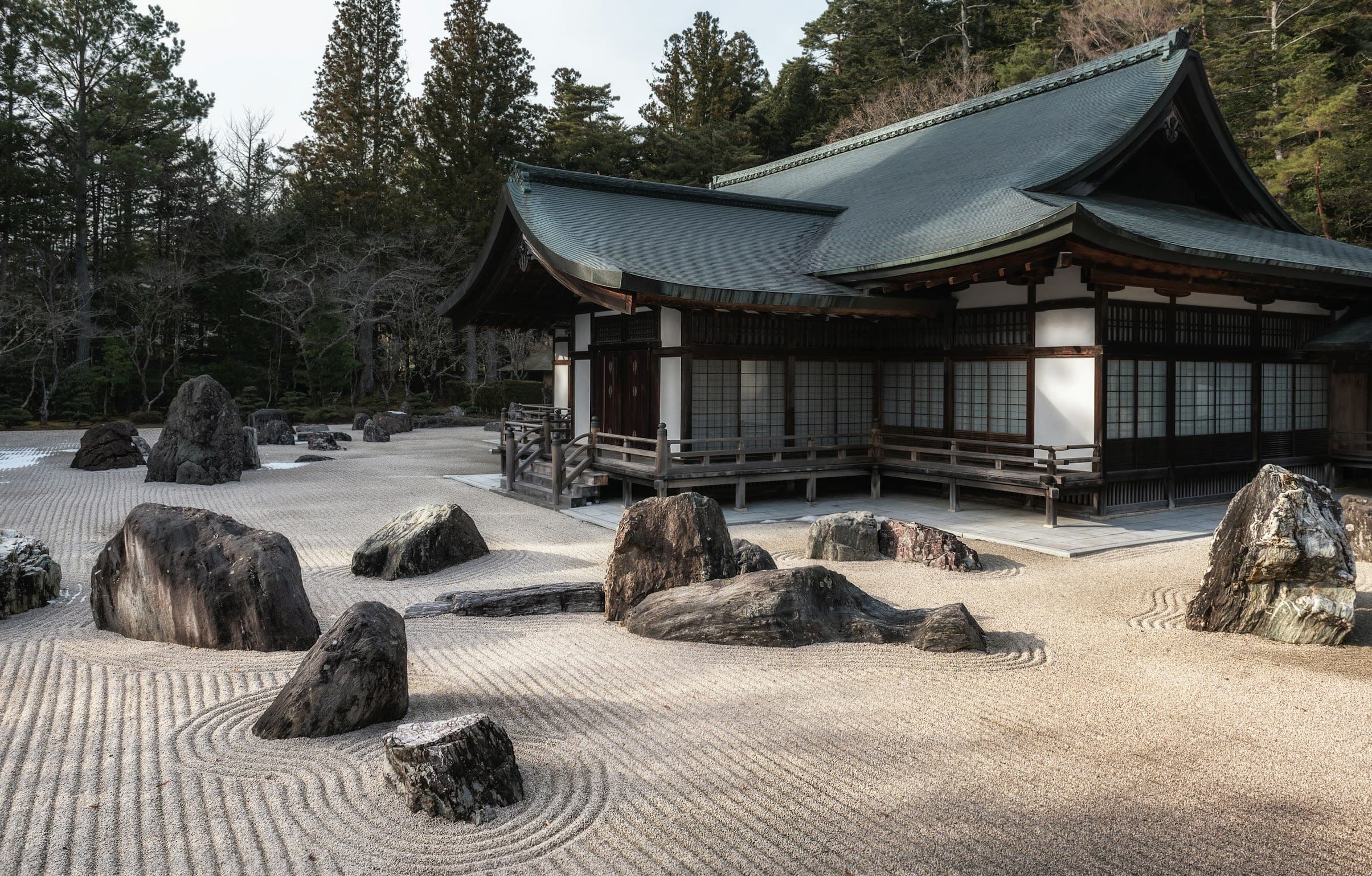
Kongobu-ji Temple (Mt. Koya)
Where Kobo Daishi established esoteric Buddhism and still waits in eternal meditation
Koya, Wakayama Prefecture, Japan
At A Glance
- Coordinates
- 34.2139, 135.5806
- Suggested Duration
- Day trip possible but overnight strongly recommended. Most visitors stay one or two nights to fully experience temple life and multiple sites.
Pilgrim Tips
- Modest attire for temple visits. Temple lodging provides yukata for comfortable wear during the stay.
- Varies by area; follow posted restrictions. Interior of Okunoin mausoleum area does not permit photography.
- Some esoteric practices are reserved for initiated practitioners and cannot be offered to casual visitors. Morning services require rising early and sitting in cold conditions (temples are traditionally unheated). Temple lodging follows Buddhist protocols including vegetarian meals and early quiet hours.
Overview
High in the mountains of Wakayama, Kongobu-ji serves as headquarters of Shingon Buddhism, the esoteric tradition Kobo Daishi brought from China in 806 CE. The temple governs 3,600 affiliated temples and serves 10 million followers. At nearby Okunoin, believers maintain that Kobo Daishi has not died but sits in eternal meditation, awaiting the coming Buddha.
In 804 CE, a young monk named Kukai traveled to Tang Dynasty China, seeking the deepest teachings of Buddhism. He mastered esoteric Buddhism in just two years—a feat that typically required decades—and returned to Japan as the eighth person to receive the title 'Luminous Vajra Master.' Emperor Saga, recognizing both the power of these teachings and the remarkable man who carried them, granted Kukai the remote mountain of Koya as a center for esoteric training.
The name Kongobu-ji means 'Temple of the Diamond Mountain Peak,' referring to the adamantine wisdom at Buddhism's heart. Kukai envisioned the entire mountain as a mandala—a sacred diagram of the cosmos—made physical in landscape. The isolation was intentional: these teachings required distance from worldly distraction.
Today, Kongobu-ji remains what Kukai founded: the headquarters of Shingon Buddhism, governing over 3,600 temples and serving ten million practitioners throughout Japan. The temple complex includes the largest rock garden in Japan, the Banryutei, where 140 granite stones represent twin dragons emerging from clouds. But what draws most visitors is not the administrative significance or artistic treasures—it is the palpable sense of encountering something that has been continuously alive for over 1,200 years.
And beneath this administrative reality lies something stranger: the belief that Kobo Daishi has not died. In 835, he entered eternal meditation at Okunoin, where he awaits the future Buddha. Monks still bring him meals twice daily. For believers, Mount Koya is not merely a temple complex but the place where a living saint continues his practice.
Context And Lineage
Kongobu-ji represents the successful transmission of esoteric Buddhism from Tang China to Japan, established by one of the most remarkable figures in Japanese religious history.
In 804, the monk Kukai traveled to Tang China seeking the deepest Buddhist teachings. He mastered esoteric Buddhism under the master Huiguo in just two years, becoming the eighth person in the transmission lineage to receive the title 'Luminous Vajra Master.' Returning to Japan in 806, he spent years establishing his teaching before Emperor Saga granted him Mount Koya in 816. Kukai designed the entire mountain as a center for esoteric training, conceiving it as a physical mandala. In 835, he entered eternal meditation at Okunoin, where believers hold he remains.
Kongobu-ji serves as head temple of Koyasan Shingon Buddhism, one of the major traditions of Japanese esoteric Buddhism. The temple governs 3,600 affiliated temples and serves approximately 10 million followers. The lineage traces directly to Kukai's transmission from Huiguo in China.
Kobo Daishi (Kukai)
Founder (774-835); brought esoteric Buddhism to Japan; believed to remain in eternal meditation at Okunoin
Huiguo
Kukai's Chinese master who transmitted esoteric teachings
Emperor Saga
Granted Mount Koya to Kukai in 816
Toyotomi Hideyoshi
Commissioned current main building in 1593
Why This Place Is Sacred
Mount Koya was conceived as a mandala made physical—a sacred geography where the structure of enlightenment takes form in landscape. The presence of Kobo Daishi in eternal meditation adds dimension beyond architectural symbolism.
The thinness at Kongobu-ji operates on multiple levels simultaneously. Most fundamentally, Kukai designed Mount Koya as a three-dimensional mandala—the geometric sacred diagrams central to esoteric Buddhism translated from image into terrain. The entire mountain was conceived as a representation of enlightened mind expressed in physical space.
This means that walking on Mount Koya is itself a form of practice. The layout of temples, the positions of sacred objects, the paths between buildings—all were intentionally arranged to correspond with cosmic principles. Visitors move through a space designed to communicate Buddhist wisdom through spatial experience.
But the deeper thinness involves Kobo Daishi's continued presence. In 835, at age 62, Kukai entered what Shingon tradition calls 'nyujo'—not death but eternal meditation. He remains at Okunoin, seated in practice, awaiting Maitreya, the Buddha of the future. Twice daily, monks bring him meals. The mausoleum has not been opened since 835, and no one claims to know the current state of his body, but the tradition holds that he is not dead.
This creates an atmosphere unlike ordinary temple visits. Whether understood as literal truth, devotional metaphor, or suspended judgment, the presence of a saint in eternal meditation shapes how visitors experience the space. The 200,000 memorial tombstones leading to Okunoin line a path to something that believers consider genuinely alive.
Staying overnight in temple lodging (shukubo) and participating in morning services extends this encounter. The monks who perform these services are not reenacting historical practice but continuing a tradition unbroken since Kukai's time, directed toward a teacher they believe remains present.
Kukai established Mount Koya as an isolated center for esoteric Buddhist training, deliberately distant from the political and social distractions of the capital. The mountain was conceived as a mandala in landscape—a sacred geography for intensive spiritual development.
From its 816 founding, Mount Koya grew to become one of Japan's most important religious centers. The current Kongobu-ji building dates to 1593, originally constructed by Toyotomi Hideyoshi to honor his mother. The site gained UNESCO World Heritage status in 2004 as part of the Sacred Sites and Pilgrimage Routes in the Kii Mountain Range. Today 117 temples exist on Mount Koya, with 52 offering lodging to visitors. The mountain continues to function as both active monastic center and major pilgrimage destination.
Traditions And Practice
Mount Koya offers active participation in Shingon Buddhist practice, from morning chanting services to sutra copying and meditation, accessible through temple lodging.
Esoteric Buddhism centers on practices believed to lead to enlightenment in this lifetime: mantra recitation, mudra (hand gestures), mandala visualization, and fire rituals (goma). These practices were transmitted from India through China to Japan by Kukai and have been maintained continuously at Mount Koya since the 9th century.
Visitors staying in temple lodging can participate in morning services (gongyo) beginning at 6:00 AM—chanting, incense offering, and guided meditation led by temple monks. Sutra copying (shakyo) sessions allow visitors to engage with Buddhist texts through meditative writing. Some temples offer guided meditation instruction. The twice-daily meal service to Kobo Daishi at Okunoin continues, maintained by Shingon monks who believe they are feeding a living master.
Temple lodging transforms a visit into an immersive experience. The early morning service, attended in the cold mountain air before dawn, connects visitors to practice unchanged since Kukai's time. The walk to Okunoin at evening or early morning, when crowds are thinner and atmosphere deeper, offers the most powerful encounter with the cemetery path. Consider sutra copying as a form of moving meditation.
Shingon Buddhism
ActiveKongobu-ji serves as head temple of Koyasan Shingon Buddhism, one of Japan's major esoteric Buddhist traditions. The temple governs 3,600 affiliated temples and serves approximately 10 million followers. Shingon teaching centers on achieving enlightenment in this lifetime through practices including mantra, mudra, and mandala.
The tradition maintains elaborate ritual practices including goma (fire rituals), mandala contemplation, and complex liturgies transmitted from Kukai's time. Temple lodging makes some of these practices accessible to visitors through morning services, sutra copying, and guided meditation.
Experience And Perspectives
Visitors consistently describe Mount Koya as existing in a different world—the combination of altitude, isolation, centuries of continuous practice, and Kobo Daishi's believed presence creating an atmosphere unlike anywhere else in Japan.
The journey to Mount Koya begins the transition. The train from Osaka climbs into increasingly remote mountain terrain; the final cable car ascends to 800 meters above sea level. Arriving on the mountain, the air is different—cooler, quieter, touched with cedar and incense.
Kongobu-ji presents as both administrative headquarters and contemplative space. The main hall contains Important Cultural Properties including paintings by Kano school masters. But the most striking feature is the Banryutei, Japan's largest rock garden. 140 granite stones, dragged from Shikoku by devotees, form the shapes of twin dragons emerging from clouds. The garden invites extended contemplation.
Most visitors continue to Okunoin, the mausoleum where Kobo Daishi sits in eternal meditation. The approach passes through one of the world's most remarkable cemeteries: 200,000 memorial stones lining a two-kilometer path through ancient cedars. Corporate logos stand beside medieval warlords; modern graves neighbor centuries-old tombs. This democracy of the dead—everyone seeking proximity to the eternal meditator—creates an atmosphere both solemn and strangely comforting.
At Okunoin itself, a hall of perpetual lights precedes the mausoleum. Thousands of lanterns donated over centuries burn day and night. The mausoleum beyond cannot be entered; visitors stand at the threshold of a mystery 1,200 years in duration.
The full experience requires overnight stay. Fifty-two temple lodgings offer shukubo—the chance to sleep in a temple, eat Buddhist vegetarian cuisine, and participate in morning services. The 6:00 AM gongyo (chanting service), attended in the cold pre-dawn, connects visitors to the daily practice that has occurred here since Kukai's time. Many describe this as the most powerful element of the Mount Koya experience.
Visitors typically arrive at Mount Koya by train and cable car from Osaka. The main sites include Kongobu-ji (headquarters), Danjo Garan (original training complex), and Okunoin (Kobo Daishi's mausoleum). The mountain can be experienced in a day trip, but overnight stay at temple lodging is strongly recommended for the full experience. Morning services typically begin at 6:00 AM.
Kongobu-ji invites interpretation as headquarters of a living tradition, as monument to one of Japan's most remarkable historical figures, and as site where beliefs about death and meditation take unusual form.
Historians recognize Kukai as among the most influential figures in Japanese religious and cultural history—not merely a religious founder but a calligrapher, poet, lexicographer, and civil engineer. The establishment of esoteric Buddhism in Japan shaped art, architecture, and spiritual practice for over a millennium. Mount Koya's continuous function from the 9th century to present makes it invaluable for understanding Japanese religious development.
In Shingon understanding, Kobo Daishi's transmission from Huiguo in China represents authentic dharma lineage leading back to the Buddha. His teachings on achieving enlightenment in this lifetime (sokushin jobutsu) offer a path distinct from traditions requiring multiple lifetimes of practice. His continued presence at Okunoin is understood literally: he has not died but waits in meditation for Maitreya.
Some interpret Mount Koya as a site of concentrated spiritual energy, viewing the mountain's long history of practice as accumulating power that visitors can access regardless of religious framework.
The state of Kobo Daishi's body within the sealed mausoleum is unknown—the space has not been entered since 835. The full extent of esoteric teachings Kukai brought from China, and how they have been adapted over twelve centuries, remains subject to scholarly research.
Visit Planning
Mount Koya is accessible from Osaka in approximately two hours by train and cable car. Temple lodging is strongly recommended for the full experience. The mountain's altitude means cooler temperatures than lowland areas.
52 of Mount Koya's 117 temples offer lodging (shukubo). Advance booking recommended, especially in autumn and during festivals. Lodging typically includes dinner and breakfast (Buddhist vegetarian cuisine) and opportunity to attend morning services.
Temple lodging on Mount Koya involves immersion in monastic protocols—early rising, vegetarian meals, and respectful conduct toward active religious practice.
Visiting Mount Koya as a day trip requires standard temple etiquette: removing shoes, speaking quietly, avoiding photography where restricted. But temple lodging involves deeper immersion. Guests typically receive yukata (robes) to wear during their stay. Meals follow shojin ryori—Buddhist vegetarian cuisine served in traditional style. Morning services begin early and are conducted with full ceremonial seriousness.
At Okunoin, the approach through the cemetery path asks for contemplative silence. The hall of lights and mausoleum area are sites of active worship where visitors should maintain respectful demeanor. The belief that Kobo Daishi remains alive in meditation gives the space a character beyond ordinary temple visits.
Mount Koya is an active monastic center, not a museum. The monks encountered are not performers but practitioners. This context asks for corresponding respect.
Modest attire for temple visits. Temple lodging provides yukata for comfortable wear during the stay.
Varies by area; follow posted restrictions. Interior of Okunoin mausoleum area does not permit photography.
Incense and coins at worship areas. Candles can be offered at the hall of lights.
{"Remove shoes in temple buildings","Maintain quiet in worship areas","Respect photography restrictions","Follow temple lodging protocols","Do not consume meat or alcohol in temple lodging"}
Sacred Cluster
Nearby sacred places create the location cluster described in the growth plan. This block is intentionally crawlable and links into the wider regional graph.