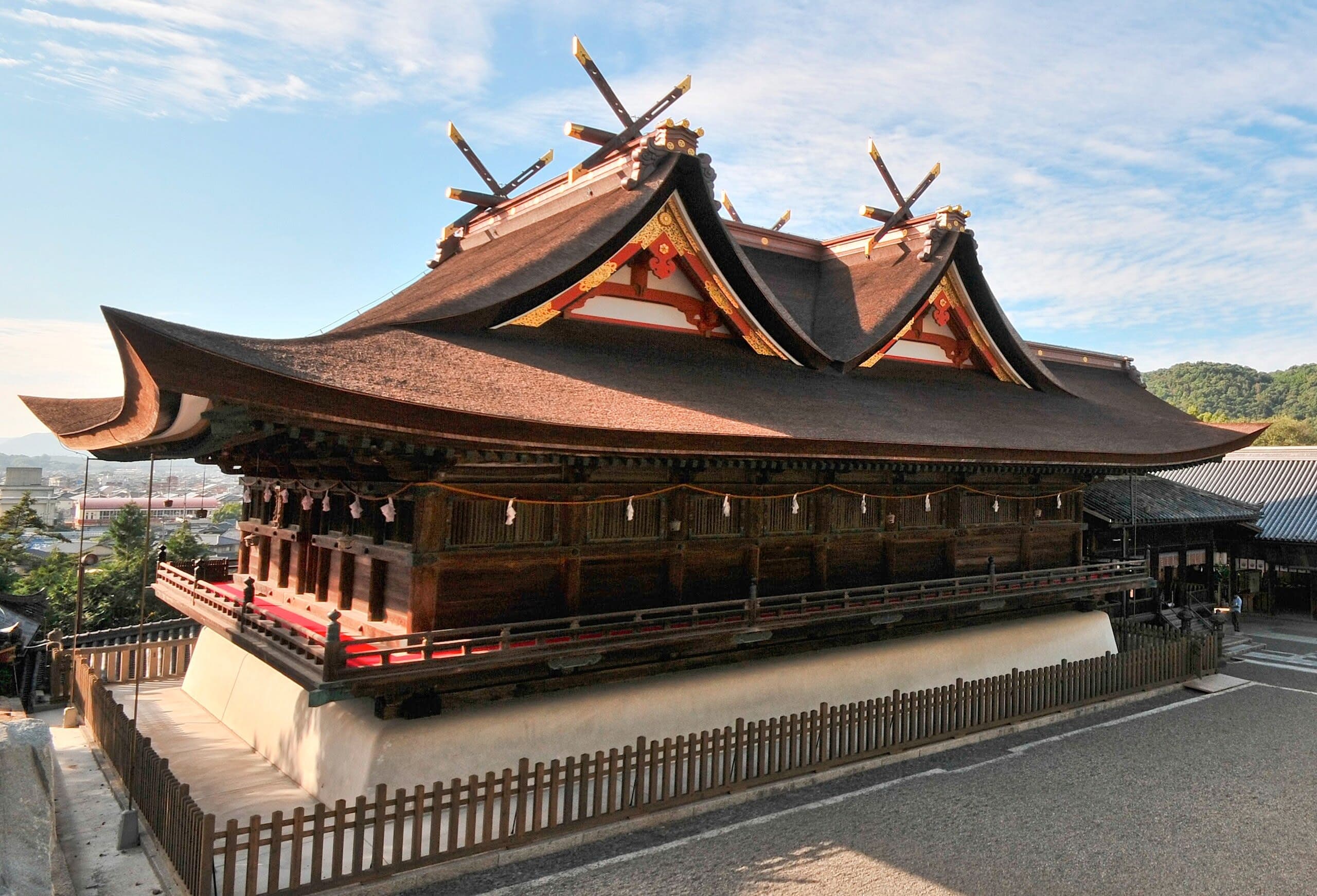
Kibitsu Jinja Shinto Shrine, Okayama
Where Japan's most beloved folktale was born from an ancient demon's defeat
Okayama, Okayama Prefecture, Japan
At A Glance
- Coordinates
- 34.6708, 133.8506
- Suggested Duration
- One to two hours allows for thorough exploration including the main hall, the full length of the covered corridor, and the sub-shrines. Allow additional time if attending the Narukama ritual.
- Access
- The shrine grounds open at 6:00 AM and close at 6:00 PM. Buildings are accessible from 8:30 AM to 4:30 PM. The grounds are free to enter; a fee applies for the Narukama ritual. From JR Okayama Station, take the Kibi Line to Kibitsu Station, from which the shrine is a ten-minute walk.
Pilgrim Tips
- The shrine grounds open at 6:00 AM and close at 6:00 PM. Buildings are accessible from 8:30 AM to 4:30 PM. The grounds are free to enter; a fee applies for the Narukama ritual. From JR Okayama Station, take the Kibi Line to Kibitsu Station, from which the shrine is a ten-minute walk.
- No specific dress code applies, though respectful attire appropriate to a place of worship is appreciated. Comfortable walking shoes are recommended for the extensive corridor.
- Photography is permitted throughout most of the shrine grounds and corridor. Use discretion in the main worship hall and kitchen area.
- The Narukama ritual requires advance reservation and is not available on demand. The inner sanctuary of the main hall is restricted. Standard Shinto shrine etiquette applies throughout.
Overview
Kibitsu Jinja preserves the origin story of Momotaro, the Peach Boy. Here Prince Kibitsuhiko defeated the demon Ura seventeen centuries ago, and the demon's severed head still groans beneath the kitchen during sacred rituals. The shrine's architecture exists nowhere else in Japan, and its 360-meter covered corridor draws pilgrims through seasons of beauty.
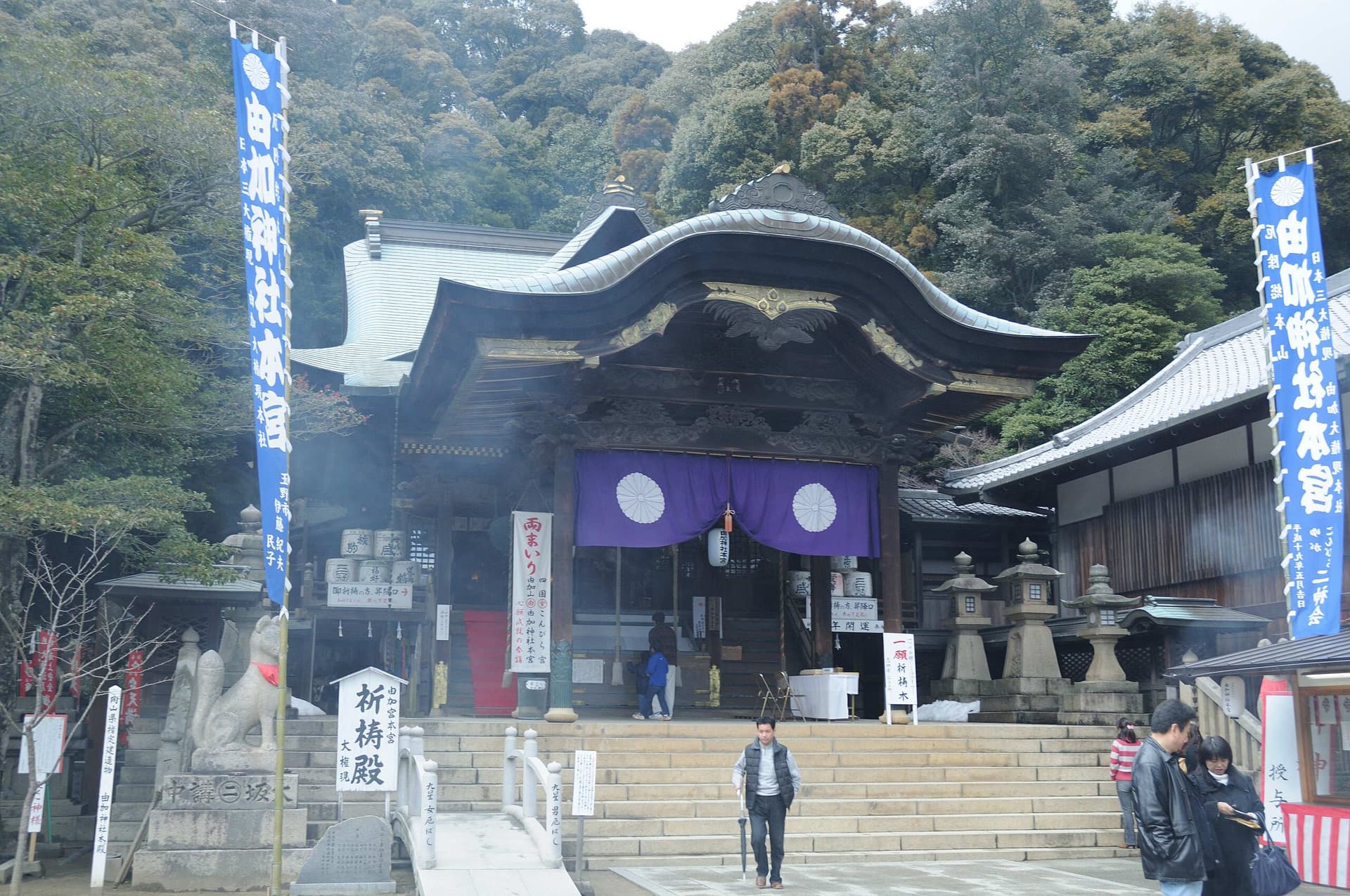
In the heart of Okayama Prefecture stands a shrine unlike any other in Japan. Kibitsu Jinja has watched over this land for approximately 1,700 years, preserving the legend that became Momotaro, the nation's most beloved folktale. The story remembers Prince Kibitsuhiko, dispatched by Emperor Korei to this region to defeat a demon named Ura who terrorized the people. The prince prevailed, but the demon's head continued to groan even after burial. A kitchen was built over the grave, and to this day those groans emerge from beneath the cauldron during the Narukama ritual, the only fortune-telling ceremony of its kind in Japan. The main hall, designated a National Treasure, displays the unique Kibitsu-zukuri architectural style found at no other shrine. A 360-meter covered corridor, itself an Important Cultural Property, leads visitors through wisteria-draped walkways past eight constituent properties now recognized as Japan Heritage. Walking here connects visitors to mythology that has shaped Japanese imagination for centuries.
Context And Lineage
Kibitsu Jinja anchors the mythology of the ancient Kibi kingdom and preserves the origin story that became Japan's most famous folktale.
Prince Kibitsuhiko, son of Emperor Korei, was dispatched to the Kibi region to defeat a demon named Ura who terrorized the land. The battle was fierce, but Kibitsuhiko prevailed and beheaded the demon. Yet Ura's head would not rest, continuing to groan even after burial. A kitchen was built over the burial spot to contain the demon's power, and the groans eventually became a source of divination. When rice is placed in a cauldron over the buried head and steam rises, the demon's voice emerges, predicting fortune or misfortune by the sound it makes. This legend gradually transformed into the tale of Momotaro, the Peach Boy who with his animal companions defeated demons on their island, becoming Japan's most beloved folktale and Okayama's cultural symbol.
Kibitsu Jinja predates Japan's formal shrine system, rooted in the ancient Kibi kingdom that flourished before the consolidation of the Yamato state. The shrine represents a regional tradition that was integrated into imperial mythology when Emperor Korei's son was credited with conquering the area. This integration pattern, where local deities and legends are incorporated into a national framework, appears throughout Japanese religious history. The shrine maintains traditional Shinto practices while serving as a Japan Heritage Site.
Kibitsuhiko-no-Mikoto
Prince and central deity
Ura
Demon of legend
Why This Place Is Sacred
Kibitsu Jinja marks the place where myth became legend and legend became national folklore, with a demon's voice still speaking from beneath the sacred kitchen.
The thinness at Kibitsu Jinja arises from multiple currents of the numinous converging in one place. There is the weight of nearly two millennia of continuous worship, maintained through wars and restorations. There is the presence of the extraordinary, embodied in architecture found nowhere else on earth and in a ritual that summons sound from a buried demon's grave. Most significantly, this is origin ground, the place where the story of Momotaro first took root before spreading throughout the nation. Standing where Prince Kibitsuhiko actually fought, where Ura's head was actually interred, visitors encounter not a memorial to mythology but the living source of it. The covered corridor creates a liminal passage, drawing visitors deeper into sacred space with each step. The kitchen where the Narukama ritual is performed carries an atmosphere of uncanny stillness, as if something beneath the floor might speak at any moment.
The shrine was established to enshrine Prince Kibitsuhiko, the legendary pacifier of the Kibi region, and to contain and transform the power of the defeated demon Ura. The Narukama ritual channels the demon's lingering presence into a force for divination and protection.
Over seventeen centuries, Kibitsu Jinja evolved from a regional shrine honoring a local deity into a repository of national mythology. The transformation of the Kibitsuhiko and Ura legend into the universally known Momotaro tale demonstrates how sacred sites serve as incubators for cultural identity. The shrine has been destroyed and rebuilt multiple times, with the current National Treasure buildings dating to 1425. Its designation as a Japan Heritage Site with eight constituent properties reflects contemporary recognition of its cultural significance.
Traditions And Practice
The shrine offers traditional Shinto worship enriched by the unique Narukama divination ritual found nowhere else in Japan.
The Narukama ritual stands as the defining practice of Kibitsu Jinja. A cauldron is placed over the spot where Ura's head is buried, rice and water are added, and as steam rises, the demon's voice emerges in groans and sounds. Trained priests interpret these sounds to divine fortune. The ritual transforms malevolent power into protective blessing, a theme central to much Japanese religion. Beyond this unique practice, the shrine maintains the annual festivals, daily worship services, and seasonal observances standard to major Shinto shrines.
Visitors engage with the shrine primarily through walking the covered corridor and worshipping at the main hall. The Narukama ritual requires advance reservation and a fee but offers an experience unavailable anywhere else. Wedding ceremonies are performed here, connecting contemporary couples to the shrine's long history. Omamori protective amulets and ema votive tablets related to the Momotaro legend draw visitors seeking blessings.
Walk the covered corridor slowly, allowing the enclosed space to create a sense of transition from everyday consciousness to sacred awareness. At the main hall, follow standard Shinto etiquette: two bows, two claps, one bow, while holding your intentions in mind. If visiting when the Narukama ritual is scheduled, make advance reservations to witness this extraordinary ceremony. Approach the kitchen area with awareness of what lies beneath.
Shinto
ActiveKibitsu Jinja functions as a major Shinto shrine maintaining nearly two millennia of continuous worship. It enshrines Kibitsuhiko-no-Mikoto as its central kami and performs the unique Narukama ritual found at no other shrine in Japan.
Daily worship services, the Narukama fortune-telling ceremony, annual festivals honoring Kibitsuhiko, wedding ceremonies, distribution of omamori and ema
Experience And Perspectives
Visitors encounter otherworldly architecture, an ethereal covered walkway, and the unsettling quiet of a kitchen built atop a demon's grave.
Approaching Kibitsu Jinja, visitors first encounter the unique silhouette of the main hall, its rooflines unlike any other shrine in Japan. The Kibitsu-zukuri style, with its hiyoku irimoya configuration, marks this as a place that developed its own sacred architecture independent of standard forms. Inside the main hall, the sense of ancient devotion is palpable, with worship spaces arranged around the enshrined deity. The true wonder begins at the covered corridor, stretching between 360 and 398 meters depending on the source, roofed and walled to create a passage that feels more like a pilgrimage than a walk. In spring, wisteria blooms along parts of the corridor, adding purple cascades to the experience. The corridor leads to various sub-shrines and eventually to the kitchen where the Narukama ritual is performed. This space carries a different quality, quieter and more charged, as visitors contemplate the legend of what lies beneath. Throughout, the sense of deep time pervades, seventeen centuries of continuous devotion layered into every stone and beam.
The shrine spreads across a hillside with the main hall at the center and the covered corridor extending to secondary shrines. Most visitors enter through the main approach, pass through the torii gate, purify at the temizu basin, and worship at the main hall before walking the corridor. The kitchen where the Narukama ritual is performed lies along the corridor route. Plan for at least an hour to walk the entire complex without rushing.
Understanding of Kibitsu Jinja spans scholarly analysis, traditional belief, and alternative interpretations, each revealing different dimensions of this ancient site.
Academic analysis positions Kibitsu Jinja as evidence of the ancient Kibi kingdom's independent religious development before cultural standardization under the Yamato state. The unique Kibitsu-zukuri architecture demonstrates regional distinctiveness in sacred building. Scholars trace the transformation of the Kibitsuhiko and Ura legend into the Momotaro folktale, illustrating how local mythology becomes national culture. The Narukama ritual represents a survival of ancient divination practices that have largely disappeared elsewhere.
In Shinto understanding, Prince Kibitsuhiko genuinely defeated the demon Ura, whose head remains beneath the kitchen to this day. The groans that emerge during the Narukama ritual are authentically the demon's voice, now transformed from malevolent force to oracular power. The unique architecture represents divine inspiration rather than regional variation. The continuous worship maintained for nearly two millennia sustains the shrine's spiritual efficacy.
Some interpreters view the Ura legend as reflecting historical conflicts between indigenous peoples and Yamato invaders, with the demon representing a local chieftain whose defeat was mythologized. The buried head might commemorate an actual interment of a defeated leader whose memory was transmuted into demon legend. The Momotaro transformation could represent deliberate cultural engineering to align regional identity with national mythology.
Significant mysteries remain unresolved. The historical reality behind the Kibitsuhiko and Ura conflict remains unknown. The original meaning and development of the Narukama ritual predates historical records. The architectural influences that created the unique Kibitsu-zukuri style, found at no other shrine, are not fully understood.
Visit Planning
Easily accessible from Okayama city, the shrine rewards visitors with a one to two hour exploration of unique architecture and sacred walkways.
The shrine grounds open at 6:00 AM and close at 6:00 PM. Buildings are accessible from 8:30 AM to 4:30 PM. The grounds are free to enter; a fee applies for the Narukama ritual. From JR Okayama Station, take the Kibi Line to Kibitsu Station, from which the shrine is a ten-minute walk.
Okayama city offers extensive accommodation options at all price levels. The shrine can be visited as a half-day trip from Okayama or incorporated into longer Setouchi region travel.
Standard Shinto shrine etiquette applies, with particular respect requested in the sacred kitchen area.
Upon arriving at Kibitsu Jinja, visitors should purify their hands and mouth at the temizu water basin before approaching the main hall. At worship areas, the standard Shinto form is followed: two bows, two claps, one bow. Make offerings of coins in the offering boxes. When walking the covered corridor, maintain a respectful pace and avoid loud conversation that might disturb other visitors in contemplation. The kitchen area where the Narukama ritual is performed warrants particular reverence given what the tradition holds is buried there. Photography is permitted in most areas but should be done without flash in interior spaces.
No specific dress code applies, though respectful attire appropriate to a place of worship is appreciated. Comfortable walking shoes are recommended for the extensive corridor.
Photography is permitted throughout most of the shrine grounds and corridor. Use discretion in the main worship hall and kitchen area.
Coins may be offered at the main hall and sub-shrines along the corridor. Omamori and ema are available for purchase.
{"Advance reservation required for Narukama ritual","Inner sanctuary restricted","Purification at temizu expected before worship"}
Sacred Cluster
Nearby sacred places create the location cluster described in the growth plan. This block is intentionally crawlable and links into the wider regional graph.