Kamares Cave
A mountain sanctuary where the Minoans offered their finest art to the darkness inside the earth
Tybakio Municipal Unit, Region of Crete, Greece
At A Glance
- Coordinates
- 35.1775, 24.8276
- Suggested Duration
- Full day. The ascent from Kamares village takes 3 to 4 hours depending on fitness and conditions. Allow approximately 1 hour to explore the cave and rest. The descent takes 2 to 2.5 hours. Total hiking time: 6 to 7.5 hours. An alternative route from the Nida Plateau on the northern side of Mount Ida connects to the cave via the E4 trail through Poros Milias, suitable for those combining the visit with a traverse of Psiloritis or a visit to the Idaean Cave.
- Access
- Primary route: Begin in Kamares village on the southern slopes of Mount Ida. The village is accessible by car from the Mesara Plain via Mires, the nearest major town. A steep uphill path leads from the village to the cave, following part of the E4 European long-distance trail, marked with red signs. Trail markings vary in reliability along different sections. The path passes through oak woodland with 3 to 4 freshwater springs along the route. The cave sits at approximately 1,700 meters altitude. Alternative route: From the Nida Plateau on the north side of Psiloritis, the E4 trail connects to the cave via the Akolita area, passing through the Poros Milias (apple-tree passage). Bring at least 2 liters of water per person, sufficient food for a full day, sun protection, a headlamp or flashlight for the cave interior, and rain gear as a precaution. There is no mobile phone signal in the area around the cave or on the upper trail. In the event of an emergency, you would need to descend to lower elevations toward the village to find signal. There are no facilities of any kind at the cave. The key artifacts from the cave are displayed at the Heraklion Archaeological Museum, which should be visited before or after the hike to understand what was found here.
Pilgrim Tips
- Primary route: Begin in Kamares village on the southern slopes of Mount Ida. The village is accessible by car from the Mesara Plain via Mires, the nearest major town. A steep uphill path leads from the village to the cave, following part of the E4 European long-distance trail, marked with red signs. Trail markings vary in reliability along different sections. The path passes through oak woodland with 3 to 4 freshwater springs along the route. The cave sits at approximately 1,700 meters altitude. Alternative route: From the Nida Plateau on the north side of Psiloritis, the E4 trail connects to the cave via the Akolita area, passing through the Poros Milias (apple-tree passage). Bring at least 2 liters of water per person, sufficient food for a full day, sun protection, a headlamp or flashlight for the cave interior, and rain gear as a precaution. There is no mobile phone signal in the area around the cave or on the upper trail. In the event of an emergency, you would need to descend to lower elevations toward the village to find signal. There are no facilities of any kind at the cave. The key artifacts from the cave are displayed at the Heraklion Archaeological Museum, which should be visited before or after the hike to understand what was found here.
- Sturdy hiking boots with ankle support are essential for the steep, rocky trail. Layered clothing is necessary given the altitude gain from the village at approximately 500 meters to the cave at approximately 1,700 meters. Temperatures can drop significantly at the cave entrance even on warm summer days. Sun protection, including hat and sunscreen, is critical for the exposed upper sections of the trail. Rain gear is advisable, as mountain weather on Psiloritis can change rapidly.
- No restrictions. The cave is an open, unattended site. A headlamp or flashlight is needed for photography inside the cave interior. The most striking photographs are often taken at the cave entrance, framing the enormous arch against the sky or capturing the view south across the Mesara Plain.
- Do not leave any objects or offerings in the cave. Do not dig, move stones, or disturb any deposits. The cave lies within a protected archaeological zone and the Psiloritis UNESCO Global Geopark. Do not light fires inside the cave. The interior slope is steep and may be slippery; move with care and a headlamp.
Overview
High on the southern face of Mount Ida, the highest mountain in Crete, a vast arched entrance opens into the mountain at nearly 1,700 meters. For centuries during the Bronze Age, Minoan worshippers climbed to this remote cave and left behind the most exquisite pottery their civilization ever produced. Over 1,800 vessels were recovered from a single excavation, offerings surrendered not to human eyes but to the dark interior of the earth goddess who dwelled within.
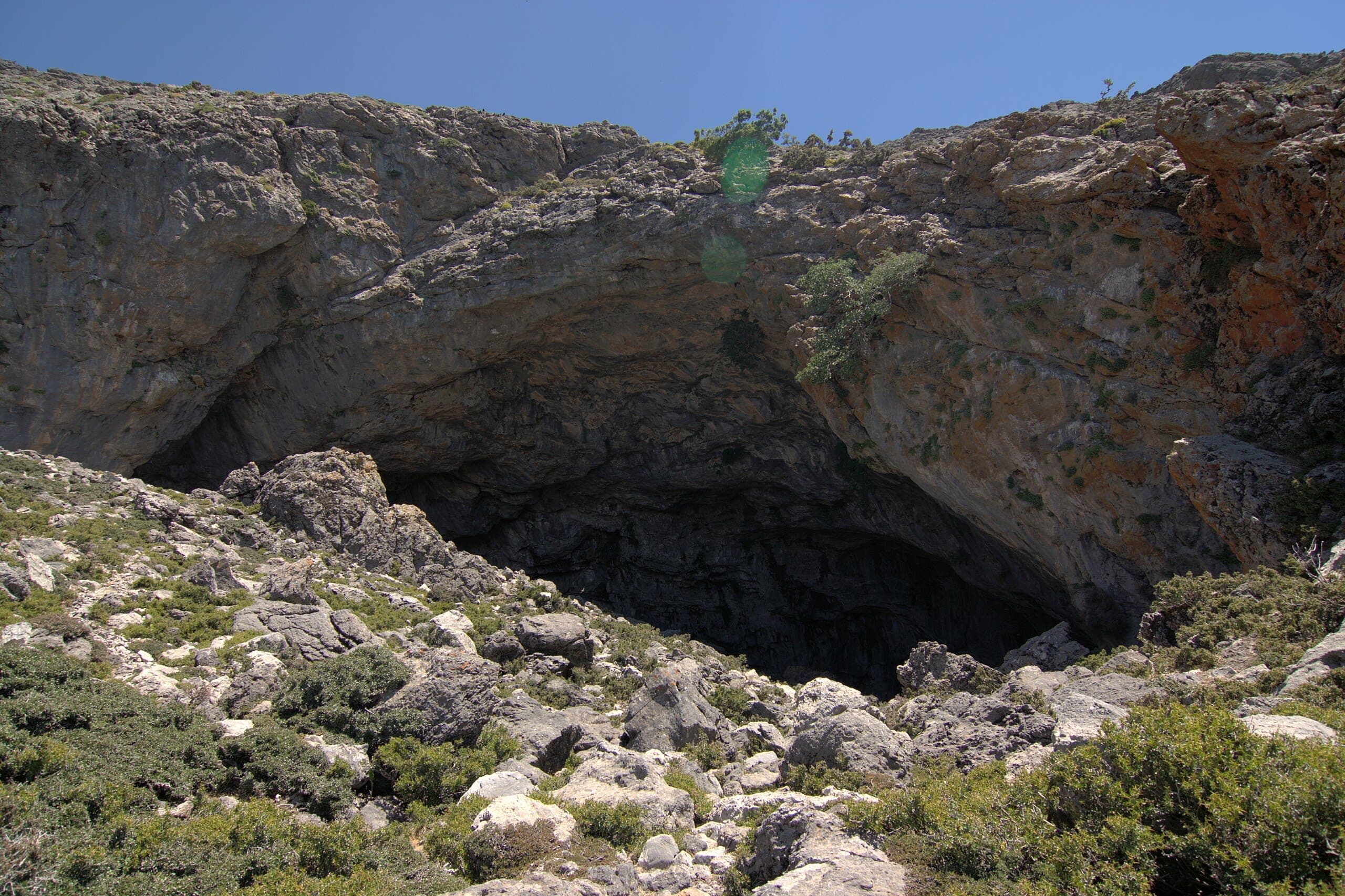
The walk takes between three and four hours. It begins in the village of Kamares on the lower slopes and ascends through oak woodland, past freshwater springs, through thinning vegetation and widening horizons, until the mountain opens. The cave entrance is 42 meters wide and 20 meters high, an enormous natural arch facing south across the Mesara Plain toward the Libyan Sea. On a clear day, the Palace of Phaistos is visible far below, a pale mark on the distant plain. This is the same view that Minoan priests would have seen four thousand years ago, looking down from the mouth of the sacred toward the seat of earthly power.
Kamares Cave gave its name to the most celebrated pottery style of the Minoan world. Kamares ware, with its polychrome decoration of spirals, tendrils, and organic forms painted in white, red, and orange against dark backgrounds, represents the peak of Bronze Age ceramic art. Some vessels were so thin that archaeologists call them eggshell ware, works of such delicacy that their creation required the highest level of craft the Minoan world could achieve. These were not decorative objects made for display. They were made to be given away, carried up this mountain and placed in the darkness of the cave as offerings to a deity whose name we no longer know.
That act of surrender is what makes Kamares Cave unlike a museum. The finest art of a civilization was not collected here but abandoned here, deliberately, repeatedly, across centuries. To stand in the cave entrance and look inward is to confront a set of values utterly different from those of the modern world: a people who understood that the highest expression of beauty was not possession but offering, and that the proper destination for the most exquisite thing a human hand could make was the interior of a mountain.
Context And Lineage
Kamares Cave was one of the four major sacred caves of Minoan Crete, linked to the Palace of Phaistos through a visual and ritual axis spanning the Mesara Plain. It gave its name to the most celebrated pottery style of the Bronze Age Aegean.
The sacredness of Kamares Cave grows from the Minoan practice of seeking the divine in the natural world. The Minoans did not build temples in the manner of later Greeks or Romans. Instead, they sought out places where the earth itself seemed to open, where mountain peaks touched the sky, where the boundary between the human world and something older, deeper, less negotiable became physically tangible. Caves were central to this theology. Throughout Crete, from Psychro in the east to Kamares in the south, the Minoans chose natural caverns as the sites of their most sustained devotion.
Kamares Cave emerged as sacred around 2100 BCE, during the period when the first palaces were rising on the Cretan lowlands. The connection to the Palace of Phaistos is not merely geographical but architecturally evidenced: roughly 200 collar-necked storage jars, types directly associated with the First Palace at Phaistos, were found in pristine condition inside the cave. These jars were not leftovers or cast-offs. They were carried up the mountain deliberately, filled perhaps with grain or wine, and placed in the cave as organized, palatial-scale offerings.
The cave's position on Mount Ida added another layer of meaning. Ida was the most sacred mountain in Crete, mythologically associated in later Greek tradition with the rearing of Zeus by the Kouretes. While this myth postdates Minoan religion, the mountain's sanctity may reflect a continuity of reverence reaching back into the Bronze Age. The cave sits on Ida's southern face, visible from the plain below as a dark opening in the bright limestone, a mark on the mountain that announced the presence of the sacred from a distance of twenty kilometers.
Kamares Cave belongs to the tradition of Minoan cave religion, one of four major sacred caves alongside the Idaean Cave, the Psychro (Diktaian) Cave, and the Arkalochori Cave. These sites formed a network of mountain sanctuaries that served communities and palaces across the island. The cave's ritual function was specifically tied to the Palace of Phaistos, the dominant political center of south-central Crete during the Protopalatial period. When Minoan civilization collapsed in the mid-second millennium BCE, the cave's sacred function ceased, and no subsequent tradition adopted or continued the practices. Unlike the Idaean Cave, which received offerings through the Greek and Roman periods, Kamares Cave appears to have been abandoned as a sacred site after the end of the Bronze Age. Its modern significance is archaeological and art-historical: the pottery that gave the cave its fame is now central to the study of Minoan art, and key pieces are displayed at the Heraklion Archaeological Museum.
Iosif Chatzidakis
Cretan physician and archaeologist who received the first pottery samples from local shepherds in 1890, published the discovery, and brought the cave to the attention of the European scholarly world. His initial recognition that the pottery was significant opened a century of investigation.
Antonio Taramelli
Italian archaeologist who conducted the first scientific exploration of the cave in 1894 on behalf of the Archaeological Institute of America, establishing the preliminary archaeological record of the site.
R. M. Dawkins
British archaeologist who led the comprehensive 1913 excavation for the British School at Athens, recovering fragments of over 1,800 vessels and co-authoring the foundational excavation report that defined Kamares ware as a distinct ceramic tradition.
Loeta Tyree
Co-director of the Kamares Cave Project (begun 2002), which reinvestigated the 1913 finds using modern analytical methods to reconstruct the phases and character of cult activity across the Bronze Age.
Aleydis Van de Moortel
Pottery specialist and co-director of the Kamares Cave Project, whose expertise in Minoan ceramics has deepened understanding of the relationship between palatial pottery production and cave sanctuary offerings.
Why This Place Is Sacred
Kamares Cave draws its sacred quality from a convergence of altitude, physical effort, dramatic threshold, and four millennia of accumulated devotion. The cave stands at the intersection of sky and earth, visible from the palace below yet reachable only through sustained pilgrimage.
The thinness of Kamares Cave begins with the approach. There is no road. There is no shortcut. The only way to reach the cave is to walk for hours uphill through changing landscapes that progressively strip away the familiar. Mediterranean scrubland gives way to oak forest, the oaks thin and yield to bare mountain slope, and the horizon expands in every direction until the Mesara Plain spreads below like a map of the ancient world. Springs mark the route, the same springs that refreshed Minoan pilgrims. By the time the cave mouth appears, the body has earned the encounter.
The entrance itself is a threshold of extraordinary power. Forty-two meters wide and twenty meters high, it opens in the mountainside like a mouth, or a womb, or an eye. The shape gave the cave its name: kamara means arch. Step inside and the transition is immediate. Behind you, the sunlit world of the Mesara Plain, the sea glinting in the distance, the villages and fields of human habitation. Before you, darkness, descending stone, the interior of the mountain. You stand at the exact boundary between the two domains.
The Minoans understood this boundary as sacred. Caves throughout Crete served as sanctuaries, but Kamares was exceptional: its altitude, its visibility from the Palace of Phaistos across twenty kilometers of open plain, its seasonal accessibility created a place where reaching the divine required not merely intent but physical commitment. Snow sealed the cave for half the year. To arrive was itself an act of devotion, timed to the mountain's permission.
Then there is the weight of what was offered here. Fragments of more than 1,800 vessels from a single excavation. Roughly 200 collar-necked jars transported from the Palace of Phaistos. Cereals and fruits placed alongside the pottery. The scale of giving was not casual but sustained, organized, and deliberate across centuries. The cave holds the residue of a devotion so deep that an entire pottery style bears its name. Four thousand years later, the offerings are gone to museums, but the place remembers what it received.
Kamares Cave functioned as a cave sanctuary for the Minoan civilization, active from at least 2100 BCE through the Bronze Age. It served as a site for the mass deposition of fine polychrome pottery (Kamares ware) and agricultural offerings to a deity associated with the earth, fertility, or childbirth. The cave's connection to the Palace of Phaistos suggests it served as a major cult center with palatial patronage, forming part of a sacred landscape linking political and religious power across the Mesara Plain.
Sacred use of the cave began in the early Protopalatial period, around 2100 BCE, and reached its peak during Middle Minoan I-II (approximately 2100-1700 BCE), coinciding with the First Palace at Phaistos. The cave continued to receive offerings through the Neopalatial period, though possibly at reduced intensity, before ritual activity declined around 1450 BCE alongside the wider destruction events across Minoan Crete. The cave then fell silent as a sacred site for more than three millennia. In 1890, Cretan shepherds brought pottery samples to the physician and archaeologist Iosif Chatzidakis, who published the discovery. Antonio Taramelli conducted the first scientific exploration in 1894. The comprehensive excavation of 1913, led by R. M. Dawkins and M. L. W. Laistner for the British School at Athens, recovered the enormous pottery assemblage that established Kamares ware as a defined style. The Kamares Cave Project, initiated in 2002 by Loeta Tyree and Aleydis Van de Moortel, reinvestigated the 1913 finds to better understand the phases and nature of cult activity. In 2004, the cave was incorporated into the Psiloritis UNESCO Global Geopark. Today it is visited primarily by hikers and those with an interest in Minoan archaeology.
Traditions And Practice
Ancient Minoan practices centered on the mass deposition of fine pottery and agricultural offerings to an earth or fertility deity. No active worship has taken place at the cave for approximately 3,500 years. The site is now visited by hikers and archaeology enthusiasts.
The rituals at Kamares Cave were organized around acts of offering. Minoan worshippers, likely including delegations from the Palace of Phaistos, ascended the mountain carrying pottery of extraordinary refinement and beauty. The Kamares ware deposited here represents the highest achievement of Minoan ceramic art: polychrome vessels decorated with spiraling, organic motifs in white, red, and orange against dark grounds, some so thin-walled they have been termed eggshell ware. The deliberate placement of such fragile objects in a cave accessible only through hours of arduous climbing speaks to a theology in which the act of offering was proportional to the difficulty of giving.
Alongside the pottery, worshippers deposited cereals and fruits of the earth, offerings that scholars interpret as agricultural thanksgiving or petitioning for continued fertility. The collar-necked jars from the Palace of Phaistos suggest that some offerings were officially organized, likely sanctioned or directed by palatial authorities as part of a formal cult calendar.
The seasonal nature of access may have carried its own ritual significance. Snow sealed the cave through winter and often into spring. The window of access was dictated by the mountain, not by human scheduling. To reach the cave at all required timing one's pilgrimage to the snowmelt, a form of submission to natural authority that may itself have been understood as devotion.
Notably, Kamares Cave yielded very few human or animal figurines, a contrast with other Minoan sacred caves and peak sanctuaries where such offerings were common. This absence suggests a distinct form of cult practice, one focused on the offering of crafted vessels and agricultural produce rather than representational objects.
No religious practice takes place at Kamares Cave today. The Minoan tradition ended approximately 3,500 years ago and was never revived. The cave is visited by hikers drawn to the physical challenge and the mountain scenery, by archaeology enthusiasts who wish to see the site where Kamares ware was first discovered, and by those who seek the solitude and contemplative quality of remote mountain landscapes.
The hike itself is the practice. Treat the ascent as the Minoans treated it: a sustained physical effort that earns the encounter. Carry water, not offerings. When you reach the cave, stand at the entrance and face south before entering. The Palace of Phaistos is visible on the plain below; let the distance between the two points register. Consider what it meant to carry the finest pottery in the world up this mountain and leave it in the dark. Then turn and enter the cave. Bring a headlamp. Move slowly on the steep interior slope. Stand in the darkness and let your eyes adjust. The cave is empty of its offerings now, but the space that received them remains unchanged. Sit, if you can find a level spot, and listen. The silence is four thousand years deep.
Minoan Cave Religion
HistoricalKamares Cave was one of the four major sacred caves of Minoan Crete, active from approximately 2100 to 1450 BCE. It served as a cave sanctuary where Minoan communities, likely including organized delegations from the Palace of Phaistos, deposited vast quantities of fine polychrome pottery, agricultural offerings, and storage vessels as part of a sustained cult practice spanning the entire Bronze Age. The cave gave its name to Kamares ware, the most celebrated pottery style of the Minoan world.
Mass deposition of fine polychrome pottery (Kamares ware) as votive offerings, including eggshell ware of extreme delicacyTransport and deposition of collar-necked storage jars from the Palace of Phaistos, indicating organized palatial cult activitiesOfferings of cereals and fruits of the earth as agricultural thanksgiving or petitioningSeasonal pilgrimage synchronized with snowmelt, with access limited to summer monthsSmall-scale offerings of terracotta animal figurines, though rarer at Kamares than at other Minoan caves
Experience And Perspectives
Kamares Cave is experienced through the pilgrimage of reaching it. The 3-4 hour ascent through changing landscapes culminates at an immense cave entrance that frames the transition between the sunlit world and the mountain's interior. Solitude and physical effort define the encounter.
There is no gentle introduction to Kamares Cave. The experience begins in the village of Kamares, on the southern slopes of Mount Ida, and it begins with walking uphill. The trail follows part of the E4 European long-distance path, marked with red signs, though the markings vary in reliability along different sections. The gradient is steady and sustained.
The first stretch passes through cultivated land that gives way to oak woodland. The oaks provide shade and shelter, and three or four freshwater springs appear along the route, natural rest points where the trail levels briefly before resuming its climb. These springs are worth pausing at. They have been watering travelers on this path for millennia, and the rhythm of climb, pause, drink, and climb again connects the modern walker to every pilgrim who preceded them.
As altitude increases, the oaks thin and the landscape opens. The Mesara Plain unfolds below, the largest agricultural lowland in Crete, and beyond it the Libyan Sea extends to the southern horizon. On clear days, the island of Gavdos is visible, the southernmost point of Europe. The Palace of Phaistos, the Minoan center whose pottery was carried up this mountain as sacred offering, is distinguishable across the plain. The visual axis between the cave and the palace is not incidental. It was the organizing principle of a sacred landscape that linked the political world below to the divine world above.
The final approach is across bare mountain terrain. The vegetation falls away and the rock takes over. Then the cave appears: an immense arched opening in the mountainside, far larger than photographs suggest. Forty-two meters wide. Twenty meters high. The scale silences conversation. You are standing at roughly 1,700 meters, having climbed for hours, and the mountain has opened before you like a doorway into another order of experience.
Step inside and the temperature drops. The cave floor descends steeply from the entrance into the main chamber. Natural stone formations line the walls. Without a headlamp, the interior quickly becomes impenetrable darkness. With one, the cave reveals itself gradually, the beams catching formations that Minoan worshippers also saw by the light of torches or oil lamps.
The cave is unattended, unfenced, and unmarked beyond whatever trail signs brought you here. There is no interpretation panel, no ticket office, no guard. This absence is itself part of the experience. You are alone with the cave, or nearly so, in the same condition as those who came here to make their offerings. The silence is profound. The only sounds are wind at the entrance and, sometimes, the drip of water within.
For the descent, allow two to two and a half hours. The knees bear what the lungs bore on the way up. An alternative approach from the Nida Plateau on the northern side of Mount Ida follows the E4 trail through the Poros Milias, connecting Kamares Cave to the Idaean Cave and the broader network of Cretan mountain paths.
Approach Kamares Cave as a pilgrimage, not a day hike. The physical effort is inseparable from the meaning of the place. Start early in the morning to avoid midday heat on the exposed upper slopes. Carry at least two liters of water per person, food, sun protection, and a headlamp or flashlight for the cave interior. When you reach the cave entrance, resist the urge to immediately enter. Stand at the threshold. Look south across the Mesara Plain toward Phaistos. Let the visual connection between the cave and the palace register. Then turn and face the darkness. The transition you are about to make is the same one that Minoan worshippers made, and the cave still holds the gravity of that crossing.
Kamares Cave can be understood through the lens of Minoan religion, Bronze Age art history, landscape archaeology, or the phenomenology of pilgrimage. Each approach reveals a different dimension of why this remote mountain cavern held such sustained and extraordinary significance.
Archaeological consensus places Kamares Cave among the four most important sacred caves of Minoan Crete, alongside the Idaean Cave, Psychro, and Arkalochori. The cave is significant on two counts: as a cave sanctuary with evidence of sustained ritual activity spanning the entire Bronze Age (approximately 2100-1450 BCE), and as the type-site for Kamares ware, the polychrome pottery style that represents the highest achievement of Minoan ceramic art. The connection between the cave and the Palace of Phaistos is well established through the collar-necked jars found inside, though scholars continue to debate whether the fine Kamares pottery was produced in a palatial workshop or by independent artisans. The Kamares Cave Project, led by Tyree and Van de Moortel from 2002, reinvestigated the 1913 finds using modern analytical techniques and confirmed that the cave received offerings across all periods of the Minoan Bronze Age, though the intensity of activity varied. The near-absence of human and animal figurines, common at other Minoan sacred caves, remains an unresolved question that may point to a distinct cult focus at Kamares.
There is no living tradition associated with Kamares Cave. Minoan religion left no descendants, no scriptures, no continuous community of practice. What survives is the material record: pottery of astonishing beauty placed in a mountain cave by people whose names, prayers, and theology are lost. The local Cretan relationship to the cave is shaped by landscape rather than religion. Shepherds have known the cave for centuries, and it was shepherds who brought the first pottery fragments to the attention of scholars in 1890. The mountain and its caves remain part of the working landscape of rural Crete, valued for grazing, for water, and for the practical knowledge of terrain that pastoralists maintain across generations.
Some interpretations read Minoan cave sanctuaries as womb-spaces of the Earth Mother, places where worshippers entered the body of the goddess herself. In this reading, the enormous arched entrance of Kamares Cave is a birth-opening in the mountain. The descent into darkness is a return to the source. The offering of the most beautiful objects of human creation into the earth's interior is an act of surrender and reciprocity, giving back to the force that gives life. The seasonal rhythm of access, governed by snowmelt rather than human calendar, reinforces the sense that approaching the sacred required submission to the earth's own timing.
The identity of the deity worshipped at Kamares Cave remains unknown. Eilethyia, the goddess of childbirth, has been proposed based on analogies with other Cretan caves. Demeter, or a pre-Greek earth and harvest goddess, has also been suggested. The truth is that Minoan religion predated written Greek and left no texts. The deity may have no name that survives in any language. Equally uncertain is why the Minoans chose to deposit their most exquisite pottery in a cave accessible only during summer. Was the seasonal restriction ritually meaningful, or simply a practical constraint that worshippers accepted? The near-absence of figurines at Kamares, which are abundant at other Minoan sacred caves, has no agreed explanation. The full extent of the cave interior remains archaeologically unexplored beyond the areas excavated in 1913, and the question of whether deposits extend deeper into the mountain is open. The exact nature of the cave's relationship with the Palace of Phaistos — whether the cave was an official palatial sanctuary under direct palace control or a communal sacred site that the palace elite also patronized — has not been definitively resolved.
Visit Planning
Full-day hiking excursion. Accessible May through October from Kamares village on the southern slopes of Mount Ida. Allow 6-7.5 hours round trip. No facilities at the cave. No mobile phone signal.
Primary route: Begin in Kamares village on the southern slopes of Mount Ida. The village is accessible by car from the Mesara Plain via Mires, the nearest major town. A steep uphill path leads from the village to the cave, following part of the E4 European long-distance trail, marked with red signs. Trail markings vary in reliability along different sections. The path passes through oak woodland with 3 to 4 freshwater springs along the route. The cave sits at approximately 1,700 meters altitude. Alternative route: From the Nida Plateau on the north side of Psiloritis, the E4 trail connects to the cave via the Akolita area, passing through the Poros Milias (apple-tree passage). Bring at least 2 liters of water per person, sufficient food for a full day, sun protection, a headlamp or flashlight for the cave interior, and rain gear as a precaution. There is no mobile phone signal in the area around the cave or on the upper trail. In the event of an emergency, you would need to descend to lower elevations toward the village to find signal. There are no facilities of any kind at the cave. The key artifacts from the cave are displayed at the Heraklion Archaeological Museum, which should be visited before or after the hike to understand what was found here.
The village of Kamares offers limited accommodation; inquire locally. The town of Mires on the Mesara Plain, approximately 20 to 25 km by road, has hotels and services. For those visiting Phaistos as well, accommodation is available at guesthouses near the archaeological site. Heraklion, Crete's capital and the location of the Archaeological Museum, is approximately 65 km north and serves as the main base for exploring central Crete.
Archaeological site within a UNESCO Global Geopark. No formal restrictions beyond standard heritage protection: do not remove or disturb anything. The primary considerations are practical, given the remote mountain setting.
Kamares Cave is an unattended, open archaeological site within the Psiloritis UNESCO Global Geopark. There are no guards, no ticket office, no infrastructure of any kind at the cave itself. This places the responsibility for the site's preservation entirely on each visitor.
The fundamentals are straightforward. Do not remove stones, pottery fragments, or any material from the cave, no matter how small or seemingly insignificant. Archaeological deposits may remain in areas not excavated during the 1913 campaign, and even surface material has scientific value. Do not dig or probe the cave floor. Do not light fires. Do not spray-paint, carve, or otherwise mark the cave walls or entrance.
The cave's remoteness means that any damage is unlikely to be noticed or repaired promptly. What you leave undisturbed will remain undisturbed. What you damage will remain damaged.
Beyond preservation, the etiquette of Kamares Cave is set by the mountain itself. Carry out all waste. Do not leave food packaging, water bottles, or any litter along the trail or in the cave. The springs along the route are natural features that should be left clean for the next traveler.
Sturdy hiking boots with ankle support are essential for the steep, rocky trail. Layered clothing is necessary given the altitude gain from the village at approximately 500 meters to the cave at approximately 1,700 meters. Temperatures can drop significantly at the cave entrance even on warm summer days. Sun protection, including hat and sunscreen, is critical for the exposed upper sections of the trail. Rain gear is advisable, as mountain weather on Psiloritis can change rapidly.
No restrictions. The cave is an open, unattended site. A headlamp or flashlight is needed for photography inside the cave interior. The most striking photographs are often taken at the cave entrance, framing the enormous arch against the sky or capturing the view south across the Mesara Plain.
Not applicable. This is an archaeological site with no active worship. Do not leave objects, flowers, or personal items in the cave.
Do not dig, remove, or disturb any material. Do not light fires. Do not mark or deface cave surfaces. The site is protected as an archaeological monument within the Psiloritis UNESCO Global Geopark.
Sacred Cluster
Nearby sacred places create the location cluster described in the growth plan. This block is intentionally crawlable and links into the wider regional graph.