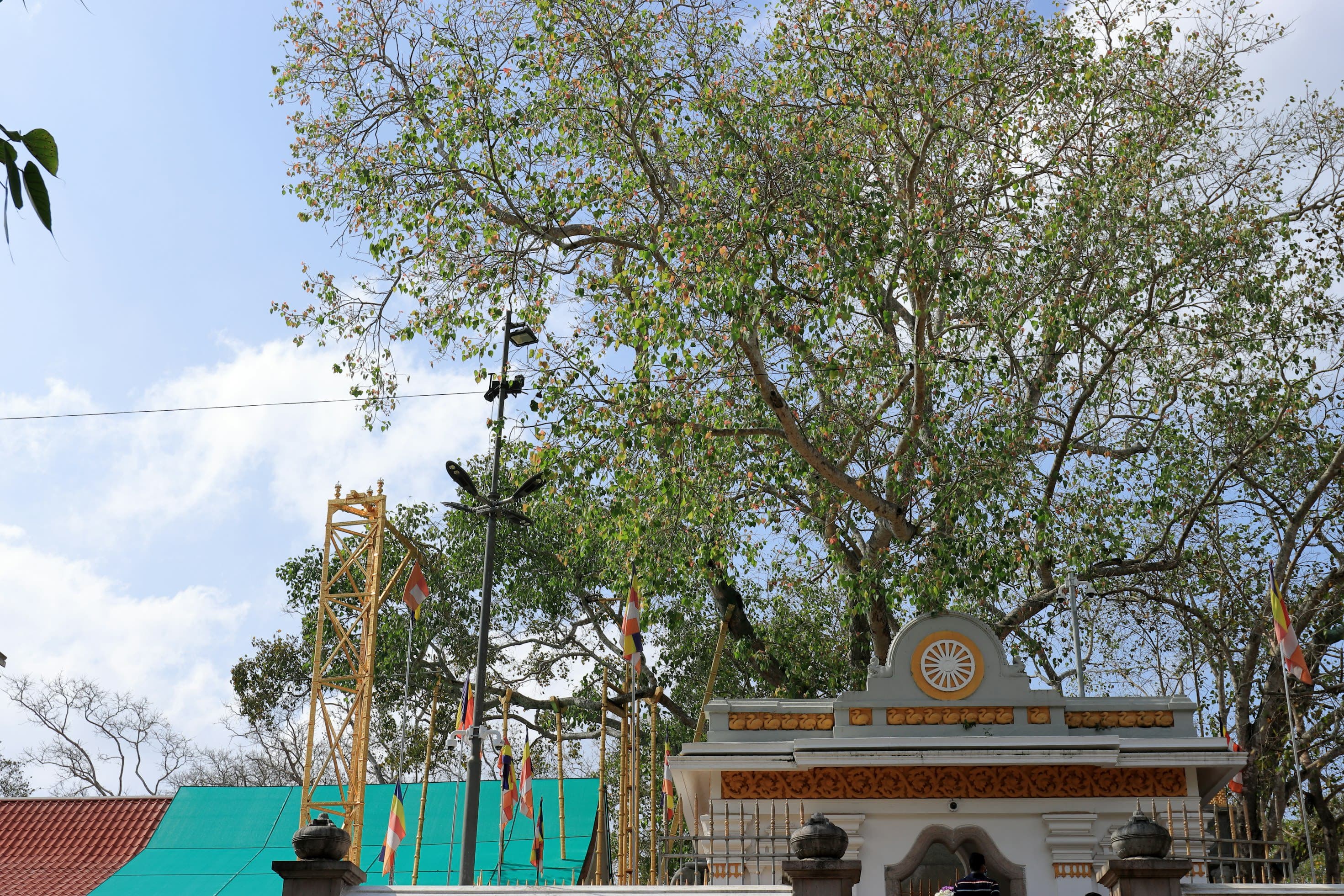
Jaya Sri Maha Bodhi
The daughter tree that outlived the mother, sheltering pilgrims for twenty-three centuries
Anuradhapura, North Central Province, Sri Lanka
At A Glance
- Coordinates
- 8.3448, 80.3972
- Suggested Duration
- The Sri Maha Bodhi itself takes 30 minutes to 1 hour for a respectful visit. Allow a full day or more to explore the greater Sacred City of Anuradhapura, including the major stupas (Ruwanwelisaya, Jetavanaramaya, Thuparamaya), monasteries, and ruins. Serious practitioners may wish to spend multiple days.
- Access
- Located in Anuradhapura, North Central Province, Sri Lanka. About 200 km from Colombo (4-5 hours by car). Anuradhapura has a train station with service from Colombo (approximately 4 hours). The tree is in the Mahamewna Gardens area within the sacred city. Bicycles (easily rented) and tuk-tuks are popular for getting around the extensive archaeological zone. A 500-meter walk from the car park leads to the tree, with a shoe counter midway.
Pilgrim Tips
- Located in Anuradhapura, North Central Province, Sri Lanka. About 200 km from Colombo (4-5 hours by car). Anuradhapura has a train station with service from Colombo (approximately 4 hours). The tree is in the Mahamewna Gardens area within the sacred city. Bicycles (easily rented) and tuk-tuks are popular for getting around the extensive archaeological zone. A 500-meter walk from the car park leads to the tree, with a shoe counter midway.
- Modest dress is required: shoulders and knees covered. Many visitors wear white, the traditional color of reverence in Sri Lankan Buddhism. Light, breathable fabrics are practical given the heat. Hats must be removed.
- Photography is generally permitted but should be done respectfully. Do not photograph monks, nuns, or devotees without permission. Do not use flash near the tree or in close proximity to worshippers. Never turn your back to the tree to take a photograph. Do not obstruct the movement or practice of pilgrims.
- The midday heat can be intense, especially between the shoe counter and the tree, when you are walking barefoot. Bring water. The midday closure (12:00-2:00 PM) means planning your visit around these hours. Poya days draw enormous crowds; if you seek quiet contemplation, visit on an ordinary weekday. The 1985 massacre by Tamil Tiger separatists is within living memory; though the site is now peaceful, some visitors may be aware of this history.
Overview
A cutting from the tree under which the Buddha attained enlightenment was brought to Sri Lanka in the 3rd century BCE. The original tree at Bodh Gaya was destroyed multiple times over the centuries. This one survived. For 2,300 years, pilgrims have venerated this living descendant of the tree that sheltered the Buddha at the moment of awakening. It is the oldest historically documented human-planted tree in the world, and when the tree at Bodh Gaya needed replanting, a cutting from this tree was sent back to India—the daughter giving life to the mother.
In the 3rd century BCE, a Buddhist nun named Sanghamitta carried a branch from the Bodhi Tree at Bodh Gaya across the sea to Sri Lanka. The Bodhi Tree was the pipal tree under which Siddhartha Gautama had attained enlightenment and become the Buddha. The branch was planted in Anuradhapura, the ancient capital, and it took root.
The original tree in India was destroyed—by a jealous queen, by hostile kings, by time. But the cutting in Sri Lanka survived. For over 2,300 years, an unbroken succession of guardians has tended this tree. It is the oldest historically documented human-planted tree in the world. When Rome was still a republic, this tree was already growing. When Europe was in the Middle Ages, pilgrims in white were already walking barefoot to offer flowers beneath its branches.
And then came the reversal that gives this site its extraordinary meaning: when the tree at Bodh Gaya needed replanting, a cutting was sent from Sri Lanka back to India. The daughter tree gave life to the mother. The circle closed. This is a place where time folds: the original enlightenment of 2,500 years ago, the continuous veneration across twenty-three centuries, and the living tree still sheltering pilgrims who come to sit where generations before them sat, offering flowers to the descendant of the tree that sheltered the Buddha.
Context And Lineage
A cutting from the original Bodhi Tree at Bodh Gaya was brought to Sri Lanka by Sanghamitta Theri in the 3rd century BCE. King Devanampiya Tissa planted it in Anuradhapura, where it has been continuously venerated for over 2,300 years. When the original tree in India was destroyed, this tree survived. A cutting from this tree was later sent back to replant Bodh Gaya—the daughter giving life to the mother.
Around 250 BCE, Emperor Ashoka sent his son Mahinda to bring Buddhism to Sri Lanka. Mahinda converted King Devanampiya Tissa, and the king's court followed. But the king's daughter, Anula, asked for the ordination of women—and for that, a bhikkhuni (fully ordained nun) was needed. Ashoka sent his daughter Sanghamitta, who carried with her a cutting from the southern branch of the Bodhi Tree at Bodh Gaya.
The cutting arrived with great ceremony. King Devanampiya Tissa received it personally and planted it in the Mahamewna Gardens in Anuradhapura. According to the Mahavamsa, the great chronicle of Sri Lanka, the tree took root immediately and grew with miraculous vigor. It has been continuously tended ever since.
Shortly after the cutting was taken, the original Bodhi Tree at Bodh Gaya was destroyed by Queen Tissarakkhā, who was jealous of the king's devotion to it. Though the tree at Bodh Gaya was replanted multiple times from surviving saplings, it was destroyed again and again—by hostile rulers, by storms, by time. The Sri Lankan tree never faltered. And when the tree at Bodh Gaya needed restoration in the 19th century, a cutting was sent from Anuradhapura to India. The daughter gave life to the mother. The circle closed.
The Jaya Sri Maha Bodhi is the senior living link to the Buddha's enlightenment. While the tree at Bodh Gaya is revered as the site of enlightenment, that tree is a fourth-generation descendant of the original. The Sri Maha Bodhi is direct—the southern branch of the original tree, carried across the sea by Sanghamitta. It is one of the Atamasthana (Eight Sacred Places) of Anuradhapura, alongside the great stupas Ruwanwelisaya, Thuparamaya, Jetavanaramaya, Abhayagiri, Mirisawetiya, Lankaramaya, and the Lovamahapaya. These eight sites together form the core of Buddhist pilgrimage in Sri Lanka. UNESCO's 1982 inscription of the Sacred City of Anuradhapura recognized the site's exceptional cultural and religious significance.
Sanghamitta Theri
Bearer of the sacred cutting
King Devanampiya Tissa
Planter of the tree
Emperor Ashoka
Patron and sender of Buddhism to Sri Lanka
Why This Place Is Sacred
The Sri Maha Bodhi is thin because it is alive—a direct living descendant of the tree under which the Buddha attained enlightenment, continuously venerated for over 2,300 years. The tree itself is the link. No representation, no reconstruction, no symbol: the living cells of this tree connect directly to the tree that sheltered the Buddha.
What makes a place thin? At the Sri Maha Bodhi, the answer is biological. This is not a site where something sacred happened long ago. This is a living organism directly descended from the tree under which the Buddha attained enlightenment 2,500 years ago. The connection is not metaphorical but genetic.
Sanghamitta Theri, daughter of Emperor Ashoka, cut a branch from the southern side of the original Bodhi Tree at Bodh Gaya and carried it to Sri Lanka in the 3rd century BCE. The cutting was planted with ceremony, and it grew. It has never stopped growing. The tree that stands in Anuradhapura today is the same tree—renewed, regenerated, maintained through golden props and careful guardianship, but continuous. The cells of this tree are descendants of the cells that shaded the Buddha.
The original tree at Bodh Gaya did not survive. It was destroyed multiple times: by Queen Tissarakkhā, by King Śaśāṅka of Gauda, by time and storm. Each time, it was replanted from surviving saplings. The current tree at Bodh Gaya is a fourth-generation descendant. But the Sri Maha Bodhi never needed replanting. It endured.
More remarkably still, when the tree at Bodh Gaya needed restoration in the 19th century, a cutting was sent from Sri Lanka. The daughter gave life to the mother. This reversal—descendant becoming ancestor, the preservation circling back to its source—adds a dimension of meaning that defies ordinary understanding of time and lineage. To sit beneath this tree is to sit within a continuous circle of life that connects directly to the moment of the Buddha's awakening.
The tree has been tended by an uninterrupted succession of guardians for over 2,300 years. Storms in 1907 and 1911 broke branches. A vandal attacked it in 1929. Tamil Tiger separatists massacred pilgrims on its upper terrace in 1985. Yet the tree survived. The devotion that surrounds it—millions of pilgrims over millennia—creates what many visitors describe as a palpable atmosphere. The thinness here is not just historical but accumulated, the weight of continuous veneration pressing against the veil between worlds.
The Jaya Sri Maha Bodhi was planted to establish a direct link between Sri Lanka and the Buddha's enlightenment. When Sanghamitta brought the cutting in the 3rd century BCE, Buddhism had just arrived on the island. The tree was intended as the center of Buddhist devotion, a living connection to the Buddha himself. It became one of the Atamasthana—the Eight Sacred Places of Anuradhapura—and has served as the preeminent Buddhist pilgrimage site in Sri Lanka ever since.
Successive kings developed the site around the sacred tree. Vasabha (1st century CE) placed four Buddha statues at its cardinal points. Voharika Tissa (3rd century CE) added metallic statues. Mahanaga (6th century CE) constructed a water canal to nourish the tree. The present wall was built under King Kirti Sri Rajasinha in the 18th century. Golden props now support the ancient branches. UNESCO inscribed the Sacred City of Anuradhapura in 1982, recognizing the site's exceptional cultural and religious significance. Through invasion, colonization, and civil war, the tree has been continuously venerated. Today, white-clad pilgrims fill the compound on Poya days, and the cycle of offerings continues unbroken.
Traditions And Practice
Daily puja includes offerings of flowers, oil lamps, and incense. Pilgrims circumambulate the tree clockwise, chant Pali sutras, and meditate beneath the branches. Poya days (full moon days) see intensified devotion. Poson Poya (June) commemorates Buddhism's arrival in Sri Lanka with national celebrations centered on Anuradhapura.
Traditional practice at the Sri Maha Bodhi follows the Theravada Buddhist pattern of puja (offerings) and meditation. Devotees bring flowers—typically white lotus, jasmine, or temple flowers—and place them in designated offering areas. Oil lamps are lit as symbols of wisdom dispelling ignorance. Incense is burned, its fragrance spreading as moral conduct spreads.
Circumambulation—walking clockwise around the tree—is a common practice, keeping the sacred object to one's right. Some pilgrims walk slowly and meditatively; others count their circuits with prayer beads. The circumambulation recalls the Buddha's own circumambulation of the Bodhi Tree in the days after his enlightenment.
Meditation beneath the tree connects practitioners to the Buddha's core practice. Though the tree is now enclosed within protective railings, seating areas around it allow pilgrims to sit in meditation. Chanting of Pali sutras, particularly the paritta (protective verses), is common both individually and in groups.
Taking refuge in the Triple Gem—Buddha, Dhamma, Sangha—at this site is considered especially meritorious. Many Sri Lankans make the pilgrimage at significant life moments: before marriage, after the birth of a child, during illness. On Duruthu Poya (January full moon), devotees offer the first batch of new rice from the harvest to the tree.
Daily worship continues unbroken. The temple is open from early morning until evening, with a midday break. On ordinary days, hundreds of devotees visit; on Poya days, the number swells to thousands.
Poson Poya (June full moon) is the most important celebration. This Poya commemorates the arrival of Buddhism in Sri Lanka—the meeting between Arahant Mahinda and King Devanampiya Tissa at nearby Mihintale. On Poson, Anuradhapura and Mihintale become the spiritual center of the nation. White-clad pilgrims fill the roads, climb the 1,843 steps to Mihintale's summit, and gather beneath the Bodhi Tree. Dansals (free food stalls) line the roads, offering meals to pilgrims as an act of generosity.
Vesak Poya (May full moon) celebrates the Buddha's birth, enlightenment, and death. Lanterns and illuminated structures (pandols) decorate the city. The tree is lit by countless oil lamps through the night.
Meditation retreats and courses are available through monasteries in Anuradhapura for those seeking deeper practice.
Begin with the walk from the car park, removing your shoes at the counter. Let the barefoot walk be a transition from ordinary time. Purchase flowers, oil lamps, and incense from vendors near the entrance if you wish to make offerings. Approach the tree slowly, observing the devotees already present. Place your offerings in the designated areas. Circumambulate the tree clockwise at least once, keeping it to your right. Find a place to sit, either on the ground or on one of the provided seats. Sit in meditation for whatever time feels appropriate—even a few minutes of stillness in the presence of this tree creates connection. If you visit during Poson Poya, expect crowds and embrace the collective devotion. Return to the site at different times of day if possible; dawn and dusk have different qualities.
Theravada Buddhism
ActiveThe Jaya Sri Maha Bodhi is the most sacred tree in Theravada Buddhism and the premier pilgrimage site in Sri Lanka. It is the southern branch of the original Bodhi Tree under which the Buddha attained enlightenment, brought by Sanghamitta Theri in the 3rd century BCE. While the original tree at Bodh Gaya was destroyed multiple times, this tree has survived continuously for over 2,300 years. It is one of the Atamasthana (Eight Sacred Places) of Anuradhapura, sites associated with the Buddha's visits to Sri Lanka according to tradition.
Daily puja with offerings of flowers, oil lamps, and incense. Circumambulation of the tree clockwise. Meditation beneath the branches. Chanting of Pali sutras, particularly protective verses (paritta). Special observances on Poya (full moon) days each month. Poson Poya (June) commemorates Buddhism's arrival in Sri Lanka and centers on Anuradhapura and Mihintale. Vesak Poya (May) celebrates the Buddha's birth, enlightenment, and death. Devotees often wear white as a sign of reverence.
Experience And Perspectives
You approach the tree along a 500-meter path, removing your shoes at a counter halfway. Pilgrims in white move with you, many carrying flower offerings. The tree rises within protective railings, its ancient branches supported by golden props. The fragrance of jasmine and incense fills the air. Oil lamps flicker before the trunk. The sound of Pali chanting rises and falls. You are standing before a living organism that connects directly to the Buddha's enlightenment.
You begin at the car park, joining a stream of visitors and pilgrims. The walk to the tree is about 500 meters, along a well-maintained path shaded by other trees. Halfway, you reach the shoe counter, where you leave your footwear for safekeeping. From here on, you walk barefoot.
The barefoot walk is itself a practice. The ground is warm. You become aware of your feet, your body, your movement. Around you, Sri Lankan pilgrims in white—the color of reverence—carry offerings: small baskets of white lotus, jasmine, temple flowers. The atmosphere shifts as you approach the tree. The voices grow quieter. The pace slows.
The tree rises within protective railings, its branches spreading outward, supported by golden props that have been added over the centuries to bear the weight of age. The trunk is thick but not visually overwhelming—what strikes you is the sense of presence, the weight of time. This tree was planted when Alexander the Great's successors still ruled vast kingdoms. Rome was still a republic. The Han dynasty was ascendant in China. And people were already walking barefoot to offer flowers beneath these branches.
The railings prevent direct contact with the tree—you cannot touch it—but this distance creates its own form of reverence. The tree is visible but protected, present but slightly removed. Pilgrims place flower offerings in designated areas, light oil lamps that flicker before the trunk, burn incense whose smoke rises into the branches. The fragrance of jasmine mingles with sandalwood. The sound of Pali chanting—the language in which the Buddha's teachings were first recorded—rises from groups seated on the ground.
The atmosphere intensifies on Poya days, the full moon days of each month when devout Buddhists observe additional precepts. Thousands of white-clad pilgrims fill the compound. The chanting becomes continuous. The offerings multiply. Poson Poya in June, commemorating the arrival of Buddhism in Sri Lanka, transforms Anuradhapura into the spiritual center of the nation.
Birds and monkeys inhabit the tree, moving through the branches as they have for centuries. The tree is alive not just as a sacred object but as an ecosystem. Leaves occasionally fall—they are gathered and treasured. The life of the tree continues alongside and within the life of the devotion that surrounds it.
You might stay for minutes or hours. You might circumambulate the tree clockwise, as pilgrims do, or find a spot to sit in meditation. The tree does not demand anything. It simply is—the oldest documented human-planted tree in the world, continuously venerated for twenty-three centuries, a living link to the moment when Siddhartha became the Buddha.
The Sri Maha Bodhi is located within the Sacred City of Anuradhapura, part of a larger UNESCO World Heritage Site. From the car park, walk 500 meters to reach the tree, removing shoes at the counter midway. The tree is enclosed within protective railings on an elevated platform. Vendors near the entrance sell flowers, oil lamps, and incense for offerings. Opening hours are 6:00 AM to 12:00 PM and 2:00 PM to 9:00 PM, with a midday closure. Early morning or late evening offers the coolest temperatures and most peaceful atmosphere. Poya days (full moon days) bring the largest crowds but also the most spiritually charged atmosphere. The site is one of eight sacred places (Atamasthana) in Anuradhapura; plan to visit the major stupas—Ruwanwelisaya, Thuparamaya, and Jetavanaramaya—as part of a fuller pilgrimage.
The Jaya Sri Maha Bodhi invites interpretation through multiple lenses: as the oldest documented human-planted tree in the world, as a direct biological link to the Buddha's enlightenment, as the center of Theravada Buddhism in Sri Lanka, and as a site where the circle of lineage reversed itself—the daughter tree giving life back to the mother site at Bodh Gaya. These perspectives layer upon each other, each enriching the others.
Historians and botanists recognize the Jaya Sri Maha Bodhi as the oldest living human-planted tree with a documented planting date. The Mahavamsa (Great Chronicle), composed in the 5th century CE, provides detailed documentation of the tree's arrival and planting in the 3rd century BCE. Archaeological evidence supports continuous veneration from that period. UNESCO's 1982 inscription recognized the site's exceptional cultural and religious significance. The tree is a Ficus religiosa (sacred fig or pipal tree), the same species as the original Bodhi Tree at Bodh Gaya. Botanists note that the tree may have regenerated from its roots over the centuries, a characteristic of this species, making the question of 'original' trunk complex but not undermining the tree's continuous biological lineage.
For Theravada Buddhists, the Sri Maha Bodhi is not merely historically significant but supremely sacred—a living descendant of the tree under which the Buddha attained enlightenment. To sit in the presence of this tree is to connect directly with the moment of awakening 2,500 years ago. The tree's survival through invasions, colonial periods, and natural disasters is seen as miraculous protection—the tree is alive because it is sacred, and sacred because it is alive. The story of the tree giving life back to Bodh Gaya (a cutting from Sri Lanka replanted the original site) represents the cyclical nature of dharma: the teaching spreads, takes root, and returns to renew its source.
Some visitors experience the tree as a source of accumulated spiritual energy. The devotion of millions of pilgrims over millennia creates, they report, a palpable atmosphere that transcends the simply historical. The tree's extraordinary longevity and resilience are seen by some as reflecting the enduring nature of the Buddha's teaching. The 'descendant-ancestor reversal'—the daughter tree becoming source for the mother site—resonates with those interested in sacred interconnection, suggesting that sacred lineage flows not only forward but can circle back upon itself.
Questions remain about the exact nature of the tree's continuity. How much of the current tree is the original trunk versus regeneration from roots over the centuries? The Ficus religiosa species is known for regenerating in this way, making the question both botanical and philosophical. The exact relationship between the various generations of trees at both Anuradhapura and Bodh Gaya is complex. Historical records, while remarkably detailed for such an ancient tree, cannot answer every question about its 2,300-year journey.
Visit Planning
Located in Anuradhapura, approximately 200 km from Colombo. Open 6:00 AM - 12:00 PM and 2:00 PM - 9:00 PM. Minimal entry fee for the tree itself; separate ticket for the broader Anuradhapura archaeological zone (USD 25). November to March offers the best weather. Allow 30 minutes to 1 hour for the tree; a full day or more for the greater Sacred City.
Located in Anuradhapura, North Central Province, Sri Lanka. About 200 km from Colombo (4-5 hours by car). Anuradhapura has a train station with service from Colombo (approximately 4 hours). The tree is in the Mahamewna Gardens area within the sacred city. Bicycles (easily rented) and tuk-tuks are popular for getting around the extensive archaeological zone. A 500-meter walk from the car park leads to the tree, with a shoe counter midway.
Anuradhapura offers accommodation ranging from budget guesthouses to mid-range hotels. Many visitors stay in the new town, which is separate from the sacred city. Some monasteries may offer simple accommodation to serious practitioners. Alternatively, Sigiriya and Dambulla (1-2 hours away) offer more tourist-oriented accommodation. For Poson Poya, book well in advance.
Dress modestly with shoulders and knees covered. Remove shoes at the counter before reaching the tree. Many visitors wear white as a sign of reverence. Do not turn your back to the tree or Buddha statues. Do not touch the tree or take any part of it. Photography is permitted but should not disturb worshippers.
The Sri Maha Bodhi is an active place of worship, and etiquette reflects both Buddhist cultural norms and the site's particular sacredness. The baseline is respect: for the tree, for the practitioners, for the tradition.
Dress should be modest: shoulders and knees covered for both men and women. Many Sri Lankan devotees wear white as a sign of reverence and purity; while not required, visitors who wish to enter more fully into the spirit of the place may choose to do so. Hats should be removed.
Shoes are removed at the shoe counter approximately 500 meters from the tree. This is not optional. The walk from the counter to the tree and back is done barefoot. The ground is generally clean and well-maintained, but the surface can be hot at midday.
In Buddhist cultures, the back is considered disrespectful to show to sacred objects. Do not turn your back to the Bodhi Tree or to Buddha statues. When photographing, position yourself so that you face the tree or approach at an angle. Similarly, do not point your feet toward the tree or Buddha images when sitting.
The tree itself is protected by railings and should not be touched. Do not attempt to take leaves, branches, or any part of the tree. Fallen leaves are sometimes gathered by temple staff and given to devotees, but removing them yourself is not permitted.
Maintain quiet or silence in the areas closest to the tree. Conversation should be minimal and soft. Mobile phones should be silenced.
Modest dress is required: shoulders and knees covered. Many visitors wear white, the traditional color of reverence in Sri Lankan Buddhism. Light, breathable fabrics are practical given the heat. Hats must be removed.
Photography is generally permitted but should be done respectfully. Do not photograph monks, nuns, or devotees without permission. Do not use flash near the tree or in close proximity to worshippers. Never turn your back to the tree to take a photograph. Do not obstruct the movement or practice of pilgrims.
Offerings of flowers (white lotus, jasmine, temple flowers), oil lamps, and incense are traditional and encouraged. These can be purchased from vendors near the entrance. Place offerings in designated areas only—not directly against the tree or on temple structures.
Remove shoes at the shoe counter before approaching the tree. Do not turn your back to the Bodhi Tree or Buddha statues. Do not point feet toward sacred objects. Do not touch the tree. Do not take leaves, branches, or any part of the tree. Maintain silence or quiet conversation. Sit at a level lower than Buddha images.
Sacred Cluster
Nearby sacred places create the location cluster described in the growth plan. This block is intentionally crawlable and links into the wider regional graph.