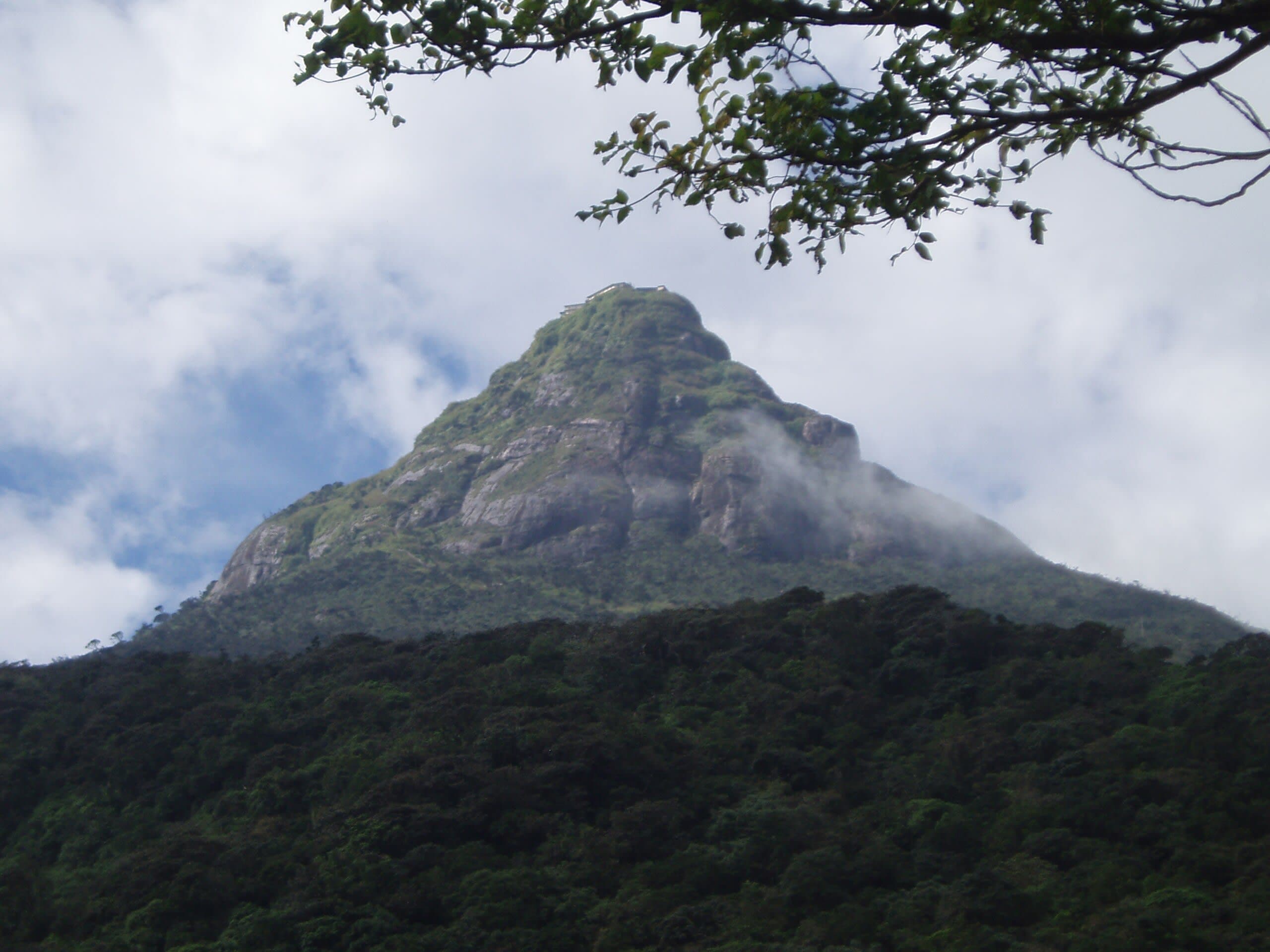
Adam's Peak (Sri Pada)
A sacred mountain where four world religions converge to venerate a single mysterious footprint at dawn
Dalhousie, Sabaragamuwa Province, Sri Lanka
At A Glance
- Coordinates
- 6.8068, 80.4932
- Suggested Duration
- Climbing: 3-5 hours depending on fitness and crowds. Summit time: 30-60 minutes including sunrise viewing. Descent: 2-3 hours. Plan for a full day including travel and recovery.
- Access
- The main trailhead is at Dalhousie (also called Nallathanniya), accessible by bus or taxi from Hatton (1-1.5 hours). Hatton is on the main Colombo-Kandy-Nuwara Eliya railway line. From Colombo: approximately 5 hours. From Kandy: approximately 3 hours. Alternative routes from Ratnapura are longer but less crowded.
Pilgrim Tips
- The main trailhead is at Dalhousie (also called Nallathanniya), accessible by bus or taxi from Hatton (1-1.5 hours). Hatton is on the main Colombo-Kandy-Nuwara Eliya railway line. From Colombo: approximately 5 hours. From Kandy: approximately 3 hours. Alternative routes from Ratnapura are longer but less crowded.
- Modest dress covering shoulders and legs. Comfortable hiking attire recommended. Warm layers essential—summit temperatures can approach freezing. Remove shoes before entering the summit temple.
- Photography is permitted and common, especially at sunrise. Be respectful around the footprint shrine and of fellow pilgrims in prayer. Flash photography may disturb others during the pre-dawn wait.
- The climb is physically demanding—over 5,000 steps with significant elevation gain. Those with heart conditions, severe knee problems, or limited fitness should consider carefully. The summit is cold; hypothermia is possible without adequate clothing. Crowds can be intense on weekends and especially Vesak; consider weekday climbing if possible. Off-season climbing is possible but weather is unpredictable and facilities are closed.
Overview
Rising 2,243 meters above the Sri Lankan highlands, the conical peak known as Sri Pada—or Adam's Peak—draws pilgrims from four world religions to a single mysterious footprint at its summit. Buddhists see the Buddha's mark; Hindus recognize Shiva's sacred step; Muslims and Christians trace Adam's penance. Each night during pilgrimage season, thousands climb through darkness toward a shared sunrise and a shadow that defies the mountain's own shape.
Something happens at Sri Pada that happens nowhere else on Earth. Four of the world's major religions—Buddhism, Hinduism, Islam, and Christianity—venerate the same physical mark on the same mountain summit. The sacred footprint, 1.8 meters long and pressed into rock at 2,243 meters above sea level, receives interpretation through each tradition's lens: the Buddha's final step on Sri Lankan soil, Shiva's dance of creation, Adam's thousand-year penance, or St. Thomas the Apostle's mark. Yet all climb together.
The pilgrimage is ancient beyond full documentation. The Vedda people, indigenous to the island, worshipped this peak as Samanala Kanda—mountain of the god Saman—before any of the major religions arrived. Chinese travelers recorded the pilgrimage in the 5th century. Ibn Battuta described the iron chains helping pilgrims ascend in the 14th. Kings built roads and shelters; devotees have worn smooth the 5,000+ steps.
Today, up to three million pilgrims and climbers make the ascent annually. During the season from December through May, the mountain comes alive each night—tea stalls illuminated along the path, streams of headlamps ascending through darkness, the slow collective movement toward what awaits at summit: the footprint itself, the temple that shelters it, the bell each climber rings to mark completion, and at the appointed hour, a sunrise that casts a triangular shadow of perfect geometry that bears no relation to the mountain's actual irregular shape.
The shadow phenomenon alone would draw seekers. Combined with the footprint, the multi-religious convergence, and the transformed consciousness that night climbing through effort toward dawn produces, Sri Pada becomes something beyond ordinary sacred sites: a place where the categories that divide humanity seem to dissolve at the precise moment the sun breaks the horizon.
Context And Lineage
Sri Pada has been sacred to Sri Lanka's indigenous Vedda people since prehistoric times. Buddhist veneration is documented from at least the 5th century CE. The mountain accumulated Hindu, Islamic, and Christian layers over subsequent centuries while never losing earlier traditions.
Each tradition tells its own origin story. Buddhists relate that the Buddha visited Sri Lanka three times, and on his final visit in the 6th century BCE, at the invitation of the god Saman, he left his footprint on this peak as an eternal symbol for worship. Hindus teach that while dancing to create the world, Lord Shiva stepped here, leaving his mark at a cosmic axis point. Muslims and some Christians tell of Adam, expelled from Paradise, landing on this peak and standing on one foot for a thousand years in penance—his tears of remorse becoming the gems for which Sri Lanka is famous. The indigenous Vedda people, predating all these traditions, recognized the mountain as the abode of Saman, guardian deity of the island.
The mountain's sacred lineage begins with the Vedda veneration of Saman and extends through Buddhist royal patronage, Hindu integration, and Abrahamic interpretation. No tradition replaced another; each added to the accumulated meaning. The infrastructure of pilgrimage—steps, chains, shelters, tea stalls—represents the work of many hands across many centuries. The present-day pilgrimage continues patterns documented by medieval travelers.
King Valagambahu
Sri Lankan king (104-76 BCE) who reportedly discovered the sacred footprint
King Vijayabahu
King who built shelters along the pilgrimage route (1065-1119 CE)
King Parakramabahu II
King who cleared jungle and built roads and bridges to the mountain (1250-1284 CE)
Ibn Battuta
Moroccan traveler who described the pilgrimage and its iron chains in 1344 CE
Marco Polo
Venetian explorer who documented the sacred mountain in 1298 CE
Why This Place Is Sacred
Sri Pada's thin place quality emerges from the unprecedented convergence of four world religions at a single sacred mark, the liminal experience of night pilgrimage toward sunrise, and the mysterious shadow phenomenon that seems to transcend physical explanation.
Sacred mountains exist across cultures, but Sri Pada presents something unique: a single sacred object—the footprint—that four major world religions simultaneously claim and venerate. This convergence creates an atmosphere unlike any other pilgrimage site. Buddhist monks climb alongside Hindu devotees, Muslim families walk the same steps as Christian pilgrims. Each understands the footprint differently, yet all recognize its power.
The pilgrimage itself induces altered consciousness through time-tested means. The climb begins in darkness, typically around midnight. For three to five hours, pilgrims ascend over five thousand steps, their effort accumulating as the night deepens. Tea stalls offer respite; fellow pilgrims provide encouragement; the shared endeavor creates temporary community across every boundary of language, nation, and belief.
As dawn approaches, the summit temple fills. Prayers rise in Sinhala, Tamil, Arabic, English. Then the moment arrives: the sun crests the horizon, and on the western side of the mountain, a triangular shadow appears—perfectly geometric, hanging suspended in the mist, bearing no resemblance to the mountain's irregular actual shape. Locals say there's an 80% chance of seeing it during pilgrimage season. Scientists explain it as atmospheric optics. Believers see miracle. Perhaps both are true.
The bell at the summit rings once for each successful pilgrimage. Some pilgrims have made the climb dozens of times, their bell-rings accumulating into a lifetime of devotion. For first-time climbers, the single ring marks entry into a lineage that stretches back millennia. In that moment—exhausted, exhilarated, standing where Buddha or Shiva or Adam or Thomas left their mark—the veil between ordinary and sacred feels impossibly thin.
The mountain was sacred to the indigenous Vedda people as the abode of the guardian deity Saman before any of the major religions arrived. Each subsequent tradition layered its own meaning onto the site: Buddhist veneration of the Buddha's footprint, Hindu worship of Shiva's dance, Islamic remembrance of Adam's penance, Christian connection to St. Thomas.
From indigenous deity worship through Buddhist royal patronage, Hindu integration, Islamic and Christian interpretation, the mountain has accumulated layers of meaning without losing any. Kings built infrastructure; pilgrims wore paths into the rock. The 21st century sees three million annual visitors, yet the experience remains remarkably similar to what medieval travelers described: the night climb, the shared effort, the dawn arrival, the footprint encounter.
Traditions And Practice
The primary practice is the night pilgrimage itself—ascending over 5,000 steps through darkness to arrive at the summit before sunrise. At the summit, pilgrims venerate the footprint, ring the bell, and witness the sunrise and shadow phenomenon.
The traditional pilgrimage involves climbing at night to arrive at the summit for sunrise. The pilgrimage season begins with the December full moon and ends in May. Vesak Poya (the full moon commemorating Buddha's birth, enlightenment, and death) is the most significant day. Buddhist pilgrims light oil lamps and offer incense; Hindu devotees pray to Shiva; Muslims offer prayers of penance; Christians mark their connection to the apostolic age. All traditions share the bell-ringing that marks completion.
Contemporary pilgrims follow patterns largely unchanged from medieval descriptions. The steps are now mostly stone rather than earth; electric lights supplement moonlight during the season. Tea stalls provide refreshment. Mobile phones capture sunrise photos that would have seemed miraculous to earlier pilgrims. Yet the essential experience—night climb, effort, arrival, footprint, bell, sunrise—remains what it has been for centuries.
If possible, make the climb during pilgrimage season (December-May) for the full experience: illuminated path, operating tea stalls, fellow pilgrims, best chance of seeing the shadow phenomenon. Start climbing between midnight and 2 AM based on your fitness level. Take the climb slowly; it is not a race but a journey. When you reach the summit, allow time to absorb the atmosphere before sunrise demands attention. Ring the bell with awareness—you join millions who have done the same. Watch for the shadow on the mountain's western side as the sun rises. On the descent, notice what the night concealed.
Theravada Buddhism
ActiveThe footprint is the Buddha's left foot, left on his third and final visit to Sri Lanka. The mountain is one of the most important Buddhist pilgrimage sites on the island.
Night pilgrimage, especially on Poya days; oil lamp lighting; incense offering; circumambulation; bell ringing; prayers at the shrine
Sri Lankan Hinduism
ActiveThe footprint is Shiva's, left while dancing to create the world. The mountain is Sivanolipatha Malai—Lord Shiva's Footprint on the Mount.
Pilgrimage and worship at the summit, prayers to Lord Shiva, integration with broader Hindu practice
Islam
ActiveThe footprint is Adam's, left during his thousand-year penance after expulsion from Paradise. The mountain is Baba Adamalai.
Pilgrimage to the footprint, prayers of repentance and remembrance, following Adam's example
Christianity
ActiveSome identify the footprint with St. Thomas the Apostle, who according to tradition brought Christianity to the region.
Pilgrimage and prayer at the summit
Indigenous Vedda
ActiveThe mountain is Samanala Kanda, abode of the guardian deity Saman. This tradition predates all others.
Worship of Saman as protector deity, integrated into contemporary pilgrimage
Experience And Perspectives
The Sri Pada pilgrimage involves a challenging night climb of over 5,000 steps, arriving at the summit temple before sunrise to witness the sacred footprint, ring the completion bell, and observe the mysterious shadow phenomenon as dawn breaks.
The experience begins in darkness. From the village of Dalhousie (Nallathanniya) at the mountain's base, pilgrims set out between midnight and 2 AM, headlamps illuminating the stone steps that rise ahead. The timing is calculated: three to five hours of climbing to arrive at the summit before the 6 AM sunrise.
The first section moves through forested slopes, relatively gentle, tea stalls appearing like oases of light and warmth every few hundred meters. Pilgrims rest, drink sweet tea, gather strength. The steps continue—some sources count over 5,000—each one worn smooth by centuries of bare and booted feet. As altitude increases, the air thins and cools. Near-freezing temperatures are common at the summit before dawn; those without warm layers soon regret their confidence.
The final approach is steepest and most crowded. Iron chains, described by Ibn Battuta in the 14th century, still aid the climb. The stream of pilgrims converges, slowing movement to a shuffle. Patience becomes practice. Then, suddenly, the summit temple appears, and you are there.
The footprint lies within the temple enclosure, 1.8 meters of rock formation that unmistakably resembles a human foot. Prayers are offered—Buddhist, Hindu, Muslim, Christian, or simply personal. The bell waits; each pilgrim rings it once for this climb, the sound joining thousands of rings that night. Then all turn toward the eastern horizon.
Watching sunrise from a mountain summit is moving anywhere. At Sri Pada, it carries additional weight: the collective presence of fellow pilgrims from many traditions, the completed effort of the climb, the awareness of standing where millions have stood across millennia. As light breaks, attention shifts west to the shadow phenomenon—that geometrically perfect triangle hanging in mid-air, slowly descending until it vanishes into the mountain's own base.
The descent takes two to three hours in daylight, revealing the landscape the night concealed: forested slopes, distant peaks, the surrounding wildlife sanctuary. By the time pilgrims return to Dalhousie, the mountain stands clear in sunlight, its conical shape unmistakable—but its meaning permanently altered by what the night revealed.
Treat the climb as pilgrimage rather than mere hiking. Begin after midnight to reach the summit before sunrise; adjust timing based on your climbing speed. Dress warmly in layers—summit temperatures can approach freezing. Carry water but expect tea stalls along the route. Move at a sustainable pace; the climb is not a race. When you reach the summit, take time with the footprint before the sunrise draws all attention eastward. Ring the bell with intention; you join a lineage of millions.
Sri Pada can be understood through multiple lenses: devotional (for each of the four religions), scholarly (historical and anthropological), and experiential (the transformed consciousness of pilgrimage). Each perspective illuminates different facets without claiming the whole.
The mountain's pilgrimage history is well-documented from at least the 5th century CE, with Chinese, Arabic, and European sources describing the tradition. The footprint is a natural rock formation that happens to resemble a human foot; its sacred interpretation varies by tradition. The sunrise shadow phenomenon is explained by atmospheric optics as a form of Brocken spectre. The multi-religious veneration represents a remarkable case of shared sacred space that developed organically over centuries.
Each religious tradition holds its interpretation of the footprint as meaningful within its own framework. Buddhists see evidence of the Buddha's visit; Hindus recognize Shiva's presence at a cosmic axis; Muslims and Christians connect to Adamic creation narrative. The Vedda indigenous tradition, predating all others, holds the mountain as the abode of the guardian deity Saman. These interpretations coexist rather than conflict.
Some interpret Sri Pada as an axis mundi—a cosmic axis point where earth connects to heaven—explaining why multiple traditions recognized its power. The convergence of four religions at a single site may reflect a pre-religious sacred quality that transcends any particular tradition. The footprint may function as a sacred object that carries whatever meaning the beholder brings.
How the footprint formation came to resemble a human foot so convincingly is unexplained. Why the shadow's geometric triangle bears no relation to the mountain's irregular shape remains mysterious despite scientific explanation of the optics involved. The original significance of the site to pre-Vedda inhabitants is unknown. How four distinct traditions came to venerate the same site without significant conflict presents an unusual historical puzzle.
Visit Planning
The pilgrimage season runs December through May. Most climbers start between midnight and 2 AM to reach the summit before the 6 AM sunrise. The climb takes 3-5 hours; descent 2-3 hours. The main trailhead is at Dalhousie.
The main trailhead is at Dalhousie (also called Nallathanniya), accessible by bus or taxi from Hatton (1-1.5 hours). Hatton is on the main Colombo-Kandy-Nuwara Eliya railway line. From Colombo: approximately 5 hours. From Kandy: approximately 3 hours. Alternative routes from Ratnapura are longer but less crowded.
Guesthouses and basic hotels in Dalhousie near the trailhead. More comfortable options in Hatton or Nuwara Eliya. Book well in advance during peak season (Vesak especially).
Sri Pada is an active pilgrimage site sacred to multiple religions. Respectful dress and behavior are essential. Remove shoes before entering the summit temple. Be mindful that you share the mountain with devotees of many traditions.
The multi-religious character of Sri Pada creates unique etiquette requirements. You climb alongside Buddhist monks, Hindu families, Muslim devotees, and Christian pilgrims—each approaching the mountain with their own understanding of what awaits at the summit. Respect for all traditions is essential.
Modest dress is expected throughout the climb and especially at the summit temple. Remove shoes before entering the temple enclosure. Maintain quiet respect around the footprint, where others may be in prayer. The bell is for completion of the climb, not casual ringing.
The mountain lies within a protected wildlife sanctuary. Stay on marked paths; do not disturb plants or animals. Carry out all waste. The tea stalls along the route depend on the mountain's health for their livelihood.
During the climb, support fellow pilgrims who may be struggling. The tradition of mutual aid on the mountain is as old as the pilgrimage itself. At the summit, share space graciously; everyone has climbed the same steps to be there.
Modest dress covering shoulders and legs. Comfortable hiking attire recommended. Warm layers essential—summit temperatures can approach freezing. Remove shoes before entering the summit temple.
Photography is permitted and common, especially at sunrise. Be respectful around the footprint shrine and of fellow pilgrims in prayer. Flash photography may disturb others during the pre-dawn wait.
Flowers and incense may be offered at the temple. Donations support maintenance of the pilgrimage infrastructure and the monks who tend the shrine.
{"Remove shoes in the temple enclosure","No alcohol on the mountain","No disturbing wildlife in the surrounding sanctuary","Stay on marked paths","Ring the bell only for completed pilgrimages"}
Sacred Cluster
Nearby sacred places create the location cluster described in the growth plan. This block is intentionally crawlable and links into the wider regional graph.