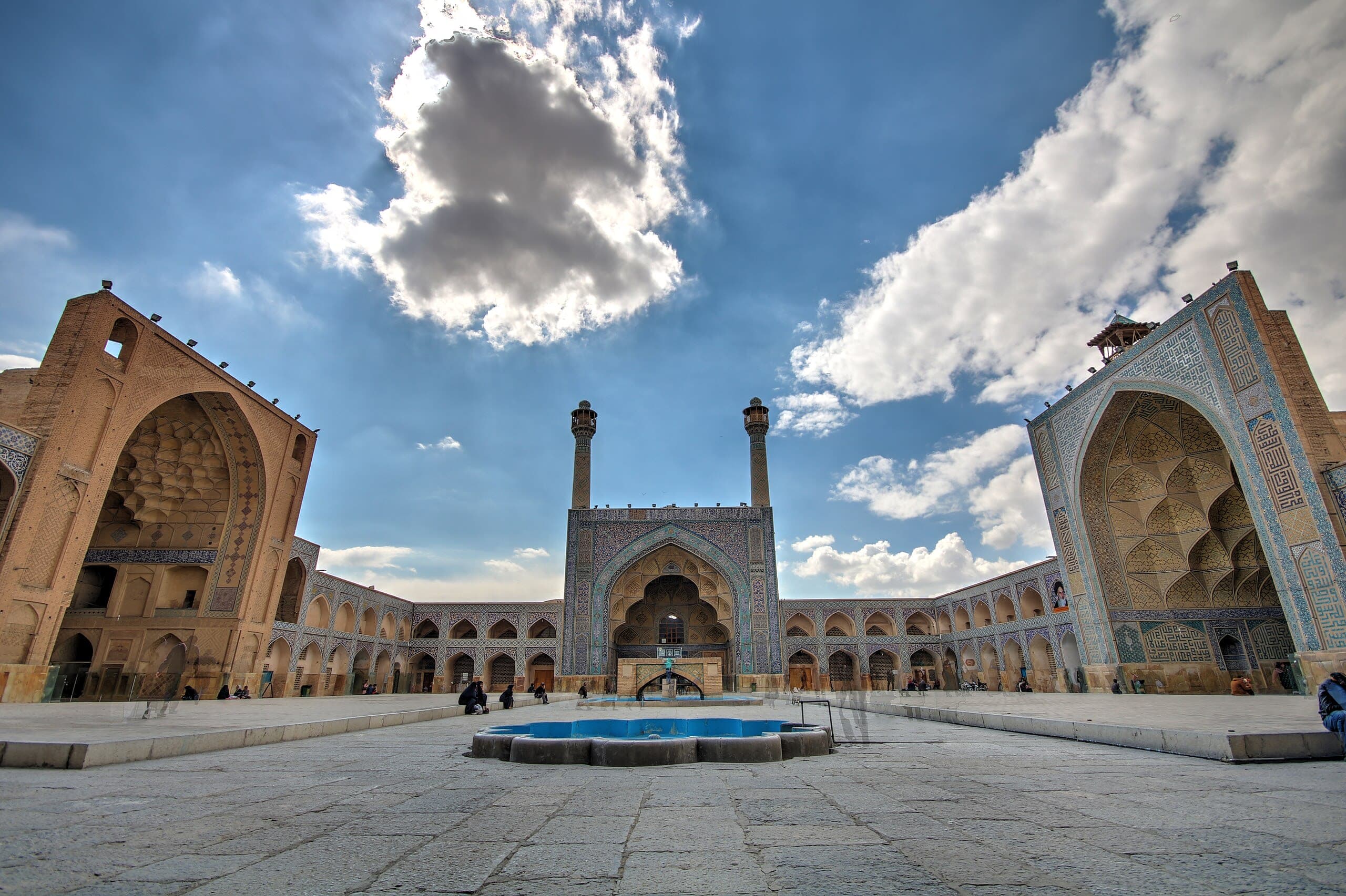
Jame' Mosque of Isfahan
Where twelve centuries of prayer shaped the architecture that taught the Islamic world how to build
Isfahan, Isfahan, Iran
At A Glance
- Coordinates
- 32.6697, 51.6853
- Suggested Duration
- One to two hours for architectural exploration. Allow more time if observing worship or contemplating the geometric patterns in detail.
Pilgrim Tips
- Strictly enforced Islamic dress code. Women: hijab (headscarf) required, loose modest clothing covering arms and legs. Men: long pants, no shorts.
- May be restricted, especially during prayers. Ask permission. Be discreet.
- This is an active mosque, not a museum. Prayer times structure access. Dress code is strictly enforced. Women must wear hijab (headscarf) and modest clothing. Non-Muslim visitors should verify current access policies. Friday midday congregational prayer is not a time for casual visiting.
Overview
In the heart of Isfahan, where the bazaar opens into tranquil courtyard, stands a mosque that has hosted continuous prayer since 771 CE. The Masjed-e Jāmé is not merely old—it is a living encyclopedia of Islamic architecture, with each century adding its layer: Abbasid hypostyle, Seljuk domes, Ilkhanid stucco, Safavid tile. The four-iwan plan that became standard for Iranian mosques was invented here. The double-shell dome was pioneered here. Twelve centuries of worship continue.
Some buildings document their history in museum placards. The Masjed-e Jāmé of Isfahan documents its history in its own structure. Walk through the mosque and you walk through twelve centuries of Islamic architectural development—not as artifact but as accumulated layers of a continuously functioning sacred space.
The first mosque here rose in 771 CE, less than 150 years after the Prophet Muhammad's death, when Islam was still young and its architectural vocabulary still forming. Subsequent centuries added their contributions. The Abbasids built a hypostyle hall of columns and wooden roof. When the Seljuk Turks made Isfahan their capital in 1051, their viziers transformed the mosque with innovations that would reshape Islamic architecture: Nizam al-Mulk's great dome over the mihrab in 1086-87, the largest masonry dome the Islamic world had yet seen; Taj al-Mulk's rival dome a year later, celebrated for its structural perfection; the four-iwan plan adapted from Sassanian palaces that became the template for Persian mosques thereafter.
The Ilkhanids added their stucco mihrab in 1310, among the finest works of Islamic sculptural art. The Safavids contributed their tilework. Even the 20th century left its mark: air raid damage in 1984 required reconstruction using traditional craftsmanship.
Through all these transformations, the mosque has never ceased its primary function. Over 65,000 Fridays of congregational prayer have been offered here. The call to worship sounds five times daily as it has for over 1,200 years. The bazaar still opens into the courtyard; sacred and daily life still interpenetrate as they have since the city was young.
Context And Lineage
The Masjed-e Jāmé has been Isfahan's congregational mosque since 771 CE, rebuilt and expanded through successive dynasties. The Seljuk transformation in the 11th century—introducing the four-iwan plan and pioneering dome construction—established innovations that influenced mosque architecture throughout the Islamic world. UNESCO inscription in 2012 recognized the mosque as an exceptional illustration of twelve centuries of architectural evolution.
The first mosque on this site was built circa 771 CE under the Abbasid caliph al-Mansur, relatively soon after the Islamic conquest of Persia. Isfahan was then a provincial city; the mosque was modest in scale.
The transformation began in 840-841 CE when a larger hypostyle mosque replaced the original structure—a forest of columns carrying a wooden roof, the typical early Islamic congregational mosque design.
The Seljuk era brought Isfahan's golden age. When the Turkic Seljuks captured the city in 1050-51 and made it their capital, the mosque received royal attention. Fire and sectarian conflict had damaged the structure. The great vizier Nizam al-Mulk commissioned a monumental dome over the mihrab area in 1086-87—the largest masonry dome in the Islamic world at the time. His rival Taj al-Mulk built a competing dome on the northern side a year later. The four-iwan plan that developed during this period—adapting the Sassanian palace form to Islamic sacred architecture—became the template for Iranian mosques thereafter.
Subsequent centuries added their layers: Ilkhanid stucco work, Safavid tilework, Qajar modifications. Even war left its mark: 1984 air raid damage required reconstruction using traditional methods. Through all changes, the mosque's function continued unbroken.
The Masjed-e Jāmé represents the development of Islamic mosque architecture from Arab hypostyle to Persian four-iwan form. The innovations developed here—the four-iwan plan, the double-shell ribbed dome, the double minaret—spread throughout Iran and influenced mosque design across the Islamic world. The mosque demonstrates how Islamic architecture adapted pre-Islamic Persian forms (Sassanian iwans) to serve Islamic worship. Contemporary mosques worldwide owe architectural debts to solutions pioneered in Isfahan twelve centuries ago.
Nizam al-Mulk
Seljuk vizier and patron
Taj al-Mulk
Seljuk official and rival
Haydar
Calligrapher and craftsman
Why This Place Is Sacred
The Masjed-e Jāmé thins the boundary between earth and heaven through continuous worship and accumulated devotion. Twelve centuries of prayer have charged this space. The architecture itself teaches: the four iwans orient attention toward Mecca, the geometric patterns encode mathematical order that some interpret as reflection of the divine, the transition from bustling bazaar to tranquil courtyard enacts the movement from worldly to sacred.
What makes the Masjed-e Jāmé thin is not merely age but continuous use. This is not a monument to departed faith but a space where worship has occurred every day for over 1,200 years. The accumulated devotion of millions of prostrations, millions of prayers, millions of Friday sermons creates a charge that visitors sense even if they cannot name it.
The architecture serves this function. The mihrab—the niche indicating the qibla direction toward Mecca—orients the worshipper toward the sacred center. Every Muslim praying anywhere in the world faces the same point; the mihrab is the local expression of this global orientation. The four iwans frame the courtyard as axial approach to this direction, the southern iwan larger than the others to emphasize the qibla. Standing in the courtyard, one stands at an intersection of lines: the axis toward Mecca, the vertical axis toward heaven, the temporal axis stretching back twelve centuries.
The geometric patterns in the brick vaulting carry their own teaching. Some scholars, including Seyyed Hossein Nasr, interpret these patterns—hexagonal, octagonal, decagonal—as expressions of Sufi mysticism encoded in mathematics. The infinite expressed in finite form, unity expressed through multiplicity, the divine order reflected in human craftsmanship. Whether or not one accepts this interpretation, the patterns reward contemplation.
The mosque's integration with the bazaar creates another dimension of thinness. The transition from commercial bustle to sacred quiet, from goods for sale to prayer for salvation, enacts the Islamic understanding that the sacred is not separated from daily life but interwoven with it. The merchant leaves his shop, performs ablution, enters the courtyard, joins the congregation, prostrates toward Mecca, returns to his shop. The mosque does not exist apart from the city but at its heart.
The Masjed-e Jāmé was built as Isfahan's congregational Friday mosque—the central mosque where the Muslim community gathers for obligatory Friday prayer. This function has continued unbroken since 771 CE. The mosque also served educational, social, and shelter functions throughout its history.
The mosque evolved through major phases: the original 8th-century structure; the larger 9th-century hypostyle mosque; the Seljuk transformation with its competing domes and four-iwan plan in the 11th-12th centuries; Ilkhanid additions in the 14th century; Safavid refinements in the 16th-17th centuries; and reconstruction following 1984 war damage. Each era left its architectural signature while the mosque's religious function continued uninterrupted.
Traditions And Practice
Daily prayers have been offered at the Masjed-e Jāmé for over 1,200 years. Friday congregational prayer with its accompanying sermon remains the week's central religious gathering. The mosque continues to serve its original function within the Shia Islamic tradition that has predominated in Iran since the Safavid era.
As a Friday mosque (masjed-e jome), the primary function is hosting jumu'ah—the obligatory Friday congregational prayer. Men are required to attend; the imam delivers a sermon (khutba) before leading the prayer. The congregation prostrates in rows facing the mihrab and thus toward Mecca. Five daily prayers (salat) are also offered: fajr (dawn), dhuhr (noon), asr (afternoon), maghrib (sunset), isha (night). The mosque has historically served additional functions: education, community gathering, shelter for travelers.
The mosque continues all traditional functions within Shia Islam. Daily prayers are offered at the designated times. Friday congregational prayer draws worshippers from across Isfahan. Religious lectures and community events occur. The integration with the surrounding bazaar means that shopkeepers and merchants step out for prayer and return to work—the pattern of worship and daily life intertwined as it has been for centuries.
Visit between prayer times to explore the architecture without interrupting worship. If you wish to observe prayer, do so quietly and respectfully from an appropriate location. The transition from bazaar to mosque courtyard is itself an experience worth attention: notice how the shift from commercial to sacred space affects your state of mind. Spend time with the brick patterns in the vaulted areas—they reward extended contemplation.
Islam (Shia)
ActiveThe Masjed-e Jāmé has served as Isfahan's congregational Friday mosque for over 1,200 years—one of the longest continuous histories of any mosque. As a Friday mosque, it hosts the obligatory weekly congregational prayer that defines Muslim community. Since the Safavid era (16th century), Iran has been predominantly Shia, and the mosque serves this tradition. The architecture itself embodies Islamic prayer: the mihrab indicates the qibla toward Mecca, the enlarged southern iwan emphasizes this orientation, the courtyard accommodates the congregation.
Five daily prayers (salat) are offered at the designated times. Friday congregational prayer (jumu'ah) with its sermon (khutba) is the week's central religious gathering. Religious lectures, community functions, and education occur. The mosque remains integrated with the surrounding bazaar—merchants step out for prayer and return to work, embodying the Islamic integration of sacred and daily life.
Experience And Perspectives
Entering from the bazaar, the transition is immediate: commercial noise yields to courtyard quiet. Four iwans frame the sky. The southern iwan, largest, draws attention toward the qibla. Domes from different centuries offer their different geometries. Brick patterns proliferate in endless variation. The faithful come and go, praying as their predecessors have for twelve hundred years.
Approach the Masjed-e Jāmé through Isfahan's bazaar. The covered market streets, with their commerce and conversation, open unexpectedly into sacred space. This transition is itself an experience: the sudden quiet, the open sky after the covered passages, the reorientation from buying and selling to the vertical dimension.
The courtyard extends before you, its proportions harmonious despite—or because of—the accumulated additions of centuries. Four iwans face each other across the open space. The southern iwan is largest, emphasizing the qibla direction. Even without knowing Islamic architectural conventions, the eye is drawn southward.
Begin exploring. The Seljuk domes reward attention. The Nizam al-Mulk dome over the southern sanctuary (1086-87) was the largest masonry dome in the Islamic world when built. Its interior geometry—octagonal zone of transition, circular dome—represents the solution to a fundamental architectural problem: how to place a round dome over a square space. Walk to the northern side to find the Taj al-Mulk dome (1087), built by Nizam al-Mulk's rival. Historians of architecture consider this smaller dome the more perfect achievement—its structural clarity and geometric balance approaching ideal form.
The brick patterns throughout the mosque vary endlessly. Hexagonal, octagonal, decagonal configurations create surfaces of mathematical complexity. Each vault offers its variation. The patterns are not merely decorative but embody structural logic—and, some scholars suggest, mystical meaning.
The Ilkhanid mihrab of 1310, carved in stucco by the calligrapher Haydar, represents another artistic peak. The intricate inscriptions and floral patterns demonstrate craftsmanship at its highest.
Throughout your exploration, worshippers come and go. This is not a museum. Prayers are offered at the designated times. The rhythm of worship that has continued for twelve centuries continues around you. If timing permits and you are invited, observe Friday congregational prayer: the rows of faithful, the imam's sermon, the collective prostration toward Mecca.
The mosque is entered from the bazaar through various passages. The courtyard is central, with four iwans on the cardinal directions. The southern iwan is largest, indicating the qibla. The Nizam al-Mulk dome is in the southern sanctuary behind the southern iwan. The Taj al-Mulk dome is on the northern side. The Ilkhanid mihrab is in a hall off the western iwan. Prayer times structure access; plan accordingly.
The Masjed-e Jāmé invites multiple readings: as architectural document of twelve centuries, as living mosque where worship continues, as expression of Islamic geometry and potentially mystical meaning. Scholarly analysis emphasizes architectural innovation. Religious understanding sees continuous sacred function. All perspectives acknowledge the mosque's exceptional significance.
Architectural historians view the Masjed-e Jāmé as one of the most important buildings in Islamic architecture. The mosque demonstrates the evolution from Arab hypostyle to Persian four-iwan plan—an evolution that occurred here and spread throughout Iran and beyond. The Seljuk domes are masterpieces of structural engineering and geometric design. UNESCO inscription recognizes the mosque as 'a stunning illustration of the evolution of mosque architecture over twelve centuries.'
The innovations developed here influenced mosque design worldwide: the four-iwan plan became standard in Iran; the double-shell ribbed dome pioneered structural techniques; the integration of mosque and bazaar modeled urban sacred space.
For Muslims, the Masjed-e Jāmé is fundamentally a house of God—a space oriented toward Mecca where the community gathers for prayer. The architectural innovations serve this primary purpose: the mihrab indicates the qibla, the minbar allows the imam to address the congregation, the courtyard accommodates worshippers, the four iwans frame approach to the sacred direction. The beauty of the architecture honors God; the continuity of worship over twelve centuries demonstrates the endurance of faith.
Some scholars, including Seyyed Hossein Nasr, interpret the geometric patterns in the mosque's brick vaulting as expressions of Sufi mystical understanding. The mathematical relationships in hexagonal, octagonal, and decagonal patterns reflect divine order—unity through multiplicity, infinity through finite form. This interpretation sees sacred geometry as a form of spiritual teaching accessible to those who contemplate it properly.
Questions remain about the mosque's history. What was the original function of the Taj al-Mulk dome? How did sectarian conflicts between legal schools affect the mosque's development? What was lost in the 1984 air raid, and how accurate is the reconstruction? What earlier structures may lie beneath the current mosque? The site has not been fully excavated; layers of history remain buried.
Visit Planning
The Masjed-e Jāmé is located in central Isfahan, integrated with the historic bazaar. Visit in spring or autumn for pleasant weather, between prayer times for easier access. Allow 1-2 hours to explore the architectural variety. Verify current access policies for non-Muslim visitors.
Isfahan offers a full range of accommodations. Staying in the historic center provides easy walking access to the Friday Mosque and other architectural sites.
Dress modestly according to Islamic requirements. Women must wear hijab. Remove shoes in prayer areas. Do not interrupt worshippers. Visit between prayer times unless observing prayer respectfully.
The Masjed-e Jāmé is an active mosque where prayers are offered daily. Visitors must respect this sacred function.
Dress code is strictly enforced. Women must wear hijab (headscarf) and loose, modest clothing that covers arms and legs completely. Men should wear long pants and avoid shorts. These requirements are not optional for visitors.
Remove shoes before entering prayer areas. Shoe racks or spaces are typically provided.
Do not walk in front of people praying. Do not interrupt prayers or religious activities. Maintain quiet and reverent demeanor.
Visit between prayer times unless you specifically wish to observe prayer, in which case do so quietly from an appropriate area. Do not treat Friday congregational prayer as a tourist spectacle.
Photography may be restricted, especially during prayers. Ask permission and be discreet.
Women may be directed to separate areas or restricted from certain sections during certain times.
Strictly enforced Islamic dress code. Women: hijab (headscarf) required, loose modest clothing covering arms and legs. Men: long pants, no shorts.
May be restricted, especially during prayers. Ask permission. Be discreet.
The mosque may accept charitable donations (sadaqah) but formal offerings as in Christian practice are not applicable.
Remove shoes in prayer areas. Do not interrupt worshippers. Do not walk in front of people praying. Observe separation of genders where indicated. Non-Muslim access may be restricted at certain times.
Sacred Cluster
Nearby sacred places create the location cluster described in the growth plan. This block is intentionally crawlable and links into the wider regional graph.