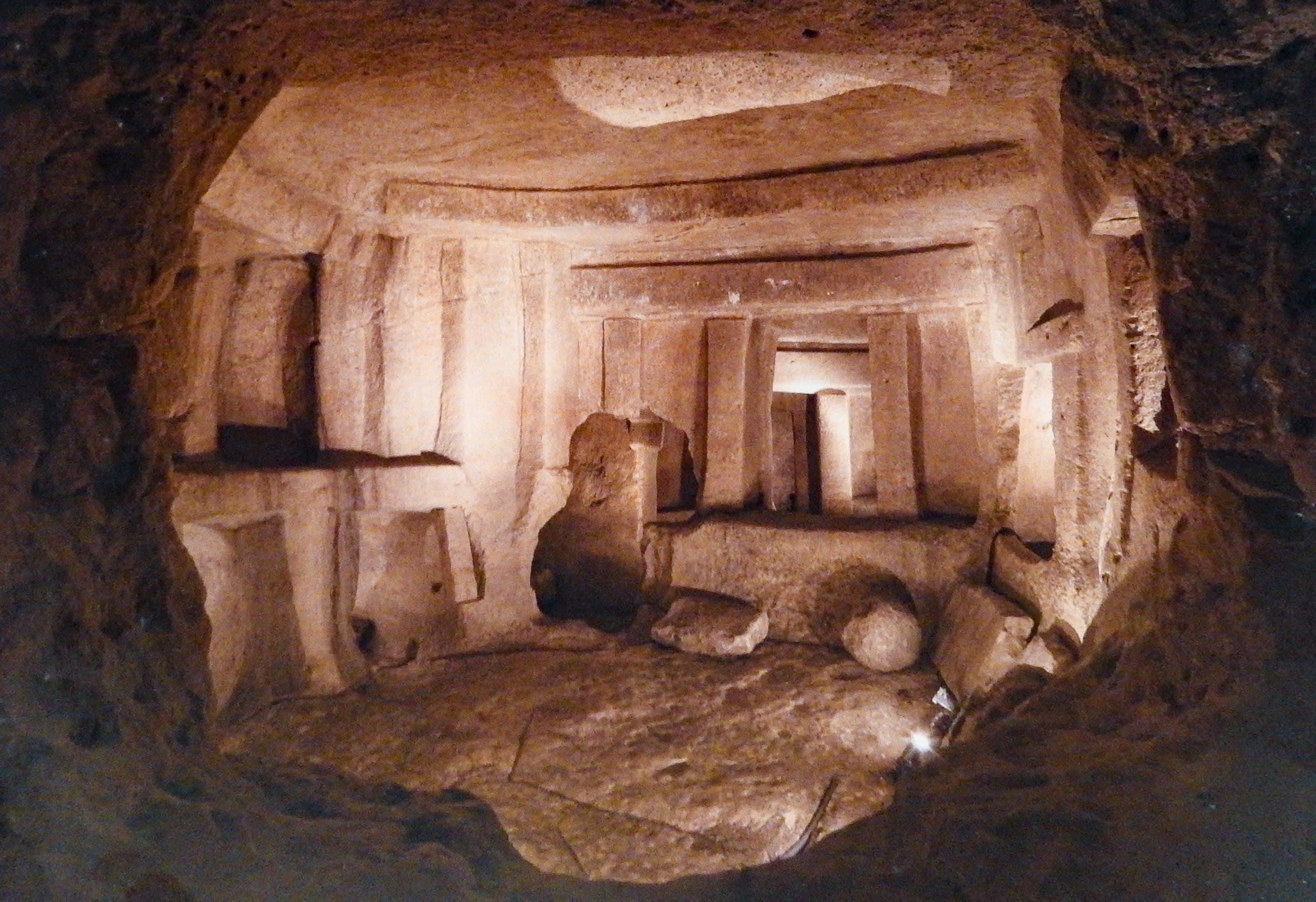
Hal Saflieni Hypogeum
Humanity's oldest underground temple, where Neolithic ancestors met the realm of the dead
Paola, South Eastern Region, Malta
At A Glance
- Coordinates
- 35.8683, 14.5078
- Suggested Duration
- The guided tour is 45 minutes. Allow approximately 2 hours total for arrival, audiovisual introduction, the tour itself, and time afterward to process the experience. Rushing away immediately after emerging diminishes the encounter.
Pilgrim Tips
- Closed, comfortable shoes are required. Visitors wearing high heels, sandals, or flip-flops will not be admitted—this is strictly enforced. The underground environment is humid and cool; light layers are advisable. No special dress code beyond footwear requirements.
- Photography and videography are strictly prohibited throughout the site. This is not negotiable. Phones and cameras must be stored in lockers before entry. This protects the site and, many visitors discover, deepens the experience.
- Do not attempt any ritual behavior within the site. No offerings, gestures, or ceremonial activities are appropriate in this archaeological context. The site is fragile; even the humidity from breathing threatens the prehistoric paintings. Do not touch any surfaces. The walls, ceilings, and carved features are irreplaceable five-thousand-year-old artifacts that cannot withstand contact. Be aware that the enclosed underground space may trigger claustrophobia. If you have significant difficulty with enclosed spaces, consider carefully before booking. There is no easy exit once the tour has begun.
Overview
Carved into living rock over 5,000 years ago, the Hal Saflieni Hypogeum descends three levels into the earth where Malta's Temple Builders interred their dead and, perhaps, sought communion with the unseen. This is the only prehistoric underground temple in the world still intact. Its Oracle Chamber resonates at frequencies proven to alter consciousness.
Beneath the streets of a Maltese suburb lies a threshold that has been crossed for five millennia. The Hal Saflieni Hypogeum is not simply old. It is a window into a world of the dead maintained by people who vanished without explanation, leaving behind only their bones, their sculptures, and their inexplicable acoustic engineering.
The Temple Builders who carved these chambers predated the pyramids. They worked soft limestone with antler and flint, creating halls that imitate their above-ground temples but exist in the realm beneath—a mirror world for the dead. An estimated 7,000 individuals were interred here over fifteen centuries of continuous use. Then, around 2500 BCE, the culture that created this place disappeared. No one knows why.
What remains is an underground labyrinth of chambers painted with spirals and honeycomb patterns in red ochre. At its heart lies the Oracle Chamber, where sound resonates at 110 hertz—a frequency shared with Newgrange and other ancient sites, recently shown to shift brain activity toward altered states. Whether the Temple Builders understood the neuroscience is irrelevant. They understood something.
Visitors descend into this space in groups of ten. The modern world falls away. What waits below is a question asked in stone five thousand years ago: what lies between the living and the dead, and can that boundary be crossed?
Context And Lineage
The Hypogeum was created by Malta's Temple Builder civilization between approximately 4000 and 2500 BCE—the same culture that built the remarkable megalithic temples across the Maltese islands. This civilization produced monumental religious architecture predating the Egyptian pyramids, then vanished without explanation, leaving no written records and no clear descendants.
The Temple Builders appeared in Malta around 3600 BCE, possibly arriving from Sicily. Within centuries, they began constructing megalithic temples unlike anything else in the prehistoric world—freestanding stone structures oriented to celestial events, decorated with spiral carvings and goddess figurines. Ggantija on Gozo, the earliest, predates Stonehenge by a millennium.
The Hypogeum was their underground counterpart. Beginning perhaps with natural caves, they gradually carved deeper, creating chambers that replicated temple architecture beneath the earth. Whether this was conceived as a mirror-world for the dead, an entrance to the underworld, or a sanctuary for practices unsuited to the surface temples remains uncertain. What is clear is the sustained intention: work continued for fifteen centuries, expanding the complex to three levels and housing the bones of thousands.
The culture that created this place vanished around 2500 BCE. The temples fell silent. The Hypogeum received no new interments. For 4,500 years, the site remained sealed, waiting to be discovered by accident during housing construction in 1902.
The Temple Builders left no successors. When Bronze Age peoples arrived in Malta around 2000 BCE, the temples and Hypogeum were already abandoned. The new arrivals apparently showed no interest in the old sacred sites. For millennia, the Hypogeum lay forgotten.
Its rediscovery in 1902 brought it into modern consciousness, though early excavation destroyed much information. Since its inscription as a UNESCO World Heritage Site in 1980, the Hypogeum has drawn increasing numbers of visitors, limited now by conservation requirements to 80 per day. It remains Malta's most profound prehistoric site, representing a civilization of extraordinary sophistication that appeared, flourished, and vanished without explanation.
The Sleeping Lady
artifact
A 12-centimeter terracotta figurine found in the Hypogeum, depicting a woman reclining in peaceful sleep on a small couch. Whether she represents a goddess, a priestess engaged in dream incubation, or the personification of death remains debated. She is Malta's most iconic prehistoric artifact, now housed in the National Museum of Archaeology in Valletta.
Sir Themistocles Zammit
historical
Maltese archaeologist who excavated the Hypogeum from 1907-1911, salvaging artifacts after earlier haphazard excavation by Manuel Magri. His systematic work preserved what remained of the site's contents for future study.
Temple Builder Deities
deity
While no names survive, the profusion of female figurines found at temple sites suggests veneration of feminine divine power—possibly an earth goddess or mother figure associated with fertility, death, and regeneration. Male figurines are rare; female forms dominate.
Why This Place Is Sacred
The Hypogeum represents an intentional threshold between worlds—carved over centuries as a space where the living could meet the dead. Its extreme antiquity, concentration of human remains, unique acoustics, and the mystery of its vanished creators combine to produce an atmosphere visitors consistently describe as unlike anywhere else on earth.
Five thousand years of accumulated intention saturate these chambers. The Temple Builders did not carve this space casually. They worked for fifteen centuries, generation after generation, creating an underground sanctuary that mirrored their temples above while serving purposes the temples could not.
The Hypogeum exists at a threshold by design. It is womb and tomb, birth canal and passage to the dead—a single space holding both meanings. The chambers were carved to resemble the megalithic temples above ground, with trilithon doorways and false bays, suggesting the builders conceived of the underworld as a mirror of the sacred spaces above. But while the temples aligned with the sun and sky, the Hypogeum turned inward, downward, into earth and darkness.
Seven thousand individuals were laid to rest here, their bones covered in red ochre—the color of blood, of life force persisting beyond death. This is not a single burial but a communal resting place maintained across generations. The accumulated presence of so many dead, tended by so many living, creates a density of human intention that the limestone still holds.
The Oracle Chamber adds another dimension. Its acoustic properties are not accidental. Sound produced in the carved niche travels throughout the complex, amplified and sustained. A deep voice speaking at the right pitch creates standing waves that can be felt in the body. Research has confirmed that the resonant frequency—110 hertz—matches frequencies at other ancient sites and causes measurable shifts in brain activity, reducing language processing while increasing emotional and introspective capacity. Whether the Temple Builders intended this or discovered it and built around it, they created a technology for altering consciousness that still functions today.
The final element is mystery. These people left no writing. Their civilization vanished completely around 2500 BCE. We cannot ask them what this space meant. The Hypogeum exists as a question that cannot be answered, only encountered.
Archaeological evidence indicates the Hypogeum served as both necropolis and sanctuary—functions that may not have been separate in Temple Builder understanding. Bodies were likely exposed until flesh decomposed, then bones were gathered, covered with red ochre, and placed in the chambers. This treatment suggests beliefs in the persistence of life force beyond death and the ongoing presence of ancestors.
The Oracle Chamber and its acoustics suggest the Hypogeum also served purposes beyond interment. The space may have been used for ritual communication with the dead, for oracular pronouncements amplified through the stone, or for inducing altered states through sustained tones. The Sleeping Lady figurine—depicting a woman in peaceful repose—may represent dream incubation, a practice of sleeping in sacred spaces to receive divine or ancestral visions. If so, the Hypogeum predates the Greek incubation temples by millennia.
For fifteen centuries, the Temple Builders maintained this space, expanding it level by level as need required. The uppermost chambers date to around 4000 BCE; the deepest were carved around 2500 BCE, when the culture abruptly ended. What happened to them remains unknown—climate change, resource exhaustion, disease, or cultural transformation have all been proposed.
After their disappearance, the Hypogeum fell silent. For nearly 4,500 years, no one entered these chambers. When workers cutting cisterns for new housing broke through the roof in 1902, they found a world preserved in darkness—bones scattered where they had lain for millennia, paintings faded but visible, the Oracle Chamber still resonant with possibility.
Today, the Hypogeum draws a different kind of pilgrim. Eighty visitors per day descend in small groups, entering a space that has been sealed to preserve its delicate microclimate. The paintings can no longer tolerate the humidity of too many breaths. The conservation requirements create an inadvertent ritual: advance booking, small groups, enforced silence, no photography. What arrives is not tourism but encounter.
Traditions And Practice
No formal religious ceremonies take place at the Hypogeum today—it is managed as a protected archaeological site. However, the structure of visiting itself creates a contemplative experience: small groups, enforced silence, no photography, immersion in prehistoric darkness.
The Temple Builders practiced multi-stage burial rituals. Bodies were likely exposed until flesh decomposed, then bones were collected, covered with red ochre, and placed in the chambers. This treatment with ochre—found across many prehistoric cultures—suggests beliefs in life force persisting beyond death, with the red pigment symbolizing blood.
The Oracle Chamber was likely used for ritual practices involving sound. The acoustic properties would have amplified chanting or spoken pronouncements, creating effects throughout the complex. Whether this served oracular functions—communication with ancestors or deities—or was used to induce altered states in participants remains uncertain. The resonance frequency matches what modern research identifies as affecting consciousness.
The Sleeping Lady figurine suggests another possible practice: dream incubation. In later Mediterranean cultures, seekers would sleep in sacred spaces to receive healing dreams or prophetic visions. If the Temple Builders practiced something similar, the Hypogeum may have functioned as an ancient dream temple, with the figurine representing a priestess or aspirant in ritual sleep.
Modern visitors cannot recreate Temple Builder practices, and the site's protected status precludes any ceremonial use. However, the constraints of visiting inadvertently create meaningful structure. Advance booking creates anticipation. Small groups prevent tourist behavior. Prohibition of photography removes the camera's mediation. The brief tour creates intensity.
Visitors seeking contemplative engagement can hold internal intention without external expression. Entering the Hypogeum with awareness of mortality and ancestral connection aligns with its original purpose. Listening fully when guides demonstrate the Oracle Chamber acoustics—with eyes closed, attention on bodily sensation—accesses the site's acoustic dimension directly.
No offerings, rituals, or ceremonial behaviors are appropriate within the site. What can be offered is attention, reverence, and presence.
Before descending, consider sitting quietly with awareness of what you carry. The Temple Builders interred their dead here; you might bring awareness of those you have lost, or of your own mortality, as a form of alignment with the space.
During the tour, practice full attention. With no camera to manage, you have nothing to do but be present. Let the guide's words enter without the urge to record. Let the silence speak.
In the Oracle Chamber, if the guide offers to demonstrate the acoustics, receive the sound with eyes closed. Notice where in your body you feel resonance. Notice any shift in consciousness, however subtle. This is the site's technology, still functional after five millennia.
After emerging, resist the urge to immediately photograph the entrance or check your phone. The transition from underworld to overworld deserves attention. Sit with what you experienced before returning to ordinary activity.
Neolithic Temple Builder Religion
HistoricalThe Hypogeum was created by the Temple Builder civilization that flourished in Malta from approximately 3600-2500 BCE—the same culture that built the megalithic temples considered among the world's oldest freestanding religious structures. The Hypogeum served as both necropolis and sanctuary, representing the underground dimension of a spiritual worldview that also expressed itself in the great temples above ground.
Archaeological evidence suggests multi-stage burial rituals: exposure of bodies until decomposition, collection of bones, application of red ochre, and interment in the chambers. The Oracle Chamber's acoustics were likely used for ritual purposes—chanting, oracle pronouncements, or trance induction. The Sleeping Lady figurine suggests possible dream incubation practices. The site's alignment and design indicate ceremonies connected to the earth, the dead, and possibly celestial cycles.
Heritage Pilgrimage
ActiveIn the absence of living religious tradition, the Hypogeum draws visitors seeking encounter with deep human history and with the mystery of a vanished civilization. For many, the visit is pilgrimage in a secular sense—an intentional journey to a place of profound significance, undertaken with awareness that something beyond tourism is occurring.
The structure of modern visiting—advance booking, small groups, no photography, guided immersion—creates inadvertent ritual. Visitors approach with intention, descend into prehistoric darkness, encounter the acoustics of the Oracle Chamber, and emerge transformed in ways they often struggle to articulate. No formal practices exist, but the constraints of conservation have created conditions for contemplative encounter.
Experience And Perspectives
Visitors consistently report experiences that transcend typical heritage tourism: a sense of stepping outside time, profound stillness, awareness of ancestral presence, and physical sensations when guides demonstrate the Oracle Chamber's acoustics. The constraints of visiting—small groups, no photography, limited time—paradoxically deepen the encounter.
The experience begins before descent. An audiovisual presentation establishes context, then visitors are led down into the earth. The modern world does not fade gradually; it vanishes. The narrow passages and low ceilings create an immediate sense of enclosure, of being held by stone that has held the dead for fifty centuries.
The stillness is not absence but presence—a quality of silence that seems to listen. Many visitors describe the sensation of being watched, though nothing moves. The awareness of thousands of ancestors once resting in these chambers creates a weight that is felt rather than seen. Bones no longer fill the niches—they were disturbed during early excavation—but something of their presence persists.
The climax comes in the Oracle Chamber. Guides demonstrate the acoustic properties, producing a tone that travels through the complex, entering the body as much as the ears. Visitors describe physical sensations: vibration in the chest, tingling in the extremities, a shift in consciousness that is subtle but unmistakable. The sound does not merely echo; it dwells, sustained for seconds after the source stops.
The Holy of Holies, with its carved trilithon doorways imitating the above-ground temples, evokes consistent responses of awe. Visitors describe it as the emotional climax of the tour, a space that concentrates whatever power the Hypogeum holds. Those who arrive skeptical often leave uncertain, unable to dismiss what they felt.
The prohibition on photography is frequently mentioned in visitor accounts—initially as frustration, ultimately as gift. With no camera to interpose, visitors must be present. The experience must be held in memory rather than files. Many report that this forced presence intensifies the encounter, making it unavoidable.
The Hypogeum cannot be hurried. The 45-minute tour is brief, and returning for a second visit is difficult given booking constraints. Arrive with the intention of attention rather than coverage.
Consider what you bring into the descent. The Temple Builders interred their dead with apparent care, honoring the transition from life to whatever comes after. You enter a space designed for that transition. Coming with awareness of mortality—your own, those you have lost—aligns with what the space was made for.
When the guide demonstrates the Oracle Chamber acoustics, close your eyes. Let the sound enter without visual distraction. Notice what happens in your body, not just your ears. The effect is subtle but, for many visitors, unmistakable.
After emerging, take time before speaking. The transition from underground sanctuary to suburban street is jarring. Some visitors sit in the courtyard for twenty minutes before they feel ready to return to the ordinary world.
The Hypogeum resists simple interpretation. Created by a people who left no writing and vanished completely, it invites speculation while refusing certainty. Archaeological, traditional, and alternative perspectives each illuminate aspects of the site—and each must acknowledge what remains unknown.
Archaeological consensus identifies the Hypogeum as a Neolithic necropolis and probable sanctuary, used from approximately 4000-2500 BCE by the same Temple Builder civilization that constructed Malta's megalithic temples. The prevailing view interprets it as the underground counterpart to the above-ground temples, with chambers carved to imitate temple architecture.
The primary function was communal burial—an estimated 7,000 individuals were interred here over fifteen centuries. The red ochre treatment of bones and the care with which chambers were designed suggest beliefs in ancestor veneration and life force persisting beyond death. Whether the site also served sanctuary or oracle functions remains debated. The acoustic properties of the Oracle Chamber have been scientifically confirmed but whether they were intentionally designed or discovered accidentally remains uncertain.
The civilization that created the Hypogeum disappeared around 2500 BCE. No satisfactory explanation has emerged—theories include climate change, resource depletion, disease, or cultural transformation. The absence of written records means that scholarly interpretation relies entirely on material evidence.
No living descendant tradition survives from the Temple Builders. However, archaeological evidence allows reconstruction of likely beliefs. The profusion of female figurines—including the Sleeping Lady—suggests veneration of feminine divine power, possibly an earth goddess associated with fertility, death, and regeneration. The womb-like chambers and the treatment of bones with life-symbolizing ochre suggest the Hypogeum was understood as a space of transition, where the dead passed from one state to another.
The communal nature of burial—thousands interred together rather than in individual tombs—suggests beliefs in collective afterlife and the ongoing presence of ancestors. The Oracle Chamber may have been understood as a place where the boundary between living and dead could be crossed through sound, trance, or dream.
Alternative perspectives emphasize the Hypogeum's acoustic properties as evidence of sophisticated prehistoric understanding of sound and consciousness. The 110 Hz resonance frequency—shared with other ancient sites like Newgrange—is interpreted as intentional 'neolithic sound technology' designed for healing, trance induction, or spiritual communication.
The Sleeping Lady is sometimes interpreted as evidence of dream incubation practices predating the Greek incubation temples by millennia, connecting the Hypogeum to a worldwide tradition of sacred sleep. Esoteric interpretations suggest the site may have functioned as an initiation center or dimensional portal.
These perspectives often emerge from genuine experiences visitors have at the site. The language of 'energy' or 'ancient technology' may be attempts to describe effects that lack conventional vocabulary. Taking the experiences seriously does not require accepting all explanatory frameworks.
Genuine mysteries remain that may never be resolved. Who were the Temple Builders and where did they come from? Why did their civilization disappear so completely around 2500 BCE? Was the 110 Hz acoustic resonance intentionally designed or coincidentally discovered? What rituals took place in the Oracle Chamber? What do the spiral and honeycomb motifs symbolize? Was the Sleeping Lady a goddess, a priestess, a portrait, or something else entirely?
The Hypogeum stands as a question mark carved in stone. Those who visit with certainty—whether archaeological, spiritual, or skeptical—may miss what the site actually offers: an encounter with an intelligence we cannot fully comprehend, which created something we cannot explain, and then vanished.
Visit Planning
Visiting the Hypogeum requires significant advance planning. Only 80 visitors are admitted daily, and tickets often sell out weeks ahead. The 45-minute guided tour is the only way to access the site. Location is in Paola, a suburb of Valletta easily reached by bus.
Most visitors stay in Valletta (5 km), Sliema, or St. Julian's and travel to the Hypogeum as a day visit. No accommodation exists immediately adjacent to the site. The Paola neighborhood is residential with limited tourist infrastructure.
The Hypogeum is one of the world's most protected archaeological sites. Strict behavioral requirements—no photography, no touching, guided tour only—exist to preserve it for future generations. Approach these not as restrictions but as the conditions that make encounter possible.
The behavioral requirements at the Hypogeum are unusually strict, and they exist for crucial reasons. The prehistoric red ochre paintings are the only surviving examples of their kind in Malta. They have already faded since discovery; further exposure to humidity, light, and touch threatens their complete loss. The 80-visitor daily limit and prohibition on photography protect these irreplaceable artifacts.
All personal belongings must be stored in lockers before entry—phones, cameras, bags. This is not merely for conservation but shapes the experience. With nothing to carry or operate, you have only attention to offer.
Follow the guide at all times. The complex includes areas that are unsafe or particularly fragile. Exploration beyond the tour route is not possible.
Maintain silence or speak quietly throughout. The acoustics that make the Oracle Chamber remarkable also mean that sound travels. Loud conversation disrupts others' experience and diminishes your own.
Do not touch any surface. The oils from human skin damage ancient stone and pigment. Keep hands at your sides or clasped. Even a single touch contributes to cumulative damage that cannot be undone.
Closed, comfortable shoes are required. Visitors wearing high heels, sandals, or flip-flops will not be admitted—this is strictly enforced. The underground environment is humid and cool; light layers are advisable. No special dress code beyond footwear requirements.
Photography and videography are strictly prohibited throughout the site. This is not negotiable. Phones and cameras must be stored in lockers before entry. This protects the site and, many visitors discover, deepens the experience.
The Hypogeum is not an active sacred site and does not accept offerings. Any items left within the site will be removed as contamination of an archaeological environment. Offer attention and reverence instead of objects.
Children under 6 years of age are not admitted due to site fragility and the demands of the tour. Maximum group size is 10, with only 80 visitors total per day. Tickets must be booked weeks in advance, often months during peak season. Visitors with claustrophobia should carefully assess their capacity for enclosed underground spaces before booking.
Sacred Cluster
Nearby sacred places create the location cluster described in the growth plan. This block is intentionally crawlable and links into the wider regional graph.