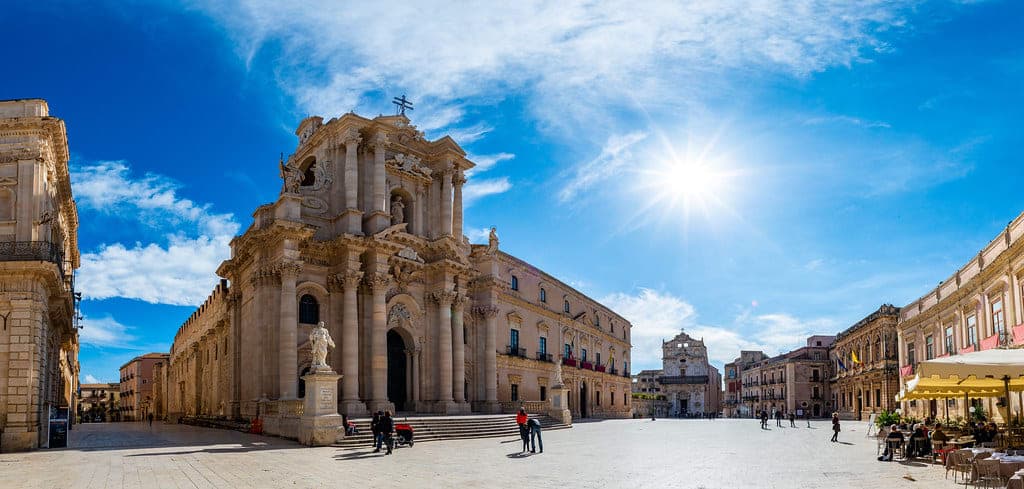
Cathedral of Syracuse
Where Athena's columns still hold up the house of Mary
Syracuse (Siracusa), Sicily, Italy
At A Glance
- Coordinates
- 37.0590, 15.2929
- Suggested Duration
- Allow 30-60 minutes inside the cathedral. Add time for Piazza del Duomo and the exterior walk to see the stylobate.
Pilgrim Tips
- Modest dress is required. Shoulders, torso, and knees must be covered. This is enforced at the entrance. Bring a scarf or light jacket in summer if wearing sleeveless clothing.
- Photography is generally permitted when services are not in progress. Flash photography may be restricted. Video recording may require special permission. Always defer to posted signs and staff instructions.
- This is an active cathedral with regular services. Dress modestly with shoulders, torso, and knees covered. Maintain respectful silence. Photography restrictions may apply during services.
Overview
In the heart of Syracuse, Doric columns from a fifth-century BC Greek temple rise within the walls of a Baroque cathedral. For nearly three thousand years, this ground has been sacred. Worshippers once brought offerings to Athena, goddess of wisdom. Now candles flicker before the altar of Mary. The ancient stones remain, bearing witness to the continuity of human devotion across religions and millennia.
The Cathedral of Syracuse contains one of the most remarkable palimpsests of sacred architecture in the Western world. Walk inside and you will see them immediately: massive Doric columns, their characteristic entasis still visible after 2,500 years, now embedded in the walls of a Christian church. This is not renovation or repurposing in the ordinary sense. This is transformation preserved in stone.
The site was sacred before the Greeks arrived. An eighth-century BC altar, discovered by archaeologist Paolo Orsi, confirms cultic activity here during the earliest days of the Syracusan colony. Around 480 BC, the tyrant Gelon erected a magnificent temple to Athena, celebrating Syracuse's victory over Carthage at the Battle of Himera. Cicero wrote of its golden shield, so large and brilliant it served as a beacon for sailors approaching the harbor.
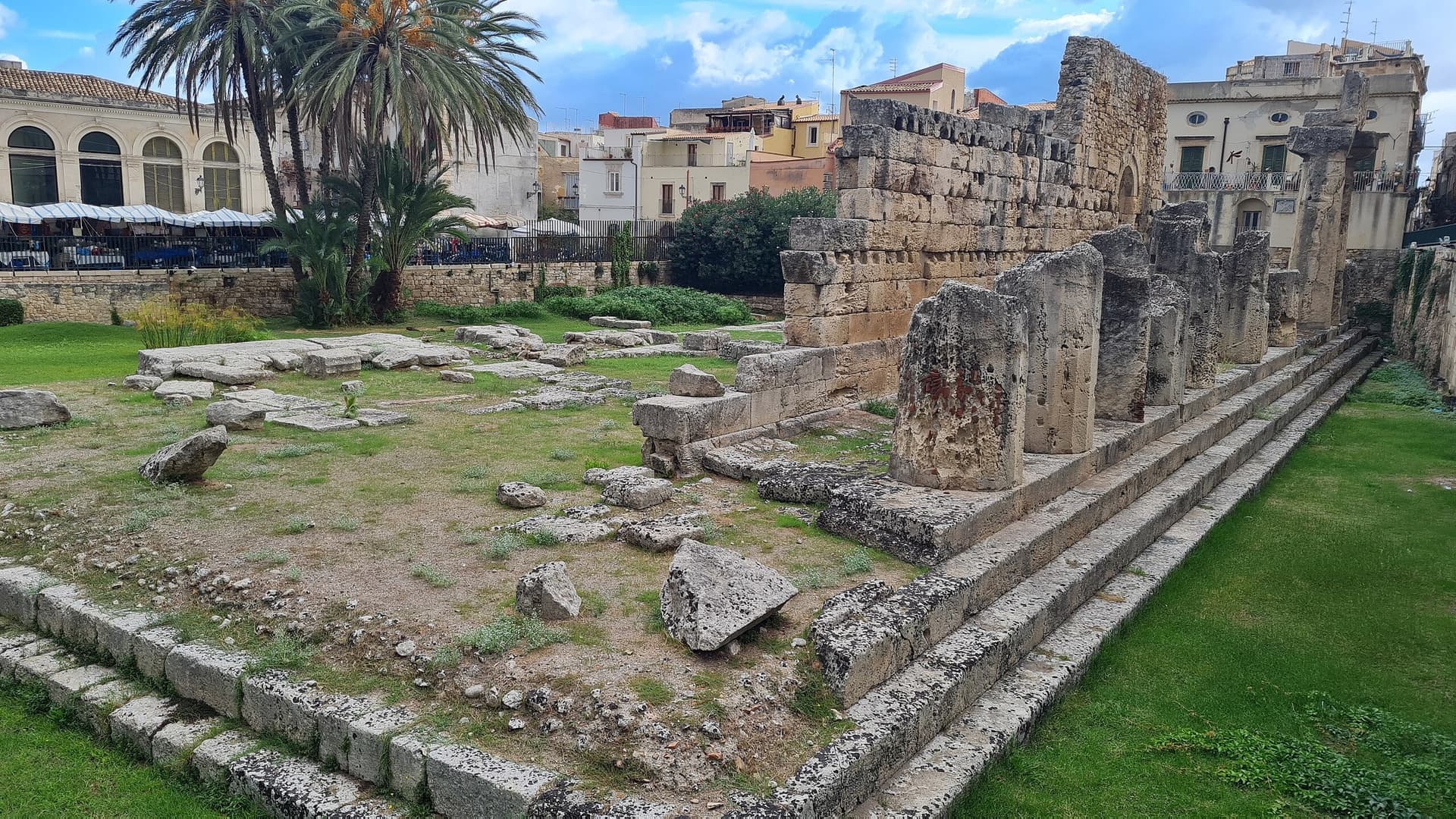
In the seventh century AD, Bishop Zosimus transformed the pagan temple into a church dedicated to the Nativity of Mary. Rather than destroy the ancient columns, the Byzantine builders walled them in, creating nave and aisles from the bones of the old temple. Nine columns from the original peristyle remain visible on the right side of the church. The Greek stylobate is still traceable along the exterior.
The Baroque facade that greets visitors today came after the devastating earthquake of 1693, when the Norman entrance collapsed. Andrea Palma's eighteenth-century design proclaims the confidence of Sicilian Catholicism. But step through those doors and you step through time itself, into a space where Athena's columns still support Mary's roof.
Context And Lineage
From prehistoric altar to Greek temple to Byzantine church to Baroque cathedral, this site documents the entire religious history of Syracuse across nearly three millennia of continuous sacred use.
Before Syracuse was Syracuse, something sacred marked this ground. The eighth-century BC altar discovered by Paolo Orsi during excavations tells us that the first Greek colonists, arriving around 734 BC, found or created a place of worship here on Ortygia.
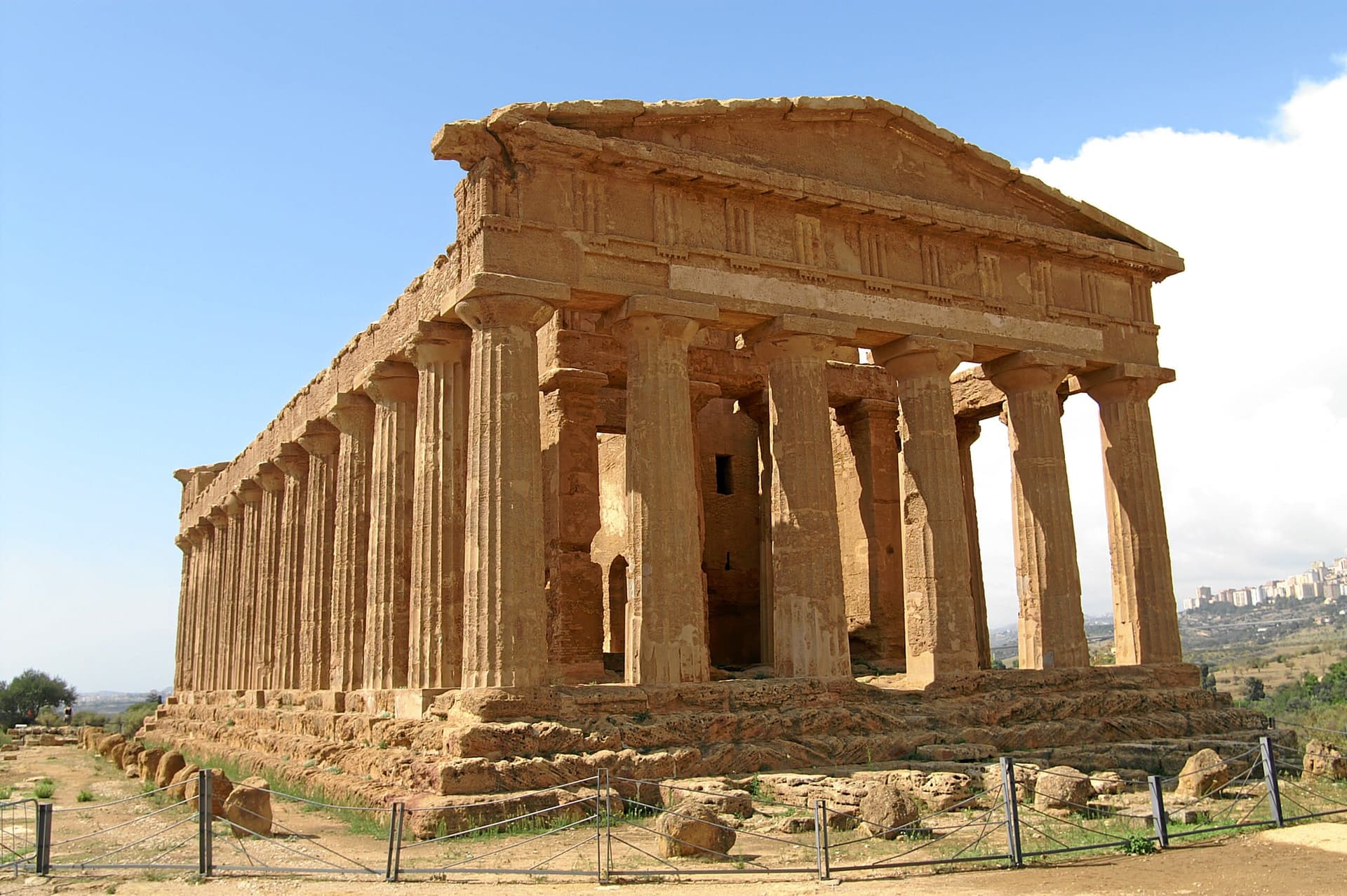
The Temple of Athena rose around 480 BC, built by the tyrant Gelon as a thanksgiving offering after Syracuse and its allies defeated the Carthaginian invasion at the Battle of Himera. This was no modest shrine. The temple featured six columns on each short side and fourteen on the long sides, built from local limestone in the Doric order. Its golden shield, mounted on the eastern pediment, became a landmark for Mediterranean navigation.
Cicero, visiting Syracuse in the first century BC, described the temple's treasures, which the corrupt Roman governor Verres would later plunder. The doors were of gold and ivory, the walls covered with paintings of Sicilian kings and cavalry battles. All of this is gone now, but the columns remain.
Bishop Zosimus of Syracuse (649-660 AD) transformed the temple into a church dedicated to the Nativity of the Blessed Virgin Mary. His builders walled up the spaces between the columns, converting the peripheral colonnade into solid walls while preserving the columns themselves. The naos became the nave. The cella became the chancel. The pagan temple became a Christian church without demolition.
Subsequent centuries added and subtracted. The Normans built a facade that fell in the earthquake of 1693. Andrea Palma designed the current Baroque front between 1728 and 1753. But the essential form, the temple-become-church, remained unchanged.
The site passed from indigenous Sicilian sacred use to Greek colonial religion (worship of Athena), to Byzantine Christianity, through the Arab period, to Roman Catholic worship under the Normans and their successors. The current cathedral serves as the seat of the Catholic Archdiocese of Syracuse.
Gelon, Tyrant of Syracuse
Temple builder
Bishop Zosimus of Syracuse
Church converter
Paolo Orsi
Archaeologist
Why This Place Is Sacred
Nearly three millennia of continuous worship have worn this place thin. The visible presence of Greek columns within Christian walls makes the layering of sacred traditions not a matter of faith but of sight. Here the boundary between past and present dissolves in stone.
What makes the Duomo di Siracusa a thin place is not mystical atmosphere but architectural fact. The ancient columns are not hidden or commemorated; they are structural. They bear weight. They do the work of holding up the roof today as they did when priests of Athena walked beneath them.
This physical continuity creates a particular quality of presence. To stand in the nave is to stand where Greek worshippers stood. The floor plan traces the outline of the cella where Athena's cult statue once resided. The Christian altar occupies approximately the same position as the pagan altar before it. The sacred geography persists even as the names of the holy have changed.
The Byzantine decision to preserve rather than destroy carries its own spiritual weight. When Bishop Zosimus converted this temple in the seventh century, he participated in an ancient Christian practice of sanctifying pagan sacred space. But the result in Syracuse is unusually complete. The temple did not become foundation stones for a new church; it became the church.
For pilgrims and seekers, this creates an opportunity for contemplation that transcends sectarian boundaries. Whatever brought the ancient Greeks to worship here, whatever draws modern Catholics to Mass, whatever pulls the spiritual tourist through those doors, operates on the same sacred ground. The thin place is not the Baroque exterior or the Christian liturgy or the Greek columns alone. It is their coexistence, their interpenetration, their refusal to be separated.
The water from the ancient sacred spring that once served Athena's temple still flows beneath the cathedral. The sacred does not depart; it transforms.
An eighth-century BC cultic site was developed into the Temple of Athena around 480 BC by the tyrant Gelon, built in thanksgiving for victory at the Battle of Himera against Carthage.
In the seventh century AD, Bishop Zosimus converted the temple into the Cathedral of the Nativity of Mary, preserving the Greek columns within the church walls. The Norman facade collapsed in 1693 and was replaced with the current Sicilian Baroque facade. UNESCO World Heritage status was granted in 2005.
Traditions And Practice
Daily Mass continues the liturgical tradition begun by Bishop Zosimus in the seventh century. The feast of Saint Lucy on December 13 is the cathedral's most important celebration, honoring Syracuse's patron saint.
The Greek temple hosted worship of Athena with animal sacrifices, processions, and votive offerings. The Byzantine church introduced Eastern Christian liturgy, later replaced by Roman rite under the Normans.
Daily Catholic Mass and liturgical services are celebrated throughout the year. The cathedral serves as the mother church of the Archdiocese of Syracuse, hosting major feast days, weddings, baptisms, and funerals. Pilgrims come especially for the Feast of Saint Lucy.
Attend Mass to experience the cathedral as a living place of worship rather than a museum. Spend time with the Greek columns, letting their presence work on you. Light a candle. Sit in silence. Walk the perimeter of the building outside to see the ancient stylobate. Return to Piazza del Duomo in the evening when the facade is illuminated.
Roman Catholicism
ActiveThe cathedral has served as the seat of the Catholic Archdiocese of Syracuse since the Byzantine period, representing over 1,300 years of continuous Christian worship. The dedication to the Nativity of Mary connects the site to broader Marian devotion.
Daily Mass, celebration of the liturgical calendar, sacraments including baptism, marriage, and funerals, veneration of Saint Lucy.
Ancient Greek Religion
HistoricalThe Temple of Athena was one of the most important Greek sanctuaries in Sicily, built to honor the goddess of wisdom and to celebrate Syracuse's victory over Carthage. The visible columns testify to the grandeur of Greek colonial religion.
Animal sacrifice, votive offerings, processions, consultation of the goddess for civic and military decisions. The golden shield served both religious and practical purposes as a navigation beacon.
Experience And Perspectives
Enter from Piazza del Duomo, through Palma's Baroque facade, into a church that reveals its Greek origins at every turn. The Doric columns demand attention, creating a dual awareness of Christian worship and ancient devotion that few sacred sites can match.
Approach the cathedral across Piazza del Duomo, one of the most beautiful squares in Sicily. The Baroque facade rises before you with its Corinthian columns, its statues of the Virgin Mary, Saint Marcian (the first bishop of Syracuse), and Saint Lucy (the city's patron saint). Nothing prepares you for what waits inside.
Step through the doors and the temple reveals itself. On your right, nine massive Doric columns march down the length of the nave, their fluted shafts still bearing the subtle bulge of classical entasis. Two more columns from the original cella entrance are visible. The spaces between the columns are filled with masonry, but the columns themselves stand free, exposed, undeniable.
Move slowly. Let your eyes adjust to the filtered light. Notice how the Christian iconography and the Greek architecture exist simultaneously without conflict. The side chapels, the paintings, the candles, the altars, all of this occupies space defined by pagan geometry. The roof that shelters the Blessed Sacrament is held aloft by columns carved for Athena.
Find the exterior wall on the left side of the cathedral where the ancient Greek stylobate, the stepped platform of the original temple, remains visible from the street. Walk around the building if time permits. The layers of construction tell the story of Syracuse itself, from Greek colony to Roman possession to Byzantine province to Arab emirate to Norman kingdom to Spanish domain to Italian nation.
Return inside for Mass if the schedule permits. Hear Latin prayers rise toward a ceiling supported by Greek engineering. This is not archaeology; this is living religion in a space where the living and the ancient have merged.
The cathedral is located on Piazza del Duomo on the island of Ortigia, the historic heart of Syracuse. Enter through the main Baroque facade facing the piazza. The Greek columns are most visible along the right (north) interior wall. The ancient stylobate is visible outside on the left (south) side of the building.
The Duomo di Siracusa can be understood as an archaeological site, as a masterpiece of adaptive architecture, as a living Catholic church, or as evidence of the continuity of sacred space across religious traditions.
Architectural historians study the cathedral as a rare example of a Greek temple preserved through Christian conversion. The building documents the transition from pagan to Christian sacred architecture in the Byzantine period. The decision to preserve rather than destroy the columns reflects theological choices about the relationship between Christianity and its pagan predecessors.
For the Catholic Church, the cathedral represents the triumph of Christianity and the sanctification of pagan space. The preservation of the columns demonstrates that Christianity did not need to erase the past but could transform and fulfill it. Mary replaced Athena; the temple became a church; the sacred continued.
Some visitors experience the site as evidence that sacred geography transcends individual religions. The same ground has drawn worshippers for three thousand years under different names. This perspective emphasizes the continuity of human spiritual longing rather than the victory of any particular faith.
The specific ritual practices of the Greek temple remain unclear. The exact circumstances of Bishop Zosimus's conversion of the building are not fully documented. The original appearance of the temple interior before Christian modification can only be partially reconstructed.
Visit Planning
The cathedral is located on Ortigia island in the historic center of Syracuse, open daily with a small entrance fee. Plan your visit to include time in Piazza del Duomo, one of Sicily's most beautiful squares.
Hotels and B&Bs throughout Ortigia and Syracuse. Staying on Ortigia allows evening access to the illuminated piazza.
Respect the cathedral as an active place of Catholic worship. Dress modestly, maintain silence, and observe any restrictions during services. The building is both church and monument; honor both dimensions.
The Duomo di Siracusa is the seat of an archdiocese, a parish church for local Catholics, and one of Sicily's most important historical monuments. Visitors must navigate all three roles with respect.
Modest dress is required. Shoulders, torso, and knees must be covered. This is enforced at the entrance. Bring a scarf or light jacket in summer if wearing sleeveless clothing.
Photography is generally permitted when services are not in progress. Flash photography may be restricted. Video recording may require special permission. Always defer to posted signs and staff instructions.
Donations support the cathedral's maintenance and the archdiocese's charitable work. Votive candles may be lit for a small offering.
Visitors may not enter during services except to participate in worship. Certain areas may be closed for restoration or liturgical preparation. The Greek columns are part of the structure; do not touch or lean against them.
Sacred Cluster
Nearby sacred places create the location cluster described in the growth plan. This block is intentionally crawlable and links into the wider regional graph.