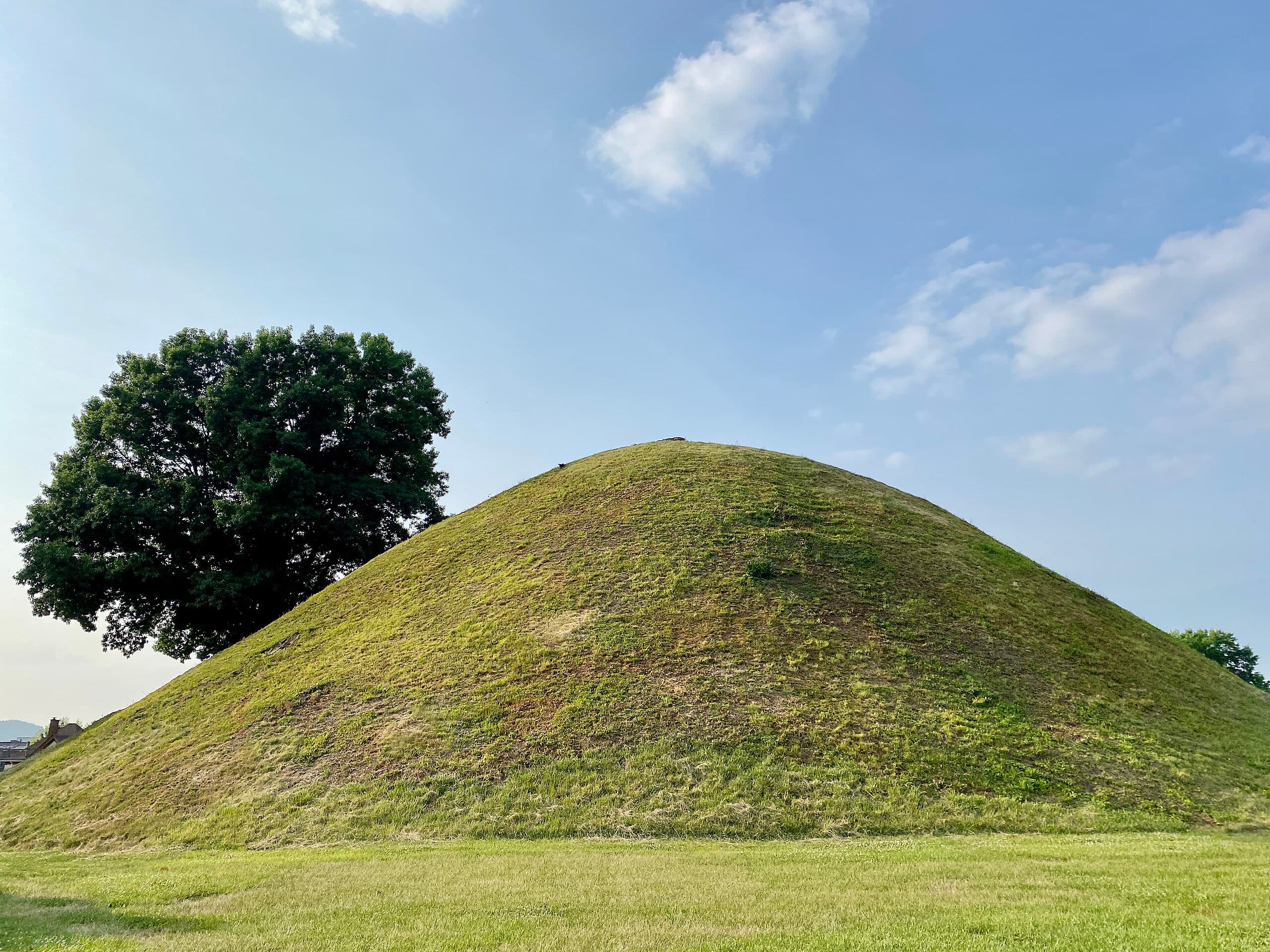
Grave Creek Mound, Moundsville, Ohio
Two thousand years of earth, carried basket by basket to honor the dead
Moundsville, West Virginia, United States
At A Glance
- Coordinates
- 39.9168, -80.7401
- Suggested Duration
- One to two hours allows adequate time to tour the museum, climb the mound, and contemplate the view from the summit. Visitors with particular interest in archaeology may spend longer with the museum collection.
Pilgrim Tips
- No specific dress code applies. Comfortable walking shoes are recommended for climbing the mound. Weather-appropriate clothing should be worn for outdoor portions of the visit.
- Photography is permitted throughout the site, including on the mound itself. The view from the summit offers panoramic opportunities. The museum may have specific restrictions; check with staff.
- Grave Creek Mound has a history of grave desecration. The 1838 excavation by Abelard Tomlinson disturbed ancestral remains without scientific method or cultural respect. The bodies were removed, the vaults exposed, the integrity of the burial violated for curiosity and profit. While modern management maintains the site responsibly, visitors should understand that they are walking on ground where Indigenous remains were treated as objects rather than ancestors. Do not attempt personal ceremonies or rituals at this site. While the mound is not currently used for active worship by any tradition, it remains a burial site. Respect for the dead requires restraint, not performance. If you feel moved to honor the ancestors, do so through quiet attention rather than imposed practice. The Grave Creek Tablet controversy also warrants caution. Some sources still reference the tablet as authentic ancient inscription; it is not. The scholarly consensus is clear: the tablet is a nineteenth-century forgery. Visitors should not let fringe theories distract from the genuine achievement of the Adena people, who needed no lost civilizations to build a monument of this scale.
Overview
Rising sixty-two feet above the Ohio River valley, Grave Creek Mound stands as one of the largest conical burial mounds in North America. The Adena people built it over a century, beginning around 250 BCE, carrying an estimated three million basket-loads of earth to create a monument to their honored dead. Two burial vaults within held high-status individuals adorned with copper, shell, and mica. For its builders, the mound likely represented an Axis Mundi connecting the realms of sky, earth, and water below.
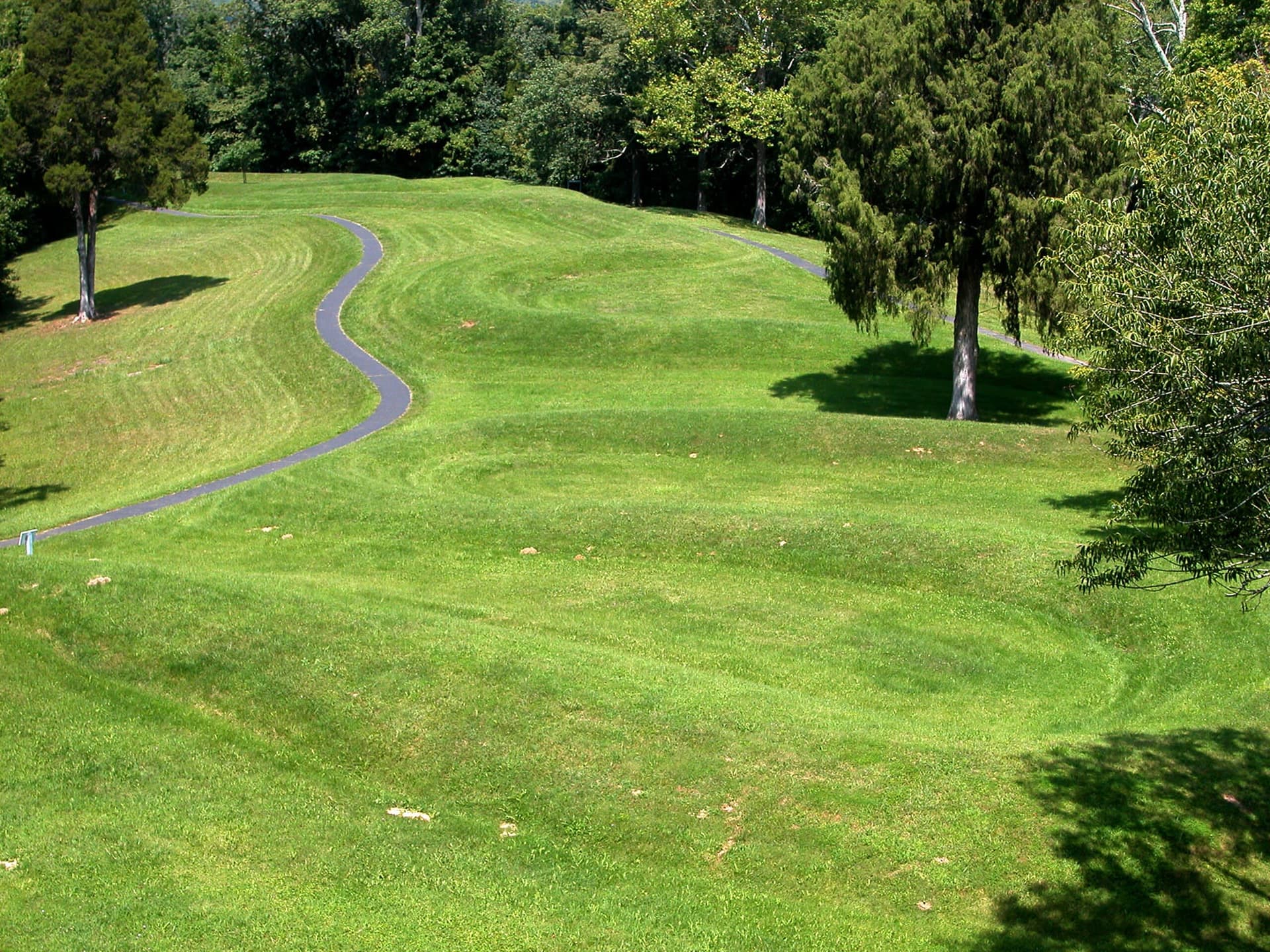
The town of Moundsville, West Virginia takes its name from the ancient earthwork that has stood here for over two thousand years. Grave Creek Mound rises sixty-two feet above the Ohio River floodplain, a massive cone of earth that once stood even taller before excavation and erosion took their toll. It is one of the largest conical burial mounds in North America, and it commands attention not through spectacle but through accumulated presence. Something persists here that transcends the tonnage of displaced soil.
The Adena people built this mound between 250 and 150 BCE, adding to it over approximately one hundred years. The construction was an act of devotion requiring extraordinary communal effort. Archaeologists estimate that sixty thousand tons of earth were moved, basket-load by basket-load, from the surrounding area to create this monument. A moat once encircled the mound, 910 feet long, 40 feet wide, its excavated soil becoming part of the structure it surrounded. The mathematics are staggering: three million trips to carry earth to a growing mound that would ultimately house only three burials.
Those burials reveal what mattered to the Adena. The upper vault contained a single individual accompanied by 1,700 bone and shell beads, five copper bracelets, a gorget, and pieces of mica. The lower vault held two people in a chamber lined with upright logs, surrounded by 650 shell beads and an atlatl weight. These were not ordinary interments. The dead were prepared, adorned, placed in the earth with objects meant for passage to another realm.
Meriwether Lewis documented the mound in 1803, on his way to meet William Clark before their famous expedition. The explorer recognized what he saw: evidence of a civilization preceding European contact, sophisticated enough to raise a monument that matched the scale of anything he knew. What Lewis could not have known was the cosmological weight of what he beheld. For the Adena, this mound likely represented the Axis Mundi, the World Tree connecting three realms: the Above World of Thunderbirds and celestial beings, the Earth World of the living, and the watery Underworld below. The Ohio River flowing past was not mere geography but a boundary between worlds.
Context And Lineage
The Adena people built Grave Creek Mound between 250 and 150 BCE as part of a broader mound-building tradition that defined Ohio Valley cultures for millennia. The site gained National Historic Landmark status in 1964 and is now protected as a state archaeological complex with educational facilities.
The Adena left no written records, and their direct descendants are unknown. What remains is the mound itself and the cosmology that archaeologists have reconstructed from burial practices, artifacts, and comparisons with historically documented indigenous traditions.
In Adena-Hopewell cosmology, the world comprised three realms. The Above World was home to Thunderbirds and celestial powers, beings of sky and light. The Earth World held the living, the dead, and the animals that moved across the land. The Underworld lay beneath, accessed through water and springs, home to serpents and water spirits. These realms existed in constant relationship, and the conical mound represented the point of connection: the Axis Mundi or World Tree through which power and presence could flow.
The mound, in this understanding, was not a passive grave but an active spiritual site. The ancestors buried within did not depart but remained present, accessible to the living through the connection the mound provided. The labor of construction was itself a form of devotion, an offering that bound community across generations. To build the mound was to participate in something larger than any individual life.
This is reconstruction, not direct transmission. The specific narratives and ceremonies of the Adena have been lost. But the mound endures as evidence of a worldview sophisticated enough to inspire a century of coordinated labor, a worldview that understood human life as embedded in larger cosmological patterns.
Grave Creek Mound belongs to the Adena culture, which flourished in the Ohio Valley from approximately 1000 BCE to 200 CE. The Adena were one of the first mound-building cultures in eastern North America, constructing conical burial mounds, earthen enclosures, and sacred sites throughout what is now Ohio, West Virginia, Kentucky, Indiana, and Pennsylvania.
The relationship between the Adena and later cultures remains a subject of scholarly investigation. The succeeding Hopewell culture, which emerged around 200 BCE and persisted until approximately 500 CE, built on Adena foundations while developing more elaborate earthworks and wider trade networks. Whether the Hopewell evolved from the Adena, absorbed them, or developed alongside them is debated.
Later cultures continued building mounds in the region, including the Fort Ancient culture that inhabited the Ohio Valley from approximately 1000 to 1750 CE. By the time of European contact, the original builders of Grave Creek Mound had been gone for over a millennium. The mounds they left behind became subjects of speculation and, eventually, scientific investigation.
Modern Indigenous nations maintain spiritual connections to burial mounds throughout the Ohio Valley, regardless of direct cultural continuity. These are sacred sites representing ancestral connection, and many contemporary Native American communities advocate for their respectful treatment and preservation.
The Adena Builders
Creators of Grave Creek Mound
Joseph Tomlinson
First documented European American to see the mound
Meriwether Lewis
Explorer, co-leader of the Lewis and Clark Expedition
Abelard Tomlinson
Excavator and property owner
Daughters of the American Revolution
Preservation advocates
Dr. E. Thomas Hemmings
Archaeologist, West Virginia Geological and Economic Survey
Why This Place Is Sacred
Grave Creek Mound embodies a cosmology in earth. Built over a century to house three honored dead, it represents the Adena understanding of the world as three interconnected realms. The vertical structure rises from ground adjacent to the Ohio River, pointing toward sky while ancestors rest within. For its builders, this was not merely a burial site but a point of connection between worlds.
Stand at the base of Grave Creek Mound and consider what it took to build. No draft animals, no wheeled carts, no metal tools. Just human hands, woven baskets, and a commitment that spanned generations. Three million basket-loads of earth, carried and dumped and shaped over a hundred years. The children who saw the work begin never saw it finished. This was devotion on a timescale that defies modern attention spans.
Why would a community invest such effort in honoring three people? The answer lies in Adena cosmology, which understood the world as three realms in constant relationship. The Above World held Thunderbirds and celestial powers. The Earth World held the living and the dead. The Underworld, accessed through water and springs, held its own beings and forces. The conical mound, rising from earth toward sky, represented the Axis Mundi: the World Tree connecting all three realms.
This was not abstract theology but lived practice. The dead placed within the mound did not depart from the community; they entered a new relationship with it. The copper and shell and mica that accompanied them were not grave goods in the sense of provisions for a journey but markers of status that would persist in other realms. The red ochre sprinkled on bodies represented life force, perhaps, or transition. The mound itself was the doorway through which honored ancestors passed while remaining present.
The Ohio River flows just east of the mound. In Adena cosmology, water offered passage to the Underworld. The mound's position was not accidental but intentional, placing the ancestors at the junction of worlds. The living could come to this place and know that here, more than elsewhere, the boundaries between realms grew thin.
We cannot fully reconstruct what ceremonies occurred here. The historical record begins only with European contact, thousands of years after the Adena culture ceased. But the mound itself is a kind of record, one written in sixty thousand tons of earth. It says: here is where we honor our dead. Here is where worlds meet. Here is where we gather to remember what matters.
Grave Creek Mound served as a burial site for high-status individuals within Adena society. Unlike ordinary people, who were cremated and placed in smaller log tombs, elite individuals received elaborate interment in wooden-lined burial vaults within the growing mound. The mound also likely functioned as a ceremonial center and focal point for communal gathering. Its construction over multiple generations suggests it was not merely a grave but an ongoing project around which community life organized itself.
The Adena people built Grave Creek Mound between 250 and 150 BCE, near the end of their cultural flourishing. The Adena culture itself emerged around 1000 BCE and persisted until approximately 200 CE, centered in the Ohio Valley. What became of the Adena remains unclear: they may have been absorbed into the succeeding Hopewell culture, or evolved into it, or dispersed.
The mound stood largely undisturbed for nearly two millennia until European Americans arrived. Joseph Tomlinson documented it in 1770. In 1803, Meriwether Lewis wrote of it in his journal. By 1838, Abelard Tomlinson, Joseph's descendant and the mound's owner, decided to excavate. He and Thomas Biggs drove two horizontal tunnels and one vertical shaft into the mound, revealing the burial vaults and their contents. This excavation, conducted without scientific method or respect for the dead, established the site's significance while also desecrating it.
The late nineteenth and early twentieth centuries brought the threat of complete destruction. Development pressures targeted the mound as an obstacle to be leveled. In 1908, the Daughters of the American Revolution raised funds to prevent its demolition. The State of West Virginia purchased the site in 1909. Scientific excavation in 1975-1976 by Dr. E. Thomas Hemmings confirmed the surrounding moat and established radiocarbon dates. The Delf Norona Museum opened in 1978, transforming the site from curiosity to educational institution.
Today, Grave Creek Mound is a National Historic Landmark and the centerpiece of an archaeological complex dedicated to preserving and interpreting Ohio Valley prehistory. The relationship between the site and Native American communities remains complex; Indigenous nations maintain spiritual connections to burial mounds throughout the region, even when direct cultural continuity cannot be established.
Traditions And Practice
No active ceremonies are performed at Grave Creek Mound by any single tradition today. The site functions as a heritage site and museum. Historical Adena practices included elaborate burial rituals, mortuary house ceremonies, red ochre anointing, and sacred tobacco smoking, all oriented toward honoring the dead and connecting realms.
The Adena burial practices revealed at Grave Creek Mound reflect a complex understanding of death and transition. High-status individuals, likely chieftains and shamans, received elaborate interment rather than the cremation that awaited ordinary people. They were placed in wooden-lined burial vaults within the mound, accompanied by grave goods that signified rank and ensured passage to other realms.
The artifacts found at Grave Creek Mound speak to what mattered: copper bracelets, shell beads, mica sheets, gorgets. These were not local materials but trade goods obtained through networks spanning hundreds of miles. Copper came from the Great Lakes region. Shell originated in the Gulf Coast. Mica was quarried in the southern Appalachians. The effort required to obtain these objects matched the effort required to build the mound itself.
Mortuary houses likely played a role in Adena practice. The dead were kept in structures near the mound where remains and grave goods could be assembled before final burial. When the time came, these structures were burned and incorporated into the mound, adding both ash and sanctity to the growing earthwork.
Red ochre was sprinkled on bodies before burial, a practice widespread among ancient cultures but carrying specific meaning for the Adena. The red pigment may have represented life force, or blood, or the transition between states of being. Its presence marks the burials as intentional, ceremonial, meaningful.
Sacred tobacco smoking connected the Earth Realm to the spirits of Above and Below. Adena pipes, often carved with bird or animal effigies, were ritual objects used to invoke Thunderbirds or facilitate communion with ancestors. The smoke rising from these pipes carried prayers and offerings between realms, making visible the connections that the mound embodied in earth.
No active religious or ceremonial use of Grave Creek Mound is documented today. The site functions as a heritage site and museum operated by the West Virginia Division of Culture and History. Educational programs, guided tours, and museum exhibits form the primary modes of contemporary engagement.
The Delf Norona Museum offers visitors context for understanding the mound within Ohio Valley prehistory. The museum's collection, transferred from the U.S. Army Corps of Engineers, spans ten thousand years of regional habitation. Exhibits interpret the Adena culture, the mound's construction, and the history of excavation and preservation.
Some visitors approach the site with contemplative or spiritual intent, seeking connection with ancestral presence or reflection on mortality. The site's management does not prohibit such approaches but does not facilitate them either. This is a public heritage site, not an active sacred site with ongoing ceremonies.
For visitors seeking more than a quick tour, the mound rewards slow attention. Begin at the museum to understand the context, then climb the mound itself. At the summit, take time to look out over the landscape and imagine it as the Adena saw it: without buildings, without roads, with the river as the primary feature and the mound as the human response to it.
Consider the scale of devotion represented. Three million basket-loads of earth. A hundred years of construction. Three burials. The mathematics do not compute in terms of efficient use of labor, and that is the point. The Adena were not building efficiently; they were building meaningfully. The mound is not a structure but an offering, not a monument but a relationship.
If you are inclined toward contemplation, sit with the fact that the people buried here have been honored by their community for over two thousand years. Their names are lost, but their presence endures in sixty thousand tons of earth. Whatever your beliefs about death and what follows, this is evidence of a community that took the question seriously.
Adena Culture
HistoricalThe Adena people were the builders of Grave Creek Mound, creating it over approximately one hundred years between 250 and 150 BCE. The mound served as a burial site for high-status individuals, reflecting Adena beliefs about death, afterlife, and ancestral connection. The Adena understood the world as three interconnected realms, and the conical mound likely represented the Axis Mundi connecting them.
Elaborate burial rituals for elite individuals, with interment in wooden-lined vaults accompanied by grave goods including copper, shell, mica, and bone artifacts. Multi-stage mound construction over generations, with each addition contributing to a growing monument. Mortuary house rituals where the dead were prepared before final burial. Red ochre anointing of bodies. Sacred tobacco smoking using pipes carved with bird and animal effigies to invoke spiritual powers and communicate between realms.
Contemporary Native American Heritage Connection
ActiveMany Indigenous nations maintain spiritual connections with burial mounds throughout the Ohio Valley region, including Grave Creek Mound. These sites are considered sacred religious and cultural places representing ancestral connection, regardless of whether direct cultural continuity with the original builders can be established.
Advocacy for respectful treatment and preservation of burial sites. Recognition of mounds as sacred ground deserving protection from desecration and development. Maintenance of spiritual connection to ancestors and ancestral places even when specific traditions have not been continuously transmitted.
Experience And Perspectives
Visitors can climb to the top of the mound via a maintained pathway, gaining panoramic views of Moundsville and the Ohio River valley. The Delf Norona Museum provides context through artifacts and exhibits spanning ten thousand years of Ohio Valley habitation. The experience is one of scale: standing atop a structure built by hand over a century, contemplating devotion made physical.
The mound reveals itself gradually as you approach. From the parking area, it appears as a large hill covered in grass, steeper than natural terrain would suggest but not immediately dramatic. The scale becomes apparent only as you stand at its base and begin the climb.
The path winds around the mound's circumference as it ascends, a spiral journey to the summit that takes perhaps ten minutes of steady walking. The surface is well-maintained, the slope manageable but present. With each turn, the surrounding landscape comes more fully into view: the streets of Moundsville below, the West Virginia State Penitentiary directly across the road, and beyond it the Ohio River marking the boundary with Ohio.
At the top, a level area allows visitors to stand where, two thousand years ago, ceremonies may have been performed as the mound rose beneath the feet of the builders. The view extends for miles. The river moves slowly, carrying its ancient freight of sediment and meaning. The town spreads in all directions, its buildings and streets overlaid on a landscape that was sacred ground long before any European conception of property.
Standing here, the achievement of the Adena people becomes visceral rather than abstract. This is not a modest memorial but a monumental undertaking. The effort required to build it without modern technology strains comprehension. And it was built not for the living but for the dead, not for immediate use but for perpetuity. The Adena invested more labor in honoring three individuals than most communities invest in anything.
The descent returns visitors to the museum level, where the Delf Norona Museum provides context that the mound itself cannot offer. The museum houses nearly 450,000 artifacts transferred from the U.S. Army Corps of Engineers, representing ten thousand years of habitation by varying cultures. Stone projectile points, a three-thousand-year-old sandstone cooking bowl predating pottery, jewelry from Fort Ancient villages centuries later, all of it telling pieces of a continuous human presence in this valley.
The museum also addresses the Grave Creek Tablet, a small inscribed stone reportedly found during the 1838 excavation. The tablet was once a sensation, its supposed ancient script fueling theories about lost civilizations, Vikings, the Lost Tribes of Israel. Modern scholarship has thoroughly debunked these claims; the tablet is now considered a nineteenth-century forgery, likely created by Dr. James W. Clemens. The episode illustrates both the fascination the mound has inspired and the ways that fascination can be misdirected.
Grave Creek Mound Archaeological Complex sits in the town of Moundsville, West Virginia, directly across Jefferson Avenue from the imposing Gothic structure of the West Virginia State Penitentiary. The Ohio River flows approximately half a mile to the east, marking the border with Ohio. The mound itself occupies the center of the complex, surrounded by museum buildings, picnic areas, and parking facilities.
The original moat that encircled the mound is no longer visible at the surface; it was identified during the 1975-1976 excavation through archaeological investigation. The passageway that once crossed the moat on the south side has similarly disappeared. What remains is the mound itself, reduced from its original 69-foot height to 62 feet, and the surrounding grounds maintained as a state archaeological park.
Grave Creek Mound invites interpretation from multiple frameworks. Archaeological investigation has established the facts of its construction and burial contents. Reconstructed Adena cosmology suggests what the mound meant to its builders. Contemporary Indigenous perspectives maintain its significance as a burial site deserving respect. These perspectives complement rather than contradict each other.
Archaeological consensus holds that Grave Creek Mound was constructed by the Adena culture between 250 and 150 BCE, making it one of the largest and best-preserved examples of Adena burial mound construction. The site was built through the labor-intensive process of carrying earth basket by basket, requiring an estimated three million trips to move sixty thousand tons of soil.
The 1838 excavation by Abelard Tomlinson, though conducted without scientific method, revealed burial practices consistent with what archaeologists later documented at other Adena sites: high-status individuals interred in wooden-lined vaults with grave goods including copper, shell, mica, and bone artifacts. The distinction between elite burial in mounds and cremation for ordinary people suggests a stratified society with recognized leaders.
The 1975-1976 scientific excavation by Dr. E. Thomas Hemmings confirmed the presence of a moat surrounding the mound, 910 feet long and 40 feet wide, and established radiocarbon dates around 200 BCE. The moat served both practical and possibly ceremonial functions, with soil from its excavation contributing to the mound's construction.
Scholars interpret the mound within the broader context of Adena-Hopewell cosmology, which understood the world as comprising three realms: Upper World, Earth World, and Underworld. Conical mounds likely represented the Axis Mundi connecting these realms, making them not merely graves but active spiritual sites where the boundaries between worlds grew thin.
Indigenous nations maintain spiritual connections to burial mounds throughout the Ohio Valley, regardless of whether direct cultural continuity with the Adena builders can be established. These are sacred sites representing ancestral connection, places where the dead were honored and where their presence persists.
The specific traditions of the Adena themselves have not survived. No living tradition can claim direct descent from the mound-builders, and no oral traditions passed down from them exist in documented form. What remains is the mound itself, and the reconstructed cosmology that archaeologists have pieced together from burial practices and comparisons with historically documented indigenous cultures.
Many contemporary Native American communities advocate for respectful treatment and preservation of burial mounds as sacred religious and cultural sites. The history of grave desecration at Grave Creek Mound, where the 1838 excavation disturbed ancestral remains for curiosity and profit, represents exactly the kind of violation these communities oppose. Modern management of the site attempts to balance educational mission with appropriate respect for the dead.
The Grave Creek Tablet, a small stone with inscribed characters reportedly found during the 1838 excavation, once fueled alternative theories about the mound's builders. Various nineteenth-century scholars claimed the inscription represented ancient Hebrew, Phoenician, Runic, or other scripts, suggesting the mound was built by lost civilizations, Vikings, or the Lost Tribes of Israel.
These theories have been thoroughly debunked. The scholarly consensus is that the tablet is a nineteenth-century forgery, likely created by Dr. James W. Clemens. No credible evidence supports the involvement of any culture other than the Adena in the mound's construction.
The tablet controversy illustrates a persistent pattern in American archaeology: the reluctance to credit Indigenous peoples with sophisticated achievements, preferring instead to attribute them to external, often European or Middle Eastern, sources. The Adena needed no outside assistance to build Grave Creek Mound. They possessed the social organization, the cosmological motivation, and the sheer determination to move sixty thousand tons of earth by hand over a century. The mound is evidence of their achievement, not of lost civilizations.
Genuine mysteries remain at Grave Creek Mound. The specific identities of the three individuals buried within are unknown. What lives they led, what roles they played in their community, why they were chosen for this extraordinary honor rather than others all lie beyond recovery.
The exact cosmological meaning the mound held for its builders cannot be definitively established. The Axis Mundi interpretation is scholarly reconstruction, plausible and well-supported but not directly attested by Adena sources. What specific ceremonies were performed here, what prayers were offered, what relationships the living maintained with the ancestors within the mound all remain matters of inference rather than knowledge.
Why this particular location was chosen for such monumental construction is unclear. The proximity to the Ohio River may have cosmological significance given the association of water with the Underworld. The terrain may have offered practical advantages for mound construction. But the specific reasons the Adena selected this spot over others are not known.
Why the Adena culture eventually ceased to exist is similarly unclear. Climate change, social transformation, absorption into or replacement by succeeding cultures all have been proposed. The mound endures, but the people who built it have been gone for nearly two thousand years.
Visit Planning
Grave Creek Mound Archaeological Complex is located in Moundsville, West Virginia, directly across from the state penitentiary. The Delf Norona Museum is open Tuesday through Saturday. Visitors can climb the mound year-round. Allow one to two hours for a complete visit.
Moundsville offers basic lodging options. Wheeling, West Virginia, approximately twelve miles north, provides more extensive accommodations and amenities. The site has no camping facilities.
Treat Grave Creek Mound as a burial site, which it is. Visitors may climb to the top via the maintained pathway. Photography is permitted. Conduct yourself with quiet respect for the ancestors interred within.
Grave Creek Mound is a burial site containing the remains of three individuals interred over two thousand years ago. This fact should inform how visitors approach the site. While it is not an active ceremonial site with strict protocols, it is also not merely a tourist attraction. The ancestors buried here were honored by their community with extraordinary devotion; visitors today can honor them with ordinary respect.
The climb to the top of the mound is permitted and encouraged. A maintained pathway spirals around the mound, providing safe access to the summit. Take your time. The ascent is not strenuous but rewards attention. At the top, take in the view and consider what it meant to build this by hand over a century.
The museum provides context that enriches the experience. The artifacts on display are not curiosities but evidence of lives lived, beliefs held, networks maintained. Give them the attention they deserve. The three-thousand-year-old sandstone cooking bowl, the stone jewelry from Fort Ancient villages, the projectile points spanning millennia all tell pieces of a larger story.
Do not leave offerings or attempt ceremonies of your own devising. This site does not belong to a living tradition that can absorb such gestures; they are more likely to be litter than devotion. If you wish to honor the ancestors, do so through quiet presence and respectful attention.
No specific dress code applies. Comfortable walking shoes are recommended for climbing the mound. Weather-appropriate clothing should be worn for outdoor portions of the visit.
Photography is permitted throughout the site, including on the mound itself. The view from the summit offers panoramic opportunities. The museum may have specific restrictions; check with staff.
Do not leave offerings at the site. There is no living tradition associated with this mound that can receive such gestures appropriately. Respect is better expressed through attention than through objects.
{"Museum hours: Tuesday-Saturday 9:00 AM - 4:30 PM; closed Sundays and Mondays","Stay on designated pathways when climbing the mound","Do not remove any artifacts or natural objects from the site","Do not leave offerings or personal items on the mound"}
Sacred Cluster
Nearby sacred places create the location cluster described in the growth plan. This block is intentionally crawlable and links into the wider regional graph.