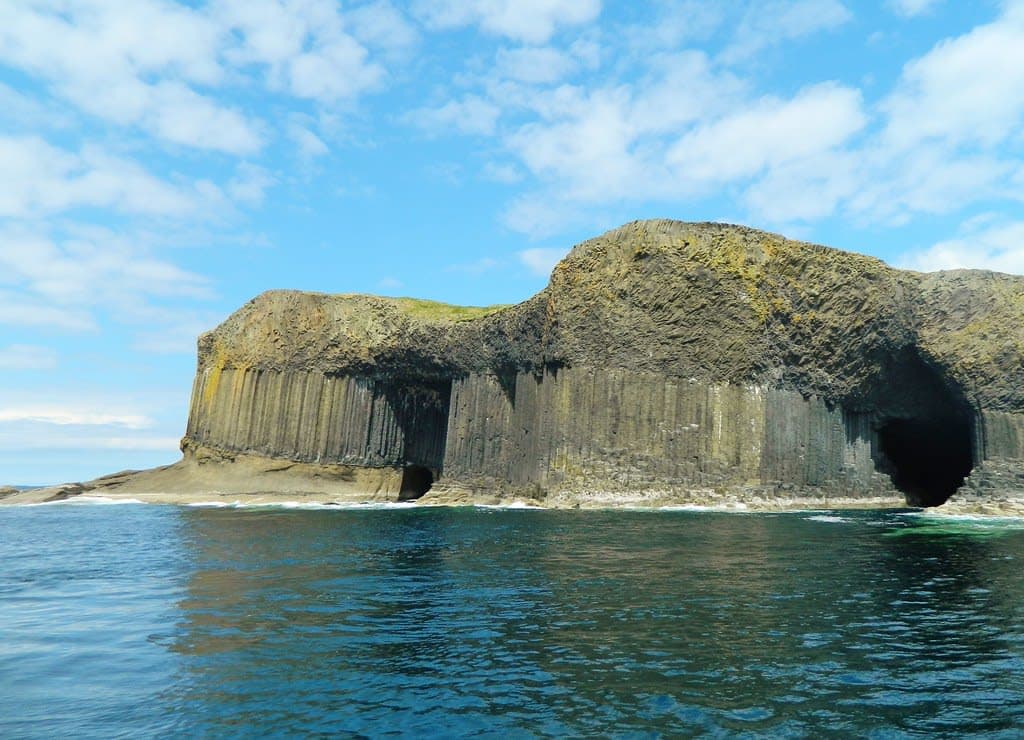
Fingal’s Cave, Island of Staffa, Scotland
Where volcanic geometry becomes cathedral, and the sea composes hymns in stone
Staffa Island, Alba / Scotland, United Kingdom
At A Glance
- Coordinates
- 56.4314, -6.3414
- Suggested Duration
- Full day excursion combining Staffa with Iona or the Treshnish Isles
Pilgrim Tips
- No dress code, but sturdy footwear with good grip is essential. The basalt columns are extremely slippery when wet, which they often are. Dress in layers for changeable Scottish weather and be prepared for wind and spray.
- Photography is welcomed. The cave is challenging to capture due to lighting contrasts. Drones are prohibited from April through October to protect breeding seabirds. Consider spending at least part of your time without the camera, actually perceiving the space rather than documenting it.
- The walkway is narrow and slippery. Watch your footing rather than your camera. The time ashore is limited, so choose how to spend it consciously. Do not leave anything in the cave or remove any stone from the island.
Overview
On the uninhabited island of Staffa, a sea cave lined with hexagonal basalt columns has drawn pilgrims for over two centuries. The Gaelic peoples called it An Uamh Bhin, the melodious cave, for the way waves become music within its vaulted space. Mendelssohn heard it and composed the Hebrides Overture. Visitors today report the same encounter with the sublime that moved the Romantic poets and painters who came before them.
Some places require effort to reach. Fingal's Cave demands it. The boat crossing from Mull, the climb up wet basalt, the narrow path above churning water, and then the threshold: a cathedral no one built.
Sixty million years ago, cooling lava fractured into hexagonal columns, creating a geometry so precise it appears designed. The cave stretches 75 meters into the cliff, its ceiling arched like a Gothic nave, its walls lined with columnar organ pipes of black stone. When waves enter, the space resonates. The sound is neither crash nor silence but something between, something the Gaelic speakers who named it An Uamh Bhin, the melodious cave, recognized as music.
This is where Felix Mendelssohn stood in 1829, seasick and astonished, and heard the opening bars of what would become one of classical music's most beloved works. Where Turner came to paint light dissolving into mist and stone. Where Keats and Wordsworth and Queen Victoria made their own pilgrimages to the edge of the knowable world.
The Romantic poets understood what they were seeking: the sublime. That category of experience that exceeds our capacity to comprehend, overwhelming the small self with something vast. Fingal's Cave delivers this reliably, for those who make the crossing and enter its darkness.
Context And Lineage
Fingal's Cave formed 60 million years ago from volcanic activity that also created the Giant's Causeway. Known to Gaelic peoples as An Uamh Bhin, the melodious cave, it entered European consciousness in 1772 when Joseph Banks published descriptions. The name Fingal comes from James Macpherson's Ossian poems, associating the cave with Celtic heroic legend. It became a pilgrimage destination for Romantic artists and remains so today.
The geological origin precedes any human story by tens of millions of years. When the Atlantic Ocean began forming during the Paleocene epoch, a mantle plume of hot rock rose beneath what is now the British Isles. Massive lava flows from the Mull volcano spread across the region. As these flows cooled slowly from both surfaces, the basalt contracted and fractured in hexagonal patterns, the most efficient way to tile a surface. Marine erosion carved out the cave over subsequent ages.
Celtic mythology offers another origin. The Irish giant Fionn mac Cumhaill, known in English as Finn MacCool, built a causeway to Scotland to fight his rival Benandonner. When Benandonner approached and found Fionn's wife had disguised her husband as a baby, he concluded that any father of such an enormous infant must be impossibly huge. He fled in terror, tearing up the causeway as he ran. The remnants became Fingal's Cave and the Giant's Causeway, which are indeed geological siblings from the same volcanic event.
The name Fingal derives from James Macpherson's 18th-century Ossian poems, which claimed to translate ancient Gaelic epic poetry. Though the authenticity of these translations is disputed, they made Fingal a Romantic icon and gave the cave its English name. Sir Joseph Banks, the botanist who accompanied Captain Cook, visited Staffa in 1772 and published descriptions that brought the cave to European attention. Within decades, it had become essential pilgrimage for anyone seeking encounter with nature's grandeur.
After Banks's 1772 description, Fingal's Cave became a destination for the Romantic movement's pilgrimage to sublime nature. The roster of visitors reads like a syllabus of 19th-century cultural achievement: Mendelssohn, Turner, Keats, Wordsworth, Sir Walter Scott, Lord Tennyson, and Queen Victoria, who arrived in 1847. Each added their response to the accumulated understanding of the place, and each understood themselves as participating in a tradition of seeking.
Fionn mac Cumhaill
mythological
The legendary Irish giant whose causeway-building explains, in mythological terms, the geological connection between Staffa and the Giant's Causeway.
Joseph Banks
historical
The botanist and naturalist who publicized the cave to European audiences in 1772, initiating the tradition of pilgrimage that continues today.
Felix Mendelssohn
historical
The composer whose 1829 visit inspired the Hebrides Overture, one of classical music's most beloved works and the cave's most enduring artistic legacy.
J.M.W. Turner
historical
The painter whose 1832 work captured the cave's atmosphere of light, mist, and stone, now held in Yale's collection.
Why This Place Is Sacred
Fingal's Cave functions as what pilgrimage scholars call a thin place, where the boundary between ordinary experience and something larger becomes permeable. Its power emerges from multiple factors: the geometric perfection that appears designed rather than natural, the acoustic properties that transform wave into song, the liminal position between land and sea, and the accumulated centuries of seekers who have found something here worth the difficult journey.
What makes a place sacred when no religion claims it? Fingal's Cave offers one answer. The cave sits at an intersection of elements, neither fully land nor sea, carved into an island named Staffa, from the Old Norse for staves or pillars. To reach it is to undertake a small pilgrimage, the boat crossing a ritual of approach, the island's steep stairs a threshold, the narrow walkway above the waves a passage requiring attention and courage.
Then the cave itself. The columns rise like organ pipes, their hexagonal geometry repeating with such mathematical precision that the mind struggles to accept their natural origin. The same volcanic event created the Giant's Causeway in Northern Ireland, and Celtic mythology explained both as the work of giants building a bridge between worlds. The geological story is no less astonishing: cooling lava contracting into the most efficient pattern, hexagonal jointing emerging from physics alone.
The acoustics amplify the effect. Waves entering the cave modulate into tones that early visitors compared to distant choirs or the low notes of an organ. The Gaelic name, An Uamh Bhin, the melodious cave, predates any Romantic tourist. Someone knew, long before Joseph Banks publicized the cave in 1772, that this was a place where nature produced music.
For contemporary visitors, Fingal's Cave continues to function as a threshold space. The combination of difficult access, extraordinary form, and acoustic presence creates conditions for encounter with the sublime. Whether this reflects geological happenstance, accumulated human intention, or something the categories of science and spirituality both fail to capture, the effect is consistent enough to take seriously.
The cave was known to Gaelic-speaking peoples long before Europeans of the Enlightenment arrived. Its name indicates awareness of its acoustic properties, and its association with Fionn mac Cumhaill suggests it held mythological significance as a place where giants shaped the world. After Joseph Banks visited in 1772 and published descriptions that captured literary imagination, the cave became a pilgrimage destination for the Romantic movement. Artists, writers, and musicians made the difficult journey seeking direct encounter with untamed nature. Mendelssohn, Turner, Keats, Wordsworth, Scott, Tennyson, and Queen Victoria all came. Today the National Trust for Scotland manages Staffa as a nature reserve, and thousands visit annually, continuing the tradition of pilgrimage to experience something that exceeds ordinary categories.
Traditions And Practice
No formal ceremonies take place at Fingal's Cave, but the site functions as a secular pilgrimage destination where visitors engage in contemplation, artistic response, and receptive presence. The primary practice is attentive listening to the cave's natural acoustics.
No documented rituals survive from pre-Christian Celtic peoples, though the Gaelic name and mythological associations suggest the cave held significance beyond the practical. Bronze Age archaeological evidence on Staffa confirms human presence as early as 1880-1700 BCE, though whether this included ritual use of the cave remains unknown.
Contemporary visitors engage in practices that echo the Romantic pilgrimage tradition: silent contemplation within the cave, listening to its natural acoustics, photography and artistic documentation as forms of attention, and combining the visit with pilgrimage to nearby Iona Abbey to create a sacred circuit through the Inner Hebrides. Some visitors intentionally sing or speak to experience the acoustic properties, following early visitors who tested the cave's resonance.
Enter the cave slowly. Pause before photographing and simply attend to what you perceive: the geometry of the columns, the quality of light on water, the sound of waves modulated by stone. If the acoustics are audible, listen for the music that gave the cave its Gaelic name. Consider what it meant for Mendelssohn to stand here and hear his overture. Consider what it means that people have been making this difficult journey for over 250 years, seeking something that language struggles to contain.
Celtic/Gaelic mythology
HistoricalThe cave was known to ancient Gaelic-speaking peoples as An Uamh Bhin, the melodious cave. In the Fenian Cycle, it forms part of the causeway built by Fionn mac Cumhaill to reach Scotland. The geological connection between Staffa and the Giant's Causeway gave rise to these explanatory myths that frame the landscape as shaped by heroes and giants.
Traditional storytelling preserved the mythology. Specific ritual practices at the cave, if they existed, are not documented.
Romantic pilgrimage
HistoricalAfter Joseph Banks publicized Staffa in 1772, the cave became essential destination for Romantic artists, writers, and musicians seeking the sublime in nature. They understood it as nature's cathedral, a place where the divine spoke through natural form. Mendelssohn, Turner, Keats, Wordsworth, and Queen Victoria all made the pilgrimage.
Artistic contemplation, composition of music and poetry, painting, and literary description. Visitors sought direct encounter with the sublime and recorded their experiences through their art.
Nature spirituality and secular pilgrimage
ActiveFor contemporary visitors, Fingal's Cave offers encounter with the numinous through extraordinary natural form. The cave's cathedral-like atmosphere and acoustic properties evoke spiritual response regardless of religious background. Many describe it as a thin place where boundaries between the ordinary and transcendent become permeable.
Silent contemplation, listening to natural sounds, meditation, photography as spiritual practice, and combining the visit with pilgrimage to nearby Iona Abbey.
Artistic pilgrimage
ActiveFingal's Cave continues to inspire artists, musicians, and writers. Mendelssohn's Hebrides Overture remains one of classical music's most performed works. The cave has influenced composers from Pink Floyd to contemporary classical musicians, and continues to draw photographers, painters, and writers seeking the experience that moved the Romantics.
Musical composition, painting, photography, writing, and film. Contemporary visitors continue the tradition of recording their encounters through creative work.
Experience And Perspectives
Visitors to Fingal's Cave consistently report experiences that exceed typical tourism: awe at the geometric perfection, a sense of entering another world or realm, profound response to the natural acoustics, and connection to the artists and seekers who came before. The encounter appears to transcend belief systems, affecting skeptics and spiritual practitioners alike.
The first response is usually visual: the columns rising in mathematical array, the cave mouth opening like the entrance to another world. The geometry is disorienting in its perfection. The brain expects caves to be irregular, organic, chaotic. Fingal's Cave is none of these. The hexagonal columns fit together like an architect's dream, rising to a ceiling that curves like a cathedral vault.
Then comes the sound. Waves entering the cave produce tones rather than noise, resonating within the columnar chamber. The quality varies with tide and weather, sometimes a low drone, sometimes rhythmic percussion, sometimes something that visitors describe as singing. Mendelssohn, who visited in 1829, wrote to his family that the cave had made a deeper impression on him than any sight he had encountered. The music that emerged from that impression, the Hebrides Overture, attempts to translate into orchestral language what the cave taught him.
Many report a sense of having crossed a threshold, not just physical but perceptual. The cave exists in a liminal zone: between land and sea, light and dark, the known and the unknowable. Standing within it, visitors describe heightened awareness, unusual stillness of mind, and the sense that something is listening. The rational mind may resist such language, but the reports are remarkably consistent across cultural backgrounds and belief systems.
The awareness of continuity adds another dimension. To stand where Mendelssohn heard his overture, where Turner saw his painting, where centuries of seekers have encountered the sublime, is to participate in a human tradition of pilgrimage to places that exceed our categories. The cave does not require belief. It requires only presence.
Fingal's Cave rewards receptive attention. The time on the island is brief, typically about an hour, and it is easy to spend it photographing rather than perceiving. Those who report the deepest encounters often describe setting aside the camera for at least part of their visit, simply standing within the cave and attending to what arises. Listen to the acoustic properties. Notice how light changes on the water. Allow the geometry to work on perception without rushing to document it. The crossing required effort. The cave deserves your full attention.
Fingal's Cave invites interpretation from multiple frameworks: geological science, Celtic mythology, Romantic aesthetics, and contemporary nature spirituality. Each offers genuine insight. The cave is large enough to contain them all.
Geologists confirm that the cave formed from Paleocene volcanic activity approximately 60 million years ago. The basalt columns result from slow cooling of lava, which contracts into hexagonal jointing perpendicular to cooling surfaces. The same geological event created the Giant's Causeway, establishing genuine connection between the sites that mythology explains as a giant's bridge. Archaeological evidence confirms Bronze Age human presence on Staffa around 1880-1700 BCE, though whether this involved ritual use of the cave remains under investigation. Sources note that Mendelssohn may have sketched the opening theme of the Hebrides Overture before actually visiting the cave, though the visit confirmed and refined his musical impressions.
Scottish Gaelic tradition named the cave An Uamh Bhin, the melodious cave, indicating awareness of its acoustic properties long before European tourists arrived. The mythology connecting Fionn mac Cumhaill to the causeway between Staffa and Ireland represents pan-Gaelic legendary tradition, framing the cave within a cosmology where giants shaped the landscape and boundaries between worlds could be crossed.
Some contemporary spiritual seekers view the cave as a natural power point or earth energy site, noting its liminal position between elements. The geometric perfection of the columns is sometimes interpreted as evidence of sacred geometry in nature. The cave's function as a gateway in Celtic myth resonates with those who experience it as a threshold space. The proximity to Iona creates what some perceive as a spiritual circuit through the Inner Hebrides.
Genuine mysteries remain. What significance did the cave hold for pre-Christian Celtic peoples? What was the nature of Bronze Age activity on Staffa? Whether a standing stone once existed at the back of the cave, as some sources suggest, remains undocumented. The precise acoustic properties that create the cave's distinctive sound have not been scientifically measured in detail.
Visit Planning
Fingal's Cave is accessible only by boat tour from April through early October. Tours depart primarily from Fionnphort on Mull and from Iona. Landings depend on weather and sea conditions. Allow a full day for the excursion, and consider combining with a visit to Iona Abbey.
No accommodation on Staffa, which is uninhabited. Stay in Fionnphort for early access to tours, or on Iona for combined pilgrimage experience. Tobermory on Mull offers more amenities. Oban on the mainland is the regional hub.
Fingal's Cave is managed as a nature reserve with emphasis on wildlife protection and visitor safety. Maintain quiet respect for the space, follow safety guidelines on the slippery walkway, and leave no trace.
The cave requires no religious protocol, but it deserves respect as both natural wonder and cultural pilgrimage site. Maintain an atmosphere appropriate to a place that has moved visitors for centuries. Loud conversation and performative behavior diminish the experience for others seeking encounter with the sublime. Allow space on the narrow walkway for others to pass. The cave rewards quiet attention.
No dress code, but sturdy footwear with good grip is essential. The basalt columns are extremely slippery when wet, which they often are. Dress in layers for changeable Scottish weather and be prepared for wind and spray.
Photography is welcomed. The cave is challenging to capture due to lighting contrasts. Drones are prohibited from April through October to protect breeding seabirds. Consider spending at least part of your time without the camera, actually perceiving the space rather than documenting it.
Do not leave offerings or objects. The site is a nature reserve. Leave no trace.
Dogs are not permitted on Staffa to protect ground-nesting birds. Stay on marked paths and respect rope boundaries. Do not disturb wildlife or approach nesting birds. Use the biosecurity mats and boot washes provided to prevent introduction of invasive species. Do not remove rocks, plants, or any natural material.
Sacred Cluster
Nearby sacred places create the location cluster described in the growth plan. This block is intentionally crawlable and links into the wider regional graph.