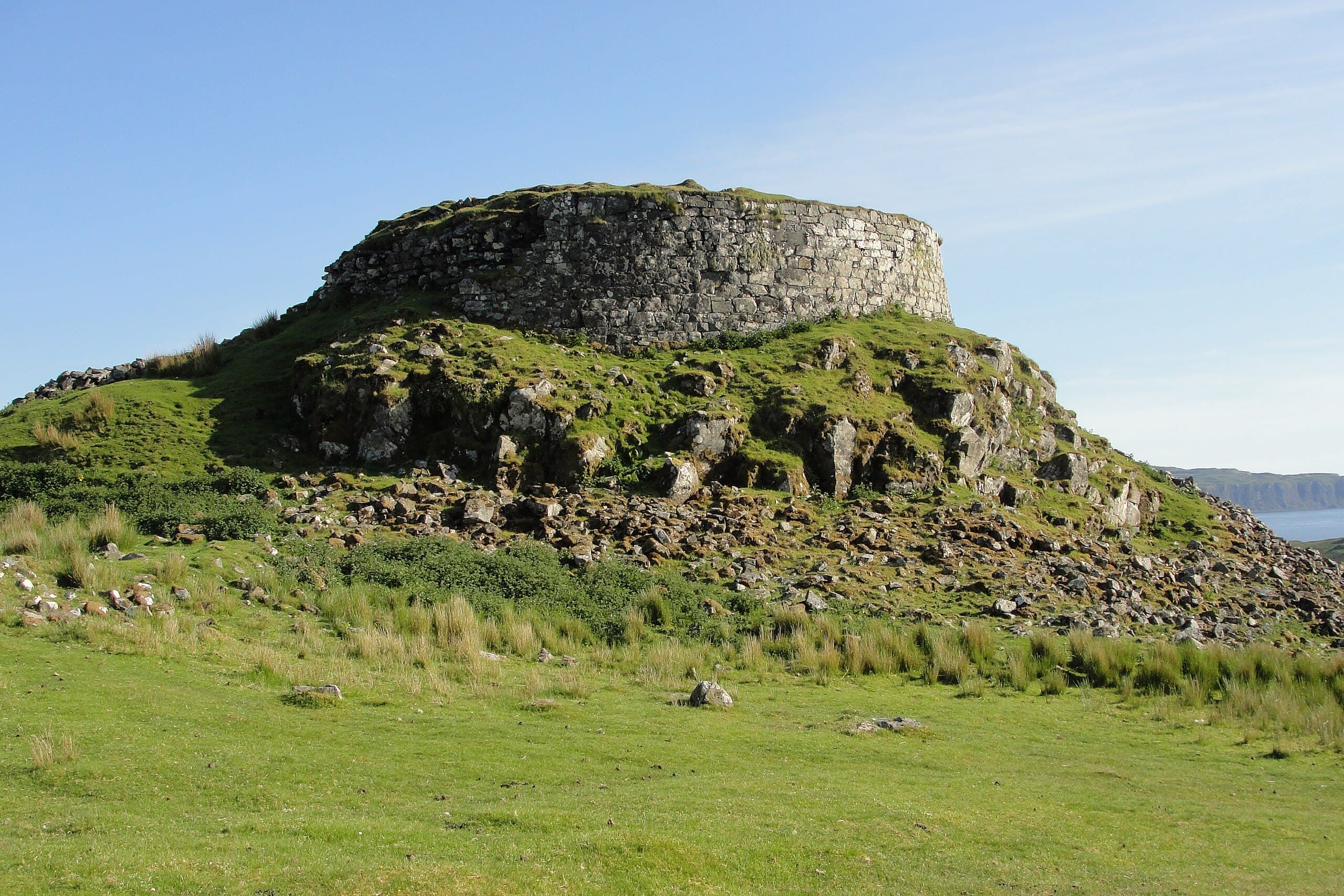
Dun Beag, Struan, Isle of Skye, Scotland
An Iron Age broch on Skye where two millennia of human presence thins the veil between worlds
Struan, Alba / Scotland, United Kingdom
At A Glance
- Coordinates
- 57.3604, -6.4258
- Suggested Duration
- 1 hour allows full exploration and time for contemplation
Pilgrim Tips
- No requirements, but practical preparation matters. Sturdy footwear with good grip is essential for the uphill walk over uneven, often wet ground. Waterproof layers protect against Skye's changeable weather. The hilltop is exposed and can be significantly windier than the car park below.
- Permitted throughout. The dramatic setting and ancient stonework reward patient photographers, particularly in the soft light of early morning or late afternoon.
Overview
On a windswept hilltop above Struan, the dry-stone walls of Dun Beag have stood for over two thousand years. This Iron Age broch, one of the best-preserved in the Hebrides, offers an intimate encounter with deep time. Visitors climb through sheep pastures to touch stones placed by forgotten hands, entering chambers where families once sheltered against the same Atlantic winds that blow today.
Some places teach by telling you nothing. Dun Beag has no interpretation panels to speak of, no guided tours, no reconstructed scenes of ancient life. There is only the broch itself: circular walls rising from a rocky knoll, a narrow entrance passage leading into darkness, and twenty stone steps climbing toward sky that the builders knew as well as you do.
The Iron Age communities who raised these walls around two thousand years ago left no written record. We do not know what they called themselves, what gods they honored, or why they chose this particular hilltop. What remains is the evidence of their labor: walls four metres thick at the base, fitted so precisely they have stood through two millennia of Hebridean weather. When you place your hand against these stones, you touch work that predates the Roman occupation of Britain.
Later generations found the broch and made it theirs. Norse settlers left behind bronze buckles and gold rings. Medieval Scots sheltered within walls their ancestors had not built. In Gaelic folklore, such places became associated with the sith, the fairy folk, as if the only explanation for structures so ancient must be supernatural.
Today Dun Beag stands quiet, offering nothing but itself. The views stretch across Skye's wild interior. The wind carries salt from Loch Bracadale. And something persists here, in the continuity of human presence, in the questions the stones refuse to answer.
Context And Lineage
Dun Beag was built approximately 2,000-2,500 years ago by Iron Age communities in Scotland. Brochs are uniquely Scottish architectural forms, with over 500 identified across the Highlands and Islands. The site was excavated between 1914 and 1920, revealing evidence of occupation from the Iron Age through the medieval period.
The story of Dun Beag begins with the broch-building tradition that flourished in northern and western Scotland from around 500 BCE. These monumental dry-stone towers required sophisticated engineering and substantial community labor. The builders fitted massive stones together without mortar, creating walls thick enough to contain galleries, chambers, and staircases. No comparable structures exist elsewhere in the ancient world.
Why this hilltop, why this form, why such massive investment of effort, the historical record cannot say. The builders kept no written accounts. What we know comes from the stones themselves and what later inhabitants left behind: pottery fragments, bone tools, and artifacts from cultures that came after.
After its Iron Age builders, Dun Beag saw waves of reoccupation. Norse settlers arrived during the Viking Age, leaving bronze buckles with Scandinavian ornamentation and gold rings similar to those found in Viking burials. Coins from the reign of Henry II indicate use continued into the 12th century. At some point the upper structure collapsed or was deliberately dismantled, and the site passed from living dwelling to ruin to heritage landmark.
Countess Vincent Baillet de Latour
Excavated Dun Beag between 1914 and 1920. A Fellow of the Society of Antiquaries of Scotland, she also excavated nearby Dun an Iardhard. Her work revealed the site's long occupation history and recovered artifacts now held in museum collections.
Why This Place Is Sacred
Dun Beag's quality as a thin place emerges from the accumulation of over two millennia of human presence, its commanding position between earth and sky, and the mystery that surrounds its builders. Scottish folklore associated such places with the otherworld, suggesting communities have long sensed something liminal here.
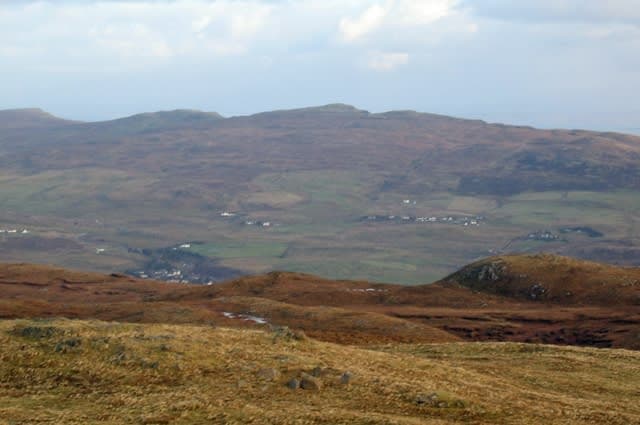
The broch rises from a rocky knoll that itself rises from the Skye moorland, creating a place suspended between elements. To the west, Loch Bracadale opens toward the Atlantic. To the east, the Cuillin ridge cuts the horizon. The builders chose this vantage point deliberately, though whether for defensive sighting, territorial display, or reasons we cannot recover, the location commands attention.
Iron Age peoples did not separate the practical from the sacred as modern categories demand. A dwelling could also be a statement of power, and both could carry spiritual significance. Archaeological evidence cannot tell us what ceremonies may have occurred here, but the Celtic-speaking communities of this era practiced ancestor veneration and understood certain places as points of connection between worlds.
Gaelic folklore later wrapped such sites in supernatural meaning. The duns became dwellings of the sith, entrances to realms beneath the ground. These stories may preserve distorted memories of the original builders, mythologized into fairy folk by communities who could not explain the massive stone structures their ancestors had not made.
What visitors report today, without knowledge of this folklore, resonates with the traditional understanding: a sense of the boundary thinning, of time collapsing, of the presence of those who came before. Whether this reflects the accumulated weight of human intention, the psychological impact of ancient architecture, or something beyond conventional explanation, the effect is consistent enough to take seriously.
Archaeological evidence indicates Dun Beag was a high-status residence, likely home to a powerful family or chieftain. The massive investment of community labor required to build such a structure, with walls thick enough to contain internal galleries and staircases, suggests the broch served as both dwelling and status symbol. Whether brochs also had defensive, ceremonial, or astronomical functions remains debated among scholars.
The broch saw occupation across centuries. Iron Age families built and inhabited it first. Norse settlers reoccupied the structure during the Viking period, leaving distinctive artifacts. Use continued into medieval times, as coins from Henry II's reign attest. At some point the upper levels collapsed or were dismantled, leaving the foundations and lower walls that stand today. Since the excavations of 1914-1920, Dun Beag has functioned as a heritage site, drawing visitors who seek connection with Scotland's deep past.
Traditions And Practice
No formal spiritual practices are documented at Dun Beag today. The site functions as a heritage attraction where visitors engage through historical interest and personal contemplation. The Iron Age rituals that may have occurred here are unknown.
Specific ritual practices at Dun Beag cannot be reconstructed. The Iron Age Celtic peoples practiced ancestor veneration, nature worship, and maintained beliefs about an otherworld accessible through certain places. Druids served as religious leaders. Whether brochs had ceremonial functions beyond their residential purpose remains a matter of scholarly debate. No evidence survives to indicate what spiritual practices, if any, took place within these walls.
Dun Beag hosts no organized ceremonies or rituals. Visitors engage primarily through historical and archaeological interest, though some come for personal reflection, ancestor connection, or contemplation of Celtic heritage. The site's openness allows each visitor to determine their own mode of engagement.
If you seek something beyond historical curiosity, approach the broch with attention rather than expectation. Take time in the central chamber simply being present. Consider who built these walls and what it meant to them to shelter here. The site offers no prescribed practice; what you bring determines what you find.
Iron Age Celtic
HistoricalDun Beag was built by Iron Age communities approximately 2,000-2,500 years ago, during a period when Celtic-speaking peoples inhabited the Scottish Highlands and Islands. Brochs represent uniquely Scottish architectural achievements requiring sophisticated dry-stone construction and complex social organization. The broch likely served as both dwelling and status symbol for a powerful local family.
Specific ritual practices at Dun Beag remain unknown. The Celtic peoples practiced ancestor veneration, nature worship, and believed in an otherworld accessible through certain places. Whether brochs had dedicated ritual functions beyond residential use remains a matter of scholarly interpretation.
Norse/Viking
HistoricalArchaeological evidence indicates Dun Beag was reoccupied during the late Viking period. Norse settlers left behind distinctive artifacts including bronze buckles with Scandinavian ornamentation and gold finger rings similar to Viking burial finds. This evidence suggests the broch continued to function as a dwelling for Norse inhabitants who had settled on Skye.
The Norse inhabitants likely used the broch as a practical dwelling, attracted by its defensible position and existing stone structure. Their religious practices, which blended Norse paganism with increasing Christian influence during this period, cannot be determined from the archaeological record at this site.
Scottish Gaelic Folklore
HistoricalIn traditional Scottish Gaelic culture, duns and brochs were associated with the supernatural. They were regarded as dwellings of the sith or as entrances to the otherworld. This tradition reflects attempts by later communities to explain the mysterious origins of structures they had not built.
Traditional beliefs held that duns were dangerous to approach after dark, as fairies might abduct mortals and take them to these places as entrances to the fairy realm. While no active practices derived from this folklore occur at Dun Beag today, the tradition preserves a sense of these places as liminal and powerful.
Experience And Perspectives
Visitors describe being transported back in time, awed by the preservation of two-thousand-year-old stonework, and moved by the intimacy of exploring chambers where Iron Age families once lived. The site's relative obscurity and lack of commercialization contribute to its atmospheric power.
The walk to Dun Beag begins with crossing the main road and passing through a gate into sheep pasture. The climb is moderate but rewarding, the broch revealing itself gradually as you ascend the grassy slope. There are no crowds here, no turnstiles, no ambient soundtracks. Just the wind, the bleating of sheep, and the growing presence of the stone circle above.
What strikes visitors first is often the scale. The walls, now standing about two metres high but once perhaps five times that, are massively thick. Approaching the narrow entrance passage, you must duck slightly, passing through a corridor that still shows the door-checks where a timber door once hung. Inside, three openings branch from the central space: one to a small chamber, another to a gallery running within the wall's thickness, and a third to a staircase of which twenty steps survive.
Climbing those stairs, your hand against the same stones Iron Age feet wore smooth, something shifts. Visitors consistently use the phrase being taken back in time, though the experience seems closer to time collapsing altogether, past and present occupying the same space. The imagination engages unbidden: who slept in that chamber, who climbed these stairs, who watched the same loch from this vantage point?
The site's unmanaged quality heightens the encounter. There is no velvet rope between you and the ancient stonework. You can sit where they sat, shelter from the same wind, watch light fall through the same entrance. For those who seek it, Dun Beag offers an intimacy with the deep past that more famous sites cannot provide.
Come prepared for the weather. Skye is beautiful precisely because it is wild, and conditions change quickly. Sturdy footwear matters for the grassy, sometimes muddy climb. Bring layers and waterproofs regardless of the forecast.
Once at the broch, resist the urge to rush. Spend time simply being present in the central chamber. Notice how sound changes within the walls. Explore the surviving staircase carefully, imagining the structure complete. Let questions arise without demanding answers. The builders left no explanations; you must make your own meaning from what they made.
Understanding Dun Beag requires holding multiple perspectives without forcing them into false resolution. Archaeological interpretation, folklore traditions, and contemporary visitor experience each illuminate something genuine about the site.
Archaeologists recognize Dun Beag as an exceptionally well-preserved example of a broch, a uniquely Scottish Iron Age architectural form. The excavations of 1914-1920 revealed stratified evidence of occupation from the Iron Age through medieval times, with a significant Norse phase indicated by Scandinavian-style artifacts. The purpose of brochs continues to be debated: earlier interpretations emphasized defensive functions, while recent scholarship suggests they primarily served as high-status residences and symbols of power. The concentration of over 500 brochs in northern and western Scotland indicates their importance to Iron Age society in these regions.
No continuous indigenous tradition survives from the Iron Age builders. Scottish Gaelic folklore, however, developed rich associations between ancient duns and the supernatural. Such places were regarded as dwellings of the sith or entrances to the otherworld. Some scholars suggest these beliefs originated from folk memories of the original builders, transformed into mythological narratives by later communities who could not explain the structures' origins. This folkloric understanding, while not historical in the conventional sense, captures something about how these places have been experienced across centuries.
Some contemporary visitors approach brochs as places of earth energy or spiritual power, connecting with Celtic spirituality and ancestor veneration. The dramatic hilltop locations of many brochs, including Dun Beag, attract those interested in sacred geography. The fairy associations in Scottish folklore resonate with those drawn to the concept of thin places where the boundary between worlds becomes permeable. These interpretations lack archaeological support but often emerge from genuine experiences visitors have at the site.
Genuine mysteries persist. The specific beliefs and ritual practices of the Iron Age builders remain unknown. Why this particular hilltop was chosen cannot be determined. The nature of the site's use during the Norse period is incompletely understood. Why brochs are found only in Scotland, and what cultural factors led to their development and eventual abandonment, continue to generate scholarly debate without resolution.
Visit Planning
Dun Beag is located approximately one kilometre northwest of Struan on the Isle of Skye. A small free car park on the A863 provides access. The walk to the broch takes 10-15 minutes uphill over grassy terrain. No facilities at the site.
Limited options in Struan itself. More extensive accommodations in Dunvegan, Carbost, and Sligachan. Advance booking essential during peak season.
Dun Beag is freely accessible and welcomes all visitors. Respect the ancient stonework by not climbing on walls. Keep dogs on leads through the grazing land. Take care on steep slopes and when crossing the main road.
The site asks little of visitors beyond common sense and basic respect. Do not climb on or disturb the ancient stonework; what has survived two thousand years deserves protection for future millennia. The approach crosses land where sheep graze, so dogs must remain on leads. The grassy slopes around the broch can be slippery, particularly after rain, and the wall tops have steep drops.
There is no admission charge, no restricted hours, no requirement to stay on marked paths. This openness is a gift; treat it accordingly. Leave nothing behind. Take nothing away. Let others who come after find the same quiet encounter you sought.
No requirements, but practical preparation matters. Sturdy footwear with good grip is essential for the uphill walk over uneven, often wet ground. Waterproof layers protect against Skye's changeable weather. The hilltop is exposed and can be significantly windier than the car park below.
Permitted throughout. The dramatic setting and ancient stonework reward patient photographers, particularly in the soft light of early morning or late afternoon.
No traditional offering practices are documented. Visitors should not leave objects that could harm the environment or the grazing sheep.
The site has no formal restrictions. Access is available at any reasonable time throughout the year. There are no facilities, so come prepared.
Sacred Cluster
Nearby sacred places create the location cluster described in the growth plan. This block is intentionally crawlable and links into the wider regional graph.