Barpa Langass
A Neolithic cairn on the slopes of Ben Langass, holding the dead of North Uist across five millennia
Lochmaddy, Alba / Scotland
At A Glance
- Coordinates
- 57.5705, -7.2915
- Suggested Duration
- 1 to 1.5 hours to explore the cairn thoroughly, take in the views, and sit with the site
Pilgrim Tips
- No formal requirements. Waterproof boots are essential as the footpath is boggy. Layers and a waterproof jacket are necessary for exposed Hebridean conditions. Wind and rain can arrive quickly even in summer.
- Photography is freely permitted. The cairn photographs well against the Hebridean sky, particularly in the long light of morning and evening. The bare stone surface and kerb stones provide strong visual detail.
- Do not enter the passage or chamber. The partial collapse of 2011, including one of the principal lintels, has made the interior structurally dangerous. The footpath to the cairn is boggy and uneven. Waterproof boots are essential. The site is fully exposed to Hebridean weather. Midges can be severe in still, warm conditions from June through September.
Overview
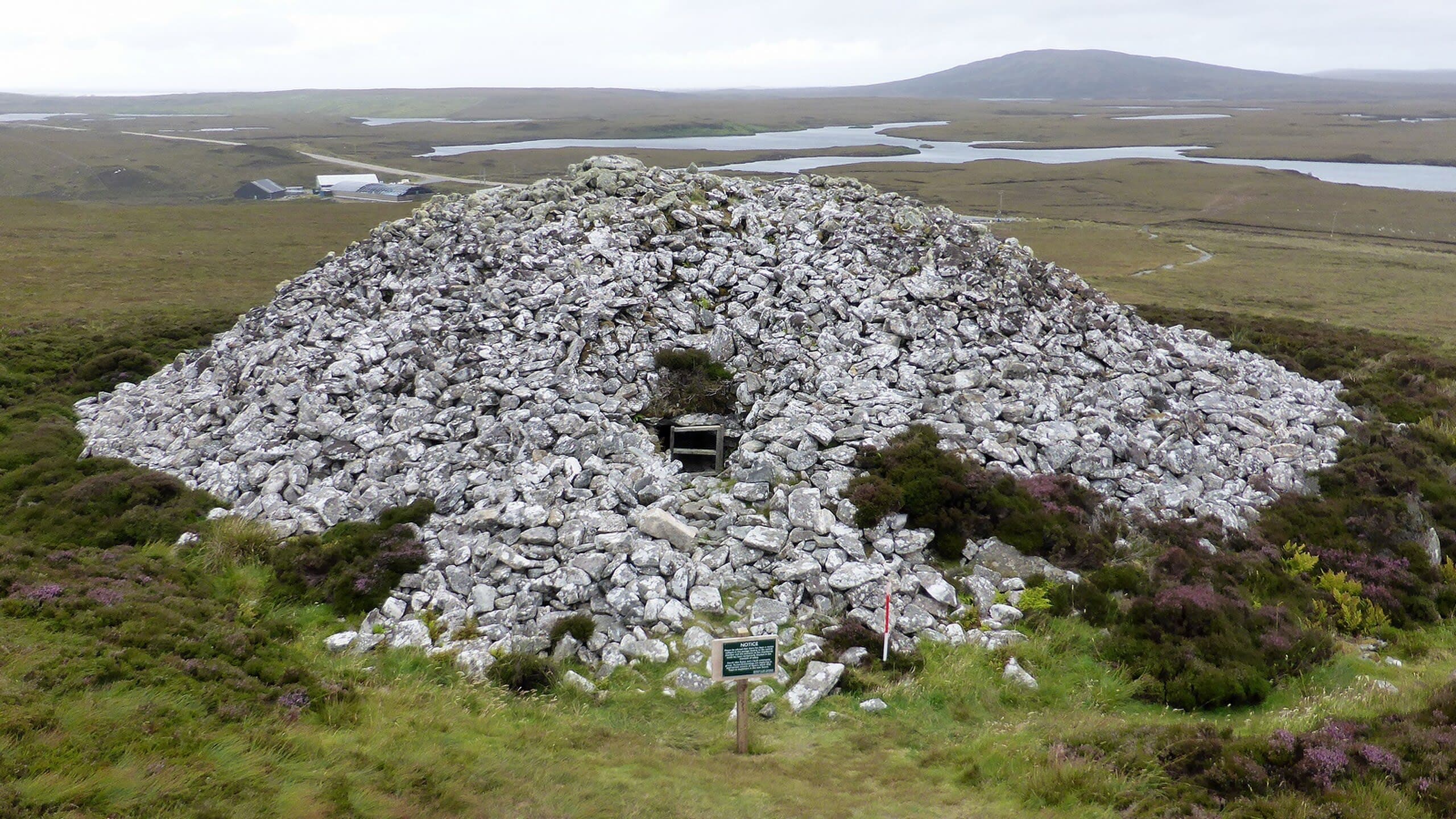
On the western flank of Ben Langass, a massive dome of stone rises from the moorland of North Uist. Barpa Langass is the best preserved Neolithic chambered cairn in the Outer Hebrides, built around 3000 BCE to house the cremated dead of a farming community. Five thousand years later, the cairn endures. Its entrance passage still opens toward the eastern horizon. The ancestors remain where they were placed, beneath stones that have outlasted every culture that followed.
You see it before you reach it. Driving the A867 across the moor of North Uist, the cairn appears on the hillside above you as a dark, rounded mass against the Hebridean sky. It does not look small. From a distance it might be mistaken for a natural feature of the hill, but as you walk the boggy path upward from the car park, its intentionality becomes unmistakable. This is not a geological accident. Every stone was carried here by human hands and placed with purpose.
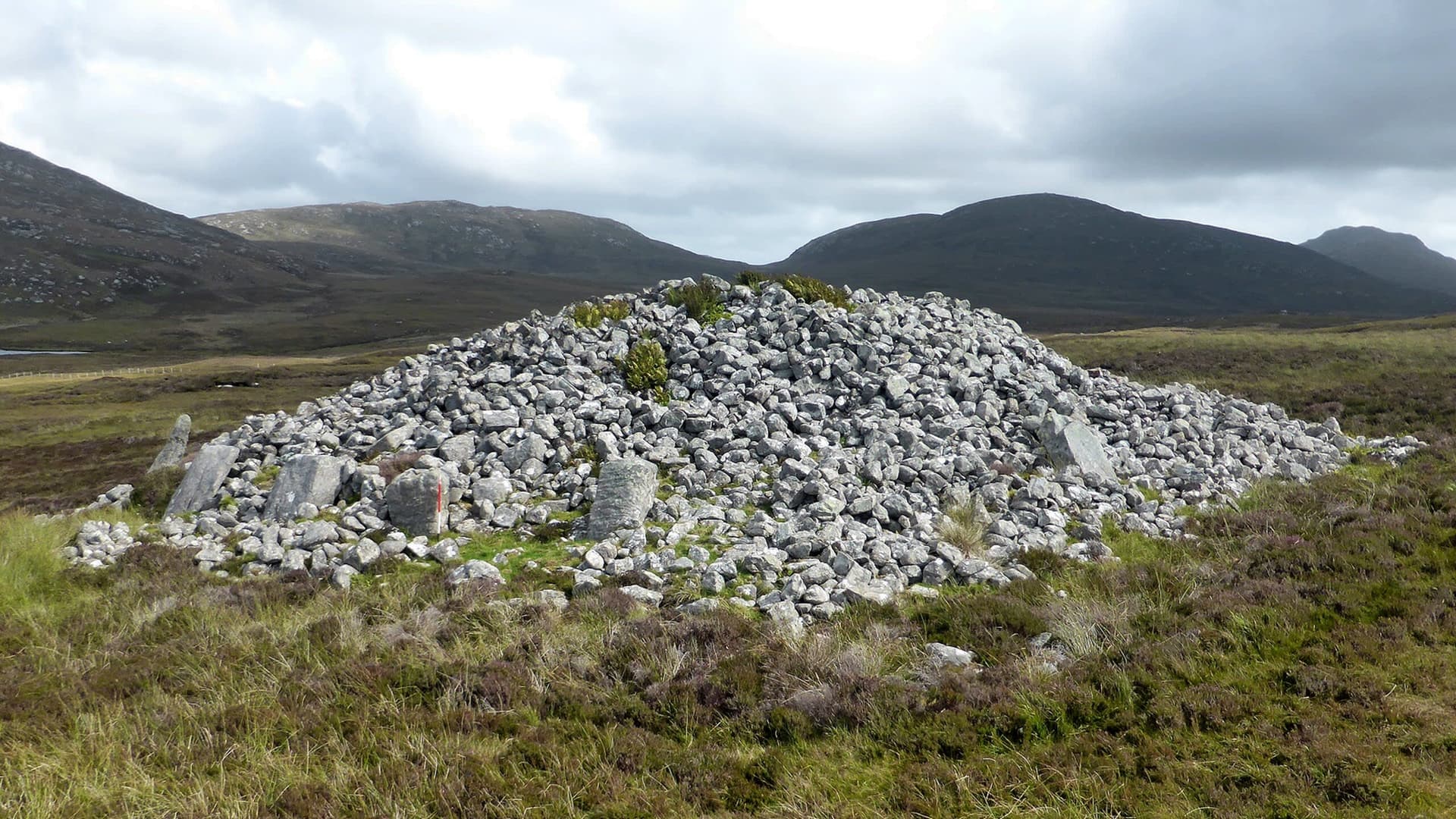
Barpa Langass stands approximately five metres high and twenty-five metres across, a circular cairn of bare stone devoid of soil or vegetation. A ring of pointed kerb stones marks the perimeter. On the east side, an entrance passage lined with seven upright slabs and roofed with massive lintels leads into an oval burial chamber four metres long. For perhaps a thousand years, the community brought their cremated dead here, along with pottery, flint tools, and small personal objects. The practice continued into the Beaker period and later still, with Iron Age pottery found among the earlier deposits. The cairn served not a single generation but dozens.
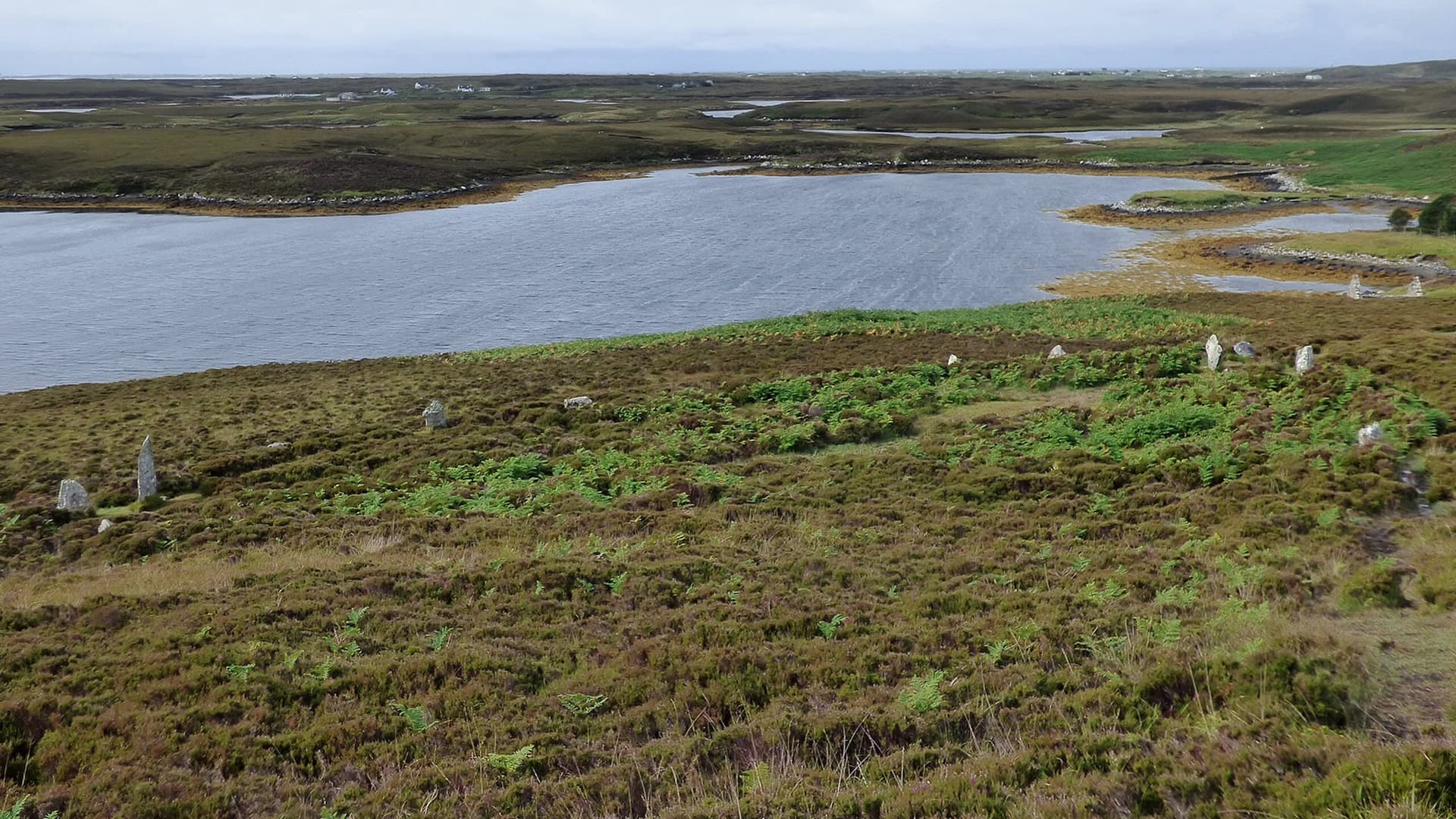
It sits within a wider ceremonial landscape. Less than a kilometre away, on the opposite slope of the same hill, stands Pobull Fhinn, the finest stone circle on North Uist. The cairn for the dead and the circle perhaps for the seasons and the sky together suggest that Ben Langass was not simply a convenient hill but a chosen place, a centre of meaning for the communities that shaped it. North Uist holds approximately twenty surviving chambered cairns, the highest concentration in the Western Isles. The ancestors are distributed across the island like a second, quieter population.
Context And Lineage
Built around 3000 BCE by Neolithic farming communities as a communal burial cairn. Used for over a thousand years. Excavated by Erskine Beveridge in 1907. Partially collapsed in 2011.
Around five thousand years ago, the farming communities of North Uist began to build. They had been on the island long enough to know it intimately, to have established the routines of cultivation and livestock that sustained them through the Hebridean seasons. They knew which stones could be prised from the hillside and which needed to be carried from further away. They knew the slopes of Ben Langass.
The construction of Barpa Langass required the coordinated effort of a community over an extended period. Thousands of stones were gathered and transported uphill. Seven large slabs were erected to line the entrance passage. Massive lintels, some up to three metres long, were lifted into place to roof the passage and chamber. The oval chamber itself, four metres long and nearly two metres wide, was formed of very large upright slabs with drystone walling between and above them. When complete, the cairn stood as the most prominent human-made feature on the hillside, visible from the moor below and from the water beyond.
The purpose was communal. Cremated remains were deposited within the chamber over time, accompanied by pottery, a flint arrowhead, a scraper, fragments of charcoal, and a piece of pierced talc. These were not the possessions of a single powerful individual but the accumulated deposits of a community returning to the same place, generation after generation, to lay their dead among the ancestors. The cairn was a house for the dead, and like any house, it was maintained and revisited.
A thousand years after construction, people were still coming. Beaker pottery from the period around 2400 to 1800 BCE was found alongside the earlier Neolithic material. Later still, Iron Age pottery sherds appeared. The cultures changed. The language changed. The cairn remained.
Barpa Langass belongs to the Hebridean-type chambered cairn tradition, characterised by a simple round form, slightly pronounced funnel entrance, narrow passage, and simple chamber. North Uist holds the highest concentration of these monuments in the Western Isles, with approximately twenty surviving examples across an island of roughly three hundred square kilometres. Two-thirds of all stone-tomb structures in the entire Western Isles chain are situated on North Uist, suggesting the island was a major focus of Neolithic ceremonial activity. The nearby Pobull Fhinn stone circle, the Cleitreabhal chambered cairn near Carinish, and the Bharpa Carinish long cairn are all part of this wider Neolithic landscape. Further north, the Callanish Stones on Lewis represent the most celebrated expression of the same megalithic tradition in the Outer Hebrides.
Erskine Beveridge
Why This Place Is Sacred
Five thousand years of the dead, held in stone on an Atlantic hillside. The passage opens east. The wind has not changed.
The thinness of Barpa Langass is inseparable from its age and its persistence. Five thousand years is not an abstraction here. It is the weight of the stones, the depth of the peat that has slowly crept up the cairn's flanks, the smoothing of the kerb stones by weather that arrives from the Atlantic without interruption. The people who built this cairn are gone. Their language is unknown. Their faces are unrecoverable. But the structure they made to house their dead still stands, and the entrance passage still opens toward the east, toward whatever the builders intended it to face.
The passage itself is the threshold. Even now, with the interior partly collapsed and entry inadvisable, the opening in the east side of the cairn draws the eye. Darkness beyond the first lintel. A space that was designed to separate the world of the living from the world of the dead, to create a boundary that could be crossed only by those who had died or by those who entered to tend them. The passage grave is a liminal architecture, a doorway built in stone between what can be seen and what cannot.
The setting amplifies this quality. North Uist is a low island, more water than land, where lochs and moorland merge into an indistinct horizon. The sky is enormous. Ben Langass is a modest hill, but on this island any elevation commands vast views. Standing beside the cairn, you see the lochs scattered across the moor below, the distant shimmer of the sea, the hills of Harris to the north. The Neolithic builders saw substantially the same view. The land has shifted, the sea level has changed, but the bones of the landscape remain. The cairn sits in this openness as a fixed point, a deliberate permanence in a landscape that otherwise dissolves into water and light.
The word barpa itself carries meaning. It is a Gaelic term of probable Norse origin, specific to the Hebrides, meaning a conical heap of stones. It is distinct from the more common cairn. The language of the islands has absorbed these monuments into its vocabulary, naming them as a category of thing so familiar they require their own word. The cairn was ancient when the Norse arrived. It was ancient when the Gaels arrived. It was already old when the Iron Age people left their pottery among the Neolithic dead. Each culture found it and recognised it as something that mattered, even if the original meaning had long been lost.
Barpa Langass was constructed as a communal burial site for Neolithic farming communities around 3000 BCE. The Hebridean-type chambered cairn housed cremated human remains deposited over extended periods, reflecting beliefs in the continuing presence and importance of ancestors within the community landscape. The enormous labour of construction indicates profound communal significance rather than individual commemoration.
The cairn remained in active ceremonial use for approximately a thousand years, with Beaker period pottery indicating continued ritual engagement into the second millennium BCE. Iron Age pottery sherds suggest periodic visitation across further millennia. Erskine Beveridge excavated the site around 1907, recovering cremated remains, pottery, flint tools, charcoal, and pierced talc, now held at National Museums Scotland. His findings were published in 1911. The site was designated Scheduled Monument SM892 by Historic Environment Scotland. In May 2011, a partial collapse within the passageway, including one of the principal lintels, caused considerable damage and effectively closed the interior to safe access.
Traditions And Practice
Walk to the cairn. Circle it. Stand at the entrance passage. Look east. Then walk to Pobull Fhinn to complete the landscape.
Archaeological evidence from Beveridge's excavation reveals Neolithic funerary rituals involving cremation of the dead, deposition of cremated remains within the chamber alongside charcoal and offerings, and the placing of pottery vessels with decorative patterned lines. The presence of a flint arrowhead, a scraper, and pierced talc suggests offerings of personal items or tools accompanying the dead. The communal nature of the burials, with multiple depositions over time, indicates periodic ritual visitation and ongoing engagement with the site across generations. The continued presence of Beaker period and Iron Age pottery suggests the rituals evolved as cultures changed, but the cairn retained its role as a place where the living attended to the dead.
No organised rituals take place at the site. Visitors come for heritage interest, archaeological study, photography, walking, and quiet contemplation. The site is often visited in combination with the Pobull Fhinn stone circle.
Begin at the car park. Read the interpretive panel, then walk the footpath uphill. The path is boggy and uneven. Let the effort of the walk prepare you. The Neolithic builders carried stones up this same slope, and the physical act of ascending connects you, however faintly, to their labour.
When you reach the cairn, resist the impulse to approach the entrance immediately. Instead, circle the perimeter first. Walk slowly around the entire circumference, noting the kerb stones, the bare stone surface, the scale. Twenty-five metres across. Five metres high. Every stone placed by hand. Let the enormity of the collective effort register.
Then find the entrance passage on the east side. Stand before it. Bring a torch if you wish to see into the passage, but do not enter. The 2011 collapse has made the interior structurally dangerous. Instead, stand at the threshold. This is where the living and the dead met. The passage is narrow, the lintels low. To enter would have required bending, making yourself smaller, a physical submission to the space. Notice how the passage frames the view eastward, toward the moor and the horizon beyond.
Sit near the cairn if the ground allows. Let the wind and the silence work. The Outer Hebrides are rarely truly silent, but the sounds here are old sounds. Wind through grass. Water moving in distant lochs. Birds. These are the same sounds the builders heard.
If time permits, walk to Pobull Fhinn. The path continues over the shoulder of Ben Langass to the stone circle on the opposite slope. The walk takes perhaps twenty minutes. Moving between the cairn and the circle, you traverse the same ceremonial landscape the Neolithic and Bronze Age communities knew. The cairn for the dead, the circle perhaps for the living. Together they suggest a completeness of vision that neither site alone can convey.
Neolithic Funerary Tradition
HistoricalBarpa Langass was built by Neolithic farming communities as a communal burial site around 3000 BCE. The cairn housed cremated remains deposited over extended periods, reflecting beliefs in the continuing presence and importance of ancestors within the community landscape. The scale of construction, requiring sustained communal effort to gather and transport thousands of stones up the slopes of Ben Langass, indicates the site held profound significance for the communities it served.
Cremation of the dead. Deposition of cremated remains within the chamber alongside charcoal and offerings. Placement of pottery vessels with decorative patterns, flint tools, and personal items such as pierced talc. Periodic return to the site across generations to add new deposits. The passage grave format created a bounded ritual space separating the world of the living from the world of the dead.
Beaker Period Continued Use
HistoricalBeaker pottery found within the cairn indicates continued ritual engagement approximately a thousand years after original construction, during the period around 2400 to 1800 BCE. This extended use demonstrates the enduring sacred significance of the site across cultural transitions. Iron Age pottery sherds suggest even later periodic visitation.
Renewed burial activity or ritual offerings, evidenced by Beaker pottery deposited alongside earlier Neolithic material. The monument maintained its role as a ceremonial focus even as pottery styles and cultural practices changed.
Archaeological and Conservation Stewardship
ActiveSince Beveridge's excavation in 1907 and the publication of his findings in 1911, Barpa Langass has been subject to ongoing archaeological study and heritage management. The site is designated Scheduled Monument SM892 by Historic Environment Scotland. The 2011 partial collapse of the passageway highlighted the ongoing conservation challenges facing the monument.
Archaeological research, heritage protection, public interpretation, and access management. The Taigh Chearsabhagh Museum and Arts Centre in Lochmaddy provides wider context for the archaeology of North Uist.
Experience And Perspectives
Walk uphill through moorland. The cairn grows as you approach. Circle it. Find the entrance passage on the east side. Look into the darkness. Then walk to the stone circle on the opposite slope.
The car park is a small gravel area beside the A867, marked by a signpost and an interpretive panel. From here, a footpath leads uphill across open moorland toward Ben Langass. The path can be boggy, particularly after rain, and waterproof boots are not optional but necessary. The ground is uneven, tussocked, the kind of terrain that demands attention to where you place your feet.
As you climb, the cairn reveals itself gradually. What seemed a dark mound from the road resolves into individual stones, thousands of them, carried and placed by hand. The cairn is devoid of soil. No grass grows on it. The bare stone surface gives it a raw, elemental quality that sets it apart from the surrounding moorland. A ring of pointed kerb stones marks the perimeter, still largely intact after five millennia.
Circle the cairn slowly. Its scale becomes apparent only from close range. Twenty-five metres across and nearly five metres high, it is a substantial structure, the work of a community acting together over an extended period. The stones came from elsewhere, carried up the slopes of Ben Langass by people who considered this labour necessary and right.
On the east side, the entrance passage opens. Seven upright slabs line the passage walls, and massive lintels roof the space above. If you bring a torch and peer in, you can see the passage narrowing toward the chamber beyond, though the 2011 collapse makes it unsafe to enter. This is the threshold. The living brought their dead through here, from the world of light and wind into the darkness of the chamber. The passage is narrow enough that you would have had to crouch, to make yourself small, to enter the space of the dead on their terms.
Stand at the entrance and look outward. The passage faces east. Whatever the builders intended by this orientation, the practical effect is that you look across the moor toward the rising sun. The lochs of North Uist spread below, silver in certain light. The horizon is distant and low.
From Barpa Langass, a path continues to Pobull Fhinn, the stone circle on the south side of Ben Langass, less than a kilometre away. The walk takes you over the shoulder of the hill and down toward an oval arrangement of approximately twenty-four stones. The two sites together compose a single landscape of meaning. To visit one without the other is to read half a sentence.
Barpa Langass sits on the western slopes of Ben Langass (Beinn Langais), North Uist, approximately halfway up the hillside. The entrance passage faces east. The Pobull Fhinn stone circle lies less than one kilometre to the south-southeast, on the opposite slope of the same hill. The car park and A867 road are below to the north.
Barpa Langass is understood primarily through its archaeology and its place within the Neolithic landscape of North Uist. In the absence of written records or surviving oral traditions specific to the site, interpretation rests on the material evidence recovered during excavation and on comparison with similar monuments across Atlantic Scotland.
Archaeologists classify Barpa Langass as a Hebridean-type round chambered cairn of Neolithic date, constructed around 3000 BCE. It is the best preserved example of its type in the Outer Hebrides and, prior to the 2011 partial collapse, was the only chambered cairn in the Western Isles known to retain its chamber intact. Erskine Beveridge's excavation around 1907 recovered cremated human remains, charcoal, Neolithic and Beaker pottery, a flint barbed-and-tanged arrowhead, a scraper, and a piece of pierced talc. These artefacts, now held at National Museums Scotland, confirm communal burial use spanning the Neolithic and Beaker periods, with Iron Age pottery indicating even later visitation. The Hebridean cairn type is characterised by a simple round form, slightly pronounced funnel entrance, narrow passage, and simple chamber. Beveridge's original interpretation as the burial place of a great chief has been superseded by the scholarly consensus that the cairn served as a communal burial site for the wider community. North Uist's concentration of approximately twenty chambered cairns, representing two-thirds of all stone-tomb structures in the Western Isles, marks the island as a major centre of Neolithic ceremonial activity. The proximity of Barpa Langass to the Pobull Fhinn stone circle suggests an integrated sacred landscape on and around Ben Langass.
No surviving oral tradition, folklore, or mythology specifically associated with Barpa Langass has been recorded. The Gaelic term barpa, of probable Norse origin, meaning a conical heap of stones, is specific to the Hebrides and distinct from the more common Gaelic word cairn. The nearby stone circle Pobull Fhinn takes its name from the legendary Gaelic hero Fionn mac Cumhaill, reflecting the embedding of ancient monuments in the Gaelic cultural landscape even though their builders predated Gaelic-speaking communities by thousands of years. The very word barpa, absorbed into a language that arrived millennia after the cairn was built, suggests the monuments were recognised as significant features requiring their own vocabulary.
Some visitors experience the cairn as a place of accumulated spiritual presence from millennia of funerary use. The passage-and-chamber design is sometimes interpreted as symbolising a journey from the world of light into the earth, a threshold between life and death or between the visible and the invisible. The cairn's prominent position on Ben Langass, overlooking the lochs and moorlands of North Uist, invites contemplation of the relationship between the ancestors and the living landscape they inhabited. The east-facing orientation of the passage raises questions about solar alignment that have not been formally investigated.
The specific beliefs and cosmology of the Neolithic community that built Barpa Langass remain unknown. Whether the east-facing passage was aligned with a particular astronomical event, such as the equinox sunrise, has not been formally documented. The precise nature of the relationship between Barpa Langass and the Pobull Fhinn stone circle, though spatial proximity suggests a connection, cannot be determined from the available evidence. Why North Uist has such a dense concentration of chambered cairns compared to other Hebridean islands is an open question. Whether the internal passage and chamber were remodelled during the cairn's long period of use, as some archaeological analysis suggests, remains uncertain. The full extent of Beveridge's excavation findings and whether further material remains undiscovered within the cairn are unknown.
Visit Planning
Signposted car park on the A867. Uphill walk over boggy ground. Open access, no admission charge. Allow 2-3 hours to include the stone circle.
Langass Lodge Hotel is adjacent to the car park and offers accommodation and dining. Limited options on North Uist; further accommodation available in Lochmaddy and scattered across the island. Booking in advance is advisable during summer.
Treat the cairn as an ancient burial site. Do not enter the passage. Do not remove or disturb stones. Leave no trace.
Barpa Langass is a Scheduled Monument under the protection of Historic Environment Scotland. It is also an ancient burial site where human remains were interred with ceremony over the course of a thousand years or more. While there is no living religious community with claims to the site, treating it with the respect due to any burial place is appropriate. The cairn has survived five millennia. The responsibility of each visitor is to ensure it survives the next visit unchanged.
The 2011 partial collapse within the passageway is a reminder that these structures, though enduring, are not indestructible. Entering the passage risks both personal injury and further damage to the monument. The exterior is freely accessible and provides the full experience of the cairn's scale, setting, and atmosphere. The entrance passage can be viewed and appreciated from outside.
Livestock may be present in the surrounding moorland. Close any gates on the footpath. Carry out all rubbish. Nothing should be left at or on the cairn.
No formal requirements. Waterproof boots are essential as the footpath is boggy. Layers and a waterproof jacket are necessary for exposed Hebridean conditions. Wind and rain can arrive quickly even in summer.
Photography is freely permitted. The cairn photographs well against the Hebridean sky, particularly in the long light of morning and evening. The bare stone surface and kerb stones provide strong visual detail.
Not traditionally associated with offerings in its current heritage context. Presence and respectful attention are sufficient. Nothing should be left at or on the cairn.
Do not enter the passage or chamber due to structural danger from the 2011 collapse. Do not remove or disturb any stones. Do not climb on the cairn. Respect the site as an ancient burial place. Leave no trace. Close any gates on the footpath.
Sacred Cluster
Nearby sacred places create the location cluster described in the growth plan. This block is intentionally crawlable and links into the wider regional graph.