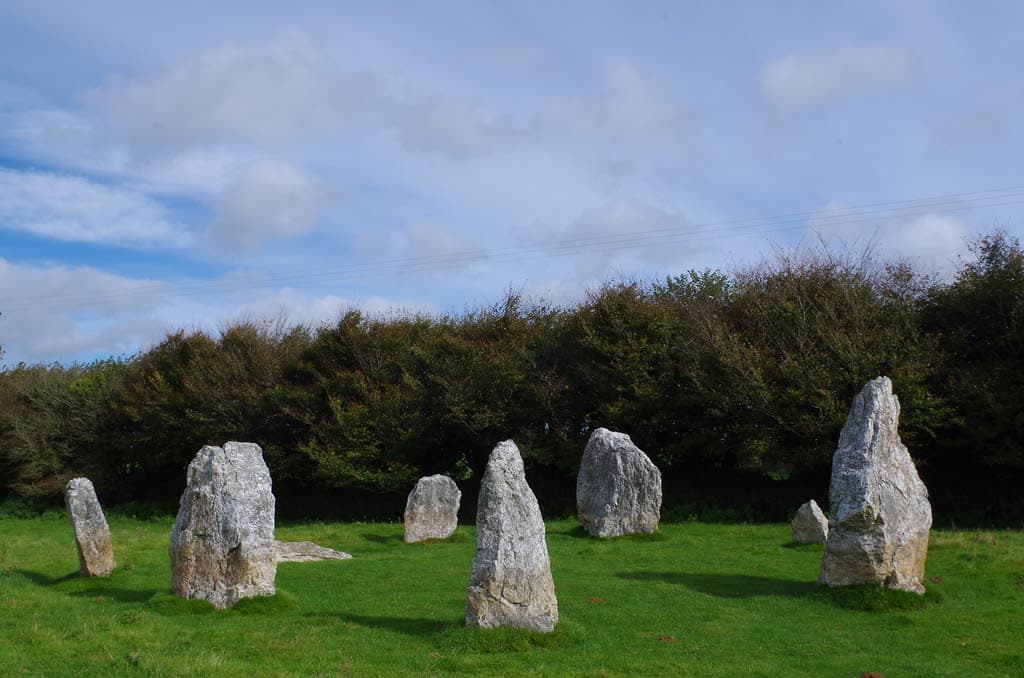
Duloe Stone Circle
Cornwall's quartz circle, where eight white stones hold four thousand years of silence
Tredinnick, England, United Kingdom
At A Glance
- Coordinates
- 50.3976, -4.4826
- Suggested Duration
- One hour allows time for contemplation and unhurried presence among the stones.
Pilgrim Tips
- No formal requirements exist. Practical outdoor clothing and sturdy footwear are sensible, as the approach crosses farm fields that may be muddy. Layers accommodate the changeable Cornish weather. There is no shelter at the site.
- Photography is permitted throughout. However, if others are present, especially if they appear engaged in spiritual practice, photograph the stones rather than the people unless you have explicit permission. The site's atmosphere benefits when visitors treat it as a place of stillness rather than content creation.
- The site is on private farmland, though public access is maintained. Respect this privilege. Do not bring large groups without consideration for the impact on the land and on other visitors seeking solitude. While touching the stones is permitted, do so with care. These are ancient structures. Avoid climbing on them or placing weight against them. The goal is encounter, not conquest. If you leave offerings, ensure they are biodegradable and will not harm livestock who graze the field. Ribbons tied too tightly to living branches can damage plants; tie loosely or find already-dead wood.
Overview
Eight quartz stones rise from a Cornish field, their whiteness still luminous after four millennia. Duloe Stone Circle is the smallest and most intimate of Britain's ancient monuments, yet visitors report its presence as unexpectedly powerful. The stones can be touched, walked among, sat with. In their compact embrace, seekers find a stillness that larger, more famous circles cannot offer.
There is something almost tender about Duloe. Unlike the grand sweep of Stonehenge or the brooding weight of Avebury, this circle gathers its eight stones into an oval no larger than a modest living room. You do not observe Duloe from without; you step inside and are immediately held.
The stones are quartz, gleaming white where lichen has not claimed them. This alone sets Duloe apart. Of all the stone circles in England, this is the only one built entirely from quartz, a choice that either held deep ritual meaning for the Bronze Age communities who erected it or simply reflected practical convenience from a nearby outcrop. Perhaps both. The original purpose, like so much about these monuments, remains a matter of interpretation rather than certainty.
What is certain: a burial urn containing cremated human remains was discovered here in the 19th century. Someone was brought to this place four thousand years ago, their body transformed by fire, their ashes placed within the circle's embrace. Whoever they were, whatever they meant to their community, they were deemed worthy of this threshold. The ancestors knew something about this ground.
Contemporary visitors report a quality of peace that surprises them, given the circle's modest scale. Many describe the sensation as nurturing, even maternal. The stones, they say, feel alive. Whether this reflects the quartz's associations with healing in modern crystal traditions, or something the Bronze Age builders understood that we have forgotten, or simply the profound quietude of a place apart from traffic and commerce, the pattern of experience is consistent enough to take seriously.
Context And Lineage
Duloe Stone Circle was erected during the Bronze Age, roughly 2000 to 1000 BCE, by communities whose names and beliefs have not survived. The discovery of a burial urn suggests ancestor veneration was central to its purpose. Rediscovered by antiquarians in the 19th century after centuries of obscurity, the site became known as The Druids Circle despite no actual connection to Druidic practice.
The builders left no written record. What we know comes from the stones themselves and the burial they protected. Sometime in the second millennium BCE, a community in what would become Cornwall chose this ridge between two rivers as sacred ground. They located quartz, likely from an outcrop of the Herodsfoot lead lode about two miles distant, and transported stones weighing as much as nine tons to this site.
The effort involved was enormous. Archaeologists estimate that moving each of the largest stones required thirty to thirty-five people working in coordination. This was not individual enterprise but collective will, requiring organization, motivation, and shared purpose. The circle they built, when complete, stood as white stone against green land, visible and luminous.
At some point, someone was cremated and their remains placed within the circle in a Trevisker-style urn, a pottery type found throughout Bronze Age Cornwall. Perhaps this was a founder, a leader, a person of spiritual significance. Perhaps others followed. We do not know. What we know is that the dead were brought here, that this threshold marked a transition between states, that the living deemed it proper to place their ancestors within this ring of white stone.
Centuries passed. The circle stood. New peoples arrived, the Celts with their Druids, the Romans with their roads, the Christians with their saints. The medieval church of St. Cuby rose nearby, possibly on ground already holy. A hedge grew up around the stones, hiding them from casual view. Local people knew the circle existed but did not disturb it. The wider world forgot.
The direct lineage from Bronze Age practitioners to the present has been broken. No tradition claims uninterrupted descent from the circle's builders. What remains is physical presence, the stones themselves, and the patterns of human response they continue to evoke.
In the 19th century, Victorian romanticism projected Druidic associations onto all stone circles, a connection that archaeology has since severed. The Druids, an Iron Age priestly class, arrived in Britain perhaps two thousand years after circles like Duloe were built. Yet the name Druids Circle persisted, reflecting perhaps a truth if not a fact: these places were holy, even if we have misidentified the priests.
Today's visitors include practitioners of contemporary paganism, earth-based spirituality, and crystal healing traditions. They bring their own frameworks, understanding the circle through lenses the Bronze Age builders could not have imagined. Yet something connects across the millennia. Humans continue to come here seeking something, whether ancestor connection, healing, or simply peace. The lineage is not doctrinal but experiential: people responding to place.
Britton and Brayley
historical
The first to record the circle in print, in 1801, describing it as a small Druidical Circle near the church of Duloe. Their brief mention began the modern rediscovery.
George Tregelles
historical
Documented the 1858 hedge removal and the 1861 re-erection of fallen stones in the Victoria County History of Cornwall, recording the changes that made the circle visible again.
W.C. Borlase
historical
Published information about the site in Naenia Cornubiae in 1872, after which it became known as The Druids Circle on Ordnance Survey maps.
St. Cuby
historical
A 5th-century Cornish saint who founded a monastic settlement at Duloe. Though he lived millennia after the circle was built, his church and holy well create a continuity of sacred significance across the landscape.
Why This Place Is Sacred
Duloe's sacredness emerges from the convergence of its unique quartz composition, its Bronze Age funerary associations, the cardinal alignment of its largest stones, and its placement within a sacred landscape that includes a medieval church and holy well. The circle's intimate scale creates a sense of enclosure that many visitors experience as holding or protective.
The Bronze Age builders chose this spot deliberately. The ridge between the valleys of the East and West Looe rivers offered elevation and visibility. More significantly, they chose quartz, carrying or dragging stones weighing up to nine tons from an outcrop two miles distant. This was not casual construction. The effort required suggests intention beyond mere boundary marking or community gathering. Something about the material, the location, or both held meaning worth extraordinary labor.
Quartz would have appeared dazzling when newly erected, the white stones catching sunlight in a landscape of muted greens and browns. Over millennia, lichen has softened their brightness, but on certain days, in certain light, the original luminosity still shows through. For those who hold beliefs about quartz's energetic properties, this composition carries additional significance. But even without such beliefs, the visual distinctiveness is striking.
The four largest stones stand at roughly cardinal points, north, south, east, and west. This alignment suggests astronomical awareness, perhaps marking seasonal changes that governed planting, harvest, and ceremony. Yet the circle is not precisely circular, but slightly oval. Whether this reflects original design, later disturbance, or the constraints of the stones themselves, we cannot know.
The discovery of a Trevisker-style burial urn connects Duloe to the broader Bronze Age practice of ancestor veneration. The dead were not simply disposed of; they were placed in relationship with the living through monuments that marked their significance. The ashes within the circle became part of the place. In some sense, they remain here.
The sacred landscape extends beyond the circle itself. Nearby stands the Church of St. Cuby, built on a circular mound that may predate Christianity, possibly an Iron Age fort later claimed by the Celtic church. A few hundred meters distant lies St. Cuby's Holy Well, its waters once sought for healing tuberculosis, scurvy, and rheumatism. Whether the circle, the mound, and the well formed a unified sacred geography for ancient peoples, or whether the connections are coincidence accumulated over millennia, the density of spiritual sites in this small area is notable.
Archaeological evidence suggests Duloe served ceremonial and funerary purposes during the Bronze Age, roughly 2000 to 1000 BCE. The burial urn discovery indicates the circle functioned as a site of ancestor commemoration, possibly the kerb or outer ring of a burial cairn that has since eroded away. The cardinal alignment of the largest stones hints at astronomical or calendrical observation, perhaps marking solstices or equinoxes for seasonal rituals. The choice of quartz may have carried symbolic meaning, perhaps lunar associations given the stone's whiteness and light-reflecting properties, or perhaps amplifying whatever ceremonies took place here.
For most of recorded history, Duloe Stone Circle was hidden. A hedge grew up around it, obscuring the stones from view. Local knowledge persisted, but the wider world forgot. In 1801, the antiquarians Britton and Brayley mentioned it briefly as a small Druidical Circle near the church of Duloe, the first known written reference. In the mid-19th century, the hedge was removed and fallen stones re-erected, revealing the monument more fully. Following W.C. Borlase's publication in 1872, it became known as The Druids Circle, a name reflecting Victorian romantic associations rather than historical accuracy.
Today, Duloe draws a different kind of visitor. Seekers interested in ancient sacred sites, practitioners of earth-based spirituality, and those drawn to the reputed properties of quartz come to stand among the stones. Small offerings appear periodically, ribbons tied to nearby hedges. The site has become a quiet pilgrimage destination for those who find the larger monuments too crowded, too regulated, or too distant from direct encounter. At Duloe, you can touch the stones. You can sit among them alone. This accessibility, increasingly rare at protected sites, draws those seeking unmediated experience.
Traditions And Practice
No organized ceremonial calendar exists for Duloe Stone Circle. The site serves primarily as a place for individual contemplation, meditation, and personal ritual. Visitors engage with the stones according to their own traditions or intuitions, with the freedom to touch and sit among them offering opportunities for direct encounter.
Original Bronze Age practices remain unknown in their specifics. The burial urn discovery suggests cremation ceremonies took place at or near the circle, with the transformed remains of the dead placed within its bounds as a form of ancestor commemoration. The cardinal alignment of the largest stones may indicate seasonal gatherings at solstices or equinoxes, times when the sun's position held calendrical significance. Whether chanting, offerings, processions, or other ritual elements accompanied these occasions, we cannot say. The builders left no written record, and oral traditions have not survived.
Duloe attracts visitors from contemporary pagan, earth-spirituality, and crystal healing traditions. No formal ceremonies are scheduled; the site functions as a place for individual practice rather than organized worship. Visitors engage according to their own frameworks: meditation within the circle, energy work with the quartz stones, silent communion with ancestors or with the land itself.
Small offerings sometimes appear, ribbons tied to vegetation near the circle in a practice borrowed from Celtic traditions of tying clooties at holy wells. These marks of passage indicate the site's ongoing significance for spiritual seekers. Some visitors report feeling called to return repeatedly, developing a relationship with the circle over time.
If you come seeking more than photography, consider these invitations.
Before entering the circle, pause at its edge. Acknowledge that you are crossing a threshold four thousand years old. You need not believe anything in particular; simply recognize the antiquity of the ground you are about to enter.
Once inside, find a stone that draws you. Approach it slowly. Place your hand against its surface if you feel moved to do so. Quartz is cool and smooth. Notice what you notice. Do not force interpretation; simply attend.
If meditation is part of your practice, the circle's center offers a natural seat. The stones create enclosure, a boundary between the ordinary world and something set apart. Let your breath settle. Let the silence of the place become your silence.
Before leaving, offer something internal: a word of gratitude, a moment of attention, an acknowledgment that you have been a guest in a place that has hosted seekers for four millennia. Physical offerings are not appropriate, but intention is always welcome.
Bronze Age Ceremonial/Funerary
HistoricalThe discovery of a Trevisker-type burial urn containing cremated human remains establishes Duloe as a site of ancestor commemoration during the Bronze Age. The placement of the four largest quartz stones at cardinal points suggests possible astronomical alignment, perhaps marking seasonal ceremonies. The unique use of white quartz may have held special ritual significance, perhaps associated with lunar cycles given the stone's luminous properties.
Specific practices are unknown. Archaeological evidence indicates cremation ceremonies were conducted and remains interred within the circle. The site may have functioned as a gathering place for seasonal observances, rites of passage, or ancestor veneration. Scattered charcoal found during excavation suggests fire played a role in ceremonies.
Contemporary Paganism and Earth-based Spirituality
ActiveModern spiritual seekers understand Duloe as a place of power, its quartz composition adding significance for those who practice crystal healing. The circle's intimate scale and the ability to touch the stones directly create opportunities for personal encounter unavailable at more regulated sites. Many describe experiencing nurturing, feminine energy here.
Visitors engage in meditation, energy work, and personal ritual according to their own traditions. Small offerings, particularly ribbons tied to nearby hedgerows, mark the site's ongoing use as a pilgrimage destination. Some practitioners return repeatedly, developing relationship with the circle over time. No organized ceremonies are scheduled; practice is individual and informal.
Celtic Christianity
HistoricalThe nearby Church of St. Cuby and Holy Well represent the Celtic Christian layer of spiritual significance in this landscape. St. Cuby, a 5th-century Cornish saint, established a monastic settlement at Duloe, suggesting that the area's sanctity was recognized even after Christianity superseded earlier beliefs. The well's waters were sought for healing tuberculosis, scurvy, and rheumatism.
Historical practices included pilgrimage to the holy well, immersion or drinking of its waters for healing, and possible baptisms at the spring. The church hosted the normal round of Christian worship. While the relationship between these Christian sites and the pre-existing stone circle is unclear, their proximity suggests some continuity of sacred landscape.
Experience And Perspectives
Visitors consistently report that Duloe produces a sense of peace and nurturing presence disproportionate to its modest size. Many describe the stones as feeling alive, even tender. The ability to touch the quartz directly and often have the site entirely to oneself creates opportunities for contemplation rarely available at more famous monuments.
The most striking aspect of Duloe is intimacy. Step into the circle and you are immediately within it, surrounded. The stones do not tower but stand at human scale, the tallest reaching perhaps nine feet, the smallest only three. This is not a monument to overwhelm but to embrace.
Visitors frequently use words like peaceful, nurturing, gentle. Some go further, describing the circle's energy as feminine or maternal, as though the stones themselves offer something like care. This is not typical language for stone circles, which more often evoke awe, mystery, or ancient power. Duloe elicits tenderness.
The quartz invites touch. Smooth and cool, the stone meets the hand with a quality different from granite or sandstone. For those who practice crystal healing, quartz is the master healer, associated with amplification, clarity, and purification. Even those without such frameworks often find themselves placing palms against the surface, following an impulse they cannot quite explain.
Some visitors report more vivid experiences. Descriptions include sensing the stones as alive and pulsating with energy, feeling recharged after meditation in the circle's center, perceiving the site as more energetic than Stonehenge despite its fraction of the size. Such reports come from individuals predisposed to energetic sensitivity but also from those who arrived skeptical and left surprised.
The relative obscurity of Duloe is part of its power. Unlike Stonehenge, where thousands compete for views behind rope lines, Duloe often offers solitude. Visitors speak of having the circle entirely to themselves, of sitting among the stones for an hour without another person appearing. This privacy allows something to unfold that crowds preclude.
Approach Duloe as you would approach an elder deserving respect but also offering welcome. The site does not demand prostration; it invites relationship. Take time before entering the circle proper. Walk around its perimeter first if you wish, acknowledging the stones as you pass.
Once inside, allow yourself to simply be. Sit on the grass if the ground is dry. Stand quietly. Let your gaze rest on the stones without agenda. If you feel drawn to touch one, do so slowly, with awareness. Notice what arises in you, whether thought, emotion, or physical sensation.
Those who practice meditation find the circle's enclosure supportive. The stones create a natural boundary, a container for attention. The surrounding field, the hedges, the distant hills all recede. You are here, within the circle, present to whatever the present holds.
Consider bringing a question, some unsettled matter in your life that you carry. You need not expect an answer. Simply holding the question in this place, among these stones that have witnessed four thousand years of human seeking, may shift your relationship to it.
Duloe Stone Circle invites multiple interpretations, none of which can claim completeness. The archaeological record provides physical facts but cannot recover lost beliefs. Contemporary spiritual practitioners bring their own frameworks, meaningful to them but unprovable to others. Between these perspectives lies honest uncertainty, the acknowledgment that some questions may never find answers.
Archaeologists classify Duloe as a Bronze Age ceremonial monument dating from approximately 2000 to 1000 BCE. The discovery of a Trevisker-type burial urn containing cremated remains supports interpretation as a funerary site, possibly the surviving kerb or peristalith of a burial cairn whose central mound has eroded over millennia.
The use of quartz distinguishes Duloe from all other Cornish stone circles, which typically employed local granite. Scholars debate whether this choice held ritual significance or simply reflected the convenience of a nearby quartz outcrop. The alignment of the four largest stones to roughly cardinal points suggests some astronomical awareness, though the oval shape and eight-stone configuration differ from more regular astronomical monuments.
Historic England lists the site as a Scheduled Monument (entry 1006714), noting its importance as a surviving example of Bronze Age ceremonial architecture. The Cornwall Heritage Trust manages the site on behalf of the Duchy of Cornwall, ensuring its preservation for future study and visitation.
No living tradition claims direct descent from the Bronze Age builders. The practices and beliefs that animated this circle have been lost. However, the site's placement within a landscape that later acquired Celtic Christian significance, through St. Cuby's church and holy well, suggests that sanctity persisted across the transition from paganism to Christianity, even if the specific understanding changed.
Local folklore does not include petrification legends common to other Cornish circles like the Hurlers or the Merry Maidens. The absence of such stories may indicate the circle's relative obscurity before Victorian antiquarians brought it wider attention.
Contemporary spiritual practitioners often interpret Duloe through the lens of crystal healing and earth energy traditions. Quartz is considered the master healer stone in these frameworks, associated with amplification, clarity, and purification. The circle's composition makes it particularly significant for those who work with crystals.
Some visitors describe perceiving feminine, nurturing energy from the stones, occasionally suggesting the site may have served as a birthing center in ancient times. One account notes that cattle have been observed entering the circle specifically to give birth, behavior interpreted as evidence of special energetic properties. Such interpretations lack archaeological support but emerge from genuine experiences visitors report at the site.
The language of energy and vortex that some use for Duloe may be attempts to describe something real that resists conventional vocabulary. The consistency of certain reported experiences across visitors of varied backgrounds suggests something worth attending to, even if we lack consensus on what to call it.
Genuine mysteries remain. Why did the builders choose quartz when granite was more readily available and was used for every other Cornish circle? Did the eight surviving stones represent the original design, or did more once stand? What ceremonies took place here, and what did the participants believe?
The exact date of construction remains uncertain, bracketed only by the broad span of the Bronze Age. The relationship between the stone circle and the later holy well and church is unclear. Did Celtic Christians recognize something sacred in this landscape and build accordingly, or is the proximity coincidence?
The burial urn raises its own questions. Who was interred here? Were they singular or first among many? What happened to any other burials that might have existed? The individual whose ashes were placed within this ring of white stone has become anonymous, their story lost with their name. They can be honored but not known.
Visit Planning
Duloe Stone Circle is freely accessible year-round, reached by a short walk from the village of Duloe in southeast Cornwall. No facilities exist at the site itself. The nearby village offers a pub and historic church. Plan to combine a visit with nearby sacred sites including St. Cuby's Holy Well.
Limited options exist in Duloe village itself. More accommodation is available in Looe, a seaside town with hotels, bed and breakfasts, and holiday rentals, or in the market town of Liskeard.
Duloe Stone Circle welcomes all visitors but asks for respect appropriate to an ancient monument and an active place of spiritual significance for many. The site's intimate scale requires particular mindfulness when others are present. Practical outdoor attire is recommended.
The first principle is presence. Duloe rewards those who approach it as a place of encounter rather than a photograph opportunity. Take your images if you wish, but spend time simply being with the stones before framing them through a lens.
When other visitors are present, be mindful of the circle's small size. A group of four or five fills the space. If someone is clearly engaged in meditation or contemplation, consider walking the perimeter first, giving them time to complete their practice before you enter. Extend the courtesy you would wish to receive.
Voices carry in the quiet of this field. Keep conversation low, or better yet, embrace silence. Part of what Duloe offers is respite from noise. Contribute to that quality rather than diminishing it.
The site is on agricultural land where sheep or cattle may graze. Respect any livestock you encounter. Close gates behind you. Do not leave anything that might harm animals.
Photography is unrestricted but should be practiced with awareness. Flash is unnecessary outdoors; tripods and extended shoots should not obstruct others' experience. Consider putting your phone away for at least part of your visit.
No formal requirements exist. Practical outdoor clothing and sturdy footwear are sensible, as the approach crosses farm fields that may be muddy. Layers accommodate the changeable Cornish weather. There is no shelter at the site.
Photography is permitted throughout. However, if others are present, especially if they appear engaged in spiritual practice, photograph the stones rather than the people unless you have explicit permission. The site's atmosphere benefits when visitors treat it as a place of stillness rather than content creation.
Small, biodegradable offerings are tolerated by site management, though not officially encouraged. Ribbons tied to hedgerow vegetation are the most common form. If you leave something, ensure it will not harm the environment or livestock. Synthetic materials, food, and candles are inappropriate. The best offering is attention.
The site is freely accessible during daylight hours. There are no entry fees and no tickets required. Stay on designated paths when approaching through farm fields. Do not attempt to move or climb on the stones. The monument is protected as a Scheduled Monument under UK law; damaging it carries serious penalties.
Sacred Cluster
Nearby sacred places create the location cluster described in the growth plan. This block is intentionally crawlable and links into the wider regional graph.