Drombeg Stone Circle, Glandore, Ireland
Seventeen stones facing the Atlantic, aligned to the winter solstice sunset for three thousand years
County Cork, West Cork, Ireland
At A Glance
- Coordinates
- 51.5646, -9.0874
- Suggested Duration
- 45 minutes to 1 hour for a thorough visit including contemplative time within the circle
Pilgrim Tips
- No formal dress code. Waterproof footwear strongly recommended, especially in autumn and winter when the field can be very muddy. Warm, layered clothing for winter solstice visits. The site is exposed to coastal winds.
- Photography is freely permitted throughout the site. The stones photograph well in varied conditions, with late afternoon light producing the warmest tones on the weathered surfaces.
- Limited parking with approximately eight spaces. No restroom facilities. The field can be extremely muddy, particularly in autumn and winter; rubber boots are strongly advisable for solstice visits. The site is exposed to coastal weather. No shelter is available.
Overview
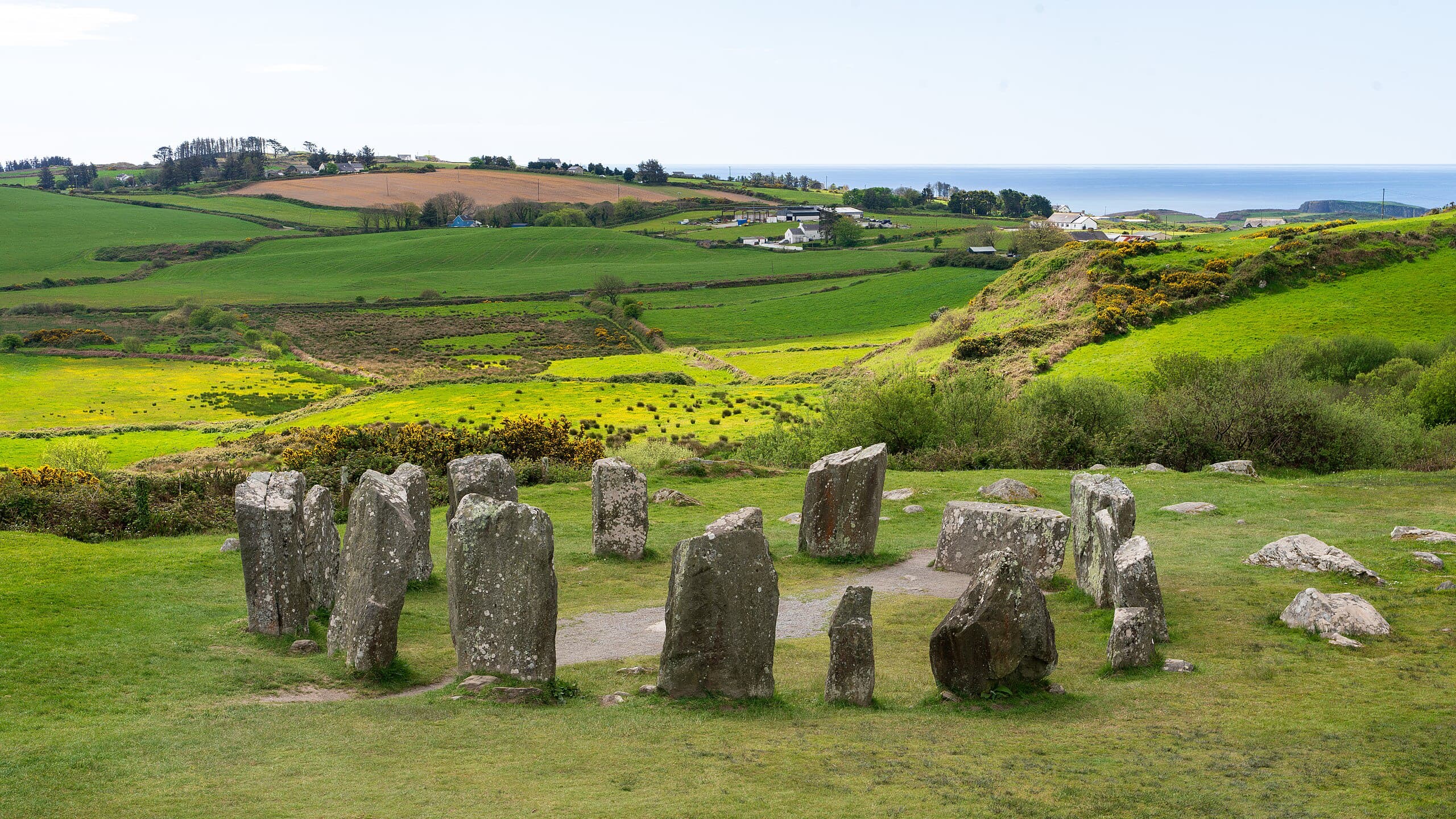
On a gentle rise above the West Cork coast, seventeen stones form one of the finest examples of Ireland's distinctive Cork-Kerry axial stone circles. At winter solstice, the setting sun's last rays pass between the two tallest portal stones and strike the low recumbent stone opposite, marking the year's turning point. Beneath the circle's centre, an adolescent child was buried three thousand years ago, wrapped in cloth and placed in a pottery vessel. A cooking pit nearby suggests this was not just a monument but a gathering place.
Drombeg Stone Circle sits on a low ridge two kilometres east of Glandore in West Cork, overlooking a landscape that rolls toward the Atlantic. The circle is modest in scale, nine metres across, composed of seventeen stones, of which thirteen survive. It belongs to a regional tradition found in counties Cork and Kerry: the axial stone circle, characterized by two tall portal stones marking the entrance and a lower recumbent stone opposite, with the axis oriented toward the southwest and the setting winter sun.
The folk name for Drombeg is The Druid's Altar. The name is later than the circle by millennia, an attribution by Celtic-speaking communities who found the ancient monument and interpreted it through their own framework. The actual builders were Bronze Age communities working around 1100 to 800 BC, who developed this particular form of ceremonial architecture in southwest Ireland and nowhere else in comparable concentration.
Edward Fahy's excavation in 1957-58 revealed what lay at the circle's heart: the cremated remains of an adolescent child, carefully wrapped in cloth and placed in a pottery vessel, buried at the exact centre of the stone ring. This was a dedicatory burial, a foundation ritual that consecrated the circle with a human life. The child's identity is unknown. The care with which the remains were placed suggests profound significance.
Adjacent to the circle, Fahy discovered a fulacht fiadh, an ancient cooking pit, along with hut foundations. The fulacht fiadh dates to a much later period, 109 to 608 AD, indicating the site continued to draw human activity for over a thousand years after the circle was built. The cooking pit and hut structures transform the circle from an isolated monument into a gathering place where community came together for ceremony and the sharing of food.
The winter solstice alignment is the circle's most celebrated feature. On December 21, the setting sun descends toward a notch in the southwestern hills. Its last rays pass between the portal stones and illuminate the recumbent stone on the far side. Whether this alignment was precisely calibrated to the solstice or marked a broader period around the year's turning is debated, but the intention is clear: the builders oriented their circle to the moment when darkness is greatest and the light begins its return.
Context And Lineage
One of the finest Cork-Kerry axial stone circles, excavated in 1957-58, revealing a central child burial and winter solstice alignment, with adjacent evidence of communal use spanning millennia.
No specific origin myth survives for Drombeg. The folk name 'The Druid's Altar' reflects a later attribution connecting the circle to druidic practices, though the circle predates the historical druids by over a millennium. The name 'Drombeg' derives from the Irish 'An Drom Beag' or 'An Droim Beag,' meaning 'the small ridge,' a topographic description rather than a mythological one. In the broader Irish folk tradition, stone circles were associated with the Tuatha De Danann or supernatural beings and sometimes avoided as fairy places. The recumbent stone's flat, altar-like appearance reinforced the popular belief in ritual sacrifice at the site.
Drombeg belongs to the Cork-Kerry axial stone circle tradition, a regional architectural form found predominantly in counties Cork and Kerry, with over one hundred examples documented. These circles share distinctive characteristics: two tall portal stones opposite a lower recumbent axial stone, with the axis typically oriented to the setting winter sun. The tradition is unique to southwest Ireland and represents one of the most concentrated regional expressions of prehistoric ceremonial architecture in Europe.
Dr. Edward (E.M.) Fahy
Boyle T. Somerville
The Bronze Age builders
Why This Place Is Sacred
A child's burial at the centre, the solstice sun at the edge, and three thousand years of human gathering on a ridge above the sea.
Drombeg is intimate. This is not Stonehenge or Newgrange, where the scale of construction asserts authority. The circle is nine metres across. You could throw a stone from one side to the other. The tallest portal stones stand just over two metres. The recumbent, the axial stone that receives the solstice light, is deliberately lower, flattened, its upper surface almost level, inviting the eye and the sun.
The intimacy is the point. This was not a monument for awe but for attendance. Bronze Age communities gathered here in numbers appropriate to the space, perhaps twenty or thirty people, the population of a few farming homesteads, assembling to mark the year's darkest moment and to honour the child who lay beneath the centre. The cremated remains, wrapped in cloth and placed in a pottery vessel, speak to a tenderness that the archaeological record rarely preserves. Someone prepared this burial with care. Someone chose this child for this purpose.
The West Cork coast is visible from the circle. The Atlantic stretches to the horizon, the edge of the known world for the people who built here. They placed their stones on a ridge oriented toward the sea and the setting sun, the two directions of departure, the two boundaries of the world they inhabited. The combination of inland ritual enclosure and maritime horizon creates a tension that the circle holds without resolving.
The fulacht fiadh adjacent to the circle extends the thinness into the domain of the ordinary. This was a cooking pit, a communal facility for boiling water using heated stones, probably for feasting. Its much later dating, 109 to 608 AD, means that communities were still using this location for gathering and eating more than a thousand years after the circle was built. The sacred and the practical shared the same ground. The place where you honoured your dead was also the place where you cooked your meal. This integration, this refusal to separate the ceremonial from the everyday, is characteristic of many of Ireland's most enduring sacred sites.
The modern solstice gatherings continue the pattern. On December 21, people come to Drombeg with drums and candles and gather in the circle as the sun sets between the portal stones. They hum, they fall silent, they watch the light drain from the sky. The continuity is not unbroken, but it is real. The circle still gathers people at the moment it was built to mark.
A ceremonial and funerary site built by Bronze Age communities to mark the winter solstice, honour the dead, and serve as a gathering place for communal ritual. The central burial and adjacent cooking pit indicate both sacred and social functions.
Built approximately 1100-800 BC. Continued use of the adjacent area for communal cooking (fulacht fiadh) from approximately 109-608 AD. The folk name 'The Druid's Altar' reflects later Celtic attribution. First noted astronomically by Boyle T. Somerville in 1909. Excavated by Edward Fahy in 1957-58. Protected under the National Monuments Act and managed by the Office of Public Works. Modern winter solstice gatherings have developed organically in recent decades.
Traditions And Practice
Witness the winter solstice sunset alignment. Walk the circle. Contemplate the Bronze Age burial beneath the centre and the cooking pit that kept the community gathering here for millennia.
The central cremation burial of an adolescent child, wrapped in cloth and placed in a pottery vessel, represents a dedicatory or foundation ritual. The winter solstice alignment indicates seasonal ceremonies marking the sun's return. The adjacent fulacht fiadh suggests communal cooking and feasting, possibly connected to ceremonial gatherings. Research has proposed that the circle may have marked all eight traditional agricultural festival dates through sunrise and shadow interactions with the stones.
The annual winter solstice sunset gathering on December 21 has become a well-attended community event, drawing locals, visitors, and spiritual practitioners. Participants describe an atmosphere of warmth and communal reverence: drumming, meditative circles, humming, and shared silence as the sun sets between the portal stones. Year-round, individuals and groups visit for meditation, personal ceremony, and quiet contemplation. Organized spiritual tours sometimes include Drombeg as part of West Cork sacred landscape itineraries.
Enter the circle through the portal stones and stand at the centre. Take a moment to register that you are standing above the burial of an adolescent child placed here three thousand years ago. This awareness transforms the space from a collection of stones into a consecrated site.
Face southwest, toward the recumbent stone and the horizon beyond. The sun sets in this direction at the winter solstice, and even if you are not visiting at that time, the alignment is architecturally present. The portal stones behind you frame the view. The recumbent stone before you receives it. You stand in the axis between.
Walk the full circuit of the stones. Notice how the heights graduate from the tall portals to the low recumbent, creating a profile that descends from entrance to axis. Place your hand against the stones if you wish. The surfaces are varied: rough, lichened, some warm in sun, all carrying the weather of thirty centuries.
Visit the fulacht fiadh and hut foundations beyond the circle. These practical structures ground the ceremonial in the everyday. The people who built the circle also cooked here. The sacred and the ordinary shared the same ridge above the sea.
If visiting for the winter solstice, arrive early. Parking is extremely limited. Bring warm clothing and waterproof boots, as the field can be very muddy in December. The gathering is informal and inclusive.
Bronze Age Cork-Kerry Axial Stone Circle Tradition
HistoricalDrombeg is one of the finest examples of over one hundred axial stone circles found predominantly in counties Cork and Kerry, dating to approximately 1100-800 BC. The tradition features two tall portal stones opposite a lower recumbent stone, with the axis oriented toward the setting winter sun. The central child burial and adjacent cooking pit indicate both sacred and communal functions.
Dedicatory cremation burial at the circle's centre. Seasonal ceremonies aligned with the winter solstice. Communal feasting at the adjacent fulacht fiadh. The careful astronomical orientation indicates ceremonies marking the sun's return at the darkest time of year.
Neo-Paganism / Contemporary Solstice Observance
ActiveDrombeg has become one of West Cork's most significant gathering places for modern spiritual practitioners and the wider community, particularly at the winter solstice. The accessibility, coastal setting, and well-preserved alignment make it a natural site for those seeking connection with ancient ceremonial traditions.
Annual winter solstice sunset gathering on December 21, with drumming, meditative circles, humming, and communal observation of the alignment. Year-round visits for meditation and personal ritual. The circle's open access allows visitors to enter and experience the space directly.
Archaeological Heritage and Conservation
ActiveDrombeg is protected under the National Monuments Act and managed by the Office of Public Works. It is one of the most visited and best-preserved megalithic sites in Ireland, contributing to public understanding of Bronze Age culture in southwest Ireland.
On-site information boards provide interpretation. The site is included on the Wild Atlantic Way driving route. Academic research continues, with the most recent peer-reviewed analysis examining the site's relationship to the eight traditional agricultural festival dates.
Experience And Perspectives
Walk a short path from the car park to a three-thousand-year-old stone circle overlooking the West Cork coast. Enter the ring. Stand between the portal stones. Face the recumbent stone where the solstice sun lands.
The approach is brief but effective. From the small car park, a gravelly path leads approximately one hundred and fifty metres to a gate, then across a grassy field to the circle. The walk takes two minutes. It is enough to shift your attention from driving to arriving.
The circle appears as you cross the field: a ring of standing stones on the low ridge, the West Cork countryside falling away beyond them toward the coast. The setting is not dramatic in the way of mountain sites, but it is deeply atmospheric. The stones sit in green grass, weathered and lichened, their textures varied. Some are rough sandstone, others smoother. They are not uniform. They were chosen, not manufactured.
Enter the circle between the two portal stones, the tallest in the ring, standing just over two metres. These are the gatekeepers, the stones that frame the entrance and through which the solstice sun sends its last rays. Face the opposite side of the circle. There stands the recumbent, the axial stone, lower and broader than the portals, its upper surface nearly flat. The axis between portal and recumbent defines the circle's alignment. This is the line the solstice sun follows.
Stand at the centre. Beneath your feet, three thousand years ago, a community placed the cremated remains of an adolescent child, wrapped in cloth, in a pottery vessel. The burial is no longer visible, but the knowledge of its presence transforms the ground you stand on. This is consecrated earth, consecrated not by prayer or blessing but by the gift of a human life.
Walk the circuit of the stones. Touch them if permitted. Notice the variation in height: the portal stones tall and commanding, the recumbent low and receptive, the remaining stones graduating in height between them, creating a profile that descends from entrance to axis. This is deliberate design, an architecture of directed attention.
Beyond the circle, the fulacht fiadh and hut foundations are visible as grassy mounds and stone outlines. Information boards explain their function. The cooking pit, with its lining of heat-cracked stones, is a reminder that the people who used this site were practical as well as ceremonial. They built for the sun and they cooked their dinner.
For the winter solstice experience, arrive well before sunset on December 21. Parking is extremely limited, with space for approximately eight vehicles. The gathering is informal and welcoming: drumming, humming, communal silence, and the shared observation of the sun setting into the notch in the southwestern hills, its light passing between the portals and touching the recumbent stone. The effect, when conditions are clear, is precise and moving.
Drombeg Stone Circle is 2.4 km east of Glandore and approximately 10 minutes' drive from Rosscarbery in West Cork. The car park holds approximately eight vehicles. The path to the circle is approximately 150 metres. The fulacht fiadh and hut foundations are adjacent to the circle.
Drombeg is understood through Bronze Age archaeology, astronomical analysis, Irish folk tradition, and the lived experience of the modern solstice gatherings that have restored communal ceremony to a circle that was built for exactly that purpose.
Archaeologists classify Drombeg as a Cork-Kerry axial stone circle, one of over one hundred such circles in southwest Ireland. Fahy's 1957-58 excavation established the key facts: a seventeen-stone circle of nine-metre diameter with a central cremation burial dating to 1124-794 BC. Somerville's earlier identification of the winter solstice alignment (1909) placed the site in the archaeoastronomical literature. Peer-reviewed research has analyzed the site with respect to the eight traditional agricultural festival dates. The adjacent fulacht fiadh, dating to 109-608 AD, demonstrates continued use of the location across radically different cultural periods.
The folk name 'The Druid's Altar' preserves a traditional association between the stone circle and pre-Christian ritual, though this attribution likely dates to the early modern period rather than to any continuous oral tradition from the Bronze Age. In broader Irish folk tradition, stone circles were associated with the Tuatha De Danann or supernatural beings. The recumbent stone's flat, altar-like appearance reinforced the belief in ritual sacrifice.
Modern spiritual practitioners view Drombeg as an energy centre where earth energies are focused by the stone configuration. Energy healers and meditators report feeling distinct sensations within the circle. The winter solstice gathering has attracted practitioners who view the alignment as an annual activation of the site's spiritual potential. The circle is sometimes included in ley line and sacred geometry interpretations.
The exact ritual function of Cork-Kerry axial stone circles remains debated: whether they served primarily as burial sites, astronomical observatories, communal gathering places, or some combination. Why an adolescent child was chosen for the central burial is unknown. The relationship between the Bronze Age circle and the much later fulacht fiadh raises questions about how and why the site continued to attract human activity across more than a thousand years of cultural change. Whether the alignment was intended for the precise solstice sunset or for a broader period around the solstice is debated.
Visit Planning
West Cork, near Glandore. Free entry year-round. Limited parking. No facilities. Short walk from car park to circle.
Accommodation available in Glandore, Rosscarbery, and across West Cork. The site has no facilities whatsoever: no visitor centre, no restrooms, no shop. Mobile phone signal is generally available in the area. No keyholder or booking required.
The stones are protected under the National Monuments Act. Do not climb on, sit on, or mark them. Be considerate of others seeking contemplative experiences.
Drombeg is a protected National Monument containing cremated human remains. The stones must not be damaged, climbed on, marked, or moved. The site's accessibility, with no barriers or fences, is a privilege that depends on visitor behaviour. Treat the circle as what it is: a three-thousand-year-old burial site that continues to serve as a gathering place.
During the winter solstice gathering, the circle becomes a shared space for diverse visitors. Step aside to allow others private moments close to the stones. The atmosphere of the gathering is consistently described as warm and communal, but maintaining that quality requires mutual consideration.
No formal dress code. Waterproof footwear strongly recommended, especially in autumn and winter when the field can be very muddy. Warm, layered clothing for winter solstice visits. The site is exposed to coastal winds.
Photography is freely permitted throughout the site. The stones photograph well in varied conditions, with late afternoon light producing the warmest tones on the weathered surfaces.
No formal offering tradition. Do not leave objects on or within the stone circle. Leave no trace.
Do not climb on, sit on, or mark the stones. They are protected under the National Monuments Act. Do not remove any stones, soil, or objects. No restroom facilities at the site. Limited parking; park responsibly and do not block the lane. Be considerate of other visitors seeking contemplative experiences.
Sacred Cluster
Nearby sacred places create the location cluster described in the growth plan. This block is intentionally crawlable and links into the wider regional graph.