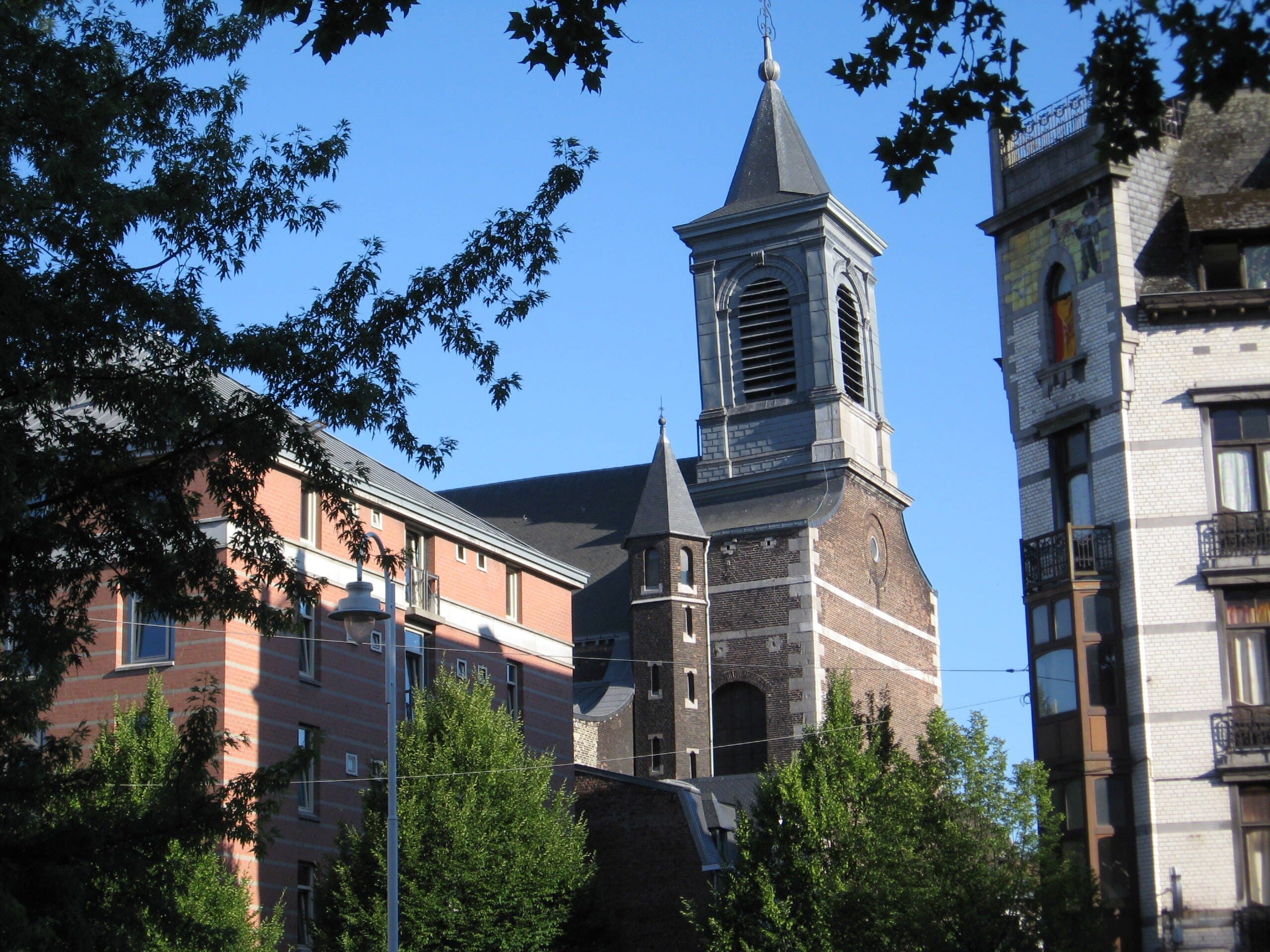
Church of St. Nicholas of Outremeuse (Black Virgin)
Where a 16th-century Black Madonna still draws pilgrims through streets where sacred and secular blur
Liège, Wallonia, Belgium
At A Glance
- Coordinates
- 50.6403, 5.5806
- Suggested Duration
- A brief church visit takes 30 minutes. To explore the church and walk the neighborhood observing potales, allow 1-2 hours. For the August festivities, plan a half-day minimum; many visitors stay for multiple days to experience the full range of events.
- Access
- The church is located at Rue Fosse-aux-Raines 9, 4020 Liege, Belgium. Bus lines 11, 3, 33, 38, 6, 61, 64, 73, and 79 stop nearby, with the closest stops being Rue J. D'Outremeuse (about 110 meters, 2 minute walk) and Monument Tchantches (about 165 meters, 3 minute walk). Tram T1 serves the area with Liege La Batte stop approximately 11 minutes walk. Outremeuse island is accessible from the city center via the Pont Saint-Nicolas footbridge.
Pilgrim Tips
- The church is located at Rue Fosse-aux-Raines 9, 4020 Liege, Belgium. Bus lines 11, 3, 33, 38, 6, 61, 64, 73, and 79 stop nearby, with the closest stops being Rue J. D'Outremeuse (about 110 meters, 2 minute walk) and Monument Tchantches (about 165 meters, 3 minute walk). Tram T1 serves the area with Liege La Batte stop approximately 11 minutes walk. Outremeuse island is accessible from the city center via the Pont Saint-Nicolas footbridge.
- Modest dress appropriate for a Catholic church is expected when entering the building. During the festival, the streets are informal, but if you intend to attend the Walloon Mass or enter the church, cover shoulders and avoid clothing with offensive imagery.
- Photography appears to be generally permitted, as numerous images of the Black Virgin and the procession are publicly shared. During Mass or other services, refrain from photography. During the procession, be mindful that you are photographing a sacred event, not merely a colorful spectacle. Ask before photographing individuals at prayer.
- During the August festival, crowds are substantial, with 200,000 to 250,000 visitors over several days. The experience is not one of private contemplation but communal celebration. If you seek quiet devotion, visit outside this period. The festival also involves considerable drinking of peket, the local juniper spirit, which is part of the tradition but may not suit all seekers.
Overview
In the heart of Outremeuse, an island neighborhood of Liege, a life-size Black Virgin has been venerated for nearly five centuries. Each August, she is carried through streets lined with wall shrines, accompanied by folk puppets and a sermon in Walloon, embodying a distinctive tradition where Marian devotion and local identity are inseparable.
The Church of St. Nicholas sits on an island between two branches of the Meuse River, in a neighborhood that has long considered itself a world apart. Outremeuse has its own identity, its own folklore, its own way of being Catholic. At the center of it all stands a Black Madonna.
The Vierge Noire d'Outremeuse is not small. She is life-size, carved from Baltic oak around 1550, her dark face holding an expression that centuries of candle smoke and devotion have only deepened. Her sculptor remains unknown. Her origins carry the mystery that Black Madonnas often hold, their dark skin inspiring theories ranging from ancient soot accumulation to deliberate theological statement to echoes of pre-Christian earth goddesses.
What is certain is her place in this community. For hundreds of years, she has watched over the people of Outremeuse. Each August 15th, on the Feast of the Assumption, she leaves her church. Carried by scouts through narrow streets, accompanied by the local puppet mascot Tchantches and folk guilds, she processes past dozens of potales, the small wall shrines that dot the neighborhood. Residents place flowers on her as she passes. The Mass is celebrated in Walloon, the old language of this region.
This is living tradition. Not preserved under glass, but practiced in the streets by people whose grandparents did the same.
Context And Lineage
The Church of St. Nicholas began as the chapel of a Franciscan monastery, destroyed and rebuilt after bombardment, and became a parish church when revolutionary forces expelled the friars. Through all these changes, the Black Virgin has remained the devotional center, predating the current building and surviving the upheavals of history to become the heart of a neighborhood's identity.
The Recollets, a reformed branch of the Franciscan order dedicated to contemplative poverty, established themselves on Outremeuse island in the late 15th century. Their monastery served the island community for two centuries until Marshal Boufflers bombarded Liege in 1691, destroying their church by fire. The friars rebuilt, laying the first stone in 1710 and completing the choir by 1711. The new church was consecrated in October 1729 by Bishop Jean-B. Gillis.
The Black Virgin who now commands such devotion was already present before the bombardment. Her creation around 1550 places her in the Counter-Reformation era, when the Catholic Church promoted miraculous images to counter Protestant iconoclasm. Who carved her from Baltic oak, and why she was made with dark skin, the records do not say. What is known is that she survived the destruction of the original church and took her place in the new one.
The French Revolution brought another transformation. In 1796, revolutionary forces expelled the Recollets along with all religious orders. The following year, when the original medieval parish church of St. Nicholas fell into ruin, the former monastery chapel became the parish church. The Black Virgin's home had changed its institutional identity but not its devotional function. She continued to receive the prayers of Outremeuse.
The devotional lineage passes from the Recollets who built the church through the parish community that inherited it to the contemporary congregation that maintains it. More significantly, the Black Virgin has been venerated continuously since the 16th century, creating a lineage of devotion that transcends institutional changes. Grandparents taught their grandchildren to honor her; those grandchildren grew old and taught their own. The August procession carries this lineage into the streets each year, renewing it in public view.
The Black Virgin of Outremeuse
devotional center
A life-size polychrome wooden statue of the Madonna and Child carved from Baltic oak around 1550. Her unknown sculptor created her with dark skin, placing her among Europe's Black Madonnas, figures that have drawn particular devotion throughout Catholic history.
Pachacuti
historical
The Recollect friars who built and maintained the monastery from the late 15th century until 1796, embedding Franciscan spirituality in this island community.
Tchantches
folk figure
The beloved puppet mascot of Outremeuse, representing the archetypal stubborn, honest, hard-drinking Liegeois. Though legendary rather than historical, he processes alongside the Black Virgin each August, symbolizing the integration of folk and sacred.
Why This Place Is Sacred
The sacredness of this site emerges from the convergence of an ancient Black Madonna statue of unknown origin, centuries of continuous veneration, and the fierce local identity of a neighborhood that sees itself as set apart. The island location, the mysterious dark-skinned Virgin, and the annual dissolution of boundaries between sacred and secular during the August festivities all contribute to a quality of thinness.
Black Madonnas have always carried a particular charge. Their dark skin, whatever its origin, sets them apart from the pale Virgins of conventional piety. Throughout Europe, they draw devotees who sense something older, something that conventional theological categories do not quite contain. Some scholars trace associations with pre-Christian earth goddesses; others point to the Song of Solomon's 'I am black but beautiful.' The Catholic Church has generally incorporated rather than explained these statues, allowing their mystery to coexist with official teaching.
The Vierge Noire d'Outremeuse emerged in the mid-16th century, during the Counter-Reformation when the Church actively promoted miraculous images. Her sculptor left no name, no record of intention. The Baltic oak she was carved from came from distant northern lands. Why she was made dark is not documented. This silence is itself part of her power.
The church that houses her sits on Outremeuse island, separated from Liege's center by the waters of the Meuse. Islands have long held liminal significance in sacred geography, places between worlds, neither fully land nor water. The neighborhood's insistence on its own identity, its self-styled 'Free Republic of Outremeuse,' adds another layer of separation that intensifies the sense of entering a distinct space.
The August 15th procession transforms the boundary between sacred and secular in ways rarely seen in contemporary Europe. The Black Virgin moves through streets where she is met not only by devout Catholics but by folk puppets, drinking songs, and communal celebration. The sacred does not remain confined to the church but processes through daily life, past the potales where smaller Virgins watch from their wall niches. For a few days, the entire neighborhood becomes sacred ground.
The current church was built between 1710 and 1729 as the chapel for the Recollets, a reformed branch of the Franciscan order who had maintained a monastery on this site since the late 15th century. The Black Virgin predates the current building, having survived the 1691 bombardment that destroyed the original church. When the French Revolution expelled the friars in 1796, the building became the parish church of St. Nicholas, preserving continuity of worship even as its institutional identity changed.
For centuries, the Black Virgin remained the devotional heart of a specific neighborhood. The August procession, established by the 17th century, has continued without significant interruption. What has evolved is the integration of secular folk tradition. Tchantches, the beloved puppet mascot representing the archetypal Liegeois, entered the festivities in the 19th century. His giant puppet has processed alongside the Virgin since 1995. The Walloon-language Mass, once simply how Mass was celebrated, has become a deliberate act of cultural preservation. The festival has grown to draw 200,000 to 250,000 visitors, transforming from neighborhood devotion to regional heritage. Yet for residents of Outremeuse, it remains what it has always been: the heart of their year.
Traditions And Practice
The Church of St. Nicholas offers regular Catholic Mass and the opportunity for private devotion to the Black Virgin throughout the year. The August 15th festivities provide a deeper engagement with both sacred ceremony and Walloon folk tradition, including procession, Walloon-language Mass, and the veneration of neighborhood potales.
The Feast of the Assumption procession follows a form established by at least the 17th century. On the morning of August 15th, the Black Virgin is removed from the church at precisely 10am. Scouts of the 5th Unit of Outremeuse bear her through the streets on a platform that will accumulate flowers from residents until it weighs between 200 and 300 kilograms. She is escorted by the 4th Regiment of Dragons of the Saint-Roch March, various confraternities, and folk guilds. At the Pont Saint-Nicolas, a Grand Mass is celebrated in the open air with a sermon in Walloon.
The potale tradition extends throughout the festival period. These wall-mounted shrines, some dating to the Middle Ages, are decorated with flowers and illuminated. The procession pays homage at each Virgin from rue Beauregard to rue Roture, passing through rue des Recollets. This practice transforms the streets themselves into sacred space, the Virgin present not only in the church but at every corner.
Regular Catholic Mass and sacraments continue throughout the year, maintaining the church's function as a parish serving the Outremeuse community. Private devotion to the Black Virgin is possible during church hours, offering visitors the opportunity for quiet contemplation away from the festival crowds. The parish community maintains activities throughout the year, though August draws the largest participation.
For a contemplative visit, come outside the August festival and spend time with the Black Virgin in the quiet church. Notice how the light falls on her face. Let the unknown sculptor's intention work on you without trying to interpret it. Walk the neighborhood streets and observe the potales; each is a small act of devotion accumulated over years.
For the full immersion, come for August 15th. Arrive early to secure a position along the procession route. Witness the scouts carrying the flower-laden Virgin through streets where her image watches from every wall. Attend the Walloon Mass if you can, even if you do not understand the language; the sound itself connects you to centuries of ancestors who prayed in this tongue. Let the boundaries between sacred ceremony and folk festival blur. This is not confusion but the tradition working as it was meant to.
Roman Catholicism
ActiveThe church serves as the parish church for the Outremeuse district, maintaining regular Catholic worship and sacraments. It is a center of Marian devotion through the veneration of the Black Virgin, making it part of the broader Catholic tradition of Black Madonna sites across Europe. The Feast of the Assumption celebration on August 15th is the high point of the liturgical year for this community.
Regular Catholic Mass and sacraments are offered throughout the year. The Walloon-language Mass on August 15th maintains a linguistic tradition that connects contemporary worship to centuries of Francophone Catholic practice in this region. The procession of the Black Virgin on the Feast of the Assumption follows forms established by at least the 17th century. Private devotion to the Black Madonna is possible year-round in the church.
Walloon Folk Catholicism
ActiveThe Outremeuse district maintains a distinctive Walloon Catholic folk tradition that blends religious devotion with local cultural identity. The 'Free Republic of Outremeuse' expresses a sense of apartness that encompasses both secular pride and sacred practice. The integration of folk figures, local language, and communal celebration with Marian devotion creates something that cannot be reduced to either religion or folklore alone.
The potale tradition places Marian shrines throughout neighborhood streets, maintaining sacred presence in daily life. During the August festivities, these are decorated and illuminated. The sermon delivered in Walloon preserves linguistic heritage within liturgical context. The integration of Tchantches and Nanesse, the beloved folk puppets, with the religious procession demonstrates how sacred and secular are held together. The communal drinking of peket during festivals is part of the tradition, not separate from it.
Franciscan (Recollets)
HistoricalThe church was originally built as the chapel of the Recollets monastery, a reformed branch of the Franciscan order dedicated to stricter poverty and contemplation. The friars served the Outremeuse community from the late 15th century until their expulsion during the French Revolution in 1796. Their presence established the site as a place of religious community before it became a parish church.
The Recollets would have followed the Franciscan rule with additional austerities characteristic of their reform movement. Their practices included contemplative prayer, penance, and service to the poor. These specific practices ended with their expulsion, though the building they constructed continues to house worship.
Experience And Perspectives
Visitors encounter a neighborhood where Catholic devotion and folk identity are so intertwined that separating them seems artificial. The imposing Black Virgin in the church, the potales visible throughout the streets, and the August festivities that blur sacred ceremony with communal celebration all create an experience of tradition that is neither purely religious nor purely cultural but something that contains both.
The first encounter with the Black Virgin often surprises. She is not hidden in a side chapel but present, life-size, her dark face and the Christ Child she holds demanding attention. The dim light of the church interior deepens her coloring. There is something about standing before her that resists quick movement. Visitors who come expecting a brief stop find themselves staying.
Walking the streets of Outremeuse reveals the potales, small wall-mounted shrines that have protected neighborhood corners since at least the Middle Ages. Each holds a statuette of the Virgin, often also dark-skinned in echo of the main statue. During most of the year, they are simply part of the urban fabric, noticed or unnoticed. But during the August festivities, they are decorated with flowers and illuminated, transforming the streetscape into a landscape of devotion.
The August 15th experience defies easy categorization. The morning begins with the Black Virgin carried from the church by scouts, processed through streets where residents place flowers on her until the weight of the float reaches 200 to 300 kilograms. The Mass is celebrated in Walloon, a language that connects present practice to centuries of ancestors who prayed in the same tongue. Yet the same streets hold peketer parties, drinking of the local juniper spirit, folk music, and the parade of Tchantches and Nanesse, the beloved puppet couple.
For visitors from traditions where sacred and secular are strictly separated, this blending can be disorienting or liberating. The festival suggests another possibility: that the sacred is not something apart from daily life but woven through it, that a neighborhood's identity and its devotion to the Mother of God might be the same thing expressed in different registers.
If you come seeking the devotional, the church welcomes quiet contemplation of the Black Virgin throughout the year. If you come seeking to understand how a community can hold sacred and folk together without contradiction, come in August and watch how seamlessly the Virgin's procession and the puppet parade coexist. If you come as a scholar of Black Madonnas or Walloon folk tradition, you will find living material here that academic categories do not quite contain. In any case, walk the streets and notice the potales. They are the neighborhood's way of saying that the Virgin does not stay in her church; she is present on every corner.
The Church of St. Nicholas and its Black Virgin can be understood through multiple lenses: as a parish church maintaining Catholic tradition, as a repository of Walloon folk identity, as an example of the Black Madonna phenomenon that runs through European religious history, or as a living demonstration of how sacred and secular traditions can coexist without contradiction. Each perspective illuminates something true.
Academic sources confirm the church's construction between 1710 and 1729 as the chapel of the Recollets monastery, following the destruction of the previous building in the 1691 bombardment. The Black Virgin dates to the mid-16th century, around 1550, though her sculptor remains unidentified. Scholars situate her within the broader phenomenon of Black Madonna devotion, which intensified during the Counter-Reformation as the Catholic Church promoted miraculous images to counter Protestant iconoclasm. The August 15th festivities represent living intangible cultural heritage of Wallonia, combining Catholic Marian devotion with regional folk traditions in ways that have continued for centuries.
The local community of Outremeuse understands the Black Virgin as their own, a neighborhood Madonna who has watched over them through wars, revolutions, and the quiet accumulation of ordinary years. The self-styled 'Free Republic of Outremeuse' maintains a strong communal identity in which religious devotion and folk culture are not separate compartments but aspects of the same belonging. The potales visible throughout the streets demonstrate how Marian devotion permeates daily life, not reserved for churches but present at every corner. The preservation of Walloon-language liturgy during the August Mass is not mere nostalgia but continuity with ancestors who prayed in the same words.
Some esoteric perspectives associate Black Madonnas with pre-Christian earth goddess worship, seeing them as Christianized versions of earlier fertility deities. The dark skin has been interpreted as representing primordial matter, the fertile earth, or connections to ancient Near Eastern goddess traditions. The emphasis on the Black Virgin's mysterious origins and unknown sculptor fits patterns found in other Black Madonna sites, where uncertainty about provenance becomes part of the sacred narrative. These interpretations are not endorsed by the Church but have contributed to the distinctive devotion Black Madonnas receive.
Several genuine mysteries surround the Black Virgin. The identity of the sculptor who carved her around 1550 remains unknown. The specific reason for her dark skin is not documented; whether it was a deliberate theological statement, a stylistic choice, or the result of later darkening cannot be determined from surviving evidence. Whether the statue was originally created for the Recollets church or came from elsewhere is unclear. The precise origins of the August procession tradition, while established by the 17th century, cannot be traced to a specific founding moment. These uncertainties are not gaps to be filled by speculation but part of what gives the tradition its depth.
Visit Planning
The Church of St. Nicholas is accessible year-round in the Outremeuse district of Liege. For the full festival experience, visit during August 13-16, centered on the Assumption on August 15th. Expect crowds during the festival; for quiet contemplation, visit at other times.
The church is located at Rue Fosse-aux-Raines 9, 4020 Liege, Belgium. Bus lines 11, 3, 33, 38, 6, 61, 64, 73, and 79 stop nearby, with the closest stops being Rue J. D'Outremeuse (about 110 meters, 2 minute walk) and Monument Tchantches (about 165 meters, 3 minute walk). Tram T1 serves the area with Liege La Batte stop approximately 11 minutes walk. Outremeuse island is accessible from the city center via the Pont Saint-Nicolas footbridge.
Liege offers accommodations at all price points in the city center, within walking distance of Outremeuse. The Georges Simenon Youth Hostel is located in Outremeuse itself, honoring the novelist who grew up in the neighborhood. During the August festival, book well in advance as the region sees significant influx of visitors.
Standard Catholic church etiquette applies: respectful silence, modest dress, and awareness that you are entering a place of active worship. During the August festival, the atmosphere is more relaxed, but the procession and Mass remain sacred moments within the larger celebration.
The Church of St. Nicholas is an active parish church, not a museum. When you enter, you enter a space where people have prayed for centuries and continue to pray today. Maintain silence or speak in whispers. If Mass or other services are in progress, either join respectfully or return another time. Do not treat the Black Virgin as a tourist attraction; she is the devotional center of a living community.
During the August festivities, the boundaries shift. The streets become festive, and the atmosphere is one of communal celebration rather than hushed piety. However, the procession of the Black Virgin and the Walloon Mass retain their sacred character. During these moments, match the tone of those around you. If the crowd falls silent as the Virgin passes, fall silent with them. If they cross themselves, you need not do so, but refrain from behavior that would disrupt their devotion.
The potales throughout the neighborhood are sacred objects, not street art. Treat them with the same respect you would give any religious shrine. During the festival when they are decorated and illuminated, they become focal points of devotion; observe without mockery even if the practice is unfamiliar to you.
Modest dress appropriate for a Catholic church is expected when entering the building. During the festival, the streets are informal, but if you intend to attend the Walloon Mass or enter the church, cover shoulders and avoid clothing with offensive imagery.
Photography appears to be generally permitted, as numerous images of the Black Virgin and the procession are publicly shared. During Mass or other services, refrain from photography. During the procession, be mindful that you are photographing a sacred event, not merely a colorful spectacle. Ask before photographing individuals at prayer.
Placing flowers on the Black Virgin's float during the August procession is a traditional form of participation. Candles can be lit in the church as is standard in Catholic practice. Internal offerings, prayers and intentions, are always appropriate.
There are no notable restrictions beyond standard church etiquette. The church is open to visitors of all backgrounds. During the festival, certain streets may be closed for the procession.
Sacred Cluster
Nearby sacred places create the location cluster described in the growth plan. This block is intentionally crawlable and links into the wider regional graph.
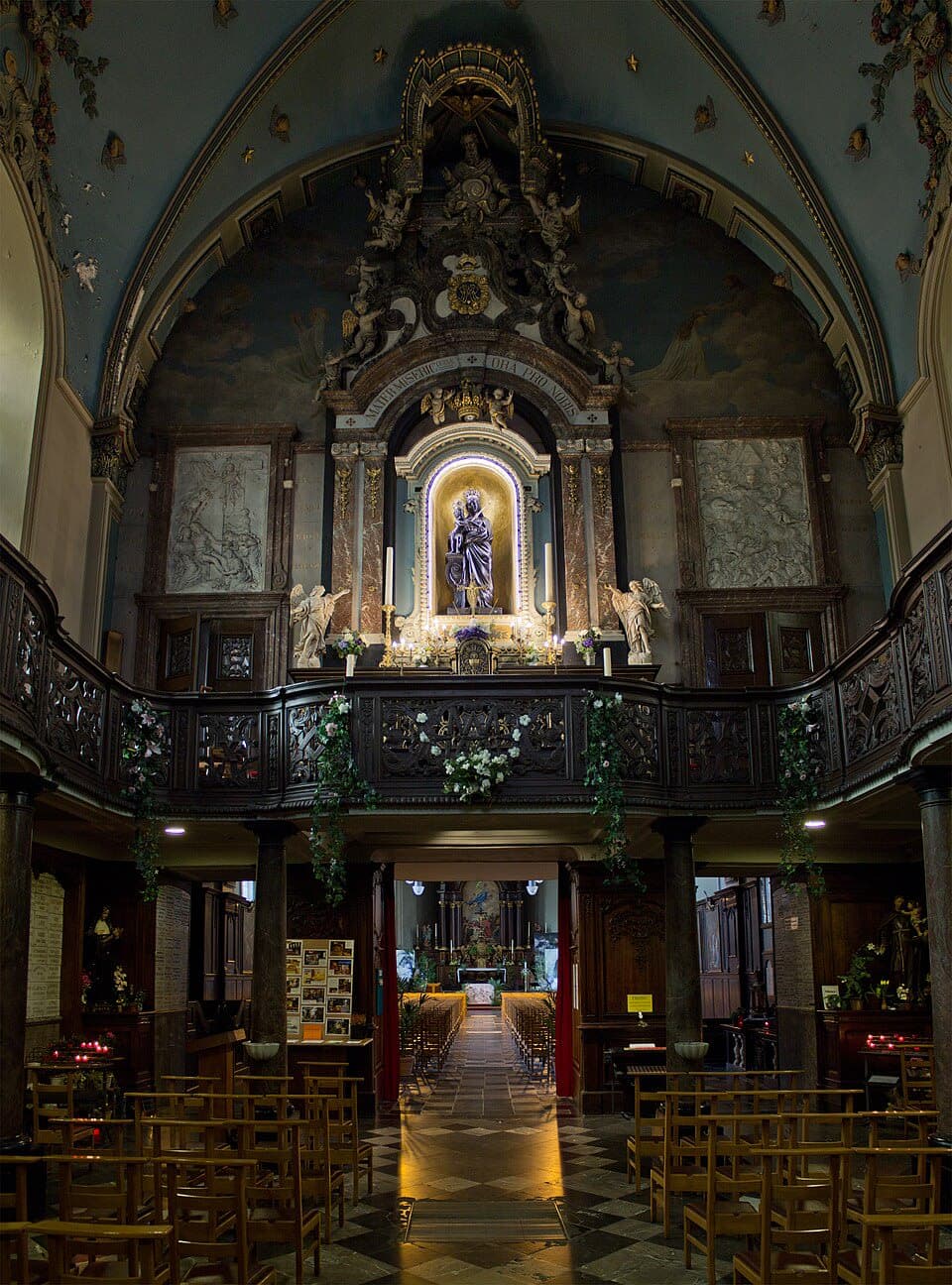
Black Virgin of the Recollects
Verviers, Liège, Belgium
20.9 km away
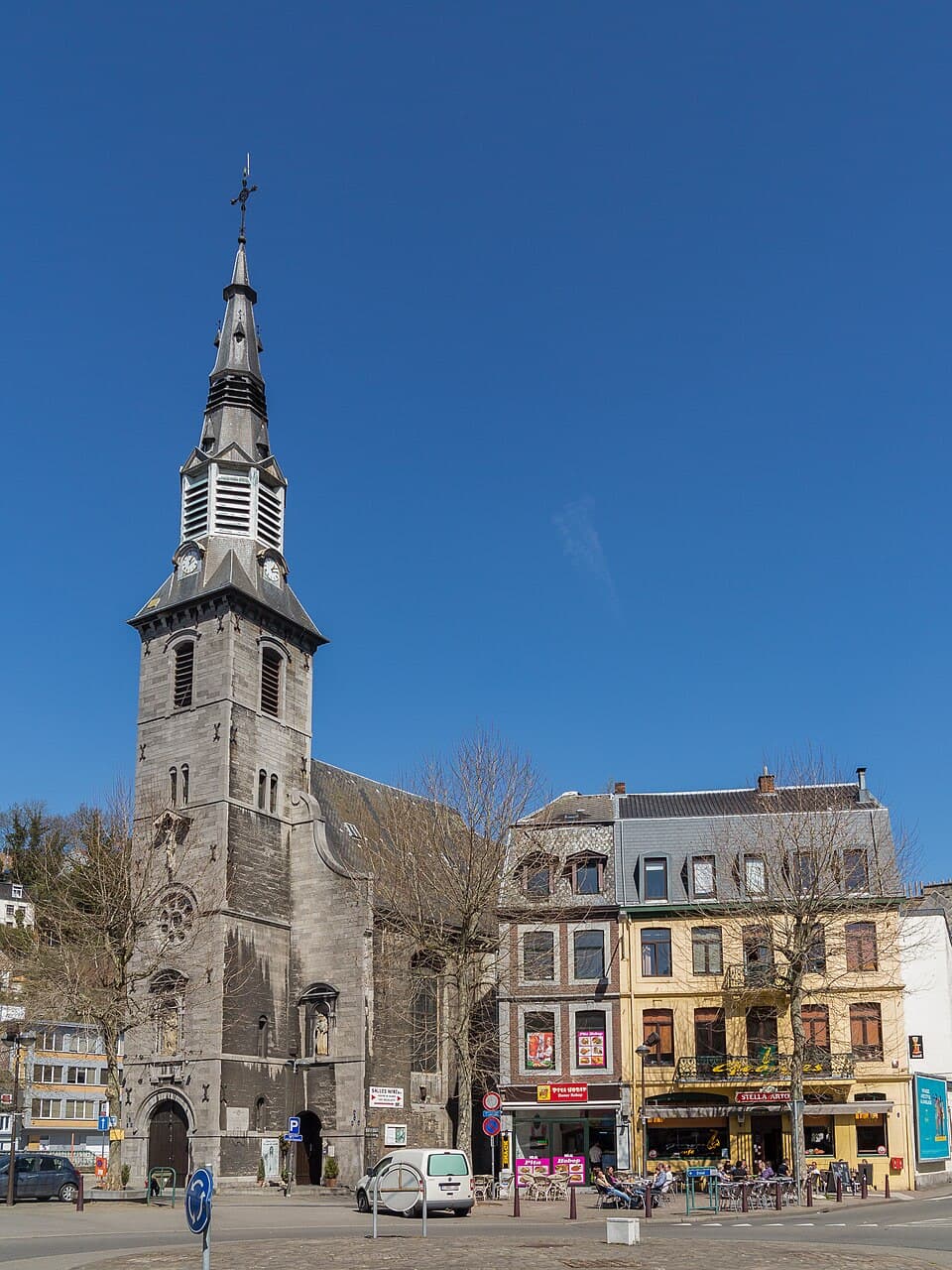
Church of Our Lady of the Recollects
Verviers, Liège, Belgium
21.0 km away
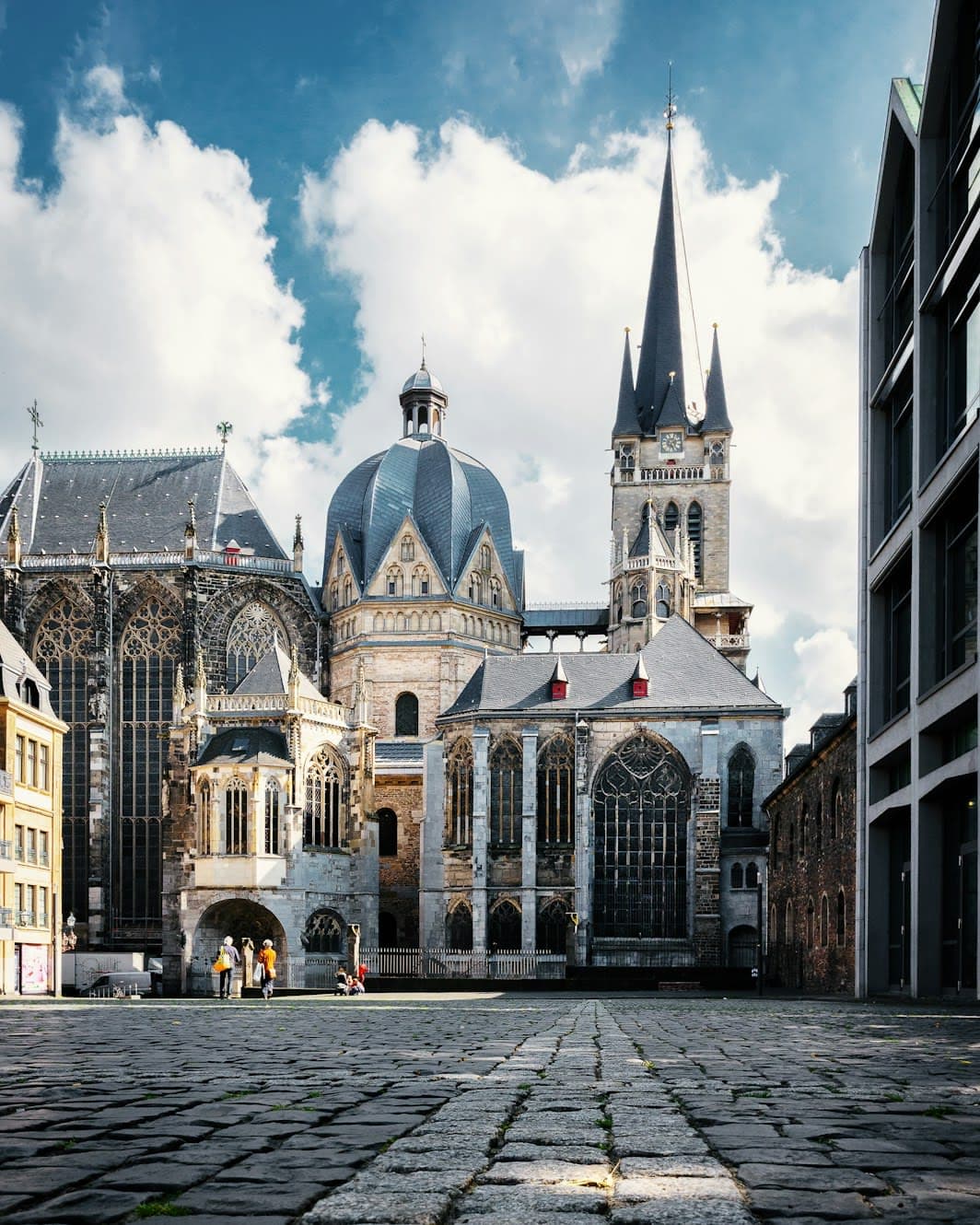
Aachen Cathedral
Aachen, North Rhine-Westphalia, Germany
38.5 km away
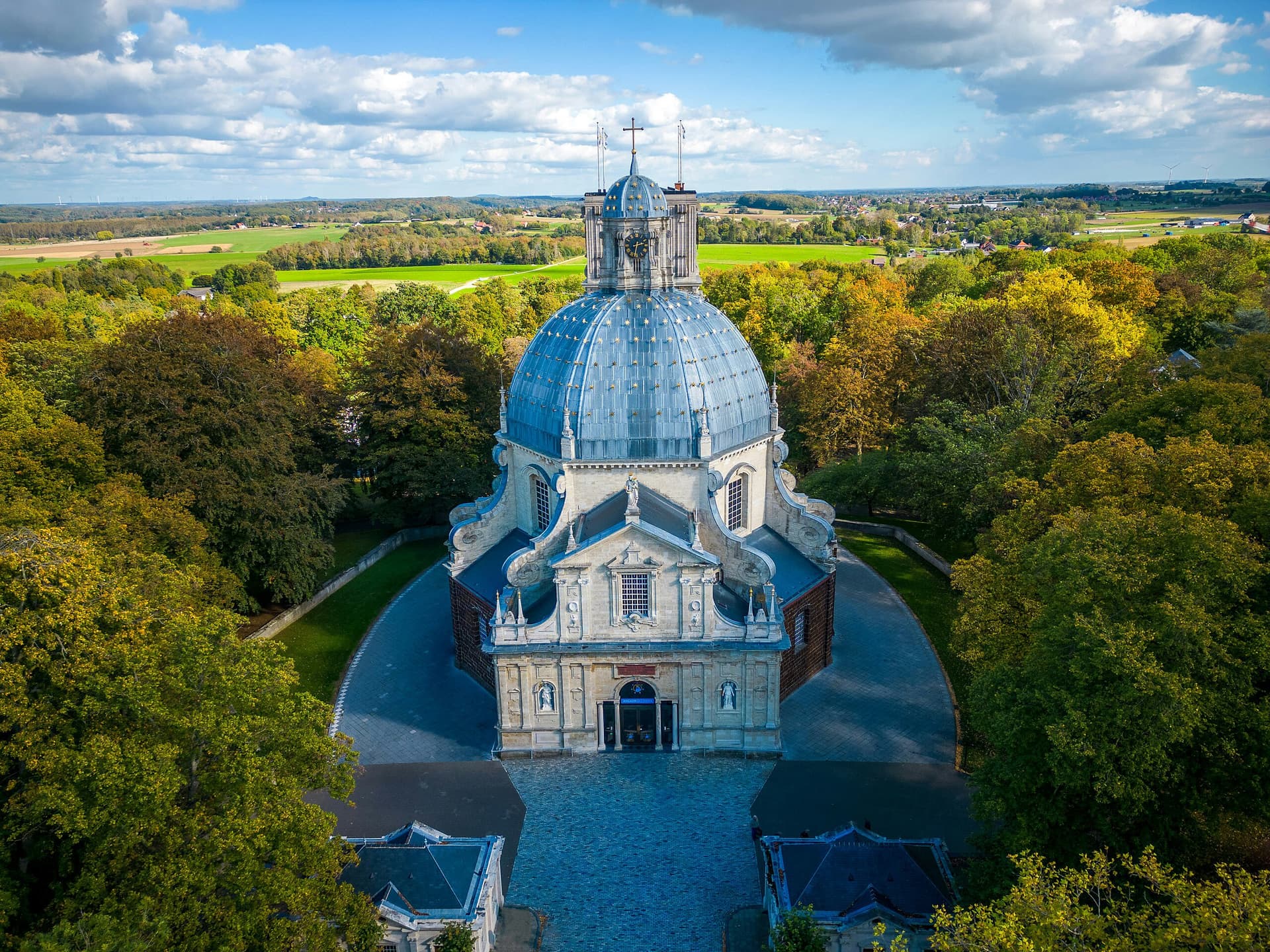
Basilica of Our Lady of Scherpenheuvel, Scherpenheuvel
Scherpenheuvel-Zichem, Flemish Brabant, Belgium
56.8 km away