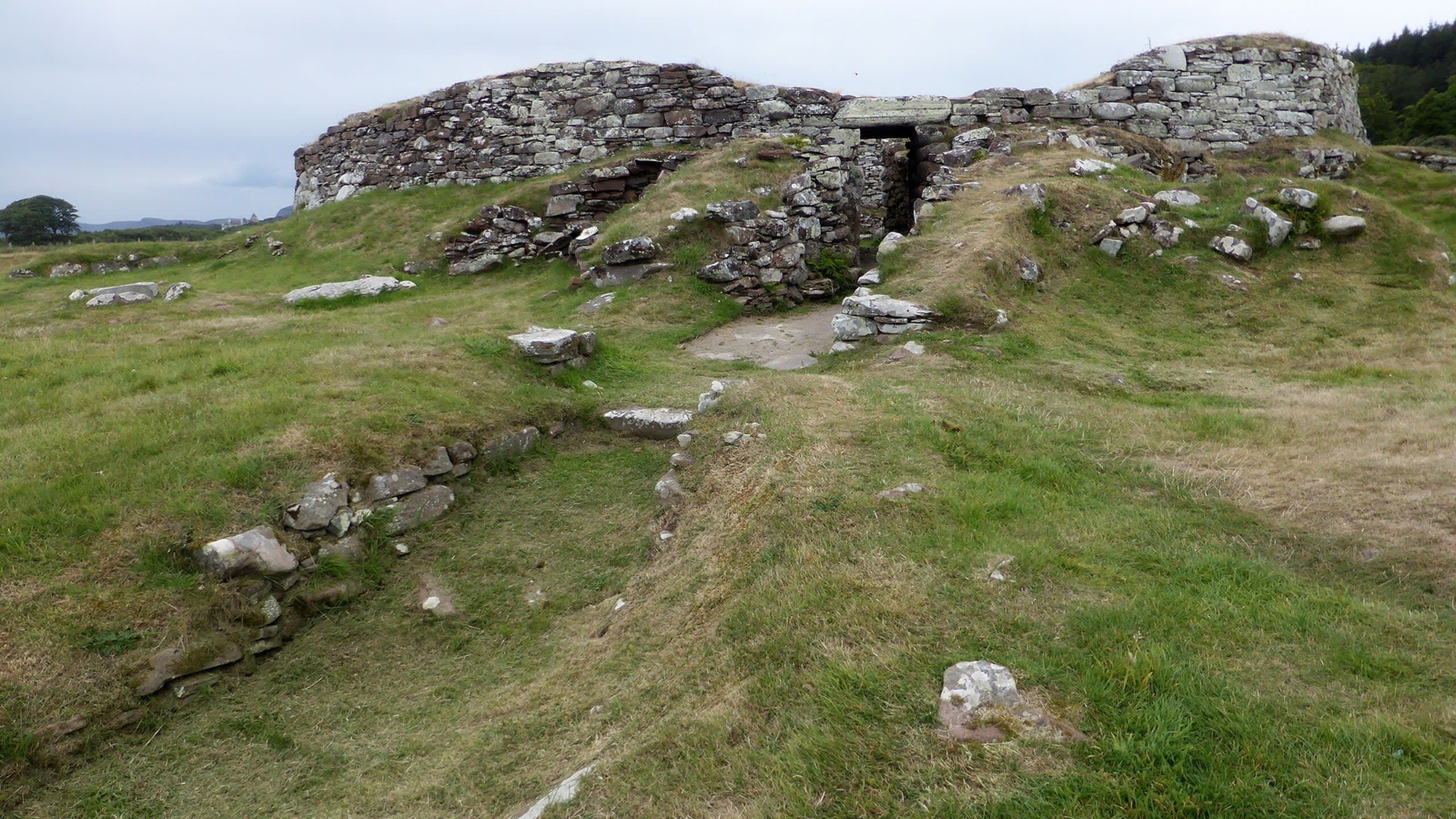
Carn Liath Broch
One of the most accessible Iron Age brochs in Scotland, standing sentinel beside the A9 where the Highlands meet the sea
Golspie, Sutherland, United Kingdom
At A Glance
- Coordinates
- 57.9872, -3.9121
- Suggested Duration
- Forty-five minutes to an hour to explore the broch, outer settlement, and enjoy the coastal views.
- Access
- Carn Liath is located directly beside the A9 road, approximately 4 km northeast of Golspie, Sutherland. The car park is clearly signposted. The broch is a short walk from the car park over grass. The nearest railway station is Golspie, approximately 4 km southwest on the Far North Line. Stagecoach buses run along the A9 between Inverness and Thurso, stopping at Golspie and Brora. The site is partially accessible to visitors with limited mobility, though the interior terrain is uneven.
Pilgrim Tips
- Carn Liath is located directly beside the A9 road, approximately 4 km northeast of Golspie, Sutherland. The car park is clearly signposted. The broch is a short walk from the car park over grass. The nearest railway station is Golspie, approximately 4 km southwest on the Far North Line. Stagecoach buses run along the A9 between Inverness and Thurso, stopping at Golspie and Brora. The site is partially accessible to visitors with limited mobility, though the interior terrain is uneven.
- No specific requirements. Sturdy footwear advisable for uneven ground. Warm, wind-resistant clothing recommended given the exposed coastal position.
- Photography is permitted throughout. The entrance passage, interior chambers, and coastal views are particularly photogenic.
- The ground within and around the broch can be uneven. Care should be taken on stone surfaces, which may be slippery when wet. Do not climb on walls or remove any material from the site.
Overview
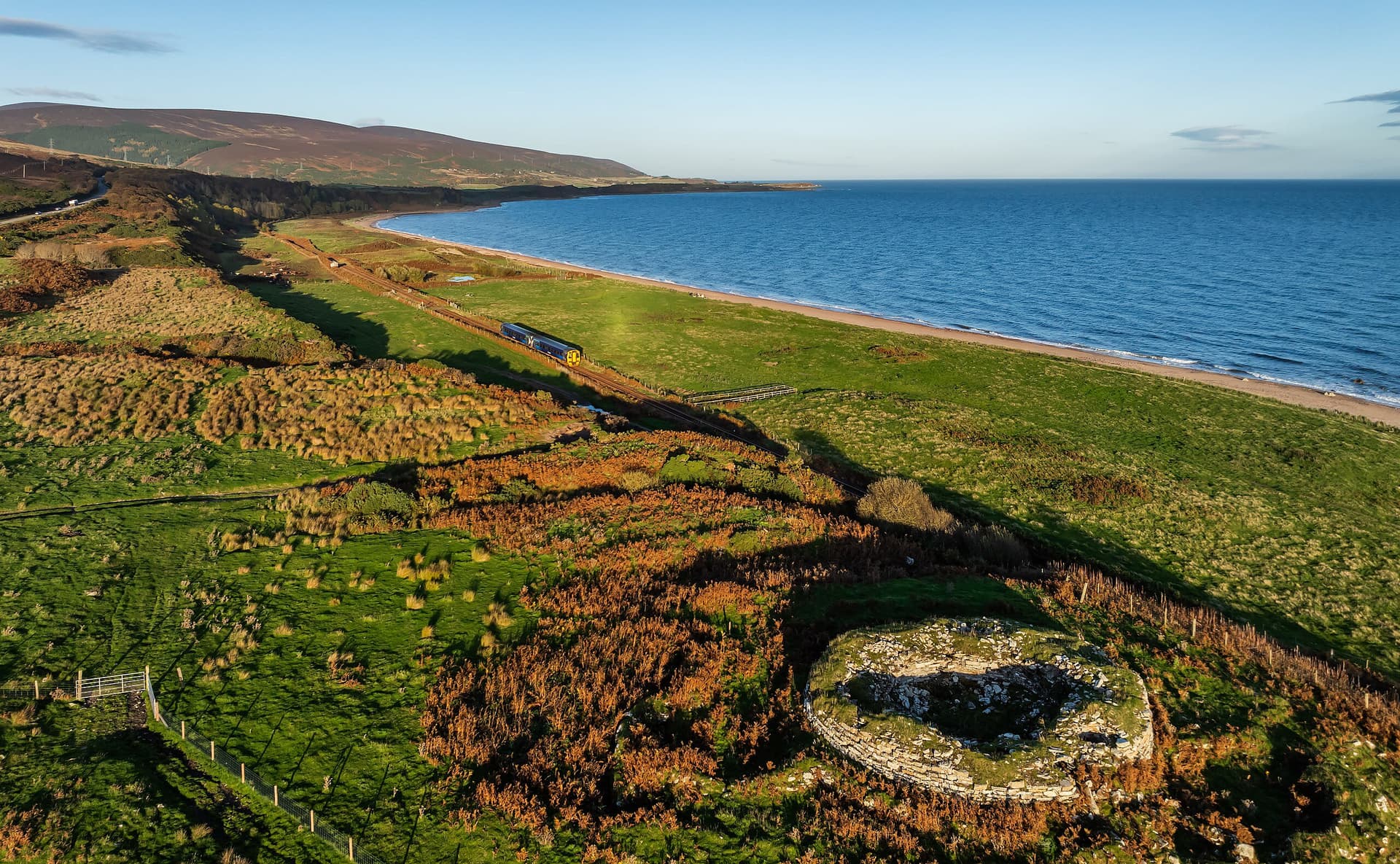
Where the A9 hugs the coast between Golspie and Brora, a circular stone tower rises from a low headland overlooking the North Sea. Carn Liath, the Grey Cairn, is among the best-preserved brochs in Sutherland, its walls still standing to approximately three metres after more than two thousand years. Unlike many Highland brochs that require long walks through remote terrain, Carn Liath sits immediately beside the road, its car park and information board making it one of the most accessible prehistoric monuments in northern Scotland. This convenience does not diminish its power. The broch's construction, dating to between 400 and 200 BCE, represents the culmination of a building tradition unique to Scotland.
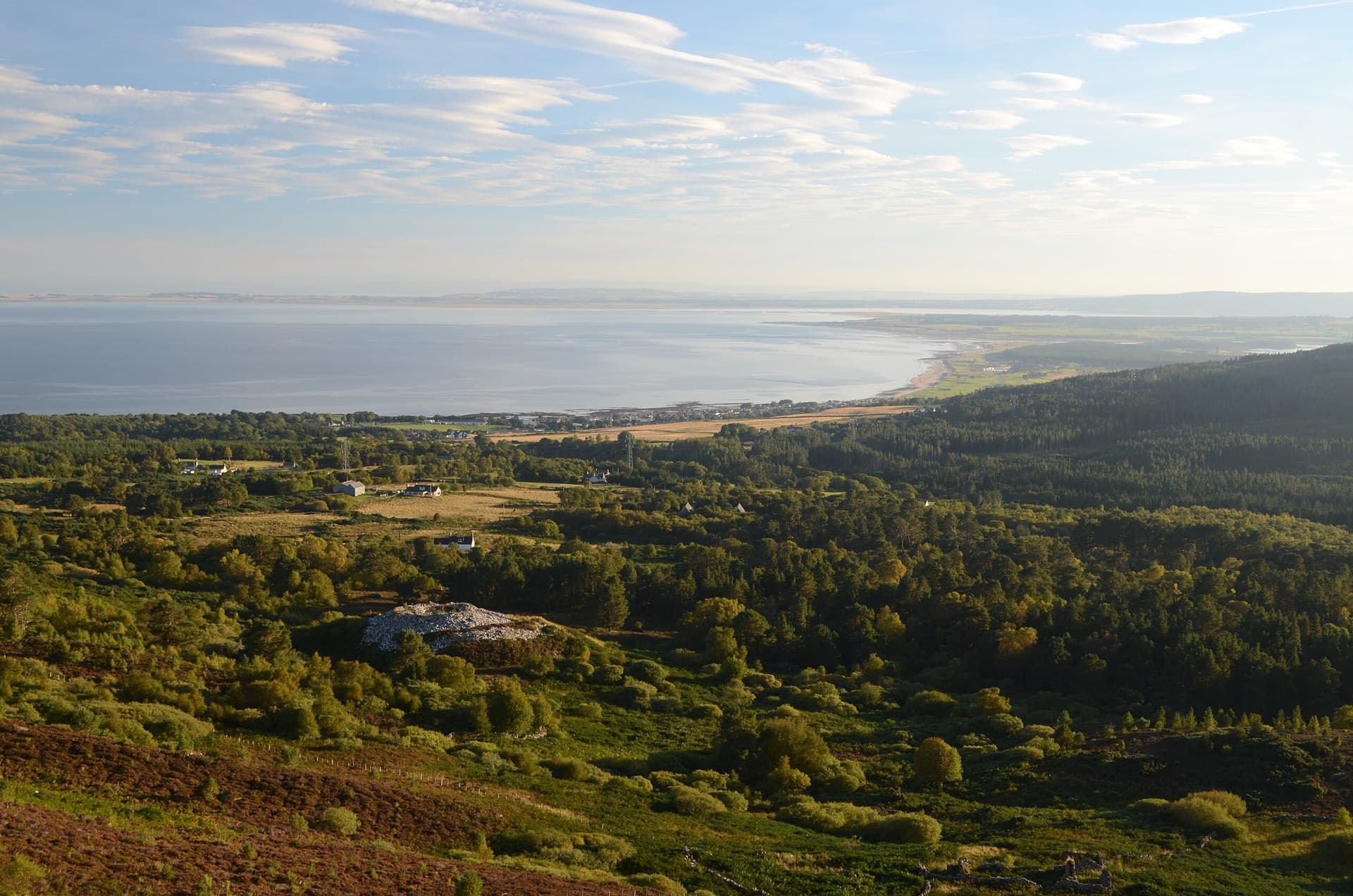
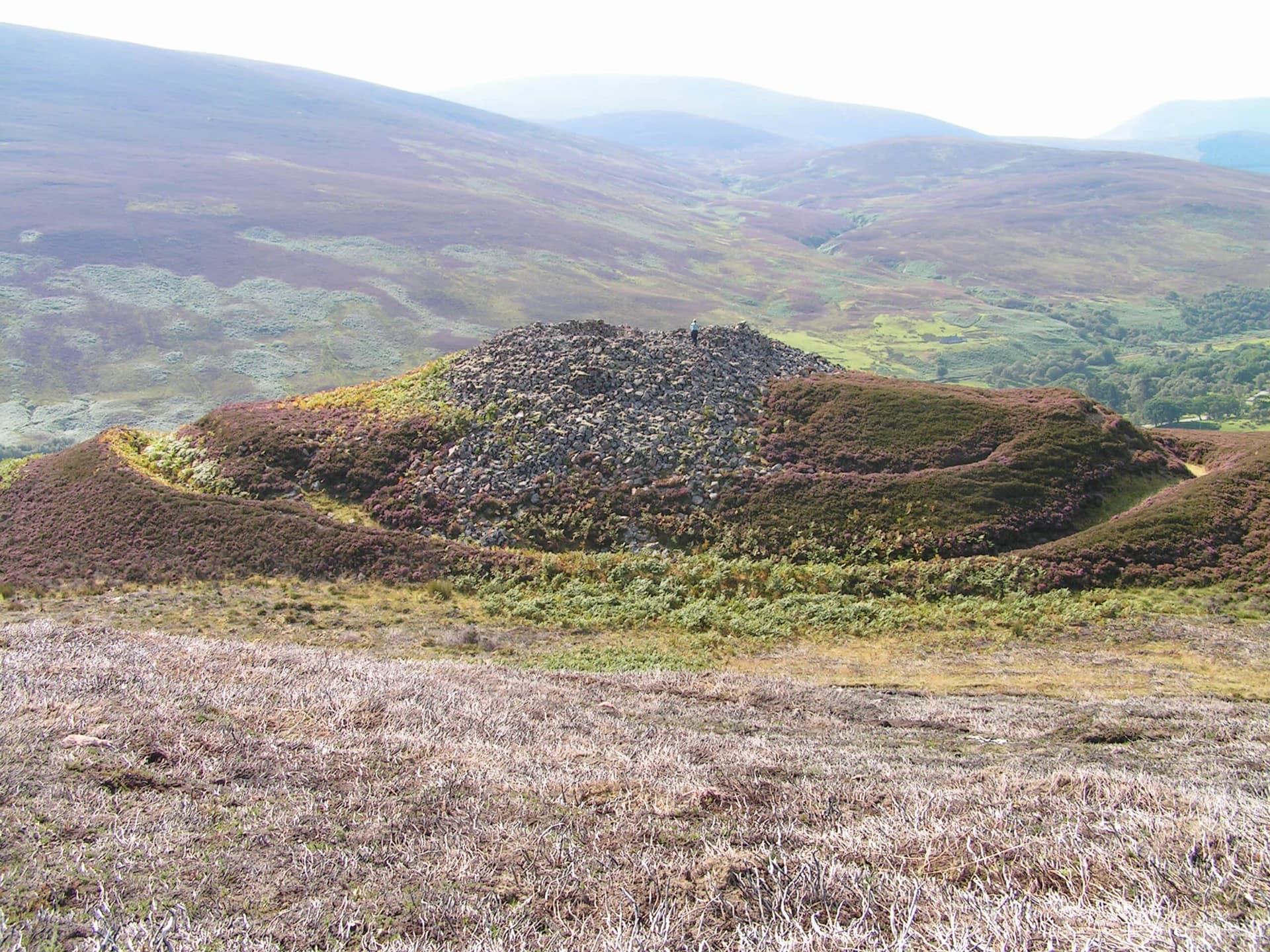
Carn Liath occupies a position that would have made strategic sense to its Iron Age builders and continues to make visual sense today. The broch commands views along the coast in both directions and inland toward the hills of Sutherland. The sea lies close, its presence felt in the salt wind that moves across the site. The name, meaning Grey Cairn in Gaelic, reflects how later generations understood the ruin: not as a dwelling but as a burial mound. This misidentification persisted until systematic archaeology revealed the broch's true nature.
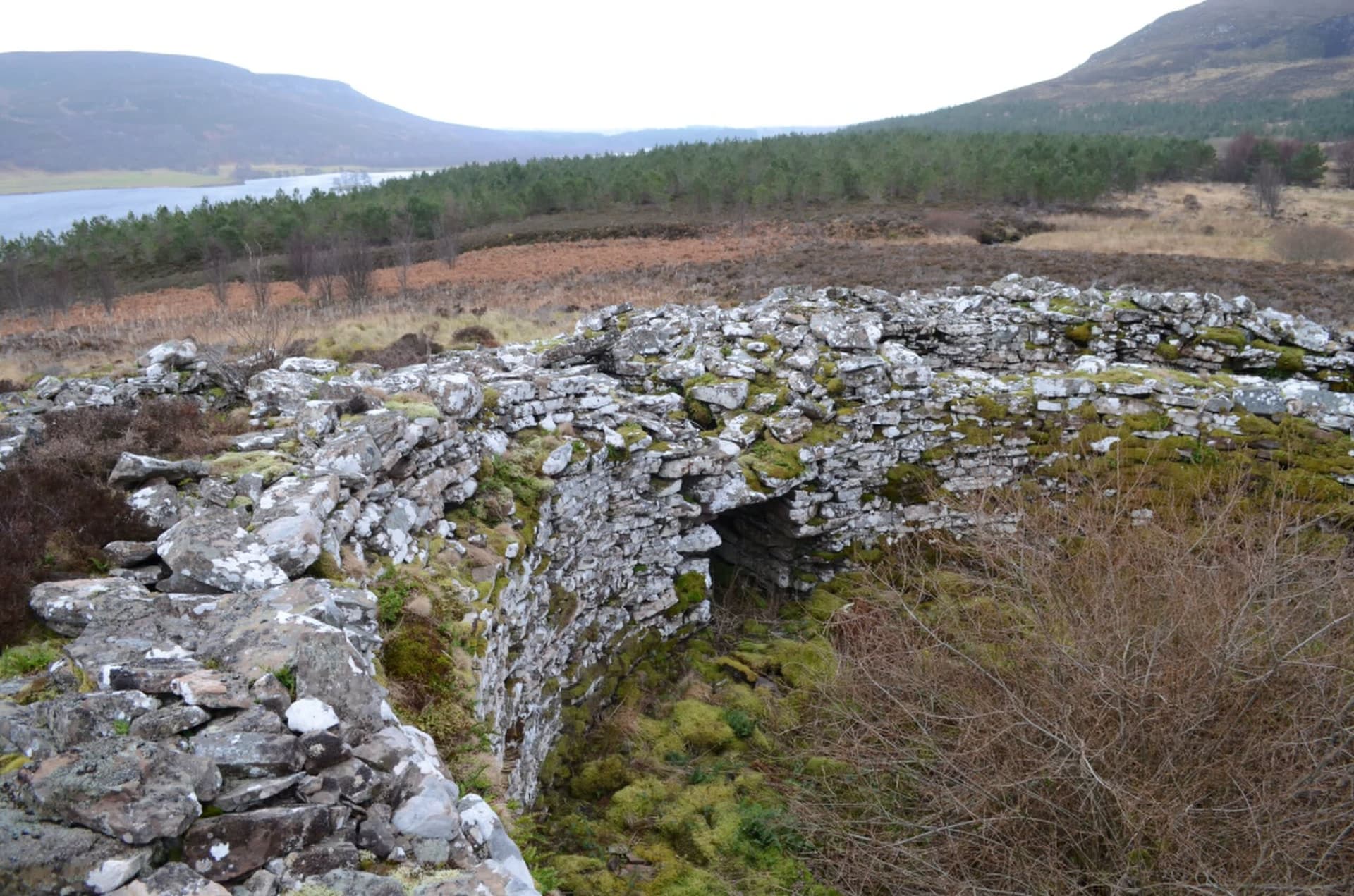
The structure is substantial. The external diameter is approximately nineteen metres. The internal diameter, the living space at the heart of the double walls, measures roughly ten metres across. The entrance passage on the east side is over four metres long and retains elaborate door checks and a bar-hole, evidence of a door that could be secured against intrusion. Within the walls, the remains of a staircase indicate that the tower originally rose to perhaps three times its current height, with galleries and chambers within the wall cavity serving as additional living and storage space.
What distinguishes Carn Liath from many other brochs is the rare survival of an associated settlement and earthworks. Beyond the broch itself, the remains of outer buildings, defensive walls, and ditches indicate that this was not an isolated tower but the centre of a community. The broch was the architectural and social heart of a settlement that likely housed an extended family or small clan, their livestock, and their provisions.
Excavations in the nineteenth century, initially undertaken when the site was still thought to be a burial cairn, revealed a rich assemblage of artefacts: pottery, flint chips, stone hammers, mortars and pestles, querns for grinding grain, spindle whorls for spinning thread, shale rings, long-handled bone combs, a whale bone club, a silver fibula brooch, steatite cups, and an iron blade. A later excavation in 1986 uncovered a Bronze Age cist burial beneath the broch, along with a food vessel, confirming that this was a significant location long before the broch was built. The site had been considered important for perhaps a thousand years before its most visible monument was constructed.
Context And Lineage
Carn Liath belongs to the broch-building tradition of Iron Age Scotland. Over five hundred brochs were constructed across northern and western Scotland between approximately 400 BCE and 200 CE. Sutherland holds one of the densest concentrations, with the brochs serving as the architectural centres of farming communities whose wealth and social organisation the towers reflect.
No foundation narrative survives for Carn Liath. The name, meaning Grey Cairn, reflects the misidentification of the broch as a burial mound that persisted until systematic archaeology began. The Iron Age builders who raised the tower left no written records. What they built, however, speaks to a community with the resources, skills, and motivation to construct a monument that would endure for millennia. The earlier Bronze Age burial beneath the broch indicates that the site's significance predates the tower by over a thousand years.
No continuous tradition connects the present to the Iron Age community that built and lived in the broch. The structure passed through centuries of abandonment and misidentification before archaeological investigation revealed its purpose. Today it is managed by Historic Environment Scotland as a heritage monument. The artefacts recovered during excavation are held in Dunrobin Castle Museum.
Duke of Sutherland
Why This Place Is Sacred
Carn Liath derives its contemplative quality from the intersection of deep time and immediate accessibility. Standing within the broch, you are inside a structure older than the Roman occupation of Britain, yet you reached it by walking twenty metres from a car park. This collision of the ancient and the everyday creates a particular kind of cognitive dissonance that some visitors experience as thinness.
Most thin places in Scotland require effort to reach. Carn Liath subverts this expectation. The broch sits beside the main road, visible to thousands of motorists who pass daily without stopping. The decision to stop, to walk the short distance from the car park, to step through the entrance passage, is itself the threshold. The transition from the modern world of the A9 to the Iron Age world of the broch happens in seconds, and this compression of temporal distance is part of the site's effect.
Within the walls, the sense of enclosure is immediate. The circular plan creates a contained space that focuses attention inward. The wind, which blows freely across the coastal headland, drops as you enter. The sounds of traffic fade. The stones around you were placed by hands that knew this coast before Christianity, before the Romans, before written language reached this part of the world.
The discovery of a Bronze Age cist burial beneath the broch adds a further dimension. This location was sacred, or at least significant, for a millennium before the broch was built. The Iron Age builders chose a site that already held meaning. Whether they knew of the burial beneath their foundations, whether it influenced their choice of location, cannot be determined. But the layering of significance, Bronze Age burial beneath Iron Age dwelling, creates a depth of time that is unusual even among Scotland's ancient monuments.
The coastal setting amplifies the effect. The sea is a constant presence, its sound and smell reaching the broch on most days. The horizon stretches east across the Moray Firth toward the coast of Caithness. This openness to the sea, this sense of standing at an edge, resonates with the liminal quality that characterises many sites experienced as thin.
The broch functioned as a high-status dwelling and the centre of a small settlement. The elaborate entrance with door checks and bar-hole, the substantial wall thickness, and the internal staircase all point to a structure designed for both habitation and defence. The associated settlement indicates a community that lived and worked around the tower. The Bronze Age cist burial beneath the broch suggests the site held significance long before the tower was constructed.
The site evolved through at least two major phases. The Bronze Age burial, discovered in 1986, dates to approximately 2000-1500 BCE. The broch was built over a thousand years later, between 400 and 200 BCE. The associated settlement grew around the broch during its period of active use. After abandonment, the broch was misidentified as a burial cairn until nineteenth-century excavation revealed its true nature. The site came into state guardianship and is now managed by Historic Environment Scotland.
Traditions And Practice
No formal practices are conducted at Carn Liath. The site functions as a heritage monument managed by Historic Environment Scotland. Visitors explore the ruins independently.
The Iron Age community that built Carn Liath would have used the broch as their primary dwelling and social centre. Evidence of iron working suggests industrial activity on site. The querns, spindle whorls, and other domestic artefacts point to a largely self-sufficient farming community. The Bronze Age cist burial beneath the broch indicates earlier funerary practices at the site, though these predate the broch by over a millennium.
No established spiritual community maintains practice at Carn Liath. The site is visited as a heritage monument, often as part of a tour of Sutherland's archaeological sites. Its accessibility makes it a popular stop for travellers on the A9 and the North Coast 500 route.
Even a brief visit rewards attention. Walk through the entrance passage slowly, noting the door checks and bar-hole. Inside, observe the sunken chambers, the wall construction, the scarcement ledge. Consider the artefacts found here, the tools and ornaments of everyday life, and what they reveal about the people who made them. From outside the broch, look out along the coast and imagine this view populated by other brochs, farmsteads, and the boats of a coastal community.
Iron Age Broch Culture
HistoricalCarn Liath represents the broch-building tradition of Atlantic Scotland, a uniquely Scottish architectural achievement of the Iron Age. The broch served as the centre of a farming community on the coast of Sutherland, providing both a dwelling and a visible statement of the community's wealth and status. The scale of construction required substantial communal labour and sophisticated engineering knowledge.
The community practiced mixed farming, craft production, and trade. Evidence of iron working, spinning, and grain processing was found within the broch. The range of materials recovered, including steatite probably from Shetland, a silver fibula suggesting Roman-period trade contacts, and shale from local sources, indicates a community integrated into wider exchange networks.
Bronze Age Burial
HistoricalThe discovery in 1986 of a Bronze Age cist burial with a food vessel beneath the broch foundations demonstrates that this site held significance for over a thousand years before the tower was built. The burial represents the funerary traditions of Bronze Age communities in Sutherland, who interred their dead in stone-lined cists with grave goods that may have been intended to accompany the deceased into an afterlife.
Cist burial involved placing the deceased in a stone-lined box, often in a crouched position, accompanied by pottery vessels and other objects. The food vessel found at Carn Liath suggests provision for the dead, possibly reflecting beliefs about continued existence after death.
Experience And Perspectives
Carn Liath offers an unusually accessible encounter with Iron Age architecture. The broch sits beside the A9 with a small car park and information board. Within a minute of leaving your car, you can stand inside a structure that was built more than two thousand years ago. The walls, rising to approximately three metres, create an enclosed space that retains a powerful sense of presence.
The car park lies just off the A9 between Golspie and Brora. An information board provides historical context. From here, the broch is immediately visible, its rough grey walls rising from the grassy headland above the coast road.
The approach is short but atmospheric. You cross a few metres of grass to reach the outer works, where the remains of settlement buildings and defensive walls hint at the community that once surrounded the tower. The broch itself rises above these foundations, its circular wall still intact to roughly three metres around most of its circumference.
The entrance passage on the east side is the primary architectural experience. Over four metres long, it channels visitors through a narrow corridor of stone. The door checks, designed to receive a heavy wooden door, are still visible. The bar-hole, into which a beam could be slotted to secure the door from inside, remains intact. These functional details humanise the monument. Someone stood here, two thousand years ago, and barred this door against the night.
Beyond the entrance, the interior opens out. Three rounded stone chambers sunk beneath ground level are visible, their purpose debated but possibly used for storage or small-scale industrial activity. Evidence of iron working was found at the site. The scarcement ledge, a projecting stone course partway up the wall, would have supported an upper wooden floor, creating a two-storey living space within the tower.
The views from the site extend along the coast and out across the Moray Firth. On clear days, the quality of light at this latitude can be extraordinary, the sky seeming to expand above the low coastal landscape.
Carn Liath is located directly beside the A9, approximately four kilometres northeast of Golspie and just over a mile from Dunrobin Castle. A small car park with an information board is clearly signposted. The broch is visible from the car park. No special equipment is needed, though the ground can be uneven. The site can be combined with visits to Dunrobin Castle Museum, which houses artefacts from Carn Liath and other local brochs, and to Backies Broch above Golspie.
Carn Liath offers an accessible entry point into questions about Iron Age life in the Scottish Highlands. Its location beside the main road means it is encountered by many visitors who might never seek out a remote archaeological site, and in this accessibility lies its particular value as a gateway to deeper engagement with Scotland's prehistoric past.
Archaeological investigation has established Carn Liath as a significant example of the broch tradition. The tower was constructed between 400 and 200 BCE, with associated settlement buildings extending the occupied area. The 1986 discovery of a Bronze Age cist burial beneath the broch confirmed that the site held significance for at least a millennium before the tower was built. The assemblage of artefacts recovered across multiple excavations, including a silver fibula, steatite cups, bone combs, and evidence of iron working, indicates a community engaged in trade and craft production. The broch is classified as an Orkney-Cromarty type, part of a regional tradition of roundhouse construction in northeast Scotland. Historic Environment Scotland manages the site as a property in care.
No oral traditions survive specifically for Carn Liath. The Gaelic name, meaning Grey Cairn, reflects the period when the broch's purpose had been forgotten and it was assumed to be a burial monument. This misidentification is itself historically significant, illustrating how knowledge of the Iron Age was lost and later recovered through archaeology.
The broch's circular form, coastal position, and the presence of an earlier burial beneath it have attracted attention from those interested in landscape spirituality and the continuity of sacred sites. The idea that significant locations retain their significance across millennia, regardless of the specific culture or practice associated with them, finds some support in the Bronze Age to Iron Age continuity at Carn Liath.
Key questions remain. The precise relationship between the Bronze Age burial and the later broch, whether the Iron Age builders knew of the earlier grave, is unknown. The full extent of the associated settlement has not been excavated. The reasons for the broch's abandonment are unclear. The identity and social organisation of its builders remain matters of inference rather than established fact.
Visit Planning
Carn Liath is one of the most accessible brochs in Scotland. It sits beside the A9 between Golspie and Brora with a free car park and information board. No admission is charged. The site can be visited year-round during daylight hours.
Carn Liath is located directly beside the A9 road, approximately 4 km northeast of Golspie, Sutherland. The car park is clearly signposted. The broch is a short walk from the car park over grass. The nearest railway station is Golspie, approximately 4 km southwest on the Far North Line. Stagecoach buses run along the A9 between Inverness and Thurso, stopping at Golspie and Brora. The site is partially accessible to visitors with limited mobility, though the interior terrain is uneven.
Golspie offers accommodation including hotels and guest houses. More options available in Brora and Dornoch. The A9 corridor provides good access to facilities.
Carn Liath is a managed heritage site with free access. Respect for the monument and its archaeological integrity is expected.
The site is freely accessible at all times. No admission fee is charged. An information board at the car park provides historical context.
As a property in the care of Historic Environment Scotland, the broch is legally protected. Visitors should not climb on the walls, remove stones or artefacts, or disturb the site in any way. The ground can be uneven; sturdy footwear is advisable.
The site is suitable for visitors of most abilities, though the interior is not fully wheelchair accessible due to uneven terrain. Dogs are welcome but should be kept under control.
No specific requirements. Sturdy footwear advisable for uneven ground. Warm, wind-resistant clothing recommended given the exposed coastal position.
Photography is permitted throughout. The entrance passage, interior chambers, and coastal views are particularly photogenic.
Do not leave offerings at the site. The monument's integrity must be preserved.
Do not climb on walls, remove stones, or disturb the site. Dogs should be kept under control.
Sacred Cluster
Nearby sacred places create the location cluster described in the growth plan. This block is intentionally crawlable and links into the wider regional graph.