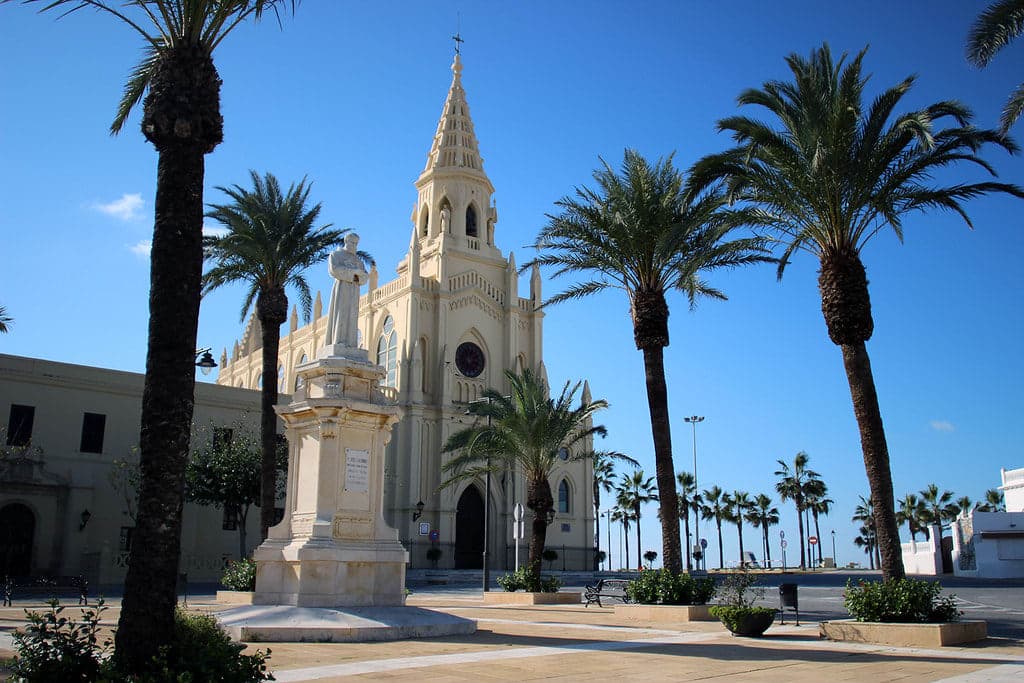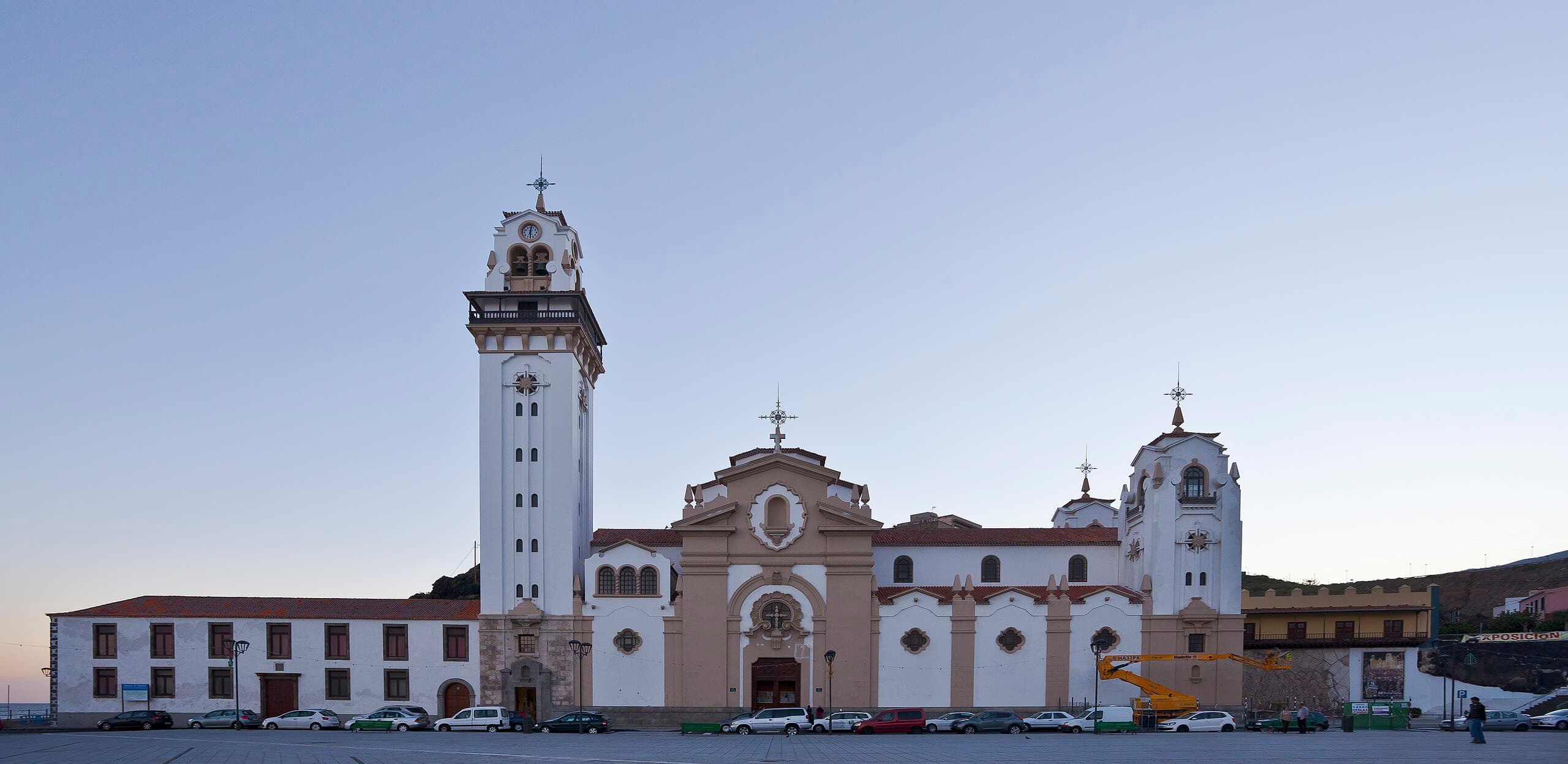
Basilica of the Royal Marian Shrine of Our Lady of Candelaria, Tenerife, Canary Islands, Spain
Where Guanche goatherds found a goddess and pilgrims still walk through the night to reach her
Candelaria, Santa Cruz de Tenerife, Spain
At A Glance
- Coordinates
- 28.3512, -16.3697
- Suggested Duration
- One to two hours to visit the basilica, Cave of Achbinico, and the menceyes statues at a contemplative pace. A half-day if combined with the town of Candelaria and its pottery center. During the August feast, plan for a full day or longer to absorb the full range of celebrations.
- Access
- Located in the coastal town of Candelaria, 17 km south of Santa Cruz de Tenerife on the TF-1 motorway. Regular bus service from Santa Cruz via lines 111, 115, 116, 120, 121, 122, 123, 124, and 131. Free parking available near the basilica. The basilica is open Tuesday to Sunday from 7:30 to 19:30. Mobile phone signal is available throughout the town. No specific accessibility information was documented at time of writing; contact the basilica or Candelaria municipal office for current arrangements.
Pilgrim Tips
- Located in the coastal town of Candelaria, 17 km south of Santa Cruz de Tenerife on the TF-1 motorway. Regular bus service from Santa Cruz via lines 111, 115, 116, 120, 121, 122, 123, 124, and 131. Free parking available near the basilica. The basilica is open Tuesday to Sunday from 7:30 to 19:30. Mobile phone signal is available throughout the town. No specific accessibility information was documented at time of writing; contact the basilica or Candelaria municipal office for current arrangements.
- Modest attire appropriate for a Catholic place of worship. Shoulders and knees should be covered when entering the basilica. Despite the coastal location, beach attire is not appropriate inside the church.
- Photography is generally permitted inside the basilica outside of services. Flash photography is discouraged. The exterior, plaza, and menceyes statues can be freely photographed. During the August reenactment, photography is welcome but should not obstruct other visitors' experience.
- During the August feast, the small town of Candelaria becomes extremely crowded. Accommodation should be booked months in advance. The nighttime pilgrimage walk requires appropriate footwear and water. Despite the coastal location, beach attire is not appropriate inside the basilica.
Overview
On Tenerife's Atlantic coast, the Basilica of Our Lady of Candelaria holds the patroness of the Canary Islands in a sanctuary built above the cave where the Guanche people first venerated her image centuries before Christianity reached their shores. Over 2.5 million visitors arrive each year, drawn by a devotion that bridges indigenous and Catholic worlds.
The statue appeared before the faith it would come to represent. Sometime around 1392, two Guanche goatherds found a carved figure of a woman holding a child and a green candle on a beach in southeastern Tenerife. One tried to throw a stone at it; his arm became paralyzed. The other tried to stab it; he stabbed himself instead. The mencey, the Guanche king of Guimar, ordered the statue brought to his cave-palace, where the people identified her as Chaxiraxi, their mother goddess.
More than a century later, when Spanish forces conquered Tenerife in 1496, Dominican friars reinterpreted the figure as the Virgin Mary and established formal Catholic worship at the site. The cave where the Guanche had venerated Chaxiraxi became the Cave of San Blas, and a hermitage, then a church, then a basilica rose above it.
The story resists any simple reading of conquest and replacement. The current basilica, completed in 1959 and granted Minor Basilica status by Pope Benedict XVI in 2011, stands on a plaza guarded by nine bronze statues of Guanche menceyes, the indigenous kings of Tenerife. Each August, on the eve of the patronal feast, locals dress as Guanche and reenact the discovery of the statue. The devotion that originated with goatherds and a mother goddess continues through Catholic liturgy, Afro-Caribbean syncretism, and Canarian cultural pride.
The original statue was swept away by a tidal wave in 1826. The replacement, carved by Fernando Estevez, now receives the prayers of millions. Whether what they venerate is the same presence the goatherds encountered is a question the site holds open rather than answers.
Context And Lineage
The devotion to the Virgin of Candelaria began with the miraculous discovery of a statue by Guanche goatherds around 1392, a century before the Spanish conquest of Tenerife. The statue was identified by the indigenous people with their goddess Chaxiraxi before being reinterpreted as the Virgin Mary after Christian contact.
Around 1392, two Guanche goatherds near Guimar encountered a carved statue of a woman holding a child and a green candle on the beach of Chimisay. When one shepherd tried to throw a stone, his arm became paralyzed. When the other tried to stab the figure, he accidentally wounded himself. The mencey of Guimar ordered the statue brought to his cave-palace, where the Guanche identified her with Chaxiraxi, their mother goddess, and installed her in the Cave of Achbinico.
After the Spanish conquest of 1496, Dominican friars reinterpreted the statue as the Virgin Mary and established formal Catholic worship. The miraculous discovery was presented as evidence of divine preparation for the island's Christianization. The first Mass at the site was celebrated in 1497, and a hermitage was built in 1526.
The custodianship of the site traces from the Guanche mencey of Guimar through Dominican friars, diocesan clergy, and the current basilica administration. The devotion itself has traveled further: Canarian emigrants carried the Virgin of Candelaria to Latin America, where she became the patroness of Medellin, Colombia, and a central figure in the Peruvian Andean fiesta tradition recognized by UNESCO. In Cuban Santeria, she is syncretized with the Yoruba orisha Oya. The lineage of this devotion is not a single line but a branching tree, its roots in a Guanche cave and its branches spanning the Atlantic.
The two Guanche goatherds of Guimar
Discoverers of the statue that would become the patroness of the Canary Islands, establishing the site's original sacred significance
Alonso Fernandez de Lugo
Adelantado who ordered the first hermitage built at the site after the conquest of Tenerife
Fernando Estevez
Sculptor who carved the replacement statue of the Virgin after the original was lost in the 1826 tidal wave
Jose Abad
Sculptor who created the nine bronze menceyes statues on the basilica plaza in 1993, asserting indigenous presence at the site
Pope Benedict XVI
Elevated the sanctuary to Minor Basilica status in 2011, confirming its significance within the Catholic Church
Why This Place Is Sacred
Candelaria's sacred quality emerges from a rare convergence: an indigenous goddess recognized as a Catholic saint on the same ground, a cave of pre-Christian devotion underlying a Christian basilica, and a devotion that has traveled from the Canary Islands to reshape religious practice across Latin America and the Caribbean.
The layering begins underground. Beneath the basilica, the Cave of Achbinico, also known as San Blas, preserves the space where the Guanche kept the statue they identified as Chaxiraxi. This is not a later chapel built in ecclesiastical style; it is a natural cave, a wound in the coastal rock face, where the indigenous people of Tenerife venerated a feminine divine presence for over a century before any missionary arrived. Entering the cave today, with its rough walls and intimate scale, strips away the institutional overlay of the basilica above and returns the visitor to something more primordial.
Above ground, the basilica faces the Atlantic Ocean. Waves crash against the rocks below the plaza, and the salt wind carries across the open space where the nine menceyes stand in bronze, each representing one of the nine kingdoms of pre-conquest Tenerife. These statues, installed in 1993, are not mere decoration. They are a political and spiritual statement: the ancestral rulers of this land stand guard over the sanctuary, asserting that the Guanche presence at this site is not a footnote to the Catholic story but its foundation.
The Black Madonna tradition adds another layer of depth. The original statue, like many of Europe's most venerated Marian images, was dark-skinned. This connects Candelaria to a network of Black Madonna sites stretching from Montserrat to Czestochowa, images that scholars associate with pre-Christian goddess traditions absorbed into Christian devotion. The candle the Virgin holds connects to Candlemas, the feast of purification, but also to light symbolism that transcends any single tradition.
Perhaps most remarkably, the Virgin of Candelaria traveled. Carried across the Atlantic by Canarian emigrants, she became embedded in Latin American and Caribbean spirituality. In Cuban Santeria, she is syncretized with the Yoruba orisha Oya. In Peru, she is associated with Pachamama. In Colombia, she is the patroness of Medellin. The devotion that began with two goatherds on a Tenerife beach now shapes religious practice across continents.
The cave served as a Guanche sacred space for the veneration of a feminine divine figure identified as Chaxiraxi. The statue's discovery predated Christian contact, suggesting that the site's sacredness was established through indigenous recognition of the numinous rather than through institutional designation.
From Guanche cave shrine to Dominican hermitage to parish church to the current basilica completed in 1959, the site's physical form has been repeatedly rebuilt while its devotional core has remained continuous. The previous church was destroyed by fire in 1789. The original statue was lost to a tidal wave in 1826. Yet the devotion has proven more durable than any single building or image. The granting of Minor Basilica status in 2011 formalized a significance that pilgrims had established over six centuries.
Traditions And Practice
Candelaria sustains year-round Catholic worship centered on Marian devotion, with two major annual peaks: the August patronal feast drawing thousands of night-walking pilgrims, and the February Candlemas celebration. The Guanche heritage is honored through annual reenactments and the permanent presence of the menceyes statues.
The Guanche venerated the statue as Chaxiraxi in the Cave of Achbinico for over a century before Christian contact. The August celebrations may represent a syncretized continuation of the ancient Benessmen harvest festival, suggesting that the current feast calendar preserves rhythms older than Christianity on the island.
Candlemas, celebrated on February 2, connects to the Virgin's attribute of holding a candle and to pre-Christian light festivals marking the midpoint between winter solstice and spring equinox. The blessing of candles during this celebration carries symbolism that reaches across multiple traditions.
Daily Masses sustain the basilica's liturgical life throughout the year. The solemn Mass on August 15, feast of the Assumption and patronal feast of the Canary Islands, draws ecclesiastical, military, and civil authorities alongside thousands of ordinary pilgrims. The nighttime pilgrimage walk on August 14-15, when pilgrims walk from across Tenerife to arrive at dawn, is the island's most significant communal spiritual practice.
On the evening of August 14, locals dressed as Guanche perform a reenactment of the discovery of the statue in the plaza, bringing the indigenous origin story into living performance. Traditional floral offerings and folk groups process to the basilica, weaving Canarian cultural identity into the devotional fabric.
The Cave of Achbinico maintains separate visiting hours and offers an experience distinct from the basilica above, connecting visitors to the pre-Christian layer of the site's sacred history.
If visiting outside the August feast, attend a weekday Mass to experience the basilica's devotional atmosphere without the crowds. Spend time in the Cave of Achbinico in silence, allowing the cave's intimate scale and geological character to speak in contrast to the basilica's institutional presence. Walk the plaza with attention to each of the nine menceyes, reading their names and kingdoms, connecting the bronze figures to the land they represent.
If you can time your visit for August 14-15, join the nighttime pilgrimage walk. The physical journey through darkness toward dawn, in the company of thousands of fellow walkers, transforms the intellectual understanding of pilgrimage into embodied experience.
Catholic Marian devotion to the Virgin of Candelaria
ActiveThe Virgin of Candelaria was proclaimed Patron Saint of the Canary Islands by Pope Clement VIII in 1599, ratified by Pope Pius IX in 1867. The basilica was elevated to Minor Basilica status in 2011. This is one of the most important Marian pilgrimage sites in Spain and the spiritual heart of the Canary Islands, receiving over 2.5 million visitors annually.
Daily Masses and devotional prayers before the image of the Virgin. Pilgrimage walks from across Tenerife, particularly on the night of August 14-15 when thousands walk through the darkness to arrive for the feast day. Candlemas celebrations on February 2. Solemn processions carrying the Virgin's image through the streets. The feast day Mass on August 15 draws ecclesiastical, military, and civil authorities alongside ordinary pilgrims.
Guanche cultural heritage
ActiveThe site represents a unique convergence of pre-Christian Guanche spirituality and Catholic Marian devotion. The Guanche identified the statue with their goddess Chaxiraxi before the Spanish conquest. The nine bronze menceyes on the plaza honor the indigenous rulers of Tenerife. The August celebrations may be a syncretized continuation of the ancient Benessmen harvest festival.
On the evening of August 14, locals dressed as Guanche perform a reenactment of the discovery of the statue in the plaza. The nine menceyes statues serve as a permanent tribute to indigenous heritage and a gathering point for those honoring Guanche identity. Cultural and educational programs interpret Guanche history at the site year-round.
Afro-Caribbean and Latin American syncretism
ActiveThe Virgin of Candelaria was carried across the Atlantic by Canarian emigrants and became deeply rooted in Latin American and Caribbean spirituality. In Cuban Santeria, she is syncretized with the Yoruba orisha Oya. In Peruvian Andean tradition, she is associated with Pachamama. She is the patroness of Medellin, Colombia. Her feast in Puno, Peru, is a UNESCO-recognized celebration combining Andean and Catholic elements.
Devotional practices vary by region but include processions, dances, and offerings that blend Catholic liturgy with indigenous and African spiritual traditions. The Fiesta de la Candelaria in Puno, Peru, features elaborate dance performances. In Cuba, devotees of Oya may honor the Virgin of Candelaria within the Santeria framework. The devotion's adaptability to diverse cultural contexts is itself a defining characteristic.
Experience And Perspectives
The basilica offers a layered encounter: the dramatic oceanfront setting, the intimate Cave of Achbinico beneath, the bronze menceyes standing watch on the plaza, and during the August feast, the overwhelming energy of thousands of pilgrims converging on a small coastal town.
The plaza sets the stage. Open to the sea, swept by salt wind, flanked by the nine bronze kings of pre-conquest Tenerife, it creates a space that is simultaneously civic and sacred. The menceyes do not kneel or pray; they stand in attitudes of authority and watchfulness, asserting indigenous presence in a landscape that colonial history attempted to overwrite.
Entering the basilica, the eye adjusts from Atlantic light to the filtered interior where the image of the Virgin presides. The replacement statue by Fernando Estevez captures the attributes of the lost original: dark-skinned, holding the child in one arm and a candle in the other. The devotional atmosphere varies with the hour and season. On quiet mornings, the space holds the accumulated silence of decades of prayer. During services, the community's devotion fills the nave with a warmth that architecture alone cannot generate.
The Cave of Achbinico, accessible separately, offers something different entirely. Descending from the basilica into the natural cave returns the visitor to the site's origins. The space is small, rough-walled, shaped by geological forces rather than architectural intention. Standing where the Guanche venerated Chaxiraxi, beneath a basilica that reinterprets her as the Virgin Mary, one stands at the juncture of two worlds that the site has never fully reconciled.
During the August feast, the experience transforms completely. On the evening of August 14, the reenactment of the Guanche discovery fills the plaza with locals in indigenous costume. Through the night, thousands of pilgrims walk from across Tenerife toward Candelaria, arriving at dawn for the solemn Mass on August 15. The energy of this convergence, the physical exhaustion of the night walk meeting the emotional intensity of communal devotion, is reported by pilgrims as one of the most affecting experiences available in the Canary Islands.
Visit the Cave of Achbinico first, before entering the basilica. Beginning underground, in the indigenous sacred space, establishes a chronological and experiential foundation for what follows above. After the cave, walk the plaza and spend time with the menceyes before entering the church. This sequence mirrors the site's history: Guanche devotion first, Catholic reinterpretation second, the two held together by the land itself.
The Basilica of Candelaria sits at a junction where indigenous Guanche spirituality, Catholic Marian devotion, and Afro-Caribbean syncretism meet. Each perspective illuminates something the others leave in shadow.
Historians view the Candelaria devotion as a product of religious syncretism, where a pre-existing Guanche sacred site was absorbed into Catholic practice during and after the conquest. The statue's pre-conquest discovery and the Guanche identification with Chaxiraxi suggest that the site was sacred to the indigenous population before being reinterpreted through a Christian lens. The spread of the devotion to Latin America and the Caribbean illustrates how colonial-era religious practices were further transformed through contact with indigenous American and African spiritual traditions. The August feast's possible roots in the Guanche Benessmen harvest festival represent a particularly complex case of cultural layering.
The Catholic tradition sees in the pre-conquest discovery of the statue evidence of divine grace preparing the island for Christianity. The Virgin chose to appear to the Guanche before the missionaries arrived, a sign of her universal maternal care. This interpretation has sustained the devotion for over six centuries and animates the daily worship and annual pilgrimage that are the basilica's living heart. For modern Canarians who identify with Guanche heritage, the site represents something different: the survival of indigenous spiritual values despite conquest and forced conversion. The menceyes statues and the annual reenactment serve as acts of cultural reclamation.
The Black Madonna tradition has attracted attention from researchers interested in pre-Christian goddess worship and the persistence of feminine divine archetypes within Christianity. Some interpret the Virgin of Candelaria as a continuation of ancient Mediterranean and North African mother-goddess traditions, noting parallels with other Black Madonna sites at Montserrat, Czestochowa, and elsewhere. The candle attribute connects to light symbolism and purification rituals found across multiple spiritual traditions. In Cuban Santeria, the syncretism with the Yoruba orisha Oya places Candelaria within an entirely different cosmological framework, one that honors the continuity between African spiritual traditions and their New World expressions.
The precise origin of the original statue remains one of the site's enduring mysteries. Whether it was carved by a European craftsman and somehow reached the island before formal contact, or whether it had some other provenance, cannot be determined. Its loss in the 1826 tidal wave means the original artifact can never be studied. The full extent of pre-Christian Guanche ceremonial use of the Cave of Achbinico and surrounding area remains only partially excavated and understood. What the Guanche goatherds actually experienced when they found the statue on the beach, and what they understood the figure to represent within their own cosmological framework, are questions the historical record cannot fully answer.
Visit Planning
Candelaria sits on the east coast of Tenerife, seventeen kilometers south of the capital Santa Cruz. Regular bus service connects the town to major population centers. The basilica is open Tuesday through Sunday, with the Cave of Achbinico maintaining separate visiting hours.
Located in the coastal town of Candelaria, 17 km south of Santa Cruz de Tenerife on the TF-1 motorway. Regular bus service from Santa Cruz via lines 111, 115, 116, 120, 121, 122, 123, 124, and 131. Free parking available near the basilica. The basilica is open Tuesday to Sunday from 7:30 to 19:30. Mobile phone signal is available throughout the town. No specific accessibility information was documented at time of writing; contact the basilica or Candelaria municipal office for current arrangements.
The town of Candelaria offers modest hotel and apartment accommodations. Santa Cruz de Tenerife, seventeen kilometers north, provides a wider range of options. During the August feast, all accommodation in and around Candelaria books months in advance.
The Basilica of Candelaria is an active place of worship receiving over 2.5 million visitors annually. The standard courtesies of a Catholic sanctuary apply, with additional sensitivity to the Guanche heritage dimension of the site.
The basilica serves a worshipping community as well as visitors. Mass is celebrated regularly, and the space around the Virgin's image holds the devotional intensity of daily prayer. Enter quietly, allow your eyes to adjust, and read the atmosphere before deciding how to move through the space. During services, remain seated or standing at the back if you are observing rather than participating.
The Cave of Achbinico requires similar reverence in a different register. This is not merely a historical exhibit but the oldest sacred space at the site. The intimacy of the cave rewards silence and stillness.
The menceyes statues deserve respectful interaction. These are memorials to indigenous rulers whose civilization was destroyed. Climbing on them, using them as photo props, or treating them as purely decorative misses their cultural significance. They are as much a part of the site's sacred geography as the basilica itself.
Modest attire appropriate for a Catholic place of worship. Shoulders and knees should be covered when entering the basilica. Despite the coastal location, beach attire is not appropriate inside the church.
Photography is generally permitted inside the basilica outside of services. Flash photography is discouraged. The exterior, plaza, and menceyes statues can be freely photographed. During the August reenactment, photography is welcome but should not obstruct other visitors' experience.
Candles can be lit inside the basilica. Donations are welcomed. Floral offerings are traditional during feast days.
Silence and reverence expected inside the basilica and the Cave of Achbinico. Do not touch the statue of the Virgin. The basilica is closed on Monday mornings. Respectful behavior expected around the menceyes statues at all times.
Sacred Cluster
Nearby sacred places create the location cluster described in the growth plan. This block is intentionally crawlable and links into the wider regional graph.