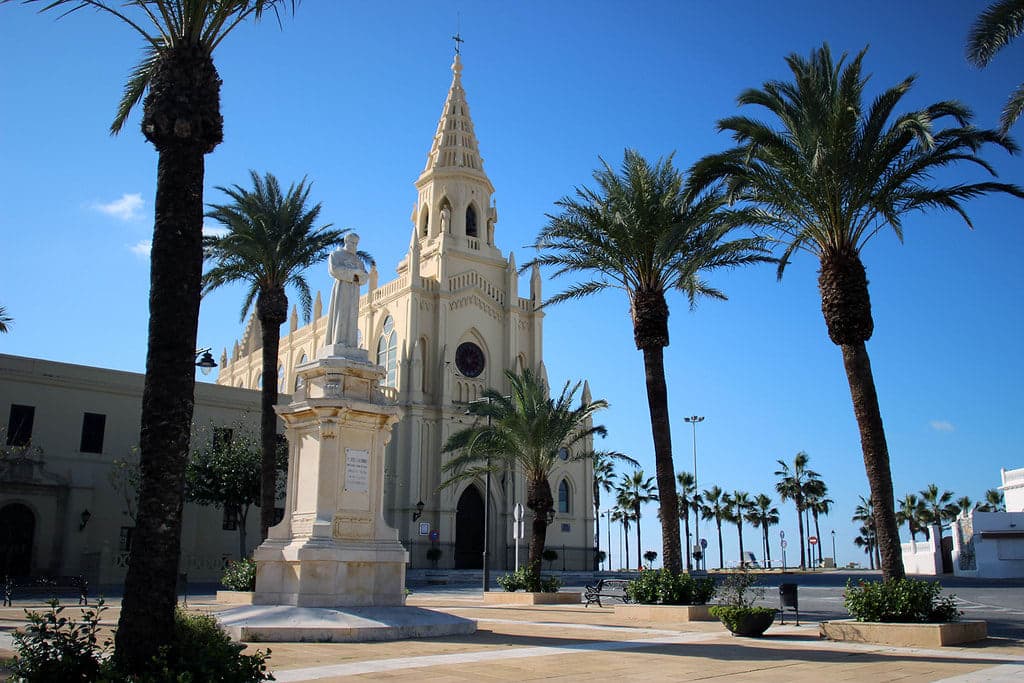
Our Lady of Chipiona
A Black Madonna at the Atlantic's edge, connecting medieval Spain to the sacred shores of Cuba
Chipiona, Andalusia, Spain
At A Glance
- Coordinates
- 36.7355, -6.4348
- Suggested Duration
- One to two hours for the church and cloister. Guided tours of the library (5 euros) and cellar with permanent nativity scene (6 euros) add time. A full guided tour of the church costs 7 euros.
- Access
- Chipiona is approximately 60 km south of Seville and 30 km northwest of Cadiz. The sanctuary is at Paseo Costa de La Luz 91, directly on the waterfront. Opening hours: Monday-Sunday 8:00-12:00 and 17:00 to final Mass (usually 20:30). Reachable by car via the A-480 from Jerez de la Frontera. Limited public transport; buses connect Chipiona to Cadiz and Seville. Free admission to the sanctuary. Tours by reservation: visitas@santamariaderegla.com.
Pilgrim Tips
- Chipiona is approximately 60 km south of Seville and 30 km northwest of Cadiz. The sanctuary is at Paseo Costa de La Luz 91, directly on the waterfront. Opening hours: Monday-Sunday 8:00-12:00 and 17:00 to final Mass (usually 20:30). Reachable by car via the A-480 from Jerez de la Frontera. Limited public transport; buses connect Chipiona to Cadiz and Seville. Free admission to the sanctuary. Tours by reservation: visitas@santamariaderegla.com.
- Modest attire inside the sanctuary: shoulders and knees covered. The seaside location means many arrive from the beach; bring a cover-up. Comfortable shoes for the September procession.
- Photography is generally permitted inside the sanctuary outside of services. Flash photography should be avoided near the statue and altarpieces. The church closes to visitors during Mass.
- The September 8 feast involves significant crowding; plan accordingly. Summer heat in coastal Andalusia can be intense. The church closes to tourists during Mass; check service schedules.
Overview
Where the Guadalquivir River meets the Atlantic, a dark-skinned Virgin has watched over sailors, prisoners, and pilgrims for seven centuries. The Santuario de Regla in Chipiona houses one of Spain's most venerated Black Madonnas, hidden for five hundred years during the Moorish occupation and credited with 104 documented miracles. Her image traveled with Spanish colonizers to Cuba, where she became syncretized with the Yoruba goddess Yemaya, creating a spiritual bridge between continents.
The story of the Virgen de Regla begins, according to devotional tradition, in the twilight of Roman North Africa. An angel commanded Saint Augustine of Hippo to carve an image of the Virgin Mary. When the Vandals besieged his city, Augustine died, but his disciple Cyprian escaped by sea, carrying the dark-skinned statue. Through storm and peril, the Virgin protected them until they reached the coast of Chipiona.
For centuries, the statue presided over a monastery at the edge of the Atlantic. When the Moorish invasion swept through Andalusia in the 8th century, monks hid her in an underground cistern beside a fig tree. There she lay for approximately five hundred years. After the Christian Reconquista, a canon from Leon received a vision directing him to the precise location of her burial. The Virgin was unearthed and veneration resumed.
Whether these events occurred as tradition remembers them is a matter of faith. What the historical record confirms is that between 1340 and 1636, Augustinian monks at the sanctuary documented 104 miracles attributed to the Virgin's intercession: prisoners freed, sailors rescued from shipwreck, children pulled from drowning, the sick made well.
The devotion did not remain in Chipiona. Spanish colonizers carried replicas of the Virgen de Regla across the Atlantic. In Cuba, enslaved Africans recognized in this dark-skinned Madonna the face of Yemaya, their own goddess of the sea and motherhood. The town of Regla across Havana harbor became a center of devotion where Catholic and Yoruba traditions converge. Today, devotees dress in blue and white, the colors shared by the Virgin and the orisha, and the Santuario de Regla stands as a rare European shrine connected to a living African-diaspora spiritual tradition.
Context And Lineage
The Santuario de Regla traces its formal origins to 1399, when the Ponce de Leon family donated a fortress castle to the Augustinian Order. The statue itself is dated by iconographic analysis to approximately 1200 CE, though devotional tradition attributes it to Saint Augustine of Hippo in the 5th century.
The devotional legend reaches back to the final years of Roman North Africa. An angel commanded Augustine of Hippo to carve an image of the Virgin. When the Vandals besieged his city, Augustine died, but his disciple Cyprian and other African hermits escaped by sea with the statue. During a fierce storm, the Dark Mother protected them, and they reached the coast of Chipiona safely. The Virgin became the patron of Spanish sailors through this maritime deliverance.
During the 8th-century Moorish invasion, monks hid the statue in an underground cistern next to a fig tree. For approximately five hundred years, the Virgin lay concealed beneath the earth. After Alfonso X of Castile liberated the region, the Virgin appeared in a vision to a canon from Leon, directing him to the exact location of her burial. The statue was unearthed intact, and veneration resumed with renewed fervor.
Art historians date the statue to approximately 1200 CE based on iconographic analysis, placing it firmly in the medieval period rather than late antiquity. The Augustinian connection, while cherished in devotional tradition, belongs to the common hagiographic practice of attributing venerated objects to apostolic or patristic figures.
The devotion belongs to the broader European tradition of Black Madonna veneration, which connects medieval Marian devotion with older associations of dark feminine divinity. The Virgen de Regla's uniqueness lies in her transatlantic journey: carried to Cuba, the Philippines, Mexico, the Dominican Republic, and the Netherlands, she became one of the most widely traveled devotional images in Catholic history.
Pedro III Ponce de Leon
Patron who donated the fortress to the Augustinian Order
Augustinian Order
Custodians of the sanctuary for over four centuries
Franciscan Order
Current custodians who have maintained the sanctuary since the late 19th century
Why This Place Is Sacred
The Santuario de Regla thins the boundary between surface and depth, between what appears to be a pleasant seaside church and a site layered with centuries of concealment, miracle, and transcultural sacred encounter. The Black Madonna's dark visage invites contemplation of what lies beneath appearances.
The thinness of the Santuario de Regla works through accumulated layers rather than dramatic spectacle. The first layer is architectural: this was a military fortress before it became a place of prayer. The conversion of a castle into a sanctuary enacts the archetypal transformation from power to devotion, from defending borders to welcoming pilgrims.
The second layer is concealment. The statue spent five centuries buried in a cistern beneath the earth, hidden from the Moorish authorities who would have destroyed her. This story of sacred hiddenness resonates with mystical traditions of the divine concealed in plain sight, of truth persisting underground when the surface world has changed beyond recognition.
The third layer is the Black Madonna herself. Dark-skinned Virgins have attracted centuries of interpretation. Some scholars connect them to pre-Christian earth goddesses; others attribute the darkening to candle soot or age. The Virgen de Regla appears to have been carved dark intentionally, and her darkness carries associations with the hidden, the chthonic, the powerful feminine that exists beneath the daylight world of official religion.
The fourth layer is the Atlantic itself. The sanctuary stands where land meets sea, where the Guadalquivir delivers Andalusia's waters to the ocean. This was the edge of the known world for centuries, and the Virgin's role as patron of sailors placed her at the threshold between safety and the deep. Every departure from this coast was an act of faith.
The deepest layer is the transatlantic connection. When the Virgen de Regla crossed the ocean and became identified with Yemaya in Cuba, a spiritual bridge was created that connects medieval Andalusian devotion with West African cosmology. Standing before the Black Madonna in Chipiona, you stand at one end of that bridge.
The monastery was established in 1399 when Pedro III Ponce de Leon donated the fortress castle to the Augustinian Order. The devotion served the spiritual needs of the maritime community and the broader region, with the Virgin invoked especially for protection of sailors and deliverance from danger.
From its 1399 Augustinian foundation through the 1835 dissolution of monasteries, the sanctuary evolved through nearly four and a half centuries of monastic custodianship. The Franciscan Order assumed responsibility in 1882, bringing a different spiritual character. The current Neo-Gothic church was built in 1904-1906. The devotion's most significant evolution was its migration across the Atlantic with Spanish colonization and its syncretization with Yoruba traditions in Cuba.
Traditions And Practice
The sanctuary maintains daily Mass and year-round devotional activity under Franciscan custodianship. The September 8 feast draws up to 80,000 participants in a 9-kilometer procession through Chipiona's streets.
The September 8 procession is the devotion's annual climax. The Virgin is carried in her most elaborate vestments through 9 kilometers of streets, accompanied by music, dancers, singers, and up to 80,000 participants. The processional platform is adorned with 2,630 nard flower stems. Fireworks illuminate the night. The preceding evening, the Velada de Regla draws the faithful for a vigil of devotional singing and prayer.
Historically, the Virgin was invoked especially for protection of sailors departing from Chipiona and the Guadalquivir estuary. Between 1340 and 1636, the Augustinian monks documented 104 miracles attributed to her intercession, creating one of the most detailed miracle collections in Spanish Catholic history.
Daily Mass is celebrated at the sanctuary, with schedules varying seasonally. Year-round devotional visits, candle lighting, and personal petitions continue the tradition of individual encounter with the Virgin. Guided tours of the monastery's historic spaces are available by reservation, offering access to the cloister, library, and cellar that most casual visitors miss.
Begin with the church and the encounter with the Black Madonna. Allow time for the silence to work. Then explore the cloister, where five centuries of layered architecture create a different kind of contemplative space. If visiting in September, the procession offers total immersion in communal devotion. At any time of year, stand facing the Atlantic after your visit and consider the waters the Virgin has watched over.
Roman Catholic Marian Devotion (Black Madonna)
ActiveThe Virgen de Regla is one of Spain's most venerated Black Madonnas, with a devotional history spanning at least seven centuries. The image has been credited with 104 officially recognized miracles between 1340 and 1636. The September 8 feast is one of the largest Marian processions in Andalusia.
Daily Mass and Rosary at the sanctuary; annual September 8 feast with procession of up to 80,000 participants over 9 kilometers; year-round devotional visits, candle lighting, and personal petitions.
Franciscan Custodianship
ActiveSince 1882, the Franciscan Order has maintained the sanctuary, bringing their distinctive spirituality of simplicity, poverty, and closeness to the people. The Franciscan simplicity contrasts with the ornate Neo-Gothic architecture.
Daily liturgical celebration, pastoral care, guided tours of the monastery's historic spaces, maintenance of the sanctuary and its devotional traditions.
Afro-Cuban Syncretic Devotion (Yemaya-Regla)
ActiveIn Cuba, the Virgen de Regla became syncretized with Yemaya, the Yoruba orisha of the sea and motherhood. Enslaved Africans adopted Catholic saints as masks for their own deities, and the dark-skinned Virgin of the sea proved a natural vessel for the orisha of ocean waters. This represents one of the most significant examples of African-Catholic religious syncretism in the Americas.
Processions at Regla, Cuba on September 7-8; offerings to Yemaya and the Virgen de Regla at the waterfront; prayers combining Catholic and Yoruba traditions; devotees wear blue and white, colors shared between the Virgin and Yemaya.
Experience And Perspectives
The Santuario de Regla offers an intimate encounter with a Black Madonna in a Neo-Gothic setting on the Atlantic coast. The 15th-century Mudejar cloister, the September 8 procession, and the awareness of the Cuban spiritual connection add layers to what might initially appear as a simple coastal church.
Approach the sanctuary from the town center of Chipiona, walking toward the waterfront. The Neo-Gothic silhouette rises against the Atlantic sky, its tower a landmark for approaching ships. The exterior, with its pointed arches and pinnacles, belongs to the early 20th century. What lies within is older and deeper.
Enter the church. The Franciscan aesthetic brings a quality of simplicity to the Neo-Gothic interior. Light filters through stained glass windows installed in 1954, casting colored patterns across stone. Move toward the main altar, where the Virgen de Regla sits in her chapel. She is small, dark, and dressed in elaborate vestments. The child Jesus rests on her knee. Her gaze is direct.
Spend time with her. The encounter with a Black Madonna carries its own gravity. Something about the dark face invites a different quality of attention than lighter-skinned Marian images. Whether this is cultural conditioning or something more fundamental, the effect is consistent across centuries of testimony: people describe being moved in ways they did not anticipate.
After the church, explore the cloister. The Mudejar architecture dates to the mid-15th century, with original Tarifa flagstones underfoot, a well from 1460, and Triana tiles from 1640. The layering of centuries in a single space creates its own contemplative quality. The guided tour continues to the library and the cellar, where a permanent nativity scene occupies the spaces once used for wine storage.
Step outside and face the Atlantic. The sea that the Virgin protected sailors upon stretches to the horizon. Somewhere across that water, in the town of Regla across Havana harbor, her image exists in a different form, honored by both Catholic and Santeria devotees in blue and white.
The sanctuary is located directly on the waterfront at Paseo Costa de La Luz 91. The church is the primary focus; the guided tours of cloister, library, and cellar require separate booking. The nearby Faro de Chipiona (lighthouse) offers coastal walks. September visits coincide with the feast day preparations.
The Santuario de Regla invites interpretation through multiple lenses: Catholic Mariology, the Black Madonna tradition, colonial religious history, and African-diaspora spirituality. Each reveals different dimensions of a devotion whose significance extends far beyond its Andalusian home.
Art historians date the statue to approximately 1200 CE based on iconographic analysis, placing it in the medieval period rather than the patristic era claimed by devotional tradition. The founding legend connecting the image to Saint Augustine follows a common hagiographic pattern. The 104 recognized miracles between 1340 and 1636 represent an unusually well-documented case of medieval and early modern miracle culture. The Black Madonna tradition has been studied extensively, with scholars including Ean Begg connecting dark-skinned Virgins to broader patterns of feminine sacred imagery.
Within Catholic devotion, the Virgin of Regla is a living maternal presence who chose this coastal location to protect sailors and the faithful. Her concealment during the Moorish period and miraculous rediscovery demonstrate her enduring will to be venerated. The 104 miracles are received as authentic divine interventions. The September 8 procession is experienced not as spectacle but as an expression of communal love, with wine, music, and fireworks understood as sacred joy.
The Black Madonna tradition has attracted esoteric and feminist interpretation. Some scholars see Black Madonnas as Christianized versions of pre-Christian earth goddesses, connecting the Virgen de Regla to ancient Iberian and North African goddess worship. The coastal location and maritime patronage echo pre-Christian associations of dark feminine divinities with water and the deep. The syncretization with Yemaya in Cuba is sometimes cited as evidence that the Black Madonna preserves an older, more universal archetype of the dark divine feminine.
The true origin and maker of the statue remain unknown. Why this particular Black Madonna became one of the most widely traveled devotional images in history, spreading across the Atlantic to Cuba, the Philippines, Mexico, and beyond, cannot be fully explained by historical circumstances alone. The mechanism by which the statue survived five centuries of concealment in reportedly good condition defies easy material explanation.
Visit Planning
Chipiona is located approximately 60 km south of Seville on the Costa de la Luz. The sanctuary is directly on the waterfront, open daily with free admission. Guided tours require advance reservation.
Chipiona is approximately 60 km south of Seville and 30 km northwest of Cadiz. The sanctuary is at Paseo Costa de La Luz 91, directly on the waterfront. Opening hours: Monday-Sunday 8:00-12:00 and 17:00 to final Mass (usually 20:30). Reachable by car via the A-480 from Jerez de la Frontera. Limited public transport; buses connect Chipiona to Cadiz and Seville. Free admission to the sanctuary. Tours by reservation: visitas@santamariaderegla.com.
Chipiona offers a range of beach-town accommodation from hotels to holiday apartments. September bookings require advance planning due to the feast day. The town is well-served with restaurants specializing in Atlantic seafood.
The sanctuary welcomes all visitors with the hospitality characteristic of Franciscan communities. Modest attire is expected inside the church, particularly given the seaside location where many arrive from the beach.
The Franciscan community maintains the sanctuary with a spirit of simplicity and welcome. Visitors of all faiths are received without distinction. The atmosphere balances reverence for the sacred space with the warmth characteristic of Andalusian religious culture.
Given Chipiona's identity as a beach town, many visitors arrive in casual seaside attire. A cover-up or change of clothes before entering the church is advisable. Shoulders and knees should be covered inside the sanctuary. The church closes to visitors during Mass and other liturgical celebrations.
During the September 8 procession, follow crowd safety guidelines. The event combines religious solemnity with festive celebration, including wine, music, and fireworks. This integration of the sacred and the celebratory is characteristic of Andalusian popular Catholicism and should be understood as an expression of sacred joy rather than irreverence.
Modest attire inside the sanctuary: shoulders and knees covered. The seaside location means many arrive from the beach; bring a cover-up. Comfortable shoes for the September procession.
Photography is generally permitted inside the sanctuary outside of services. Flash photography should be avoided near the statue and altarpieces. The church closes to visitors during Mass.
Candles are the traditional offering. Personal petitions and ex-votos are part of the devotional tradition. Monetary donations support the Franciscan community.
The Black Madonna is behind the altar and cannot be touched. Quiet and respectful behavior is expected throughout. During the September 8 procession, follow crowd safety guidelines.
Sacred Cluster
Nearby sacred places create the location cluster described in the growth plan. This block is intentionally crawlable and links into the wider regional graph.