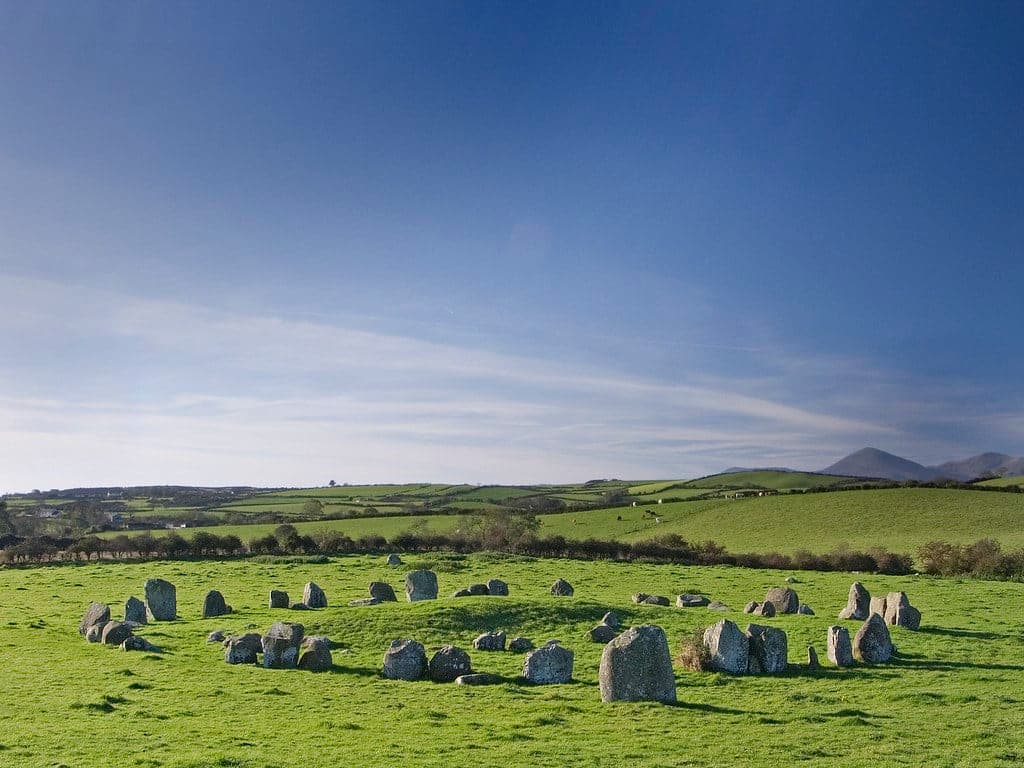
Ballynoe Stone Circle, Downpatrick, Ireland
Where ancient Ireland laid its dead to rest beneath stones aligned with the turning sun
Downpatrick, Northern Ireland, United Kingdom
At A Glance
- Coordinates
- 54.2906, -5.7262
- Suggested Duration
- A minimum of thirty minutes allows basic exploration. One hour is recommended to walk the hawthorn path slowly, sit with the stones, and take in the landscape. Those seeking deeper engagement may stay longer, though the site's simplicity is best met with presence rather than extended analysis.
- Access
- From Downpatrick, head south on the Ballynoe Road for approximately 2.5 miles. The site is signed, though the sign can be easy to miss. Look for it near the old railway station. From the Castle Inn, go south on Ballynoe Road about 200 meters and watch for the sign and path on the west side of the road. Note that GPS navigation may not lead directly to the site; if directed to turn before the crossroads, continue to the crossroads, turn right, and look for the sign. Parking is available roadside for one to three cars.
Pilgrim Tips
- From Downpatrick, head south on the Ballynoe Road for approximately 2.5 miles. The site is signed, though the sign can be easy to miss. Look for it near the old railway station. From the Castle Inn, go south on Ballynoe Road about 200 meters and watch for the sign and path on the west side of the road. Note that GPS navigation may not lead directly to the site; if directed to turn before the crossroads, continue to the crossroads, turn right, and look for the sign. Parking is available roadside for one to three cars.
- No formal requirements, but dress for the Irish climate. Sturdy footwear is essential, as the path can be muddy and the field uneven. Wellies are recommended in wet weather. Layers accommodate the changeable conditions typical of County Down. The site is exposed; wind is common.
- Photography is freely permitted. The site is photogenic at all times of day, particularly at sunset when the Mourne Mountains catch the light. If others are present and appear to be engaged in meditation or spiritual practice, exercise discretion. Consider whether your photography is adding to or detracting from the atmosphere. The stones will still be here after you put the camera away.
- Do not disturb or move any stones. Do not remove anything from the site, however small. The archaeological integrity of Ballynoe depends on leaving it as you found it. While the fairy tradition invites offerings, avoid leaving non-biodegradable items. Plastic ribbons and synthetic materials do not belong here. Natural fibers, coins, and organic materials decompose without harming the site. Be respectful of others who may be engaged in their own practice. The site is often empty, but when shared, silence is the common courtesy. Loud conversation and music diminish the quality that draws people here. Dogs are permitted but must be kept under control. The surrounding fields contain sheep.
Overview
Rising from the green fields of County Down, Ballynoe Stone Circle holds five thousand years of accumulated silence. One of Ireland's largest and most intact megalithic rings, it enfolds a burial mound where cremated ancestors once slept beside sacred water-smoothed stones. Visitors consistently describe a quality of peace here that feels less like absence than presence.
The path to Ballynoe Stone Circle passes through an avenue of hawthorn trees hung with ribbons and trinkets. This is fairy country, and the offerings continue a conversation that has never quite ceased between the living and what lies beyond.
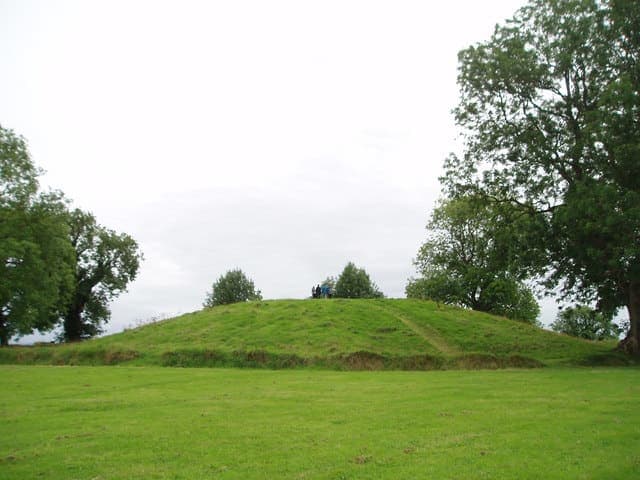
At the path's end, the circle opens: some fifty rough stones standing close together, forming a ring roughly thirty-five meters across. They are not the towering monoliths of Stonehenge but something older and more intimate, worn by five millennia of wind and rain. Within the ring lies a raised mound, the burial place of at least seven individuals whose cremated remains were discovered during excavation in 1937.
The builders aligned their work with the sky. At the spring equinox, the setting sun passes through the entrance stones. At the winter solstice, it descends over Slieve Donard in the distant Mourne Mountains, the highest peak in Northern Ireland. These were a people who understood themselves as participants in celestial rhythms.
That understanding has passed from living practice into memory and stone. Yet visitors consistently report something here that resists the label of ruin. A quietude that feels inhabited. A sense, as one put it, that standing on the central mound and looking out through the stones produces a profound effect on inner peace. Whether this reflects the accumulated weight of centuries of human attention, the geometry of the site, or something less easily named, the pattern is consistent enough to take seriously.
Context And Lineage
Ballynoe Stone Circle was constructed in phases beginning around 3000 BCE, making it possibly Ireland's oldest stone circle. It served as a burial ground and ceremonial site through the Late Neolithic and Early Bronze Age. Mentioned in early Irish mythology as part of the sacred geography of Mag nInis, it connects to both the passage tomb tradition of Carrowkeel and the court tomb tradition of nearby Audleystown. The site remained unexcavated until 1937, when Dutch archaeologist Van Giffen revealed its burial contents.
The founding narrative of Ballynoe is lost. Unlike sites documented in medieval manuscripts, this circle predates written record by millennia. What remains is inference from stone and bone.
The builders chose a low-lying spot on the Lecale Peninsula, unusual for megalithic monuments which typically favor high ground. Perhaps they sought proximity to water, or to the now-invisible paths their communities traveled. They raised fifty or more rough stones in an ellipse, placing them close together in a style that echoes circles in Cumbria across the Irish Sea. Within the ring, they built a long cairn with burial cists at both ends.
At the western cist, they deposited cremated remains in a three-chambered structure reminiscent of court tombs. At the eastern cist, a single chamber held other remains along with a decorated sherd of Carrowkeel pottery, linking these builders to the passage tomb tradition of County Sligo. Among the bones, they placed baetyls, sacred water-smoothed stones carried from rivers or shore. These stones may have represented souls, or journeys, or the waters of the Otherworld.
The mythology picks up the thread centuries later. In the Tochmarc Etaine, Ailill Angubae, brother of the High King, lives in Mag nInis. The Mac Oc comes seeking the goddess Etain. Whether this tale preserves genuine memory or merely borrows the site's numinous reputation, it places Ballynoe among the most significant locations in Irish sacred geography, alongside Tara and Emain Macha.
The builders of Ballynoe left no names. They belong to the Neolithic and Early Bronze Age communities of Ireland whose monuments still punctuate the landscape but whose identities are irrecoverable. They built for the dead and for the sky, placing cremated remains at points aligned with the turning sun.
The site passed into mythology as part of Mag nInis, the sacred plain of Lecale. Medieval monks may have known of it, though no written record survives. Local farmers worked the surrounding fields for centuries, the stones a familiar feature of their landscape.
In 1937, Van Giffen's excavation brought Ballynoe into archaeological discourse. His death left the record incomplete, a fitting echo of a site that resists full disclosure. Today the circle is maintained by Northern Ireland's heritage authorities, free and open to all. It draws archaeologists, pagans, tourists, and seekers who fit no category. The hawthorn path fills with new offerings each season. Whatever conversation began here five thousand years ago continues, in languages that change while something underneath remains.
Ailill Angubae
mythological
King of the Ulaid mentioned in the Tochmarc Etaine as residing in Mag nInis, the plain encompassing Lecale. His presence in mythology connects Ballynoe to the mythic geography of ancient Ireland.
Etain
deity
Goddess-figure central to the Tochmarc Etaine, whose story of transformation and reincarnation touches Mag nInis. Her presence in tales associated with this region suggests its supernatural significance.
The Aos Si
spiritual beings
The fairy folk believed to dwell in liminal places where the veil between worlds is thin. Stone circles are considered entrances to their realm. The ongoing practice of leaving fairy offerings at Ballynoe honors this tradition.
Albert van Giffen
historical
Dutch archaeologist who excavated Ballynoe in 1937-1938, uncovering its burial contents. He died before publishing his findings, which were later completed by colleagues in 1976.
Why This Place Is Sacred
Ballynoe's sacredness emerges from the convergence of death, cosmos, and landscape. As a burial site aligned with solstices and equinoxes, it sits at the intersection of the temporal and eternal. Its mention in early Irish mythology places it within the sacred geography that once mapped the island, while the ongoing practice of leaving fairy offerings suggests the boundary between worlds remains porous here.
For the Neolithic peoples who built Ballynoe, the line between worlds was not a metaphor but a geography. They placed their dead at points where that line grew thin, where the passage between realms might be eased. The astronomical alignments suggest they understood this thinness as rhythmic: there were moments when the veil lifted, when sun and stone and ancestor aligned.
The presence of baetyls among the grave goods offers a clue to their thinking. These water-smoothed stones, found in the burial cists, were sacred objects carried from elsewhere, perhaps from rivers or the sea. Their inclusion with cremated remains suggests a cosmology that saw in natural forms a connection to realms beyond the visible.
Ballynoe appears in the Tochmarc Etaine, one of the earliest Irish mythological texts. The tale places Ailill Angubae, king of the Ulaid, in Mag nInis, the plain that includes Lecale. This situates the site alongside Tara and Emain Macha in the sacred geography of ancient Ireland, a landscape mapped not by politics but by numinous power.
Contemporary visitors often describe the approach through the hawthorn lane as enchanted, as if they are walking into another register of experience. The hawthorn is the fairy tree in Irish tradition, a boundary marker between ordinary and Otherworld. The offerings left along the path suggest this boundary work continues. The circle itself, when reached, often produces a deepening of whatever arose on the path: a stillness that visitors struggle to articulate, a sense of being held by the ring of stones and the mountains beyond.
Archaeological evidence indicates Ballynoe served as a ceremonial burial site over at least a millennium, from approximately 3000 BCE into the Early Bronze Age. The long cairn within the circle contained stone cists at both ends, holding the cremated remains of at least seven individuals including a young child. The presence of Carrowkeel ware pottery connects the site to the passage tomb tradition, while the two-chambered design at the western end echoes court tomb architecture. This hybrid suggests either prolonged use by different groups or a cosmology that wove multiple burial traditions together. The astronomical alignments indicate the site was also an observatory, marking the turning points of the year when ceremonies may have occurred.
The original builders are unknown, their practices lost to the silence of five thousand years. The site passed from active ceremonial use into the half-memory of mythology, where it persisted as a place of royal significance in early Irish tales. Christianity likely layered new meanings onto old, though no church was built here. The stones stood through the centuries, known to local farmers, occasionally disturbed by treasure seekers, but largely left alone.
Dutch archaeologist Albert van Giffen excavated in 1937-1938, uncovering the burials and grave goods that now inform our understanding. He died before publishing his findings, adding another layer of incompleteness to a site that refuses full disclosure. Today Ballynoe draws those who seek the old ways: pagans at solstices, pilgrims on no fixed calendar, and ordinary visitors who find themselves unexpectedly moved. The fairy offerings accumulate. The conversation continues.
Traditions And Practice
No organized ceremonies take place at Ballynoe today. The site is managed as a heritage monument rather than active temple. However, informal spiritual practice continues through solstice and equinox observation, meditation among the stones, and the ongoing tradition of leaving fairy offerings along the hawthorn approach.
The original practices at Ballynoe are unknown, lost to the five-thousand-year gap between construction and written record. Archaeological evidence suggests cremation burial ceremonies occurred here over many centuries. The presence of Carrowkeel pottery and baetyls indicates ritual deposition of sacred objects with the dead. The astronomical alignments point to ceremonies at the turning points of the year, when the sun's position relative to the entrance stones marked solstice and equinox.
Scholars speculate about processional activities using the entrance avenue, perhaps moving from the outer world into the sacred enclosure. The random scatter of cremation deposits between the central mound and the stone ring suggests the entire interior was consecrated ground. But specifics remain inference. The builders left only stone and bone.
Modern visitors engage with Ballynoe in ways that feel authentic to them. Many simply sit in silence, allowing the place to work at its own pace. The central mound offers a natural focal point, a place to stand or sit while taking in the circle and the mountains beyond.
At solstices and equinoxes, small numbers of visitors come to observe the astronomical alignments. The spring equinox sunset through the entrance stones and the winter solstice sunset over Slieve Donard are the most significant moments. No formal gatherings are organized, but those who come on these dates find others drawn by the same rhythms.
The practice of leaving fairy offerings continues without organization or doctrine. Visitors tie ribbons to the hawthorn trees, leave coins at the roots, place small objects along the path. This is not performance but participation in a tradition that predates any current understanding of what fairies are or want. The offerings accumulate and eventually return to the earth, making room for more.
If you come seeking more than scenery, consider these approaches.
Walk the hawthorn path slowly, as threshold rather than route. Notice what has been left by those who came before. You need not leave anything yourself, but if something feels right, let it be biodegradable.
At the circle, stand first on the central mound. Face the entrance stones, then turn slowly, taking in each quadrant. Let your attention settle on whatever draws it. The Mourne Mountains to the southwest hold the winter solstice sunset; the entrance to the northwest frames the spring equinox. Even on ordinary days, these alignments shape the space.
Sit on one of the fallen stones at the perimeter if you wish. Close your eyes if that helps. Ask no questions. Make no demands. Let the place reveal what it will, in its own time.
If you come at solstice or equinox, arrive an hour before sunset. The light changes slowly. The alignments emerge gradually. Patience is part of the practice.
Neolithic/Bronze Age Funerary Tradition
HistoricalBallynoe served as a burial ground and ceremonial center for ancient peoples over more than a millennium. Excavations revealed cremated remains of at least seven individuals including a young child, along with Carrowkeel pottery associated with passage tomb traditions. The presence of baetyls, sacred water-smoothed stones, in burial cists suggests the dead were accompanied by objects connecting them to other realms.
Archaeological evidence indicates cremation burial in stone cists, deposition of pottery and baetyls with the dead, and construction of the long cairn structure within the circle. The astronomical alignments suggest ceremonies at solstices and equinoxes. The processional entrance may have facilitated ritual movement from ordinary to sacred space.
Irish Celtic Mythology
HistoricalThe site appears in the Tochmarc Etaine, one of the earliest Irish mythological texts. Ailill Angubae, king of the Ulaid and brother of the High King, resided in Mag nInis, the plain that includes Lecale. This places Ballynoe alongside Tara and Emain Macha in the sacred geography of early Ireland.
As a mythological location, Ballynoe features in tales of royal residence and supernatural visitation. The Mac Oc comes seeking Etain at Ailill's house. These narratives suggest the site retained numinous significance well into the medieval period, even as its original purpose faded from memory.
Irish Folk Tradition
ActiveBallynoe maintains connections to Irish fairy lore. The approach path lined with hawthorn trees, the offerings of ribbons and coins, the sense that the veil between worlds is thin here, all reflect beliefs that predate and persist alongside Christianity. Stone circles are understood as liminal spaces, entrances to the Otherworld where the Aos Si dwell.
Visitors continue to leave offerings along the hawthorn path and at trees near the circle. Ribbons tied to branches, coins at roots, small objects placed as votive gifts, these accumulate through the seasons. The offerings are not addressed to named deities but to the fairy folk, to whatever inhabits the threshold spaces.
Contemporary Paganism
ActiveBallynoe attracts modern pagans and seekers, particularly at solstices and equinoxes when the astronomical alignments can be observed. The site offers direct encounter with ancient sacred architecture in a landscape relatively undeveloped by modern infrastructure.
Individual and small-group visits for meditation, solstice and equinox observation, and personal spiritual practice. No formal ceremonies or organized gatherings are documented, but the site serves as pilgrimage destination for those walking neo-pagan, druidic, or eclectic spiritual paths. The emphasis is on presence, attunement, and personal encounter rather than scripted ritual.
Experience And Perspectives
Visitors to Ballynoe consistently describe peace, but peace of an unusual quality: not emptiness but presence, not relaxation but attention. The site seems to quiet mental noise while sharpening awareness. Many report feeling connected to deep time, to ancestral energies, to the land itself. The enchanted hawthorn approach amplifies these effects.
The experience of Ballynoe begins on the path. Walking between hawthorn trees hung with ribbons and small offerings, visitors often notice a shift in attention. The everyday mind quiets. Something opens. By the time the stones appear, many have already entered a different register of awareness.
The circle itself produces remarkably consistent effects. Visitors describe profound peace, but peace of an active rather than passive quality. The stones seem to hold something. The silence, as one account put it, is not empty but full, a listening quality. Those who stand on the central mound and look out through the stones toward the distant mountains often report a sense of being placed, of occupying exactly the right position in a larger pattern.
Unexpected emotion is common. Not grief, necessarily, though the site is a burial ground. Something closer to recognition, or homecoming. Visitors who had no prior interest in archaeology or spirituality find themselves moved in ways they struggle to explain. The word they reach for most often is magical, though the quality they describe seems less supernatural than simply deeper, as if ordinary experience had been stripped of its noise.
Many note the quality of solitude. Even during summer months, visitors often find themselves alone at the circle. This isolation amplifies the sense of stepping outside time, of entering a space that belongs to another order of experience. The stones, the mound, the mountains on the horizon, the offerings along the path, all conspire to produce what one visitor called a tranquil and quiet little sanctuary.
Approach slowly. The hawthorn path is not mere access but preparation, a threshold crossing. Notice what has been left there, the ribbons and coins and fairy doors. These are not decoration but communication, evidence of a relationship between visitors and place that predates any single tradition.
At the circle, consider standing on the central mound before exploring the perimeter. Look out through the stones toward the Mourne Mountains. Let your eyes rest on Slieve Donard. The winter solstice sun sets there, marking the year's turning. Even on ordinary days, something of that alignment persists.
If you come seeking meaning, let the seeking relax. Ballynoe does not require effort. It requires presence. Sit on one of the stones if you wish, though do not disturb or move any. Let the place work at its own pace. What arrives may be subtle: a quieting, a widening, a sense of deep time folding around the present moment. It may be nothing you can name. That, too, is valid.
Ballynoe Stone Circle invites multiple readings, and honest engagement requires holding them together without forcing resolution. Archaeologists, mythologists, folk traditionalists, and contemporary spiritual seekers each offer genuine insight, and each operates within frameworks that shape what they see. The site is old enough and complex enough to contain contradiction.
Archaeological consensus places Ballynoe's construction in the Late Neolithic, around 3000 BCE, with continued use into the Early Bronze Age. The site defies simple classification, combining elements of stone circle, passage tomb, and court tomb traditions. Gabriel Cooney suggests it may have begun as a court tomb, with the stone circle and passage tomb features added later. John Waddell notes the Carrowkeel ware pottery connecting the site to the passage tomb tradition of western Ireland. Aubrey Burl sees architectural links to stone circles in Cumbria, suggesting connections across the Irish Sea.
The astronomical alignments, documented by researchers at ResearchGate and elsewhere, are well established: the spring equinox sunset through the entrance stones, the winter solstice sunset over Slieve Donard. Whether these alignments were primarily calendrical, agricultural, ceremonial, or all three remains debated. Van Giffen's unpublished notes, finally released through Palaeohistoria in 1976, provide the primary archaeological documentation, though the absence of radiocarbon dating from the original excavation limits chronological precision.
In Irish folk tradition, stone circles are places where the veil between worlds thins. The Aos Si, the fairy folk, are said to dwell in or pass through such places. The hawthorn trees lining the approach path are fairy trees, boundary markers between the ordinary world and the Otherworld. The ongoing practice of leaving offerings along this path reflects a relationship between human and other-than-human that predates Christianity and persists alongside it.
The site's appearance in the Tochmarc Etaine places it within the mythological geography of ancient Ireland. That Ailill Angubae, brother of the High King, resided in this region suggests it was no backwater but a place of significance in the pre-Christian understanding of the island. The conjunction of archaeological antiquity and mythological prominence reinforces the sense that Ballynoe was and remains a place apart.
Some contemporary practitioners describe Ballynoe as a peace circle with powerful earth energies. The astronomical alignments are interpreted as evidence of sophisticated cosmological knowledge, with the site functioning as a cosmic temple or calendar. The term energy is frequently used to describe what visitors feel here, though it resists precise definition. Some associate the site with ley lines or earth currents, though these concepts find no support in academic archaeology.
These interpretations often emerge from genuine experiences visitors have at the site. The language of energy may be an attempt to describe something real that resists conventional vocabulary. Taking the experience seriously does not require accepting every explanatory framework offered for it.
Genuine mysteries remain. The exact sequence of construction phases is uncertain. The relationship between the stone circle and the internal burial mound, which came first, cannot be definitively established. Why this particular location was chosen, in low-lying farmland rather than on commanding heights, is unexplained.
The significance of the baetyls found in the burial cists is debated. Were they soul-stones? Tokens of journey? Connection to water-sources? No contemporary tradition survives to interpret them. Van Giffen's death left his excavation notes incomplete, and questions he might have answered went unasked.
Perhaps most fundamentally, the original experience of this place, what it meant to those who built it, who walked the entrance avenue toward the setting sun, who laid their dead in the stone-lined chambers, is irrecoverable. We can reconstruct architecture and alignment. We cannot reconstruct belief.
Visit Planning
Ballynoe Stone Circle is free and open at all times. Access is via a short walk from roadside parking near Downpatrick. The site has no facilities; nearby Downpatrick offers all services. Summer offers the easiest conditions, while winter solstice provides the most significant astronomical alignment. Allow at least an hour to fully experience the site.
From Downpatrick, head south on the Ballynoe Road for approximately 2.5 miles. The site is signed, though the sign can be easy to miss. Look for it near the old railway station. From the Castle Inn, go south on Ballynoe Road about 200 meters and watch for the sign and path on the west side of the road. Note that GPS navigation may not lead directly to the site; if directed to turn before the crossroads, continue to the crossroads, turn right, and look for the sign. Parking is available roadside for one to three cars.
There is no accommodation at the site. Downpatrick, 2.5 miles north, offers various options including hotels, bed and breakfasts, and guesthouses. Belfast, approximately 30 miles north, provides a full range of urban accommodation. For those wishing to stay closer to the landscape, self-catering cottages and farmhouse B&Bs can be found throughout the Lecale Peninsula.
Ballynoe requires behavior appropriate to both a protected heritage site and a place that still carries meaning for contemporary practitioners. Do not disturb the stones, stay on existing paths, keep dogs controlled, and maintain a contemplative atmosphere. Offerings are traditional but should be biodegradable.
The most important principle is non-disturbance. These stones have stood for five thousand years. They are not climbing structures, props for photographs, or objects to be rearranged for better composition. The impulse to touch is natural, and gentle contact with the stones is not harmful, but climbing on structures, moving stones, or digging around bases compromises archaeological integrity.
The site sits within agricultural land. Close any gates you pass through. Keep dogs under control, as sheep graze the surrounding fields. Stay on existing paths and worn routes through the circle. The grass within the ring may cover archaeological features that foot traffic could damage.
Maintain an atmosphere appropriate to the site's significance. Those who come for spiritual practice deserve the same respect as those engaged in prayer at any active site of worship. Loud conversation, music from devices, and performative behavior for social media diminish the experience for others. The quality that draws people here depends on collective care.
If leaving offerings along the fairy path, choose materials that will return to the earth: natural fibers, coins, flowers. Plastic and synthetic materials do not belong here. If you find offerings left by others disturbing or inappropriate, leave them alone. They are not yours to remove.
No formal requirements, but dress for the Irish climate. Sturdy footwear is essential, as the path can be muddy and the field uneven. Wellies are recommended in wet weather. Layers accommodate the changeable conditions typical of County Down. The site is exposed; wind is common.
Photography is freely permitted. The site is photogenic at all times of day, particularly at sunset when the Mourne Mountains catch the light. If others are present and appear to be engaged in meditation or spiritual practice, exercise discretion. Consider whether your photography is adding to or detracting from the atmosphere. The stones will still be here after you put the camera away.
The tradition of leaving offerings for the fairies continues along the hawthorn approach and at trees near the circle. Common offerings include ribbons tied to branches, coins placed at roots, and small natural objects. If you choose to participate, select biodegradable materials. Do not leave offerings within the stone circle itself, where they may be considered litter by heritage authorities.
There are no entry fees or restricted hours. The site is open to all at any time. There are no facilities, including no toilets, no visitor center, and no marked parking. Roadside parking is available for one to three cars. Treat the site with the respect you would bring to any sacred ground, regardless of your personal beliefs about its significance.
Sacred Cluster
Nearby sacred places create the location cluster described in the growth plan. This block is intentionally crawlable and links into the wider regional graph.
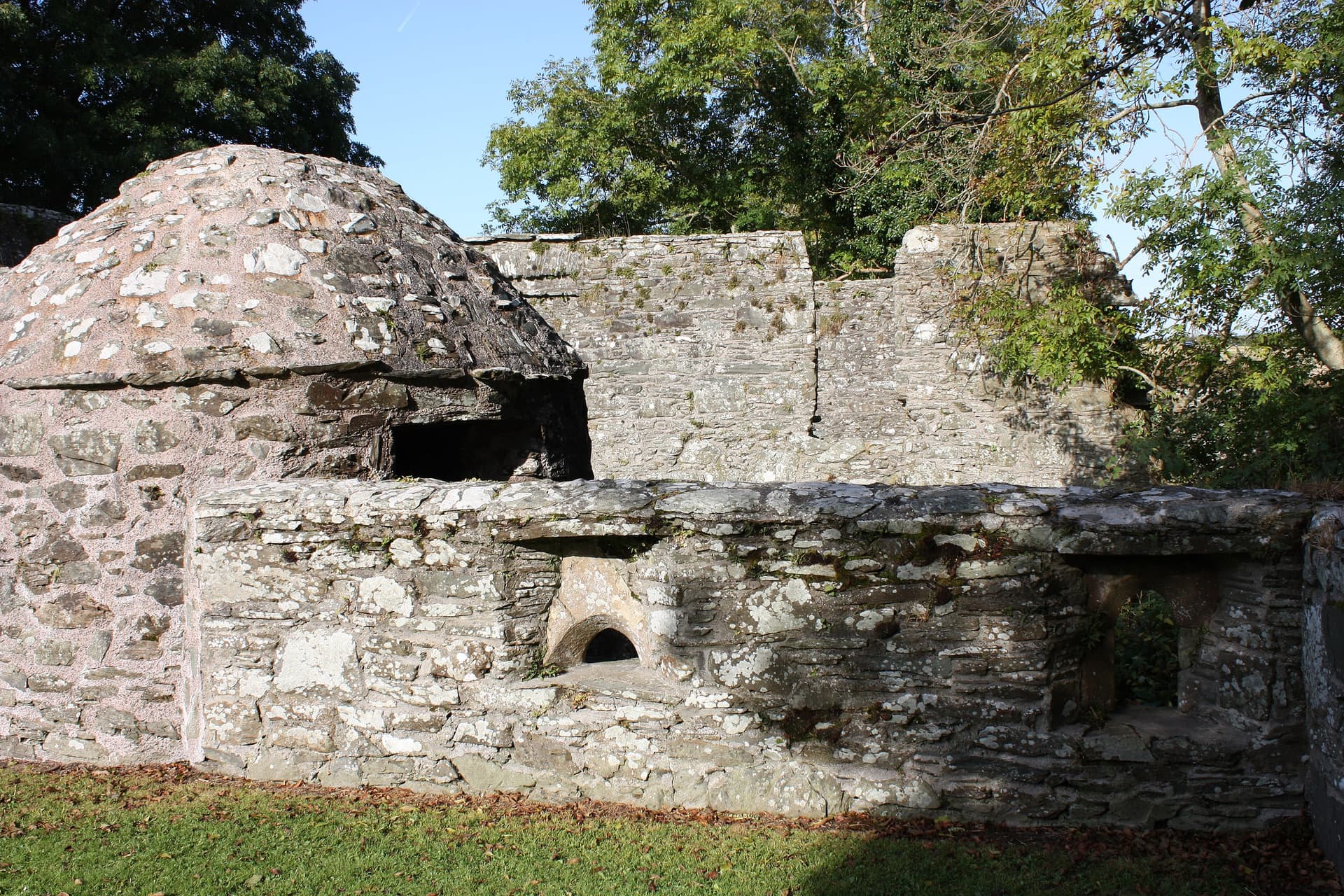
Struell Wells, Downpatrick, Northern Ireland
Downpatrick, Northern Ireland, United Kingdom
4.8 km away
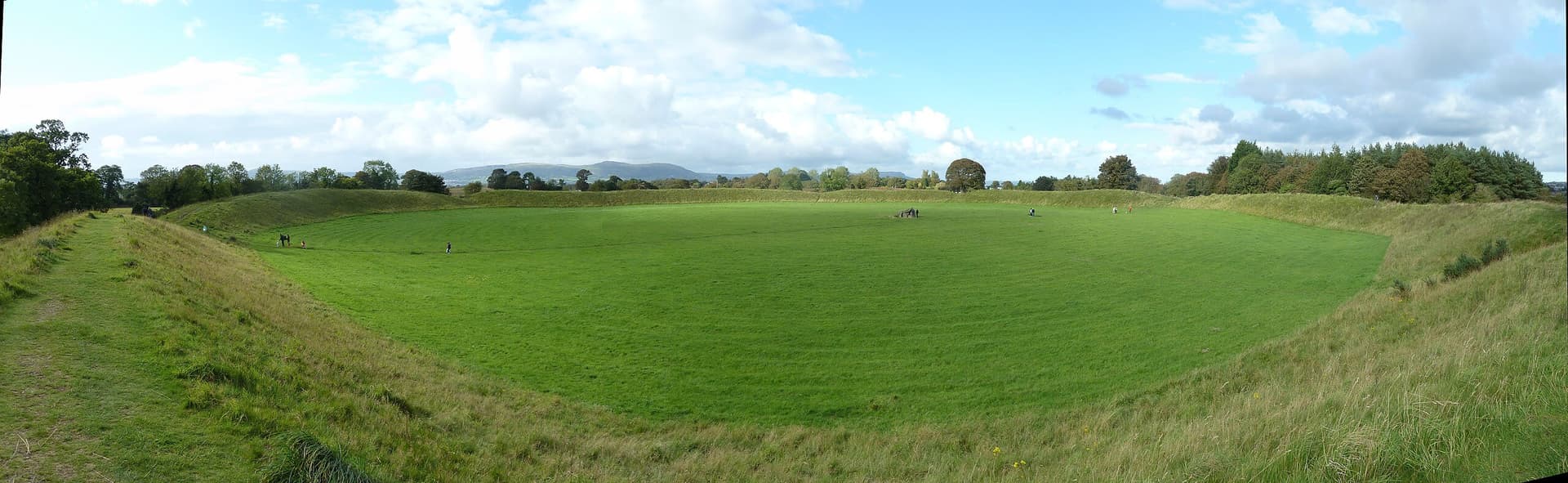
Giant’s Ring, Belfast, Northern Ireland
Belfast, Northern Ireland, United Kingdom
31.5 km away
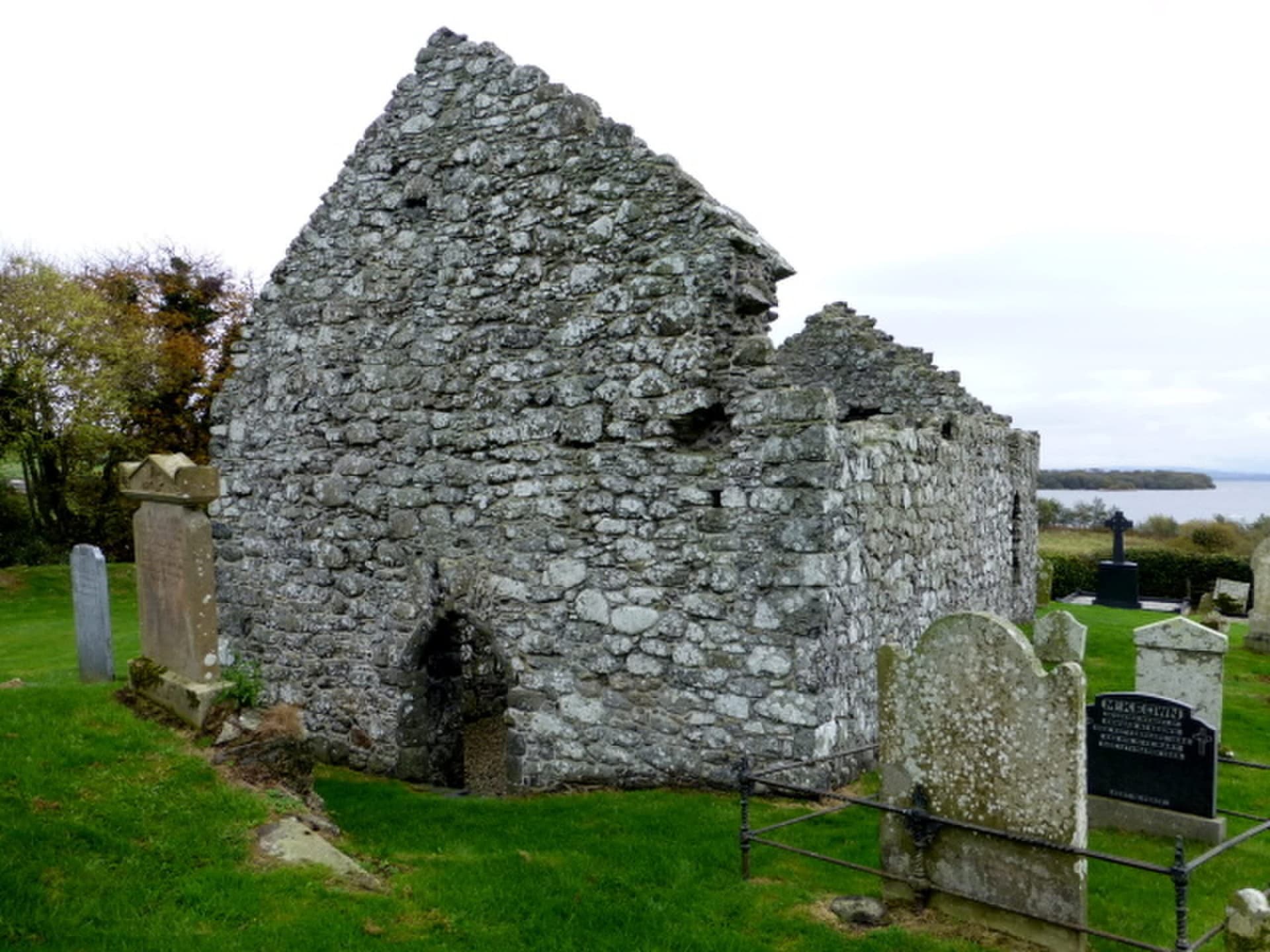
Cranfield Church, Antrim, Northern Ireland
Antrim and Newtownabbey District, Northern Ireland, United Kingdom
62.4 km away
Eamhain Mhacha
Armagh, Northern Ireland, United Kingdom
63.4 km away