Amarna (Akhetaten)
Where a pharaoh built humanity's first city dedicated to a single god, abandoned within a generation
Tel Al Amarna, Al Minya, Egypt
At A Glance
- Coordinates
- 27.6570, 30.9033
- Suggested Duration
- Half-day minimum for main sites (Great Temple, Small Temple, North Tombs, Boundary Stela U). Full day if including the Royal Tomb (6 km into Royal Wadi). Many visitors combine with stays in Minya or Asyut.
- Access
- From Cairo: 312 km south (approximately 4 hours) via the Eastern Desert Highway with turnoff to Mallawi. From Minya: 58 km south (approximately 1.5 hours). Train service to Mallawi or Deir Mawwas, but local transportation is needed from stations. Private tours available from Cairo (long day trips) or Minya. Nile cruises occasionally include Amarna.
Pilgrim Tips
- From Cairo: 312 km south (approximately 4 hours) via the Eastern Desert Highway with turnoff to Mallawi. From Minya: 58 km south (approximately 1.5 hours). Train service to Mallawi or Deir Mawwas, but local transportation is needed from stations. Private tours available from Cairo (long day trips) or Minya. Nile cruises occasionally include Amarna.
- Practical clothing for desert conditions. Sturdy walking shoes. Sun protection (hat, sunscreen, sunglasses). Light, breathable fabrics. No formal dress code.
- Personal photography generally permitted. Flash may be restricted in decorated tombs. Professional equipment and tripods may require permits. Check current regulations at the ticket office.
- This is an archaeological site, not an active sacred space. No offerings should be left. No climbing on or touching ruins. The desert heat can be extreme, especially in summer. Limited shade and facilities require preparation. The Royal Tomb involves a 6 km journey into the wadi.
Overview
Amarna rises from the Egyptian desert as the remains of history's first experiment in monotheistic state religion. Here, Pharaoh Akhenaten constructed a city dedicated solely to the Aten, the sun disc, abandoning the traditional gods of Egypt. The revolution lasted barely two decades before being erased from memory. Yet the ruins remain, offering an unparalleled window into a moment when one ruler attempted to transform the spiritual consciousness of an entire civilization.
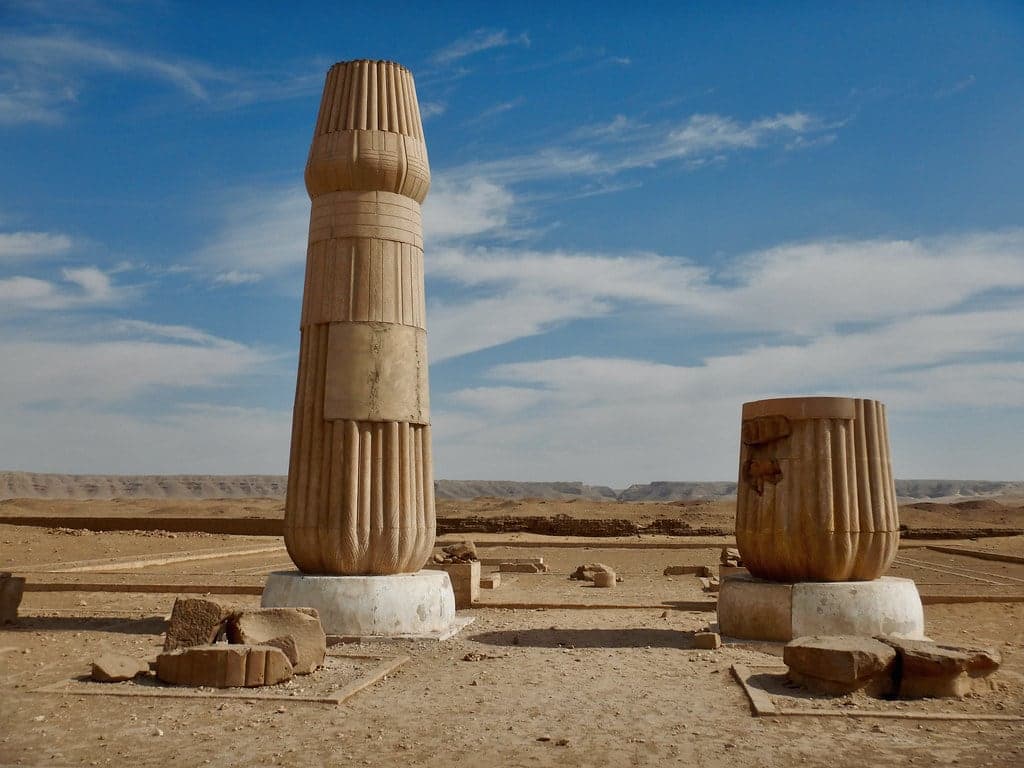
On the east bank of the Nile, the ruins of Akhetaten, Horizon of the Aten, spread across twelve kilometers of desert plain. This was humanity's first purpose-built city for the worship of a single deity. Pharaoh Akhenaten, abandoning Thebes and its powerful priesthood of Amun, constructed an entirely new capital dedicated exclusively to the Aten, the visible disc of the sun. No other gods could be worshipped here. Temples rose without roofs, open to the sky so the sun's rays could directly participate in worship.
The experiment lasted approximately fourteen years. After Akhenaten's death, his successors repudiated the new religion, returned the capital to Thebes, and systematically destroyed Akhetaten. Akhenaten's name was erased from monuments, his image defaced, his memory condemned. The city was abandoned and eventually buried beneath desert sand.
Yet burial preserved what persecution could not destroy. Modern excavations have revealed a complete ancient city with streets, houses, temples, palaces, and decorated rock-cut tombs. The Amarna Letters, a diplomatic archive of cuneiform tablets, were discovered here, transforming understanding of Bronze Age international relations. The famous bust of Queen Nefertiti emerged from a sculptor's workshop at this site. The Great Hymn to the Aten, preserved in the nobles' tombs, expresses a vision of cosmic unity under the sun that some scholars compare to biblical psalms.
Amarna offers something no other ancient Egyptian site provides: the physical remains of a religious revolution. Here, visitors can contemplate a moment when one individual attempted to redirect millennia of tradition toward a new understanding of the divine. The attempt failed, but the questions it raised about the nature of god, the relationship between religious and political authority, and the fate of revolutionary ideas remain as relevant as ever.
Context And Lineage
A city built in approximately 1346 BCE as the capital of Akhenaten's religious revolution, abandoned within two decades, and preserved by its isolation until modern excavation.
According to the boundary stelae, Akhenaten declared that the Aten himself revealed this place. On the thirteenth day of the season of Peret in Year 5 of his reign, Akhenaten traveled by chariot to the site and proclaimed it the Horizon of the Aten, describing it as the seat of the First Occasion which the Aten had made for himself. The king vowed that neither he nor Nefertiti would ever extend the boundaries beyond those marked by the stelae. The Royal Wadi's natural formation, resembling the hieroglyph for horizon where the sun rose between two hills, indicated to Akhenaten that the Aten desired worship at this location.
No continuous religious lineage exists. Atenism ceased with Akhenaten's death and was actively suppressed. The site later hosted early Christian monks during the Roman and Byzantine periods, representing an entirely separate religious tradition. Today, the site is an archaeological heritage destination managed by the Egyptian Ministry of Tourism and Antiquities, with ongoing excavation by the Amarna Project (Egypt Exploration Society).
Akhenaten (Amenhotep IV)
Pharaoh of the 18th Dynasty (c. 1353-1336 BCE)
Nefertiti
Great Royal Wife of Akhenaten
Tutankhamun
Pharaoh and likely son of Akhenaten
Thutmose
Sculptor, active c. 1340 BCE
Why This Place Is Sacred
A place where intense, concentrated devotion to a single god once filled every structure, now preserved in its abandonment as a meditation on religious reform and its costs.
The thinness of Amarna is peculiar. No continuous tradition of worship accumulated here over centuries. Instead, the site represents an explosion of devotion compressed into fewer than twenty years, followed by deliberate erasure and millennia of silence. What makes it thin is the intensity of that brief period and the remarkable preservation that resulted from its abandonment.
Akhenaten chose this location because he believed the Aten itself had revealed it. The Royal Wadi's natural formation resembles the hieroglyph for horizon, akhet, where the sun rises between two hills. To Akhenaten, this was sacred geography, a place where the sun god had already written his desire into the landscape. The boundary stelae carved into surrounding cliffs declare this land holy, set apart for the Aten and never to be used for any other purpose. The very ground was consecrated by royal decree.
The open-air temples concentrated worship in a unique way. Traditional Egyptian temples grew progressively darker as worshippers approached the sanctuary, culminating in a small, enclosed space where the god's statue resided. At Amarna, temples had no roofs. Hundreds of offering tables stood exposed to the sky. When the sun rose over the eastern hills, its rays fell directly on the offerings, making the god's presence visible and tangible. Every morning brought a theophany, the manifestation of the divine in light.
The Great Hymn to the Aten, preserved in the tombs of Amarna nobles, articulates a vision of cosmic unity under the sun that still resonates:
'How manifold it is, what thou hast made! They are hidden from the face of man. O sole god, like whom there is no other! Thou didst create the world according to thy desire, Whilst thou wert alone.'
These words, composed over three thousand years ago, express a theological vision of striking sophistication. Scholars have noted parallels with Psalm 104. Whether there was direct influence remains debated, but the hymn demonstrates that profound religious poetry emerged from Akhenaten's revolution.
The site's later use adds another layer. Recent research reveals that early Christian monks settled in the cliffs overlooking the Nile Valley, seeking spiritual purity in the same remoteness that once hosted Atenist worship. Two radically different religious movements left their marks on this place, separated by over a millennium but united by the impulse to seek the divine apart from conventional society.
To serve as the exclusive capital and worship center for the Aten, the sun disc, in humanity's first recorded monotheistic state religion.
Constructed rapidly around 1346 BCE, occupied for approximately 14-20 years, abandoned after Akhenaten's death, systematically dismantled by later pharaohs, buried by desert, rediscovered in the nineteenth century, excavated extensively from 1891 to present. Later used as a Christian monastic retreat during the Roman and Byzantine periods.
Traditions And Practice
Ancient Atenist worship ceased 3,300 years ago. Today the site functions as an archaeological destination supporting personal contemplation.
In Akhenaten's time, daily worship of the Aten occurred at open-air temples where offerings were presented on exposed tables while the sun shone directly upon them. The Great Temple contained hundreds of offering tables. Worship occurred under the sky rather than in enclosed sanctuary spaces. Akhenaten and Nefertiti traveled by chariot along the Royal Road between palaces and temples, publicly demonstrating their role as intermediaries between the Aten and the people. Hymns including the Great Hymn to the Aten were recited. The religion required no priestly class interpreting hidden mysteries; the sun's visible presence was the god's constant manifestation.
No religious practices occur at Amarna. The site functions as an archaeological heritage destination. Visitors explore the city, temples, and tombs, often reflecting on the historical and spiritual significance of what they encounter. The Amarna Project continues academic research and excavation. The Visitor Centre provides educational resources.
Allow yourself time for contemplation rather than rushing between sites. Sit in the ruins of the Great Temple and consider what it meant to worship here, exposed to the sun. Read portions of the Great Hymn to the Aten before visiting the tombs where it is preserved. Consider visiting at sunrise or sunset when the light conditions evoke the centrality of the sun to this place. Bring the text of Psalm 104 for comparison with the Great Hymn.
Atenism
HistoricalAtenism was the world's first recorded state religion focused on a single deity, established by Akhenaten in the fourteenth century BCE. The religion centered on the Aten, the visible disc of the sun, portrayed as the sole creator and sustainer of all life. Akhenaten built Akhetaten as the exclusive sacred city of the Aten, the only place in Egypt where no other gods were worshipped. The Great Hymn to the Aten expresses profound theological concepts that some scholars compare to later biblical texts, particularly Psalm 104.
Daily worship at open-air temples under the sun's rays. Offerings presented on exposed tables. Royal family as intermediaries between the Aten and the people. Hymns and prayers including the Great Hymn. Suppression of other deities.
Early Christian Monasticism
HistoricalRecent research reveals that Amarna hosted early Christian monks during the Roman and Byzantine periods, centuries after its abandonment as a pharaonic capital. Monks settled in the elevated cliffs seeking spiritual purity and isolation, drawn by the site's remoteness and pre-existing rock-cut structures.
Ascetic desert living in rock-cut tombs and cliffs. Prayer and contemplation in isolation. Christian worship in adapted ancient structures.
Experience And Perspectives
Walking through a complete ancient city frozen in abandonment, entering decorated tombs where Akhenaten and Nefertiti worship the sun, contemplating the rise and fall of a religious revolution.
Approaching Amarna from the modern village of El-Till, the site's scale becomes apparent. This is not a single temple or pyramid but an entire city stretched along the Nile's east bank. The Amarna Visitor Centre provides orientation through panels, models, and a reconstructed official's house. From here, visitors can explore the main elements of Akhenaten's sacred geography.
The Great Temple of the Aten, the largest structure in the city, presents a different kind of temple experience. Where other Egyptian temples enclosed their mysteries, this one opened to the sky. Walking among the foundations and reconstructed elements, visitors can imagine hundreds of offering tables laden with bread, beer, meat, and vegetables, all receiving the sun's direct blessing as it rose each morning. The absence of the roofed sanctuary that characterizes every other Egyptian temple emphasizes how radically Akhenaten broke with tradition.
The Small Temple of the Aten, better preserved, offers more visible architectural details. Here the relationship between royal worship and the sun becomes clearer. The design guided the worshipper's eye toward the horizon where the Aten rose.
The rock-cut tombs of the nobles provide Amarna's most vivid artistic experience. Carved into the cliffs, these tombs preserve painted and relief scenes showing daily life in Akhenaten's city. The distinctive Amarna art style, with its elongated figures and naturalistic depictions of the royal family, covers the walls. Most striking are the scenes of Akhenaten and Nefertiti worshipping the Aten, the sun disc extending its rays, each ending in a small hand, toward the royal couple. The king and queen raise their arms in adoration. Their daughters accompany them. Above, the Aten dominates the sky.
Some tombs preserve texts including portions of the Great Hymn to the Aten. Reading these words in the space where their owners were meant to spend eternity creates a powerful connection to Akhenaten's vision.
The Royal Tomb, requiring a separate ticket and a journey into the Royal Wadi, offers a more challenging but rewarding experience. Here Akhenaten intended his own burial. The wadi's formation, resembling the horizon hieroglyph, explains why this specific location was chosen. The tomb's carved reliefs include scenes of mourning for Princess Meketaten, one of the most emotionally expressive works to survive from ancient Egypt.
The Boundary Stela U, accessible via a steep staircase, preserves the proclamation with which Akhenaten defined his sacred city. Standing before these carved words, visitors encounter the pharaoh's own voice explaining his vision and dedication.
The site's remoteness and relative lack of crowds compared to Luxor or Giza allows for contemplation that more popular sites cannot provide. Here, a visitor can stand in the ruins of a failed revolution and consider what it means to attempt religious transformation against the weight of tradition.
Amarna lies on the Nile's east bank, approximately 58 km south of Minya and 312 km south of Cairo. The modern village of El-Till serves as the entry point. The site stretches about 12 km along the river. Key areas include the Central City (temples, palaces), North Tombs, South Tombs, Boundary Stela U, and the Royal Wadi. The Visitor Centre provides orientation. A vehicle is needed to reach the Royal Tomb (6 km into the Royal Wadi). The North Tombs and Boundary Stela U involve steep staircases.
Amarna invites reflection on the nature of religious reform, the relationship between political and spiritual authority, and the fate of revolutionary ideas.
Egyptologists recognize Amarna as one of the most significant archaeological sites for understanding the New Kingdom and ancient Egyptian religion. The brief but intense occupation left an exceptionally well-preserved urban plan rarely available for study. The Amarna Letters provide the earliest known international diplomatic archive. Scholarly debate continues regarding whether Atenism represents true monotheism, monolatry (exclusive worship of one god while accepting others exist), or henotheism (focus on one god within a polytheistic framework). Most scholars agree Akhenaten's reforms were motivated by complex political, theological, and personal factors. The artistic innovations of the Amarna period, with its naturalistic and sometimes exaggerated style, represent a distinctive break from Egyptian convention. DNA analysis has confirmed the mummy in tomb KV55 is Tutankhamun's father, likely Akhenaten himself.
Modern Egypt values Amarna as part of its pharaonic heritage. The site represents an important chapter in the religious history of the Nile Valley. Contemporary Egyptians may view the site through the lens of later Islamic tradition, which similarly emphasizes monotheism, creating a sense of connection with Akhenaten's vision despite vastly different historical contexts.
Some spiritual seekers view Akhenaten as a visionary mystic who received genuine divine revelation of monotheism centuries before Moses or other prophets. The resemblance between the Great Hymn to the Aten and Psalm 104 has led some to speculate about direct influence on Israelite religion, though most scholars attribute similarities to common ancient Near Eastern themes. New Age interpretations sometimes present Akhenaten as an enlightened spiritual teacher whose wisdom was suppressed by traditional religious authorities. Some alternative researchers connect Amarna to theories about ancient advanced consciousness, though these views lack academic support.
The cause of Akhenaten's death and whether it was natural or assassination remains unknown. The final burial location of Queen Nefertiti has not been definitively identified. Whether Atenism was genuinely monotheistic or a political strategy to diminish priestly power is debated. The extent to which ordinary Egyptians adopted Atenist beliefs versus simply following royal directives is unclear. The identity of Smenkhkare and relationship to Akhenaten and Nefertiti remains uncertain. Whether the Great Hymn to the Aten influenced biblical psalms or reflects parallel development cannot be determined with certainty.
Visit Planning
Accessible from Minya (58 km) or Cairo (312 km), best visited October through April, requiring half to full day depending on scope of exploration.
From Cairo: 312 km south (approximately 4 hours) via the Eastern Desert Highway with turnoff to Mallawi. From Minya: 58 km south (approximately 1.5 hours). Train service to Mallawi or Deir Mawwas, but local transportation is needed from stations. Private tours available from Cairo (long day trips) or Minya. Nile cruises occasionally include Amarna.
Limited options near Amarna itself. Minya offers the nearest selection of hotels. Asyut provides additional options to the south. Some visitors make day trips from Cairo, though this requires very early departure.
Respect for archaeological preservation, practical preparation for desert conditions, and personal contemplation appropriate to a heritage site.
Amarna requires the etiquette of an archaeological site rather than a place of worship. Stay on designated paths to protect fragile remains. Do not touch, climb on, or remove any stones, artifacts, or debris. What appears to be ordinary rubble may contain archaeological information. Respect any roped-off or restricted areas. The site guards are present to protect the remains and should be treated courteously.
In the decorated tombs, observe any photography restrictions. Flash photography may be prohibited to protect ancient pigments. The reliefs and paintings have survived over three thousand years and deserve careful preservation.
Dress practically for desert conditions. Sturdy closed-toe walking shoes are essential for uneven terrain. Light, breathable fabrics protect from sun and heat. A hat, sunscreen, and sunglasses are necessary. Bring more water than you think you need. There are limited facilities for purchase within the site.
The site's spiritual dimension, while not actively worshipped, invites personal reflection. Visitors may wish to sit quietly in the temple areas or tombs, contemplating the religious vision that shaped this place. Such reflection should not disturb other visitors or site operations.
Practical clothing for desert conditions. Sturdy walking shoes. Sun protection (hat, sunscreen, sunglasses). Light, breathable fabrics. No formal dress code.
Personal photography generally permitted. Flash may be restricted in decorated tombs. Professional equipment and tripods may require permits. Check current regulations at the ticket office.
Modern offerings are not appropriate and should not be left at the site. Archaeological preservation takes priority.
{"Stay on designated paths","Do not touch or climb on ruins","Do not remove any materials","Respect restricted areas","The Royal Tomb requires a separate ticket","Site closes at 4:00pm"}
Sacred Cluster
Nearby sacred places create the location cluster described in the growth plan. This block is intentionally crawlable and links into the wider regional graph.