Agia Triada Monastery
Where Venetian architecture and Orthodox prayer meet among the olive groves of Akrotiri
Chania, Region of Crete, Greece
At A Glance
- Coordinates
- 35.5606, 24.1350
- Suggested Duration
- Allow 1 to 2 hours for the monastery, including the church, museum, courtyard, and shop. For visitors combining Agia Triada with Gouverneto Monastery and the ruins of Katholiko, plan for a full half-day excursion.
- Access
- The monastery is located on the Akrotiri Peninsula, approximately 15 km northeast of Chania city center, near Chania International Airport. Drive via Kounoupidiana village and Kambani — the journey takes approximately 30 minutes from central Chania. Ample parking is available at the monastery. Public bus service from Chania is limited and infrequent; a rental car or taxi is strongly recommended. Hours are approximately 8:00 AM to sunset in summer, with a midday closure. Winter hours are more restricted: 8:00 AM to 2:00 PM and 4:00 PM to sunset. Admission is approximately 3 euros. Contact: +30 28210 63572. Email: info@agiatriada-chania.gr. Website: www.agiatriada-chania.gr. Mobile phone signal is available throughout the area.
Pilgrim Tips
- The monastery is located on the Akrotiri Peninsula, approximately 15 km northeast of Chania city center, near Chania International Airport. Drive via Kounoupidiana village and Kambani — the journey takes approximately 30 minutes from central Chania. Ample parking is available at the monastery. Public bus service from Chania is limited and infrequent; a rental car or taxi is strongly recommended. Hours are approximately 8:00 AM to sunset in summer, with a midday closure. Winter hours are more restricted: 8:00 AM to 2:00 PM and 4:00 PM to sunset. Admission is approximately 3 euros. Contact: +30 28210 63572. Email: info@agiatriada-chania.gr. Website: www.agiatriada-chania.gr. Mobile phone signal is available throughout the area.
- Shoulders and knees covered for both men and women. Wraps may be available at the entrance. Comfortable walking shoes recommended for the grounds, which include some uneven surfaces.
- Photography is generally permitted in the courtyard, grounds, and exterior areas. Inside the church, photography may be restricted — check posted signs or ask the monks. Flash photography should not be used near icons or frescoes. Photographing the monks themselves should only be done with their permission.
- This is an active monastery with resident monks. It is not a museum. Visitors should maintain a level of quiet that respects the contemplative life of the community. Mobile phones should be silenced before entering the courtyard. The midday closure is observed strictly — plan to arrive either in the morning or later afternoon. During services, visitors are welcome to observe from the rear of the church but should not move around or take photographs.
Overview
Agia Triada Monastery rises from the Akrotiri Peninsula near Chania, a 17th-century complex where Renaissance proportions serve Orthodox devotion. Built by two Venetian-Cretan brothers who studied Sebastiano Serlio's architectural treatises and chose to house their faith in the language of classical form, it remains a working monastery whose monks produce olive oil, wine, and honey from the same groves that their predecessors planted four centuries ago.
Somewhere between Chania and the wild northern coast of Crete, the road narrows through a corridor of ancient cypresses and the world changes register. The trees are taller than they should be, the light more filtered, the silence more intentional. At the end of this passage stands a building that belongs to no single tradition. Its facade is Venetian Renaissance — twin Doric and Corinthian columns framing the entrance, proportions drawn from the pages of Sebastiano Serlio's architectural treatises. Its heart is Byzantine — a cruciform church with an iconostasis gleaming with gold leaf, where monks have chanted the liturgy since the age of Ottoman conquest. Its grounds produce some of the finest olive oil and wine in western Crete, twenty tonnes of oil pressed each year from trees that were old when the monastery was young.
Agia Triada Tzagarolon holds the rare status of Patriarchal-Stavropegiac, meaning it answers not to the local bishop but directly to the Ecumenical Patriarch of Constantinople. This places it in a select category of Greek monasteries whose spiritual authority reaches beyond the island. The designation is not ceremonial. It reflects the monastery's historical role as a center of Orthodox education and cultural preservation during the centuries when Crete existed under Ottoman rule and Greek identity survived partly through the discipline of monastic life.
The brothers Jeremiah and Lawrence Tzagarolos, from a prominent Venetian-Cretan family, began construction in 1611 on the site of an earlier church dedicated to the Holy Apostles. Jeremiah was no provincial builder. A scholar of wide learning and a friend of the Patriarch of Alexandria, he designed the complex himself, drawing on the Renaissance architectural theory he had absorbed during his education. The result is a monastery that holds East and West in a single architectural sentence — columns that could stand in Florence supporting walls that shelter icons painted in the Cretan school tradition.
Context And Lineage
Two Venetian-Cretan brothers, one of them a scholar who nearly became Patriarch of Constantinople, built a monastery that holds Renaissance architecture and Orthodox devotion in a single form. It has survived Ottoman occupation, revolutionary fire, and world war to remain a working monastic community with rare ecclesiastical status.
The story of Agia Triada begins with a family and a friendship. The Tzagarolos brothers belonged to the Venetian-Cretan aristocracy, the class of families who had absorbed both Greek and Italian culture during the centuries of Venetian rule over Crete. Jeremiah, the elder, was a man of extraordinary learning. He had studied architecture, theology, and the classical languages, and had formed a deep friendship with Meletios Pigas, the Patriarch of Alexandria. When Pigas died in 1601, Jeremiah was himself considered as a candidate for the Patriarchate of Constantinople — a distinction that suggests the scale of his reputation.
Instead of pursuing ecclesiastical power, Jeremiah chose to build. In 1611, on the Akrotiri Peninsula where a small church dedicated to the Holy Apostles already stood, he began constructing a monastic complex that would embody everything he had learned. His primary architectural influence was Sebastiano Serlio, the Italian Renaissance architect from Verona whose treatise Libro Estraordinario had provided systematic methods for adapting classical forms to difficult terrain. Jeremiah applied Serlio's principles to the sloping Cretan landscape, creating an entrance gate and courtyard that are among the most accomplished examples of Renaissance architecture applied to an Orthodox monastic context.
Jeremiah died in 1634 without seeing the project completed. His brother Lawrence continued the work, carrying forward the architectural vision and the spiritual purpose. The painters came next — Skordilis between 1635 and 1645, creating the major works for the church interior, and later Mercourios of Santorini, who crafted the gold-plated iconostasis in a style that bridged post-Byzantine tradition and Baroque exuberance. The Ottoman conquest of Chania in 1645 interrupted the decorative program, but the essential structure was complete.
Agia Triada belongs to the Greek Orthodox tradition and holds the exceptional status of Patriarchal-Stavropegiac, placing it under the direct authority of the Ecumenical Patriarchate of Constantinople rather than the local bishop. This status, shared by only a handful of monasteries, reflects its historical importance as a center of education, cultural preservation, and theological training. The seminary established in 1892 continued the educational mission that Jeremiah Tzagarolos envisioned from the beginning. The monastery's architectural lineage is equally significant: it represents the meeting point of Venetian Renaissance design and Orthodox monastic practice, a synthesis made possible by the unique cultural circumstances of Crete under Venetian rule.
Jeremiah (Ieremias) Tzagarolos
Founder, architect, and primary builder of the monastery. A scholar of wide learning who had studied architecture and formed a friendship with Patriarch Meletios Pigas of Alexandria, Jeremiah designed the entire complex under the influence of Sebastiano Serlio's Renaissance treatises. He was himself considered as a candidate for Patriarch of Constantinople — a measure of the man who chose to build a monastery instead. He died in 1634 before the project was finished.
Lawrence (Lavrentios) Tzagarolos
Jeremiah's brother, who took over construction after Jeremiah's death in 1634 and brought the monastery to completion. The continuity between the brothers ensured that the original architectural and spiritual vision was maintained.
Sebastiano Serlio
Italian Renaissance architect from Verona (1475-1554) whose treatise Libro Estraordinario directly shaped Jeremiah's design for the monastery. Serlio's methods for adapting classical architectural forms to sloping terrain and his systematic approach to proportion are visible in the entrance gate and courtyard layout — a rare instance of Renaissance architectural theory entering the Orthodox monastic world.
Meletios Pigas
Patriarch of Alexandria (1590-1601) and close friend of Jeremiah Tzagarolos. His intellectual and spiritual influence likely shaped Jeremiah's decision to found a monastic community dedicated to learning and devotion. The friendship between a Cretan scholar and an Alexandrian patriarch reflects the interconnected world of late Byzantine and early modern Orthodox thought.
Monks Kalliopios and Gregorios
The two monks who led the reconstruction of the monastery after its destruction by fire during the Greek War of Independence in 1821. By 1830 they had completed repairs, including the great dome that the Ottomans had left unfinished. Their work represents the monastery's capacity for renewal — the refusal to let destruction be final.
Why This Place Is Sacred
Four centuries of unbroken prayer on a peninsula with a millennium of monastic presence, housed in architecture that synthesizes Eastern and Western sacred traditions, surrounded by groves whose annual harvest binds the spiritual and material into a single rhythm.
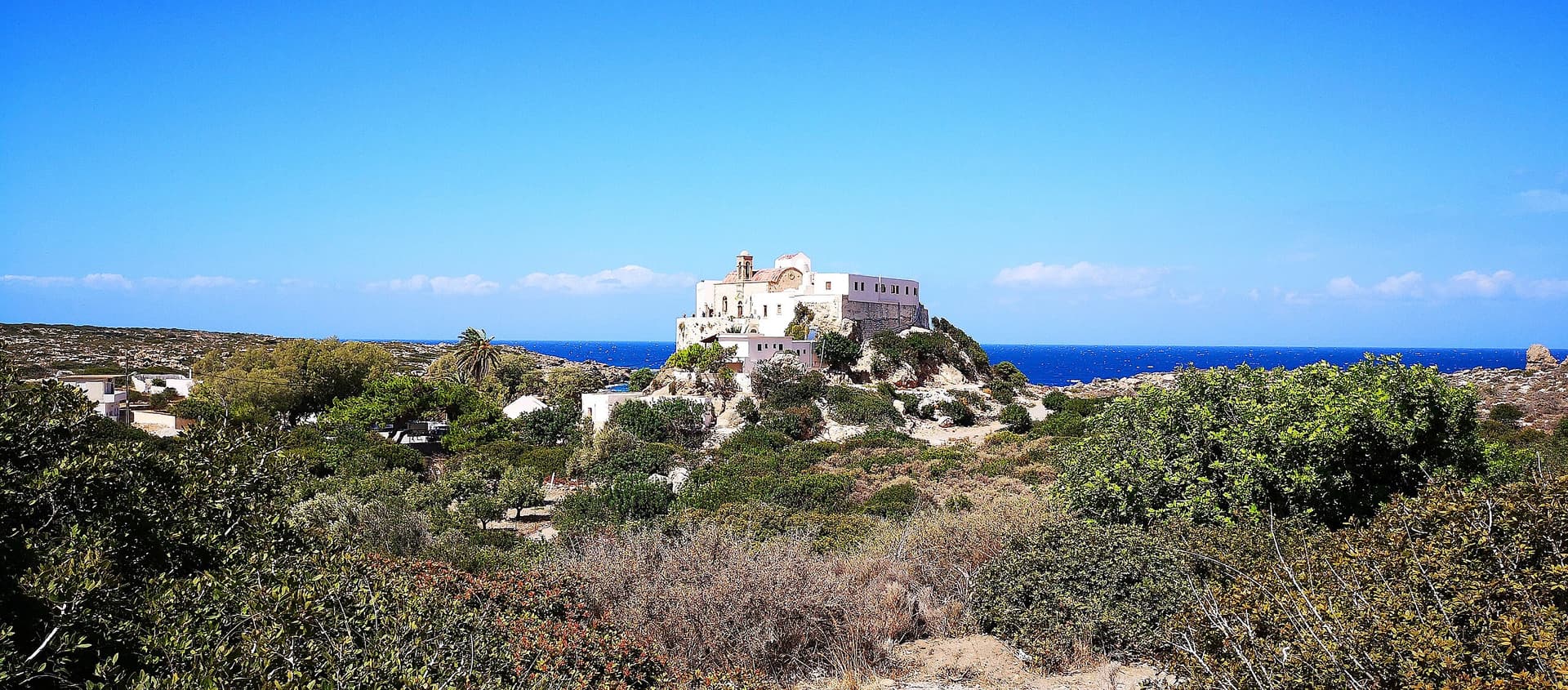
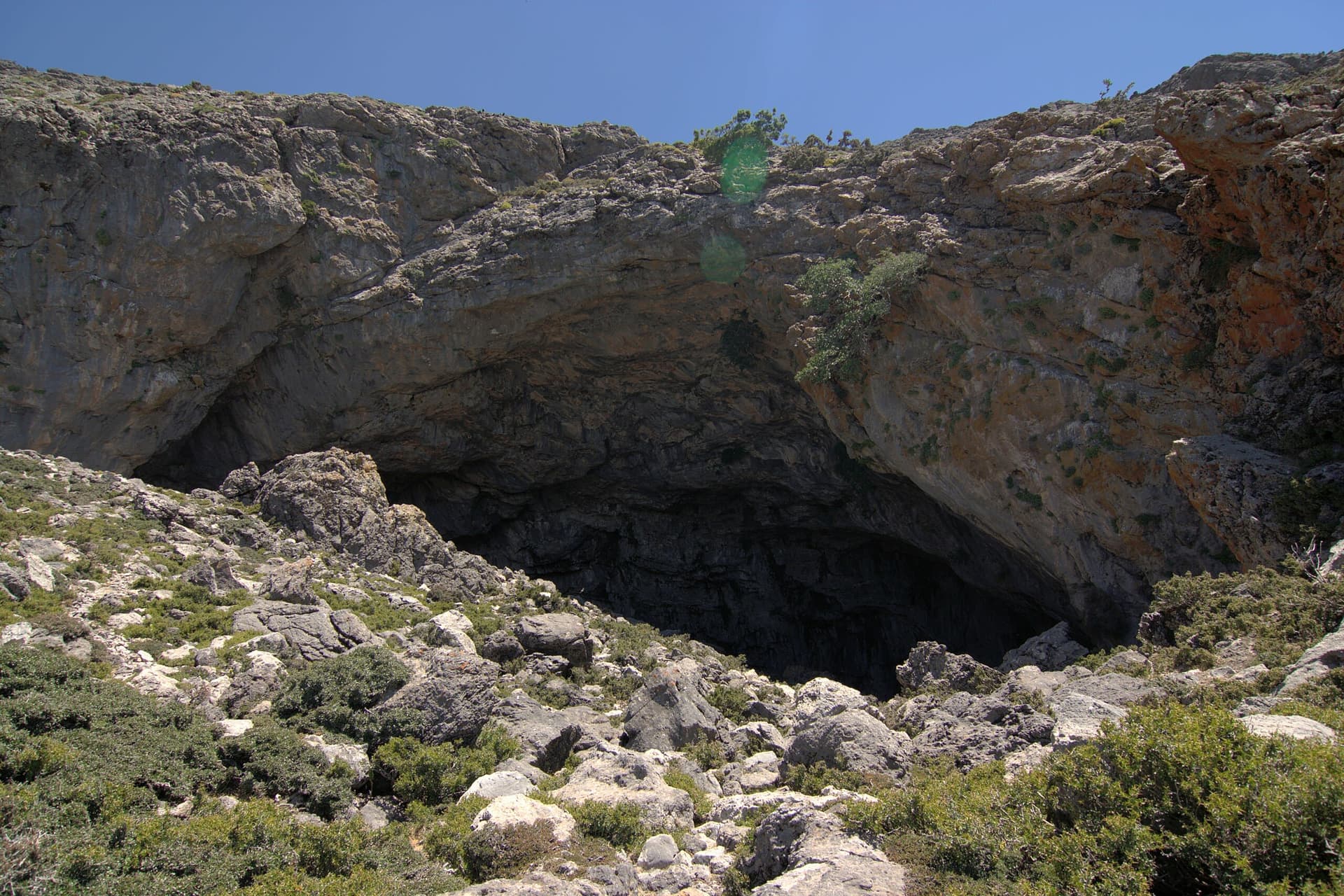
The Akrotiri Peninsula has been a landscape of prayer for far longer than Agia Triada has stood. To the north, the ruins of Katholiko Monastery date to the eleventh century, built into the walls of Avlaki Gorge by monks who sought solitude in the manner of the desert fathers. Between Katholiko and Agia Triada stands Gouverneto, a fortress-like complex from the sixteenth century. Near Gouverneto, the Bear Cave — Arkoudospilio — holds a stalactite formation that ancient worshippers associated with Artemis, suggesting that this rocky finger of land extending into the Sea of Crete has drawn human devotion since long before Christianity reached these shores.
Agia Triada gathers this deeper history into a form that is simultaneously welcoming and reserved. The cypress-lined approach functions as a threshold, a liminal passage that separates the world of the road from the world of the courtyard. The shift is physical: temperature drops, sound changes, the light filters through canopy into something that resembles the light inside a church. Then the courtyard opens, enclosed on all sides, with the main church rising at its center. The proportions are generous but not monumental. The scale is human. You feel held rather than diminished.
What gives the space its particular quality is the layering of purpose. The monks who live here do not merely pray. They farm. They press olives. They ferment wine from Cabernet Sauvignon and the indigenous Romeiko grape. They produce soap and honey and raki. The spiritual and the material are not separated but woven together in the daily cycle of ora et labora that Western monasticism formalized but that Orthodox practice has always understood. When you stand in the courtyard of Agia Triada and smell the olive oil from the press and the incense from the church simultaneously, you are experiencing the monastery's essential argument: that the sacred does not float above the world but grows from its soil.
Jeremiah Tzagarolos founded the monastery as an act of devotion to the Holy Trinity, the central mystery of Orthodox Christian faith. His decision to build was informed by a spiritual vocation deepened through friendship with Patriarch Meletios Pigas of Alexandria, and by his own candidacy for the Patriarchate of Constantinople. The site was chosen where a small church dedicated to the Holy Apostles already stood, suggesting the brothers recognized a prior sacred claim on the land. The monastery was conceived as both a place of prayer and a center of learning — a dual purpose it maintained through the founding of a seminary in 1892 and its ongoing support of schools in Chania.
The monastery's history follows the arc of Crete itself. Begun during the final decades of Venetian rule, it was disrupted by the Ottoman conquest of Chania in 1645. The Ottomans renamed it Selvili Manastir — the Monastery of the Cypresses — and construction of the great dome was halted. Yet the monastic community endured. During the Greek War of Independence in 1821, the monastery was destroyed by fire and the monks fled. Historical manuscripts and relics accumulated over two centuries were lost in that conflagration. But two monks, Kalliopios and Gregorios, returned and rebuilt. By 1830 the dome was completed. By 1833 a school operated on the grounds. By 1864 the imposing bell tower was added, and by 1892 a priestly seminary had been established. World War II brought damage during the German occupation, another wound absorbed and repaired. Each cycle of destruction and renewal has deepened the monastery's meaning, making it not merely a building but an argument for endurance.
Traditions And Practice
The monastery maintains a full Orthodox liturgical cycle alongside organic agricultural production. Monks celebrate the Divine Liturgy, press olive oil, ferment wine, and welcome visitors to a site where prayer and labor have been inseparable for four centuries.
The liturgical life of the monastery follows the rhythms of the Orthodox calendar. The Divine Liturgy is celebrated regularly in the cruciform church beneath the iconostasis of Mercourios of Santorini. The monastery's principal feast day is the Feast of the Holy Spirit, observed on the Monday after Pentecost — typically falling in late May or early June. This celebration draws worshippers from across western Crete and represents the monastery's most significant annual gathering.
From its earliest years, the monastery combined contemplative life with education. Jeremiah Tzagarolos conceived it as a place where scholarship and devotion would reinforce each other, a vision that found formal expression in the priestly seminary established in 1892 and in the monastery's ongoing support of schools in Chania. The educational mission was not peripheral but central, a response to the conditions of Ottoman occupation when monasteries served as repositories of Greek language, faith, and cultural identity.
The agricultural tradition runs equally deep. The olive groves that surround the monastery have been cultivated since its founding, and the practice of pressing oil from the monks' own trees connects the present community to the labors of the Tzagarolos brothers' era. Wine production, likely dating to the early years of the monastery, now encompasses both international varieties — Cabernet Sauvignon, Merlot, Trebbiano, Moscato — and the indigenous Fokiano Romeiko grape.
The monastery's current community maintains the intersection of spiritual practice and material production that has defined Agia Triada from the beginning. The monks produce approximately twenty tonnes of organic olive oil annually, along with wines, tsikoudia (raki), honey, vinegar, and olive oil soap. These products are sold from the monastery shop, and the income sustains both the community and the upkeep of the historic buildings.
The ecclesiastical museum preserves icons, vestments, and liturgical objects from across the monastery's history. The collection serves as a material record of the continuity of worship in this place — objects that have been handled, venerated, and cared for across generations of monks.
The monastery also hosts cultural events, religious celebrations, and festivals, maintaining its role as a center of community life on the Akrotiri Peninsula. Its support of schools in Chania continues the educational mission that Jeremiah Tzagarolos established four centuries ago.
A visitor seeking more than a photograph might approach Agia Triada in layers. Begin with the cypress avenue, walking slowly enough to notice the shift in atmosphere — the drop in temperature, the change in sound, the way the light filters through the canopy. In the courtyard, stand still for a moment before entering any building. Let the proportions of the space register: the arcades, the dome, the bell tower, the relationship between enclosed stone and open sky.
In the church, allow your eyes to adjust to the dimness. The iconostasis reveals its details gradually — the gold leaf, the painted figures, the craftsmanship of Mercourios's work. If a service is in progress, remain near the entrance, still and attentive. The sound of Orthodox chant in this particular acoustic space, shaped by stone walls and a Renaissance dome, is unlike what you will hear in any other monastery on Crete.
At the wine cellar, take the tasting seriously. The monks' wines are the product of the same land and the same commitment that produced the architecture above. To taste the Fokiano Romeiko is to taste a grape variety that has grown on Crete for centuries, fermented by men whose daily schedule alternates between prayer and the work of the press.
Greek Orthodox Christianity
ActiveThe monastery is dedicated to the Holy Trinity and holds the exceptional status of Patriarchal-Stavropegiac, meaning it is governed directly by the Ecumenical Patriarchate of Constantinople rather than the local diocese. This places it among the most spiritually authoritative monasteries in Crete. Since its founding in the early 17th century, it has served as a center of Orthodox worship, theological education, and cultural preservation — roles that became critical during the centuries of Ottoman rule when monasteries functioned as guardians of Greek language, faith, and identity.
Regular Orthodox Divine Liturgy and monastic offices in the cruciform churchCelebration of the Feast of the Holy Spirit on the Monday after PentecostOrganic olive oil production (approximately 20 tonnes annually) as monastic agricultureWine production from international and indigenous grape varietiesOperation of the ecclesiastical museum preserving icons, vestments, and liturgical objectsContinuing support of schools in Chania as part of the monastery's educational mission
Experience And Perspectives
The approach through ancient cypresses prepares the visitor for a courtyard of Renaissance proportions and Byzantine devotion, where the fragrance of olive groves mingles with incense, and the monks' wine and oil are offered alongside centuries of accumulated silence.
The road from Chania crosses the plain of Akrotiri through scattered villages and olive groves, climbing gently toward the peninsula's rocky interior. At a certain point the cypresses appear, tall and dark, lining the road in two rows that form a natural nave. This passage is perhaps three hundred meters long, and it changes everything. The cypresses are among the oldest on the peninsula, their bark furrowed and resinous, their shade deep and cool. The temperature drops. The road narrows. You are no longer driving toward a tourist attraction. You are approaching something that has been waiting.
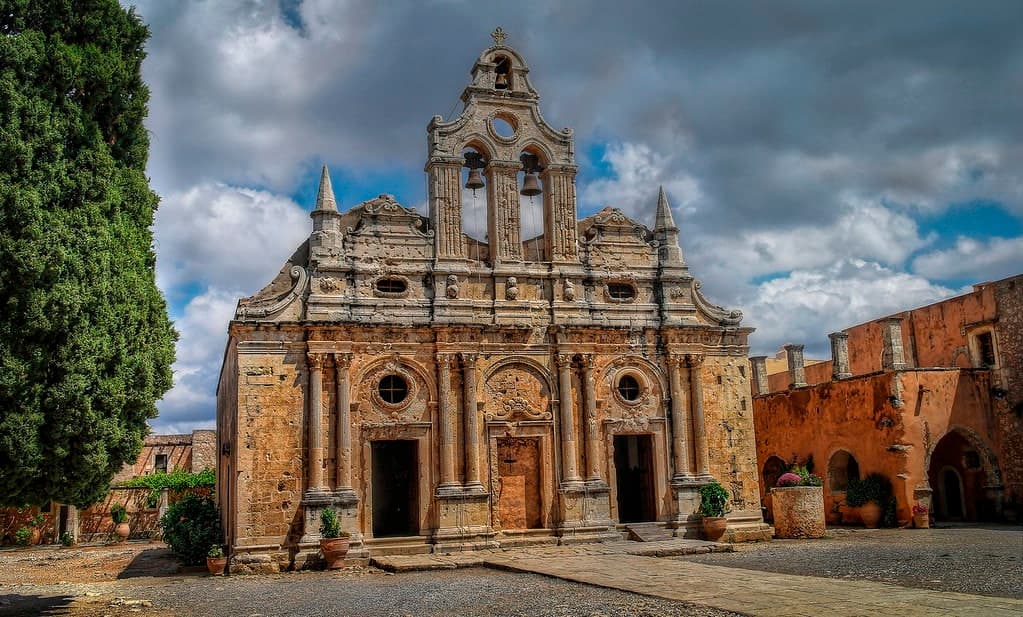
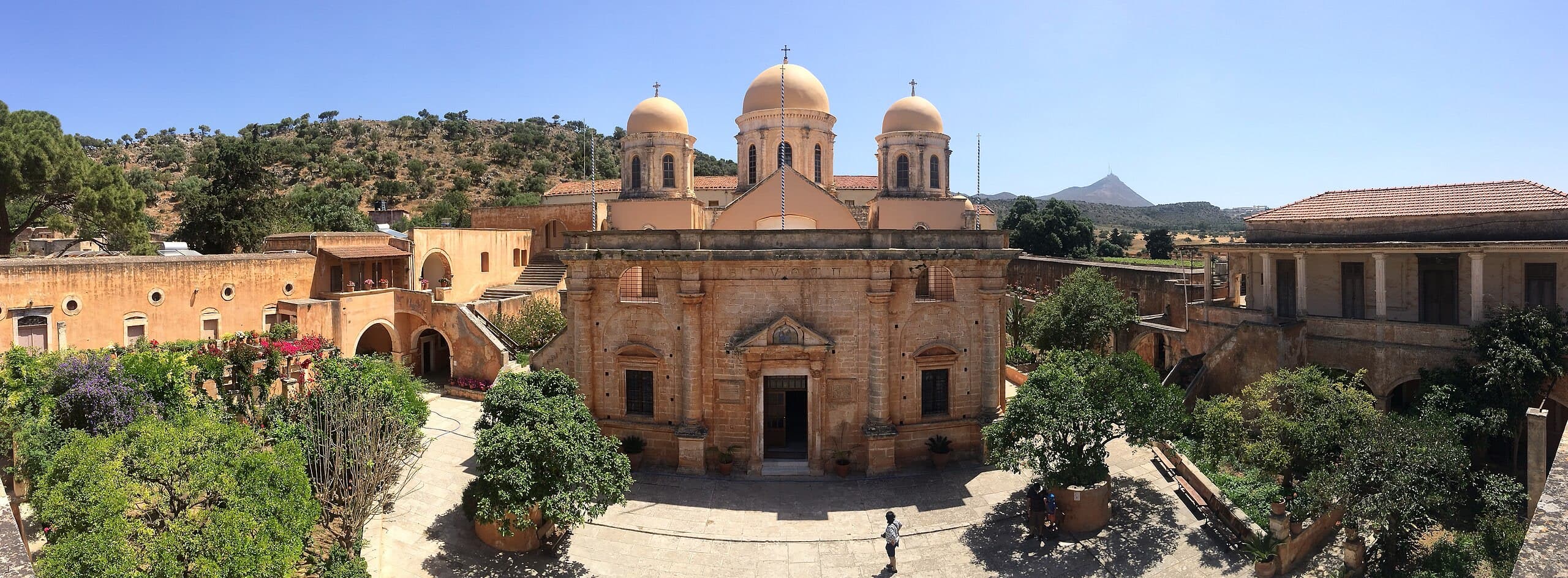
The monastery reveals itself gradually. The entrance gate — the element most directly influenced by Serlio's designs — presents twin columns of the Doric and Corinthian orders, an arrangement more common in the villas of the Veneto than in the monasteries of the Aegean. Above the gate, a bell marks the threshold. Inside, the courtyard unfolds with surprising spaciousness. Stone arcades run along the periphery, their arches regular and measured. Flowering plants climb the walls. The fountain at the center is simple, practical, old.
The main church occupies the courtyard's heart. Its exterior blends the vocabulary of both traditions — the dome is Byzantine, the facade carries Renaissance proportions, the bell tower added in 1864 rises with a confidence that suggests the monastery had, by that point, survived enough to build with permanence. Inside, the gold-leaf iconostasis by Mercourios of Santorini catches whatever light enters through the narrow windows. The icons by Skordilis — the Enthroned Christ, the Living Spring, the Second Coming — watch from the walls with the particular intensity of Cretan school painting, where Western naturalism and Byzantine formality achieved a synthesis found nowhere else.
The ecclesiastical museum occupies several rooms and holds icons, vestments, woodcarvings, and liturgical objects spanning the monastery's history. The collection is not large but its quality is consistent, and the setting — thick-walled rooms that smell of old wood and stone — gives the objects a presence that a modern gallery would strip away.
Before leaving, the monastery shop and wine cellar deserve unhurried attention. The monks produce organic olive oil from their own groves, wines from both international and indigenous grape varieties, tsikoudia (the Cretan raki), vinegar, honey, and olive oil soap. These are not souvenirs. They are the material output of a community that has been working this land for four hundred years. To carry a bottle of Agia Triada wine home is to carry something of the place's continuity.
Arrive in the morning, ideally by 9:00 AM, when the light in the courtyard is warm and the air still carries the coolness of the previous night. Allow the cypress avenue its full effect by walking the final stretch if possible. In the courtyard, resist the pull of the camera for the first few minutes. Let the proportions register. Visit the church when it is quiet. Spend time in the museum without rushing. End at the wine cellar, where tasting the monks' production becomes a way of tasting the place itself. The whole visit takes one to two hours. If you are continuing to Gouverneto and Katholiko, plan for a full half-day.
Agia Triada can be read as architecture, as resistance, as agricultural tradition, or as the material record of a place where East and West have been in conversation for four centuries.
Architectural historians recognize Agia Triada Tzagarolon as one of the most important monuments of the Cretan Renaissance — the cultural flowering that occurred during the final centuries of Venetian rule over Crete (1204-1669). The direct influence of Sebastiano Serlio's Libro Estraordinario on the monastery's design is well established, making Agia Triada a rare and significant example of Renaissance architectural theory applied to an Orthodox monastic context. The synthesis of Venetian and Byzantine elements in the complex — Doric and Corinthian columns at the entrance, a Byzantine cruciform church plan, a gold-leafed iconostasis combining post-Byzantine technique with Baroque influence — reflects the unique cultural conditions of Venetian Crete, where two civilizations overlapped rather than merely coexisted. The monastery's role during Ottoman rule as a center of education and cultural preservation is recognized as significant in the broader history of Greek identity on the island.
For Orthodox Christians and for the people of western Crete, Agia Triada is not a historical monument but a living monastery whose monks continue the work of prayer, education, and cultivation that began four centuries ago. Its Stavropegiac status — direct governance by the Ecumenical Patriarch — places it among the most spiritually authoritative monasteries on the island. The Feast of the Holy Spirit draws worshippers who understand the monastery not as a destination but as a place where the continuity of faith takes visible form. The products of the monastery — the olive oil, the wine, the honey — carry a significance beyond the commercial. They are the fruits of a practice that understands labor and prayer as aspects of a single discipline.
Some visitors experience the monastery as a place where the boundaries between aesthetic and spiritual response dissolve. The architecture, produced by a mind steeped in both Renaissance humanism and Orthodox mysticism, creates an environment that does not demand a particular belief but invites a particular quality of attention. The cypress avenue, the enclosed courtyard, the play of light through stone arcades — these produce an effect that transcends denomination. The Akrotiri Peninsula's concentration of monastic foundations, combined with the ancient Artemis association at the Bear Cave, suggests layers of sacred landscape that predate Christianity and persist beneath it.
Several questions about Agia Triada resist definitive resolution. The exact nature and date of the small church dedicated to the Holy Apostles that preceded the monastery on this site remain uncertain — whether it was itself built on an earlier sacred site is unknown. The full extent of the manuscripts and relics destroyed during the 1821 fire represents an irretrievable loss whose dimensions can only be guessed. Whether the Akrotiri Peninsula's concentration of monasteries reflects an ancient pre-Christian sacred landscape tradition remains an open question. And the precise details of Jeremiah Tzagarolos's candidacy for the Patriarchate of Constantinople — and how this remarkable near-appointment influenced his decision to found a monastery instead — remain obscure.
Visit Planning
Located 15 km northeast of Chania on the Akrotiri Peninsula. Open from 8:00 AM to sunset with midday closure. Admission approximately 3 euros. Car recommended. Allow 1-2 hours, or a half-day if combining with Gouverneto and Katholiko.
The monastery is located on the Akrotiri Peninsula, approximately 15 km northeast of Chania city center, near Chania International Airport. Drive via Kounoupidiana village and Kambani — the journey takes approximately 30 minutes from central Chania. Ample parking is available at the monastery. Public bus service from Chania is limited and infrequent; a rental car or taxi is strongly recommended. Hours are approximately 8:00 AM to sunset in summer, with a midday closure. Winter hours are more restricted: 8:00 AM to 2:00 PM and 4:00 PM to sunset. Admission is approximately 3 euros. Contact: +30 28210 63572. Email: info@agiatriada-chania.gr. Website: www.agiatriada-chania.gr. Mobile phone signal is available throughout the area.
Chania city, 15 km southwest, offers the full range of accommodation from hostels to boutique hotels in the atmospheric Venetian old town. The village of Stavros, on the northern coast of the Akrotiri Peninsula, provides a quieter base with beach access. Chania International Airport is approximately 10 km from the monastery.
Modest dress required for all visitors. Shoulders and knees must be covered. The monastery provides wraps at the entrance. Quiet behavior expected throughout. Photography restricted inside the church.
Agia Triada is a working monastery, and the etiquette that applies reflects this. The atmosphere is welcoming but not casual. The monks receive visitors as guests, and guests are expected to honor the space they enter.
Dress modestly. Shoulders and knees must be covered for both men and women. Wraps or light coverings may be available at the entrance for visitors who arrive without appropriate clothing, but it is better to come prepared. Clothing should be respectful in character — this is not a beach or a taverna.
Inside the monastery, speak quietly. The courtyard is a shared space where contemplation and conversation coexist, but the church and museum call for particular restraint. During services, remain near the entrance and avoid walking around the interior. The monks' residential quarters are off-limits. Follow posted signs and respect any areas marked as restricted.
When visiting the shop and wine cellar, the atmosphere is more relaxed, and the monks or staff are typically happy to discuss the products and the processes behind them. This is a good opportunity to engage with the monastery's material culture in a way that feels natural and reciprocal.
Shoulders and knees covered for both men and women. Wraps may be available at the entrance. Comfortable walking shoes recommended for the grounds, which include some uneven surfaces.
Photography is generally permitted in the courtyard, grounds, and exterior areas. Inside the church, photography may be restricted — check posted signs or ask the monks. Flash photography should not be used near icons or frescoes. Photographing the monks themselves should only be done with their permission.
A small entrance donation of approximately 3 euros is customary and supports the monastery's maintenance. The most meaningful way to support the community is to purchase products from the monastery shop — olive oil, wine, honey, or soap. These purchases sustain the monks' work directly.
Visitors must respect the midday closure period. Access to the monks' private quarters is not permitted. During services, movement within the church should be minimal. No food consumption in the church or sacred areas. Mobile phones should be silenced upon entering the courtyard.
Sacred Cluster
Nearby sacred places create the location cluster described in the growth plan. This block is intentionally crawlable and links into the wider regional graph.