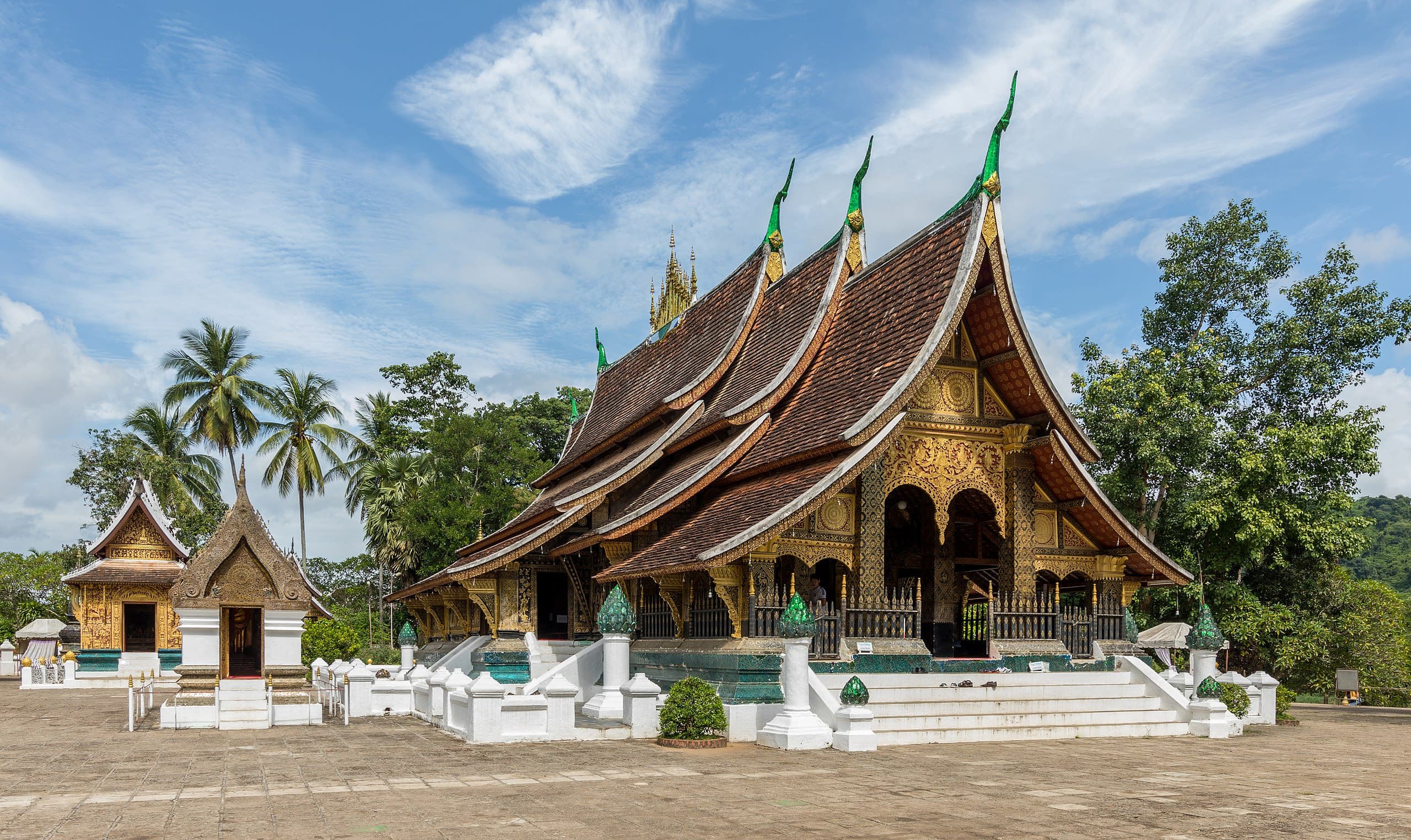
Wat Xieng Thong, Luang Prabang
Where royal Laos and living Buddhism meet beneath roofs that sweep toward earth like folded prayer
Luang Prabang, Luang Prabang, Laos
At A Glance
- Coordinates
- 19.8956, 102.1415
- Suggested Duration
- 1-2 hours to explore the main sim, chapels, and Funeral Chariot Hall. Add 1 hour if observing morning tak bat.
- Access
- Located on the tip of the Luang Prabang peninsula at the confluence of the Mekong and Nam Khan rivers. Easy walk from anywhere in the old town. Luang Prabang International Airport has connections to Bangkok, Hanoi, Vientiane, and Siem Reap.
Pilgrim Tips
- Located on the tip of the Luang Prabang peninsula at the confluence of the Mekong and Nam Khan rivers. Easy walk from anywhere in the old town. Luang Prabang International Airport has connections to Bangkok, Hanoi, Vientiane, and Siem Reap.
- Modest dress: shoulders and knees covered. Avoid white clothing. Shoes removed at building entrances.
- Permitted in compound and buildings. Ask permission before photographing monks. No flash inside buildings. Do not disrupt ceremonies.
- The tak bat has become heavily touristed. If participating, do so with genuine respect, not as a photo opportunity. Buy offerings from local vendors, not tour operators. Kneel, do not stand. Do not photograph monks' faces without permission. Inside the temple, maintain quiet respect. This is a functioning monastery, not a theme park.
Overview
At the tip of Luang Prabang's peninsula, where the Mekong meets the Nam Khan, Wat Xieng Thong has stood since 1560. Built by King Setthathirath of the Lan Xang kingdom, it served as the royal temple for coronations and funerals until 1975. Today, monks still chant in the sim beneath sweeping multi-tiered roofs decorated with gold leaf. The dharma descends to earth here, embodied in architecture.
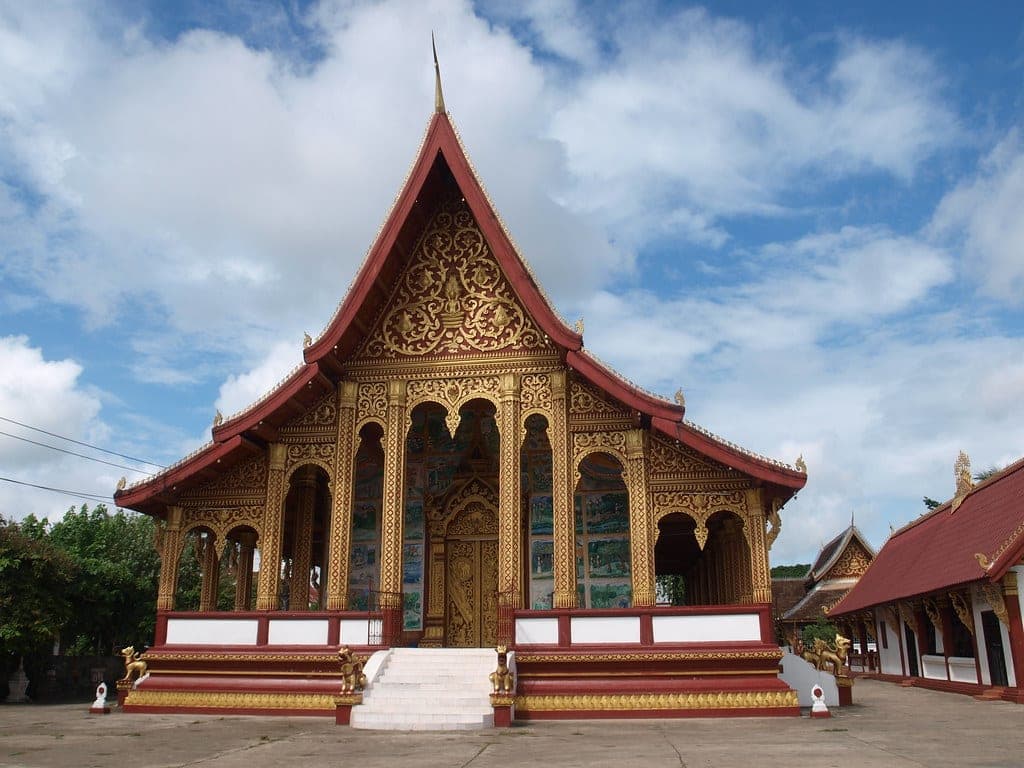
Wat Xieng Thong is the finest temple in Laos. Its multi-tiered roofs sweep nearly to the ground, layer upon layer of curved eaves that seem to fold the sky downward. Gold stenciling covers red and black walls. Glass mosaics tell stories on exterior surfaces. At dawn, monks in saffron robes receive alms from kneeling townspeople in the streets outside.
The temple's name means 'Temple of the Golden City.' King Setthathirath built it in 1560 at the confluence of two rivers—the Mekong and the Nam Khan—a location of spiritual significance in Buddhist geography. For over four centuries, this was the royal temple of Laos. Kings were crowned here. When they died, their funeral processions began here, the twelve-meter-high gilded chariot bearing their bodies through the streets.
The monarchy ended in 1975 when the Lao People's Democratic Republic was established. The last king died in a re-education camp. But the temple continues. Monks still live here, chant here, receive alms here. Lay Buddhists still come to make merit, to light incense and candles, to kneel before Buddha images that have witnessed centuries.
In 1887, Chinese Black Flag marauders invaded Luang Prabang. They destroyed much of the city. But Wat Xieng Thong survived. The leader of the invasion, Deo Van Tri, had been a novice monk at this very temple in his youth. He used it as his headquarters rather than burning it. Some places hold such meaning that even their enemies spare them.
The roofs sweep down like wings, like prayer, like the dharma itself descending to meet ordinary life. This is what sacred architecture does: it makes visible what is normally invisible. At Wat Xieng Thong, the teaching takes the form of curves and gold.
Context And Lineage
King Setthathirath built Wat Xieng Thong in 1560 as the royal temple of the Lan Xang kingdom. It served royal coronations and funerals until the monarchy ended in 1975. The temple survived the 1887 Black Flag invasion because its leader had been a novice here. Today it remains the finest expression of Luang Prabang Buddhist architecture.
King Setthathirath founded Wat Xieng Thong in 1560 to commemorate Chanthaphanith, a betel merchant who became the legendary first king of Luang Prabang. The temple was placed at the tip of the peninsula where two rivers meet—a location of particular significance in Buddhist sacred geography.
The king who built it, Setthathirath, ruled the Lan Xang kingdom—the 'Land of a Million Elephants'—from Luang Prabang and later from Vientiane. He placed the temple under royal patronage, establishing it as the primary royal monastery where kings would make merit, receive religious instruction, and eventually be cremated.
Centuries later, in 1887, Chinese Black Flag marauders invaded Luang Prabang. They destroyed or damaged much of the city and many of its temples. Wat Xieng Thong was spared. The leader of the invasion, Deo Van Tri, had been a novice monk at this very temple in his youth. Recognizing his old monastery, he made it his headquarters rather than destroying it. The temple that had shaped him in youth survived to shape others.
Wat Xieng Thong represents the Theravada Buddhist tradition as expressed in Lao royal culture. The temple's architecture influenced other temples throughout Laos. Its function as royal temple connected religious and political power for four centuries. After 1975, the temple maintained its religious function while losing its royal one. The monastic lineage continues unbroken.
King Setthathirath
Founder
King Sisavang Vong
Last king cremated at Wat Xieng Thong
Deo Van Tri
Invasion leader who spared the temple
Why This Place Is Sacred
Wat Xieng Thong is thin at the confluence of rivers, at the meeting of royal and monastic traditions, at the point where Buddhist teaching takes architectural form. The sweeping roofs embody dharma descending to earth. The temple's survival through invasion and revolution suggests a protected sanctity.
The location itself is thin. Where two rivers meet, energies converge. The Mekong—one of the great rivers of Asia—joins the Nam Khan at the tip of Luang Prabang's peninsula. The temple sits at this confluence, at a geographical point of meeting. In Buddhist sacred geography, such locations hold particular significance.
The architecture makes thinness visible. The multi-tiered roofs of Wat Xieng Thong are unlike those of Thai or Burmese temples. They sweep downward, layer upon layer, until the lowest eaves nearly touch the ground. This is not merely aesthetic; it is theological. The dharma descends from high to low, from enlightenment to ordinary consciousness. The roofs make this descent visible, tangible, walkable-around.
The royal function added another layer. For centuries, this was where kings were crowned and where they began their final journey. Royal power and religious power converged in this space. The Funeral Chariot Hall still houses the twelve-meter-high chariot that carried King Sisavang Vong's body in 1959—a physical reminder that even kings become ash.
The survival story speaks to protected sanctity. When invaders destroyed much of Luang Prabang in 1887, they spared this temple because their leader had been a novice here. The place held such meaning that even in the chaos of invasion, its sanctity was recognized. Places that survive what would destroy them gather a particular thinness—the sense that something beyond ordinary causation is at work.
And the continuity matters. Since 1560, monks have lived here, chanted here, received alms here. The rhythm of Buddhist practice has continued through political change, through war and revolution, through the fall of the monarchy that built the temple. The practice persists. The chanting continues. The alms bowls are still filled each dawn.
Royal temple of the Lan Xang kingdom and later the Kingdom of Laos. Site of coronations, royal rituals, and funerals. Repository of sacred Buddha images and royal regalia. Home to a monastic community.
Built 1560 by King Setthathirath. Served as royal temple until 1975. Survived the Black Flag invasion of 1887. After 1975, lost royal function but retained monastic and devotional practice. UNESCO inscription in 1995 recognized its architectural and cultural significance. Today functions as active monastery, pilgrimage site, and major tourist attraction.
Traditions And Practice
Daily monastic chanting and alms rounds. Merit-making by lay visitors through offerings. Major Buddhist festivals, especially Lao New Year (Boun Pi Mai) in April. The morning tak bat (alms giving) in surrounding streets is one of Luang Prabang's most significant daily rituals.
As the royal temple, Wat Xieng Thong hosted coronations, royal merit-making ceremonies, and funerals. Kings received religious instruction from the monks. Major festivals were celebrated with royal participation. The Lao New Year included ritual bathing of Buddha images with the king's participation.
Monks maintain daily chanting practice in the sim. The morning tak bat sees monks receiving alms from kneeling laypeople on surrounding streets—a practice tourists can observe or respectfully join. Lay Buddhists visit to make merit through offerings. Buddhist festivals, especially Boun Pi Mai (Lao New Year in mid-April), see elaborate celebrations. Ordination ceremonies for new monks take place throughout the year.
Rise before dawn and observe or participate in the tak bat. If participating, kneel on a mat, offer appropriate food (sticky rice, fruit), and do so respectfully without standing above the monks. Later, enter the temple compound and take time to sit in the sim. Light incense or candles as an offering. Walk slowly. Let the architecture work on you.
Theravada Buddhism
ActiveWat Xieng Thong is one of the most important temples in Lao Theravada Buddhism. It served as the royal temple for coronations and funerals. Today it remains a functioning monastery and major pilgrimage site.
Daily monastic chanting. Morning tak bat (alms giving). Merit-making by lay visitors. Buddhist festival celebrations, especially Boun Pi Mai. Ordination ceremonies.
Experience And Perspectives
Visitors enter a compound of red, black, and gold buildings beneath extraordinary sweeping roofs. The main sim (ordination hall) is the masterpiece, with its Tree of Life mosaic. The Funeral Chariot Hall houses the twelve-meter gilded chariot. Morning alms giving on nearby streets precedes any visit.
Arrive before dawn if you can. By 5:30 or 6:00 AM, saffron-robed monks emerge from Wat Xieng Thong and other temples to collect alms. Residents kneel on mats along the streets, offering sticky rice to each monk who passes. This is tak bat, the daily alms round that has sustained Buddhist monasticism for millennia. Observe from a respectful distance, or kneel and participate with appropriate offerings.
The temple compound opens with the morning. The sim—the main ordination hall—draws the eye immediately. Its roofs sweep down in three tiers, the front portico forming a fourth level. The lines are extraordinary: curves that seem organic rather than constructed, as if the building grew rather than was built. Red and black walls are covered with gold leaf stenciling in geometric and mythological patterns. Dharmachakras (dharma wheels) decorate the ceiling.
Walk around to the rear. The back wall of the sim bears the famous Tree of Life mosaic. Rendered in colored glass pieces against a red background, the tree spreads its branches across the entire wall. Animals and spirits populate its branches. This is religious art that tells its story in light: when sun strikes the glass, the tree comes alive.
The compound contains multiple chapels and shrines. The Red Chapel houses a rare reclining Buddha in an unusual style—not the standard 'entering nirvana' pose but a pose of rest. The Funeral Chariot Hall, added in 1960, protects the twelve-meter-high gilded funeral chariot used for King Sisavang Vong. Five naga (serpent) heads rise from its front. Carved deities and mythological figures cover every surface. Standing before it, you encounter the Buddhist teaching of impermanence: even kings ride this chariot only once.
The library (Ho Trai), elevated on wooden stilts to protect its manuscript collection from humidity and pests, represents the temple's role as repository of knowledge. The small chapel containing the Standing Buddha served royal bathing ceremonies during the Lao New Year.
Take time to sit. The compound is peaceful. If monks are chanting, listen. If laypeople are making offerings, observe. This is not a museum but a functioning monastery. The architecture is extraordinary, but the practice within it is the point.
Enter through the main gate and proceed to the sim (main hall). Circle the building to see the Tree of Life mosaic on the rear wall. Visit the Funeral Chariot Hall. Explore the smaller chapels and shrines. If possible, arrive before dawn to observe or participate in the morning tak bat in the streets outside the temple.
Wat Xieng Thong invites interpretation as an architectural masterpiece, as the heart of Lao royal Buddhist tradition, as a living monastery, and as testimony to the resilience of sacred places through political change.
Art historians recognize Wat Xieng Thong as the finest example of Luang Prabang temple architecture and one of the most important Buddhist temples in Southeast Asia. The distinctive multi-tiered roofs, gold stenciling, and glass mosaics represent the pinnacle of traditional Lao religious art. UNESCO inscription recognized the temple as part of the exceptional cultural landscape of Luang Prabang.
For Lao Buddhists, Wat Xieng Thong is the heart of their tradition—the royal temple where kings made merit, the repository of sacred images, the model for temple architecture throughout the country. Making merit here connects laypeople to the highest expression of Lao Buddhism.
Some visitors connect the temple's location at the confluence of rivers to geomantic principles of sacred geography. The temple's survival through invasion and revolution suggests to some a protective spiritual presence.
Details of original construction techniques are not fully documented. The exact symbolism of certain decorative motifs remains debated. How the distinctive Luang Prabang architectural style developed and influenced other traditions is an ongoing area of study.
Visit Planning
Located on the tip of Luang Prabang's peninsula. Entry approximately 20,000-30,000 kip ($1-2 USD). Open throughout the day. Arrive before dawn for tak bat. November-February is the best season.
Located on the tip of the Luang Prabang peninsula at the confluence of the Mekong and Nam Khan rivers. Easy walk from anywhere in the old town. Luang Prabang International Airport has connections to Bangkok, Hanoi, Vientiane, and Siem Reap.
Luang Prabang's old town offers accommodations from backpacker hostels to boutique hotels. Staying in the old town allows easy walking access to Wat Xieng Thong and observation of the morning tak bat.
Dress modestly with shoulders and knees covered. Remove shoes before entering buildings. Women should not touch monks. Speak quietly. Ask permission before photographing monks.
Wat Xieng Thong is a functioning monastery deserving the respect given to any active religious site. Dress modestly: shoulders and knees covered for both men and women. Remove shoes before entering any building. Avoid white clothing, which is associated with mourning.
Behavior toward monks follows Buddhist protocol. Women should not touch monks or hand objects directly to them—place offerings on a cloth or table. Do not point your feet toward Buddha images. Do not sit with your back to Buddha images. Maintain quiet, respectful behavior.
Photography is generally permitted in the compound and inside buildings, but avoid photographing monks without permission. Do not use flash inside buildings. Do not photograph during ceremonies unless invited.
The morning tak bat requires particular sensitivity. This is a religious practice, not a performance. If observing, maintain respectful distance. If participating, do so genuinely: kneel, offer appropriate food, do not stand above the monks. The tradition is vulnerable to tourist impact; treat it accordingly.
Modest dress: shoulders and knees covered. Avoid white clothing. Shoes removed at building entrances.
Permitted in compound and buildings. Ask permission before photographing monks. No flash inside buildings. Do not disrupt ceremonies.
Incense, candles, and lotus flowers appropriate at shrines. For tak bat, offer sticky rice or fruit purchased from local vendors.
Women should not touch monks. Do not point feet toward Buddha images. Some areas may be restricted to monks.
Sacred Cluster
Nearby sacred places create the location cluster described in the growth plan. This block is intentionally crawlable and links into the wider regional graph.