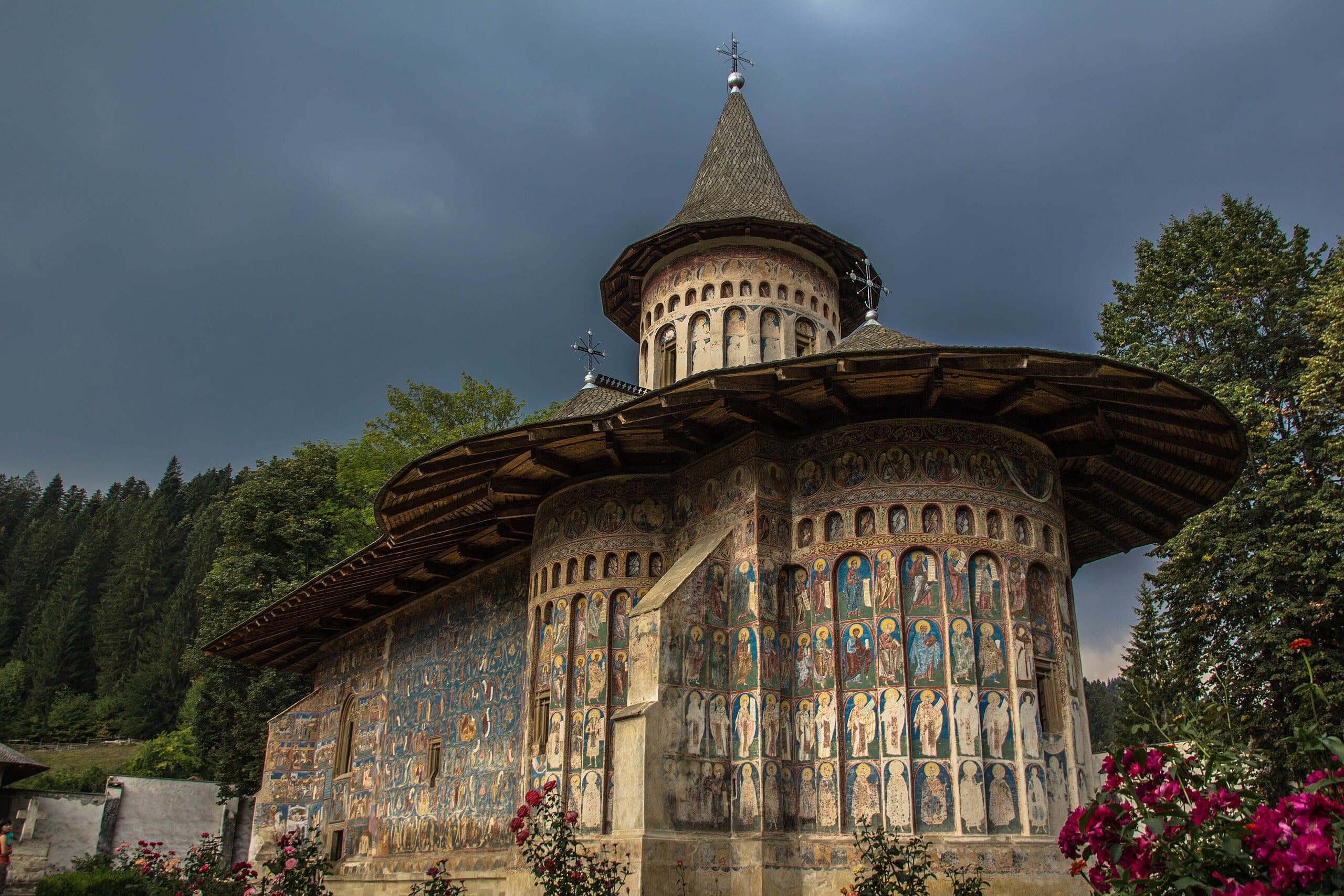
Voronet Monastery, Romania
The Sistine Chapel of the East, painted in a blue whose secret has outlasted five centuries
Gura Humorului, Suceava, Romania
At A Glance
- Coordinates
- 47.5171, 25.8642
- Suggested Duration
- Allow 1-2 hours for a thorough visit including the exterior frescoes, church interior, and monastery grounds. Additional time may be warranted for attending a service or visiting the painting workshop. Voronet can be combined with other Bucovina painted monasteries in a full-day itinerary.
- Access
- Located in the village of Voronet, approximately 4 km south of the town of Gura Humorului, Suceava County, northern Romania, at approximately 500 meters altitude. Accessible by road from Gura Humorului via a short taxi ride or a pleasant walk. Gura Humorului has train connections from Suceava and bus service throughout Bucovina. The nearest airport is Suceava Stefan cel Mare Airport. Bucharest is approximately 450 km south. Mobile phone signal is generally available in the area.
Pilgrim Tips
- Located in the village of Voronet, approximately 4 km south of the town of Gura Humorului, Suceava County, northern Romania, at approximately 500 meters altitude. Accessible by road from Gura Humorului via a short taxi ride or a pleasant walk. Gura Humorului has train connections from Suceava and bus service throughout Bucovina. The nearest airport is Suceava Stefan cel Mare Airport. Bucharest is approximately 450 km south. Mobile phone signal is generally available in the area.
- Standard Romanian Orthodox dress code is enforced. Women: skirts or dresses below the knee, shoulders covered. Men: long trousers, covered shoulders. Sleeveless tops and shorts are not appropriate. Head coverings for women are appreciated during services.
- Exterior photography of the monastery and frescoes is permitted. Interior photography is restricted or prohibited. No flash photography near any frescoes, interior or exterior. No drones. Do not photograph the nuns without explicit permission.
- Voronet is an active convent. The nuns have organized their lives around prayer and contemplative practice. Do not photograph them without explicit permission. Do not interrupt services or private devotions. Do not enter areas marked as restricted. Do not touch the frescoes. Though they have survived over five hundred years, human contact threatens pigments that cannot be replaced. No flash photography is permitted near the frescoes.
Overview
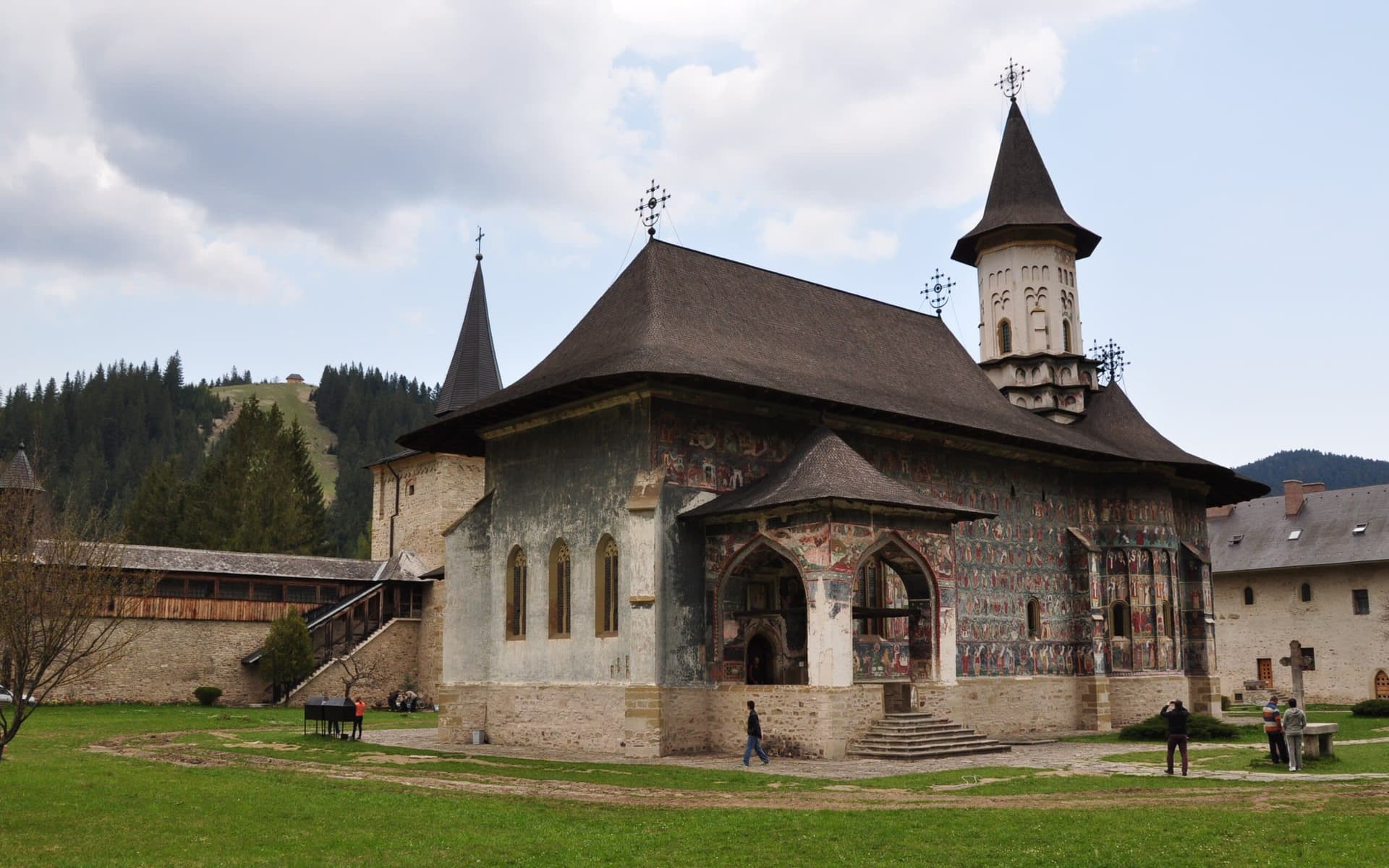
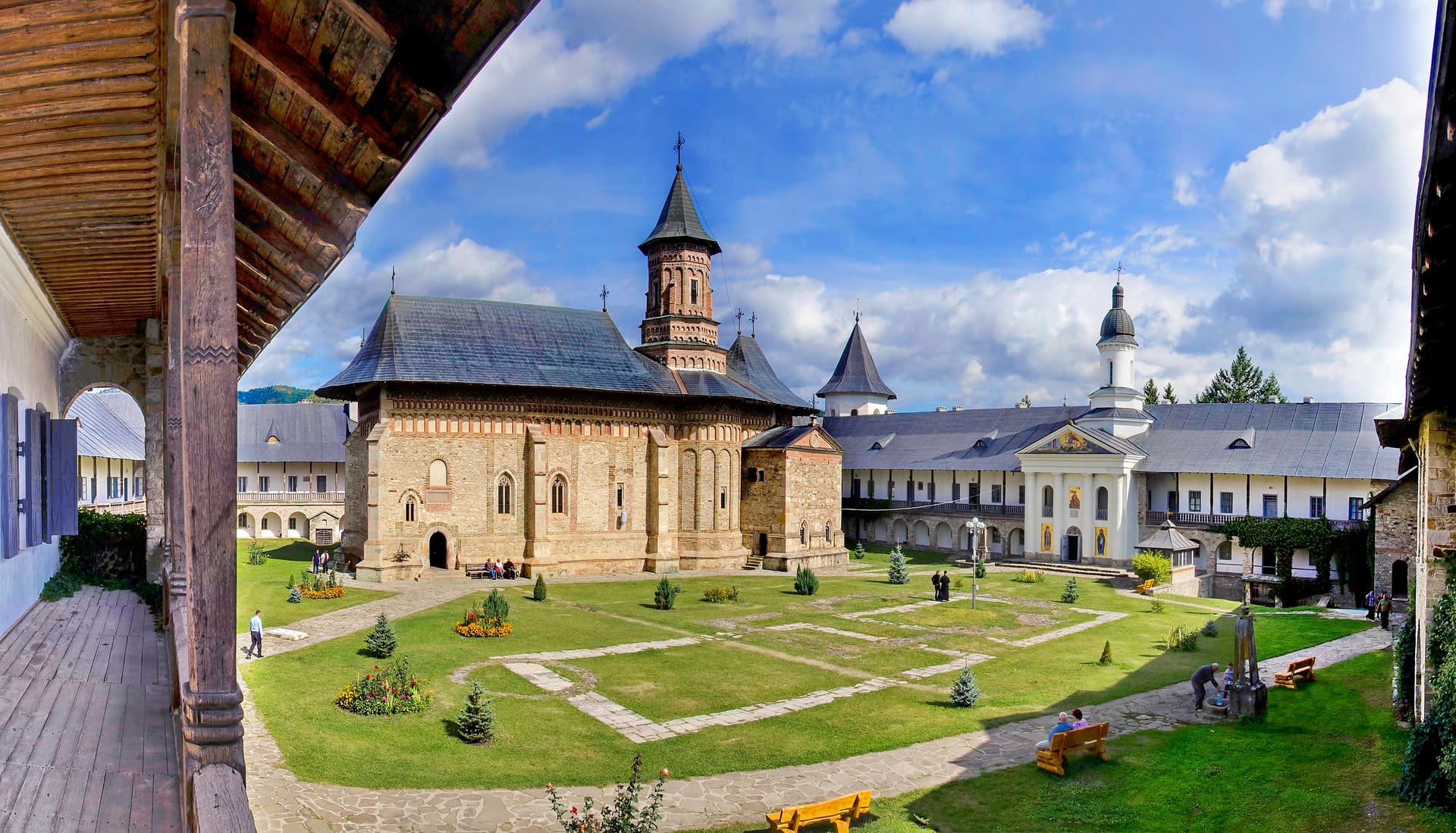
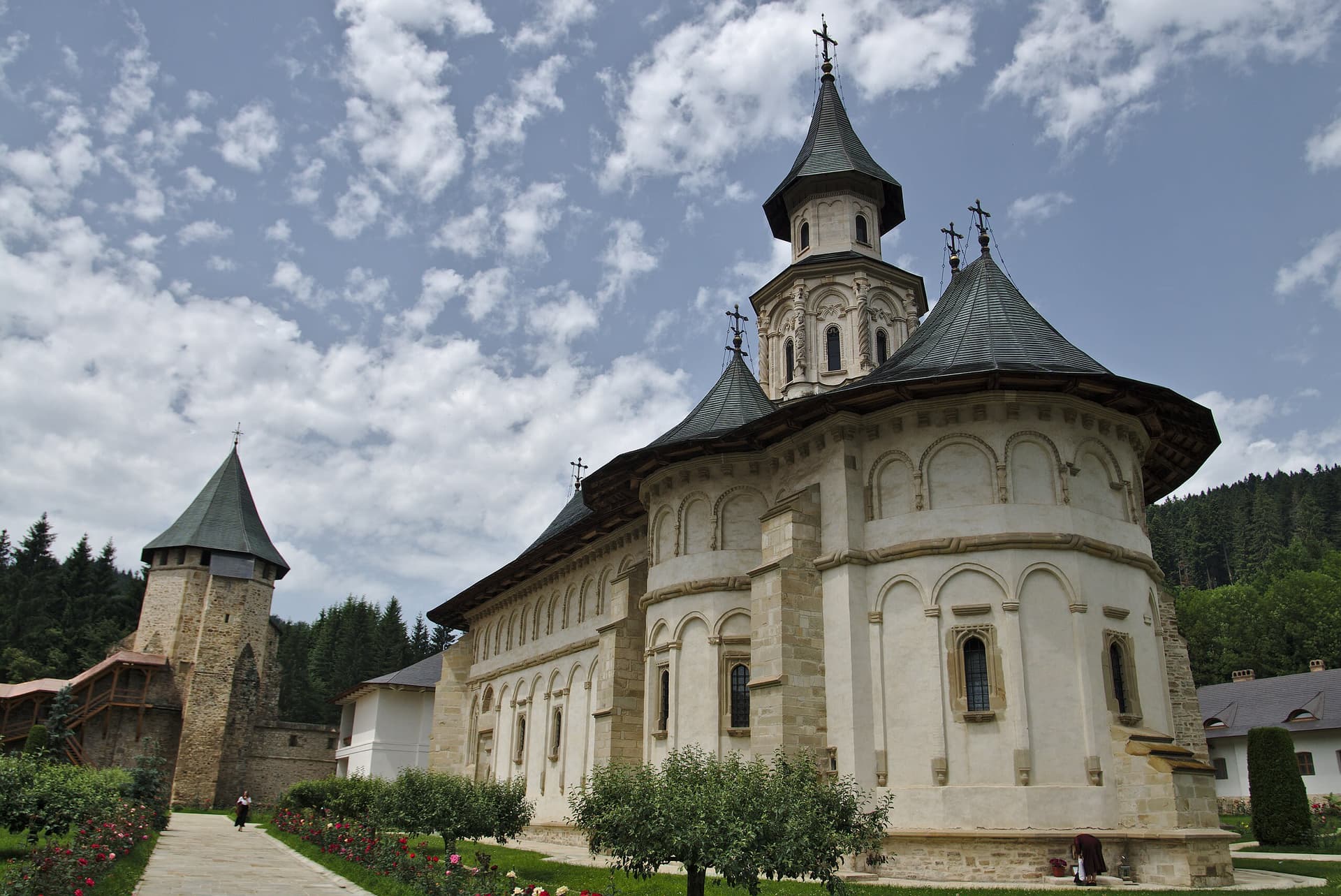
Built by Stephen the Great in 1488 on the counsel of a hermit who prayed for twenty years in a stone cell nearby, Voronet Monastery carries on its western wall a Last Judgement fresco that has earned it the title Sistine Chapel of the East. The Voronet Blue pigment, whose full composition remains a mystery after five centuries, lends the paintings an otherworldly luminosity that draws pilgrims and seekers to this Bucovina hillside.
A hermit prayed in a stone cell for twenty years. A prince sought his counsel before battle. The hermit told him to fight, and to build a monastery if he won. Stephen the Great defeated the Ottoman Turks, and in three months, three weeks, and three days, Voronet rose from the Bucovina hills.
This founding narrative, with its convergence of contemplative withdrawal and decisive action, establishes the terms of what visitors encounter today. Voronet is a place where interior and exterior, hidden and revealed, coexist with unusual force. The hesychast tradition that shaped the hermit Daniel's twenty years of solitary prayer sought the divine in silence and darkness. The frescoes that later covered the monastery's exterior walls proclaim divine judgment in vivid color. Both dimensions remain present.
The frescoes, painted in the 1530s and 1540s under Metropolitan Grigore Rosca, represent the pinnacle of the Moldavian tradition of exterior theological painting. The Last Judgement on the western wall, covering the entire surface in hundreds of figures arranged around the figure of Christ in Majesty, is among the most powerful visual statements in Christian art. Souls are weighed. The righteous ascend. The damned descend. The composition addresses every viewer with the same question: where do you stand?
The color in which this question is posed has become the monastery's most famous feature. Voronet Blue, a pigment based on azurite but whose complete formulation has eluded five centuries of analysis, lends the frescoes a luminosity that appears almost to generate its own light. Under certain conditions of sky and season, the blue seems to detach from the wall and hover in the air between painting and viewer.
Today, approximately twenty nuns maintain the monastic life that Stephen initiated and Daniel inspired. They paint icons, tend gardens, guide visitors, and pray the Hours that connect this moment to the hermit's cell and the prince's vow. The Sistine Chapel comparison, though inevitable, misses something essential: Voronet is not a museum of sacred art. It is a monastery where sacred art and sacred practice still occupy the same space.
Context And Lineage
Voronet Monastery was built in 1488 by Stephen the Great on the counsel of Saint Daniel the Hermit, as a votive church following victory over the Ottoman Turks. The exterior frescoes, painted in the 1530s-1540s, represent the pinnacle of the Moldavian painted church tradition. The Voronet Blue pigment remains a scientific mystery. Part of the UNESCO Churches of Moldavia World Heritage listing since 1993.
The founding of Voronet begins with a hermit and a prince at the intersection of contemplation and crisis.
Daniel, later known as Saint Daniel the Hermit, had lived in a small stone cell near the present site of the monastery for approximately twenty years, practicing the hesychast discipline of interior prayer. When Stephen the Great, Voievode of Moldavia, faced a critical battle against the Ottoman Turks, he sought Daniel's counsel.
The hermit assured Stephen of divine support and instructed him to build a monastery dedicated to Saint George should he prove victorious. Stephen defeated the Turks, and in what tradition records as three months, three weeks, and three days, the monastery was constructed and consecrated. The speed of construction is sometimes cited as evidence of the intensity of Stephen's gratitude.
Daniel became Voronet's first abbot, bringing the contemplative tradition that had formed him into the institutional framework of monastic life. Under his guidance, the monastery established a calligraphy school that produced significant manuscripts, including the Codex of Voronet and the Psalter of Voronet, both discovered in the 19th century and recognized as important documents in the history of Romanian language.
The exterior frescoes came later, nearly fifty years after the founding. Metropolitan Grigore Rosca commissioned them during the reign of Petru Rares, and the master painter Toma of Suceava executed the program between approximately 1534 and 1547. The Last Judgement on the western wall, which would earn Voronet its comparison to the Sistine Chapel, was painted not as decoration but as prayer: a prayer for the defeat of invaders and the salvation of Moldavia.
Stephen the Great built over forty churches and monasteries during his nearly five decades of rule. Voronet was not the largest or the most elaborate, but the story of its founding, with the hermit's counsel and the vow before battle, gave it a particular resonance.
The calligraphy school flourished under Daniel's guidance, producing manuscripts whose later discovery proved invaluable to Romanian linguistic scholarship. The monastery operated as a male institution until the Habsburg dissolution in 1785.
For over two centuries, Voronet stood empty. The frescoes weathered seasons without maintenance. The Voronet Blue endured. When the monastery reopened as a nunnery in 1991, the new community inherited both a masterpiece and a responsibility. The approximately twenty nuns who live here now maintain the dual identity that has always defined Voronet: a place where the deepest interior practice and the most vivid exterior expression occupy the same ground.
Stephen the Great
founder
Voievode of Moldavia from 1457 to 1504, regarded as Moldova's greatest medieval ruler. He built over 40 churches and monasteries across his realm, but Voronet, built on a hermit's counsel after victory in battle, holds particular significance. Canonized as a saint of the Romanian Orthodox Church.
Saint Daniel the Hermit
spiritual_founder
Hermit who practiced contemplative prayer in a stone cell for twenty years before counseling Stephen the Great to build the monastery. His hesychast practice gave Voronet its spiritual foundation. He served as the monastery's first abbot.
Grigore Rosca
patron
Metropolitan who commissioned the exterior frescoes during the reign of Petru Rares. His patronage transformed a relatively modest church into the masterpiece of Moldavian painted architecture.
Toma of Suceava
artist
Master painter responsible for the exterior fresco program, including the celebrated Last Judgement. His use of the Voronet Blue pigment produced what is now considered one of the most original contributions to European sacred art.
Why This Place Is Sacred
Voronet's thinness emerges from the convergence of hesychast contemplative practice, extraordinary visual theology, and a color whose persistence defies full explanation. Twenty years of a hermit's silent prayer, followed by five centuries of monastic worship and the enduring mystery of the Voronet Blue, create conditions where the boundary between the visible and invisible feels unusually permeable.
What makes Voronet thin is the density of what meets here. Before the monastery existed, Daniel the Hermit prayed in his stone cell for two decades. The hesychast tradition that formed him sought something specific: the experience of divine light through interior stillness, a thinning of the boundary between human and divine accomplished through the repetition of the Jesus Prayer. Twenty years of this practice, directed at a single patch of Bucovina hillside, constitutes an extraordinary investment of spiritual attention.
Stephen the Great's vow added another dimension. The monastery was built as an act of gratitude for divine intervention in battle, which means it was founded not on ambition but on acknowledged dependence. The dedication to Saint George, patron of warriors and dragon-slayers, reflects the martial context, but the deeper impulse was devotional: God had acted, and the prince responded.
The frescoes transformed the monastery from a place of prayer into a place of proclamation. The Last Judgement, covering the entire western wall, presents the final reckoning in terms so vivid and so comprehensive that standing before it is less like viewing art than being viewed. Christ in Majesty occupies the center, flanked by angels and the instruments of the Passion. Below, the dead rise. The righteous are welcomed. The damned are claimed. The composition leaves no neutral ground.
And then there is the blue. Voronet Blue has become famous precisely because it resists explanation. Azurite is a primary component, but the full formula that has allowed this color to remain so vivid through five centuries of Bucovina weather has not been replicated. The color seems to inhabit a register slightly beyond the ordinary, a quality that some describe as luminous, others as numinous. Whether this reflects chemistry, optics, or something less measurable, it contributes to an atmosphere that visitors consistently describe as set apart.
The ongoing presence of the nuns prevents the thinness from being merely historical. Prayer continues. Icons are being painted. The toaca is struck. Whatever Daniel opened with his twenty years of silence, whatever Stephen sealed with his vow, whatever the painters consecrated with their blue, the tradition that holds these together has not been broken.
Stephen the Great built Voronet as a votive church, a monument of thanksgiving for divine assistance in battle against the Ottoman Turks. Daniel the Hermit, who had counseled Stephen before the fight, became the first abbot, connecting the monastery's military origins to its contemplative foundation. The site combined the functions of royal chapel, monastic community, and center of learning, with a calligraphy school that produced manuscripts including the Codex of Voronet and the Psalter of Voronet.
Voronet's history tracks the turbulence of Romanian history. The exterior frescoes, added nearly fifty years after the monastery's founding, transformed a relatively modest church into a masterpiece of visual theology. The calligraphy school flourished, producing manuscripts that would later prove invaluable to Romanian linguistic and literary scholarship.
In 1785, the Habsburg authorities dissolved the monastery as part of their campaign against Romanian Orthodox institutions. For over two centuries, Voronet stood empty, its frescoes exposed to the elements. The resilience of the Voronet Blue through this period of neglect only deepened its mystery.
In 1991, after the fall of Communism, the Holy Synod of the Romanian Orthodox Church reopened Voronet as a nunnery. Approximately twenty nuns now inhabit the monastery, restoring the living dimension that the Habsburgs had suppressed. The Romanian Patriarch has described Voronet as a "gift from God" and a "symbol of the Romanian soul."
Traditions And Practice
Voronet Monastery maintains daily Orthodox worship through its community of approximately twenty nuns. The patronal feast of Saint George (April 23) is the main annual celebration. The nuns operate an icon painting workshop and combine prayer with farm work and visitor guidance. Candles can be lit, and services are open to the public.
The monastery's original spiritual practice was rooted in the hesychast tradition through Daniel the Hermit. His twenty years of solitary contemplative prayer, seeking inner stillness and direct experience of divine light through the Jesus Prayer, established the contemplative ground on which the monastery was built.
Under Daniel's leadership as abbot, the community maintained both liturgical worship and scholarly activity. The calligraphy school produced manuscripts in a period when handwritten texts were primary vehicles for transmitting culture and faith. The Codex of Voronet and the Psalter of Voronet, discovered in the 19th century, demonstrate the quality of this scholarly tradition.
The commissioning and execution of the exterior frescoes constituted a major devotional act. The painting program was conceived not as aesthetic embellishment but as theological instruction and collective prayer. The Last Judgement on the western wall was specifically a prayer for the salvation of Moldavia during a period of Ottoman threat.
Daily Divine Liturgy and canonical Hours are maintained by the community of nuns. The monastic routine combines prayer with manual labor: icon painting in a workshop continuing the Byzantine-Moldavian tradition, farm work, housekeeping, and the guidance of visitors.
The patronal feast of Saint George the Martyr on April 23 draws the largest annual pilgrimage gathering. If the feast falls during Lent, the celebration is transferred to the Monday after Easter. Orthodox Easter brings special liturgical services of particular solemnity.
The nuns serve as informal guides to the monastery and its frescoes, offering insight into the iconographic program that academic descriptions cannot match. Their presence transforms the visitor experience from art viewing into encounter with a living tradition.
Voronet offers its deepest rewards to those who engage with it as more than a collection of frescoes. If seeking contemplation, consider these approaches.
Spend at least twenty minutes with the Last Judgement before looking at anything else. Let the composition address you on its own terms. Notice where your attention goes. Notice which figures you return to. The fresco was painted to provoke self-examination, and it still works.
Light a candle inside the church. In Orthodox tradition, the flame carries prayer. Placing your candle among the others connects your intention to those of countless visitors before you.
If a service is in progress, stand quietly near the entrance. The experience of hearing the nuns chant within this painted space provides something that external viewing cannot: the fusion of image, voice, and sacred time that the monastery was built to produce.
Consider visiting in autumn, when the Bucovina foliage provides a natural complement to the blue and the crowds thin enough to allow sustained attention.
Romanian Orthodox Christianity
ActiveVoronet is one of the most important Orthodox monasteries in Romania, described by the Romanian Patriarch as a gift from God and symbol of the Romanian soul. Founded by Stephen the Great, Moldova's greatest medieval ruler and a saint of the Romanian Orthodox Church, it represents the continuity of Romanian Orthodox faith through centuries of foreign rule, dissolution, and restoration.
Daily Divine Liturgy, canonical Hours, icon veneration, Orthodox fasting calendar, feast day celebrations with particular emphasis on Saint George the Martyr (April 23). The nuns maintain an icon painting workshop producing works in the Byzantine-Moldavian tradition. Prayer, farm work, and visitor guidance are integrated as aspects of a unified monastic discipline.
Hesychasm
HistoricalVoronet's founding is directly connected to the hesychast movement through Saint Daniel the Hermit, who practiced contemplative prayer in a stone cell near the site for twenty years before counseling Stephen the Great. Daniel's hesychast practice represents the deeper spiritual current underlying Voronet's establishment, a tradition that seeks the divine through interior stillness and the Jesus Prayer.
Contemplative prayer seeking inner stillness and direct experience of divine light; solitary ascetic practice in hermit cells; the Jesus Prayer. While formal hesychast practice as Daniel established it is no longer the primary mode, the contemplative tradition informs the monastery's spiritual life and the quality of attention the nuns bring to their work.
Moldavian Exterior Fresco Painting
HistoricalThe tradition of painting extensive theological narratives on exterior monastery walls was unique to Moldavia in the 15th and 16th centuries. Voronet's Last Judgement represents the pinnacle of this tradition. The practice served to communicate biblical narratives and theological concepts to those who could not read, creating open-air visual theology of extraordinary scope and power.
Master painters used mineral pigments, including the mysterious Voronet Blue, to create monumental compositions on exterior walls. The frescoes followed Byzantine iconographic programs adapted with local Moldavian elements. The painting was conceived as a form of prayer and sacred instruction, not decoration.
Experience And Perspectives
Visitors consistently report a sense of awe upon encountering the vivid Voronet Blue frescoes, which appear luminous despite being over 500 years old. The Last Judgement on the western wall is described as overwhelming in scale and detail. The peaceful atmosphere maintained by the nuns, the Bucovina countryside, and the scent of incense and candles create conditions for contemplative engagement that transcends typical heritage tourism.
The first encounter with Voronet's exterior frescoes produces a response that visitors struggle to articulate. The color is the immediate catalyst. Photographs, however skilled, do not prepare for the experience of standing before the actual blue, which appears to possess a depth and luminosity that flat reproduction cannot convey. Under certain light conditions, particularly in the morning or on overcast days when no direct sunlight washes out the pigment, the blue seems to hover slightly in front of the wall, occupying a space between surface and viewer.
The Last Judgement demands sustained attention. The composition unfolds in horizontal registers that can be read like a text, from the figure of Christ at the apex through the resurrection of the dead, the weighing of souls, and the separation of righteous from damned. The faces of the figures, painted with a specificity that suggests portraiture rather than generalization, address the viewer individually. Many visitors report the uncanny sensation of being looked at rather than looking.
Inside the church, the atmosphere shifts. The interior is smaller, darker, and more intimate than the exterior might suggest. The scent of beeswax and incense, the flicker of candle flames, the icons watching from every surface create an environment of sensory saturation. If a service is in progress, the chanting of the nuns adds a temporal dimension, reminding visitors that this space is not preserved but used.
Those who visit during quieter hours, when the tour groups have departed and the Bucovina countryside reasserts its silence, describe a quality of peace that seems intrinsic to the place rather than merely the absence of noise. The combination of Daniel's twenty years of prayer, Stephen's vow, the painters' blue, and the nuns' ongoing practice creates accumulated presence.
Autumn visits offer a particular intensity. The Bucovina foliage, turning gold and crimson, provides a backdrop that deepens the blue by contrast. Cooler temperatures thin the crowds. The light takes on a quality that seems designed for these frescoes.
Voronet rewards those who arrive before the tour groups. The first buses typically arrive mid-morning; come earlier if possible.
Begin with the western wall. The Last Judgement is the monastery's defining statement, and it deserves your full attention before other images compete for it. Stand at a distance that allows you to take in the full composition, then move closer to read the details. Notice the faces. Notice the contrast between the orderly ascent of the righteous and the chaotic descent of the damned.
Circle the church clockwise, following the exterior frescoes from west to north to east to south. Each wall presents a different aspect of the theological program. Give yourself permission to slow down.
If time permits, enter the church during a service. The experience of hearing the nuns chant within a space covered floor to ceiling with sacred imagery provides something that no exterior viewing can replicate.
Before leaving, sit somewhere quiet within the monastery grounds and reflect. The blue will be with you for a long time. Give it space to settle before returning to the world of roads and schedules.
Voronet invites interpretation from art historical, theological, spiritual, and scientific perspectives. The convergence of hesychast contemplative tradition, masterful visual theology, and an enduring pigment mystery creates a site that resists reduction to any single framework. Each perspective reveals something genuine, and the monastery is large enough, and old enough, to contain them all.
Scholars regard Voronet as the masterpiece of the Moldavian school of exterior fresco painting, one of the most original contributions to European sacred art. The UNESCO inscription under criterion (i), recognizing a masterpiece of human creative genius, reflects this consensus.
Art historians emphasize the uniqueness of exterior theological fresco programs as a Moldavian innovation, the sophistication of the Last Judgement's iconographic program, and the enigmatic durability of the Voronet Blue pigment. The Mapping Eastern Europe project at Princeton University has produced scholarly analysis of the monastery's hesychast connections and its place within the broader currents of Byzantine and post-Byzantine art.
Historians contextualize the monasteries as expressions of Moldavian identity and resistance during the Ottoman period. Stephen the Great's building program, encompassing over forty churches and monasteries, represented a sustained investment in Orthodox cultural infrastructure as a form of national assertion.
Within Romanian Orthodox tradition, Voronet is understood as a place of divine favor where God granted victory to the faithful through the intercession of Saint George and the prayers of Saint Daniel the Hermit. The Romanian Patriarch has described Voronet as a "gift from God" and a "symbol of the Romanian soul."
The frescoes are not mere decoration but theology in paint. Each scene carries catechetical weight and devotional power. The Last Judgement is understood as a call to repentance and an assurance that divine justice will prevail. The Voronet Blue is sometimes viewed as a sign of heavenly blessing, a color that endures because it participates in the eternal.
For many Romanians, Voronet is a symbol of national spiritual identity, representing the faith and cultural resilience of the Romanian people through centuries of foreign domination, dissolution, and restoration.
Some alternative interpretations focus on the Voronet Blue as evidence of lost alchemical or hermetic knowledge, suggesting that the painters possessed technical understanding that has not survived. While azurite has been identified as a primary component, the suggestion that the full formula involved processes beyond ordinary chemistry has attracted interest from those studying lost arts.
The monastery's location in the Bucovina Carpathian foothills has been noted by some as significant in terms of earth energies, though there is no academic support for these claims. The hesychast tradition associated with the site, with its emphasis on inner light and divine energy, has attracted interest from scholars of comparative mysticism who draw parallels with contemplative traditions in other religions.
The exact composition of the Voronet Blue pigment remains the site's most enduring mystery. Azurite has been identified as a primary component, but the precise formula that has allowed the color to remain vivid for over five centuries has not been fully replicated. Whether the painters' knowledge was technical, spiritual, or both remains an open question.
The extent of Saint Daniel the Hermit's spiritual influence, including the full scope of hesychast practice in 15th-century Moldavian monasticism, remains an area where documentation is incomplete. The foundation date varies between 1487 and 1488 across sources. The full scope of the calligraphy school's manuscript production, and the fate of works that have not been recovered, is unknown.
Visit Planning
Voronet Monastery is located approximately 4 km south of Gura Humorului in Suceava County, northern Romania. It is easily accessible by road and can be reached by a short drive or walk from Gura Humorului, which has train connections. The monastery is part of the Bucovina painted churches circuit. Mobile phone signal is generally available in the area.
Located in the village of Voronet, approximately 4 km south of the town of Gura Humorului, Suceava County, northern Romania, at approximately 500 meters altitude. Accessible by road from Gura Humorului via a short taxi ride or a pleasant walk. Gura Humorului has train connections from Suceava and bus service throughout Bucovina. The nearest airport is Suceava Stefan cel Mare Airport. Bucharest is approximately 450 km south. Mobile phone signal is generally available in the area.
Gura Humorului, 4 km away, offers a range of accommodation from guesthouses to hotels. The town serves as a convenient base for visiting multiple Bucovina monasteries. The city of Suceava, approximately 50 km northeast, provides a wider range of options.
Voronet requires respectful behavior appropriate to both a UNESCO World Heritage component and an active Orthodox convent. Modest dress is enforced, photography restrictions apply inside the church, and visitors should approach the site with awareness that it remains a place of daily worship.
Voronet occupies a particular space between heritage site and living monastery. The UNESCO designation draws visitors who approach it as art; the resident nuns inhabit it as prayer. Respecting both dimensions requires attention.
Dress modestly before arrival. The dress code is enforced, and arriving in inappropriate attire can mean waiting at the entrance or being turned away. This is not an arbitrary rule but a mark of respect for the monastic community and their tradition.
The exterior frescoes invite extended viewing and photography. Take your time with them, but be aware of other visitors who deserve their own space for contemplation. Do not lean against the walls or touch the painted surfaces.
Inside the church, the atmosphere changes. This is a space of active worship, not a gallery. Maintain silence. If a service is in progress, stand still near the entrance. Do not walk around, talk, or use devices. The nuns are praying, and your presence is received within that context.
When interacting with the nuns, let them set the terms. Some are happy to discuss the monastery and its frescoes; others prefer silence. Their workshop, where icons are painted, is sometimes open to visitors, but this is a privilege rather than a right.
Standard Romanian Orthodox dress code is enforced. Women: skirts or dresses below the knee, shoulders covered. Men: long trousers, covered shoulders. Sleeveless tops and shorts are not appropriate. Head coverings for women are appreciated during services.
Exterior photography of the monastery and frescoes is permitted. Interior photography is restricted or prohibited. No flash photography near any frescoes, interior or exterior. No drones. Do not photograph the nuns without explicit permission.
Candles may be purchased and lit in the church. Donations to support the monastery are welcomed. Icons and religious items produced by the nuns are available for purchase.
Do not touch the frescoes or any sacred objects. Monastic living quarters are off-limits. Food and drink should be consumed in designated areas outside the church. Follow all instructions from the nuns and staff regarding access. Maintain quiet and reverent behavior throughout the monastery grounds.
Sacred Cluster
Nearby sacred places create the location cluster described in the growth plan. This block is intentionally crawlable and links into the wider regional graph.