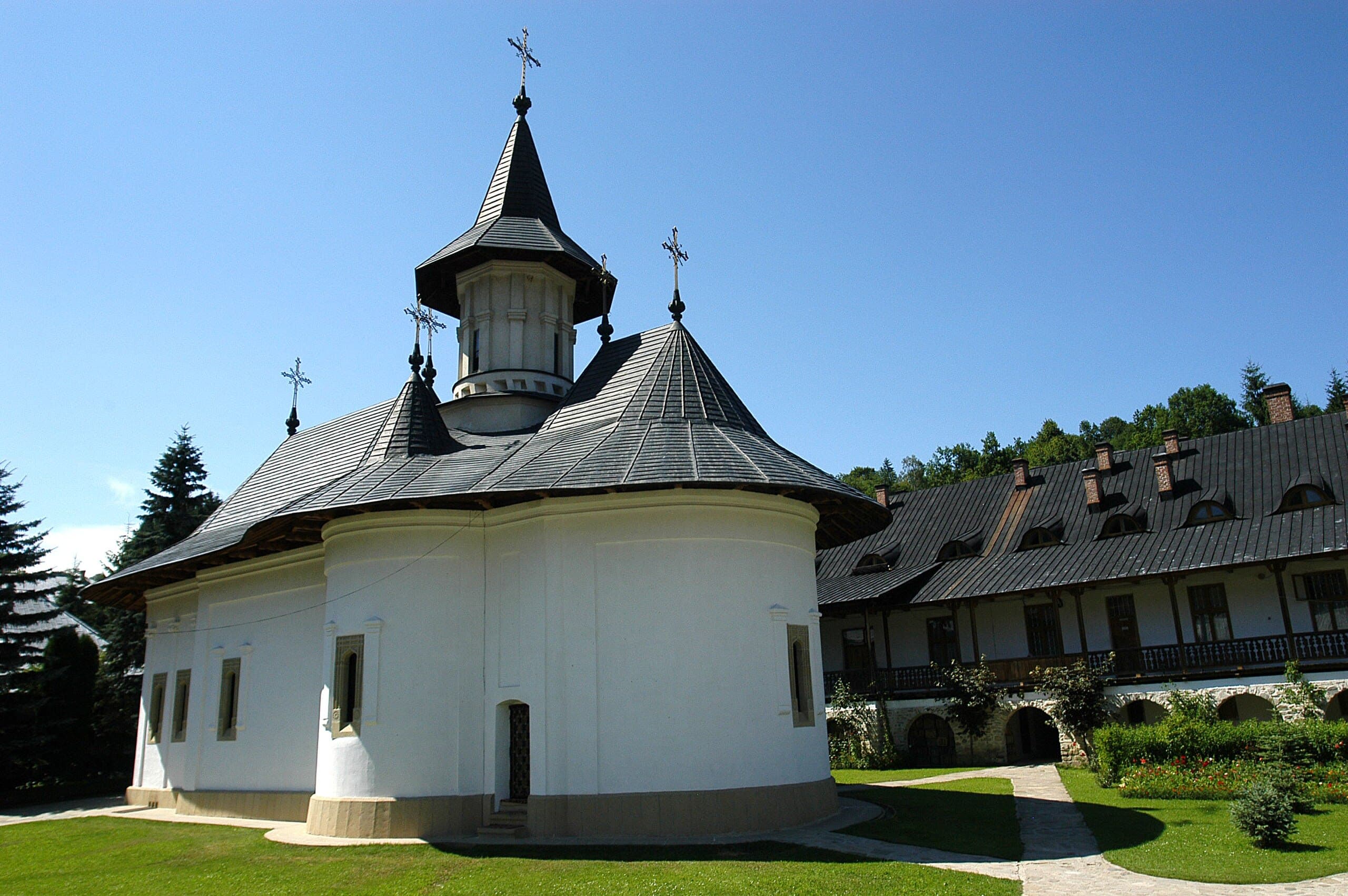
Sihastria Monastery, Romania
Where two newly canonized saints kept the prayer of the heart alive through decades of persecution
Vânători-Neamț, Neamț, Romania
At A Glance
- Coordinates
- 47.1758, 26.1679
- Suggested Duration
- One to three hours for a visit including the churches, grounds, and cemetery. However, the monastery's deepest gifts require longer: an overnight stay, if accommodation is available, allows participation in morning and evening services and a fuller experience of the monastic rhythm. The broader Neamt monastery circuit — Sihastria, Secu, Sihla, Agapia — requires a full day or more.
- Access
- Located in Neamt County, northeastern Romania, approximately 22 km from Targu Neamt. Accessible via a 15 km secondary road from the main road, running alongside the Ozana River through the Secu valley. You pass Secu Monastery after 4 km and reach Sihastria after another 3 km. The nearest city is Piatra Neamt (approximately 40 km). The nearest airport is Suceava (approximately 90 km). Bucharest is approximately 400 km south. The road is paved but narrow. A car is strongly recommended. Mobile phone signal may be limited in the forested valley; check with local providers for current coverage.
Pilgrim Tips
- Located in Neamt County, northeastern Romania, approximately 22 km from Targu Neamt. Accessible via a 15 km secondary road from the main road, running alongside the Ozana River through the Secu valley. You pass Secu Monastery after 4 km and reach Sihastria after another 3 km. The nearest city is Piatra Neamt (approximately 40 km). The nearest airport is Suceava (approximately 90 km). Bucharest is approximately 400 km south. The road is paved but narrow. A car is strongly recommended. Mobile phone signal may be limited in the forested valley; check with local providers for current coverage.
- Standard Romanian Orthodox monastery dress code applies with particular seriousness. Women must cover shoulders and wear skirts below the knee. Men must wear long trousers. Head coverings for women are expected during services. As a male monastery, women visitors should be attentive to dress code requirements and aware that access to certain areas may be restricted.
- Exterior photography of the monastery grounds is generally permitted. Interior photography of churches may be restricted, especially during services. Photography of monks should only be done with explicit permission. Do not disrupt the atmosphere of prayer for the sake of photographs.
- Spiritual counsel from monks is a gift, not a service. Approach with humility rather than expectation. Do not interrupt monks during prayer or work. The monastery can be busy during weekends and feast days, particularly since the 2025 canonization. The December 2 feast of Saints Paisie and Cleopa draws very large numbers of pilgrims. For a contemplative experience, visit on weekdays.
Overview
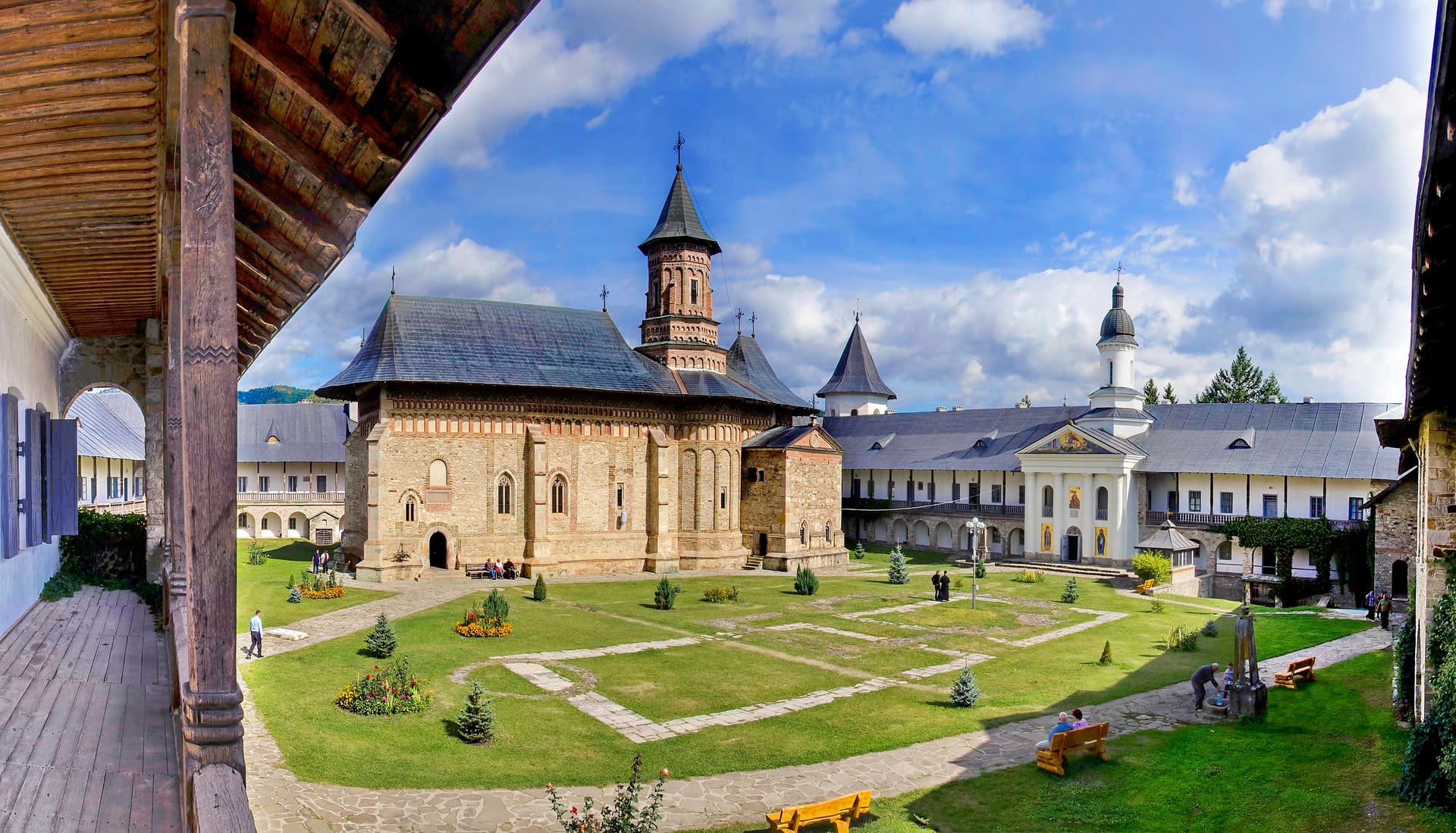
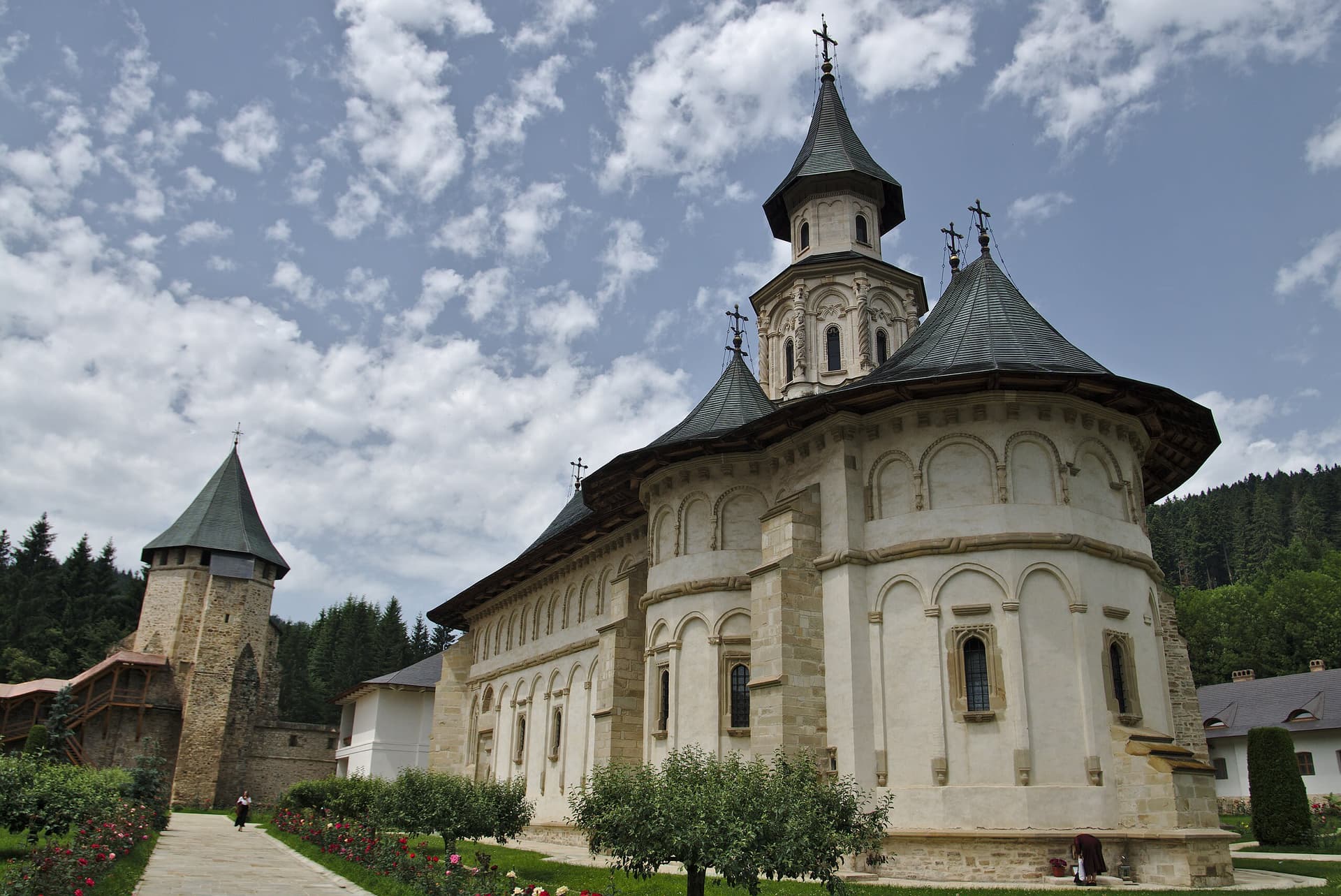
Deep in the forests of Neamt County, Sihastria Monastery carries the most concentrated spiritual atmosphere of any Romanian monastic community. Founded by hermits in 1655, it became the foremost center of the Jesus Prayer tradition in the 20th century through the ministry of Elder Cleopa and Elder Paisie, both canonized in 2025. Their relics now rest in the main church, and the monastery continues as a place where contemplative prayer is not historical curiosity but daily practice.
The road to Sihastria narrows as it follows the Ozana River into the forest. You pass Secu Monastery after four kilometers, then continue three more until the valley closes in and the trees thicken. By the time you arrive, the world outside the forest has receded. This is deliberate. The monastery's name comes from sihastru — hermit in Romanian — and everything about its location announces its vocation.
Seven hermits from Neamt Monastery settled here in 1655, drawn by the silence of the forest and the solitude of the valley. Bishop Ghedeon of Husi formalized the community, and the first church was built in 1665. For three centuries, the monastery remained a small woodland hermitage. Then, in 1942, a twenty-nine-year-old monk named Cleopa Ilie was unexpectedly chosen as superior, and everything changed.
Elder Cleopa transformed Sihastria into Romania's most significant center of spiritual fatherhood. For over thirty years, hundreds of people came daily seeking his guidance. He preached with vivid, patristic-rooted language. He practiced the Jesus Prayer with an intensity rooted in the hesychast tradition that Saint Paisius Velichkovsky had revived at nearby Neamt Monastery in the 18th century. When the communist regime tried to silence him, he retreated into the mountains and lived as a hermit — in 1948 to 1949 and again from 1952 to 1964 — returning each time with his spiritual authority deepened rather than diminished.
Elder Paisie Olaru, who lived in a simple cell from 1947 until his death in 1990, was the complementary presence. Where Cleopa was charismatic and public, Paisie was quiet and hidden, receiving the countless pilgrims who found their way to his door with gentleness and few words. Together they represented two faces of holiness: the prophet and the silent father.
In 2025, the Romanian Orthodox Church canonized both elders. Twenty thousand pilgrims and twenty-four hierarchs attended the proclamation ceremony. Their relics, enshrined in the main church, now draw pilgrims who come to venerate saints whose living memory is still fresh — saints who walked these forests and taught that the most important thing a person can do is learn to say the Jesus Prayer with the whole heart.
The region is known as the Romanian Athos for its density of monasteries. Sihastria holds a particular place: the chain of contemplative prayer, from the Desert Fathers through Mount Athos to Saint Paisius Velichkovsky, found its most intense Romanian expression here.
Context And Lineage
Founded in 1655 by seven hermits from Neamt Monastery, Sihastria became Romania's foremost center of hesychast spirituality and spiritual fatherhood through the ministry of Elder Cleopa and Elder Paisie, both canonized in 2025.
Seven monks from Neamt Monastery sought the solitude of the forest in 1655, settling at a clearing called Atanasie's Plain, named after a hermit who had previously lived there alone. Bishop Ghedeon of Husi, himself a former prior of Secu Monastery, formalized the community. The first church was built in 1665 by Vaarlam Motoc. The name Sihastria — from sihastru, hermit — declares the community's founding intention: withdrawal into the wilderness for prayer. The monastery's modern spiritual character was established when Father Cleopa was chosen as superior in 1942 at age twenty-nine, transforming a small woodland hermitage into one of Romania's most significant spiritual centers.
Sihastria's spiritual lineage extends from the Desert Fathers' practice of continuous prayer, through the hesychast tradition cultivated on Mount Athos, to Saint Paisius Velichkovsky's revival of that tradition at Neamt Monastery in the 18th century, and finally to the 20th-century flowering at Sihastria through Elder Cleopa and Elder Paisie. This chain of transmission is not abstract genealogy but a living practice: the Jesus Prayer taught by one generation of monks to the next, unbroken through centuries of political upheaval and persecution.
Saint Cleopa (Ilie)
patron_saint
Appointed superior of Sihastria in 1942, he spent over fifty years as the monastery's spiritual father, drawing hundreds of seekers daily. He practiced the Jesus Prayer in the hesychast tradition and preached with vivid, patristic-rooted language. Forced into the mountains as a hermit twice during communist persecution (1948-1949 and 1952-1964). He died in 1998 and was canonized in 2025. His feast day is December 2.
Saint Paisie (Olaru)
patron_saint
Quiet, hidden spiritual father who lived in a simple cell at Sihastria from 1947 until his death in 1990. Where Cleopa was charismatic and public, Paisie received pilgrims with gentleness and few words. He possessed nothing in his cell except a bed and a few books. Canonized alongside Cleopa in 2025. His feast day is December 2.
Saint Paisius Velichkovsky
spiritual_ancestor
Ukrainian-born monk (1722-1794) who revived the hesychast tradition at nearby Neamt Monastery. His translation of the Philokalia and his restoration of the Jesus Prayer as a central monastic discipline created the spiritual lineage that Sihastria inherits and continues.
Bishop Ghedeon of Husi
historical
Former prior of Secu Monastery and later Bishop of Roman, who formalized the hermit community at Sihastria in 1655. His connection to Secu links Sihastria to the broader network of Neamt County monasteries.
Why This Place Is Sacred
Sihastria's thinness derives from the concentrated practice of the Jesus Prayer by a monastic community that has maintained this tradition through persecution and into the present, the forest setting that creates a natural environment of silence, and the presence of two recently canonized saints whose memory remains vivid and personal.
The forest does half the work. The Carpathian foothills surrounding Sihastria are dense with deciduous trees that absorb sound and filter light. The approach through the Secu valley, along the narrowing road beside the river, progressively strips away the urban noise that most visitors carry unconsciously. By the time you reach the monastery, your nervous system has already begun to quiet.
The monastic community does the rest. Sihastria's monks practice the Jesus Prayer — Lord Jesus Christ, Son of God, have mercy on me, a sinner — as a continuous interior discipline. This is not devotional recitation but the hesychast tradition of prayer as transformation, the systematic cultivation of inner stillness through a single phrase repeated until it descends from the mind into the heart. The community's collective practice of this prayer creates an atmosphere that visitors consistently describe as different from other monasteries. Something is more still here, more concentrated.
The recently enshrined relics of Saints Cleopa and Paisie add a dimension that is unusually intimate. These are not saints from the distant past. People alive today sat in Elder Cleopa's presence and received spiritual counsel. Some remember Elder Paisie opening his cell door. The gap between the visitor and the holy figures is narrow enough to feel personal, which gives the encounter a charge that more ancient reliquaries cannot replicate.
The landscape itself holds accumulated presence. Centuries of hermits have walked these forests in prayer. Cleopa lived as a hermit in the surrounding mountains for a total of thirteen years, and the locations of his forest cells, though not fully mapped, are understood as part of the sacred geography. The designation Romanian Athos acknowledges that the entire region functions as a landscape of concentrated monastic prayer.
The monastery was founded as a hermitage — a place of withdrawal from the world for the practice of contemplative prayer. Seven monks from Neamt Monastery sought the solitude of the forest in 1655, and the eremitic character of the foundation has shaped everything that followed.
From its origins as a forest hermitage, Sihastria grew slowly into a cenobitic monastery while retaining its contemplative character. The arrival of Elder Cleopa in 1942 transformed it from a small woodland community into Romania's most influential spiritual center. The communist period tested the monastery through direct persecution and the forced exile of its elders, but the tradition survived and even deepened. The 2025 canonization and the enshrinement of the saints' relics mark a new chapter as a major pilgrimage destination.
Traditions And Practice
The Jesus Prayer stands at the center of Sihastria's spiritual life, practiced continuously by the monastic community alongside the full cycle of Orthodox liturgical worship. The recent canonization of Elders Cleopa and Paisie has added the veneration of relics as a major practice.
The hesychast practice of the Jesus Prayer — Lord Jesus Christ, Son of God, have mercy on me, a sinner — repeated with a prayer rope until it descends from the mind into the heart, is the monastery's defining spiritual discipline. Elder Cleopa's daily prayer practice included the Morning Prayers, the Akathist Hymn to the Savior, the Psalter, Vespers, Compline, the Paraclesis to the Theotokos, and Evening Prayers. He spent time in the mountains in solitary prayer during the week, coming down on Saturdays for the evening Vigil and Sunday Divine Liturgy. This pattern of alternation between solitary prayer and communal worship shaped the monastery's rhythm.
Daily Divine Liturgy and canonical hours. The Jesus Prayer maintained as a continuous practice by the monastic community. Spiritual fatherhood and confession ministry for pilgrims. Veneration of the relics of Saints Cleopa and Paisie, enshrined in the main church. The feast of Saints Paisie and Cleopa on December 2. Vigil services. The Orthodox fasting calendar strictly observed. Sacred oil from Elder Cleopa's cross distributed to pilgrims seeking healing. The monks combine prayer with manual labor, maintaining the monastic tradition of ora et labora.
If you come seeking the monastery's deepest gift, it is the Jesus Prayer itself. You need not be Orthodox to learn from it. Ask a monk — respectfully and with genuine interest — about the practice. Sit in the church during services and attend to the quality of the silence between the chanting. Walk in the surrounding forest and try repeating the prayer slowly, with attention, allowing each word its weight. Lord. Jesus. Christ. Son of God. Have mercy on me. A sinner. The prayer is not asking for something. It is an act of placing yourself in relation to the sacred. The monastery's atmosphere supports this work in ways that are difficult to reproduce elsewhere.
Romanian Orthodox Christianity
ActiveSihastria represents the living heart of Romanian Orthodox monasticism in the 20th and 21st centuries. The canonization of Saints Cleopa and Paisie in 2025, described by Patriarch Daniel as pillars of 20th century monasticism, confirmed the monastery's significance as a spiritual center of the first order. The community continues to function as one of Romania's most spiritually active monastic houses.
Daily Divine Liturgy and canonical hours. Intensive Jesus Prayer practice. Spiritual fatherhood and confession ministry. Veneration of Saints Cleopa and Paisie with feast day on December 2. Vigil services. Strict observance of the Orthodox fasting calendar. Sacred oil distributed from Elder Cleopa's cross.
Hesychasm and the Jesus Prayer
ActiveSihastria stands in direct spiritual descent from Saint Paisius Velichkovsky, who revived the hesychast tradition at nearby Neamt Monastery in the 18th century. Elder Cleopa is explicitly recognized as continuing this lineage. The practice of the Jesus Prayer as a path to inner stillness remains central to the monastery's daily life, making Sihastria one of the most significant living centers of the hesychast tradition in the Orthodox world.
Continuous practice of the Jesus Prayer using a prayer rope. Cultivation of hesychia through ascetic discipline. Spiritual fatherhood guiding others in the prayer life. Reading of the Philokalia and patristic texts on prayer. Integration of the Jesus Prayer with all daily activities including manual labor.
Romanian Eldership (Staretism)
ActiveSihastria is the foremost monastery in Romania associated with the tradition of experienced monks serving as spiritual fathers to both monastics and laypeople. Saints Cleopa and Paisie established a model of spiritual guidance combining deep personal prayer with pastoral availability. For over thirty years, hundreds of people daily sought Elder Cleopa's counsel. This tradition continues with the current monastic community.
One-on-one spiritual direction. Confession and spiritual counsel. Public preaching rooted in patristic sources. Guiding both monastics and laypeople in the spiritual life. Receiving visitors and pilgrims for spiritual conversation.
Experience And Perspectives
Visitors describe a quality of spiritual peace at Sihastria that exceeds typical monastic atmospheres, attributed to the deep prayer life of the community, the forest setting, and the tangible connection to recently canonized saints. The monastery rewards those who stay long enough to absorb the rhythm of its contemplative life.
The first thing most visitors notice is the silence. Not an empty silence but one with weight and texture, the kind that arises when a community has been practicing inner stillness for generations. The forest contributes its own quiet, but the monastery's silence is something added — an intentional quality cultivated through the Jesus Prayer.
Pilgrims seeking the relics of Saints Cleopa and Paisie find them in the main church. The experience of venerating saints whose living memory is still present in the community carries a particular charge. Monks who knew the elders personally continue to serve at the monastery. The stories are not legends from centuries past but firsthand accounts, still told with the specificity of lived experience.
The cemetery where the elders were originally buried remains a place of prayer. Visitors leave flowers, light candles, and sit quietly among the graves of monks who spent their lives in this forest. The simplicity of the graves — modest markers among trees — reflects the monastery's character: spiritual depth expressed through material restraint.
Those who stay to attend services encounter the monastery at its most powerful. The liturgy here has a quality of concentrated attention that reflects decades of the Jesus Prayer permeating the community's consciousness. The chanting is not performance but prayer. Visitors describe feeling held by the collective devotion, carried by a current of intention that requires nothing from them except presence.
The sacred oil from Elder Cleopa's cross, distributed to pilgrims, is sought for its reputed healing properties. Whether or not you share the Orthodox understanding of relics and sacred objects, receiving the oil connects you physically to a lineage of prayer that the monastery embodies.
Arrive prepared for quiet. Leave devices silenced. If possible, attend both an evening vigil and the morning Divine Liturgy to experience the full arc of the monastery's prayer day. Visit the relics in the main church, then walk to the cemetery. If monks are available for conversation, approach with humility rather than curiosity. The broader pilgrimage circuit connecting Sihastria to Secu, Sihla, Agapia, and Neamt monasteries rewards those with a full day or more.
Sihastria invites engagement not primarily as a historical monument or architectural site but as a living laboratory of the interior life. Understanding it requires attending to the hesychast tradition it embodies and the extraordinary human beings who carried that tradition through the 20th century.
Scholars position Sihastria as the foremost center of Romanian Orthodox eldership and a critical link in the hesychast chain stretching from Mount Athos through Saint Paisius Velichkovsky to the contemporary Romanian church. Academic works explicitly place Elder Cleopa in the tradition of Saint Paisius Velichkovsky. Historians note the monastery's role as a center of spiritual resistance during the communist era, when the regime attempted to suppress monastic life but could not fully contain the influence of charismatic elders. The 2025 canonization, attended by twenty thousand pilgrims and twenty-four hierarchs, confirmed their significance in Romanian religious and cultural history. The Neamt region's designation as the Romanian Athos is recognized in scholarly literature on Orthodox monasticism.
Within Romanian Orthodox tradition, Sihastria is understood as a place where the Holy Spirit has been particularly active through the ministry of its spiritual fathers. Saints Cleopa and Paisie are venerated as God-bearing elders who received gifts of discernment, prophetic insight, and healing. The tradition emphasizes the unbroken chain of spiritual fatherhood from the Desert Fathers through Mount Athos to Neamt and Sihastria. The saints' relics, described as intact and fragrant, confirm their holiness in the hagiographic tradition. The sacred oil from Elder Cleopa's cross is understood to convey healing.
Some observers note the extraordinary density of monasteries in the Neamt forests as possible evidence of a landscape with inherent spiritual properties. The concept of the Romanian Athos has attracted interest from those studying the relationship between geography and spiritual practice across traditions. The coincidence of multiple recognized saints emerging from a single small monastery in the 20th century has been noted as suggesting exceptional spiritual conditions at the site. These perspectives are speculative.
The precise mechanisms by which the hesychast tradition was transmitted at Sihastria through the disruptions of World War II and communist persecution remain areas of study. Elder Cleopa's two periods of forest hiding are not fully documented, and the exact locations of his hermitages are not completely mapped. The extent of underground spiritual networks connecting Sihastria's elders with other monasteries and laypeople during the communist era is still being researched. Whether the Romanian Athos designation reflects conscious imitation of the Mount Athos model or organic development driven by the landscape is debated.
Visit Planning
Sihastria is located in a remote forest setting in Neamt County, approximately 22 km from Targu Neamt. A car is strongly recommended. The feast of Saints Paisie and Cleopa on December 2 is the primary pilgrimage date.
Located in Neamt County, northeastern Romania, approximately 22 km from Targu Neamt. Accessible via a 15 km secondary road from the main road, running alongside the Ozana River through the Secu valley. You pass Secu Monastery after 4 km and reach Sihastria after another 3 km. The nearest city is Piatra Neamt (approximately 40 km). The nearest airport is Suceava (approximately 90 km). Bucharest is approximately 400 km south. The road is paved but narrow. A car is strongly recommended. Mobile phone signal may be limited in the forested valley; check with local providers for current coverage.
Whether the monastery offers accommodation for pilgrims was not documented in available English-language sources; contact the monastery directly for current arrangements. Guesthouses are available in the surrounding villages. Targu Neamt, approximately 22 km away, offers a range of accommodation. Piatra Neamt, approximately 40 km away, provides full tourist infrastructure.
Sihastria demands a higher standard of contemplative behavior than most visitor sites. This is a male monastery centered on deep prayer, and visitors are expected to honor that vocation through their conduct.
Sihastria's primary identity is as a place of prayer, not a tourist destination. Visitors are welcomed, but the welcome assumes you come with genuine respect for what the monastery is and does. The atmosphere of concentrated stillness that gives the site its power depends on everyone present — monks and visitors alike — maintaining an interior and exterior quiet.
Speak very softly throughout the monastery grounds. The silence here is not a rule imposed from outside but a quality cultivated through generations of the Jesus Prayer. Breaking it with normal-volume conversation or phone calls is not merely rude but destructive to the atmosphere that draws people here.
During services, enter and leave quietly. Stand at the back or along the side unless invited forward. The liturgy is not a performance for visitors but a continuation of the community's prayer life. Your presence is accommodated, not catered to.
At the graves of the elders and the reliquaries in the church, observe the behavior of pilgrims around you and follow their lead. If you are not Orthodox and are unsure about venerating relics, it is perfectly acceptable to stand quietly at a respectful distance.
Standard Romanian Orthodox monastery dress code applies with particular seriousness. Women must cover shoulders and wear skirts below the knee. Men must wear long trousers. Head coverings for women are expected during services. As a male monastery, women visitors should be attentive to dress code requirements and aware that access to certain areas may be restricted.
Exterior photography of the monastery grounds is generally permitted. Interior photography of churches may be restricted, especially during services. Photography of monks should only be done with explicit permission. Do not disrupt the atmosphere of prayer for the sake of photographs.
Candles may be purchased and lit in the churches. Donations to the monastery are welcomed. The sacred oil from Elder Cleopa's cross may be received by pilgrims. Small offerings are customary when seeking spiritual counsel.
Maintain silence or near-silence throughout the monastery grounds. Monastic cells are strictly off-limits. Do not bring secular entertainment to the monastery grounds. Do not interrupt monks during prayer or work without invitation. Plan arrivals and departures to minimize disruption.
Sacred Cluster
Nearby sacred places create the location cluster described in the growth plan. This block is intentionally crawlable and links into the wider regional graph.