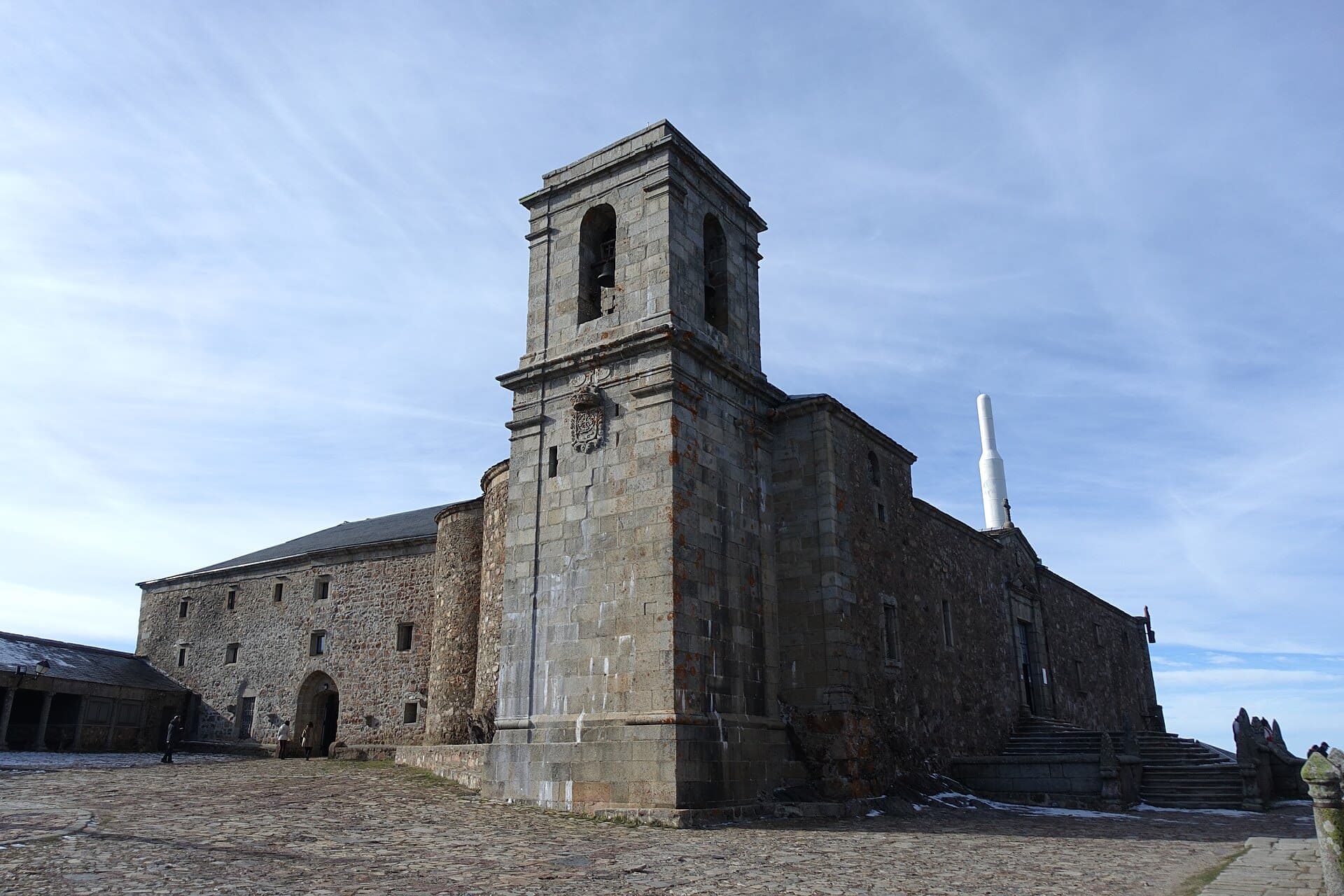
The Sanctuary of the Peña de Francia
Where a French pilgrim's vision led to a hidden Black Madonna on Spain's highest Marian sanctuary
El Cabaco, Castile and León, Spain
At A Glance
- Coordinates
- 40.5128, -6.1689
- Suggested Duration
- A focused visit to the sanctuary takes one to two hours. Those who hike rather than drive should allow additional time for the approach. For deeper engagement, overnight stays at the sanctuary guesthouse permit experiencing the mountain at dawn and dusk, when day visitors have departed.
- Access
- By car, the sanctuary is reached via the SA-203 road, branching from the route connecting La Alberca with Monsagro and Serradilla del Arroyo. A parking lot is located approximately 200 meters from the sanctuary. Driving time is about one hour from Salamanca, 45 minutes from Ciudad Rodrigo, or 20 minutes from La Alberca. On foot, multiple hiking routes approach the summit including the GR-10 long-distance trail and local PR routes: the PR-SA 8 from El Cabaco and the PR-SA 9 from El Cabaco via Nava de Francia and El Casarito. These trails traverse the Las Batuecas-Sierra de Francia Natural Park, offering beautiful forest walking before emerging at the rocky summit. The final approach from the parking area involves some walking. Those with significant mobility limitations should inquire about accessibility before visiting.
Pilgrim Tips
- By car, the sanctuary is reached via the SA-203 road, branching from the route connecting La Alberca with Monsagro and Serradilla del Arroyo. A parking lot is located approximately 200 meters from the sanctuary. Driving time is about one hour from Salamanca, 45 minutes from Ciudad Rodrigo, or 20 minutes from La Alberca. On foot, multiple hiking routes approach the summit including the GR-10 long-distance trail and local PR routes: the PR-SA 8 from El Cabaco and the PR-SA 9 from El Cabaco via Nava de Francia and El Casarito. These trails traverse the Las Batuecas-Sierra de Francia Natural Park, offering beautiful forest walking before emerging at the rocky summit. The final approach from the parking area involves some walking. Those with significant mobility limitations should inquire about accessibility before visiting.
- Dress modestly, as appropriate for a Catholic religious site. Cover shoulders and knees. Practical footwear is advisable given the mountain terrain and potentially cool temperatures at altitude.
- Photography is permitted in public areas of the sanctuary. A designated area has been adapted specifically for photography exhibitions, suggesting the community's openness to visual documentation. However, do not use flash during religious services, and refrain from photography that would disrupt worship or other visitors' contemplative experience.
- Respect the limited access within the sanctuary. Only designated areas are open to visitors: the chapels, the cloister, and the photography exhibition area. The monastery interior—where the remaining Dominican community lives—is not accessible. This is not rejection but appropriate boundary; the monks' privacy enables their prayer. Be aware of weather conditions, particularly if visiting in shoulder seasons. The summit can be significantly colder than the valley, and fog can reduce visibility suddenly. In winter, the road may be impassable and the image itself has been moved to Zarzoso.
Overview
Rising to 1,723 meters in the Sierra de Francia, this Dominican sanctuary guards a Black Madonna hidden for six centuries during Muslim rule. Simón Vela, guided by divine visions across France and Spain, discovered her in 1434. Pilgrims still climb to this thin place where the boundary between mountain and sky, history and miracle, seems to dissolve.
Some places are sacred because of what happened there. Others because of what was found. The Sanctuary of the Peña de Francia holds both: the mountain that became a hiding place during conquest, and the moment a persistent seeker finally uncovered what had waited centuries to be found.
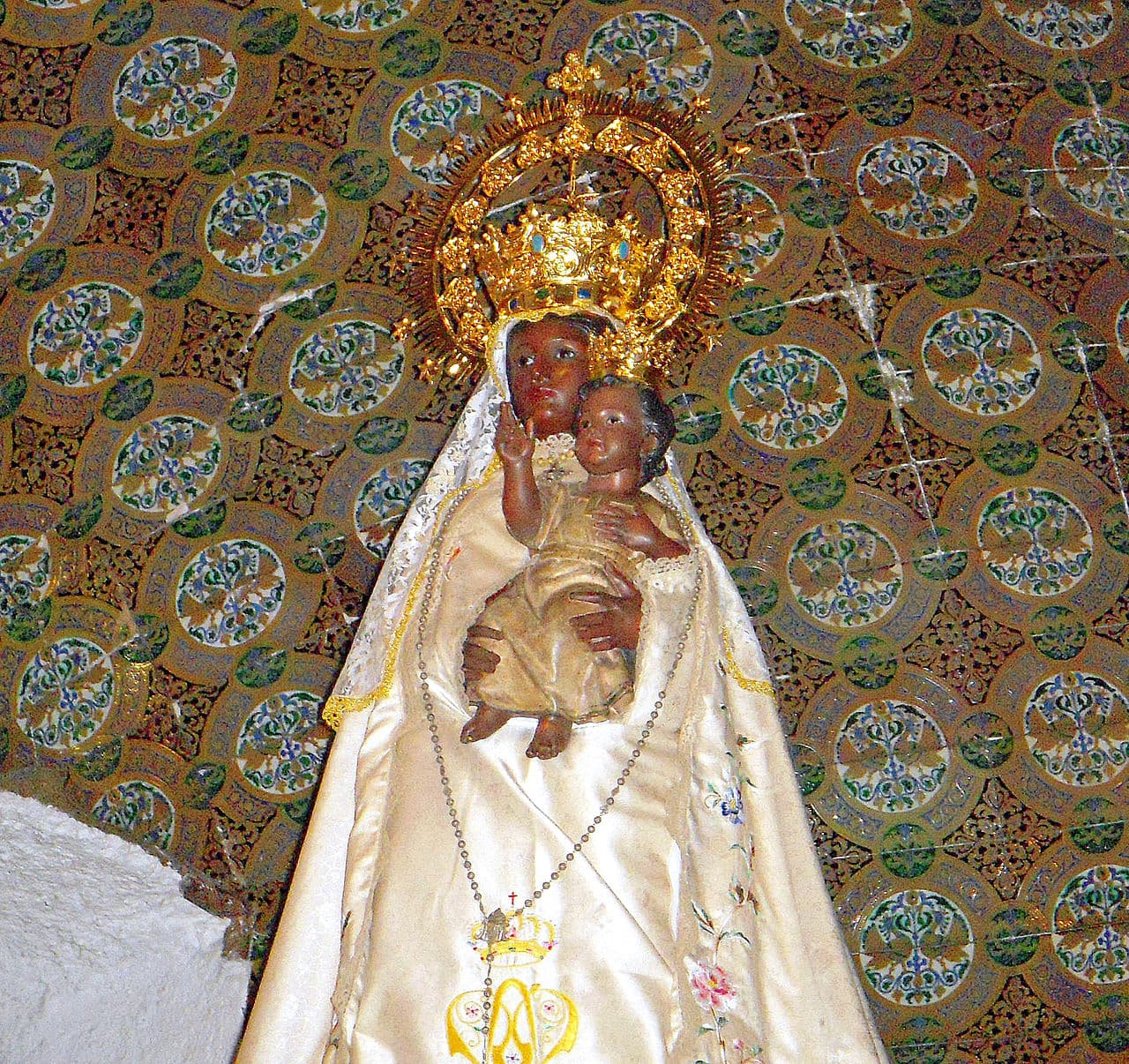
At 1,723 meters, this is the highest Marian sanctuary in the world. The Dominicans have kept watch here since 1437, building their monastery on the very rock where the Black Madonna lay buried. The statue—la Morenita, they call her—predates the medieval period, perhaps reaching back to the time of Charlemagne and the French knights who first consecrated this peak as Monte Sacro, Sacred Mountain.
The approach itself prepares visitors. Whether driving the winding road from La Alberca or walking the ancient trails through the Sierra de Francia Natural Park, the ascent is gradual, deliberate. Clouds often wrap the summit. When they part, the view extends across Castile and León, the land the Virgin now officially patronizes.
What draws people here is not merely age or altitude. It is the particular quality of a place where someone searched for years before finding what he sought—and where what was found still waits for those who make the climb.
Context And Lineage
The sanctuary marks the 1434 discovery of a Black Madonna believed to date from the Carolingian period, hidden during centuries of Muslim rule in Spain. A French nobleman named Simón Vela, called by divine vision, searched for years before uncovering the statue. King Juan II of Castile entrusted the site to the Dominicans in 1437, beginning a tradition of stewardship that continues, with interruption, to the present day.
The story begins with concealment. Sometime during the 8th or 9th century, according to tradition, French knights discovered a statue of the Virgin Mary on Mount Peña de Francia. A French bishop consecrated the mountain as Monte Sacro. But the Reconquista—the centuries-long struggle between Christian and Muslim powers for control of the Iberian Peninsula—was far from over. When Muslim forces again took the territory, faithful custodians buried the Madonna deep in the rock, hiding her from destruction.
There she waited. For approximately six hundred years, through the entire flowering and decline of Al-Andalus, the Black Madonna lay concealed in her mountain cave.
In Paris in the early 15th century, a wealthy nobleman named Simon Rolan gave away his inheritance to serve God. While in deep contemplation at a Franciscan church, he heard a voice: 'Simon, vela y no duermas!'—Simon, stay awake and do not sleep! The voice commanded him to journey to Peña de Francia in the Western regions to find a hidden image of the Virgin. He changed his surname to Vela so that whenever heaven called him by name, he would hear the command to awaken.
Believing Peña de Francia to be in France, Simón Vela searched for five years among every cave and mountain between Paris and the sea. Finally understanding that 'Western regions' meant southwest into Spain, he followed the Camino Francés pilgrimage route toward Santiago de Compostela. At the Salamanca market, he overheard a coal vendor mention Mount Peña de Francia. He wept with joy.
On May 14, 1434, Simón Vela arrived at the mountain and found four local men who remembered a prophecy of 'La Moza Santa'—the holy young woman—and a treasure hidden in the peak. For three days they dug. On May 19, after removing a huge stone, they found the Black Madonna embedded among the rocks. Instantly, all five received miraculous healings—documented by notary the same day.
King Juan II of Castile, with the blessing of Pope Martin V, entrusted the sanctuary to the Dominican Order in 1437—just three years after the discovery. The Dominicans built the church, convent, and hospice that still stand, establishing the patterns of worship and hospitality that have defined the site for nearly six centuries.
The continuity was broken in 1835, when the Mendizábal confiscations expelled religious communities across Spain. For 65 years the sanctuary lacked its traditional guardians. The theft of the statue in 1872 added insult to absence—though its return in 1889, under confession, preserved the essential connection.
The Dominicans returned on July 16, 1900, resuming a stewardship that continues today. The community has diminished—reports suggest only a single Dominican monk currently resides at the sanctuary—but the site remains active as a guesthouse and place of pilgrimage. The Ciudad Rodrigo brotherhood maintains annual pilgrimage, and feast days still draw the faithful. The tradition is attenuated but unbroken.
The devotion has traveled far beyond Spain. In the early 18th century, a Spanish official's son brought devotion to Our Lady of Peñafrancia to Naga City in the Philippines, where she became patroness of the Bicol region. The September festivals in her honor are now among the largest Catholic celebrations in Asia—a daughter tradition that has grown larger than its mother.
Simón Vela
historical
French nobleman born in Paris in 1401 who received visions calling him to find the hidden Virgin. After years of searching across France and Spain, he discovered the Black Madonna on May 19, 1434. His changed surname—Vela, meaning 'stay awake'—embodied his mission of constant vigilance for divine guidance.
King Juan II of Castile
historical
The Castilian monarch who, with the blessing of Pope Martin V, ordered the site entrusted to the Dominican Order in 1437, establishing the institutional framework that continues to govern the sanctuary.
Our Lady of the Peña de Francia
sacred figure
The Black Madonna whose statue, believed to date from the time of Charlemagne, was hidden during Muslim rule and rediscovered in 1434. Crowned Queen of Castile in 1952, she is patroness of Ciudad Rodrigo, the province of Salamanca, and all of Castile and León.
Why This Place Is Sacred
The sanctuary's sacredness emerges from converging factors: its extreme elevation as the highest Marian site in the world, a Black Madonna hidden during centuries of conflict and miraculously rediscovered, documented healings at the moment of discovery, and nearly six hundred years of continuous pilgrimage and prayer. The mountain rises above the Castilian plain like a threshold between earth and sky.
The Peña de Francia is visible from throughout the surrounding region—a solitary peak rising abruptly from the plains of western Spain. Long before Simón Vela's vision, French settlers fleeing northward gave the mountain its name. Long before them, the Vettones and other pre-Roman peoples likely recognized something in this place that transcended ordinary geography.
What makes a mountain sacred is not solely height. The Peña de Francia stands at an intersection: geographically between Portugal and central Spain, historically between Christian and Muslim periods, spiritually between the hidden and the revealed. For approximately six hundred years, a Black Madonna lay buried in rock here—placed by faithful hands to protect her from destruction, waiting through the entire period of Al-Andalus until a French nobleman heard a voice in Paris calling him to search.
The notarized record of May 19, 1434, preserved in the archives of San Martín de Castañar, documents what happened when Simón Vela and four local men finally uncovered the stone: all five received instant healings. Simón's head wound vanished. A blind eye recovered sight. Ten years of stomach trouble ended. Hearing returned. A crippled finger straightened. These are not legends told across centuries of oral tradition but events recorded by a Notary Public within days of their occurrence.
Something about extreme elevation intensifies encounter. At nearly the edge of where humans can live comfortably, the air is thinner, the sky closer. Pilgrims who climb here often speak of feeling they have entered a liminal zone—still on earth but at its upper limit, where what seems impossible below becomes plausible. The clouds that frequently shroud the summit add to this quality, wrapping the sanctuary in mist that visitors describe as both isolating and enveloping, separating them from the ordinary world they left in the valley.
The mountain's sacred use predates the sanctuary by centuries. According to researcher Ean Begg and others studying Black Madonna traditions, French knights during the time of Charlemagne discovered an image on this peak, and a French bishop consecrated the mountain as Monte Sacro. When Christians later lost the territory to Muslim forces, faithful custodians buried the Madonna to prevent her destruction—an act of protective concealment that would last over half a millennium.
The 15th-century sanctuary was built not to create a sacred site but to mark one already recognized. Simón Vela did not choose this location; he was called to it by vision. The Dominicans who followed were given charge of a place already charged with meaning. Their task was stewardship of what had been there, hidden, all along.
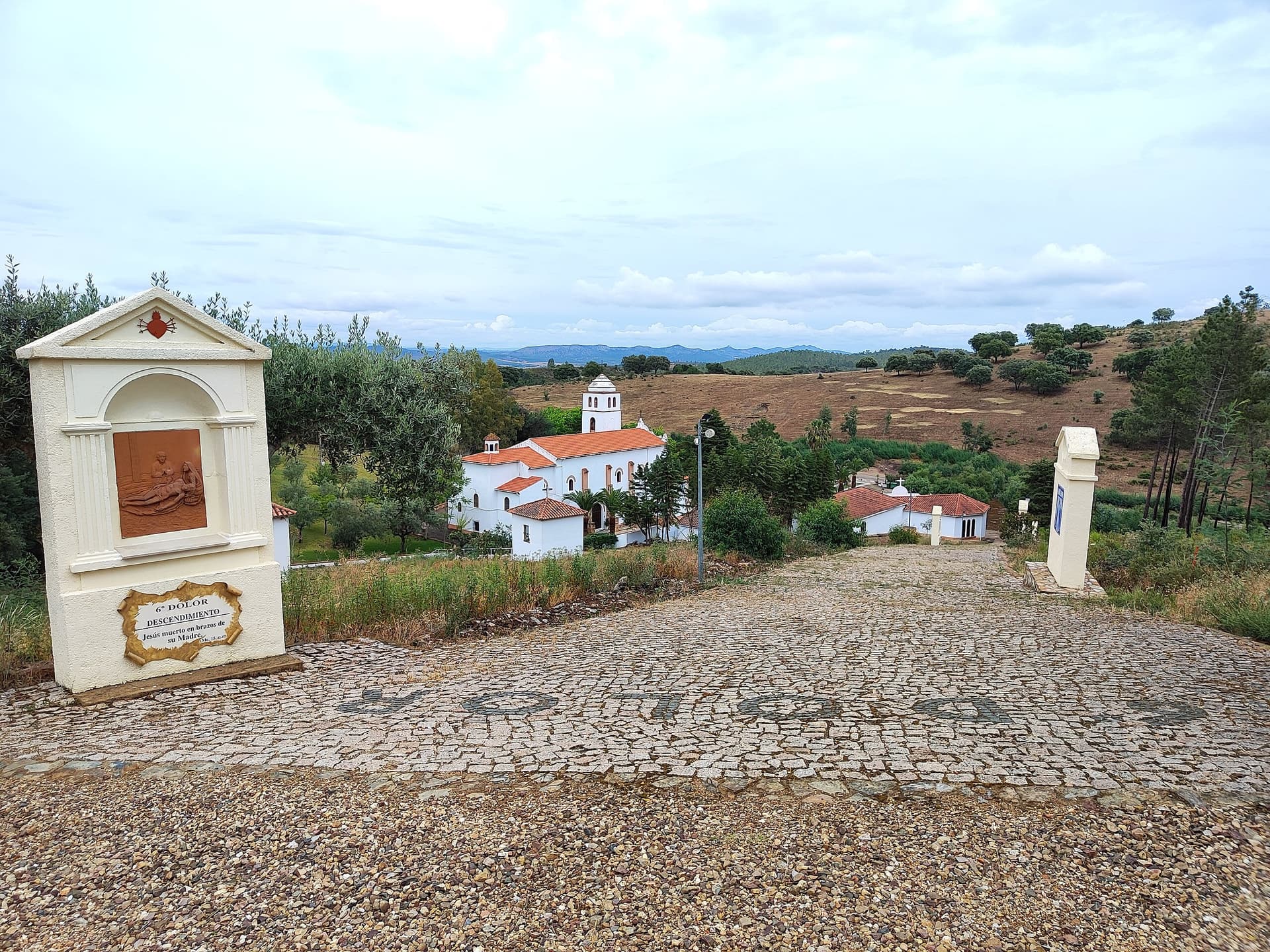
The Dominicans built their monastery beginning in 1437, constructing the Gothic church, convent, and hospice that still form the core of the sanctuary. The 16th century added the Chapel of La Blanca directly over the discovery cave—the very rock cavity where Simón Vela reached in and pulled forth the Black Madonna. A neoclassical façade came in the 17th century, the tower in the 18th.
But continuity has not been unbroken. In 1835, during the Mendizábal confiscations, the Dominicans were expelled along with religious communities across Spain. For 65 years the sanctuary stood without its traditional guardians. In 1872, the statue itself was stolen—returned in 1889 under the seal of confession, so badly deteriorated that a new image was carved to replace it. The current statue incorporates remnants of the ancient original within its form.
On July 16, 1900, the Dominicans returned. In 1952, the Virgin was solemnly crowned Queen of Castile in the main plaza of Salamanca—official recognition of what pilgrims had long known. Today the community is diminished, reportedly to a single Dominican monk, but the sanctuary continues to function as a guesthouse and pilgrimage site. The tradition persists, even if the numbers have thinned.
Traditions And Practice
The sanctuary offers daily Mass and prayers, opportunities for personal contemplation in the chapels and cloister, and overnight stays at the guesthouse. Major celebrations occur on September 8, the Feast of the Nativity of Mary, and the last weekend of June when the Ciudad Rodrigo brotherhood makes its annual pilgrimage on foot and horseback.
The Dominicans have maintained the rhythms of monastic prayer at Peña de Francia since 1437. Daily Mass and the Liturgy of the Hours structure time at the sanctuary, as they have for nearly six centuries. The annual cycle centers on September 8, the Feast of the Nativity of Mary, which serves as the principal celebration of the patroness.
A distinctive practice is the seasonal translation of the Virgin's image. During summer months the statue resides at the mountaintop sanctuary, accessible to pilgrims who climb to meet her. In winter, when snow and harsh weather can make the peak inhospitable, the image moves to the convent of the Poor Clares in Zarzoso, where devotees can still venerate her in more accessible conditions.
The Ciudad Rodrigo pilgrimage continues as a living tradition. Each year on the last weekend of June, the Brotherhood of Our Lady of the Peña de Francia organizes a procession from the city to the summit. Pilgrims travel on foot, horseback, or horse-drawn carriage, carrying their own image of the patroness up to the sanctuary and then returning to bring her back down. The route traces paths that devotees have followed for generations.
Visitors today participate primarily through personal pilgrimage and contemplation. The sanctuary welcomes those seeking quiet prayer, retreat, or simply a pause from ordinary life. The guesthouse makes overnight stays possible—an opportunity to experience the mountain's different qualities at dawn, dusk, and under starlight.
Hiking to the sanctuary has become a popular form of pilgrimage. Trails including the GR-10 and local PR routes traverse the Las Batuecas-Sierra de Francia Natural Park, allowing visitors to approach on foot as pilgrims did before roads were built. The physical effort of the climb mirrors the spiritual journey of seeking.
Photography exhibitions in designated areas of the sanctuary indicate an openness to contemporary forms of engagement with the site. The buildings themselves—Gothic church, neoclassical façade, stone cloisters—reward careful attention.
If you come seeking more than scenery, consider these approaches.
Spend time in the Chapel of La Blanca. This 16th-century chapel was built directly over the cave where Simón Vela discovered the Black Madonna. To stand in this space is to occupy the exact location where centuries of concealment ended—where what was hidden became found. Let the significance of that threshold settle.
Walk the cloister in silence. Monastic cloisters were designed for contemplative walking—a practice of prayer in motion. Even if formal meditation is not your practice, the simple act of slow, attentive walking in this space can produce its own effects.
If possible, stay overnight. The sanctuary functions as a guesthouse, and those who remain after day visitors depart describe a different quality of encounter. The mountain at sunset and dawn, the quiet of evening prayers, the stars at high altitude—these are not available to those who arrive and leave in a single afternoon.
Before departing, offer silent gratitude. Catholic tradition provides forms—lighting a votive candle, making a donation—but the offering need not follow any prescribed shape. Simply acknowledging what you have received, if you have received anything, completes the exchange.
Roman Catholicism - Dominican Order
ActiveThe Dominicans have been stewards of the sanctuary since 1437, when King Juan II of Castile entrusted the site to the Order with the blessing of Pope Martin V. They built the church, convent, and hospice that still stand, and have maintained the rhythms of prayer and hospitality—with one significant interruption during the Mendizábal confiscations—for nearly six centuries. The Virgin of Peña de Francia was crowned Queen of Castile in 1952, confirming her position as patroness of the region.
Daily Mass and the Liturgy of the Hours structure time at the sanctuary. The principal feast is September 8, the Nativity of Mary. The Ciudad Rodrigo brotherhood maintains annual pilgrimage on the last weekend of June. The statue's seasonal translation—summer at the summit, winter at the Poor Clares convent in Zarzoso—adapts devotion to the mountain's harsh conditions. The sanctuary operates as a guesthouse, extending hospitality to pilgrims as the Dominicans have for centuries.
Black Madonna Veneration
ActiveThe sanctuary houses one of Spain's Black Madonnas—dark-skinned representations of the Virgin Mary that carry particular devotional significance across Europe. Called la Morenita or la Virgen Morena, the Peña de Francia Madonna is believed by tradition to date from the time of Charlemagne, hidden during Muslim rule and rediscovered after six centuries. The current statue, carved in 1890, contains remnants of the ancient original.
Devotees venerate the Black Madonna through prayer, pilgrimage, and petition for her intercession. The approach to her—whether by car or on foot up mountain trails—becomes itself a devotional act. Candles are lit; prayers are offered. The physical elevation of her sanctuary mirrors the spiritual elevation attributed to her protection. Those who have received graces through her intercession sometimes return in thanksgiving.
Experience And Perspectives
Visitors to Peña de Francia report experiences shaped by the dramatic altitude and isolation: a sense of having physically ascended to meet something, encounters with unusual stillness and peace in the ancient chapels, and the atmospheric power of arriving at a summit often wrapped in cloud. The pilgrimage from Ciudad Rodrigo each June, when devotees travel on foot or horseback, demonstrates the living tradition that still animates this place.
The experience begins with the approach. Whether by the winding SA-203 road or on foot along trails like the GR-10, visitors are aware of climbing. The transition is gradual but undeniable—agricultural lowlands giving way to forest, the air cooling, the horizon widening with each switchback. Many describe a sense of entering sacred space before the sanctuary comes into view.
When it appears, the impression is of architecture that belongs to its site. The buildings cluster at the summit as though they grew there, dark stone against often-grey sky. The contrast with the ascent—verdant forests of the Sierra de Francia Natural Park—makes the arrival feel like emerging into a different climate, a different century.
Inside the sanctuary, the atmosphere shifts again. The chapels hold the particular silence of places prayed in for centuries—not empty silence but dense, expectant. Visitors speak of an invitation to stillness that the space seems to extend. The Chapel of La Blanca, built directly over the cave where Simón Vela made his discovery, concentrates this quality. Standing where someone once reached through rock to find what had been hidden so long produces its own effect.
Weather contributes to the experience in ways unique to high-altitude sites. Clouds frequently surround the peak, wrapping visitors in mist that limits visibility to a few meters. The effect is simultaneously isolating and focusing—the ordinary world disappears, and what remains is the mountain, the stone, the presence of those who have prayed here before. When the clouds part, the views extend across the entire region, reminding visitors how far above the everyday they have climbed.
The quietest visits come outside peak seasons. In winter the statue moves to Zarzoso, but the buildings remain. Those who come in spring or autumn, midweek, may find themselves nearly alone with the sanctuary—sharing the space only with the stones, the wind, and whatever else inhabits this summit.
Peña de Francia rewards those who come prepared to receive rather than consume. The site can be photographed in thirty minutes, but the experience most visitors remember requires longer—time to sit in the Chapel of La Blanca, time to walk the cloister, time to let the altitude and silence do their work.
Consider the journey itself as part of the practice. Whether driving or walking, the ascent is an opportunity to leave behind the pace and preoccupations of lower elevations. Arriving already rushed diminishes what the site can offer.
The sanctuary guesthouse allows overnight stays, and those who spend the night describe a different quality of encounter—sunset and sunrise from the summit, the stars at altitude, the sound of morning prayers from the chapel. The day visitors have left by evening; what remains is the mountain, the monastery, and the quiet.
If you come with a question, bring it consciously. The story of Simón Vela is one of persistent seeking—years of searching before the discovery. The site seems to honor those who arrive with genuine questions, even if answers do not come in expected forms.
The Sanctuary of the Peña de Francia invites multiple readings—historical, devotional, and speculative. The documented record is substantial: notarized accounts of the discovery, centuries of Dominican stewardship, official heritage recognition. The devotional tradition is living, with ongoing pilgrimage and an offshoot devotion in the Philippines that has grown larger than the original. And questions remain: about the true age of the buried statue, about the experiences of those who hid it, about what draws seekers to this particular summit.
The historical record is unusually strong for a Marian apparition site. The discovery of May 19, 1434, was documented by a Notary Public; this record survives in the archives of San Martín de Castañar. The establishment of Dominican custody in 1437 by King Juan II with papal blessing is similarly documented. The 1956 declaration as a Monumento Artístico and subsequent recognition as Bien de Interés Cultural confirm the site's architectural and cultural significance.
Scholars note the sanctuary's importance as the highest Marian shrine in the world and its role in the religious landscape of medieval and early modern Castile. The spread of the devotion to the Philippines in the 18th century demonstrates the global reach of Spanish Marian cults during the colonial period.
What remains less certain is the origin and age of the original statue. Claims that it dates to the Carolingian period—the time of Charlemagne—rest on tradition rather than archaeological analysis. The current statue dates to 1890, with only remnants of the earlier image enclosed within it.
Catholic teaching holds that the statue's discovery was divinely ordained. Simón Vela did not happen upon Peña de Francia; he was called by voice in prayer and obeyed through years of searching. The immediate miraculous healings of all five discoverers testifies to the Virgin's power and the authenticity of the discovery.
The Virgin of Peña de Francia was solemnly crowned Queen of Castile in 1952—official recognition of her patronage over Ciudad Rodrigo, the province of Salamanca, and all of Castile and León. Her intercession is sought for healing and protection, as it has been since the day she emerged from the rock.
The devotion's spread to the Philippines, where Our Lady of Peñafrancia became patroness of the Bicol region, demonstrates her reach beyond Spanish borders. The September festivals in Naga City, among the largest Catholic celebrations in Asia, show how a hidden Madonna in the mountains of Salamanca can mother a tradition across oceans.
Some researchers, including Ean Begg in his studies of Black Madonna traditions, suggest the statue may represent older strata of goddess veneration adapted to Christian form. Black Madonnas across Europe often appear at sites with evidence of pre-Christian sacred significance; the mountain's name and its early designation as Monte Sacro by a French bishop hint at layers predating medieval Marian devotion.
The French connection embedded in the name 'Peña de Francia' suggests possible links to Frankish settlement or pilgrimage routes. The Camino de Santiago passes through this region, and the sanctuary sits near the Mozarabic Way. Some see in Black Madonna sites a persistence of earth-based spirituality within Christian garb—the dark mother who guards mountain caves and spring waters, whatever name she is given.
Genuine mysteries remain. Who hid the original statue, and under what circumstances? Tradition places the concealment during Muslim rule, but no contemporary record documents the act. The identity and fate of those who chose to bury their Madonna rather than see her destroyed—hoping someone centuries hence would find her—remains unknown.
The true age and origin of the original statue cannot be verified. Claims range from the 8th century to later medieval periods. Since only remnants of the ancient image survive, enclosed within the 1890 replacement, definitive dating may be impossible.
How Simón Vela, praying in Paris, received a vision about a specific mountain in western Spain whose name he did not recognize—and why he was chosen rather than someone local to the region—are questions the historical record cannot answer. These belong to the territory of faith, or mystery, depending on how one holds such things.
Visit Planning
The sanctuary is accessible by car via the SA-203 road, about an hour from Salamanca or 20 minutes from La Alberca. Multiple hiking trails also lead to the summit. Late spring through early autumn offers the best conditions. The sanctuary operates a guesthouse for overnight stays. Winter visits require checking conditions, as the road may be impassable and the Virgin's image is moved to Zarzoso.
By car, the sanctuary is reached via the SA-203 road, branching from the route connecting La Alberca with Monsagro and Serradilla del Arroyo. A parking lot is located approximately 200 meters from the sanctuary. Driving time is about one hour from Salamanca, 45 minutes from Ciudad Rodrigo, or 20 minutes from La Alberca.
On foot, multiple hiking routes approach the summit including the GR-10 long-distance trail and local PR routes: the PR-SA 8 from El Cabaco and the PR-SA 9 from El Cabaco via Nava de Francia and El Casarito. These trails traverse the Las Batuecas-Sierra de Francia Natural Park, offering beautiful forest walking before emerging at the rocky summit.
The final approach from the parking area involves some walking. Those with significant mobility limitations should inquire about accessibility before visiting.
The sanctuary itself operates as a guesthouse, offering the opportunity to stay overnight on the mountain—an experience that deepens engagement with the site. La Alberca, approximately 15 kilometers away, offers additional lodging options in a historic village setting. Salamanca and Ciudad Rodrigo provide full urban accommodation for those preferring to day-trip to the sanctuary.
The Sanctuary of Peña de Francia is an active Catholic site requiring modest dress, quiet behavior, and respect for ongoing worship. Photography is permitted in public areas but should not disrupt prayer or services. The monastic community's privacy should be honored.
This is a place of active worship, not a museum. While the sanctuary welcomes visitors, the Dominicans have maintained prayer here for nearly six centuries, and that continuity deserves respect. Your presence is welcome; your attention to etiquette makes that welcome possible.
The most important principle is quiet. The chapels and cloister are spaces for prayer and contemplation—not casual conversation. Speak in hushed tones if you must speak at all. Turn off mobile phones, or at minimum set them to silent.
If Mass or other services are in progress, you are welcome to attend or to wait quietly at the back. Do not enter the sanctuary during the Eucharistic prayer if you would not participate. If you do not know Catholic liturgical patterns, simply observe and follow the lead of others.
The monastery living quarters are not accessible to visitors. This is not inhospitality but appropriate separation between the public sanctuary and the private life of the community. Accept the boundaries as part of what enables the monks to maintain the site.
Dress modestly, as appropriate for a Catholic religious site. Cover shoulders and knees. Practical footwear is advisable given the mountain terrain and potentially cool temperatures at altitude.
Photography is permitted in public areas of the sanctuary. A designated area has been adapted specifically for photography exhibitions, suggesting the community's openness to visual documentation. However, do not use flash during religious services, and refrain from photography that would disrupt worship or other visitors' contemplative experience.
Donations to support the sanctuary's maintenance are welcomed. Votive candles may be lit in the traditional Catholic manner. These simple offerings sustain both the physical structure and the spiritual continuity of the site.
Only designated areas are open to visitors: the chapels, the cloister, and the photography exhibition area. The monastery interior is restricted. Check opening hours before visiting, as the site may have limited winter hours due to weather conditions. Note that the statue itself is moved to Zarzoso during winter months.
Sacred Cluster
Nearby sacred places create the location cluster described in the growth plan. This block is intentionally crawlable and links into the wider regional graph.