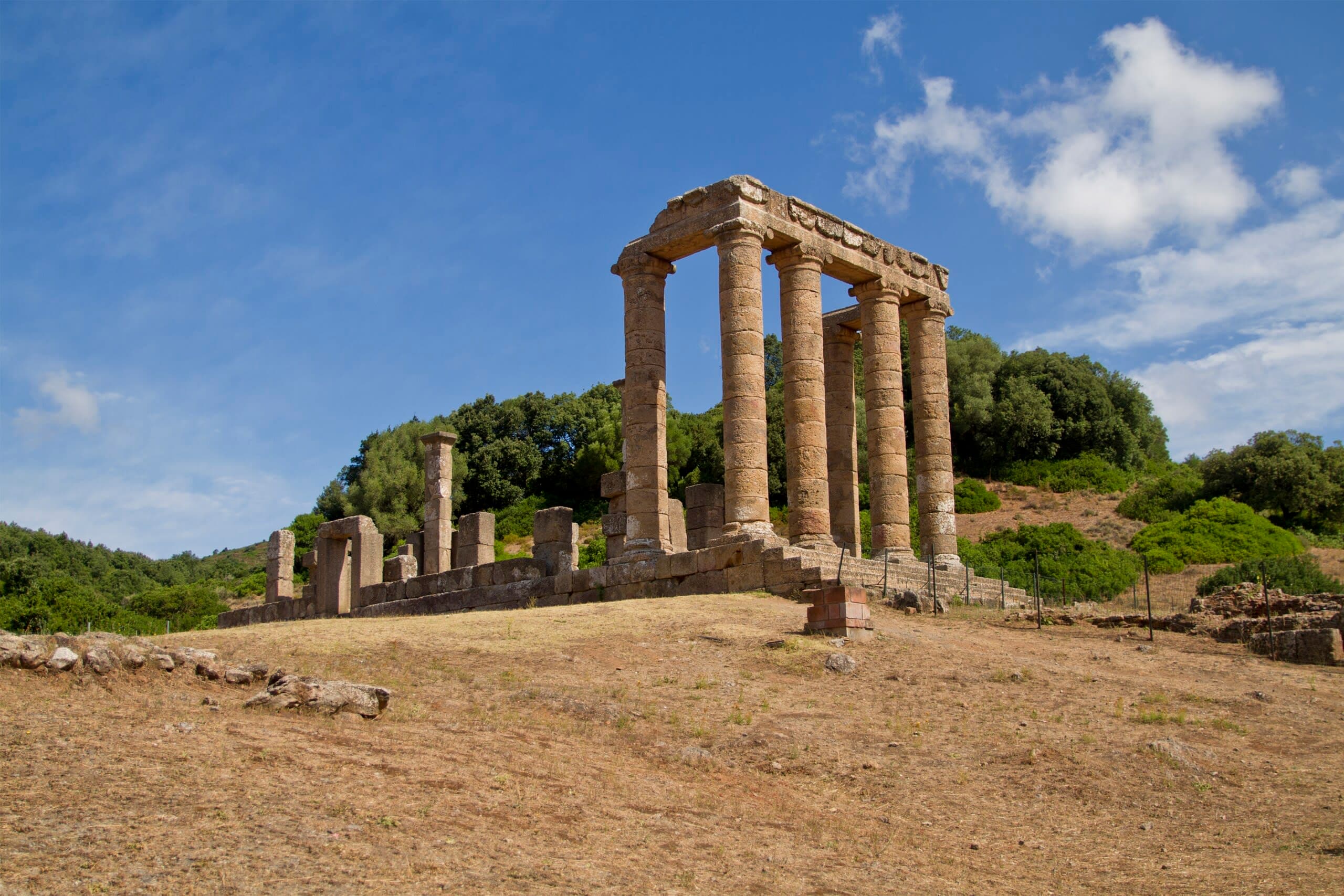
Temple of Antas
Three civilizations built their temples here, each honoring the divine ancestor of the Sardinian people
Frùmini Majori/Fluminimaggiore, Sardinia, Italy
At A Glance
- Coordinates
- 39.3940, 8.5002
- Suggested Duration
- 1-2 hours including archaeological area and nearby Roman quarries.
Pilgrim Tips
- No specific requirements. Comfortable walking shoes recommended.
- Photography permitted throughout the site.
- Some areas may be restricted for preservation. The site involves some walking on uneven terrain.
Overview
In a mountain valley of southwestern Sardinia, three civilizations constructed temples to the same deity under three different names. The Nuragic people called him Babai. The Carthaginians named him Sid Addir. The Romans worshipped Sardus Pater—Father of the Sardinians. For nearly three thousand years, this site served as the sacred heart of Sardinian identity. The reconstructed Roman columns now rise where Bronze Age priests once made offerings, testament to a place so powerful that conquering civilizations built upon rather than destroyed what came before.
The Temple of Antas stands where three civilizations recognized sacred ground. In the ninth century BC, the Nuragic people established a necropolis here, venerating a deity called Babai whose bronze image—a naked male holding a spear—was recovered from an ancient tomb. Six hundred years later, Carthaginian colonizers built their own temple to Sid Addir, warrior god and hunter, finding in the indigenous Babai a face they recognized from their own pantheon.
Then came Rome. The Emperor Augustus rebuilt the temple around 2 BC, dedicating it to Sardus Pater Babai—Father of the Sardinians—who Roman mythology connected to Hercules himself. According to Pausanias and Sallust, Sardus was the son of Hercules who migrated from Libya to give the island its name. The Romans understood something essential: this was not merely a temple but the sacred center of Sardinian identity.
Emperor Caracalla restored the structure in the third century AD, ensuring that the temple remained functional for worshippers who continued coming to honor their divine ancestor. The reconstructed columns you see today date from 1967, but they rise from foundations laid by Augustus, which themselves rest upon Carthaginian work, which overlays Nuragic sacred ground.
The layers matter. Each civilization that came to Sardinia recognized the power of this valley and chose to build rather than destroy. The syncretism was not erasure but accumulation—Babai became Sid became Sardus Pater, yet remained fundamentally the same deity, the father-ancestor of the Sardinian people. This is sacred ground that three thousand years of devotion has marked indelibly.
Context And Lineage
The Temple of Antas served three civilizations as the sanctuary of Sardinia's divine ancestor, known successively as Babai, Sid Addir, and Sardus Pater.
Sacred activity at Antas began in the ninth century BC when the Nuragic people established a necropolis in this mountain valley. Among the offerings found was a bronze figurine representing Babai—a naked male holding a spear—the indigenous deity who would later be identified with Carthaginian and Roman gods.
When Carthage colonized Sardinia, they recognized Babai as their own god Sid Addir, patron of warriors and hunters. Around 500 BC, they constructed a temple, leaving many inscribed votives that confirm this syncretic identification. The Carthaginian temple was restored around 300 BC.
Rome conquered Sardinia but did not destroy the sacred site. Instead, Emperor Augustus rebuilt the temple between 27 BC and 14 AD, dedicating it to Sardus Pater Babai—Father of the Sardinians. Roman mythology, recorded by Sallust and Pausanias, made Sardus the son of Hercules who migrated from Libya to give the island its name.
Emperor Caracalla restored the temple between 213-217 AD, ensuring its continued function. After the fall of Rome, the temple fell into ruin, forgotten until General Alberto La Marmora discovered the remains in 1836. The identification as Sardus Pater's temple was established in 1954, and reconstruction to the current appearance was completed in 1967.
Nuragic necropolis (9th century BC), Carthaginian temple to Sid Addir (500 BC), Roman temple to Sardus Pater under Augustus (27 BC-14 AD), restored under Caracalla (213-217 AD), discovered 1836, reconstructed 1967.
Sardus Pater / Babai / Sid Addir
Divine Ancestor
Emperor Augustus
Temple Builder
Why This Place Is Sacred
The Temple of Antas draws its thin quality from nearly three millennia of continuous sacred use, from its role as the spiritual center of Sardinian identity, and from the remarkable syncretism that allowed three civilizations to worship here under a shared understanding.
What makes Antas thin is precisely what makes it rare: continuity. Most ancient sacred sites were destroyed by conquering religions. Here, each successive civilization recognized what had come before and built upon it rather than obliterating it.
The Nuragic Babai was a deity of ancestors, a connection to those who had gone before. The Carthaginians saw in him their own Sid Addir, god of warriors and hunters, and left dozens of inscribed votives honoring this identification. The Romans elevated the syncretism further, making Sardus Pater the eponymous divine ancestor of the entire Sardinian people and linking him to the hero Hercules.
This is not the thin quality of a single sacred event but of accumulated devotion. For nearly three thousand years, people climbed this valley to worship. The priests changed, the language of prayer changed, the empire that claimed sovereignty changed—but the fundamental act of coming to this place to honor the father-ancestor continued.
The limestone outcrop that forms the natural focus of the site may have been the original sacred object, before any structure was built. Water from a nearby sacred cave connected the site to the Nuragic water cult. The Romans added water basins within the adyton for ablution ceremonies, maintaining the aquatic dimension of sanctity.
What remains today is architectural fragment—reconstructed columns, foundation walls, carved inscriptions. But the valley itself has not changed. The mountains that framed the original Nuragic rituals still rise around the site. The same air that Bronze Age worshippers breathed is what you breathe when you stand before the temple today.
The thinness at Antas is the thinness of cultural memory, of identity expressed through millennia of religious practice, of a people who knew themselves as children of a divine father and came here to honor that relationship.
Established as Nuragic necropolis and cult site in 9th century BC, honoring the deity Babai. Carthaginians built temple to Sid Addir around 500 BC. Romans rebuilt under Augustus (27 BC-14 AD) as temple to Sardus Pater Babai, the divine ancestor of the Sardinian people.
Carthaginian temple restored around 300 BC. Roman temple built by Augustus, restored under Caracalla (213-217 AD). Site discovered in 1836 by General La Marmora, identified as Sardus Pater temple in 1954. Reconstructed to current appearance in 1967.
Traditions And Practice
No active religious practices continue at the Temple of Antas. Visitors engage through self-guided or audio-guided archaeological tours that illuminate the layered religious history of the site.
Nuragic practices included ancestor veneration and offerings to Babai. Carthaginians made votive offerings with inscriptions to Sid Addir. Romans performed animal sacrifices at the altar, ablution ceremonies in the water basins, and priestly ceremonies within the cella. The temple served as a major pilgrimage destination for Sardinians honoring their divine ancestor.
Archaeological tourism provides the primary mode of engagement. Audio guides offer detailed interpretation of the site's layered history. Some visitors may approach the site as connection to Sardinian cultural identity.
Begin with the audio guide to understand the layers of religious history. Move through the temple space contemplating how three civilizations worshipped here. Notice the water basins, the priestly spaces, the limestone outcrop that may have been the original sacred focus. Consider visiting the nearby sacred cave of Su Mannau to understand the broader sacred landscape.
Nuragic Ancestor Cult
HistoricalThe earliest religious activity at the site, honoring the deity Babai represented as a naked male with spear. This cult connected the Nuragic people to their divine ancestry.
Funerary rites at the necropolis, offerings to Babai, veneration of ancestors. The bronze figurine of Babai found in a tomb demonstrates the material culture of this worship.
Carthaginian Worship of Sid Addir
HistoricalThe Carthaginians built a temple around 500 BC, identifying indigenous Babai with their own warrior-hunter god. Many inscribed votives demonstrate this syncretic worship.
Votive offerings with inscriptions, temple rituals, identification of local and Carthaginian deities.
Roman Worship of Sardus Pater
HistoricalRome rebuilt the temple under Augustus, elevating Sardus Pater Babai to eponymous divine ancestor of all Sardinians. The mythology connected Sardus to Hercules, integrating Sardinian identity into Roman cosmology.
Animal sacrifices at the altar, ablution ceremonies in water basins, priestly ceremonies in the cella. The temple served as pilgrimage destination for Sardinians honoring their divine father.
Experience And Perspectives
Visitors encounter the reconstructed Roman temple in its mountain valley setting, with the layered history of Nuragic, Carthaginian, and Roman worship visible in the archaeological remains. Audio guides provide detailed context.
The road to Antas winds through southwestern Sardinian hills, arriving at a valley that seems designed by nature for contemplation. The temple appears gradually—first the columns against the sky, then the platform, then the full complexity of the archaeological site spread before you.
Begin at the reconstructed Roman facade. Four Ionic columns support what remains of the temple front, their restoration based on fragments discovered during excavation. These columns date to the Augustan reconstruction around 2 BC, but they stand on Carthaginian foundations that themselves overlay Nuragic sacred ground. The layering is the story.
Move through the temple space, observing the two water basins in the adyton where Roman worshippers performed ablution rituals. The cella beyond was accessible only to priests, who performed sacrifices at the altar and maintained the sacred flame. Notice the limestone outcrop that may have been the original focus of worship before any temple was built.
The audio guide provides detailed interpretation, connecting what you see to the historical record. Inscriptions discovered here name both Sid Addir and Sardus Pater Babai, confirming the syncretistic identification that allowed three civilizations to worship at the same site.
Nearby, the Roman limestone quarries show where the temple's building materials were extracted. The sacred cave of Su Mannau, associated with Nuragic water cult practices, adds another dimension to understanding the sacred landscape.
Take time simply to be present in this valley. The reconstructed columns may be modern, but the decision to worship here was made three thousand years ago. Something in this place spoke to Nuragic, Carthaginian, and Roman alike. Listen for what they heard.
Located about 10 km from Fluminimaggiore in southwestern Sardinia. Take SS 130 to Iglesias, then SS 126 to Fluminimaggiore; follow signposted road. Open July-September 9:30-19:30 daily; April-June and October 9:30-17:30; November-March 9:30-16:30 (closed Mondays and December 25). Adults: €4; audio guide: €2 additional.
The Temple of Antas can be understood as evidence of religious syncretism, as the sacred center of Sardinian identity, as an archaeological site of exceptional importance, or as testimony to how sacred places can transcend specific religious frameworks.
Archaeologists recognize Antas as one of the most important religious sites in ancient Sardinia, demonstrating cultural continuity from Nuragic through Roman periods. The identification of Babai with Sid with Sardus Pater shows how indigenous deities were syncretized rather than erased. The site's connection to Sardinian ethnic identity makes it culturally significant beyond its religious history.
The temple holds special significance for Sardinians as the sanctuary of their eponymous ancestor deity. Modern Sardinian cultural movements have drawn on this heritage to assert regional identity, finding in Sardus Pater a connection to pre-Roman roots.
Some researchers propose connections between Sardus Pater and other Mediterranean fertility/warrior deities, suggesting the site participates in broader sacred geography. The continuity of worship across three civilizations attracts interest from those studying how sacred sites transcend specific religions.
The precise nature of Nuragic rituals at the original sanctuary remains partially obscure. The full meaning of Punic inscriptions awaits complete translation. The relationship between the temple and the nearby sacred cave invites further research. The circumstances of the temple's final abandonment after the Roman period are not documented.
Visit Planning
Located 10 km from Fluminimaggiore in southwestern Sardinia. Open daily with seasonal hours. Allow 1-2 hours including the archaeological area and nearby Roman quarries.
Accommodation available in Fluminimaggiore and surrounding area.
Respect the archaeological site through careful movement and appreciation of its significance to Sardinian cultural identity.
The Temple of Antas represents the sacred heart of Sardinian identity across nearly three millennia. While no active worship continues, the site deserves respect as a monument to cultural continuity.
No specific requirements. Comfortable walking shoes recommended.
Photography permitted throughout the site.
Not appropriate at archaeological sites.
Stay on designated paths. Do not climb on reconstructed structures. Follow guide instructions.
Sacred Cluster
Nearby sacred places create the location cluster described in the growth plan. This block is intentionally crawlable and links into the wider regional graph.