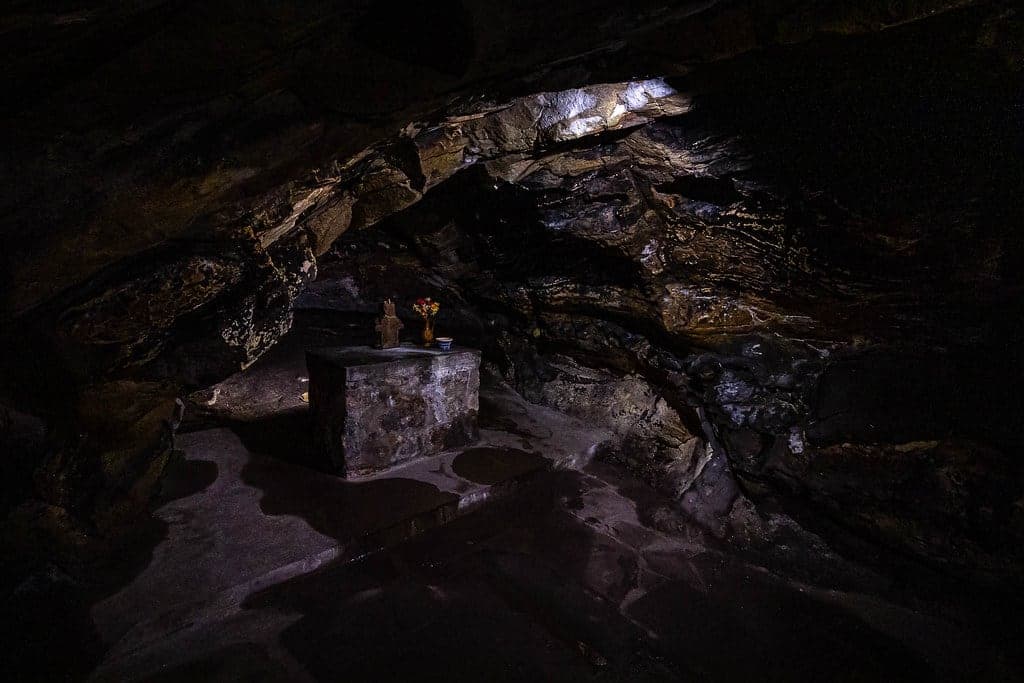
St. Fillan’s Cave, Pittenweem, Scotland
Where a 7th-century hermit prayed by miraculous light, and pilgrims still descend into darkness seeking stillness
Pittenweem, Alba / Scotland, United Kingdom
At A Glance
- Coordinates
- 56.2132, -2.7275
- Suggested Duration
- 30-45 minutes for quiet contemplation
Pilgrim Tips
- No formal requirements. Dress warmly, as the cave maintains cool temperatures year-round. Sturdy shoes with good grip are recommended for the uneven stone floors.
- Photography is permitted for personal use. The low lighting makes flash tempting but may disturb others in prayer. Use discretion.
- The holy well water should not be drunk due to modern water quality concerns. Do not remove any stones, water, or materials from the cave. Keep voices low and respectful, recognizing this is an active place of worship. Turn the lights off when leaving.
Overview
Beneath the fishing village of Pittenweem lies a cave where the Irish missionary Fillan once prayed in solitude, his glowing arm said to illuminate the scriptures in darkness. For over 1,300 years, seekers have descended these stone steps toward the ancient spring and simple altar. The Scottish Episcopal Church still holds Easter Vigil here, the cave's resemblance to a rock-hewn tomb lending profound weight to the celebration of resurrection.
The village takes its name from the cave beneath it. Pittenweem, from the Pictish and Gaelic, means simply 'place of the cave.' Before there were houses, before there was a harbor, there was this hollow in the coastal rock where a holy man came to pray.
St Fillan, an Irish missionary of the 7th or 8th century, chose this darkness for his hermitage while working to convert the local Picts. According to tradition, when he could not read his scriptures in the cave's blackness, God granted him a miraculous gift: his left arm began to glow with divine light. By this luminous limb he studied and wrote, becoming one of Scotland's most beloved saints.
The cave has never stopped being sacred. Augustinian monks built a priory above it, carving stairs down to incorporate the ancient cell into their worship. Pilgrims passed through on their way to St Andrews or the Isle of May. The mentally ill were brought here overnight, bound with rope, in the belief that St Fillan might heal what medicine could not touch.
Today, visitors collect a key from a chocolate shop on the High Street and descend alone into the cool stone chamber. A simple altar, consecrated in 1935, awaits in the darkness. A holy well still trickles. On Easter Saturday, worshippers gather here for the vigil service, the cave's tomb-like quality making the promise of resurrection feel less abstract and more like the weight of stone.
Context And Lineage
St Fillan was an Irish missionary of the 7th or 8th century who came to Scotland with his mother Kentigerna and uncle Comgan, all three later canonized. His cave at Pittenweem became a site of pilgrimage, incorporated into an Augustinian priory and visited by those seeking healing. After centuries of neglect following the Reformation, the cave was rediscovered and restored in the 20th century.
According to hagiographic tradition, Fillan was born into Irish royalty. His mother Kentigerna was daughter of Cellach Cualann, King of Leinster. After training at Taghmon Abbey in Wexford, Fillan traveled to Scotland with his mother and uncle around 717 AD, part of the great movement of Irish missionaries who brought Christianity to the Picts and Scots.
He chose this cave overlooking the Firth of Forth as his hermitage. The darkness was so complete that he could not read his scriptures or prepare his sermons. When he prayed for help, God granted a miracle: his left arm began to glow with divine light. By this radiance he could read with his right hand while illuminating the pages with his left. The story became one of Scotland's most beloved hagiographic legends, and the bone of St Fillan's arm was later carried as a relic at the Battle of Bannockburn in 1314.
The Augustinian monks of Pittenweem Priory maintained the cave as a chapel from the 13th century until the Reformation in 1560. After centuries of neglect, the cave was rediscovered around 1900 and restored in 1935. It is now entrusted to St John's Scottish Episcopal Church, which maintains it as an active place of worship.
St Fillan
founding saint
Irish missionary of the 7th or 8th century who used the cave as his hermitage. Famous for his luminous arm and later venerated as patron saint of the mentally ill. His relics were believed to have aided Robert the Bruce's victory at Bannockburn.
St Kentigerna
historical
Fillan's mother, an Irish princess who accompanied her son to Scotland. Later canonized as a saint in her own right.
Robert the Bruce
historical
King of Scotland who credited St Fillan's intercession for his victory at Bannockburn. He is said to have founded or endowed a priory at Pittenweem in the saint's honor.
Why This Place Is Sacred
St Fillan's Cave gathers several qualities that traditions across cultures associate with thin places: the presence of a holy person who sanctified the space through devotion, a natural spring long held to carry healing properties, the liminal threshold between surface and underground worlds, and fourteen centuries of continuous sacred use. The cave sits at the boundary of land and sea, darkness and light.
What makes a place sacred? The cave offers several answers layered atop one another.
First, there is the presence of a holy person. In Celtic Christianity, the desert fathers' search for wilderness found expression in remote islands and sea-caves. St Fillan brought his prayer here, sanctifying the space through years of devotion. The hagiographic tradition holds that his holiness was so intense it became visible, his arm glowing in the darkness. Whether understood literally or symbolically, the story points to something the early Christians recognized: prolonged prayer changes a place.
Then there is the water. The cave contains a natural spring that forms a holy well. Throughout the Celtic world, springs were understood as points where the Otherworld touched this one, places where healing might flow from depths beyond ordinary reach. The well's long association with curing eye ailments and, more strikingly, mental illness, suggests the spring was sacred before Fillan arrived, its power absorbed into Christian practice rather than replaced.
The cave itself creates liminal space. To enter is to cross a threshold, descending from the everyday world of fishing boats and tourists into something older and darker. The resemblance to a burial chamber is not accidental to the cave's spiritual power. Death, burial, resurrection: the sequence that lies at the heart of Christian hope finds physical expression in this rock-hewn space.
Finally, there is continuity. For over 1,300 years, people have come here seeking something. The accumulated weight of human intention, prayer, and hope leaves traces that visitors consistently report sensing, though they struggle to name what they feel.
St Fillan used the cave as a hermitage, a place for solitary prayer, study, and communion with God while he worked to convert the Pictish people of the region. The cave likely served also as a baptismal site, the holy well providing water for initiating new Christians into the faith.
After Fillan's time, the cave was incorporated into Pittenweem Priory, an Augustinian foundation that flourished from the 13th century until the Reformation. The monks carved stairs connecting the cave to their grounds above, making the ancient hermitage part of organized monastic life. The cave became a stopping point for medieval pilgrims traveling to St Andrews or the Isle of May.
The Reformation brought neglect. The cave entrance was eventually blocked, the space forgotten until around 1900, when a horse reportedly fell through into the priory garden, revealing the hidden chamber. In 1935, Canon de Voil and his father excavated and restored the cave, and the Bishop of St Andrews consecrated the stone altar. The wrought iron gate was added in 2000. Today the cave is entrusted to St John's Scottish Episcopal Church, maintaining its function as a place of active worship.
Traditions And Practice
While the cave no longer hosts the healing rituals of medieval times, it remains a functioning chapel. The Scottish Episcopal Church holds occasional services, most significantly the Easter Vigil on Holy Saturday. Visitors are welcome to pray, light candles, and spend time in contemplation at the stone altar.
Medieval pilgrims visited the cave as part of journeys to St Andrews or the Isle of May, praying at the holy well and seeking St Fillan's blessing. The mentally ill were brought to the cave overnight, bound with rope, left under the saint's protection. If their bonds loosened by morning, they were considered healed. Pilgrims sought cures from the holy well water, particularly for eye ailments.
The most significant regular practice is the annual ecumenical Easter Vigil service on Holy Saturday night. The cave's resemblance to Christ's rock-hewn tomb makes it a powerful setting for commemorating death, burial, and resurrection. Occasional other services and prayer gatherings are organized by St John's Scottish Episcopal Church. Throughout the year, visitors come for personal pilgrimage and private prayer. The stone altar remains consecrated and available for contemplation.
If you come seeking more than history, consider sitting in silence at the altar before exploring. You need not believe anything in particular about the cave's power. Simply notice what arises when the noise of the day falls away and the ancient stone holds your attention. Before leaving, you might offer silent gratitude, perhaps for those who have prayed here before you, or for whatever brought you to this place.
Celtic Christianity
HistoricalSt Fillan represents the wave of Irish missionaries who brought Christianity to Scotland in the early medieval period. His choice of a sea-cave as hermitage reflects the Celtic Christian practice of seeking wild, remote places for contemplative prayer, following the example of the Desert Fathers. The cave embodies the austere spirituality of this tradition.
Solitary prayer, fasting, reading and writing scripture by miraculous light, emerging to preach to the Picts and baptize converts, possibly using the cave's holy well for baptism.
Scottish Episcopal Church
ActiveSince the cave's restoration in 1935, it has been entrusted to St John's Scottish Episcopal Church. The cave functions as an active chapel with a consecrated altar. The annual Easter Vigil on Holy Saturday is the most significant regular service, the cave's tomb-like character lending profound weight to the celebration of resurrection.
Annual ecumenical Easter Vigil service, occasional prayer gatherings and services, maintenance of the cave as a place of pilgrimage and contemplation.
Medieval Pilgrimage and Healing Cult
HistoricalFrom the 13th century through the Reformation, the cave was incorporated into Pittenweem Priory and served as a stopping point for pilgrims traveling to St Andrews or the Isle of May. St Fillan's patronage of the mentally ill made the cave a site where healing was sought through the saint's intercession.
Pilgrimage to the holy well, overnight vigils for the mentally ill bound with rope, veneration at the site believed sanctified by Fillan's presence.
Experience And Perspectives
Visitors describe entering St Fillan's Cave as stepping out of time. The small scale and darkness, the trickling water, the simple stone altar create an atmosphere of authentic ancient spirituality that larger sites often lack. Many report a quality of stillness and peace that surprises them given the cave's modest appearance.
The approach is ordinary enough: a steep lane descending toward the harbor, an iron gate, a small donation. Then the descent begins, and the contemporary world falls away.
The cave is not large. This is not the grand architecture of cathedrals but something more intimate, more raw. Stone walls close around you. The air is cool and damp, carrying the mineral smell of ancient rock and trickling water. Light, what there is of it, must be switched on by the visitor. Many choose to sit first in darkness, as Fillan once did.
Visitors frequently describe peace, though not the peace of relaxation. Something more alert, more expectant. The quality of the silence is often noted, how it seems to hold attention rather than empty it. Standing where a 7th-century hermit prayed, touching history so directly, produces an emotional response that catches many off guard.
The holy well draws its own attention. To approach the spring that has flowed here for millennia, that medieval pilgrims sought for healing, is to participate in something very old. The water should not be drunk today, but its presence still carries weight.
Those who attend the Easter Vigil service describe the experience as profoundly moving. Gathering in the cave's darkness on the night between death and resurrection, the stone walls echoing with ancient liturgy, the similarity to Christ's rock-hewn tomb in Jerusalem becomes palpable rather than metaphorical.
Consider entering without expectations. The cave is small and can be seen in minutes, but something different happens when you sit in stillness and let the place work at its own pace. Bring a question if you have one, something unsettled in your life. The tradition of seeking healing here, though its medieval forms have passed, still finds expression in the quiet requests visitors bring to the altar.
St Fillan's Cave invites interpretation from several angles: the historical, concerned with what can be documented and dated; the traditional, holding the hagiographic narratives as spiritually authoritative; and the experiential, attending to what visitors actually report when they enter this ancient space. Each perspective illuminates something the others might miss.
Archaeological and historical scholarship accepts St Fillan's Cave as an authentic early medieval hermit site, though precise dating remains uncertain. Sources vary on whether Fillan lived in the 7th or 8th century. Scholars note that two distinct saints named Fillan existed, one associated with Pittenweem and another with Strathfillan in Perthshire, whose legends became intertwined over centuries. The cave's incorporation into Pittenweem Priory from the 13th century is well documented. The healing cult of St Fillan as patron of the mentally ill reflects medieval approaches to psychological distress that combined religious faith with practices now considered cruel.
Scottish Episcopal and Celtic Christian traditions honor the cave as a place where early Christianity took root in Scotland through the devotion of missionary hermits. The story of Fillan's glowing arm is understood not primarily as literal history but as hagiographic testimony to the divine light that accompanied his ministry. The cave's continued use for worship, particularly the Easter Vigil, maintains connection with a tradition stretching back fourteen centuries.
Some contemporary spiritual seekers view St Fillan's Cave as a thin place where the boundary between ordinary reality and the sacred becomes permeable. The cave's holy well connects to Celtic beliefs about sacred springs as sources of healing energy and portals to the Otherworld. The long association with healing, particularly of mental illness, attracts those seeking psychological or spiritual restoration today.
Genuine mysteries persist. The exact dates of St Fillan's life and his use of the cave cannot be fixed with certainty. Whether there were one or two saints named Fillan, and how their legends became conflated, remains debated. The cave's possible use before St Fillan, perhaps in pre-Christian sacred practice, is plausible but undocumented. What happened during the Reformation and the subsequent centuries before rediscovery around 1900 is largely unknown.
Visit Planning
St Fillan's Cave is accessed by collecting a key from the Pittenweem Chocolate Company on the High Street. A small donation is requested. The cave is open year-round during the cafe's hours. Allow 30-45 minutes for a contemplative visit, longer if combined with exploring the village.
Pittenweem has limited accommodation in B&Bs and self-catering properties. Anstruther, 1.5 miles east, offers more options. St Andrews has extensive accommodation from luxury hotels to hostels. Book ahead in summer.
St Fillan's Cave is both an archaeological treasure and an active Christian chapel. Visitors should maintain respectful quiet, take care on the uneven floors, and remember that others may be using the space for prayer.
The cave functions as a sacred space. While no formal rules govern behavior, the site's character calls for restraint and respect. Speak quietly or not at all. Allow others their solitude if they arrived before you. The cave is small enough that a single loud visitor can shatter the contemplative atmosphere for everyone present.
Physically, take care. The floors are uneven, the lighting dim. Sturdy footwear is recommended. The space is not suitable for wheelchairs, and those with mobility difficulties should assess the steep descent carefully.
When leaving, ensure you have turned off the lights and that the gate is secured. Return the key to the Cocoa Tree Cafe promptly so others may visit.
No formal requirements. Dress warmly, as the cave maintains cool temperatures year-round. Sturdy shoes with good grip are recommended for the uneven stone floors.
Photography is permitted for personal use. The low lighting makes flash tempting but may disturb others in prayer. Use discretion.
No formal offering tradition exists. Candles may be available for lighting at the altar. The donation requested when collecting the key supports the cave's maintenance.
Do not carve or write on the walls. Do not remove anything from the cave. Do not drink the holy well water. Dogs should remain outside or be well-controlled if brought inside.
Sacred Cluster
Nearby sacred places create the location cluster described in the growth plan. This block is intentionally crawlable and links into the wider regional graph.