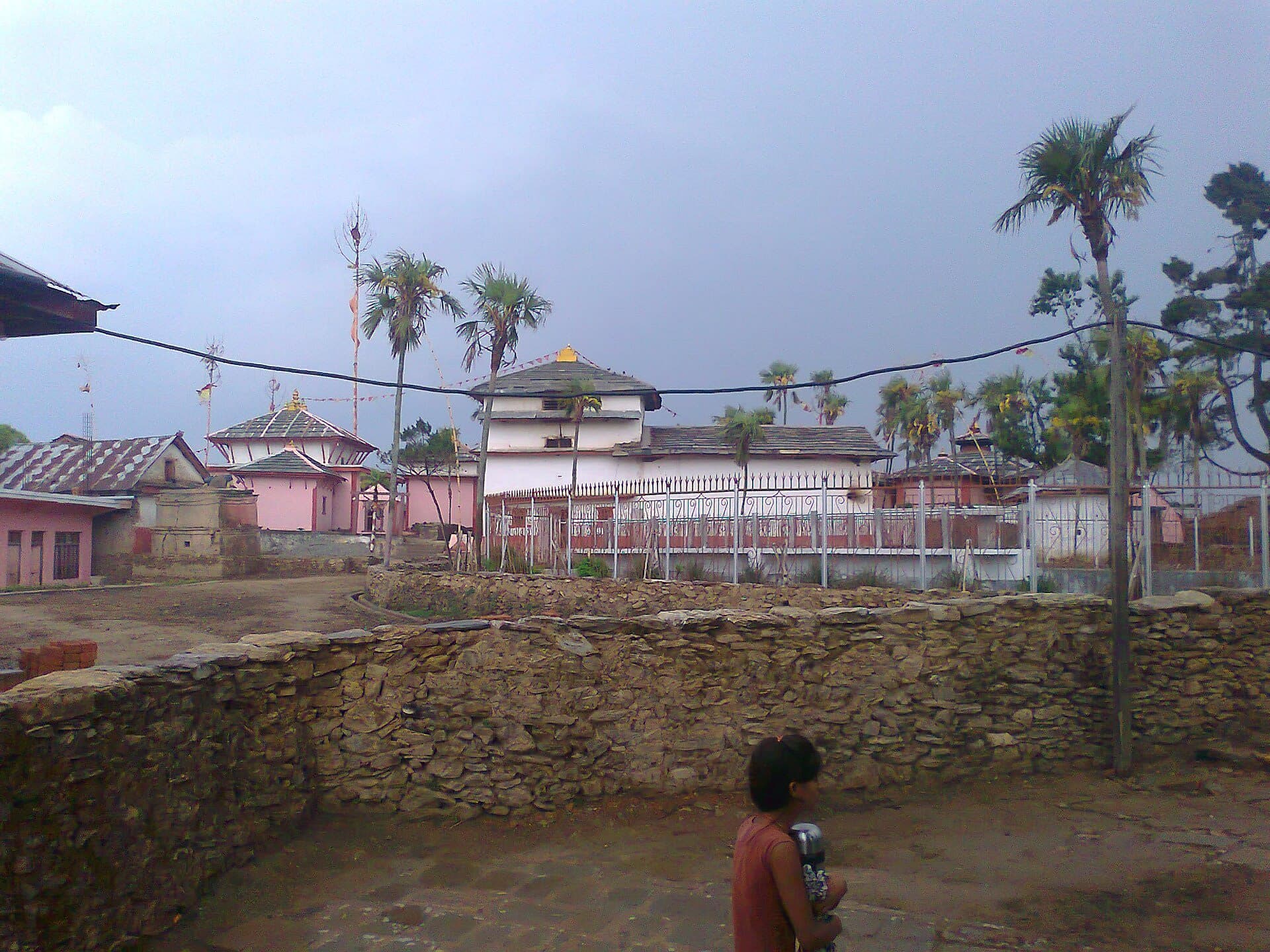
Shree Swargadwari Mandir
Where an eternal fire has burned for over a century at Nepal's gateway to heaven
Swargadwari, Lumbini Province, Nepal
At A Glance
- Coordinates
- 28.1210, 82.6744
- Suggested Duration
- A minimum of one to two days is recommended, including travel time. The remote location and the ashram experience benefit significantly from an overnight stay, allowing participation in morning and evening fire offerings. Multi-day pilgrimage tours from Lumbini or Kathmandu are available and typically span five to seven days.
- Access
- Swargadwari is located in Pyuthan District, Lumbini Province. By air, fly from Kathmandu to Nepalgunj (approximately one hour), then travel five to six hours by road. By road from Kathmandu, the distance is approximately 320 kilometers, taking ten to twelve hours. The final approach requires a four-wheel-drive vehicle due to rough, steep terrain and takes three to five hours. A helipad at the ashram allows helicopter access. Alternative routes run via Ghorahi-Holari through Dang or via Bhalubang-Bhingri through Pyuthan.
Pilgrim Tips
- Swargadwari is located in Pyuthan District, Lumbini Province. By air, fly from Kathmandu to Nepalgunj (approximately one hour), then travel five to six hours by road. By road from Kathmandu, the distance is approximately 320 kilometers, taking ten to twelve hours. The final approach requires a four-wheel-drive vehicle due to rough, steep terrain and takes three to five hours. A helipad at the ashram allows helicopter access. Alternative routes run via Ghorahi-Holari through Dang or via Bhalubang-Bhingri through Pyuthan.
- Modest, conservative clothing covering shoulders and legs. Remove shoes before entering temples.
- General photography of the complex and landscape is typically permitted. Ask permission before photographing rituals, priests, or the inner sanctum.
- The fire altars are sacred and should not be touched. Vegetarian principles are observed throughout the ashram. The cows are revered beings within this tradition and should not be disturbed or treated casually.
Overview
At 2,121 meters on a forested hilltop in western Nepal's Pyuthan District, Shree Swargadwari Mandir houses a sacred fire that has not been extinguished since 1895. The name translates literally as 'Gateway to Heaven,' and for Hindu pilgrims completing the Seven Dhams circuit of Nepal, this is where the circuit ends and something else begins. Over half a million devotees arrive each year to sit before the fire, receive its ash, and contemplate the threshold between the earthly and the divine.
The fire is the first thing. Not the pagoda-style temples, not the Himalayan panorama, not the ashram buildings or the hundreds of cows grazing on hillside pastures. The fire. It has burned in its altar since the full moon of Baisakh, 1952 Bikram Sambat — 1895 by the Western calendar — when, according to the tradition preserved here, flame emerged from the mouth of a Brahman priest during the chanting of Vedic mantras. That fire has never gone out.
To sit before the Akhanda Mahayajna — the eternal, unbroken sacrifice — is to confront a particular kind of continuity. Not the continuity of stone, which endures by being inert, but of flame, which endures only through constant tending. For over 130 years, priests have fed this fire. Students of the Gurukul have risen before dawn to attend it. The ash it produces — called bivut — is distributed to devotees who understand it as carrying the accumulated merit of every mantra chanted into those flames across a century of unbroken practice.
Swargadwari sits at the end of a long road, and that is not incidental to its meaning. The Seven Dhams pilgrimage begins at Pashupatinath in Kathmandu and passes through six sacred sites before arriving here, at the western edge of Nepal's sacred geography. The physical difficulty of reaching Swargadwari — hours of rough mountain road, the final approach navigable only by four-wheel-drive vehicle or helicopter — mirrors the Hindu understanding that liberation does not come easily. What awaits at the summit is not spectacle but presence: the quiet persistence of fire, the sound of Vedic chanting carried on mountain wind, and a view that stretches across the peaks of Dhaulagiri, Annapurna, and Manaslu.
Context And Lineage
Swargadwari was founded in 1895 by the ascetic Guru Maharaj Narayan Khatri Chhetri, known as Swargadwari Mahaprabhu, who initiated the eternal fire sacrifice that continues to this day. The site draws on far older mythological associations with the Pandavas' ascent to heaven from the Mahabharata.
The founding narrative of modern Swargadwari centers on an ascetic born around 1858 in Rolpa District. Guru Maharaj Narayan Khatri Chhetri, who would become known as Swargadwari Mahaprabhu or Svami Hamsananda, spent years wandering across Nepal and India in spiritual practice before settling on this hilltop. In 1895, on the full moon of the month of Baisakh, he initiated the Akhanda Mahayajna — the eternal fire sacrifice — with prayers for world peace.
The tradition preserved at the ashram records what happened next: during the chanting of Vedic mantras, fire emerged from the mouth of Brahman Tikaram Gautam. This fire became the Akhanda Mahayajna, the continuously burning sacrifice that has not been extinguished since. The event is understood within the tradition as miraculous — a divine confirmation that the prayers offered here would maintain a continuous connection between earth and heaven.
Mahaprabhu himself built the pagoda-style Shiva temple that remains a centerpiece of the complex. He spent much of his life herding and milking cows, establishing the Gaushala tradition that continues. He took samadhi — the conscious departure from the body that Hindu tradition distinguishes from ordinary death — in 1940.
The deeper mythological layer reaches back to the Mahabharata. According to Hindu tradition, the five Pandava brothers paused at this hilltop and performed yajna before beginning their final spiritual march through the Himalayas toward heaven. In the Mahabharata narrative, Yudhisthira alone completes the ascent, accompanied by a dog who is revealed to be the god Dharma in disguise. Hindu tradition at Swargadwari holds that Yudhisthira entered heaven directly from this place — an association that gives the site its name and its deepest significance.
Older still, according to tradition, Lord Indra performed a yajna at this location during the Satya Yuga, the first and most pure of the cosmic ages. Lord Brahma is also said to have performed penance here. These mythological layers locate Swargadwari within the deepest strata of Hindu sacred history.
The site belongs to the broader Hindu Vedic ritual tradition, with particular emphasis on yajna (fire sacrifice) as a path to spiritual realization and liberation. The ashram draws on multiple strands of Hindu practice — Vaishnavism, Shaivism, and Vedic ritual tradition — reflected in the five Kundas dedicated to the Panchayan deities. The Gurukul system of residential education, in which students live with teachers and learn Vedic texts and rituals, connects Swargadwari to one of Hinduism's oldest educational traditions.
Swargadwari Mahaprabhu (Guru Maharaj Narayan Khatri Chhetri / Svami Hamsananda)
Founder of the ashram and initiator of the Akhanda Mahayajna in 1895. Born circa 1858 in Rolpa district, he was an ascetic who established the continuous fire sacrifice, built the Shiva temple, and founded the Gaushala and Gurukul traditions.
Brahman Tikaram Gautam
The priest from whose mouth, according to tradition, the sacred fire miraculously emerged during the inaugural Vedic chanting in 1895.
Yudhisthira
The eldest Pandava brother of the Mahabharata, who according to Hindu tradition entered heaven from this location accompanied by his faithful dog, giving the site its name 'Gateway to Heaven.'
Why This Place Is Sacred
Swargadwari's thinness arises from the convergence of an eternal fire, mythological associations with the Pandavas' ascent to heaven, a living ashram community, and a remote hilltop location commanding views of the high Himalayas. Multiple layers of tradition understand this as a place where the boundary between earthly existence and the heavenly realm grows permeable.
Several dimensions converge to give Swargadwari its quality of thinness. The most tangible is the Akhanda Mahayajna itself — a fire that has burned without interruption for more than a century. In Hindu understanding, the sacrificial fire functions as a mediator between the human and divine realms. Offerings placed into the flames are transformed and carried upward; blessings descend in return. A fire that has performed this mediation continuously for over 130 years represents an accumulation of spiritual potency difficult to quantify but, according to those who sit before it, impossible to miss.
The mythological dimension reaches further back. According to the Mahabharata tradition, the Pandava brothers paused at this hilltop and performed yajna before beginning their final march toward heaven through the Himalayas. Hindu tradition holds that Yudhisthira, the eldest Pandava renowned for his righteousness, entered heaven directly from this place, accompanied by his faithful dog — one of the most beloved and morally complex episodes in all of Hindu scripture. Whether or not these events occurred in historical time, the narrative has saturated this ground with meaning for centuries.
The physical setting reinforces the metaphysical claims. At over two thousand meters, surrounded by dense forest that gives way to rhododendron meadows and then sky, the hilltop complex occupies a position that feels genuinely liminal — between earth and air, between the cultivated lowlands and the Himalayan peaks that Hindu cosmology associates with the dwelling places of the gods. On clear mornings, the snow-covered summits of Dhaulagiri, Annapurna, and Manaslu appear close enough to belong to the same world as the temple. The effect is not decorative. It is orienting.
The living community adds a final dimension. The Gurukul students who study Vedic texts and tend the fire, the priests who perform the three-daily offerings at the five Kundas, the cows that graze the hillside as living expressions of Hindu veneration — all of this sustains a field of continuous practice. Swargadwari is not a monument to something that once was. It is a place where the gateway remains tended, the fire remains lit, and the passage between worlds remains, in the understanding of those who come here, open.
The ashram and eternal fire were established by Swargadwari Mahaprabhu in 1895 as a center for continuous Vedic fire sacrifice and spiritual practice. The site's deeper mythological purpose, as the place where the Pandavas ascended to heaven, predates the ashram.
From its founding as a single guru's hermitage in 1895, Swargadwari has grown into one of Nepal's most significant Hindu pilgrimage sites, receiving over 500,000 visitors annually. The Gurukul educational system, the extensive Gaushala housing over 300 cows, and the ashram's organic farming operations have expanded the site from a place of fire worship into a self-sustaining spiritual community. The site is now listed in Nepal's national inventory of cultural and historic heritage sites and serves as the culminating destination of the Seven Dhams pilgrimage circuit.
Traditions And Practice
The Akhanda Mahayajna — the continuously burning fire sacrifice — anchors daily practice at Swargadwari. Three daily fire offerings at five altars, Vedic chanting, Gurukul education, cow worship, and organic communal living form a comprehensive system of ritual and contemplative life.
The Akhanda Mahayajna is the primary sacred practice — a fire that has burned continuously since 1895, tended by generations of priests and Gurukul students. In Hindu understanding, the sacrificial fire is not merely symbolic but functional: it transforms offerings into spiritual sustenance and carries prayers between the earthly and divine realms. The fire's unbroken duration is itself understood as a form of accumulated spiritual power.
Three times each day, priests perform havan — structured fire offerings — at the five Kundas dedicated to the Panchayan deities: Ganesha, Shiva, Devi, Surya, and Vishnu. These offerings follow Vedic ritual protocols transmitted through the Gurukul lineage. Ghee, grain, and other prescribed materials are placed into the flames while Sanskrit mantras are chanted. The practice is both worship and maintenance — a continuous renewal of the connection between the temple and the deities it honors.
The distribution of bivut — sacred ash from the eternal fire — is a practice of particular significance. Devotees receive the ash and apply it to the forehead, carry it home for use in personal worship, or preserve it as a spiritual remedy. Within the tradition, bivut is understood to carry therapeutic and protective properties derived from the century-long accumulation of mantric power in the fire.
Cow worship and care at the Gaushala represents another form of practice. Swargadwari Mahaprabhu himself spent much of his life herding cows, and the Gaushala housing over 300 animals is understood not as farming but as devotion. The dairy produced — milk, yoghurt, ghee — is integral to both the ritual offerings and the communal meals.
The Gurukul remains an active center of Vedic education, with students living at the ashram and receiving training in scripture, ritual, philosophy, and the practical skills of maintaining the fire sacrifice and temple complex. This living educational tradition ensures that the practices at Swargadwari are not merely preserved but transmitted — each generation of students becomes capable of tending the fire and performing the rituals.
The ashram operates as a self-sustaining community. Organic vegetable farming on terraced hillside plots provides food. The Gaushala supplies dairy. Communal meals are served to residents, students, and visitors alike. This integration of spiritual practice with agricultural self-sufficiency reflects a model of Hindu ashram life that has deep roots in the tradition.
Periodic festivals and fairs — particularly during the Nepali months of Kartik and Baisakh — draw larger gatherings, with pilgrimage traffic peaking in April, September, and January. These occasions amplify the daily rhythms of worship into communal celebrations.
Visitors can participate in the daily havan and observe the Vedic chanting at the five Kundas. Sitting quietly before the Akhanda Mahayajna — even for a few minutes — allows something of the fire's century-long continuity to register. Receiving bivut from the priests is open to all and carries deep meaning within the tradition. Walking the grounds of the ashram, visiting the Gaushala, and sharing the communal vegetarian meals offer an experience of immersion in a living spiritual community. The meditation caves at Guptisagara provide space for personal contemplation. Engaging resident priests in conversation about Hindu philosophy and the history of the ashram can provide context that deepens the visit considerably.
Hinduism (Vedic Ritual Tradition)
ActiveSwargadwari is one of Nepal's most significant centers of continuous Vedic fire ritual. The Akhanda Mahayajna, initiated in 1895, has burned without interruption for over 130 years. Five Kundas dedicated to the Panchayan deities receive offerings three times daily according to Vedic rites. The Gurukul maintains living transmission of Vedic knowledge.
Continuous Akhanda Mahayajna; daily havan at five Kundas three times per day; Vedic mantra chanting; scripture recitation; Gurukul education; distribution of sacred ash to devotees.
Hinduism (Seven Dhams Pilgrimage)
ActiveSwargadwari is the final destination in Nepal's Hindu Seven Dhams pilgrimage circuit, which begins at Pashupatinath in Kathmandu. Completing the circuit is understood within the tradition as necessary for attaining heaven after death. As the 'Gateway to Heaven,' Swargadwari represents the culmination of the pilgrimage and is associated with moksha.
Pilgrimage to Swargadwari as the culminating dham; darshan at the main temple; participation in yajna; circumambulation; prayer for moksha and spiritual liberation.
Hindu Cow Veneration
ActiveThe Gaushala housing over 300 cows is a central feature of the ashram. Swargadwari Mahaprabhu spent much of his life in cow husbandry as a form of spiritual practice. The integration of cow care into ashram life reflects the broader Hindu tradition of gomata — reverence for the cow as sacred.
Maintenance of the Gaushala; organic dairy production providing milk, yoghurt, and ghee for ritual offerings and communal meals; daily cow care as devotional practice.
Mahabharata Mythological Tradition
HistoricalAccording to Hindu tradition, the Pandava brothers performed yajna at this hilltop before their final ascent toward heaven. Yudhisthira is held to have entered heaven directly from this place, accompanied by his faithful dog. Ancient sages, Lord Indra, and Lord Brahma are also traditionally associated with the site.
These associations are preserved in the site's name, its founding mythology, and the understanding that the yajna performed here today continues a practice initiated by the Pandavas themselves.
Experience And Perspectives
The journey to Swargadwari is itself a form of pilgrimage — hours of rough mountain road through forests and fields before arriving at a hilltop ashram where the pace of life is governed by fire offerings, Vedic chanting, and the rhythms of a self-sustaining spiritual community.
The approach prepares the visitor. From whichever direction one comes — through Dang from the east, through Pyuthan from the south — the road narrows and steepens. The final hours require a vehicle capable of handling unpaved switchbacks cut into forested hillside. Trees thicken. The air cools. The world left behind at the highway grows increasingly abstract. By the time the ashram buildings appear on the hilltop, the ordinary world feels genuinely distant.
This distance is not incidental. Swargadwari's remoteness functions the way an airlock functions — as a transitional space between different conditions of pressure. The hours of travel strip away the pace and noise of lowland life. What replaces them is something closer to the rhythm of the ashram itself: unhurried, cyclical, governed by the schedule of the fire offerings performed three times daily at the five Kundas.
The Kundas — fire altars dedicated to the Panchayan deities of Ganesha, Shiva, Devi, Surya, and Vishnu — anchor the experience. To witness the havan, the fire offering, is to enter a sensory world older than any building here: the crackle of flames receiving ghee and grain, the resonance of Vedic mantras chanted in Sanskrit, the fragrance of offerings burning. The priests move with the precision of people performing actions they have performed thousands of times. The Gurukul students — young men being trained in Vedic ritual and philosophy — sit in rows, their voices joining the chanting.
The Akhanda Mahayajna occupies a place apart. The eternal fire does not blaze dramatically; it persists. Its constancy is its power. Pilgrims sit before it in silence, some for minutes, others for hours. The ash — bivut — is gathered and distributed, received by devotees who press it to their foreheads or carry it home wrapped in cloth. In Hindu understanding, this ash carries the concentrated merit of over a century of continuous sacrifice.
Beyond the temples, the ashram unfolds across the hillside. The Gaushala houses over 300 cows, tended with the reverence Hindu tradition accords these animals. The dairy they produce — milk, yoghurt, ghee — feeds the community and its guests. Organic vegetables grown on the ashram's terraced fields appear in the simple, nourishing meals served to all visitors without charge. The experience of eating together, seated in rows, sharing food grown and prepared within the community, carries its own contemplative weight.
The meditation caves at Guptisagara offer a different register of silence — enclosed, mineral, away from even the quiet activity of the ashram. Tradition holds that ancient sages performed penance in these caves before ascending to heaven, giving the site its name.
At dawn and dusk, when the Himalayan peaks catch light, the panoramic views from the hilltop create a sense of elevation that is both literal and figurative. The snow summits of Dhaulagiri, Annapurna, and Manaslu arc across the northern horizon. In these moments, the name Swargadwari — Gateway to Heaven — feels less like a claim and more like a description.
The temple complex sits atop a hill at 2,121 meters in Pyuthan District, Lumbini Province. The core complex includes the main temple (pagoda-style Shiva temple), the five yajna Kundas, the Akhanda Mahayajna altar, the Gurukul, the Gaushala, residential and guest buildings, and the Guptisagara meditation caves. The ashram campus extends across extensive grounds encompassing terraced organic farmland and pastoral hillside.
Swargadwari exists at the intersection of Mahabharata mythology, nineteenth-century Hindu revivalism, and living Vedic practice. Each lens reveals different dimensions of a site that half a million people visit each year.
Historical documentation places Swargadwari's founding in 1895, when the ascetic Swargadwari Mahaprabhu initiated the Akhanda Mahayajna on the hilltop site. The continuous Vedic fire sacrifice represents one of the longest-running yajna traditions in Nepal and is recognized in the national inventory of cultural and historic heritage sites. The site's role as the endpoint of the Seven Dhams pilgrimage circuit is established within Nepali Hindu pilgrimage geography. The Mahabharata associations — the Pandavas' passage through this location on their way to heaven — are mythological traditions shared across Hinduism, with Swargadwari being one of several sites claiming connection to this narrative. Archaeological evidence for use of the site prior to the late nineteenth century is not documented, leaving the pre-modern history of the location open. The scale of the ashram's growth — from one ascetic's hermitage to a complex receiving over 500,000 annual visitors — represents a significant case study in modern Hindu pilgrimage development.
For Nepali Hindus, Swargadwari is the literal gateway through which the soul passes from earth to heaven. The Pandavas' association is understood not as mythology but as sacred history — Yudhisthira walked this ground, performed yajna here, and ascended. The continuous burning of the Akhanda Mahayajna maintains a tangible spiritual connection between the earthly and heavenly realms, a doorway kept open through unbroken ritual. The miraculous origin of the fire — emerging from a devotee's mouth during Vedic chanting — confirms the site's divine selection. Completing the Seven Dhams pilgrimage ending at Swargadwari is understood as spiritually compulsory for attaining heaven after death. The bivut distributed from the eternal fire carries the accumulated merit of every mantra chanted into those flames across more than a century of continuous practice, giving it therapeutic and protective properties.
Some interpret the 'Gateway to Heaven' as representing a state of consciousness achievable through deep meditation and sustained Vedic practice rather than a literal physical doorway. In this reading, the continuous fire symbolizes the eternal nature of consciousness itself, and the hilltop location — surrounded by Himalayan peaks, requiring considerable effort to reach — embodies the yogic concept of ascending beyond worldly attachments to reach spiritual elevation. The ashram's integration of physical labor, communal living, and ritual practice suggests a holistic model of spiritual development where liberation is cultivated through the totality of daily life, not through any single ritual act.
The mechanism by which fire reportedly emerged from Brahman Tikaram Gautam's mouth during the inaugural yajna in 1895 has no scientific explanation and is accepted within the tradition on faith. The pre-modern history of the site — whether sages actually practiced here in ancient times, as tradition holds — remains archaeologically undocumented. The specific connection to the Pandavas' journey toward heaven is a matter of tradition rather than historical evidence, though it should be noted that the same is true of nearly all Mahabharata-associated sites. What is not in question is the fire's continuity since the late nineteenth century, nor the sincerity and depth of the half-million annual pilgrims who regard this ground as sacred.
Visit Planning
Swargadwari is remote and requires significant travel to reach. The best seasons are autumn and spring. Overnight stays at the ashram are available on a donation basis and strongly recommended.
Swargadwari is located in Pyuthan District, Lumbini Province. By air, fly from Kathmandu to Nepalgunj (approximately one hour), then travel five to six hours by road. By road from Kathmandu, the distance is approximately 320 kilometers, taking ten to twelve hours. The final approach requires a four-wheel-drive vehicle due to rough, steep terrain and takes three to five hours. A helipad at the ashram allows helicopter access. Alternative routes run via Ghorahi-Holari through Dang or via Bhalubang-Bhingri through Pyuthan.
The ashram provides accommodation for up to several hundred pilgrims on a donation basis. Facilities are simple but sufficient. Organic vegetarian meals are provided as part of the ashram's communal life. Visitors staying overnight share in the rhythms of the community, including early morning and evening fire offerings.
Swargadwari is an active site of Hindu worship with a resident community of priests and students. Modest dress, vegetarian conduct, and respect for the sacred fire and animals are expected.
Swargadwari welcomes visitors of all backgrounds, but it remains first and foremost a functioning Hindu ashram with continuous religious activity. The resident community of priests, Gurukul students, and support staff maintains daily worship that has not been interrupted for over a century. Visitors enter this rhythm as guests.
Modest, conservative clothing is expected. Shoulders and legs should be covered. Shoes must be removed before entering any temple building. These are standard expectations at Hindu sacred sites, and at Swargadwari they are observed without exception.
The sacred fire and the five Kundas are the spiritual heart of the complex. Approach them with reverence. Do not touch the fire altars or reach toward the flames. During havan — the fire offerings performed three times daily — maintain silence and stillness. If you are present during Vedic chanting, sitting quietly and attentively is the most respectful response.
The Gaushala and its cows hold particular significance. Do not harm, disturb, or treat the animals casually. Cow veneration is not a quaint custom here; it is a central spiritual practice.
Vegetarian principles apply throughout the ashram. No meat, fish, or eggs should be brought onto the grounds. The communal meals provided by the ashram are entirely plant-based and dairy-based, prepared with produce and dairy from the ashram's own organic farms.
Photography of the temple complex and surrounding landscape is generally permitted. Before photographing rituals, priests, or the inner sanctum, ask permission. The eternal fire is a sacred object; photograph it from a respectful distance and only after confirming that photography is welcome.
Donations are appreciated and directly support the Gurukul, the Gaushala, and the maintenance of the ashram community. Offerings of flowers, fruits, and incense to the fire altar are appropriate.
Modest, conservative clothing covering shoulders and legs. Remove shoes before entering temples.
General photography of the complex and landscape is typically permitted. Ask permission before photographing rituals, priests, or the inner sanctum.
Flowers, fruits, incense, and offerings to the fire altar are appropriate. Donations to the ashram support the Gurukul and Gaushala.
{"Do not touch the yajna Kundas or the sacred fire","Vegetarian principles must be observed within the ashram","Do not harm or disturb the cows","Maintain silence and respect during prayer and Vedic chanting","Remove shoes before entering temples"}
Sacred Cluster
Nearby sacred places create the location cluster described in the growth plan. This block is intentionally crawlable and links into the wider regional graph.