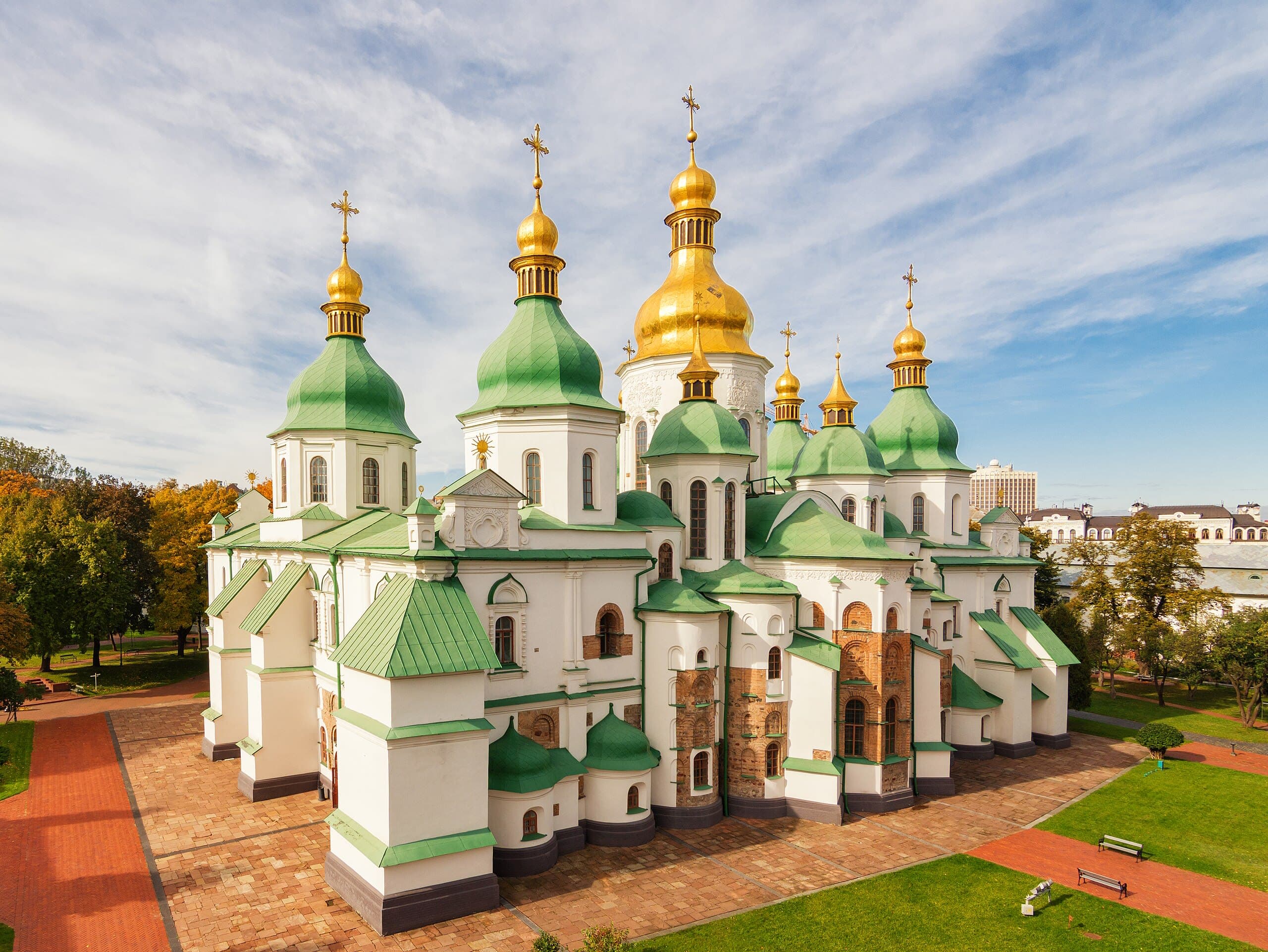
Saint-Sophia Cathedral, Kiev
Where Byzantine mosaics have watched over Kyiv for a thousand years, holding faith through every storm
Kyiv, Kyiv, Ukraine
At A Glance
- Coordinates
- 50.4527, 30.5143
- Suggested Duration
- 3-4 hours to fully explore the cathedral, bell tower, monastery buildings, and related exhibitions
Pilgrim Tips
- Modest dress is expected. While the cathedral functions as a museum and does not enforce Orthodox church dress codes, respectful attire appropriate to a historically sacred space shows sensitivity. Avoid shorts, sleeveless shirts, and overly casual clothing. Head coverings for women are not required but may feel appropriate to some visitors.
- Personal photography is generally permitted, though flash may be restricted to protect the ancient mosaics. Check current policies at the entrance. Tripods and professional equipment typically require advance permission. More importantly, consider whether constant photography serves your experience or distances you from it. The mosaics have survived a thousand years; they will still be here after you lower your camera.
- Remember this is a museum, not an active church. Lighting candles, leaving offerings, or attempting to venerate icons in the traditional Orthodox manner is not permitted. If liturgical participation is important to your journey, the nearby St. Volodymyr's Cathedral serves as an active Orthodox church. Respect the space's dual nature. For many Ukrainian visitors, this is not merely a heritage site but a place of deep national and religious significance. Loud conversation, dismissive comments about religious art, or treating the space purely as a photo opportunity shows insensitivity to what the building means to those for whom it is more than museum.
Overview
Built in the 11th century as the mother church of Kyivan Rus', Saint-Sophia Cathedral stands as one of the oldest surviving Christian monuments in Eastern Europe. Though now a museum, its golden mosaics and the Virgin Orans continue to draw seekers who sense in these ancient stones a living connection to a millennium of prayer, resistance, and enduring faith.
Some buildings outlive their empires. Saint-Sophia Cathedral has outlived several.
For a thousand years, this cathedral has stood at the heart of Kyiv, watching as grand princes rose and fell, as Mongols burned the city, as empires claimed and reclaimed the land. Through Soviet atheism and ongoing war, the Virgin Orans continues to extend her arms in prayer over the city from her golden apse. The faithful call her the Indestructible Wall.
The cathedral functions today as a museum, its daily liturgies silenced since 1934. Yet it remains a place where the boundary between heritage and holiness blurs. In 2019, it hosted the creation of the Orthodox Church of Ukraine, a moment of religious and national significance that demonstrated the building's persistent power to witness pivotal moments. Visitors entering the dim interior, their eyes adjusting to encounter golden mosaics assembled from two million pieces of colored glass a millennium ago, often find themselves moved in ways that transcend museum-going.
The word 'Sophia' means wisdom. Not information but something deeper, the ordering intelligence that holds the world together. For those who built this cathedral, Holy Wisdom was not abstract philosophy but living presence. Something of that understanding persists in these stones, available to any visitor willing to look up and receive what the Virgin's gaze has offered to centuries of seekers.
Context And Lineage
Saint-Sophia Cathedral was built in the early 11th century, likely under Grand Prince Yaroslav the Wise, as the principal church of Kyivan Rus' and symbol of Kyiv's emergence as a major Christian capital. Byzantine builders and local craftsmen created a synthesis that became foundational to Ukrainian and Eastern Slavic Orthodox tradition. The cathedral has served as coronation site, burial ground for princes, seat of metropolitans, and in 2019, birthplace of the autocephalous Orthodox Church of Ukraine.
The founding date remains debated. Traditional accounts credit Yaroslav the Wise with building the cathedral in 1037 to commemorate his victory over the Pecheneg nomads the previous year. An alternative theory, advanced by historian Nadia Nikitenko and accepted by UNESCO for the 2011 millennium celebration, places the foundation in 1011 under Yaroslav's father, Vladimir the Great, the prince who converted Kyivan Rus' to Christianity in 988.
What is certain is the intention: to create a church worthy of comparison with Constantinople's own Hagia Sophia, establishing Kyiv as a spiritual and political equal to the Byzantine capital. Byzantine master builders arrived with expertise in mosaic and masonry. Local craftsmen worked alongside them, learning techniques and contributing innovations. The resulting structure combined Byzantine tradition with features found nowhere else: thirteen domes forming a pyramidal silhouette, a ground plan wider than it was long, innovations that mark the emergence of a distinct Kyivan style.
The mosaics that cover the interior required over two million pieces of colored glass, called smalt, cut and set into plaster in 177 different colors. The artists worked quickly, embedding tesserae at slightly different angles to catch light from multiple directions. The Virgin Orans alone contains pieces beyond counting, each one placed deliberately to create an image that has watched over Kyiv for a thousand years.
For nearly a thousand years, the cathedral served as the seat of the Metropolitan of Kyiv, the head of Orthodox Christianity in Ukraine. The metropolitans who presided here shaped the religious and often political life of the land. Princes were consecrated within these walls, their authority sanctified by the same church that housed their ancestors' bones.
The Soviet period severed this living lineage, transforming the cathedral from active church to architectural museum in 1934. Yet the building's significance could not be entirely secularized. When Ukrainian independence came in 1991, and more fully when the Orthodox Church of Ukraine achieved autocephaly in 2019, the cathedral resumed its role as witness to foundational moments. The lineage continues, even if in altered form.
Yaroslav the Wise
historical
Grand Prince of Kyiv from 1019 to 1054, credited as the cathedral's primary builder and patron. Under his rule, Kyivan Rus' reached its cultural and political apex. He was buried in the cathedral, though his remains disappeared during World War II and their location remains a mystery.
Vladimir the Great
historical
Grand Prince who converted Kyivan Rus' to Christianity in 988. According to the alternative dating theory, he may have laid the cathedral's first foundations before his death in 1015, making him the original patron.
The Virgin Orans
sacred image
The six-meter mosaic of the Virgin Mary with arms raised in prayer, positioned in the main apse. Known as the 'Indestructible Wall,' she is believed by Orthodox faithful to protect Kyiv. Her survival through every calamity the city has faced reinforces this belief.
Metropolitan Epiphanius
religious leader
First primate of the Orthodox Church of Ukraine, enthroned in Saint-Sophia Cathedral on February 3, 2019, following the church's reception of autocephaly from the Ecumenical Patriarch.
Why This Place Is Sacred
Saint-Sophia's sacredness flows from its thousand-year continuity as the spiritual heart of Kyivan Christianity, its Byzantine mosaics that have survived every attempt at destruction, and its role as witness to the defining moments of Ukrainian religious and national identity. The cathedral stands where the newly Christianized Kyivan Rus' announced its arrival among the great Christian civilizations.
The Inca built at intersections of mountain and sky. The builders of Saint-Sophia sought a different confluence, where Byzantine civilization met the newly converted Slavic north, where imperial Christianity took root in soil that would nurture it for a millennium.
When Yaroslav the Wise ordered the cathedral's construction, he intended Kyiv to become the 'new Constantinople.' The name 'Sophia' was borrowed from Hagia Sophia itself, claiming for Kyiv not a copy but an equivalent, a place where Holy Wisdom would dwell with equal presence. Byzantine master builders arrived with local craftsmen. Together they created something unprecedented, adapting Constantinople's traditions into forms that had never existed before: thirteen domes instead of one, a pyramidal silhouette, a width greater than length. These innovations suggest not imitation but creative response, a nascent civilization finding its own voice within a received tradition.
The mosaics that cover the interior represent some of the most complete surviving examples of Byzantine art. The Virgin Orans, standing six meters tall in the main apse, extends her arms in the gesture of eternal prayer, her blue robe and golden halo assembled from glass pieces no larger than a fingernail. Medieval faithful believed her presence protected the city. The belief survived into modernity. When the Soviets demolished Kyiv's other great medieval church, St. Michael's Golden-Domed Monastery, in the 1930s, they spared Saint-Sophia, converting it to a museum instead. Something, perhaps political calculation or perhaps something harder to name, preserved the Indestructible Wall.
The cathedral has served as burial place for princes, site of treaty signings, seat of metropolitans, witness to invasions and liberations. Each layer of history adds to its accumulated significance. Visitors today walk floors worn by a thousand years of feet, beneath images that have looked down on weddings and coronations, wars and plagues, the birth of nations and the death of empires. This continuity itself becomes sacred, evidence that something can endure.
In Kyivan Rus' understanding, the cathedral served simultaneously as the religious heart of the realm, the political center of princely power, and the symbolic announcement of Kyiv's arrival among the great Christian capitals. Grand princes were consecrated here. Treaties were signed with religious sanction. The Metropolitan of Kyiv presided from this seat. These functions were not separate but woven together in a world where sacred and political authority flowed from the same source.
The cathedral's journey through time reads as a history of Ukraine itself. After the Mongol invasion of 1240, the building fell into disrepair, its glory dimmed by centuries of neglect. In the 17th century, Metropolitan Petro Mohyla restored it in Ukrainian Baroque style, encasing the Byzantine core in new forms while preserving the ancient mosaics. Soviet authorities seized it in 1934, silencing its liturgies but paradoxically ensuring its preservation as a museum.
The cathedral's contemporary significance crystallized in 2019 when the Orthodox Church of Ukraine received its autocephaly, independence from the Russian Orthodox Church, in a ceremony held within these walls. Metropolitan Epiphanius was enthroned here, the Tomos of autocephaly displayed for the faithful. In that moment, the building demonstrated its persistent capacity to hold the sacred, functioning as something more than museum even while officially designated as such. Listed as World Heritage 'in danger' since September 2023 due to the ongoing war, the cathedral continues its thousand-year role: standing firm while storm after storm passes.
Traditions And Practice
As a museum, Saint-Sophia Cathedral does not host regular religious services. However, it has served as the site of significant Orthodox ceremonies, particularly the 2019 autocephaly events. Visitors engage primarily through contemplation of the mosaics and architecture, though the space retains its capacity to facilitate something more than aesthetic appreciation.
When the cathedral functioned as an active church, it hosted the full liturgical cycle of Eastern Orthodoxy. The Divine Liturgy was celebrated regularly, with the Metropolitan of Kyiv presiding on major feasts. Princes were consecrated before these altars. Treaties were signed with religious sanction. The building functioned as the heart of ecclesiastical life for a vast territory.
The iconographic program still visible in the mosaics and frescoes would have guided worshippers through the entire Orthodox understanding of salvation: Christ Pantocrator reigning from the dome, the Virgin Orans interceding in the apse, saints and prophets lining the walls, creating an image of the entire church triumphant gathered in this space.
Since 1934, regular liturgical use has ceased. The cathedral operates as a museum within the National Conservation Area 'St. Sophia of Kyiv.' However, exceptional religious ceremonies have occurred. The December 2018 Unification Council that created the Orthodox Church of Ukraine met here. Metropolitan Epiphanius was enthroned on February 3, 2019. The Tomos of autocephaly was displayed for public veneration on Orthodox Christmas 2019.
These events suggest the building retains its capacity for liturgical use, even if deployed only at moments of extraordinary significance. The museum designation coexists with persistent sacred potential.
Though services are not held, visitors can engage the space contemplatively. Find a position where you can view the Virgin Orans without obstruction, and simply remain present to her gaze. The Orthodox understanding of icons holds that the image is a window, not a wall; what looks back at you is not merely art.
Walking the perimeter of the interior, pausing at each major mosaic or fresco, can become a form of meditation. The iconographic program tells a story; let it unfold as you move through the space. At Yaroslav's sarcophagus, consider what it means for a person's bones to disappear while their building endures.
If possible, visit more than once. The first visit often absorbs attention with the sheer volume of visual information. Subsequent visits allow something subtler to emerge.
Eastern Orthodox Christianity
ActiveSaint-Sophia Cathedral represents the birthplace of Orthodox Christianity in what is now Ukraine, the mother church of Kyivan Rus'. Built to signal Kyiv's place among the great Christian capitals, named after Hagia Sophia to claim equivalent spiritual significance, the cathedral served as the seat of metropolitans, site of coronations, and heart of ecclesiastical life for centuries. The 2019 autocephaly of the Orthodox Church of Ukraine, granted by the Ecumenical Patriarch and celebrated in this cathedral, renewed its living significance for contemporary Ukrainian Orthodoxy.
While regular liturgies have not been held since 1934, the cathedral hosted the creation of the Orthodox Church of Ukraine in December 2018, the reception of the Tomos of autocephaly in January 2019, and the enthronement of Metropolitan Epiphanius in February 2019. These ceremonies demonstrate that the building retains its capacity for liturgical and ceremonial use at moments of extraordinary significance. The complete iconographic program remains in place, offering the visual theology of Orthodoxy to all who enter.
Ukrainian National Heritage
ActiveNamed one of the Seven Wonders of Ukraine in 2007, Saint-Sophia Cathedral functions as a cornerstone of Ukrainian national identity. It represents the cultural achievements of medieval Kyivan Rus' and Ukraine's historical connection to broader European and Byzantine civilization. The cathedral's survival through Mongol invasion, centuries of foreign rule, Soviet persecution, and ongoing conflict makes it a symbol of Ukrainian resilience and continuity.
The National Conservation Area 'St. Sophia of Kyiv' operates educational programs interpreting the cathedral's history and art. The Bouquet Kyiv Stage festival, held annually since 2018, brings contemporary Ukrainian culture to the historic grounds. National commemorations and cultural events regularly invoke the cathedral's significance. Its placement on the UNESCO World Heritage List since 1990 represents international recognition of Ukraine's cultural patrimony.
Experience And Perspectives
Visitors to Saint-Sophia consistently report a sense of profound historical and spiritual weight, particularly in the presence of the Byzantine mosaics. The experience bridges art appreciation and something more personally affecting, as centuries of accumulated prayer and witness seem to become tangible in the dim, golden light of the interior.
The transition from Kyiv's busy streets to the cathedral's interior takes only seconds but spans a thousand years. Your eyes adjust slowly, and the mosaics emerge from the dimness like memory returning. The Virgin Orans appears first, her gold catching whatever light filters through, her gaze directed somewhere beyond the space itself.
Visitors often fall silent here. Not the polite silence of museums but something more involuntary, as though the accumulated weight of a millennium of prayer exerts its own kind of gravity. The mosaics create an effect that photographs cannot capture, the way golden tesserae catch and return light from every angle, shifting as you move. Byzantine artists understood this, designing the images not as flat surfaces but as responses to light, alive in a way that seems intended.
Those who arrive knowing the cathedral's history often find themselves tracing it in the stones. Here princes knelt for consecration. Here the Metropolitan sat. Here treaties were signed that shaped the fate of nations. The marble sarcophagus of Yaroslav the Wise stands in its place, though his bones have been missing since the war years, their disappearance another layer of mystery in a building that holds many.
Contemporary Ukrainian visitors frequently describe the experience in terms of national identity and resilience. The cathedral's survival through Mongol invasion, Soviet persecution, and ongoing conflict becomes a kind of evidence: that some things can endure, that meaning persists. For visitors of Orthodox faith, the experience carries additional dimensions. Though services are not held, the iconographic program remains complete, a theological universe expressed in mosaic and fresco. Standing beneath the Pantocrator in the dome, meeting the Virgin's gaze across the nave, believers often describe feeling held within an ongoing conversation between heaven and earth.
Even secular visitors frequently report being moved beyond expectation. There is something in the quality of the light, the depth of the silence, the sheer age of the images meeting their eyes, that produces effects more common at pilgrimage sites than heritage attractions.
Enter slowly. If you can, arrive early to experience the space without crowds. Let your eyes adjust fully before trying to understand what you are seeing.
The Virgin Orans in the main apse deserves extended attention. Find a place where you can see her without craning your neck, and simply look. Notice how the gold shifts as your position changes. The Byzantine mosaicists designed these images to move, to respond to viewer and light. You are meant to encounter them, not just observe them.
If you carry questions about endurance, survival, or faith through difficulty, this is a place to hold them. The cathedral has witnessed every kind of storm and continues to stand. Whatever you seek to understand about persistence and hope, these walls have something to offer.
Saint-Sophia Cathedral invites interpretation from multiple angles: as an architectural monument, as a repository of Byzantine art, as the origin point of Ukrainian Christianity, and as a living symbol of national identity and resilience. These perspectives complement rather than compete with each other.
Art historians and archaeologists understand Saint-Sophia as one of the most significant surviving examples of Byzantine artistic influence in Eastern Europe. The cathedral's architectural innovations, combining Byzantine structural principles with unprecedented forms like the thirteen domes, represent the emergence of a distinct Kyivan Rus' building tradition. The mosaics, comprising over 260 square meters of original 11th-century work, constitute an invaluable corpus for understanding Byzantine artistic technique and iconographic programs.
The dating controversy continues among scholars. The traditional 1037 date aligns with chronicles describing Yaroslav's construction campaign after defeating the Pechenegs. The 1011 date, championed by historian Nadia Nikitenko, rests on analysis of graffiti, architectural parallels, and reconsideration of chronicle evidence. UNESCO's acceptance of the 1011 date for the millennium celebration lends it institutional weight, though scholarly consensus remains divided.
For Orthodox believers, Saint-Sophia is more than museum or monument. The iconographic program remains complete, offering the full visual theology of the Orthodox faith. The Virgin Orans is understood not merely as art but as presence, the Theotokos herself extending protection over Kyiv through her image. The cathedral's survival through every calamity, from Mongol invasion to Soviet persecution to ongoing war, confirms for the faithful her identity as the Indestructible Wall.
The 2019 autocephaly of the Orthodox Church of Ukraine, celebrated within these walls, represents for many Ukrainian believers the restoration of rightful ecclesiastical independence. The cathedral's role in that event connects its medieval significance to contemporary Ukrainian religious identity.
Several mysteries surround the cathedral. The fate of Yaroslav the Wise's remains constitutes an unsolved puzzle. When the sarcophagus was opened in 1936 and 1939, researchers found a skeleton matching his historical description. By 2009, the remains had vanished. Evidence suggests they were removed during the German occupation, possibly by Archbishop Nikanor retreating with German forces, and may now be in the United States. Ukraine has sought their return.
The exact founding date remains genuinely uncertain. Whether Vladimir the Great laid the first stones in 1011 or Yaroslav built from scratch in 1037 affects how we understand the cathedral's relationship to Kyiv's Christianization. The architectural innovations present another puzzle. The thirteen-dome pyramidal form appears nowhere in Byzantine architecture before this cathedral. Were there lost Byzantine precedents, or did the builders innovate on their own? The answer remains unclear.
Most profoundly, there is the question the building itself poses: how has it survived when so much around it has not? The St. Michael's monastery was demolished. Other medieval churches fell to war and ideology. Yet Saint-Sophia stands. Historians offer political explanations. The faithful offer spiritual ones. Perhaps both are true.
Visit Planning
Saint-Sophia Cathedral is located in central Kyiv, accessible by metro and on foot from major landmarks. Due to the ongoing Russia-Ukraine conflict, travel conditions should be verified before planning a visit. The museum offers tiered ticketing for various areas of the complex, including the bell tower with panoramic views of the city.
Central Kyiv offers lodging at all price points, from budget hostels to luxury hotels. Staying within walking distance of the cathedral allows multiple visits and evening walks past the illuminated complex. Given current conditions, verify hotel operations and safety considerations before booking.
Saint-Sophia Cathedral requires the respectful behavior appropriate to both a UNESCO World Heritage Site and a place of profound religious significance. Modest dress, quiet conduct, and careful attention to preservation guidelines demonstrate respect for the building's multiple meanings.
The cathedral asks visitors to hold its dual nature: heritage site and sacred space. Treat it as you would wish your own most meaningful places to be treated by strangers.
Quiet is essential. The stone and mosaic create acoustics that carry sound; conversations that seem private echo throughout the space. More importantly, other visitors may be having experiences that require silence. The cathedral has held a millennium of prayer; let your visit add to rather than subtract from that atmosphere.
Move slowly and mindfully. The floor has been worn by countless feet over a thousand years; it will accept yours as well, but there is no need to rush. Pause before the major mosaics. Let the Pantocrator's gaze in the dome actually reach you, rather than snapping a photo and moving on.
The mosaics and frescoes are irreplaceable. Do not touch any surface. The oils from human skin, accumulated over millions of visitors, cause measurable damage to ancient materials. Appreciate with your eyes; keep your hands to yourself.
Modest dress is expected. While the cathedral functions as a museum and does not enforce Orthodox church dress codes, respectful attire appropriate to a historically sacred space shows sensitivity. Avoid shorts, sleeveless shirts, and overly casual clothing. Head coverings for women are not required but may feel appropriate to some visitors.
Personal photography is generally permitted, though flash may be restricted to protect the ancient mosaics. Check current policies at the entrance. Tripods and professional equipment typically require advance permission. More importantly, consider whether constant photography serves your experience or distances you from it. The mosaics have survived a thousand years; they will still be here after you lower your camera.
As a museum, the cathedral does not accept religious offerings. No candles, flowers, or other items should be left. If you wish to make an offering, consider a donation to the museum's preservation efforts. Internal offerings, prayers, or intentions made silently are always possible and require no physical form.
{"No touching of mosaics, frescoes, or other historical surfaces","No flash photography in areas with ancient artwork","No loud conversation or disruptive behavior","Follow all staff instructions and posted guidelines","Some areas may be closed for preservation or research"}
Sacred Cluster
Nearby sacred places create the location cluster described in the growth plan. This block is intentionally crawlable and links into the wider regional graph.