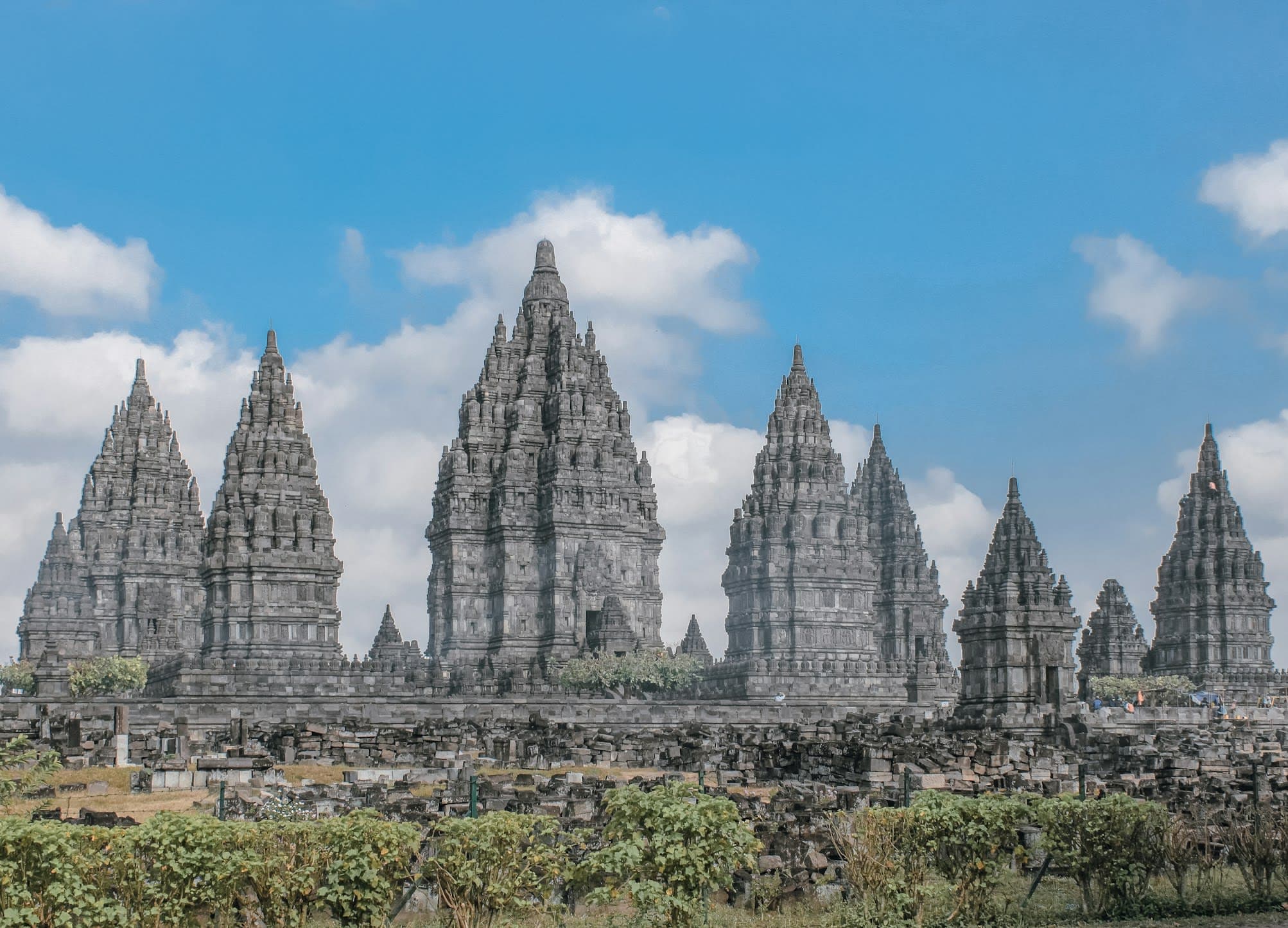
Prambanan Temple
Where Hindu gods touch earth through spires of stone that reach toward heaven
Bokoharjo, Special Region of Yogyakarta, Indonesia
At A Glance
- Coordinates
- -7.7520, 110.4915
- Suggested Duration
- Two to three hours to explore the main temples and complete circumambulation. Add two hours for Ramayana Ballet performance. A full day allows combination with Borobudur (45 km distant).
Pilgrim Tips
- Modest clothing covering shoulders and knees. Sarongs may be provided at entrance. Comfortable, sturdy shoes essential for stone surfaces and stairs.
- Permitted throughout except during ceremonies. Be mindful of worshippers. Evening and golden hour light produce the most dramatic images.
- The stone surfaces can be uneven and slippery, especially on temple stairs. Appropriate footwear is essential. The compound is large; allow sufficient time and bring water. During festivals, crowds can be significant. The Ramayana Ballet runs only during dry season (May-October); verify performance schedule in advance.
Overview
Rising from the Javanese plain like fingers pointing toward the divine, Prambanan is Indonesia's largest Hindu temple complex—a stone cosmos built for the Trimurti: Brahma the Creator, Vishnu the Preserver, and Shiva the Destroyer. The central tower soars 47 meters, symbolizing Mount Meru, the axis of the universe. Relief panels encoding the Ramayana transform circumambulation into contemplation of dharma, while the Ramayana Ballet brings the stone narratives to life under moonlit skies.
Prambanan rises. Where Borobudur spreads horizontally across the plain, Prambanan thrusts skyward—its central spire reaching 47 meters toward heaven, flanked by lesser towers for Vishnu and Brahma. This is Hindu architecture's essential gesture: the vertical aspiration connecting earth to the divine realm.
Built in the 9th century by the Sanjaya dynasty, Prambanan served as the royal temple of the Mataram Kingdom—a political and spiritual statement that Hinduism commanded power equal to the Buddhist Shailendra and their massive Borobudur nearby. The temple compound originally contained 240 structures, a stone mandala laid out according to Vastu Shastra, the Hindu science of sacred architecture. What remains after earthquakes and time, restored through the 20th century, still constitutes the largest Hindu temple complex in Indonesia and the second-largest in Southeast Asia.
The three main temples embody the Trimurti. Shiva occupies the center, his towering temple containing four chambers: Shiva himself in the east, his consort Durga in the north, his son Ganesha in the west, and his teacher Agastya in the south. Facing the Trimurti temples stand three smaller structures for their vahanas—the divine vehicles: Nandi the bull for Shiva, Garuda the eagle for Vishnu, Hamsa the swan for Brahma.
But Prambanan is not mere architecture. The inner walls encode the Ramayana in stone relief—Rama's exile, Sita's abduction, Hanuman's courage, the great war against Ravana. Pilgrims circumambulate clockwise, reading the epic with their feet, absorbing dharma through movement. And when the sun sets and the Ramayana Ballet begins, dancers bring the stone panels to life, performing against the silhouette of the very temples that depict their story. Past and present become one.
Context And Lineage
Prambanan was built around 850 CE by the Sanjaya dynasty of the Mataram Kingdom, marking the return of Hindu royal power in Central Java after Buddhist Shailendra dominance. The temple compound originally contained 240 structures arranged in a mandala according to Vastu Shastra principles. It served as the kingdom's spiritual center until the court moved to East Java around 930 CE.
The construction of Prambanan was both religious devotion and political statement. The Hindu Sanjaya dynasty had ceded Central Java to the Buddhist Shailendra dynasty, who built Borobudur. When the Sanjayas regained power, they demonstrated their resurgence through architecture that rivaled and perhaps surpassed their Buddhist predecessors in height if not in scale.
Rakai Pikatan, likely the commissioner, married a Shailendra princess, suggesting the transition involved alliance as much as conquest. His successor King Lokapala expanded the complex to its full scale of 240 temples. The compound was designed according to Vastu Shastra, creating a mandala—a sacred geometric pattern representing the universe in miniature.
The temple's original name was Shiva-grha (House of Shiva) or Shiva-laya (Realm of Shiva). The form was designed to symbolize Mount Meru, the cosmic mountain at the universe's center. Thus Prambanan was not merely a temple but a constructed cosmos, a human-made axis mundi connecting the earthly kingdom to divine realms.
Folk tradition offers a different origin. According to the legend of Rara Jonggrang, a princess was pursued by the prince Bandung Bondowoso. To reject him, she demanded he build one thousand temples in a single night. When he nearly succeeded using supernatural assistance, she tricked him by pounding rice to simulate dawn, causing his spirit helpers to flee. Enraged, he cursed her to become the final statue. The Durga in the Shiva temple is identified as the transformed princess.
Prambanan belongs to the broader tradition of Hindu temple architecture that spread from India throughout Southeast Asia. The temple's iconography draws from Sanskrit texts including the Ramayana and Bhagavata Purana. The architectural form follows Vastu Shastra principles shared across Hindu temple building. Contemporary worship at Prambanan is led primarily by Balinese Hindu communities, who maintain the strongest Hindu tradition in Indonesia, along with Javanese Hindus who have revived practice at this ancestral site.
Rakai Pikatan
Builder/Commissioner
King Lokapala
Expander
President Sukarno
Modern patron
Why This Place Is Sacred
Prambanan thins the boundary between earth and heaven through vertical architecture. The soaring spires direct attention upward; the cosmic mountain made manifest in stone. The relief narratives transform walking into reading dharma. The living ceremonies and Ramayana Ballet bridge the gap between ancient worship and contemporary devotion.
What makes Prambanan thin is the insistence of its upward reach. Buddhist architecture tends toward the horizontal—stupas that spread and settle, paths that circumambulate rather than ascend. Hindu temples point. They thrust toward the sky like fingers reaching for the divine. Standing at the base of the Shiva temple, looking up forty-seven meters of carved stone, the eye has nowhere to go but toward heaven.
This vertical aspiration embodies the Hindu understanding of the divine as transcendent—above and beyond, accessible through elevation. The temple form symbolizes Mount Meru, the cosmic mountain at the center of Hindu and Buddhist cosmology, the axis around which the universe revolves and through which gods and humans meet. To enter the Prambanan compound is to enter a constructed Meru, a human-made axis mundi.
But verticality alone does not make a thin place. What activates Prambanan is the narrative encoded in its walls. The Ramayana relief panels are not mere decoration—they are scripture in stone, dharma made visible. Walking the circumambulation path clockwise, keeping the temple on your right in the traditional pradaksina gesture of respect, you read the epic with your body. Rama's journey becomes your journey; his trials illuminate your own relationship with duty, devotion, and righteousness.
The thinness deepens when the ballet begins. Since 1961, dancers have performed the Ramayana against the backdrop of the temples. What the stone panels depict, living bodies enact. The ancient story moves through flesh as well as stone, sound as well as silence. During full moon performances, the Padhang Bulan, natural moonlight illuminates both temple and dancer. The separation between mythic time and present time dissolves.
And the ceremonies continue. After centuries of abandonment, Hindu worship has returned. Balinese and Javanese Hindus gather for Galungan, for Nyepi, for sacred observances that reconnect the restored temples with their original purpose. The stones that stood silent for five hundred years again hear prayer.
Prambanan was built as the royal temple of the Hindu Mataram Kingdom, serving both political and religious functions. The construction demonstrated that Hinduism retained royal patronage despite the Buddhist Shailendra dynasty's Borobudur. State religious ceremonies and sacrifices were conducted here, and the temple compound served as the spiritual center of Hindu kingship in Central Java.
Abandoned in the 930s when the Javanese court moved to East Java, Prambanan fell into ruin. A 16th-century earthquake caused further collapse. Dutch colonial awareness of the ruins began in 1733, but serious restoration only commenced in the 20th century. The main Shiva temple reconstruction was completed in 1953 and inaugurated by President Sukarno, with Brahma and Vishnu temples following by 1991. Since restoration, Hindu communities have reclaimed Prambanan for worship, and the Ramayana Ballet has connected the temple to living artistic tradition since 1961.
Traditions And Practice
Hindu ceremonies have returned to Prambanan since its restoration. Balinese and Javanese Hindus gather for annual observances including Galungan and Nyepi. The traditional practice of pradaksina—clockwise circumambulation while contemplating the relief narratives—continues for devotees and visitors alike.
During the Mataram Kingdom period, Prambanan served as the royal temple where state religious ceremonies were conducted. Priests performed puja (worship) with offerings to Shiva, Vishnu, and Brahma. The king's participation in temple rituals reinforced the connection between divine order and earthly kingship. Pilgrims circumambulated the temples in pradaksina, moving clockwise while studying the Ramayana and Krishnayana reliefs—a practice that transformed walking into scriptural engagement.
Sacrifices were likely offered, though specific details of 9th-century Javanese Hindu ritual remain unclear. The temple functioned as the spiritual center of the kingdom, where cosmic order was maintained through human devotion.
Since the temple's reconstruction, Hindu worship has revived. Galungan, celebrating the victory of dharma over adharma, brings Hindu communities for offerings and prayers. Tawur Kesanga, a purification ceremony, precedes Nyepi, the day of silence. These annual observances reconnect the restored stones with living devotion.
The Ramayana Ballet, performed since 1961, represents a different form of contemporary practice—artistic rather than explicitly devotional, yet rooted in the same sacred narratives. The full moon Padhang Bulan performances include a cleansing procession, adding ritual dimension to the theatrical experience.
Walk the circumambulation path around the Shiva temple clockwise, as traditional pradaksina requires. Let the relief panels set your pace—they are meant to be read, not passed. Notice how the narrative unfolds: exile, loss, war, restoration. Consider how Rama's journey reflects dharma, the cosmic order of righteousness and duty.
If possible, attend the Ramayana Ballet. The experience of seeing the stone narratives embodied by dancers, against the silhouette of the temples themselves, bridges centuries. The full moon performances add natural illumination to artificial lighting, creating an atmosphere that approaches the ceremonial.
If your visit coincides with Hindu festivals, observe the ceremonies with respect. The living worship reconnects you to the temple's original function as a place where humans and gods meet.
Hinduism (Trimurti worship)
ActivePrambanan is dedicated to the Trimurti—Brahma the Creator, Vishnu the Preserver, and Shiva the Destroyer—representing the cosmic cycle of creation, maintenance, and destruction that enables renewal. The central Shiva temple, largest and tallest, reflects classical Hindu understanding of Shiva's supremacy as the transformer whose destruction enables new creation. The temple complex embodies the Hindu cosmos in architectural form.
Annual ceremonies have resumed since restoration. Galungan celebrates dharma's victory over adharma with offerings and prayers. Tawur Kesanga purification precedes Nyepi, the day of silence. Balinese and Javanese Hindu communities gather for these observances. Pradaksina (circumambulation) while studying the Ramayana reliefs continues as devotional practice.
Javanese Hindu-Buddhist Synthesis
HistoricalPrambanan was built during a remarkable period of Hindu-Buddhist coexistence in Central Java. The Sanjaya (Hindu) and Shailendra (Buddhist) dynasties intermarried; temples of both religions rose within kilometers of each other. Prambanan and Borobudur together represent the peak of classical Javanese civilization, when two great religious traditions inspired architectural and artistic achievement without mutual destruction.
The Mataram Kingdom's state ceremonies at Prambanan coexisted with Buddhist practice at nearby temples. Royal patronage supported both traditions. The relief panels teaching Hindu dharma through Ramayana narrative paralleled Buddhist teaching at Borobudur through its own sculptural program.
Experience And Perspectives
Entering the temple compound, the Shiva temple dominates—its 47-meter spire drawing the eye upward. Walking the circumambulation path, the Ramayana reliefs unfold Rama's story panel by panel. As afternoon shadows lengthen, the stone glows gold. When the sun sets and the Ramayana Ballet begins, the temple silhouette provides a backdrop where myth becomes movement.
Approach Prambanan in the afternoon, when the light begins to soften and the crowds thin. The temples reveal themselves gradually as you enter the compound—first the silhouettes of the three vahana temples, then the full majesty of the Trimurti shrines behind them. The Shiva temple draws the eye immediately: a tower of carved stone rising nearly fifty meters, its profile a series of diminishing tiers that focus attention upward until it terminates in a point against the sky.
Begin at the eastern entrance of the Shiva temple, where the relief narratives commence. Turn left and walk clockwise, keeping the temple on your right. The first panels introduce the Ramayana—Rama's birth, his youth, his training. The carvings are remarkably detailed, faces expressive, bodies dynamic. Let yourself slow to the pace the panels require. This is not a tour to rush.
As you circle the temple, the story progresses: Rama's exile, the golden deer, Sita's abduction by Ravana. The narrative continues on the Brahma temple to the south. On the Vishnu temple to the north, different reliefs depict the Krishnayana—scenes from the life of Krishna, another avatar of Vishnu. Three temples, three narrative cycles, three circumambulations possible.
Climb the stairs to the Shiva temple chambers if access permits. The eastern chamber contains Shiva himself—a three-meter statue of the destroyer in serene pose. The north chamber holds Durga Mahisasuramardini, the goddess slaying the buffalo demon—this statue is identified in legend as Rara Jonggrang, the slender virgin of the temple's folk name. Ganesha occupies the west, Agastya the south.
As sunset approaches, the stone transforms. What appeared gray in midday takes on golden warmth. Shadows deepen the relief carvings, making faces more expressive, gestures more dramatic. The temple seems to awaken as light withdraws.
If you have timed your visit for a performance night, make your way to the open-air theater. As darkness falls and the gamelan orchestra begins, the Ramayana Ballet commences. Dancers in elaborate costume embody the characters the stone reliefs depicted. The temple spires rise behind them in silhouette. What was carved becomes choreographed. The ancient story moves through living bodies against the backdrop of the very walls that have held it for twelve hundred years. During full moon performances, natural moonlight contributes to the illumination, and the experience approaches the numinous.
Enter from the main gate and proceed to the inner compound. Begin circumambulation at the eastern stairs of the Shiva temple, turning left to walk clockwise. The Ramayana reliefs start here and continue to the Brahma temple (south). The Vishnu temple (north) contains Krishnayana reliefs. The vahana temples (Nandi, Garuda, Hamsa) face their respective deity temples. Allow the reliefs to set your pace—they reward attention. For Ramayana Ballet, proceed to the open-air theater (separate ticket required); performances typically begin around 7:30 PM during dry season.
Prambanan invites multiple readings: as architectural masterpiece, Hindu pilgrimage site, and testimony to Java's religious complexity. Scholarly analysis emphasizes engineering and artistic achievement. Hindu practitioners experience living connection with the Trimurti. Alternative interpretations explore cosmological alignments and encoded wisdom. All perspectives acknowledge that this temple complex represents a peak of human devotion and skill.
Art historians and archaeologists view Prambanan as the masterpiece of Hindu temple architecture in Indonesia. The construction demonstrates sophisticated engineering—47-meter stone towers that have survived earthquakes and centuries. The relief panels rank among the finest examples of Hindu sculptural narrative, their detail and dynamism remarkable.
Scholars emphasize Prambanan's political as well as religious significance. The temple marked the Sanjaya dynasty's restoration to power and their assertion of Hindu identity against Buddhist Shailendra achievements. Yet the proximity of Hindu and Buddhist monuments—Sewu Temple stands 800 meters away—suggests coexistence rather than conflict.
The UNESCO designation recognizes both artistic merit and religious significance: 'a masterpiece of the classical period' representing 'past religious peaceful cohabitation.'
For Hindu practitioners, Prambanan remains a living temple where the Trimurti can be worshipped. The revival of ceremonies since restoration demonstrates ongoing religious significance for Balinese and Javanese Hindus. The circumambulation path around the Shiva temple continues to serve its original purpose: transforming walking into dharmic contemplation through engagement with the Ramayana reliefs.
The temple's identification as Shiva-grha (House of Shiva) places it within the broader Shaivite tradition of India and Southeast Asia. Shiva's central position, with Vishnu and Brahma flanking, reflects classical Hindu understanding of Shiva as supreme among the Trimurti—destroyer and transformer, ending that enables new beginning.
Some researchers emphasize Prambanan's astronomical and geometric symbolism. The mandala layout, cardinal orientations, and proportions invite analysis for cosmic significance. The relationship between Prambanan and Borobudur—Hindu and Buddhist, vertical and horizontal, within 45 kilometers of each other—suggests intentional dialogue between traditions.
The legend of Rara Jonggrang, with its impossible task and transformation curse, has been interpreted as encoding initiatory teachings about the spiritual journey. The thousand temples demanded overnight may symbolize the overwhelming nature of spiritual accomplishment; the princess's transformation into the Durga statue suggests divine metamorphosis.
These interpretations remain outside academic consensus but reflect genuine engagement with the monument's mysterious power.
Despite extensive study, significant questions remain about Prambanan. Why was the temple abandoned in the 930s—political instability, volcanic threat, religious change, or other factors? What specific ceremonies did 9th-century Javanese Hindus perform here? The original 240 temples are largely unrestored rubble; what would the complete compound have looked like and how did pilgrims navigate it? How did Hindu and Buddhist communities interact at neighboring temples—competition, cooperation, or indifference? The stones hold secrets they have not yet revealed.
Visit Planning
Prambanan is located 17 kilometers northeast of Yogyakarta city, easily accessible by car or tour. Visit during dry season (May-October) for best conditions and Ramayana Ballet performances. Late afternoon allows for sunset and optional evening ballet.
Yogyakarta offers the widest range of accommodations, from budget to luxury. Staying near Prambanan reduces travel time for sunrise visits or evening ballet, though options are more limited.
Dress modestly for a sacred site. Walk clockwise when circumambulating temples. Maintain awareness that this is an active Hindu pilgrimage destination, especially during festivals.
Prambanan functions both as Indonesia's second-most-visited heritage site and as an active Hindu temple. Both dimensions deserve respect.
Modest dress is appropriate: shoulders and knees covered. Sarongs may be provided for those in shorts. Comfortable walking shoes are essential for the stone surfaces, stairs, and distances involved.
When circumambulating temples, walk clockwise (pradaksina), keeping the temple on your right. This follows Hindu tradition and ensures smooth traffic flow.
During Hindu ceremonies, which occur particularly around Galungan and Nyepi, be especially respectful. Worship takes precedence over tourism. Observe quietly without intruding on devotees.
Photography is permitted throughout except during active ceremonies. The temples offer remarkable photo opportunities, but be mindful not to obstruct worshippers or other visitors in pursuit of images.
Modest clothing covering shoulders and knees. Sarongs may be provided at entrance. Comfortable, sturdy shoes essential for stone surfaces and stairs.
Permitted throughout except during ceremonies. Be mindful of worshippers. Evening and golden hour light produce the most dramatic images.
Hindu practitioners may make offerings at shrine chambers. Non-Hindus should observe rather than participate in ritual offerings.
Do not climb on temple structures outside designated stairs. Do not sit on statues. Stay on designated paths. Be especially respectful during Hindu ceremonies and festivals.
Sacred Cluster
Nearby sacred places create the location cluster described in the growth plan. This block is intentionally crawlable and links into the wider regional graph.