Borobudur
A mountain of stone where walking becomes meditation and ascent becomes awakening
Desa Borobudur, Central Java, Indonesia
At A Glance
- Coordinates
- -7.6079, 110.2038
- Suggested Duration
- Two to four hours for thorough circumambulation of all gallery levels. A full day allows for combining Borobudur with nearby temples Mendut and Pawon, which together formed the original pilgrimage route. Those walking only the upper terraces may spend one to two hours.
Pilgrim Tips
- Modest clothing covering shoulders and knees. Sarongs may be provided at the entrance for those in shorts. Comfortable, sturdy walking shoes essential for stone stairs and surfaces.
- Permitted throughout except during special ceremonies. Drones prohibited. Use awareness and restraint during busy periods.
- The monument is fragile. Walk only on designated paths and stairs. Do not climb on stupas or sit on Buddha statues. The stonework has endured over a millennium but cannot withstand unrestricted contact. During Vesak and holidays, crowds can be intense—the contemplative experience is more accessible during quieter times. The steep stairs can be slippery, especially when wet; appropriate footwear is essential.
Overview
Rising from the Kedu Plain of Central Java, Borobudur is the world's largest Buddhist monument—a three-dimensional mandala carved in volcanic stone. Nine terraces ascend from the realm of desire through the realm of form to formlessness. Five kilometers of relief panels guide the pilgrim through the Buddha's life and teachings. The journey from base to summit enacts the path from suffering to enlightenment, from darkness into light.
Borobudur does not simply depict the Buddhist cosmos—it is the Buddhist cosmos, rendered in two million blocks of gray andesite. Built by the Shailendra dynasty in the 9th century, this stepped pyramid rises 35 meters from a 123-meter base, its nine platforms representing the three realms of existence: Kamadhatu, the realm of desire where craving binds consciousness to suffering; Rupadhatu, the realm of form where attachment loosens through contemplation; and Arupadhatu, the formless realm where only Buddhas remain, visible but unreachable within their perforated stupas.
The monument is designed for circumambulation. Walking the five kilometers of corridors clockwise, the pilgrim encounters 2,672 relief panels narrating the Buddha's previous lives, his final incarnation, and the journey of the seeker Sudhana toward wisdom. The panels do not merely illustrate doctrine—they guide attention, regulate pace, and transform walking into meditation. From above, the structure forms a perfect mandala. From within, it becomes a path.
Abandoned for centuries after Java's Islamization and buried under volcanic ash, Borobudur was rediscovered in 1814 and restored to become Indonesia's most visited monument. Yet for Buddhist pilgrims who process here during Vesak, it remains what its builders intended: a technology for transformation, a mountain where ascending is awakening.
Context And Lineage
Borobudur was constructed between 778 and 850 CE by the Shailendra dynasty of Central Java, ardent patrons of Mahayana Buddhism. The monument rises 35 meters from a 123-meter square base, built from approximately two million blocks of gray andesite volcanic stone. Its 2,672 relief panels extend over six kilometers when aligned, constituting the world's largest collection of Buddhist sculptural narrative.
The Shailendra dynasty, whose name means 'Lord of the Mountain,' ruled Central Java during the 8th and 9th centuries as fervent proponents of Mahayana Buddhism. They constructed Borobudur as a monument to the Three Bodies of Buddha (Trikaya) and the path to enlightenment. The central stupa was dedicated to Vairocana, the cosmic Buddha whose radiance illuminates all existence.
The monument's design synthesized Indian Buddhist concepts with indigenous Javanese beliefs. The stepped pyramid form echoed the prehistoric punden berundak structures, sacred platforms where ancestral spirits (hyangs) were venerated. The artificial mountain rising from the plain replicated the axis mundi, the cosmic mountain connecting earth to heaven. Thus Borobudur represented not merely an imported Indian religion but a uniquely Javanese expression of Buddhist spirituality.
Construction required approximately 75 years and the labor of thousands. Some scholars estimate 30,000 sculptors alone worked on the relief panels. The massive blocks of andesite were cut from riverbeds and volcanic deposits, transported without wheels or pulleys, and fitted without mortar. The engineering precision remains remarkable: drainage channels built into the structure have protected it from water damage for over a millennium.
Borobudur belongs to the broader tradition of Mahayana Buddhism that spread from India throughout East and Southeast Asia. The monument's iconography and relief narratives draw from Sanskrit texts including the Lalitavistara (life of the Buddha), the Jataka tales (previous lives), and the Gandavyuha (Sudhana's journey to wisdom). The architectural form combines the Indian Buddhist stupa with the Javanese sacred mountain tradition. Contemporary Indonesian Buddhism, practiced by a small minority, maintains Borobudur as a pilgrimage site, with monks from across Asia participating in annual Vesak celebrations.
King Samaratungga
Probable royal patron
Thomas Stamford Raffles
Rediscoverer
Theodoor van Erp
Restorer
Why This Place Is Sacred
Borobudur transforms pilgrimage into practice. The architecture itself teaches: walking the corridors clockwise, ascending the terraces, emerging from enclosed galleries into the openness of the upper platforms—these physical movements mirror the spiritual journey from bondage to liberation. The 72 perforated stupas on the upper terraces contain Buddha statues that can be glimpsed but not fully seen, embodying the paradox of the formless realm: presence without grasping.
What makes Borobudur thin is not merely its age or its scale but its participatory genius. This is not a monument to be observed but a path to be walked. The Shailendra architects understood that transformation occurs through the body as much as through the mind.
The journey begins in darkness. The galleries of the lower terraces are enclosed, their walls lined with relief panels depicting the karma of desire and its consequences. Light filters down from above, but the pilgrim walks in shadow, studying scenes of craving and suffering rendered with extraordinary narrative precision. The pace is necessarily slow; the reliefs demand attention.
As the pilgrim ascends, the architecture opens. The upper galleries admit more light. The relief narratives shift from karmic bondage to the Buddha's teaching and the bodhisattva's path. Then, at the sixth terrace, the enclosed galleries end entirely. The pilgrim emerges onto the circular platforms of the formless realm.
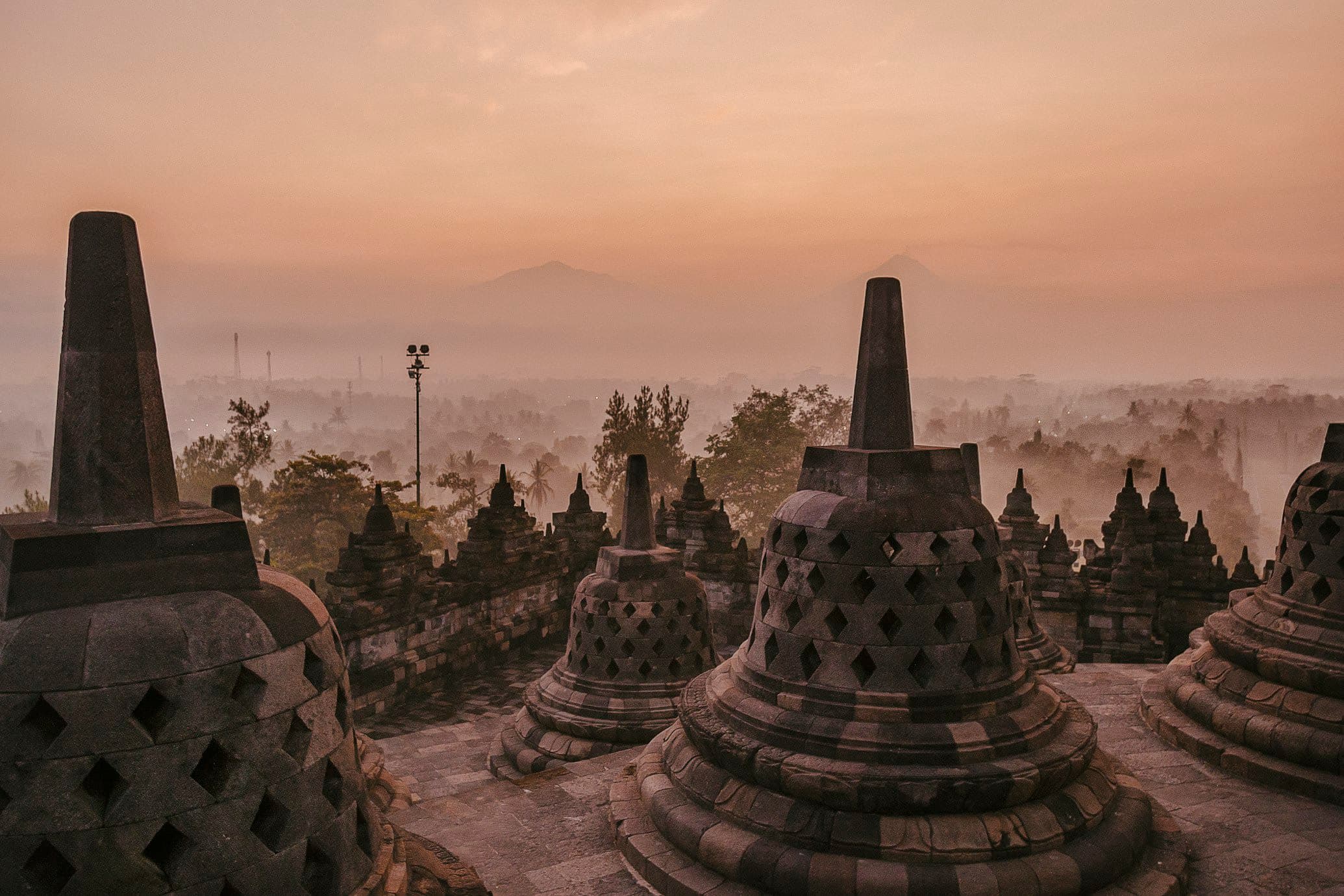
Here the change is dramatic. After kilometers of detailed narrative imagery, there is suddenly nothing but sky, stupas, and the volcanic peaks of Merapi and Merbabu on the horizon. The 72 perforated stupas contain Buddha statues—visible through the diamond-shaped holes but impossible to touch. This is the formless realm made architectural: presence without substance, awareness without object.
The central stupa crowns the structure, larger and unperforated. When opened in the 19th century, it was found empty. Whether it always was, whether it once contained a relic, remains unknown. The emptiness seems appropriate: the goal of the path, like the center of a mandala, is beyond form.
Borobudur was constructed as a monument to Mahayana Buddhist cosmology and a site of royal pilgrimage. The Shailendra dynasty, whose name means 'Lord of the Mountain,' built the temple as a three-dimensional representation of the Buddhist universe and the path to enlightenment. The structure synthesized Indian Buddhist concepts with indigenous Javanese beliefs about sacred mountains as dwelling places of ancestral spirits.
Following the decline of Buddhist kingdoms in Java and the spread of Islam in the 14th-15th centuries, Borobudur was abandoned and gradually buried under volcanic ash and vegetation. It was rediscovered in 1814 when the British briefly governed Java, and Thomas Stamford Raffles ordered its excavation. Major restoration by the Dutch followed, and a comprehensive UNESCO-led restoration from 1975-1982 stabilized the structure for modern pilgrimage and tourism. Today Borobudur functions both as Indonesia's premier cultural heritage site and as a living pilgrimage destination for Buddhists, particularly during Vesak celebrations.
Traditions And Practice
Circumambulation remains the primary practice at Borobudur—walking the five kilometers of corridors clockwise while contemplating the relief narratives. Vesak celebrations bring thousands of pilgrims who process from Mendut Temple to Borobudur by candlelight, culminating in ceremonies at the monument.
The traditional practice at Borobudur is pradakshina—clockwise circumambulation of the monument while keeping it on one's right as a gesture of respect. Pilgrims were expected to walk all corridor levels in sequence, studying the relief narratives that guide attention through the Buddhist cosmos. The ascent from base to summit enacted the path from the realm of desire through form to formlessness.
Meditation and mantra recitation accompanied the circumambulation. Offerings would have been made at various Buddha statues. The monument functioned as a teaching device: the reliefs provided visual dharma instruction while the act of walking transformed intellectual understanding into embodied knowledge.
Royal ceremonies during the Shailendra period remain poorly documented, but the monument likely served as a site of court ritual as well as popular pilgrimage.
For Buddhist pilgrims today, circumambulation remains the central practice. Many visitors walk at least one complete circuit, though few complete all gallery levels. During Vesak (Waisak in Indonesian), the primary annual celebration, thousands of Buddhist pilgrims and monks gather for a candlelight procession from Mendut Temple to Borobudur. The procession covers three kilometers, passing Pawon Temple, and culminates at Borobudur where practitioners circumambulate the monument and participate in ceremonies through the night.
Some visitors meditate at various levels of the monument, particularly on the upper circular terraces where the architecture creates a contemplative atmosphere. Touching the Buddha statues visible through the perforated stupas is believed by some to bring blessings, though this practice contributes to wear on the stonework.
Walk the full circuit if time permits, beginning at the east staircase and circumambulating clockwise through all gallery levels. Move slowly—the reliefs reward attention. Notice how your experience shifts as the architecture changes from enclosed to open. At the upper terraces, sit quietly and observe: the horizon, the stupas, the quality of light. If visiting at sunrise, allow silence to accompany the transition from darkness to day. Whether or not you identify as Buddhist, the monument invites the practice it was designed for: walking as meditation, ascending as awakening.
Mahayana Buddhism
ActiveBorobudur is the world's largest Buddhist monument and a three-dimensional representation of Mahayana cosmology. The structure embodies the Three Bodies of Buddha (Trikaya) and the path to enlightenment. The central stupa was dedicated to Vairocana, the cosmic Buddha. The relief panels narrate Buddhist teachings and the journey of the seeker Sudhana. For Mahayana practitioners, Borobudur remains a supreme pilgrimage destination and a functioning spiritual path.
Circumambulation (pradakshina) constitutes the central practice—walking the corridors clockwise while contemplating the relief narratives. The Vesak celebration brings thousands of pilgrims for candlelight procession from Mendut Temple and ceremonies at the monument. Meditation and offerings at Buddha statues continue throughout the year.
Javanese Ancestral Tradition
HistoricalBorobudur synthesizes imported Mahayana Buddhism with indigenous Javanese beliefs about sacred mountains and ancestral spirits (hyangs). The stepped pyramid form echoes prehistoric punden berundak structures. The artificial mountain rising from the plain replicates the axis mundi connecting earth and heaven. The monument thus represents not merely Indian religion transplanted but a uniquely Javanese expression of the sacred mountain tradition.
The ascent of Borobudur mirrors the ascent of sacred mountains to encounter the divine—a practice predating Buddhism in Java. The Shailendra dynasty name ('Lord of the Mountain') suggests royal identification with the sacred mountain tradition. This indigenous layer of meaning persisted alongside Buddhist interpretation during the monument's active period.
Experience And Perspectives
Arriving at Borobudur in the pre-dawn darkness, the pilgrim climbs through shadows to reach the upper terraces as light breaks over the volcanic peaks. The monument emerges from obscurity into presence, its stupas and Buddhas silhouetted against the orange sky. Those who walk the full circuit experience the architecture's transformation: from enclosed corridors dense with narrative to open platforms where only sky and stone remain.
The most powerful approach to Borobudur begins in darkness. Sunrise tours allow visitors to ascend before dawn, climbing the steep stone stairs in near-blindness, guided only by footfall and the shapes of pilgrims ahead. This darkness is not incidental—it replicates the condition of the unrealized mind, walking without seeing.
As the sky lightens, forms emerge. The stupas of the upper terraces become visible first, their bell shapes cutting geometric patterns against the orange horizon. Then the volcanoes appear: Merapi, still active, smoking gently to the east; Merbabu beyond. The Kedu Plain spreads below, its rice paddies and palm groves slowly revealed. The monument itself seems to rise with the sun, its gray stone taking on golden warmth.
For those who have walked the galleries, the arrival at the upper platforms is transformative. After hours in the narrative density of the relief corridors, the openness of the circular terraces produces a visceral shift. The mind, trained by kilometers of imagery to attend to detail, suddenly has nothing to grasp. The perforated stupas offer only glimpses of the Buddhas within—presence without possession.
During Vesak, the full moon of May, this experience intensifies. Thousands of pilgrims in white process from Mendut Temple three kilometers away, carrying candles and chanting. They circumambulate Borobudur as a community, their movement a living demonstration of the sangha, the Buddhist community of practice. The monument becomes what it was built to be: not a museum but a path walked together.
Enter from the east side, where the main staircase aligns with the rising sun. Begin circumambulation at the lowest gallery, walking clockwise (keeping the monument on your right). Study the relief panels as you walk—they are meant to regulate pace and attention. Ascend each terrace before moving to the next level of galleries. The full circuit of all terraces covers approximately five kilometers. Allow your experience to change as the architecture changes: narrative gives way to openness, enclosure to sky. If visiting at sunrise, arrive at least 30 minutes before dawn to reach the upper terraces in darkness.
Borobudur invites multiple readings: as architectural masterpiece, Buddhist pilgrimage path, and Javanese sacred mountain. Scholarly analysis emphasizes the monument's artistic and historical significance. Traditional Buddhist understanding sees it as a functioning spiritual technology. Alternative interpretations explore astronomical alignments and esoteric symbolism. All perspectives acknowledge that questions remain about this extraordinary structure.
Art historians and archaeologists view Borobudur as the supreme achievement of Javanese Buddhist architecture and one of the world's great monuments. The structure combines three forms—stupa, temple mountain, and mandala—in an unprecedented synthesis. The 2,672 relief panels represent the most extensive collection of Buddhist sculptural narrative, executed with remarkable artistic sophistication.
The monument's construction reflects the Shailendra dynasty's political power and religious devotion. Scholars estimate construction required 75 years and thousands of workers. The engineering sophistication—drainage systems, weight distribution, precise stone fitting without mortar—demonstrates advanced technical knowledge.
The reasons for Borobudur's abandonment remain debated. The shift of Javanese power centers, the spread of Islam, and volcanic activity all likely contributed. By the time of European contact, the monument was largely buried and forgotten.
For Buddhist practitioners, Borobudur remains what its builders intended: a path to awakening. The circumambulation route enacts the journey from suffering to liberation. The relief narratives teach the dharma visually. The architecture's progression from enclosed galleries to open terraces mirrors the loosening of attachment. The empty central stupa represents the goal: enlightenment beyond form.
Contemporary Indonesian Buddhists and pilgrims from across Asia treat Borobudur as sacred ground. The annual Vesak celebration renews this function. The monument is not a museum of dead religion but a functioning spiritual technology, designed to transform those who engage it properly.
Some researchers emphasize Borobudur's cosmological alignments and sacred geometry. The monument's positioning relative to Mount Merapi and Mount Merbabu, its cardinal orientation, and its mathematical proportions have been analyzed for astronomical and symbolic significance. The three circular upper terraces may align with specific celestial phenomena.
Others see the monument as an initiation temple where practitioners underwent transformative experiences in the dark galleries before emerging into the light of the upper platforms—a death-and-rebirth journey encoded in stone.
These interpretations remain outside academic consensus but express genuine uncertainty about the full range of the monument's intended functions.
Despite extensive study, significant questions remain. Why was the lowest level of relief panels, depicting the realm of desire, covered over with additional stonework, possibly during construction? What originally occupied the empty central stupa? How did the Shailendra dynasty organize the construction of such a massive monument? What specific ceremonies were performed during its active period? Why was this site chosen from among the many possible locations in the Kedu Plain? The monument continues to withhold some of its secrets.
Visit Planning
Borobudur is located in Central Java, approximately 40 kilometers northwest of Yogyakarta. Visit during the dry season (May-September) for best conditions. Sunrise visits offer the most powerful experience but require separate tickets and early arrival.
Yogyakarta offers the widest range of accommodations, from backpacker hostels to luxury hotels. Staying near Borobudur (Magelang) allows easier access for sunrise visits. Several hotels near the monument cater specifically to sunrise visitors.
Dress modestly for a sacred site. Walk clockwise when circumambulating. Maintain awareness that this remains a living pilgrimage destination for Buddhist practitioners, not merely a tourist attraction.
Borobudur functions simultaneously as Indonesia's most-visited cultural heritage site and an active Buddhist pilgrimage destination. Both dimensions deserve respect.
Modest dress is appropriate: shoulders and knees covered. Sarongs may be provided or required for those in shorts. Comfortable walking shoes are essential for the stone surfaces, which can be uneven and slippery.
When circumambulating, walk clockwise, keeping the monument on your right. This follows Buddhist tradition and ensures smooth traffic flow. Move at a pace that allows others to pass if needed.
During Vesak and Buddhist holidays, the monument takes on its primary character as a site of active practice. Be especially respectful of pilgrims in prayer or meditation. Silence or quiet voices are appropriate.
Photography is permitted throughout except during special ceremonies. Be mindful not to obstruct pilgrims or other visitors, and avoid posed photographs that treat the monument as mere backdrop.
Modest clothing covering shoulders and knees. Sarongs may be provided at the entrance for those in shorts. Comfortable, sturdy walking shoes essential for stone stairs and surfaces.
Permitted throughout except during special ceremonies. Drones prohibited. Use awareness and restraint during busy periods.
Small offerings may be made at Buddha statues. Do not leave litter on the monument. Incense and candles are generally reserved for formal ceremonies.
Do not climb on the monument outside designated paths. Do not sit on Buddha statues or stupas. Do not touch the relief panels. The monument is fragile; these restrictions protect what has survived eleven centuries for future pilgrims.
Sacred Cluster
Nearby sacred places create the location cluster described in the growth plan. This block is intentionally crawlable and links into the wider regional graph.