Mycenae
Seat of the first Greek kings, where gold-masked rulers met the gods in stone and darkness
Municipal Unit of Mykines, Peloponnese, Western Greece and the Ionian, Greece
At A Glance
- Coordinates
- 37.7309, 22.7561
- Suggested Duration
- Two hours is the minimum for the citadel, museum, and Treasury of Atreus. Two and a half to three hours allows for thorough engagement with the cult center area and unhurried time at key points. Do not arrive near closing time -- the site cannot be meaningfully experienced in less than ninety minutes.
- Access
- Located near the village of Mykines (Fichti), Argolis, northeastern Peloponnese. Approximately 120 km (1.5 hours) southwest of Athens via the E94/A7 motorway. Also accessible from Nafplio (25 km, 30 minutes) and Argos (12 km). KTEL buses run from Athens, Nafplio, and Argos to Fichti; from the village it is approximately 4 km to the site (taxi or walk). Opening hours: Summer (April) 08:00-19:00; Summer (May-October) 08:00-20:00; Winter (November-March) 08:30-15:30. Hours may vary; check with the Greek Ministry of Culture. Ticket: 12 EUR full price, 6 EUR reduced (students). Free admission days include March 6, April 18, May 18, last weekend of September, October 28, and first/third Sundays of each month November through March. Phone: +30 27510-76585. The citadel is NOT wheelchair accessible (steep, uneven terrain). The museum and Treasury of Atreus forecourt have limited accessibility. Mobile signal is available. The village of Mykines and the nearby town of Fichti have basic services. Nafplio, the nearest city with full tourist services, is 25 km south.
Pilgrim Tips
- Located near the village of Mykines (Fichti), Argolis, northeastern Peloponnese. Approximately 120 km (1.5 hours) southwest of Athens via the E94/A7 motorway. Also accessible from Nafplio (25 km, 30 minutes) and Argos (12 km). KTEL buses run from Athens, Nafplio, and Argos to Fichti; from the village it is approximately 4 km to the site (taxi or walk). Opening hours: Summer (April) 08:00-19:00; Summer (May-October) 08:00-20:00; Winter (November-March) 08:30-15:30. Hours may vary; check with the Greek Ministry of Culture. Ticket: 12 EUR full price, 6 EUR reduced (students). Free admission days include March 6, April 18, May 18, last weekend of September, October 28, and first/third Sundays of each month November through March. Phone: +30 27510-76585. The citadel is NOT wheelchair accessible (steep, uneven terrain). The museum and Treasury of Atreus forecourt have limited accessibility. Mobile signal is available. The village of Mykines and the nearby town of Fichti have basic services. Nafplio, the nearest city with full tourist services, is 25 km south.
- No dress code applies. Comfortable walking shoes with good traction are essential -- the citadel terrain is steep, rocky, and uneven. In summer, sun protection is critical: hat, sunscreen, light long sleeves. In cooler months, layers and wind protection are advisable, as the hilltop is exposed.
- Photography is permitted throughout the site for personal use. No flash photography in the museum. Tripods may require special permission from the site management.
- The citadel involves significant uphill walking on steep, uneven ancient stone surfaces. This terrain is genuinely challenging for those with mobility limitations and is not wheelchair accessible. The site is exposed to full sun with almost no shade -- summer temperatures can be extreme. Carry water and wear sun protection. Sturdy footwear with good grip is essential, not optional.
Overview
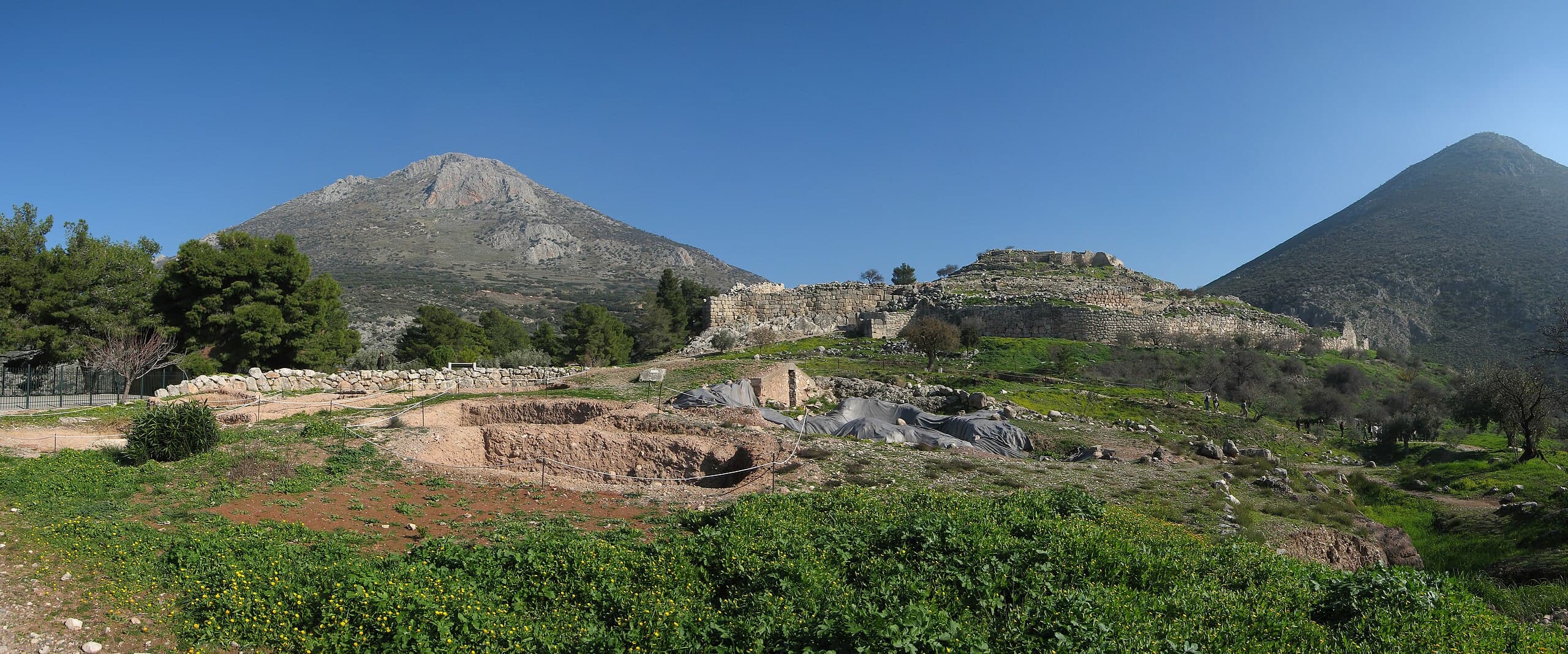
Mycenae rises from a rocky spur between two ravines in the northeastern Peloponnese, commanding the Argive Plain with a strategic authority that persists in the bones of its Cyclopean walls. For four centuries this citadel was the political and sacred capital of the first advanced civilization on the Greek mainland. Its Lion Gate, its gold death masks, and its tholos tombs remain among the most powerful encounters with the deep past available anywhere in the Mediterranean.
Something happened here that the landscape has not forgotten. The hill at Mycenae is not especially large, nor is the plain below it especially dramatic. But from the moment the massive walls come into view, assembled from limestone blocks so enormous that the ancients credited Cyclopes with their construction, the site announces itself as a place where human ambition once pressed hard against the limits of the possible.
Between roughly 1600 and 1100 BCE, Mycenae was the richest and most powerful center in the Aegean world. Its rulers controlled trade routes stretching from Egypt to the Baltic, accumulated gold in quantities unmatched outside the Near East, and built a complex of shrines and temples that constituted the most extensive Bronze Age religious center ever discovered on Greek soil. When the poet of the Iliad needed a king to command the thousand ships sailing to Troy, he chose the lord of Mycenae.
The civilization that bore this citadel's name collapsed in a catastrophe that remains one of history's great unsolved questions. The palaces burned. The writing system was lost. The population scattered. What survived was stone, gold, and story. Homer sang of Agamemnon's kingdom. Pausanias described the ruins in the second century. Schliemann dug for proof that the legends were true and found a gold mask he pressed to his face, telegraphing the world that he had gazed upon the face of Agamemnon himself.
The mask predates the Trojan War by three centuries. The face belongs to a ruler whose name we will never know. But this collision between myth and evidence, between what we want the past to be and what it actually was, is part of what gives Mycenae its particular gravity. This is a place where the known and the unknown press against each other with unusual force.
Context And Lineage
Mycenae was the political and sacred capital of the first advanced Greek civilization, housing the most extensive Bronze Age cult center known and the richest concentrations of gold artifacts in the pre-Classical Mediterranean. Its mythological associations with the House of Atreus made it central to Greek tragic literature and the Western imagination.
Greek mythology traced the founding of Mycenae to Perseus, son of Zeus and Danae. According to Pausanias, writing in the second century CE, Perseus named the city after the cap of his scabbard fell off at the site, or after finding a mushroom growing beside a spring -- the word mykes meaning both cap and mushroom. In either version, the founding was accidental and divinely guided, a chance discovery that revealed a place already marked by the gods.
The mythological narrative that defines Mycenae, however, is the curse of the House of Atreus. The story begins with Tantalus, a son of Zeus who enjoyed the privilege of dining with the gods on Olympus. To test their omniscience, Tantalus killed his own son Pelops and served his flesh at a divine feast. The gods recognized the horror immediately, punished Tantalus to eternal torment in the underworld, and restored Pelops to life.
Pelops prospered and won his bride Hippodamia through a chariot race against her father, King Oenomaus, but the victory involved treachery that brought a dying man's curse upon Pelops and all his descendants. His grandsons Atreus and Thyestes carried the curse to Mycenae, where Atreus murdered his brother's sons and served their flesh to Thyestes at a feast that deliberately echoed Tantalus's original crime. Agamemnon, son of Atreus, inherited both the throne and the curse. To gain favorable winds for the fleet sailing to Troy, he sacrificed his daughter Iphigenia to the goddess Artemis. After ten years of war and the destruction of Troy, Agamemnon returned to Mycenae in triumph, only to be murdered by his wife Clytemnestra and her lover Aegisthus.
The cycle ended with Orestes, who killed his mother to avenge his father and was pursued by the Furies until Athena convened a court at Athens and cast the deciding vote for acquittal. The story is the foundation of Aeschylus's Oresteia, the only complete Greek tragic trilogy to survive, and it established the themes of guilt, justice, and the possibility of breaking inherited cycles of violence that have shaped Western literature ever since.
Mycenae's sacred lineage spans from Neolithic occupation through Bronze Age grandeur to mythological afterlife. The earliest cult activity on the hill cannot be precisely dated, but by the sixteenth century BCE the shaft graves indicate elaborate funerary ritual involving gold death masks and lavish grave goods. The thirteenth-century cult center, with its multiple shrine buildings and goddess frescoes, represents the peak of organized Mycenaean worship. After the Bronze Age Collapse, Archaic-period settlers built a temple to Hera on the summit and maintained a heroon for hero veneration. Argos destroyed the settlement in 468 BCE, ending active use. The mythological tradition -- Homer, Aeschylus, Sophocles, Euripides -- kept the site alive in cultural memory for millennia. Modern archaeological work, beginning with Schliemann in 1876 and continuing today, constitutes a new form of sustained engagement. UNESCO inscription in 1999 recognized this layered significance as belonging to all humanity.
Heinrich Schliemann
The German merchant turned archaeologist who excavated Mycenae in 1876, driven by his conviction that Homer's epics recorded historical truth. His discovery of Grave Circle A with its gold death masks, weapons, and jewelry electrified Europe and inaugurated the modern study of Mycenaean civilization. His famous telegram announcing he had gazed upon the face of Agamemnon was almost certainly wrong -- the mask predates the traditional Trojan War by three centuries -- but his instinct that something extraordinary lay beneath these ruins was vindicated beyond any reasonable expectation.
Christos Tsountas
The Greek archaeologist who succeeded Schliemann and conducted systematic excavations between 1884 and 1902. Tsountas discovered the palace on the citadel summit, excavated numerous buildings that proved central to understanding Mycenaean domestic and religious life, and brought methodical rigor to a site that Schliemann had approached with more enthusiasm than discipline. The Tsountas House in the cult center bears his name.
Lord William Taylour and Elizabeth French
The British archaeologists who led excavations from 1968 that uncovered the cult center religious complex on the western slope of the citadel. This discovery -- the most extensive Mycenaean shrine complex ever found -- transformed scholarly understanding of Bronze Age Greek religion, revealing a degree of architectural and ritual elaboration that had not been suspected. French continued directing excavations and publications into the twenty-first century.
Agamemnon
The legendary king of Mycenae who commanded the Greek forces in the Trojan War, as sung in Homer's Iliad. Son of Atreus, husband of Clytemnestra, father of Iphigenia, Orestes, and Electra. His sacrifice of Iphigenia, his murder by Clytemnestra upon his return from Troy, and the vengeance cycle that followed form the dramatic core of the Atreid curse. Whether any historical ruler lies behind the legend remains debated, but Agamemnon's name is inseparable from the site.
Pausanias
The second-century CE Greek geographer whose Description of Greece provides the earliest detailed account of Mycenae's visible remains. Pausanias described the Lion Gate, the walls, and the traditions associated with the site at a time when the citadel had been a ruin for six centuries. His account guided later travelers and ultimately helped Schliemann locate the shaft graves.
Why This Place Is Sacred
Mycenae's thinness arises from the extraordinary density of human meaning layered across millennia, the physical encounter with Bronze Age religious architecture designed to mediate between human and divine, and the collision between mythic narrative and archaeological evidence that keeps the site permanently unresolved.
A thin place is one where the ordinary seems insufficient to account for what is felt. Mycenae generates this feeling through an accumulation of factors that no single explanation can contain.
The first is sheer depth. Human beings have inhabited this hill for nine thousand years. The Neolithic settlers who first chose it did so for reasons of defense and water supply, but the Mycenaean Greeks who built their citadel here between 1600 and 1200 BCE transformed the site into something more than a fortress. They carved shaft graves into bedrock and filled them with gold. They laid beaten-gold masks over the faces of their dead. They built beehive-shaped tombs of such precision that the Treasury of Atreus remained the largest domed structure in the world for over a thousand years, until the Roman Pantheon. Each of these acts was an assertion that this place was where the boundary between the living and the dead could be crossed.
The second factor is the cult center. Discovered in 1968 on the southwestern slope of the citadel, this complex of shrines, temples, frescoed chambers, and idol rooms constituted the most elaborate Mycenaean religious architecture known. Goddesses dominated the imagery. A figure called Potnia, the Mistress, presided over rituals involving processions from the palace summit down to the shrine complex. The frescoes showed female deities in attitudes of authority, including one figure bearing a sword. These were spaces designed to facilitate encounters with the numinous, and the care with which they were constructed suggests that those who built them experienced something here worth elaborate architectural framing.
The third factor is mythological weight. Mycenae is the seat of the House of Atreus, whose five-generation curse encompasses murder, cannibalism, child sacrifice, betrayal, and eventual acquittal. The story moves from Tantalus serving his own son to the gods, through Atreus feeding his brother's children to him at a feast, through Agamemnon sacrificing Iphigenia and being murdered by Clytemnestra, to Orestes killing his mother and being tried before the Areopagus in Athens. This is not merely mythology. It is the foundational narrative of Greek tragedy, the template through which the ancient world explored the relationship between guilt, fate, and justice. That it is set here, in these stones, gives the ruins a narrative intensity that few archaeological sites can match.
The fourth factor is the unresolved. The Bronze Age Collapse that destroyed Mycenae and the entire Mycenaean palatial system around 1200 BCE remains one of the great mysteries of ancient history. Invasion, earthquake, drought, internal revolt, systems collapse -- scholars have proposed every explanation and confirmed none. Walking through Mycenae is walking through the aftermath of a catastrophe whose cause we do not know, in a landscape that cannot tell us what happened.
Mycenae was established as a hilltop settlement in the Neolithic period, valued for its defensive position commanding the routes between the Corinthian Gulf and the Argive Plain. By the Late Bronze Age it had become the political, economic, and religious capital of the Mycenaean world. The citadel's cult center -- with its multiple shrine buildings, frescoed goddess images, ritual altars, and idol rooms -- served as the primary sacred precinct of a civilization that worshipped predecessors of the later Olympian gods, with particular emphasis on female deities including Potnia, an earth-mother figure, and possible precursors to Athena and Hera.
From Neolithic settlement to Bronze Age superpower to mythological touchstone to archaeological revelation, Mycenae's sacred function has undergone radical transformation while retaining its capacity to generate awe. The Mycenaean cult center, active in the thirteenth century BCE, was destroyed late in that century and never rebuilt. After the Bronze Age Collapse, a smaller community persisted and eventually constructed an Archaic temple to Hera on the summit and a heroon for hero veneration within the walls. This post-Mycenaean religious life ended when Argos destroyed the city in 468 BCE. For two millennia the site existed as ruin and legend. Schliemann's 1876 excavations began the modern era of discovery, and the 1968 excavation of the cult center transformed scholarly understanding of Mycenaean religion. UNESCO inscription in 1999 recognized the site's universal significance. Today Mycenae functions as an archaeological monument, but visitors consistently report experiences that exceed the merely educational -- a sense that the stones hold more than can be accounted for by historical knowledge alone.
Traditions And Practice
The ancient practices of the Mycenaean cult center -- goddess worship, processional ritual, altar offerings, mortuary rites with gold masks -- ceased with the Bronze Age Collapse over three thousand years ago. No active religious tradition operates at the site. Visitors engage through contemplative walking, close observation of ruins and landscape, and the kind of sustained attention that allows archaeological remains to communicate beyond their material surfaces.
Mycenaean religion, as reconstructed from the cult center and contemporary sites, was centered on goddess worship. The figure of Potnia, the Mistress, presided over a pantheon that included early forms of deities later known as Zeus, Poseidon, Hera, Athena, Hermes, Dionysos, and Eileithyia. These names appear on Linear B tablets, establishing direct continuity between Bronze Age and Classical Greek religion.
The cult center at Mycenae operated through processional worship. A pathway descended from the palace on the summit to the shrine complex below, and rituals involved movement through successive sacred spaces: forecourts with plastered altars, the Room with the Fresco where painted goddesses presided over hearth ceremonies, the Room with the Idols where large clay figurines served as cult images, and the Temple with its megaron-plan layout and central hearth. The frescoes depicted exclusively female divine figures, including a striking image of a goddess bearing a sword -- possibly a precursor to Athena.
Mortuary ritual was equally elaborate. The shaft graves of the sixteenth century BCE contained bodies with gold death masks pressed to their faces, accompanied by weapons, jewelry, and vessels of silver and gold that suggest ritual feasting. The tholos tombs, of which the Treasury of Atreus is the grandest example, were constructed as monumental architectural events -- processional corridors leading to domed chambers where the dead were laid in darkness. These were not merely graves but spaces designed to mark and facilitate the passage between worlds.
After the Bronze Age Collapse, a smaller Archaic-period community at Mycenae built a temple to Hera on the citadel summit and maintained a heroon for hero cult. This later religious activity drew on the prestige of the Bronze Age ruins without directly continuing their traditions.
No religious ceremonies take place at Mycenae. The site functions as an archaeological monument and UNESCO World Heritage property, managed by the Greek Ministry of Culture. Archaeological research, particularly by the Greek Archaeological Society and collaborating international teams, represents the primary sustained engagement with the site beyond tourism.
Enter through the Lion Gate with deliberate attention. Pause at the threshold stone and register the worn surface beneath your feet. This is the oldest monumental gateway in Europe, and the act of crossing it is the act of entering a space that has been marked as significant for over three millennia.
At Grave Circle A, stand at the edge and look down into the circular enclosure. Consider that the Mycenaeans who built the great walls chose to enclose these centuries-old graves within their fortifications. The dead were not left outside. They were brought in. This decision tells us something about the relationship between the living and the dead in this civilization that words alone cannot convey.
At the cult center, find the foundations of the Room with the Fresco and the Room with the Idols. The walls are low and the spaces are small. But imagine them roofed, painted, populated with clay goddesses and the smell of offerings burning on the hearth. These were the most sacred interior spaces in Bronze Age Greece.
At the palace summit, turn slowly and take in the full panorama of the Argive Plain. The ruler who stood here controlled everything visible. The mountains that frame the view are the same mountains. The light is the same light.
At the Treasury of Atreus, walk the dromos slowly. Count the ashlar blocks on either side. When you reach the entrance, pause before stepping in. The doorway is deliberately monumental -- designed to make you feel small before the fact of death. Inside, stand in the center of the dome and listen. The silence is architectural. It was built.
If time permits, visit the National Archaeological Museum in Athens before or after your trip to Mycenae. Seeing the gold masks and grave goods in their physical reality transforms what the ruins communicate.
Mycenaean Religion
HistoricalMycenae was the political and sacred capital of the Mycenaean world from approximately 1600 to 1100 BCE. The citadel housed the most extensive Bronze Age cult center discovered on Greek soil, consisting of at least four zones of shrines and temples south of Grave Circle A. Deities worshipped included precursors to the later Olympian gods, with particular emphasis on female figures: Potnia (the Mistress), possible precursors to Athena and Hera, and other goddesses depicted in frescoes and clay figurines. Linear B tablets record offerings to named deities, establishing direct continuity between Mycenaean and Classical Greek religion.
Processional worship from the palace summit to the cult center shrine complexAltar offerings at plastered altars in shrine forecourtsGoddess worship in frescoed shrines with hearth ceremoniesIdol veneration in dedicated rooms with large clay goddess figurinesElite shaft grave burials with gold death masks and elaborate grave goodsTholos tomb interments with monumental architectural settingsLinear B record-keeping of religious offerings and dedications
Ancient Greek Religion (Post-Mycenaean)
HistoricalAfter the Bronze Age Collapse, Mycenae was partially resettled during the Archaic period. A temple to Hera was built on the citadel summit, and a heroon served as a shrine for hero veneration. The nearby Heraion of Argos, the region's most important sanctuary, linked Mycenae to the broader religious landscape of the Argolid. A Mycenaean contingent fought at Thermopylae and Plataea during the Persian Wars, indicating continued civic and religious identity. Argos destroyed Mycenae in 468 BCE, ending its religious function.
Hera worship at the citadel summit templeHero cult at the heroon within the citadel wallsParticipation in the Heraia festival at the Argive HeraionCompetitive dedications between Mycenae, Argos, and Tiryns
Experience And Perspectives
Mycenae unfolds as a journey upward through layered time: the Lion Gate threshold, the grave circles, the cult center foundations, the palace summit with its panoramic views, and the separate walk to the Treasury of Atreus. Each encounter deepens the sense of a civilization that placed extraordinary resources in the service of the sacred and the dead.
Approach matters at Mycenae. The site sits above the modern road, and the walk uphill to the entrance follows a path that ancient visitors would recognize. The Cyclopean walls appear first -- massive blocks of fitted limestone that seem less built than grown from the bedrock. The ancients said the Cyclopes had constructed them because no human labor could account for stones of this size. Standing beneath these walls before entering, you begin to understand why.
The Lion Gate is the threshold. Two lionesses, or possibly lions, or possibly griffins -- the heads are lost and the identification debated -- flank a tapering column in what is the oldest monumental sculpture in Europe. The relief triangle above the lintel stone is immediately legible as a symbol of power, guardianship, and the sacred. The lintel itself weighs roughly twenty tons. The threshold stone beneath your feet has been worn smooth by thirty-two centuries of passage. Step across it and you enter a different order of time.
Inside the walls, Grave Circle A opens to the right. Six shaft graves were cut into the rock here, and from them Schliemann extracted gold death masks, diadems, cups, sword hilts, and inlaid daggers of extraordinary craftsmanship. The graves date to the sixteenth century BCE, three centuries before the citadel reached its peak. The gold is now in Athens, but the circular enclosure with its double ring of upright slabs communicates the reverence with which these burials were maintained -- the Mycenaeans who built the later citadel walls deliberately enclosed these older graves within the fortifications, treating ancestors dead for centuries as sacred presences requiring protection.
Climb higher and the cult center foundations appear on the western slope. The buildings are reduced to low walls and floor plans, but the complexity is evident. The Room with the Fresco, the Room with the Idols, the Tsountas House Shrine, the Temple -- these were spaces where processions of worshippers descended from the palace to encounter goddess images in frescoed chambers. The large clay figurines found here, now in the archaeological museum at Nauplion and Athens, depicted female figures with upraised arms and painted features. Standing among these foundations, you are in what was the most elaborate religious complex of Bronze Age Greece.
The palace summit rewards the final climb. Little remains of the megaron -- the great hall with its central hearth where the ruler held court -- but the view from the top explains everything about why this site was chosen. The Argive Plain spreads below in every direction, bounded by mountains. The sea is visible to the south. You can see Argos, and beyond it the site of Tiryns. This is a landscape of control and observation, and the panorama communicates power more effectively than any surviving structure could.
After descending, walk the short distance to the Treasury of Atreus. This is Mycenae's most concentrated encounter with the sacred. The dromos -- the walled approach corridor, thirty-six meters long -- narrows as it leads toward the entrance. The doorway is framed by massive ashlar blocks, the lintel stone alone weighing over 120 tons. Step inside and the space opens into a corbelled dome nearly fifteen meters high and thirteen meters across. The acoustics are extraordinary. A whisper carries. The darkness, relieved only by the entrance behind you, presses in. This was a space built for the dead, and it communicates that purpose with an immediacy that three thousand years have not diminished.
The on-site museum provides essential context. Replicas of the gold masks, pottery from the cult center, and architectural fragments help animate the ruins. But the originals -- the Mask of Agamemnon, the gold cups, the inlaid daggers -- are in the National Archaeological Museum in Athens, and seeing them there before or after visiting Mycenae transforms the experience of both places.
Begin at the Lion Gate and move upward through the citadel to the palace summit. Descend and visit the cult center foundations on the western slope. The archaeological museum is near the entrance. Walk separately to the Treasury of Atreus, a few hundred meters from the main site along the road. Allow at least two hours; three hours permits unhurried engagement with each zone. Visit in the morning, especially in summer -- the citadel is fully exposed to the sun and heat becomes severe by midday. Sturdy shoes are essential; the terrain is steep and the stones uneven. Carry water.
Mycenae can be approached as an archaeological site, a mythological landscape, a chapter in the story of Western civilization, or a place where the sacred expressed itself through architecture, gold, and the architecture of death. Each lens reveals dimensions the others cannot reach.
Archaeological consensus recognizes Mycenae as the defining site of the Mycenaean civilization, the first advanced culture on the Greek mainland, active from approximately 1600 to 1100 BCE. The 1968 discovery of the cult center fundamentally changed understanding of Bronze Age religion, demonstrating that Mycenaean worship was far more architecturally and ritually elaborated than previously suspected. Linear B tablets confirm that many Classical Olympian deities -- Zeus, Poseidon, Hera, Athena, Hermes, Dionysos -- were already worshipped in Mycenaean times, establishing direct continuity across the Dark Ages. The prominence of female deities, particularly Potnia and possible precursors to Athena, in the cult center frescoes remains a major area of research. The Mask of Agamemnon, while iconic, is dated to the sixteenth century BCE, several centuries before any historical Trojan War could have occurred; modern scholarship rejects the Agamemnon attribution while recognizing the mask as evidence of an extraordinary elite funerary cult.
For modern Greeks, Mycenae represents the deep root of Hellenic civilization, a point of origin that precedes the Classical golden age by a millennium. The site's connection to the Homeric epics -- Agamemnon, the Trojan War, the heroic age -- resonates with a national narrative that sees continuity between the Mycenaean past and the Greek present. The Greek Archaeological Society and Ministry of Culture have maintained stewardship of the site since the nineteenth century. The myths of the House of Atreus, taught in Greek schools and performed in Greek theaters, keep Mycenae present in the living culture in ways that extend beyond its function as a tourist destination.
Some visitors and writers engage Mycenae through the lens of earth-based spirituality, interpreting the site's placement between two ravines on a rocky spur as evidence of deliberate geomantic choice. The acoustics of the Treasury of Atreus have prompted speculation about sound being used ritually, though no scholarly evidence supports deliberate acoustic engineering beyond the inherent properties of the corbelled dome. The Lion Gate's twin animals flanking a column have been compared to Near Eastern sacred iconography, and alternative interpreters sometimes read the site as evidence of a broader Mediterranean goddess religion connecting Mycenae to Crete, Anatolia, and Egypt.
The precise causes of the Bronze Age Collapse that destroyed Mycenae and the wider palatial system remain one of ancient history's most debated questions -- invasion, earthquake, drought, internal revolt, and systems collapse have all been proposed, and none is sufficient alone. The exact nature of the Potnia cult and how Mycenaean goddess worship transformed into Classical Greek religion across the intervening Dark Ages is incompletely understood. The identity of the sword-bearing female figure in the cult center frescoes is unresolved. Whether the mythological traditions surrounding the House of Atreus preserve genuine Bronze Age memory or represent later invention projected onto impressive ruins cannot be determined with current evidence. The full extent of the religious complex outside the citadel walls remains unexcavated.
Visit Planning
Open daily year-round with seasonal hours. Located in the northeastern Peloponnese, accessible from Athens, Nafplio, or Argos. Allow 2-3 hours minimum. Spring and autumn offer the best conditions. The Treasury of Atreus is a separate walk included in the same ticket.
Located near the village of Mykines (Fichti), Argolis, northeastern Peloponnese. Approximately 120 km (1.5 hours) southwest of Athens via the E94/A7 motorway. Also accessible from Nafplio (25 km, 30 minutes) and Argos (12 km). KTEL buses run from Athens, Nafplio, and Argos to Fichti; from the village it is approximately 4 km to the site (taxi or walk). Opening hours: Summer (April) 08:00-19:00; Summer (May-October) 08:00-20:00; Winter (November-March) 08:30-15:30. Hours may vary; check with the Greek Ministry of Culture. Ticket: 12 EUR full price, 6 EUR reduced (students). Free admission days include March 6, April 18, May 18, last weekend of September, October 28, and first/third Sundays of each month November through March. Phone: +30 27510-76585. The citadel is NOT wheelchair accessible (steep, uneven terrain). The museum and Treasury of Atreus forecourt have limited accessibility. Mobile signal is available. The village of Mykines and the nearby town of Fichti have basic services. Nafplio, the nearest city with full tourist services, is 25 km south.
The village of Mykines has a handful of small hotels and guesthouses within walking distance of the site. Nafplio, the most attractive base in the region (25 km south), offers a full range of accommodation from budget hostels to boutique hotels in a beautiful Venetian-era old town. Argos (12 km south) has more limited but less expensive options. Staying overnight in the area allows an early-morning visit before tour buses arrive.
Mycenae is a secular archaeological site with no active religious function. Standard heritage site etiquette applies: stay on paths, do not climb or touch ancient structures, and give the ruins the respectful attention their age and significance merit.
As an archaeological monument rather than an active sacred site, Mycenae imposes no religious protocols. But the site responds to a quality of attention that goes beyond touristic consumption. The ruins are ancient, fragile, and irreplaceable. The Cyclopean walls have stood for over three thousand years. The threshold of the Lion Gate has been crossed by millions of feet. The cult center foundations preserve the floor plans of spaces where Bronze Age people encountered their gods. All of this deserves care.
Move slowly and observe closely. The site reveals its complexity gradually. Rushing through Mycenae to check it off a list is to miss almost everything it offers. Speak at a volume appropriate to the setting. In the Treasury of Atreus especially, the acoustic properties of the dome reward silence.
The museum contains replicas, but the site contains originals. Every stone is an artifact. Treat the entire citadel as what it is: a three-dimensional document of a lost civilization.
No dress code applies. Comfortable walking shoes with good traction are essential -- the citadel terrain is steep, rocky, and uneven. In summer, sun protection is critical: hat, sunscreen, light long sleeves. In cooler months, layers and wind protection are advisable, as the hilltop is exposed.
Photography is permitted throughout the site for personal use. No flash photography in the museum. Tripods may require special permission from the site management.
Not applicable. Mycenae is a secular archaeological site. Do not leave objects, flowers, coins, or any material at the ruins.
Stay on marked paths. Do not climb on walls or ancient structures. Do not touch carved or painted surfaces. Do not remove any material -- stones, pottery fragments, or soil -- from the site. Last admission is twenty minutes before closing. The Treasury of Atreus is included in the same ticket and should not be missed.
Sacred Cluster
Nearby sacred places create the location cluster described in the growth plan. This block is intentionally crawlable and links into the wider regional graph.
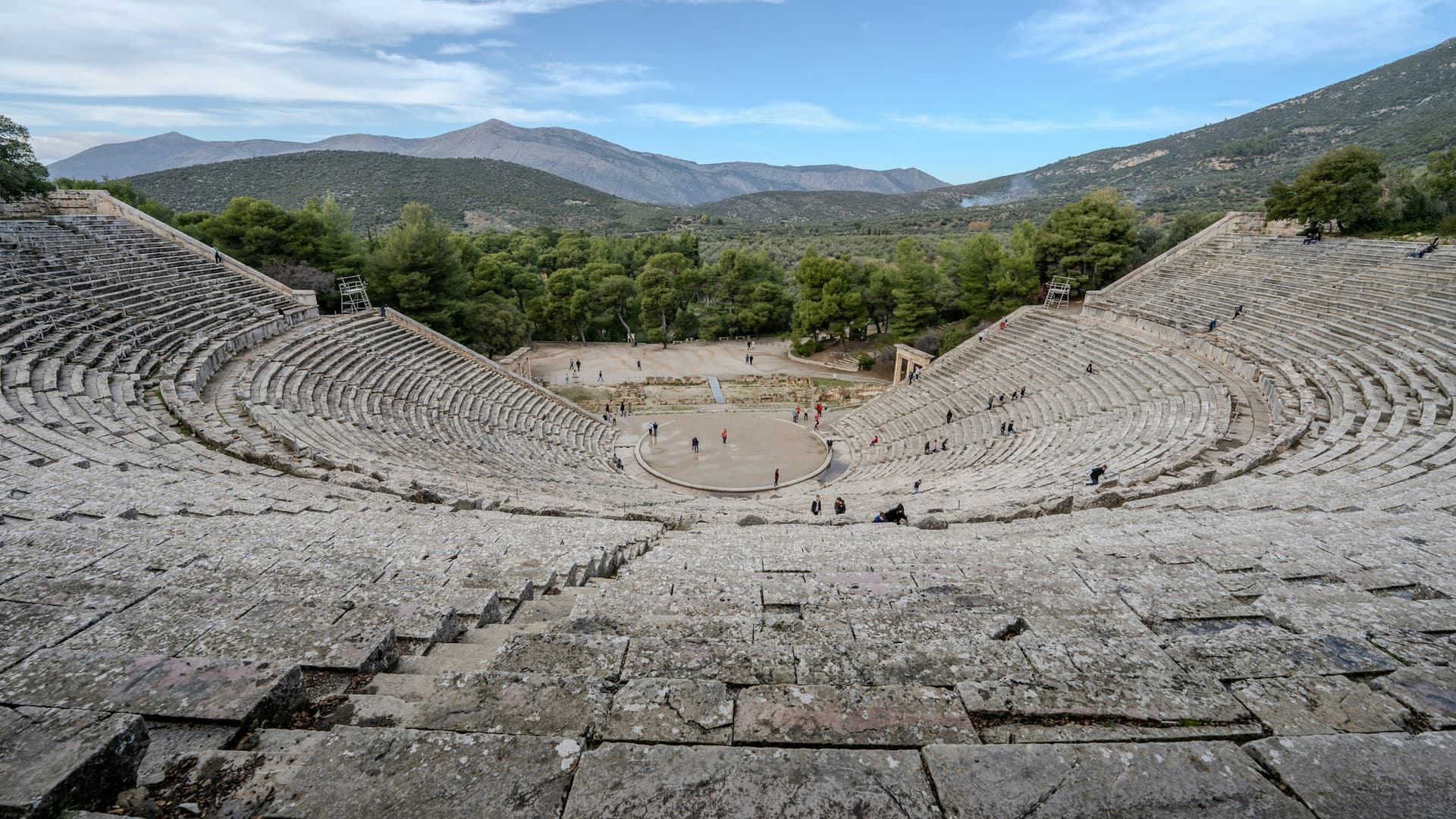
Epidauros
Municipal Unit of Epidavros, Peloponnese, Western Greece and the Ionian, Greece
37.2 km away

Trofonion Oracle, Livadia, Greece
Levadia Municipal Unit, Thessaly and Central Greece, Greece
78.6 km away
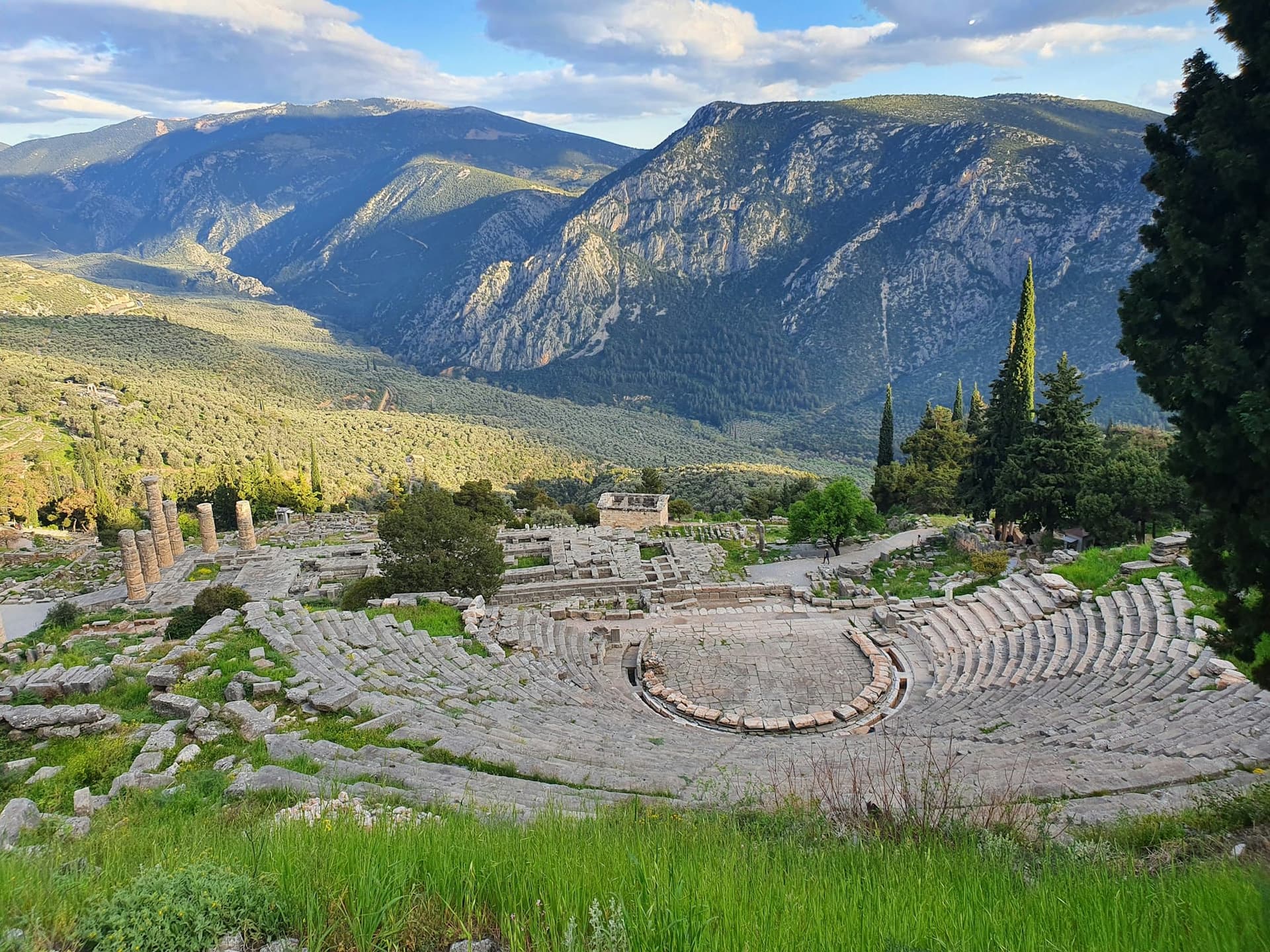
Delphi
Municipal Unit of Delphi, Thessaly and Central Greece, Greece
86.5 km away
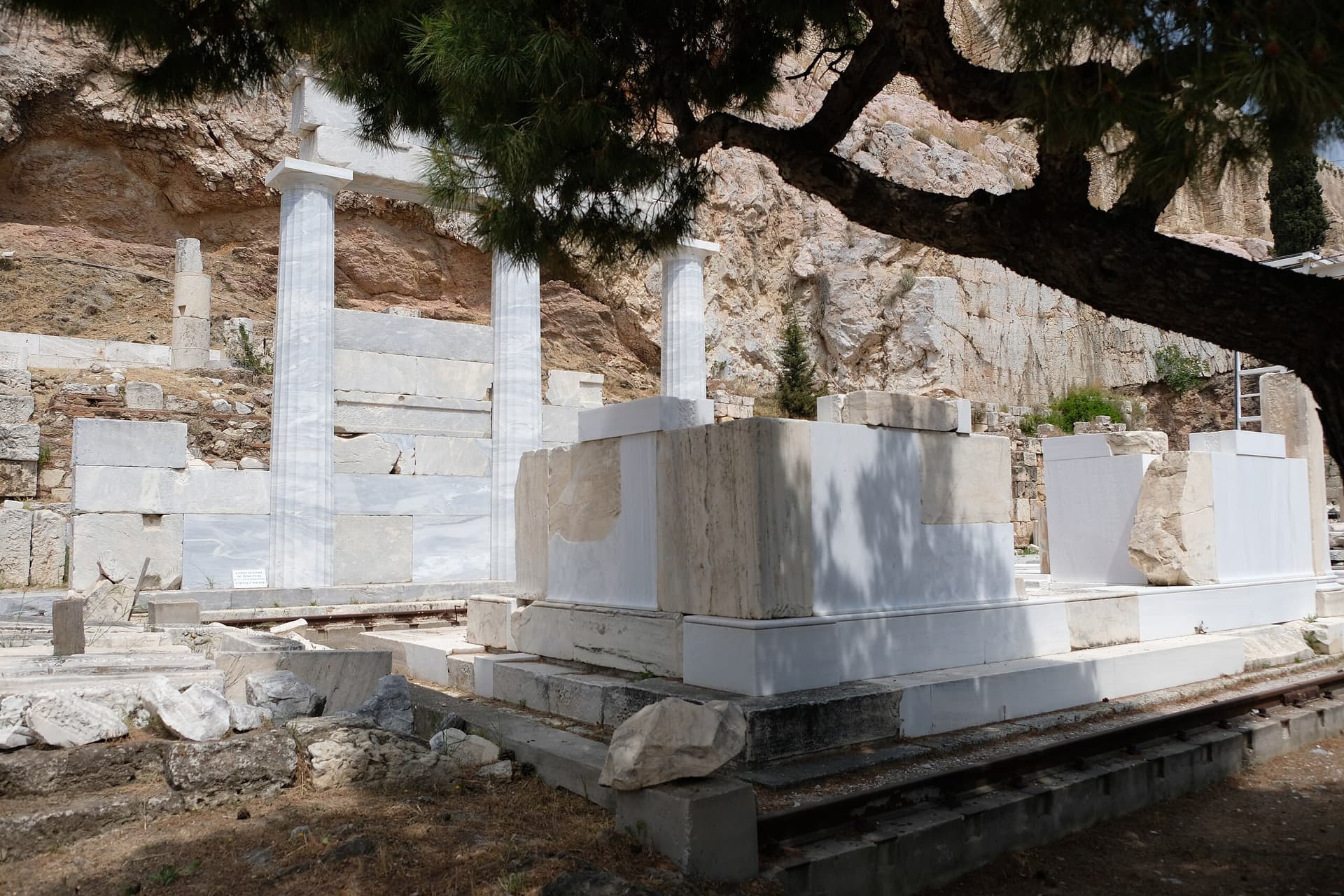
Asklepion shrine
Athens, Attica, Greece
89.3 km away