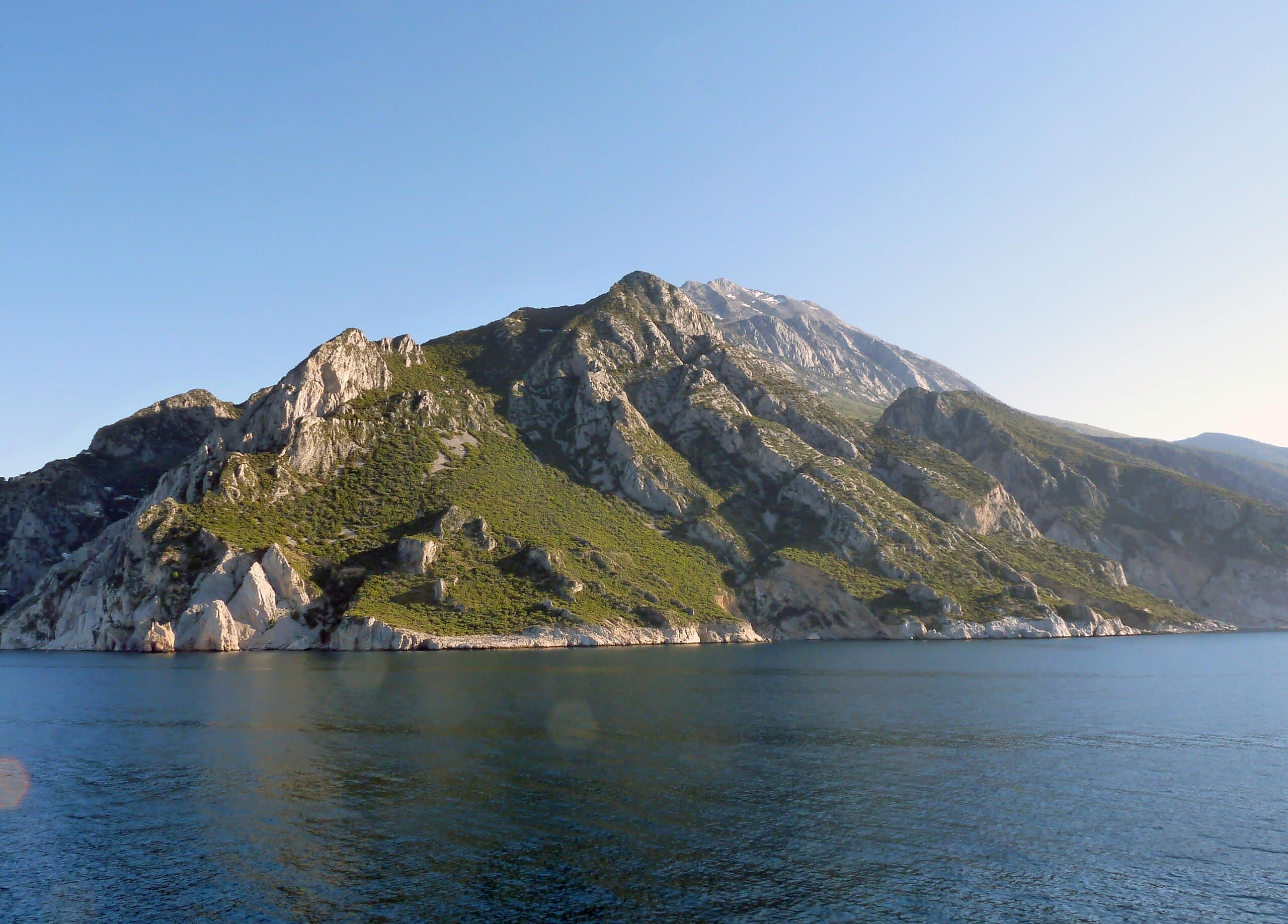
Mt. Athos
The Holy Mountain where monks have prayed without ceasing for over a thousand years
Autonomous Monastic State of the Holy Mountain, Greece
At A Glance
- Coordinates
- 40.1589, 24.3283
- Suggested Duration
- The standard diamonitirion is valid for four days and can be extended at the Holy Community office in Karyes. Three to four days allows a visitor to experience two to four monasteries and the rhythm of monastic life. Those seeking deeper immersion can apply for longer stays, though these are granted at the discretion of the monasteries.
- Access
- Travel to Thessaloniki, then drive or bus to Ouranoupolis on the Chalkidiki coast (approximately 2.5 hours). The morning ferry departs Ouranoupolis for Dafni, the main port, with stops at monasteries along the western coast. A minibus connects Dafni to Karyes. From Karyes, visitors walk. Walking times between monasteries range from two to five hours on forest paths. Small boats connect coastal monasteries. No cars for visitors. Apply for the diamonitirion by email to the Mount Athos Pilgrims' Bureau (athosreservation@gmail.com) at least three to six months in advance. Passport required. Mobile signal available in Karyes and some coastal areas but absent in much of the interior.
Pilgrim Tips
- Travel to Thessaloniki, then drive or bus to Ouranoupolis on the Chalkidiki coast (approximately 2.5 hours). The morning ferry departs Ouranoupolis for Dafni, the main port, with stops at monasteries along the western coast. A minibus connects Dafni to Karyes. From Karyes, visitors walk. Walking times between monasteries range from two to five hours on forest paths. Small boats connect coastal monasteries. No cars for visitors. Apply for the diamonitirion by email to the Mount Athos Pilgrims' Bureau (athosreservation@gmail.com) at least three to six months in advance. Passport required. Mobile signal available in Karyes and some coastal areas but absent in much of the interior.
- Long trousers and long-sleeved shirts required for all visitors. No shorts, tank tops, or open-toed sandals. Dark, muted colors preferred. Hats should be removed inside churches. Bring sturdy walking shoes or hiking boots for the paths between monasteries.
- Photography is generally prohibited inside churches, during services, and in monks' living quarters. Exterior photography of monastery buildings is usually permitted but ask first. Video recording is generally prohibited. Never photograph a monk without explicit permission. Some monasteries have stricter rules than others; follow the guidance given at each.
- Mount Athos is not a retreat center. There are no programs, no guided meditations, no spiritual directors available on request. The monasteries offer hospitality, not services. Visitors who arrive expecting to be entertained or enlightened on a schedule will be disappointed. The mountain asks for receptivity, patience, and the willingness to be uncomfortable. The early hours, the long services, the simple food, the absence of privacy, all of these are features, not bugs. Respect the silence when it is observed. Do not attempt to engage monks in extended conversation unless they initiate it. Some monks are happy to speak with visitors; others have taken on practices of silence that should not be interrupted.
Overview
Mount Athos rises 2,033 meters above the Aegean at the tip of a forested peninsula in northern Greece. Twenty monasteries, home to roughly 2,000 monks, sustain an unbroken tradition of Orthodox prayer stretching back to the tenth century. It is a self-governing monastic republic, a UNESCO World Heritage Site, and the place Eastern Orthodox Christianity considers the earthly garden of the Virgin Mary.
There are places in the world where time runs differently. Mount Athos is one of them. On a narrow peninsula extending forty kilometers into the Aegean Sea, twenty monasteries and hundreds of smaller hermitages maintain a form of life that the rest of Europe abandoned centuries ago. Monks wake at three in the morning to the sound of the semántron, a wooden plank struck with a mallet. They stand through hours of Byzantine chanting in candlelit churches. They eat two silent meals a day while a brother reads scripture. They work the land, paint icons, copy manuscripts, and return to prayer.
This has been happening without interruption since 963 AD, when Saint Athanasius the Athonite founded the Great Lavra. Before that, hermits had already lived in the mountain's caves and forests for at least a century. The result is not a museum of monastic life but its living, breathing continuation. The monasteries house some of the most important Byzantine manuscripts, icons, and frescoes in existence, not under glass, but in rooms where they are still used for their intended purpose.
The peninsula is accessible only by boat. Women and children are prohibited under a rule called the avaton, in place since at least 1046 AD. Male visitors are limited to 120 per day and require a diamonitirion, an entry permit applied for months in advance. Those who arrive find themselves entering a world that asks nothing of the modern era and offers something that the modern era cannot easily provide: total immersion in the rhythms of prayer, silence, and physical labor, sustained across a millennium.
Context And Lineage
Mount Athos has been a monastic community since the ninth century, with the Great Lavra founded in 963 AD. It is a self-governing territory under Greek sovereignty, home to twenty ruling monasteries representing Greek, Russian, Serbian, Bulgarian, Georgian, and Romanian Orthodox traditions. UNESCO inscribed it in 1988 for its outstanding universal cultural and natural value.
The founding narrative of Mount Athos belongs to the Virgin Mary. According to Orthodox tradition, she was sailing from Jaffa to visit Lazarus in Cyprus when a violent storm drove her ship to the eastern shore of the Athos peninsula. Stepping ashore, she was so moved by the mountain's beauty and solitude that she prayed to her Son: let this place be given to her. A voice answered from the heights: 'Let this place be your lot, your garden, your paradise and a salvation, a haven for those who seek salvation.' At that moment, the pagan temples on the mountain are said to have collapsed, and the peninsula was consecrated as the Garden of the Theotokos.
Historical monastic settlement began in earnest in the ninth century, when Emperor Basil I confirmed the peninsula as exclusively monastic territory in 885 AD. Hermits and small communities of monks had likely been present before this, drawn by the isolation and the tradition associating the mountain with the Virgin. The decisive foundation came in 963 AD, when Athanasius the Athonite, a monk from Trebizond, established the Great Lavra with the patronage of Emperor Nikephoros II Phokas. Athanasius introduced the coenobitic rule, organized communal monastic life, and created the template that the subsequent nineteen monasteries would follow. The first formal constitution, the Tragos, was signed nine years later by Emperor John I Tzimiskes, establishing the legal framework for the self-governing monastic republic that persists to this day.
Mount Athos belongs to the Eastern Orthodox tradition in its fullest expression. The twenty ruling monasteries are ranked in a hierarchy established over centuries, with Great Lavra first and Konstamonitou twentieth. Seventeen are Greek, one is Russian (Panteleimonos), one Serbian (Chilandari), and one Bulgarian (Zografou). The Romanian skete of Prodromos and the Georgian community at Iviron maintain those nations' monastic traditions. The peninsula is governed by the Holy Community, composed of representatives from each monastery, with an annually rotating epistasia (executive committee). The Ecumenical Patriarch of Constantinople holds spiritual authority, while the Greek state provides civil administration through a governor. This dual sovereignty, ecclesiastical and civil, reflects a compromise between monastic independence and political reality that has held since 1926.
Saint Athanasius the Athonite (c. 920-1003)
Founder of the Great Lavra in 963 AD and architect of organized monastic life on Mount Athos. Born in Trebizond, he was a scholar and monk who, with imperial patronage from Nikephoros II Phokas, established the coenobitic model that became the standard for all twenty monasteries. He composed the first monastic typikon (rule) for Athos and died in a construction accident at the Great Lavra.
Saint Gregory Palamas (1296-1359)
Theologian and monk who spent twenty years on Mount Athos and became the foremost defender of hesychasm during the fourteenth-century controversy. His articulation of the distinction between God's essence and God's energies provided the theological foundation for the monks' contemplative practice and was affirmed by the Church councils of 1341 and 1351. His defense ensured that the hesychast tradition of the Jesus Prayer remained central to Orthodox spirituality.
Saint Nikodemos the Hagiorite (1749-1809)
Scholar-monk who compiled the Philokalia, the foundational anthology of Eastern Orthodox contemplative writings, together with Makarios of Corinth. Working from the libraries of Athos, he gathered texts spanning a millennium of hesychast teaching and made them accessible to both monastic and lay readers. The Philokalia became the single most influential text in the renewal of Orthodox spiritual life.
Emperor John I Tzimiskes (925-976)
Byzantine emperor who signed the Tragos, the first constitution of the Athonite monastic community, in 972 AD. This chrysobull established the legal framework for self-governance, defined the relationships between monasteries, and created the institutions, including the Holy Community and the Protaton, that still govern Mount Athos today.
Saint Sabbas of Chilandari (1175-1236)
Serbian prince who became a monk on Athos and, with his father Stefan Nemanja (who took the monastic name Simeon), refounded the Monastery of Chilandari as a Serbian house. Sabbas later became the first Archbishop of the autocephalous Serbian Church. His presence established Athos as a multinational monastic community, a character it retains with Greek, Russian, Serbian, Bulgarian, Georgian, and Romanian monasteries.
Why This Place Is Sacred
A thousand years of continuous prayer on a peninsula accessible only by sea, where the entire structure of daily life orients toward the divine. The physical isolation, the unbroken monastic tradition, and the mountain itself rising as an axis mundi above the Aegean create conditions of spiritual density found nowhere else on earth.
What makes a place thin is not a single quality but a layering of conditions, each reinforcing the others until the cumulative weight becomes palpable. Mount Athos possesses this layering to a degree that is difficult to overstate.
The first layer is geological. The mountain is the easternmost of three fingers that the Chalkidiki Peninsula extends into the northern Aegean. It culminates in a marble peak that rises 2,033 meters directly from the sea, a natural axis mundi visible from across the water. The ancients knew the mountain as a place of consequence; before the monks came, pagan temples stood on its slopes. According to Orthodox tradition, these temples crumbled spontaneously when the Virgin Mary arrived.
The second layer is temporal. Monks have been praying here for at least eleven centuries without a single break. The daily liturgical cycle, the hesychast practice of the Jesus Prayer, the fasting, the chanting, the manual labor that is itself understood as prayer, all of this has accumulated in the stones, the forest paths, the silence between monastery walls. This is not metaphor in the monastic understanding. Prayer, they hold, changes a place. A thousand years of it saturates.
The third layer is isolation. There is no road to Mount Athos. You arrive by ferry from Ouranoupolis to the port of Dafni, and from there you walk or take small boats between monasteries. There are no cars for visitors, no hotels, no shops in the ordinary sense. The peninsula functions as a threshold. The crossing by water marks a departure from one world and an entry into another.
The fourth layer is exclusion. The avaton, the prohibition of women and children, has been in place for nearly a thousand years. Whatever one thinks of it in modern terms, its practical effect is the creation of a community of absolute dedication. Everyone present, monks and visitors alike, is there for one reason. This singularity of purpose generates a quality of attention that visitors consistently describe as unlike anything they have experienced elsewhere.
Taken together, these layers produce a place where the boundary between the ordinary and the sacred does not merely thin but, for many who visit, dissolves entirely.
Orthodox tradition holds that the Virgin Mary, sailing to visit Lazarus in Cyprus, was blown by a storm to the shores of Mount Athos. Overcome by the beauty of the mountain, she asked her Son to give it to her as a garden. A divine voice answered: 'Let this place be your lot, your garden, your paradise and a salvation, a haven for those who seek salvation.' The peninsula was thus understood as consecrated ground from its origin. Hermits withdrew here to live in caves and forests, seeking the conditions for uninterrupted prayer. When Saint Athanasius founded the Great Lavra in 963 AD, he formalized a monastic presence that had already been gathering for generations.
The earliest documented monastic activity dates to the ninth century, though hermits likely inhabited the peninsula before that. The founding of the Great Lavra by Saint Athanasius in 963 established the coenobitic (communal) model. The first constitution, the Tragos, was signed in 972 by Emperor John I Tzimiskes. Over the following centuries, the community grew to twenty ruling monasteries, each governing its own territory and smaller dependencies. The hesychast controversy of the fourteenth century, in which Gregory Palamas defended the monks' contemplative practices against scholastic criticism, became a defining theological moment not just for Athos but for all of Eastern Orthodoxy. Ottoman rule (1430-1912) paradoxically preserved the mountain's isolation, as the sultans granted the monasteries protective firmans. Liberation came during the First Balkan War in 1912. The Greek constitution of 1926 formalized the peninsula's unique self-governing status. UNESCO inscription in 1988 recognized the mountain's outstanding universal value across six criteria, a distinction held by very few sites in the world.
Traditions And Practice
Mount Athos sustains the full daily cycle of Orthodox liturgical worship, the hesychast tradition of continuous prayer, communal meals in silence, manual labor, and the reception of pilgrims. These practices have continued without fundamental change for over a thousand years.
The core of Athonite life is the liturgical cycle. Monks rise before dawn, summoned by the semántron. The day begins with Orthros and the Divine Liturgy, services lasting three to four hours. The chanting follows Byzantine modes, often antiphonal, with two choirs facing each other across the katholikon. In the candlelit darkness, the only illumination comes from oil lamps and the gold leaf of icons.
The hesychast tradition runs beneath the liturgical cycle. Hesychasm, from the Greek hesychia meaning stillness, is the practice of continuous interior prayer centered on the Jesus Prayer: 'Lord Jesus Christ, Son of God, have mercy on me, a sinner.' Monks repeat this prayer using the komboskini, a knotted prayer rope, coordinating the words with breath and heartbeat. The goal is not ecstatic experience but nepsis, watchful attentiveness to the presence of God. Gregory Palamas, writing from Athos in the fourteenth century, articulated the theological position that through hesychast prayer, monks could experience the uncreated light of God, the same light that shone on Mount Tabor during the Transfiguration.
Two communal meals are served daily in the trapeza while a reader chants from scripture. The food follows the Orthodox fasting calendar: most days are vegan, with olive oil, wine, fish, or dairy permitted only on certain feasts. The meals are brief. Eating is understood as sustenance, not pleasure.
Manual labor completes the daily rhythm. Monks tend gardens, orchards, and vineyards. They paint icons in studios where the tradition has been passed from master to student for centuries. Work is not separate from prayer but an extension of it.
The fundamental structure of Athonite life has not changed. What has shifted is the composition of the community. After a decline in the mid-twentieth century, a renewal began in the 1970s and continues today. Young, often university-educated men have entered the monasteries, bringing new energy to ancient practices. Several monasteries have undertaken major restoration projects, and the libraries are being digitized with international scholarly support. The reception of pilgrims has also intensified. Monasteries balance the ancient obligation of hospitality with the need to protect the silence and solitude that make the place what it is.
For visitors, the most meaningful engagement is simply entering the rhythm. Attend the services, even if the hours of standing and the unfamiliar chanting feel demanding. Eat with the monks in silence. Walk between monasteries with attention rather than haste. If you use a prayer rope or have a personal contemplative practice, carry it with you. The forest paths are ideal for walking meditation. Many visitors find that the act of following the monastic schedule, rising before dawn, eating simply, sleeping early, produces its own form of insight, a lived understanding of what it means to organize a life around something other than productivity.
Eastern Orthodox Christianity — Athonite Monasticism
ActiveMount Athos is the preeminent center of Eastern Orthodox monasticism and the world's oldest continuously active monastic community. It is considered the earthly garden of the Theotokos and the primary center of hesychasm, the tradition of inner stillness through continuous prayer. The twenty monasteries represent the full range of Orthodox traditions, with Greek, Russian, Serbian, Bulgarian, Georgian, and Romanian monks living and praying on the peninsula. The theological defense of hesychasm by Gregory Palamas, developed and argued from Athos, became foundational to Orthodox theology.
Hesychasm — continuous Jesus Prayer coordinated with breath and heartbeat using the komboskini prayer ropeDaily liturgical cycle beginning with Orthros at 3:00 AM, followed by Divine Liturgy, Vespers, and ComplineSemántron — wooden plank struck with a mallet to summon the community to prayerCommunal meals in the trapeza eaten in silence while scripture is read aloudByzantine chanting in antiphonal modes during all liturgical servicesIcon painting following the Byzantine iconographic tradition transmitted from master to studentAll-night vigils (agrypnia) before major feasts, lasting eight to twelve hoursStrict fasting according to the Orthodox calendar, with most days observing a vegan dietVeneration of miraculous icons, particularly those of the TheotokosManual labor — agriculture, woodworking, gardening — as an extension of monastic prayer
Experience And Perspectives
Arriving by ferry, sleeping in a monastery guest room, waking to the semántron at three in the morning, standing through the Divine Liturgy in candlelight, eating in silence with monks, walking forest paths between monasteries above the sea. Mount Athos strips daily life to its essentials and replaces noise with prayer.
The experience begins with the crossing. You board the ferry at Ouranoupolis, a small town on the Chalkidiki coast. The boat moves along the western shore of the peninsula, and one by one the monasteries appear: fortress-like complexes rising from the waterline or perched on cliffs above the sea. Some look like small medieval cities. Others are tucked into ravines, barely visible through forest. The summit of Mount Athos, stark white marble above the tree line, dominates the horizon.
You disembark at Dafni, the main port, and take a bus to Karyes, the administrative capital, where your diamonitirion is validated. From Karyes, you walk. The paths between monasteries run through chestnut and oak forest, along ridgelines overlooking the Aegean, through olive groves and past hermitages where a single monk might live in a stone cell above a cliff. The walks take between two and five hours, and they are not incidental to the experience. They are the experience. The silence of the forest, the labor of the body on steep terrain, the absence of any sound except wind, birdsong, and the distant sea, all of this prepares the ground for what the monasteries offer.
Arriving at a monastery, you are received as a guest. A monk shows you to a simple room, offers coffee and loukoumi, and explains the schedule. The evening meal, eaten in the trapeza, is communal and silent. Monks and visitors sit together at long wooden tables while a brother reads from scripture. The food is simple, often vegan according to the fasting calendar: bread, olives, beans, cheese when permitted, fruit, water, and sometimes wine.
Then the semántron. At three in the morning, a monk walks through the courtyard striking a wooden plank with a mallet. You rise and go to the katholikon, where the liturgy has already begun. The interior is dark except for oil lamps and candles. Icons, their gold leaf catching the flame, look out from every wall and pillar. The monks chant in Byzantine modes that can sound unearthly to Western ears. The services are long. You stand throughout.
The combination of candlelight, ancient chanting, the smell of incense, and the knowledge that this exact sequence has occurred in this exact place for a thousand years creates a condition of heightened receptivity. The mind, deprived of its usual stimulation, grows quiet. This is not relaxation. It is alert stillness, what the monks call nepsis, watchfulness.
After the morning liturgy and a communal meal, you leave for the next monastery, and the cycle begins again. Over three or four days, a rhythm establishes itself: walking, silence, prayer, silence, eating, prayer, walking. Many visitors report that by the second or third day, something shifts. The anxiety of disconnection, no internet, no phone signal in most places, no news, gives way to a clarity that feels almost physical. The world does not disappear. It simplifies.
The typical visit lasts three to four days, the duration of the standard diamonitirion. Plan your route between monasteries in advance, as walking times are significant and you must arrive before the gates close at sunset. Carry water, sun protection, and a light pack. Leave electronic devices behind or off. The monasteries provide everything you need: food, shelter, bedding. What they ask in return is your presence, not as a tourist documenting an experience, but as a guest entering a rhythm that existed long before you arrived and will continue long after you leave.
Mount Athos can be understood through many frames: as a living museum of Byzantine civilization, as the spiritual engine of Eastern Orthodox Christianity, as a radical experiment in communal life sustained across a millennium, or as a landscape where the sacred has been given absolute priority over every other human concern.
Academic scholarship recognizes Mount Athos as an institution of extraordinary cultural and historical significance. The monasteries' libraries collectively hold approximately 15,000 manuscripts, including some of the oldest surviving copies of Classical Greek texts and illuminated manuscripts of exceptional artistic quality. Art historians regard the Athonite tradition of icon painting and fresco as a living link to Byzantine aesthetics. The hesychast theology developed on Athos, particularly by Gregory Palamas, is recognized as one of the most important intellectual achievements of medieval Christianity, offering a sophisticated account of contemplative experience grounded in the distinction between divine essence and divine energy. UNESCO's inscription under six criteria reflects the scholarly consensus that Mount Athos is exceptional across multiple domains.
For Eastern Orthodox Christians, Mount Athos is not merely an important religious site but the spiritual heart of their tradition. The monks' prayer is understood as sustaining the spiritual health of the entire world. The peninsula is the Garden of the Theotokos, given to her by her Son, and her presence is felt as real and immediate. The avaton is not a cultural anachronism but the preservation of conditions that allow total dedication to God. The monastic life is not a historical curiosity but the highest form of Christian life, a continuous offering of praise that benefits all of creation. The icons are not art objects but windows into the divine. The relics, including portions of the True Cross, the gifts of the Magi, and the belt of the Virgin Mary at Vatopedi, are understood as physical points of contact with sacred history.
Seekers from non-Orthodox backgrounds have found in Mount Athos a living example of contemplative intensity that transcends confessional boundaries. The hesychast practice of the Jesus Prayer, with its emphasis on the coordination of prayer, breath, and heartbeat, has been compared to Hindu mantra meditation, Sufi dhikr, and Buddhist mindfulness practices. The concept of theosis, the belief that human beings can participate in the divine nature through sustained contemplative practice, parallels the mystical traditions of nearly every major religion. Writers including Patrick Leigh Fermor and Robert Byron have described the mountain in terms that suggest a universal spiritual resonance beneath the specifically Orthodox surface.
Despite its long history, much of Mount Athos remains genuinely unknown. The full contents of the monastery libraries have not been completely catalogued, and scholars believe that significant manuscripts await discovery or identification. The oral traditions transmitted from elder to younger monks are, by their nature, not fully documented. The subjective experience reported by monks who practice hesychasm at its deepest levels, the vision of uncreated light, the dissolution of the boundary between self and divine presence, remains beyond empirical verification while being central to the tradition's self-understanding. The ecological history of the peninsula, relatively undisturbed by development for a millennium, is only beginning to be studied. And the question of how this community has sustained itself, adapting to Byzantine, Ottoman, and modern Greek governance while preserving its essential character, offers lessons in institutional resilience that have yet to be fully explored.
Visit Planning
Access is by ferry from Ouranoupolis to Dafni. A diamonitirion (entry permit) must be applied for 3-6 months in advance. Only men aged 18+ are admitted. Daily limit: 120 visitors. The typical visit is 3-4 days, walking between monasteries on forest paths.
Travel to Thessaloniki, then drive or bus to Ouranoupolis on the Chalkidiki coast (approximately 2.5 hours). The morning ferry departs Ouranoupolis for Dafni, the main port, with stops at monasteries along the western coast. A minibus connects Dafni to Karyes. From Karyes, visitors walk. Walking times between monasteries range from two to five hours on forest paths. Small boats connect coastal monasteries. No cars for visitors. Apply for the diamonitirion by email to the Mount Athos Pilgrims' Bureau (athosreservation@gmail.com) at least three to six months in advance. Passport required. Mobile signal available in Karyes and some coastal areas but absent in much of the interior.
Each monastery has an archontariki (guest house) where visitors are housed free of charge. Rooms are simple: beds, blankets, sometimes shared bathrooms. Meals are provided in the trapeza with the monks. There are no hotels, guesthouses, or commercial accommodations on the peninsula. Visitors stay at whichever monastery they reach before sunset. It is advisable but not always necessary to phone ahead; monasteries rarely turn away a visitor who arrives at the gate.
Mount Athos requires modest dress, respectful silence during services, adherence to the monastic schedule, and sensitivity to the fact that you are a guest in a community organized entirely around prayer. The access restrictions are absolute: men only, diamonitirion required, 120 visitors per day.
The etiquette of Mount Athos is not a set of arbitrary rules but the outward expression of the monastic life itself. Every expectation placed on visitors reflects a discipline that the monks observe with far greater rigor.
Dress modestly. Long trousers and long-sleeved shirts are required. Dark or muted colors are preferred. This is not about prudishness but about entering a space where the visual field is deliberately simplified. The monks wear black. The churches are dark. The attention is directed inward.
During services, stand quietly. You will stand for the duration, which can be several hours. If you need to rest, lean against a stasidi, a wooden standing stall along the walls. Do not talk, whisper, or use your phone.
Follow the monastery schedule without exception. Gates close at sunset. Meals are served at set times. There is no late dining, no flexible schedule. You eat when the monks eat and sleep when the monastery sleeps.
The most important etiquette is invisible: approach the place with genuine respect for what it is. The monks are not performing their lives for visitors. They are living them. The appropriate response is gratitude for being allowed to witness, however briefly, what a community looks like when it has devoted itself entirely to one thing for a thousand years.
Long trousers and long-sleeved shirts required for all visitors. No shorts, tank tops, or open-toed sandals. Dark, muted colors preferred. Hats should be removed inside churches. Bring sturdy walking shoes or hiking boots for the paths between monasteries.
Photography is generally prohibited inside churches, during services, and in monks' living quarters. Exterior photography of monastery buildings is usually permitted but ask first. Video recording is generally prohibited. Never photograph a monk without explicit permission. Some monasteries have stricter rules than others; follow the guidance given at each.
Monasteries do not charge for accommodation or meals. Donations are accepted and appreciated, typically left in the church or given to the guest master. Small gifts such as incense, candles, or coffee are also welcome. The monasteries support themselves through agriculture, icon painting, and the sale of their products.
Women and children under 18 are absolutely prohibited from entering the peninsula. This is the avaton, enforced since at least 1046 AD, and it admits no exceptions. Male visitors must be 18 or older and must hold a valid diamonitirion. Only 120 visitors are admitted per day: 100 Orthodox Christians and 10 non-Orthodox, with additional permits issued for special circumstances. Swimming, sunbathing, and singing secular music are not permitted. Alcohol is served only at meals, in small quantities, at the monastery's discretion. The monastery gates lock at sunset. Visitors must be inside before dark.
Sacred Cluster
Nearby sacred places create the location cluster described in the growth plan. This block is intentionally crawlable and links into the wider regional graph.
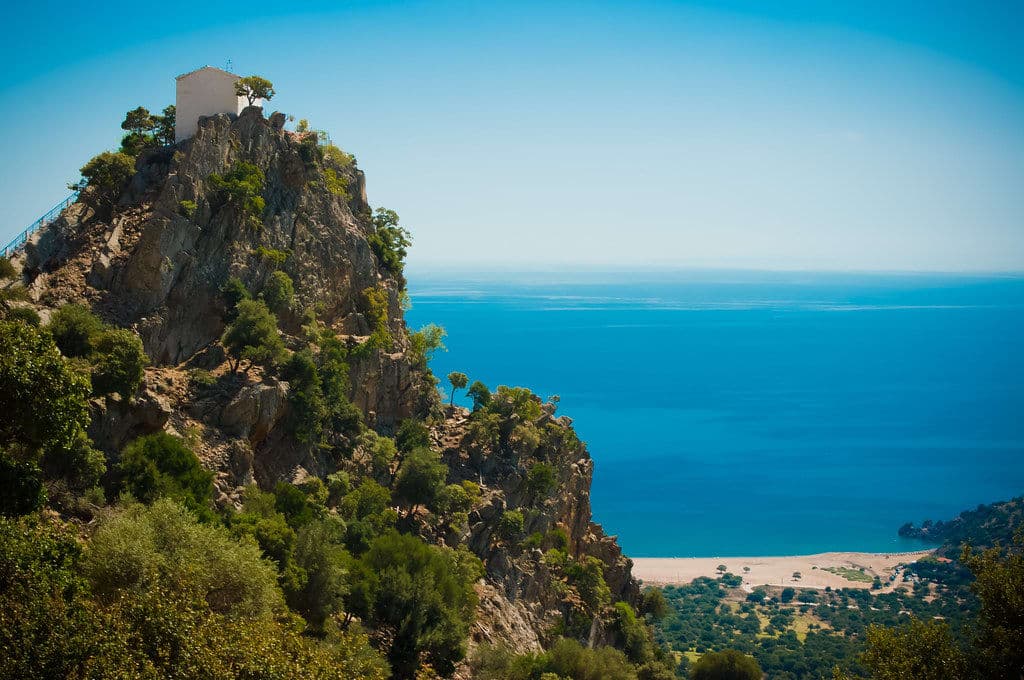
Panagia Krimniotissa
Municipality of Samothraki, Macedonia and Thrace, Greece
110.1 km away
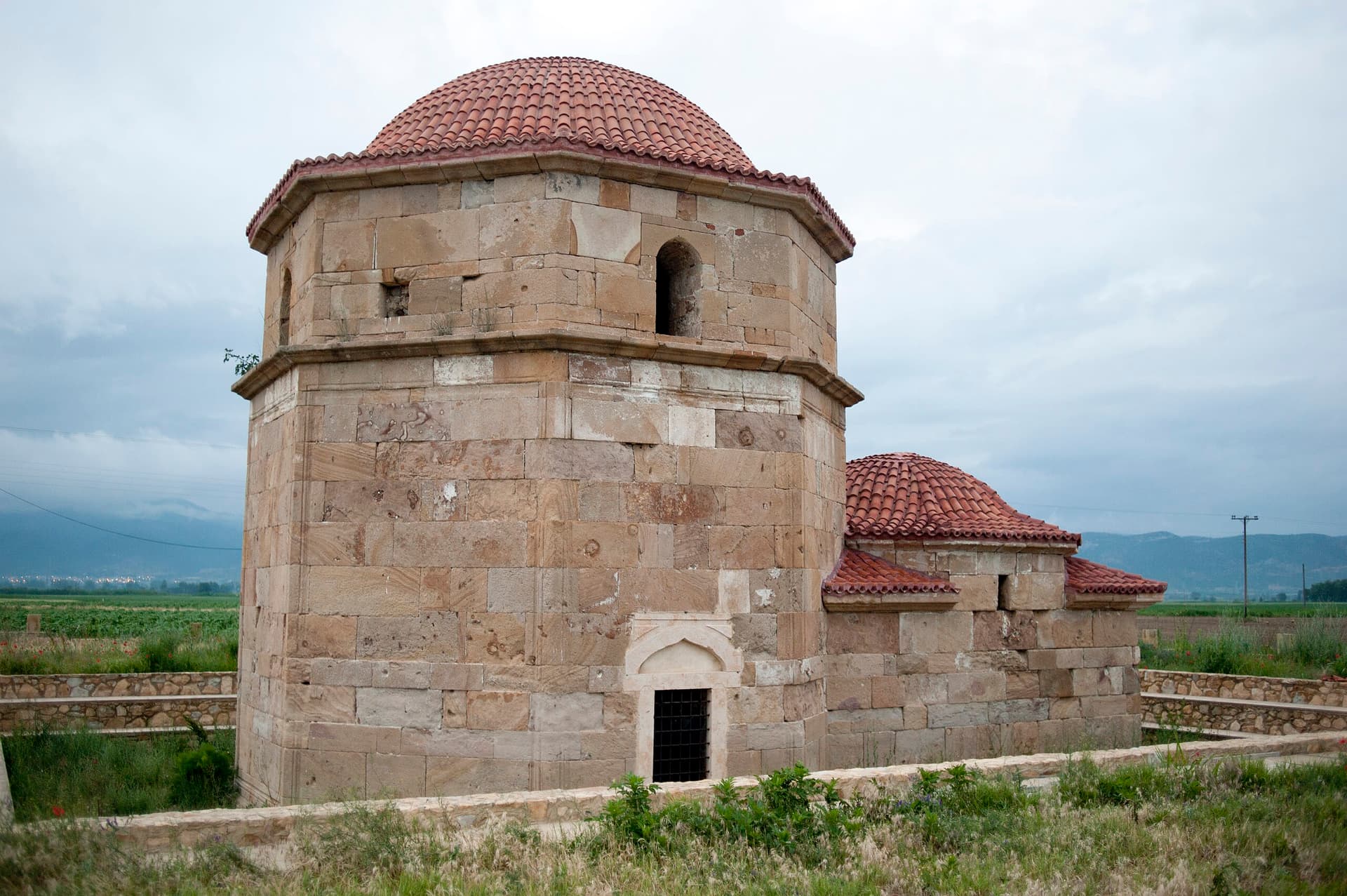
Kutuklu Baba Tekke, Selina, Greece
Συδινή, Macedonia and Thrace, Greece
119.1 km away
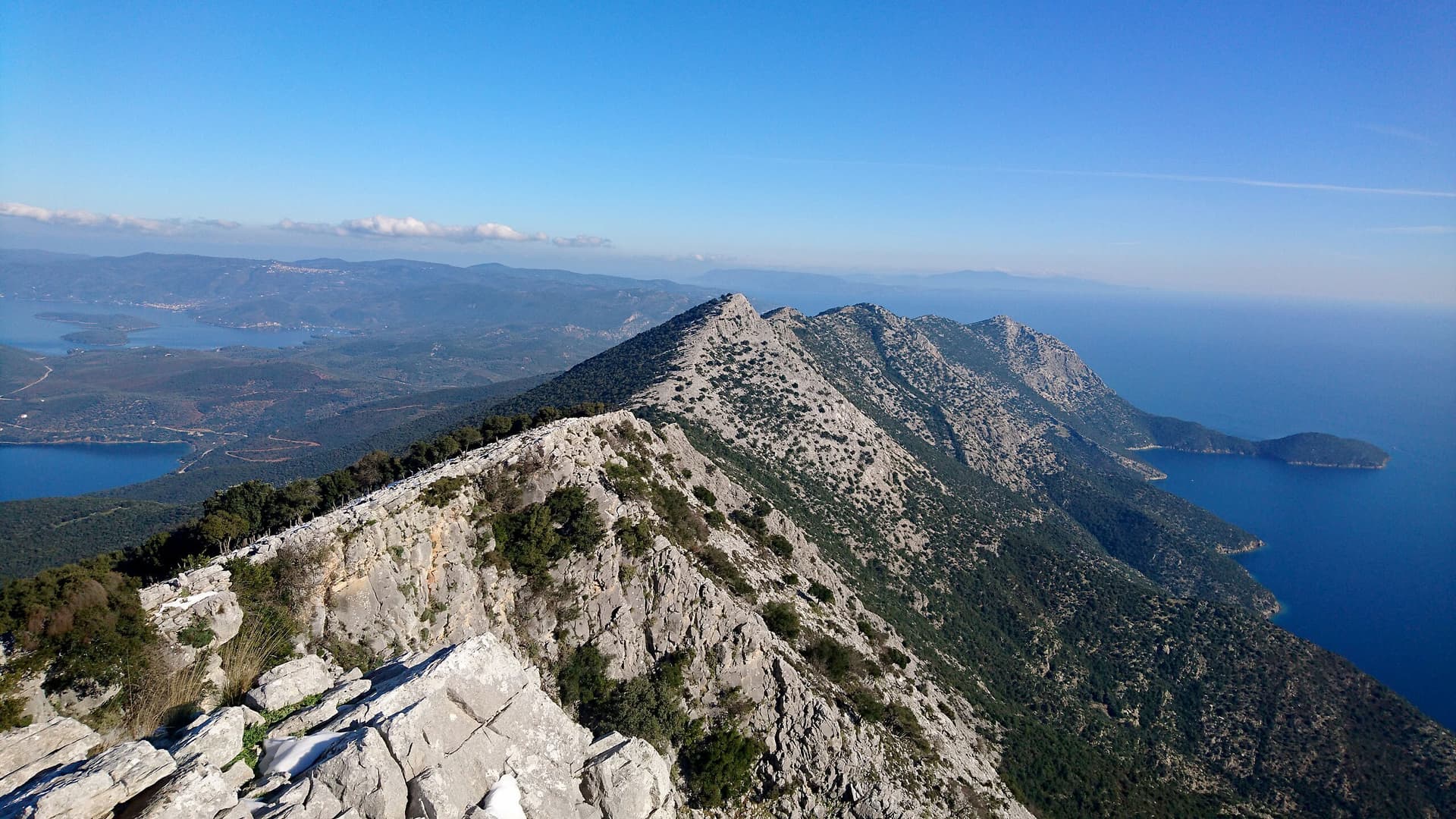
Mt. Pelion
Municipal Unit of Zagora, Thessaly and Central Greece, Greece
135.6 km away
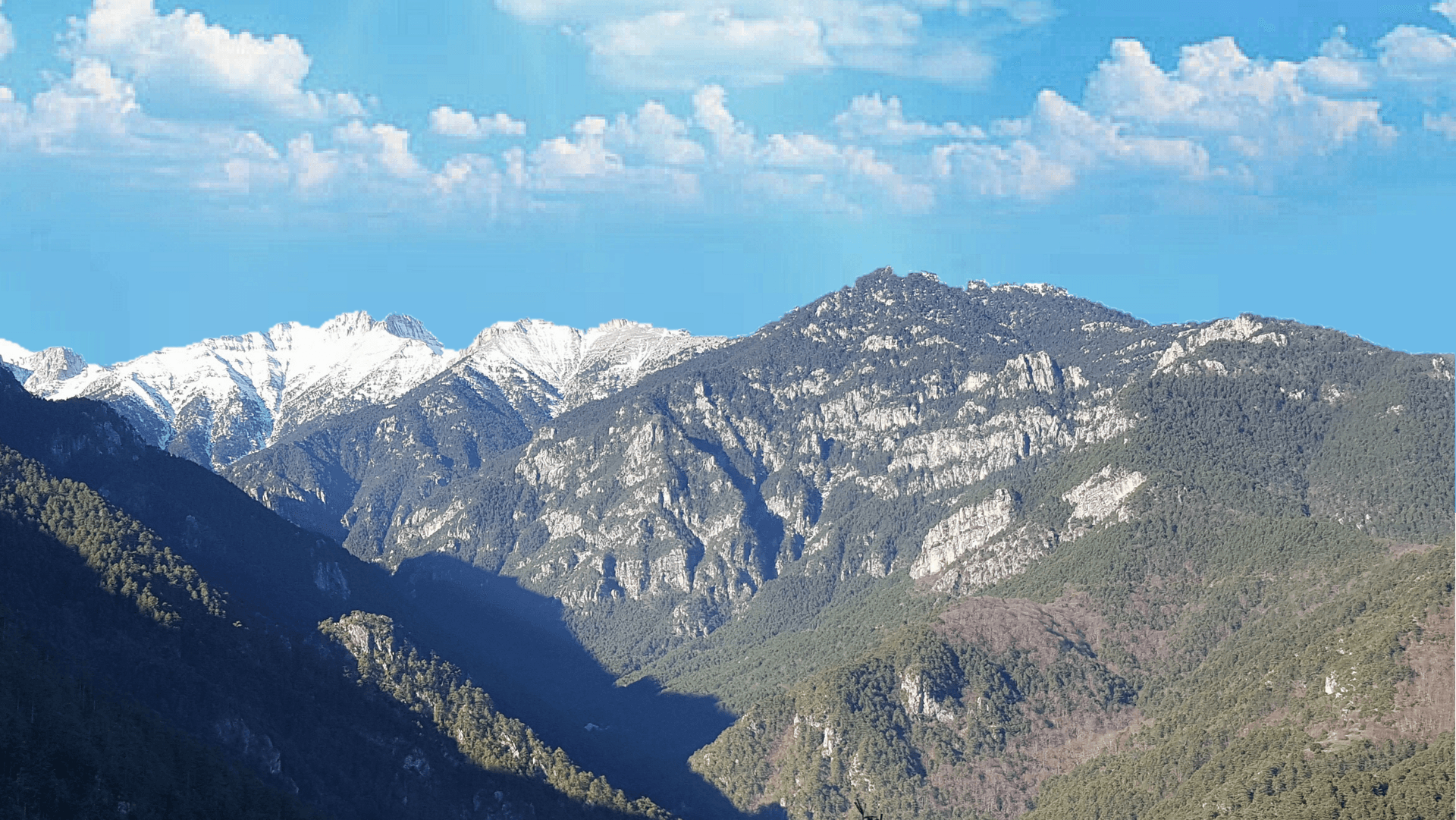
Mt. Olympus
Dion - Olympos Municipality, Macedonia and Thrace, Greece
167.7 km away