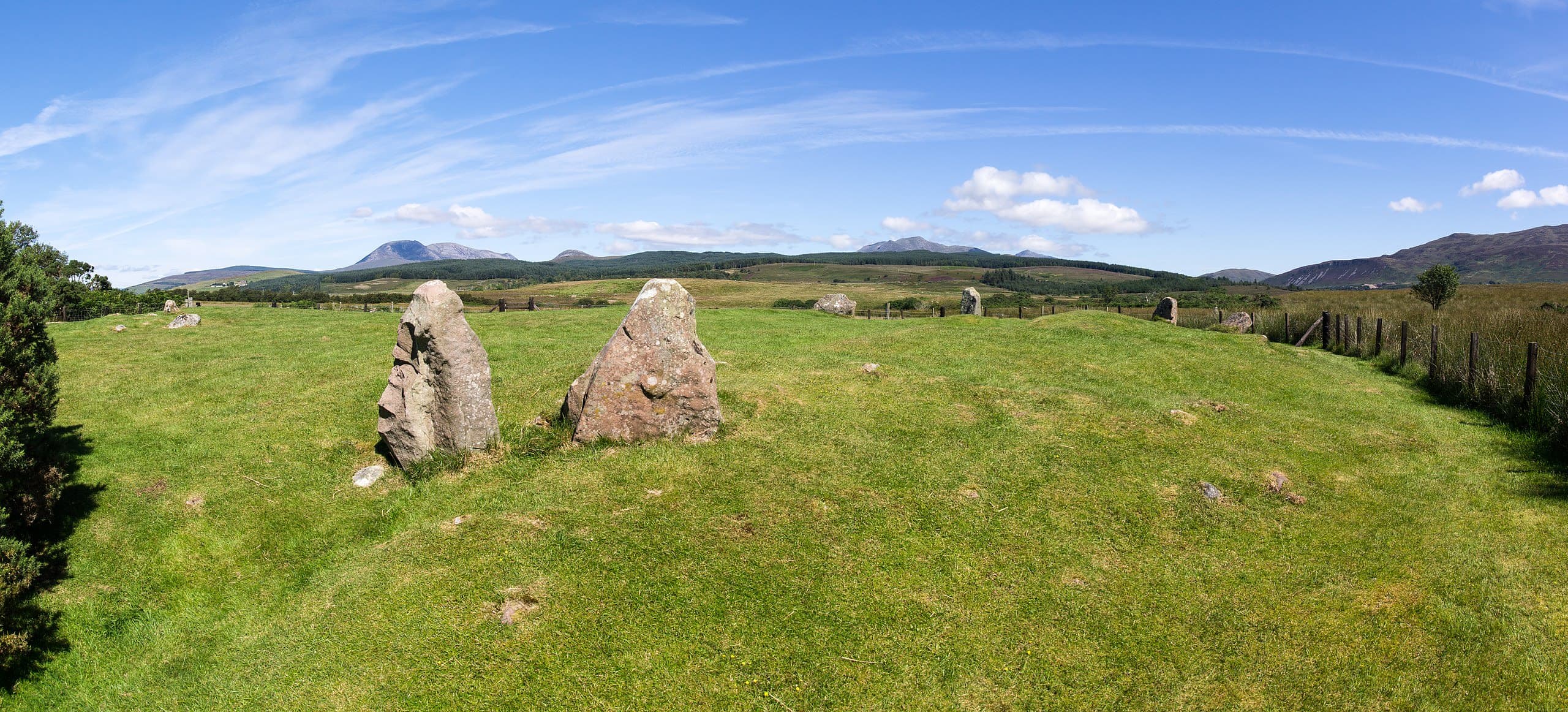
Moss Farm Road Stone Circle
A Bronze Age threshold to one of Scotland's most layered sacred landscapes
Machrie, North Ayrshire, United Kingdom
At A Glance
- Coordinates
- 55.5419, -5.3294
- Suggested Duration
- Fifteen to thirty minutes for Moss Farm Road alone. Two to three hours to walk the full Machrie Moor path, visiting all the stone circles and returning to the car park.
- Access
- Park at the signposted parking area on the A841 coastal road, approximately 3 miles north of Blackwaterfoot. Walk east along the Moss Farm track for roughly 600 metres to reach the stone circle. The path is an unsurfaced farm road, generally flat but not wheelchair accessible. The Isle of Arran is reached by CalMac ferry from Ardrossan on the mainland (approximately 55 minutes) or from Claonaig on the Kintyre peninsula in summer.
Pilgrim Tips
- Park at the signposted parking area on the A841 coastal road, approximately 3 miles north of Blackwaterfoot. Walk east along the Moss Farm track for roughly 600 metres to reach the stone circle. The path is an unsurfaced farm road, generally flat but not wheelchair accessible. The Isle of Arran is reached by CalMac ferry from Ardrossan on the mainland (approximately 55 minutes) or from Claonaig on the Kintyre peninsula in summer.
- No specific dress code. Wear appropriate footwear for walking on an unsurfaced farm track, which may be muddy after rain. Scottish west coast weather is changeable; layers and waterproofs are advisable.
- Photography is permitted. The stones are photogenic in the low light of early morning or late afternoon. Be considerate of other visitors.
- Do not climb on, lean against, or touch the stones unnecessarily. Do not remove any material from the site. Be aware that the farm track is a working agricultural road; livestock may be present. Close any gates you pass through.
Overview
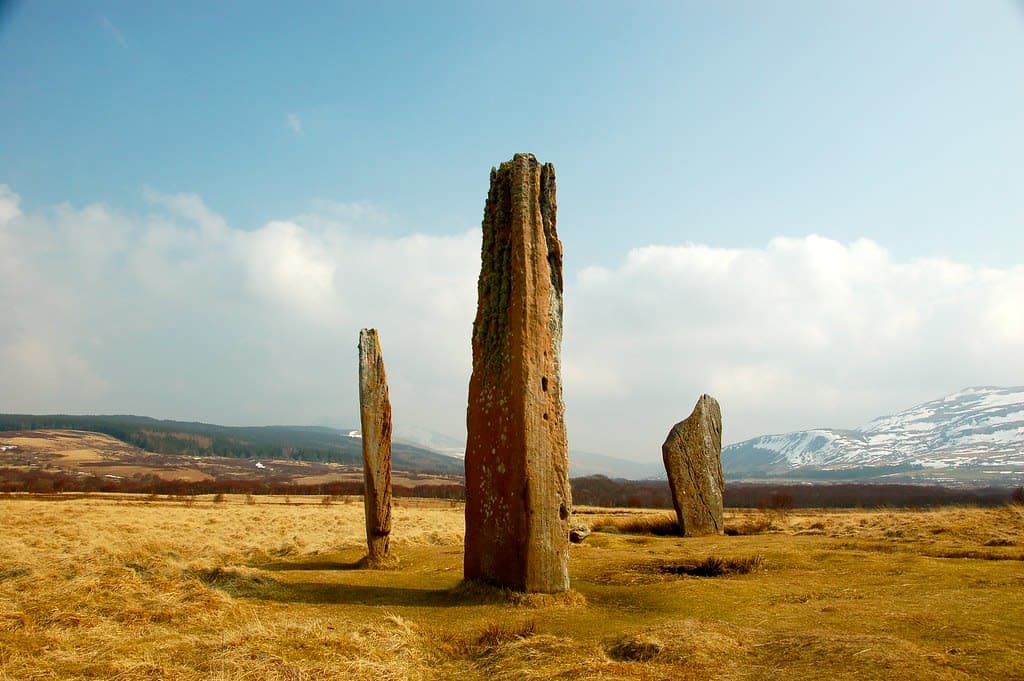
On the western shore of the Isle of Arran, where a farm track leads into the ancient ceremonial moorland of Machrie, seven stones still stand in a broken ring. This Bronze Age ring cairn, the first monument visitors encounter on the walk into the moor, has guarded the passage between the ordinary and the sacred for four thousand years. Beyond it, six more stone circles wait in the open landscape.
There is a moment, walking east from the Arran coast road along the Machrie farm track, when the present loosens its grip. The road noise fades. The moor opens ahead, rolling toward the granite hills. And there, beside the path, stands a ring of weathered stones, their tops just clearing the heather. This is Moss Farm Road Stone Circle, also known as Machrie Moor 10, and it is the first greeting from a landscape that has been ceremonially significant for over four thousand years.
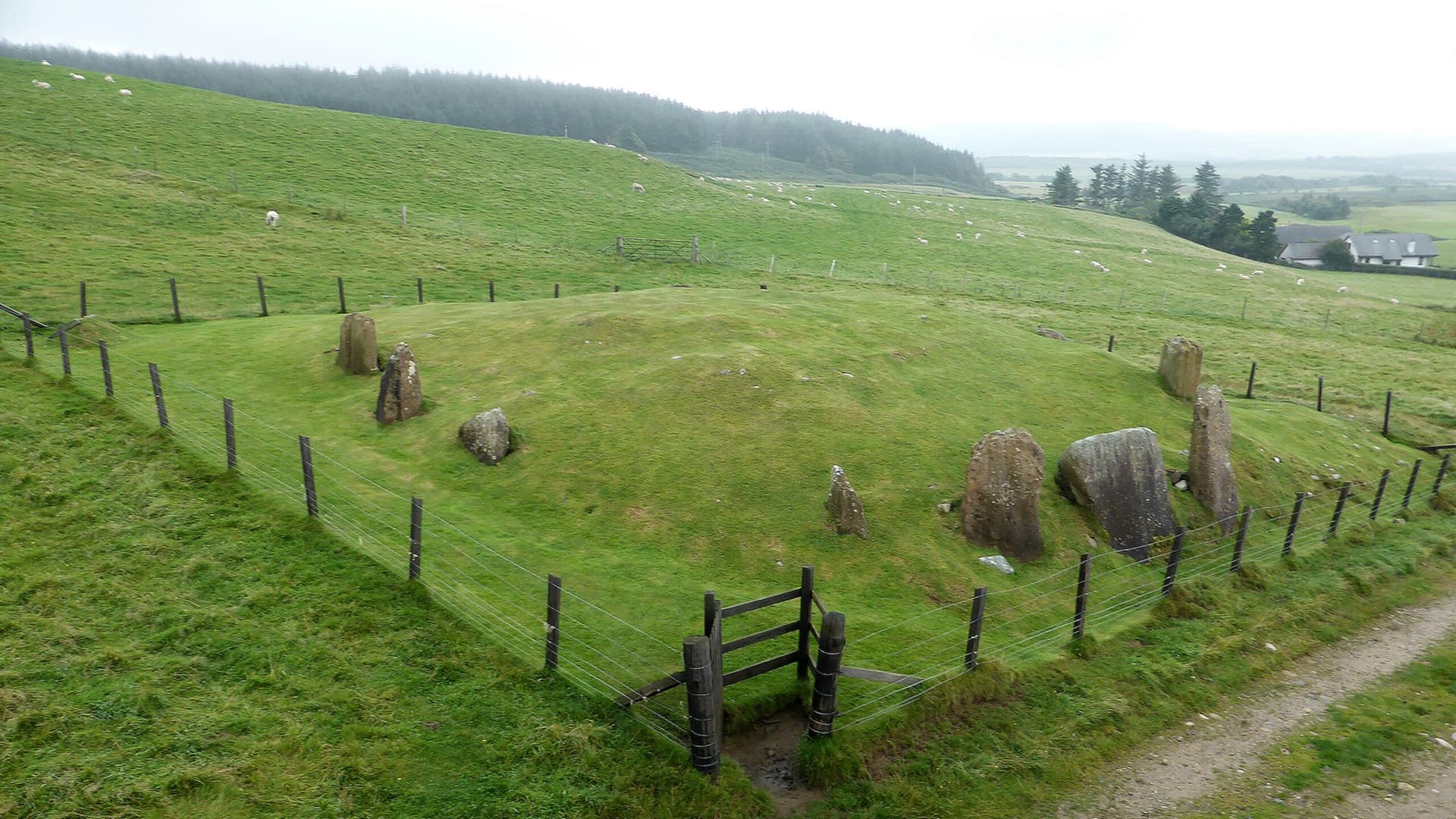
What remains is a fragment of what once existed. Seven upright stones, each roughly a metre tall, survive from a ring that originally enclosed a burial cairn some twenty-two metres across. The farm road that gives the site its modern name cuts through the monument. Centuries of stone robbing have stripped away the cairn material. Five more stones lie fallen on their sides. Yet what survives is enough to feel the shape of what was here, a circular space deliberately marked and enclosed, a boundary between the living and the dead.
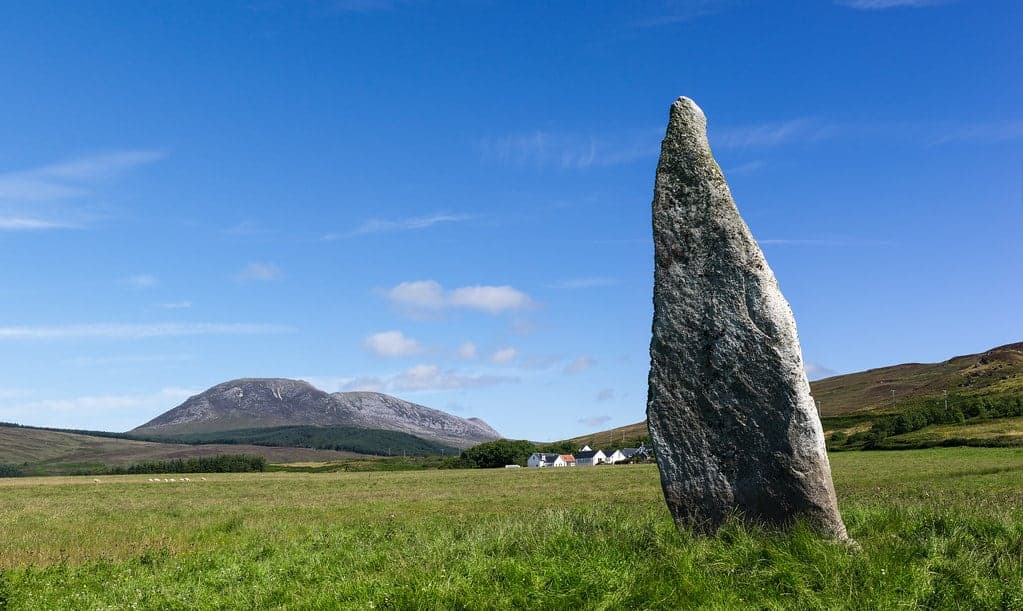
This is not the most famous monument on Machrie Moor. That distinction belongs to the tall sandstone pillars and granite rings deeper into the landscape, which draw visitors from across the world. But Moss Farm Road holds something the grander circles do not: the quality of a threshold. It is the first sacred marker on a journey into a landscape where the Neolithic and Bronze Age communities of Arran buried their dead, raised their timber and stone circles, and aligned their monuments with the midsummer sunrise. To pass this ring cairn is to enter that landscape with the awareness that you are crossing a boundary that was drawn four millennia ago.
Recent archaeological work has revealed that Machrie Moor may be even more significant than previously understood. A Neolithic cursus, a vast ceremonial avenue, has been identified on the moor, suggesting that the landscape was the centre of a ritual complex comparable in ambition to Stonehenge. Moss Farm Road sits at the edge of this world, the first stone sentinel encountered on the approach.
Context And Lineage
Moss Farm Road Stone Circle is a Bronze Age ring cairn (c. 2000-1500 BC) at the western edge of the Machrie Moor ceremonial landscape on the Isle of Arran. The broader landscape has been in sacred use since at least 3500 BC and includes six stone circles, standing stones, burial cairns, and a recently discovered Neolithic cursus.
No founding narrative survives for this monument. It belongs to the pre-literate cultures of Bronze Age Scotland, whose stories have not been preserved in any form we can now read. The stones themselves are the only testimony to the intentions of their builders.
The broader Machrie Moor landscape carries folk associations with the mythical giant Fionn Mac Cumhaill, known in Scotland as Fingal. One of the nearby stone circles is called Fingal's Cauldron Seat. These associations, though far younger than the monuments themselves, reflect a human need to explain the presence of ancient structures through stories of extraordinary beings.
The lineage at Moss Farm Road is one of landscape rather than institution. No unbroken tradition connects the Bronze Age builders to the present. Instead, there is a landscape that has been recognised as significant across enormous stretches of time.
The earliest known activity on Machrie Moor dates to around 3500 BC, when pits and gullies were dug for purposes that remain unclear. Around 2500 BC, elaborate timber circles were erected. Some five hundred years later, around 2000 BC, stone circles were built on the exact same locations as their timber predecessors. Moss Farm Road's ring cairn belongs to this later phase of stone construction.
After the Bronze Age, the ceremonial use of the moor appears to have declined. Gaelic-speaking peoples later assigned the monuments to Fingal and his legends. In the modern era, Historic Environment Scotland has taken stewardship of the monuments, and the walk across the moor to the stone circles has become a pilgrimage in its own right for those drawn to prehistoric sacred landscapes.
Fionn Mac Cumhaill (Fingal)
mythological association
The legendary giant Fionn Mac Cumhaill is associated with the broader Machrie Moor landscape. One nearby circle bears the name Fingal's Cauldron Seat. These associations represent later folklore explaining the presence of ancient monuments.
Why This Place Is Sacred
Moss Farm Road Stone Circle draws its power from its position as the threshold to the Machrie Moor ceremonial landscape. Damaged but still present, it marks the transition from ordinary space into a landscape that held sacred significance for at least two thousand years of continuous use.
The concept of a threshold, a place where one kind of space gives way to another, is fundamental to how human beings organise sacred geography. Every temple has a door. Every sacred grove has an edge. At Machrie Moor, the threshold is Moss Farm Road Stone Circle.
This is not a metaphor imposed from outside. The monument sits precisely at the point where the farm track from the coast road enters the moorland where the stone circles stand. Whether this positioning was deliberate in the Bronze Age or is an accident of how the modern road follows ancient routes, the effect is the same. You walk past the Moss Farm Road stones and the texture of the landscape changes. The moor opens. The mountains rise. The world becomes older.
The damage to the monument is itself a kind of teaching. Seven stones stand where perhaps twenty once stood. The cairn that filled the centre is largely gone. The road cuts through the ring. This is what four thousand years does to human construction. Yet the stones remain, still marking their circle, still holding the shape of intention. They testify to both the fragility and the persistence of sacred space.
The broader Machrie Moor landscape amplifies this quality. Excavations have revealed that timber circles preceded the stone circles, that the same locations were chosen again and again over centuries for ceremonial construction. The earliest activity on the moor dates to around 3500 BC. The stone circles were erected around 2000 BC. That is fifteen hundred years of continuous sacred use before the stones even appeared. Something about this landscape was recognized as significant long before anyone chose to mark it permanently.
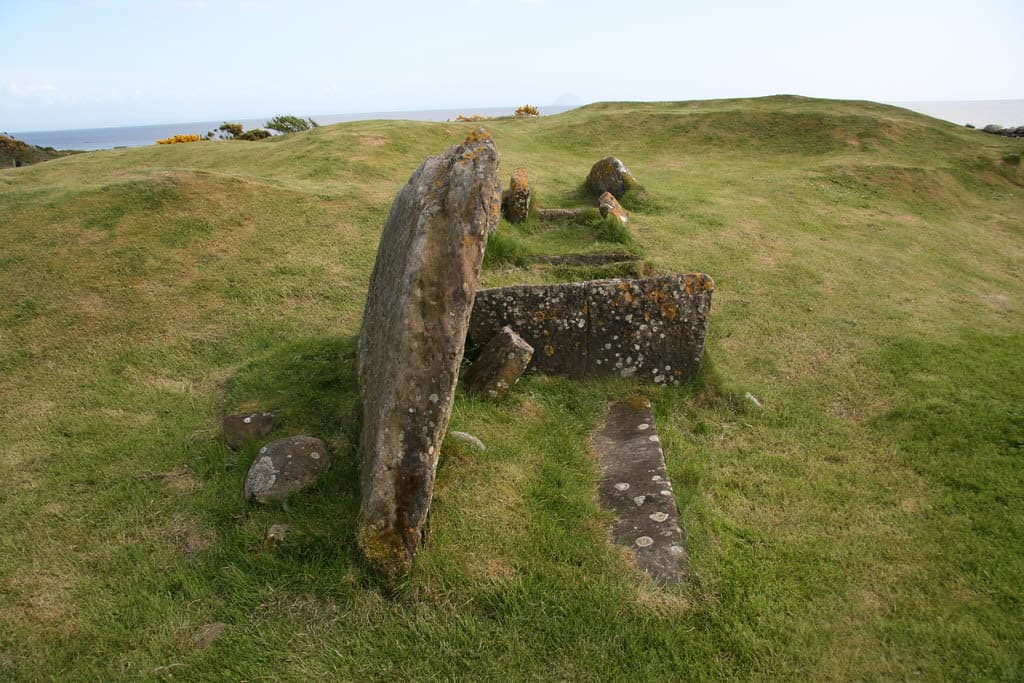
Moss Farm Road Stone Circle is classified as a ring cairn, a circular bank of stones enclosing a burial area. The upright stones formed a kerb around the cairn rather than a freestanding stone circle. The site was used for burials, though it has not been fully excavated, so the extent of its funerary use remains unknown. It likely served the Neolithic and Bronze Age farming communities of western Arran as a place to inter their dead within a landscape already understood as sacred.
The monument was probably constructed around 2000-1500 BC, during a period when the Machrie Moor landscape was being transformed from a place of timber circles to one of stone monuments. The choice to build a burial cairn at the edge of this landscape rather than at its centre may reflect the monument's role as a marker of transition, a boundary between the world of the living and the ceremonial realm beyond.
Over subsequent millennia, the cairn fell into disuse as the religious frameworks that created it were replaced. Stone was robbed for building. The construction of the farm road in more recent centuries caused further damage. But the monument was never entirely forgotten. Historic Environment Scotland now manages it as a Scheduled Monument, and it serves as the entry point for visitors walking into the Machrie Moor landscape.
In recent decades, the broader understanding of Machrie Moor has deepened significantly. The discovery of a possible Neolithic cursus has elevated the entire landscape to one of potential global significance, comparable to the great ceremonial complexes of southern England. Moss Farm Road Stone Circle, long overshadowed by its more impressive neighbours, is now recognised as part of something far larger than previously imagined.
Traditions And Practice
No formal ceremonies are currently performed specifically at Moss Farm Road Stone Circle. Individual visitors practice quiet contemplation and meditation. The site is primarily experienced as part of the walk into the wider Machrie Moor landscape.
The original practices at Moss Farm Road Stone Circle were funerary. As a ring cairn, the monument served as a place for burying the dead, probably members of the farming communities who worked the western coastal lands of Arran. The exact nature of the rites performed here, whether they involved cremation or inhumation, what words were spoken, what beliefs guided the placement of the dead within the cairn, cannot be recovered. The broader Machrie Moor landscape reveals a ceremonial world of considerable sophistication, with timber circles giving way to stone circles over centuries, and alignments with the midsummer sunrise suggesting a cosmology attentive to astronomical cycles.
There are no formal contemporary ceremonies specific to Moss Farm Road Stone Circle. The site is experienced primarily as part of the walk into Machrie Moor, where visitors engage with the landscape at their own pace and in their own way. Some contemporary Pagan practitioners include the Machrie Moor stones in solstice and equinox observances. Individual visitors practice meditation, contemplation, and simple presence at the stones.
Allow Moss Farm Road to serve its ancient function as a threshold. Pause here before continuing into the moor. Let the transition from modern road to ancient landscape happen naturally, without forcing it.
Stand within or beside the ring and look east, toward the ceremonial heart of Machrie Moor. The monuments you cannot yet see are out there, waiting. This moment of anticipation, of standing at the edge of something older and larger than yourself, is itself a practice.
On the return journey, pause again. After the experience of the inner moor, the Moss Farm Road stones may speak differently. Notice what has changed.
Neolithic and Bronze Age Funerary Practice
HistoricalMoss Farm Road Stone Circle was built as a ring cairn for the burial of the dead, probably around 2000-1500 BC. It belongs to a period when the Machrie Moor landscape was being transformed from a place of timber circles to stone monuments, reflecting evolving ceremonial and religious practices over at least 1,500 years.
Funerary rites involving burial within a ring cairn enclosed by upright stones. The exact nature of these rites, whether cremation, inhumation, or both, remains unknown for this specific site. The broader Machrie Moor landscape reveals sophisticated ceremonial practice including the construction of timber circles, stone circles, and alignment with astronomical events.
Gaelic Folklore
HistoricalGaelic-speaking peoples who later inhabited the Isle of Arran incorporated the Machrie Moor monuments into their folklore, associating them with the legendary giant Fionn Mac Cumhaill. While not a living ceremonial tradition, these stories preserve a cultural recognition that the landscape is extraordinary.
Storytelling and oral tradition. The naming of Fingal's Cauldron Seat reflects the integration of prehistoric monuments into the Gaelic cultural landscape.
Contemporary Heritage Pilgrimage
ActiveThe walk from the coast road across Machrie Moor to the stone circles has become a form of secular and spiritual pilgrimage for visitors drawn to prehistoric sacred landscapes. Moss Farm Road Stone Circle serves as the first station on this journey.
Walking the Machrie Moor path as a contemplative journey. Quiet meditation at the stone circles. Solstice and equinox visits. Photography and artistic response to the landscape.
Experience And Perspectives
Visitors encounter Moss Farm Road Stone Circle as the first prehistoric monument on the walk from the coast road into Machrie Moor. Its modest scale and visible damage create an intimate, contemplative atmosphere quite different from the grander circles deeper in the landscape.
The experience begins at the car park on the A841, the coastal road that circles the Isle of Arran. A sign points east toward the Machrie Moor Standing Stones. The track is a farm road, surfaced but rough, passing through fields where sheep graze among scattered boulders. The Firth of Clyde lies behind you. Ahead, the moor rises gently toward the interior hills of Arran.
After roughly six hundred metres, the Moss Farm Road stones appear to the south of the track. They do not announce themselves dramatically. There are no tall pillars here, no soaring sandstone columns. Instead, seven squat, weathered stones describe a partial arc in the heather, their tops barely reaching waist height. Others lie fallen. The ring is broken but its shape is still readable.
There is a quietness here that the more visited circles deeper in the moor do not always possess. Fewer people stop at Moss Farm Road. Many pass it without notice, eyes fixed on the path ahead. Those who do pause find something worth the attention: a damaged but resolute presence, the stubbornness of four thousand years of standing.
From within the ring, the landscape frames itself. To the east, the moor stretches toward the taller monuments. To the west, the coast and the sea. The hills of Arran circle the horizon. On clear days, the light has a quality particular to the Scottish west coast, soft and penetrating, making colours more vivid than they have any right to be.
The walk onward to the main Machrie Moor circles takes another twenty minutes. Having paused at Moss Farm Road, that walk carries a different quality. You have already entered the sacred landscape. The threshold has been crossed.
Take the Moss Farm Road stones as your introduction to the Machrie Moor landscape rather than hurrying past to the more famous circles beyond. Spend time with them before walking on. Let the transition happen.
Notice how the remaining stones describe the shape of the original ring. Try to sense the scale of what was once here, the full circle of uprights, the cairn mass within. The damage is part of the story.
If you plan to walk the full Machrie Moor path, consider Moss Farm Road as your opening and your closing. The stones will have a different quality on the return journey, after you have seen what lies deeper in the moor.
Moss Farm Road Stone Circle invites understanding from multiple angles. Archaeological science, landscape archaeology, and contemporary spiritual engagement each illuminate aspects the others cannot fully capture. What they share is recognition that this place, and the landscape it introduces, held deep significance for the people who shaped it.
Archaeologists classify Moss Farm Road as a Bronze Age ring cairn, approximately dated to 2000-1500 BC. The term acknowledges that the upright stones form a kerb around a burial cairn rather than a freestanding ceremonial circle, though the distinction may not have been meaningful to the original builders. The site has not been fully excavated, limiting what can be said about its specific use.
The wider Machrie Moor landscape, however, is one of the best-studied prehistoric ceremonial complexes in Scotland. Excavations at other circles on the moor, particularly by Alison Haggarty in 1985-86, revealed that elaborate timber circles preceded the stone monuments, and that the same locations were chosen for construction across a span of roughly 500 years. The earliest known activity on the moor dates to around 3500 BC. The discovery of a possible Neolithic cursus in 2023, through geophysical survey and excavation by teams from the University of Glasgow and Bournemouth University, has elevated Machrie Moor to a site of potential global significance.
Moss Farm Road sits at the western edge of this landscape. Its position may be incidental or may reflect deliberate placement at the boundary of the ceremonial zone.
No living traditional perspective specific to Moss Farm Road survives. The Gaelic folklore of the Isle of Arran associates the Machrie Moor monuments with the legendary giant Fionn Mac Cumhaill, whose stories were carried by the Gaelic-speaking peoples who inhabited Arran after the Bronze Age culture faded. The name Fingal's Cauldron Seat, attached to one of the nearby circles, preserves this association.
These stories represent a cultural response to mysterious ancient structures rather than a continuous tradition from the builders. They are no less valuable for that. Folklore preserves a recognition that these places are extraordinary, even when the original reasons for their creation have been forgotten.
Some contemporary spiritual seekers experience the Machrie Moor landscape, including Moss Farm Road, as an energy landscape where the arrangement of stones reflects and amplifies earth forces. The midsummer sunrise alignment through Machrie Glen is sometimes interpreted within frameworks of sacred geometry and astronomical spirituality. The threshold quality of Moss Farm Road, its position at the entrance to the sacred landscape, resonates with traditions that understand certain places as gateways between worlds.
These interpretations, while not supported by archaeological evidence, emerge from genuine engagement with the site's atmosphere and positioning.
Much about Moss Farm Road Stone Circle remains unknown. Who was buried here, and why they were chosen for interment in this particular location, cannot be answered without excavation and perhaps not even then. Whether the monument's position at the edge of the Machrie Moor landscape was deliberate or coincidental is uncertain. The relationship between this ring cairn and the grander stone circles further east is unclear. What rites accompanied burial, what beliefs governed the arrangement of stones, what the landscape of Machrie Moor meant to those who shaped it over two millennia of use, are questions that the stones hold but cannot speak.
Visit Planning
Moss Farm Road Stone Circle is located on the west coast of the Isle of Arran, accessed by a short walk from the A841 coastal road. The site is free to visit and open at all times.
Park at the signposted parking area on the A841 coastal road, approximately 3 miles north of Blackwaterfoot. Walk east along the Moss Farm track for roughly 600 metres to reach the stone circle. The path is an unsurfaced farm road, generally flat but not wheelchair accessible. The Isle of Arran is reached by CalMac ferry from Ardrossan on the mainland (approximately 55 minutes) or from Claonaig on the Kintyre peninsula in summer.
Accommodation is available in Blackwaterfoot (3 miles south), Machrie, and throughout the Isle of Arran. Lochranza in the north has a youth hostel. No retreat facilities exist at the site. The island has a range of hotels, bed and breakfasts, self-catering cottages, and camping options.
Moss Farm Road Stone Circle is an open-access Scheduled Monument. Visitors should treat the site with respect, avoid damaging the stones, and be mindful of the agricultural landscape through which access is gained.
The site is protected as a Scheduled Monument under Scottish law, making any damage a criminal offence. This protection exists because the stones, though damaged, are irreplaceable evidence of Bronze Age culture on the Isle of Arran.
Visitors should approach the monument with the awareness that they are entering a funerary site. People were buried here. Whatever your personal beliefs about the dead and their resting places, a degree of respect is appropriate.
The path to the stones crosses agricultural land. Sheep graze in the surrounding fields. Dogs should be kept under close control. Gates should be closed behind you. Do not stray from the path unnecessarily.
If you encounter other visitors at the stones, share the space quietly. The site is small enough that one group can easily displace another. Courtesy and patience serve everyone.
No specific dress code. Wear appropriate footwear for walking on an unsurfaced farm track, which may be muddy after rain. Scottish west coast weather is changeable; layers and waterproofs are advisable.
Photography is permitted. The stones are photogenic in the low light of early morning or late afternoon. Be considerate of other visitors.
Not traditional at this site. If you feel moved to leave a small offering, choose only natural, fully biodegradable materials. Do not leave items on the stones themselves.
Do not damage, climb on, or remove stones. Do not dig or excavate. Do not camp at the site. Respect livestock and close gates.
Sacred Cluster
Nearby sacred places create the location cluster described in the growth plan. This block is intentionally crawlable and links into the wider regional graph.