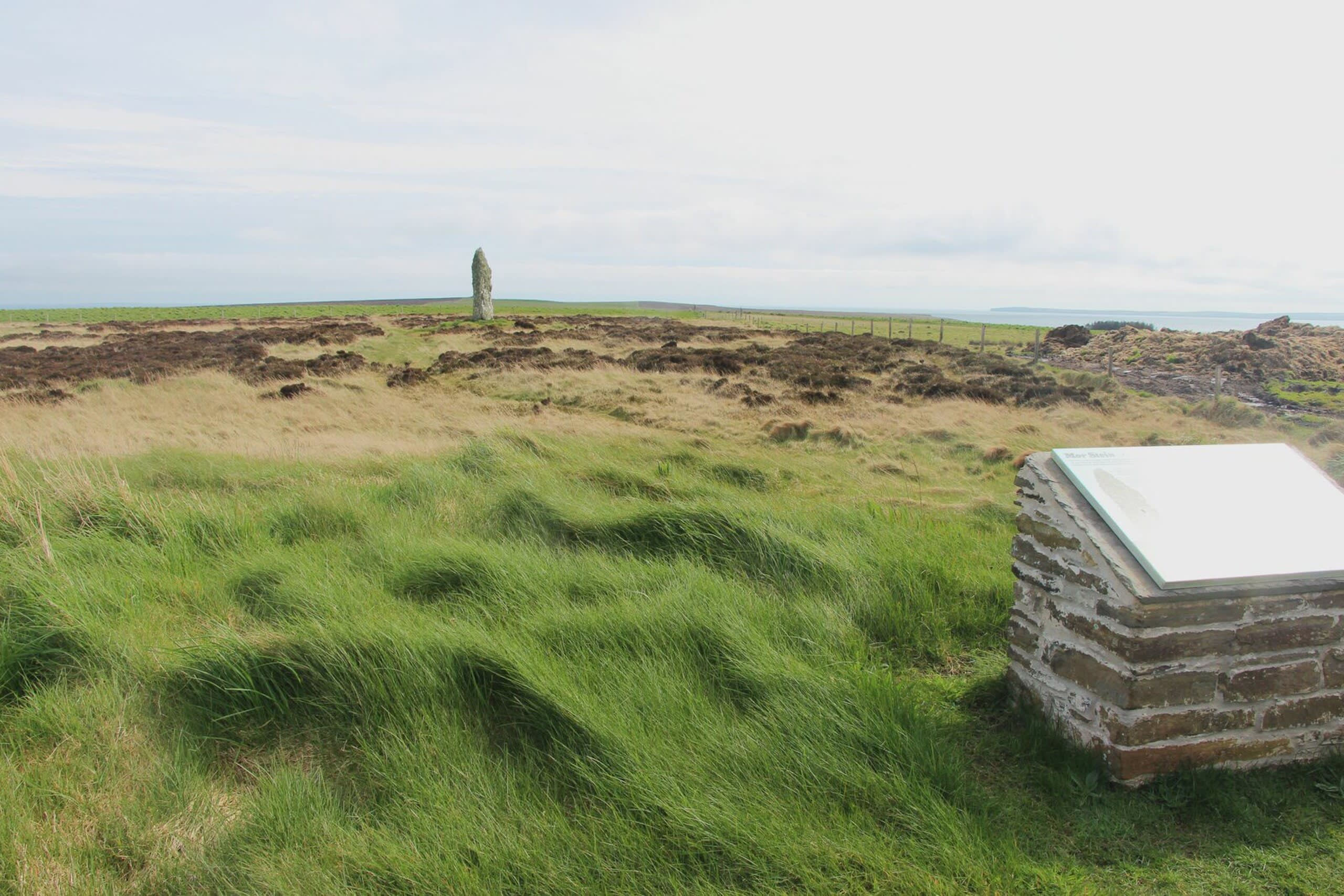
Mor Stein
A solitary Neolithic sentinel on Shapinsay, shaped by giant-lore and five millennia of Atlantic wind
Shapinsay, Orkney Islands, United Kingdom
At A Glance
- Coordinates
- 59.0361, -2.8312
- Suggested Duration
- Thirty minutes to an hour, allowing time for quiet contemplation and exploration of the immediate surroundings.
- Access
- Shapinsay is reached by Orkney Ferries from Kirkwall, a crossing of approximately twenty-five minutes. Sailings run several times daily. The stone is located in the southeastern part of the island, a short walk from the nearest road. No vehicular access directly to the stone. The terrain is relatively flat agricultural land.
Pilgrim Tips
- Shapinsay is reached by Orkney Ferries from Kirkwall, a crossing of approximately twenty-five minutes. Sailings run several times daily. The stone is located in the southeastern part of the island, a short walk from the nearest road. No vehicular access directly to the stone. The terrain is relatively flat agricultural land.
- No specific requirements. Sturdy walking shoes are advisable for the walk across agricultural land. Windproof and waterproof clothing is recommended at any season in Orkney.
- Photography is permitted throughout. The solitary stone against the open Orkney landscape makes for atmospheric images.
- The stone is a scheduled monument. Do not climb on it, lean against it, or attempt to remove fragments. The crack from its historical damage makes the stone potentially more vulnerable than intact menhirs.
Overview
On the southeastern shore of Shapinsay, one of the inner Orkney Islands, a single standing stone rises roughly ten feet from the turf. Mor Stein has stood here for approximately five thousand years, unshaped and uncarved, a monument whose original purpose has been lost to time. Local folklore holds that a giant hurled it at his fleeing wife, and it landed here. The stone was at some point toppled and split, then re-erected, yet it retains the raw presence of a monument that predates written language in these islands by millennia.
Mor Stein does not announce itself from afar. It stands in low-lying ground near Shapinsay's southeastern coast, a single pillar of unhewn stone roughly three metres tall. There is no stone circle surrounding it, no companion monuments in immediate view. It stands alone, as it has since the Neolithic communities of Orkney raised it sometime around 3000 BCE.
The name itself is Norse in origin, meaning 'great stone,' a later naming by Viking settlers who found it already ancient when they arrived in these islands. The stone predates their language, their culture, their gods. It predates the brochs and the Pictish carvings. It belongs to the same era as the Ring of Brodgar, the Standing Stones of Stenness, and the Stone of Setter on neighbouring Eday, though it lacks their fame.
At some uncertain point in its history, Mor Stein was knocked down and broken. It was subsequently re-erected, though a visible crack remains as evidence of this interruption. The stone was scheduled as a historic monument in 1953, granting it legal protection. Today it stands in its original landscape, surrounded by Shapinsay's farmland, the sea never far from view.
Shapinsay is one of the more accessible Orkney islands, a short ferry ride from Kirkwall, yet visitors to Mor Stein are few. The stone rewards those who seek it out with the particular quality of encounter that solitary standing stones offer: an object of immense age, raised by people whose intentions we cannot recover, standing in silence against the Orkney sky.
Context And Lineage
Mor Stein belongs to the widespread Neolithic tradition of erecting standing stones across Orkney and Atlantic Europe. These monuments were raised by farming communities who had settled the islands and begun transforming the landscape with permanent structures. The stone's Norse name reflects the later Viking colonisation of Orkney, when settlers encountered monuments already ancient in their landscape.
No origin narrative survives from the Neolithic builders. The oldest story attached to Mor Stein is a folk tale: a giant threw the stone at his fleeing wife, and it landed where it now stands. This story, likely of Norse or later origin, acknowledges the stone's strangeness while providing an explanation within the logic of folklore. The archaeological explanation is more provisional: sometime around 3000 BCE, a Neolithic community selected, transported, and erected this stone for purposes that remain genuinely unknown.
No continuous tradition of practice connects the present to the Neolithic builders. The stone passed through Pictish and Norse periods, acquiring its current name from Viking settlers. It entered the modern heritage system through scheduling in 1953. Today it functions as a heritage monument rather than an active sacred site, though individual visitors may engage with it according to their own spiritual inclinations.
Historic Environment Scotland
Why This Place Is Sacred
Mor Stein's quality as a thin place derives from its solitary persistence. Five thousand years of standing in one spot creates a kind of temporal depth that resists easy articulation. The stone was raised by people who left no written record, for reasons we cannot reconstruct, and it has outlasted every human enterprise on this island since. That duration, combined with the stripped-back Orkney landscape and the stone's isolation from other monuments, gives it a quality of concentrated presence.
Solitary standing stones occupy a particular position in the archaeology of thin places. Unlike stone circles, which create defined ritual spaces, or chambered cairns, which enclose the dead, a lone menhir simply marks. What it marks, we cannot say with certainty. A boundary, perhaps. A gathering point. A memorial. An astronomical reference. The honest answer is that we do not know.
This unknowing is itself part of the thinness. Mor Stein cannot be fully explained, and that resistance to explanation opens a space for encounter. The stone does not instruct or narrate. It simply stands, as it has stood since before the pyramids were built, before bronze was smelted in these islands, before anyone on earth had learned to write.
The Orkney landscape amplifies the effect. Shapinsay is low-lying, its terrain composed of farmland and moorland without dramatic topography. The sky dominates. Weather moves visibly across the island. In this setting, even a modest standing stone becomes a vertical assertion against the horizontal world, a mark of human intention in a landscape shaped by wind and sea.
The folklore of the giant's throw adds another layer. Whether or not anyone still believes the story, it acknowledges the stone's strangeness, the human need to explain why this massive object stands where it does. The crack from its toppling and re-erection adds vulnerability to the monument's presence. Even stone is not permanent. Even Mor Stein has been brought low and raised again.
The original purpose of Mor Stein is unknown. Archaeological classification identifies it as a prehistoric ritual and funerary standing stone, but this is a broad category. Standing stones of this period may have served as territorial markers, astronomical indicators, gathering points for ceremony, or memorial monuments. No excavation has been conducted at the base of the stone, so any buried deposits or structural features remain undiscovered.
The stone was erected during the Neolithic or early Bronze Age, approximately five thousand years ago. It stood undisturbed through the Pictish and Norse periods, acquiring its Norse name, Mor Stein, from Viking settlers. At an unknown date it was toppled and split, possibly by deliberate human action, possibly by natural forces. It was subsequently re-erected. Historic Environment Scotland scheduled the stone as a protected monument in 1953.
Traditions And Practice
No formal ceremonies are conducted at Mor Stein today. The stone functions as a heritage monument. Individual visitors may engage in personal contemplation or reflection, but no organised spiritual practice is associated with the site.
The original ritual practices associated with the stone are unknown. As a Neolithic standing stone, it may have been connected to ceremonies whose specific forms are irrecoverable. No folklore beyond the giant's throw story has been recorded for the site.
No established spiritual communities maintain regular practice at Mor Stein. Some visitors interested in prehistoric landscapes may include it in explorations of Orkney's standing stones.
For individual visitors, the site rewards quiet attention. Allow time to observe the stone's texture, the crack from its toppling, the way it stands against the sky. The absence of interpretation materials means the encounter is unmediated. Silence and patience are appropriate.
Neolithic Megalithic Tradition
HistoricalMor Stein belongs to the widespread Neolithic tradition of erecting standing stones across Orkney and Atlantic Europe, dating from approximately 3000 BCE. These monuments represent some of humanity's earliest permanent landscape modifications, erected by farming communities who had begun to settle the Orkney Islands. The stone's placement on Shapinsay, within sight of the sea, connects it to a network of megalithic monuments scattered across the archipelago.
The specific practices associated with the stone are unknown. Standing stones of this period are generally interpreted as markers for ceremonial gatherings, astronomical observations, territorial boundaries, or commemorative purposes. No excavation has been conducted to reveal associated deposits or features.
Experience And Perspectives
Reaching Mor Stein requires a short walk from the nearest road on Shapinsay. The stone stands in low-lying ground near the coast, visible as a dark vertical form against farmland and sky. There is no interpretation panel, no car park, no other visitors. The encounter is between you and a five-thousand-year-old stone in an Orkney field. The visible crack from its historical toppling adds a note of fragility to the monument's endurance.
The approach to Mor Stein is quiet. Shapinsay is a working agricultural island, and the stone stands amid farmland in the southeastern part of the island. You walk from the road across grass, and the stone appears, not dramatically but steadily, a dark upright form perhaps three metres tall.
Close up, the stone reveals its character. It is unhewn, unshaped, the natural form of the rock preserved. The surface is weathered by five millennia of Orkney wind and rain. A crack runs through the stone, evidence of its historical toppling and re-erection. You can place your hand against it and feel the texture of deep time.
There is nothing else here. No interpretation panel. No other monuments in immediate view. The stone stands in relationship to the land, the sky, and the sea, which is visible from this low-lying part of the island. Seabirds may pass overhead. Wind is nearly constant.
This simplicity is the experience. A stone, a field, the sky. Five thousand years of standing in one place. The giant's throw of folklore, the unknown intention of the builders, the crack and repair. Mor Stein offers no spectacle, only presence.
Mor Stein is located in the southeastern part of Shapinsay, accessible from the road that runs along the coast. Shapinsay is reached by a twenty-five-minute ferry from Kirkwall. The stone is a short walk from the road. Those wishing to explore Shapinsay's heritage more broadly can visit Balfour Castle and the nearby chambered cairn. Allow half a day for Shapinsay including the ferry crossings.
Mor Stein invites more questions than it answers. A single standing stone offers minimal archaeological evidence compared to chambered cairns or settlement sites. What survives is the stone itself, its location, and the fact that Neolithic people invested considerable effort in placing it here. Everything else is inference.
Archaeological classification identifies Mor Stein as a prehistoric ritual and funerary standing stone of the Neolithic or early Bronze Age period, approximately five thousand years old. It belongs to the broader tradition of megalithic monument construction across Orkney, Scotland, and Atlantic Europe. Historic Environment Scotland has scheduled it as a monument of national importance (SM1323). No excavation has been conducted at the stone, so subsurface features and deposits remain unknown. The stone's re-erection after toppling means its current position may not precisely match its original orientation.
No indigenous oral tradition survives from the Neolithic builders. The principal folk tradition is the story of a giant who threw the stone at his fleeing wife. This tale, likely of Norse or later origin, belongs to a widespread genre of folklore explaining standing stones through supernatural action. Whether it preserves any genuine memory of the stone's significance is unknowable.
Some contemporary visitors view solitary standing stones as markers of earth energy or as focal points for spiritual practice. These interpretations cannot be confirmed or denied by archaeological evidence. The stone's isolation and antiquity lend themselves to contemplative and mystical engagement.
Nearly everything about Mor Stein's original purpose is unknown. Why this particular location was chosen, what ceremonies may have taken place here, whether the stone was part of a larger complex now lost, what lies beneath the surface around its base, all these questions remain unanswered. The stone's re-erection after toppling adds further uncertainty about its original orientation and setting.
Visit Planning
Mor Stein is freely accessible year-round on the island of Shapinsay, one of the most accessible of Orkney's outer islands. A regular ferry service connects Shapinsay to Kirkwall, making day visits straightforward.
Shapinsay is reached by Orkney Ferries from Kirkwall, a crossing of approximately twenty-five minutes. Sailings run several times daily. The stone is located in the southeastern part of the island, a short walk from the nearest road. No vehicular access directly to the stone. The terrain is relatively flat agricultural land.
Limited accommodation on Shapinsay, including Balfour Castle and local B&Bs. More extensive options in Kirkwall on the Orkney Mainland.
Mor Stein is a freely accessible scheduled monument with no formal restrictions beyond the legal protection afforded to all scheduled ancient monuments in Scotland.
The site is accessible during daylight hours throughout the year. No admission fee is charged. The stone stands on agricultural land, so visitors should be mindful of livestock and crops. Close gates behind you. Dogs should be kept under close control.
As a scheduled monument, it is illegal to damage, disturb, or excavate the stone or surrounding ground without consent from Historic Environment Scotland. Do not climb on the stone or attempt to remove fragments. The historical crack makes the stone's integrity a particular concern.
Photography is unrestricted. The stone photographs well against Shapinsay's open sky, particularly in low-angled light.
No specific requirements. Sturdy walking shoes are advisable for the walk across agricultural land. Windproof and waterproof clothing is recommended at any season in Orkney.
Photography is permitted throughout. The solitary stone against the open Orkney landscape makes for atmospheric images.
Leaving offerings is not traditional and is discouraged at heritage monuments. If moved to leave something, ensure it is small, natural, and biodegradable.
Do not climb on the stone, lean against it heavily, or remove any material. The stone's historical damage makes physical contact a concern. Respect agricultural land and livestock.
Sacred Cluster
Nearby sacred places create the location cluster described in the growth plan. This block is intentionally crawlable and links into the wider regional graph.