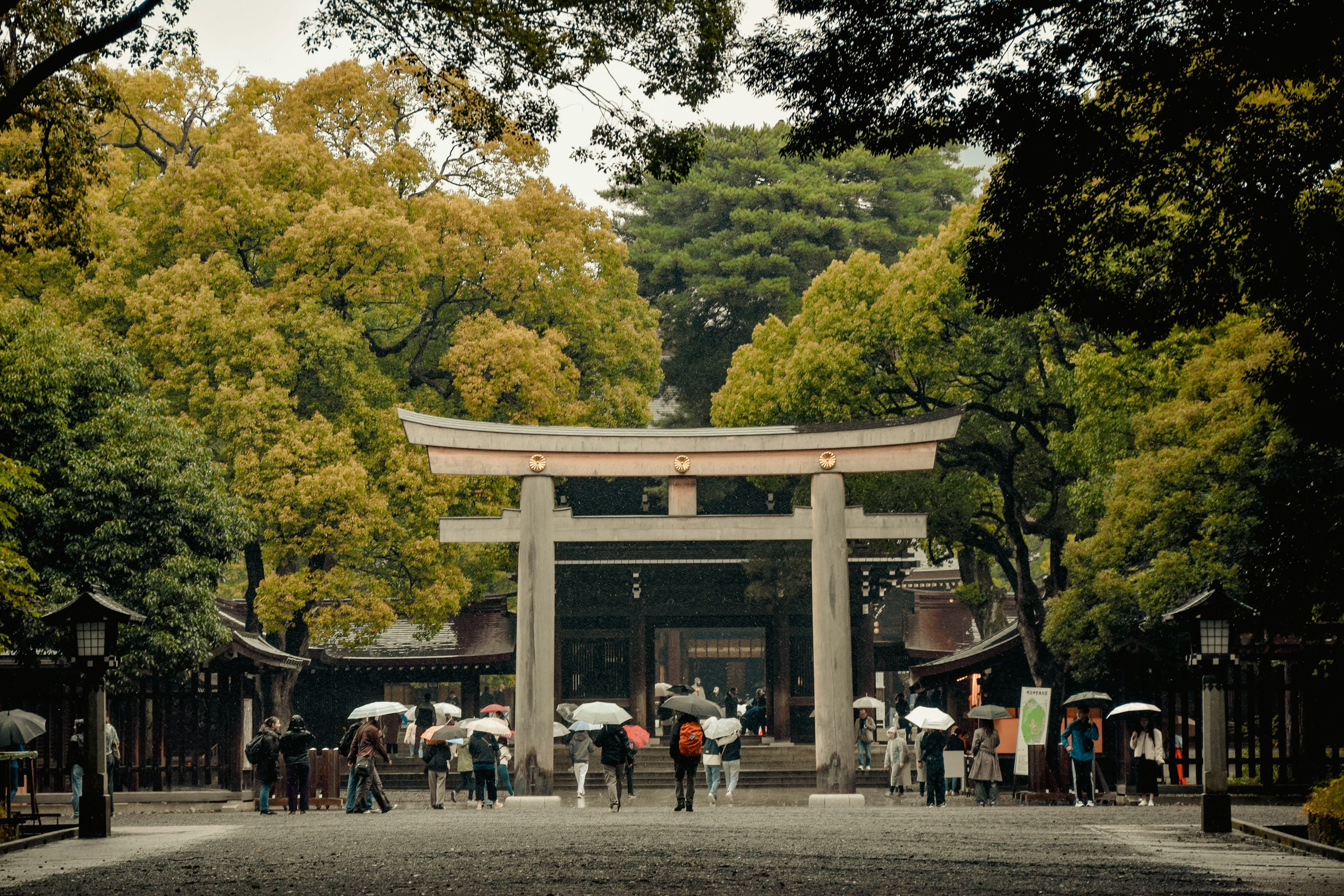
Meiji Shrine
A century-old forest shields a shrine where modern Japan honors its transforming emperor
Tokyo, Tokyo, Japan
At A Glance
- Coordinates
- 35.6764, 139.6993
- Suggested Duration
- A focused visit to the main shrine takes about one hour, including the ten-minute walk each way through the forest. Adding the Inner Garden (with Kiyomasa's Well and the iris garden) extends this to approximately two hours. The Meiji Jingu Museum adds another hour. Those wishing to attend a festival or ceremony should plan for half a day.
- Access
- JR Harajuku Station on the Yamanote Line is one minute's walk from the south entrance—the most dramatic approach through the great torii. Tokyo Metro Meiji-jingumae Station on the Chiyoda and Fukutoshin Lines offers equally close access. JR Yoyogi Station provides approach from the north, while Odakyu Sangubashi Station offers access from the west.
Pilgrim Tips
- JR Harajuku Station on the Yamanote Line is one minute's walk from the south entrance—the most dramatic approach through the great torii. Tokyo Metro Meiji-jingumae Station on the Chiyoda and Fukutoshin Lines offers equally close access. JR Yoyogi Station provides approach from the north, while Odakyu Sangubashi Station offers access from the west.
- No strict dress code is enforced, but modest, respectful attire is expected. Cover shoulders and knees. Long pants or skirts are preferred over shorts. Avoid beachwear, athletic wear designed for visibility, or clothing with offensive imagery. Long sleeves are practically useful given the insects in the forest during warmer months.
- Personal photography is permitted throughout most of the grounds. The exception is directly in front of the main shrine where people are praying—here, cameras should be put away. Commercial or promotional photography, video for publication, and drone use require advance permission. Tripods and monopods are discouraged in crowded areas. Flash is inappropriate.
- The center of the main path is traditionally reserved for the kami. Walk to the left or right, not down the middle. Remove your hat before passing through the torii gate and bow as you enter. These are not rules enforced by staff but courtesies that honor the nature of the space. Do not approach the shrine as a photo opportunity alone. Visitors who spend their entire time staging shots miss what the place offers. Photography is permitted in most areas, but directly in front of the main hall where people are praying, cameras should be put away.
Overview
Rising from the heart of Tokyo, Meiji Shrine offers one of the world's most dramatic sacred thresholds. Step through the massive torii gate and the city dissolves—replaced by a forest planted over a century ago by 110,000 volunteers. At its center, a shrine honors the spirits of Emperor Meiji and Empress Shoken, the imperial couple who shepherded Japan from isolation into modernity.
The transition happens within steps. One moment you stand in the kinetic chaos of Harajuku, surrounded by fashion subcultures and the press of millions. Then you pass beneath the great torii—12 meters of ancient cypress from a 1,500-year-old tree—and enter silence.
This is not an ancient forest, though it feels like one. In 1915, this land was largely bare fields. What you walk through now was planted by approximately 110,000 volunteers who donated trees from every prefecture in Japan, envisioning what this place would become in a century. They succeeded beyond their planning. The forest has become self-sustaining, home to species that have arrived without human intervention. It is a shrine grove created by collective intention, now more alive than its makers could have imagined.
At the forest's heart sits the shrine itself, dedicated to the kami—the divine spirits—of Emperor Meiji and Empress Shoken. In Shinto understanding, the emperor who opened Japan to the modern world and the empress who championed education and social welfare have become beings worthy of veneration. Twice daily, priests make offerings. Weddings unfold in traditional ceremony. Over three million visitors arrive in the first days of each new year, seeking blessings for what lies ahead.
This is not a museum of tradition. It is tradition continuing—a living demonstration that modernity and sacredness need not be opposed.
Context And Lineage
Meiji Shrine was built between 1915 and 1920 to enshrine the spirits of Emperor Meiji and Empress Shoken, the imperial couple who led Japan through its transformation from feudal isolation to modern nation-state. The shrine represents a remarkable convergence of national sentiment, ecological vision, and Shinto tradition—a sacred site created through the collective effort of a nation honoring its modernizing emperor.
Emperor Meiji died in 1912, and Empress Shoken followed in 1914. For the Japanese people, these were not merely political figures but the architects of their nation's emergence into the modern world. The Meiji Restoration of 1868 had ended centuries of feudal rule, opened Japan to international engagement, and initiated transformations that touched every aspect of society. When the emperor who presided over this transformation died, the popular desire to honor his memory was intense.
The Diet passed a resolution to build a shrine where the imperial couple's spirits could dwell and be venerated. The location was chosen because Emperor Meiji and Empress Shoken had frequently visited the iris garden that existed on part of this land. It was a place already associated with their presence.
What followed was extraordinary. The architect Ito Chuta designed the shrine structures. But the forest required different expertise. Dr. Honda Seiroku, Dr. Takanori Hongo, and Keiji Uehara planned a grove that would grow for 150 years. They selected 365 species of trees, primarily evergreens that would remain green year-round, creating a perpetual sacred grove. And they invited the nation to participate. Approximately 110,000 volunteers came to plant. Trees were donated from every prefecture. Materials came from across Japan and from Taiwan, then a Japanese territory. The shrine was built not by contractors but by collective intention.
Shinto shrines do not have lineages in the way temples do—they are maintained by hereditary priestly families or, for major shrines, by organized priesthoods. Meiji Shrine is managed by a religious corporation that maintains the shrine, trains priests and shrine maidens, and oversees the daily and annual cycles of ritual.
The shrine exists within a broader context of Japanese imperial spirituality. The emperor's role in Shinto cosmology connects to Amaterasu, the sun goddess from whom the imperial line is understood to descend. This connection was emphasized during the State Shinto period (1870-1945) and has been quieter since. But the shrine continues to draw visitors who understand themselves as connecting with something significant about Japanese identity and tradition.
Emperor Meiji
enshrined deity
The 122nd Emperor of Japan, who reigned from 1867 to 1912. During his reign, Japan transformed from a feudal society to a modern nation-state. In Shinto understanding, exceptional emperors become kami—divine spirits—after death. Emperor Meiji is enshrined here as such a being, capable of receiving worship and extending blessings.
Empress Shoken
enshrined deity
Consort of Emperor Meiji, known for her advocacy of women's education and support for the Red Cross. Her spirit is enshrined alongside the emperor's. The Inner Garden's iris beds were created by Emperor Meiji for her enjoyment.
Ito Chuta
historical
The architect who designed Meiji Shrine. His work follows the Nagare-zukuri style of traditional Shinto architecture, using Japanese cypress and copper.
Dr. Honda Seiroku
historical
The forestry scientist who led the planning of the sacred forest. His vision extended 150 years into the future, designing an ecosystem that would become self-sustaining.
Why This Place Is Sacred
Meiji Shrine's quality as a thin place emerges from the extraordinary threshold it creates: one of the world's most intense urban environments giving way, within steps, to forest silence. The man-made grove functions as traditional shrine groves have for centuries—a sacred buffer that separates ordinary life from the space where kami dwell. The contrast between what lies outside and what lies within makes the crossing unusually potent.
The concept of chinju no mori—the sacred grove surrounding a shrine—is central to Shinto understanding. The forest is not decoration but purification, a buffer that separates the profane from the sacred. At Meiji Shrine, this buffer was created with extraordinary intentionality. The forest planners, led by Dr. Honda Seiroku, designed not just for their lifetime but for 150 years ahead. They selected species based on how they would appear after a century while ensuring natural appearance at planting.
What they created is a threshold unlike any other. The forest blocks the sights and sounds of one of the world's most densely urban environments. Within minutes of entering, you cannot hear traffic. You cannot see buildings. The temperature drops. The air changes. Your nervous system, shaped by millions of years of evolution in forests rather than cities, responds to signals it recognizes.
Within the forest, certain spots have acquired reputation as power spots—locations where spiritual energy is believed to concentrate. Kiyomasa's Well, a 400-year-old spring in the Inner Garden, draws lines of visitors seeking its restorative presence. The Meoto Kusu—two ancient camphor trees bound by shimenawa sacred rope—are sought by those desiring blessings for relationships. Whether these spots hold something measurable or simply focus human attention, the consistency of reports suggests something worth taking seriously.
The shrine itself sits at the forest's heart, approached through multiple torii gates that mark progressive stages of crossing from ordinary to sacred space. By the time you reach the main hall, you have walked for ten minutes through living green. Whatever you left behind has had time to fade.
The shrine was conceived as a place where the spirits of Emperor Meiji and Empress Shoken could dwell and be venerated. In Shinto understanding, certain exceptional humans become kami after death—divine spirits capable of receiving worship and granting blessings. The Diet's decision to build this shrine reflected both genuine popular sentiment and state strategy, embedding the transformative emperor within the spiritual fabric of the nation he had modernized.
The forest was essential to this purpose. A shrine requires a sacred grove; since none existed here, one would be created. But the planners thought in terms longer than their own lives. They designed a forest that would not reach maturity for a century, that would eventually become self-sustaining, that would outlast the empire itself.
The original shrine, completed in 1920, was destroyed in American air raids in 1945. What stands now was rebuilt through public donation and completed in 1958. The great torii at the main approach, made from a 1,200-year-old cypress from Taiwan, was destroyed by lightning in 1966 and replaced with an even older tree—1,500 years of growth, now serving as a gate between worlds.
The forest, however, survived. And contrary to some expectations after the war, the shrine remained significant to Japanese life. The separation of shrine and state that followed Japan's defeat did not diminish the popular appeal of Meiji Jingu. Today it receives more Hatsumode visitors—people making their first shrine visit of the new year—than any other shrine in Japan.
Traditions And Practice
Meiji Shrine hosts an active ritual calendar including daily offerings, monthly ceremonies, and major seasonal festivals. Visitors can participate in several traditional practices: purification at the temizuya, prayer at the main hall, writing wishes on ema plaques, and drawing omikuji fortune slips. Traditional Shinto weddings take place regularly.
Priests perform daily food offerings (Nikku-sai) to the enshrined kami at 8:00 AM and 2:00 PM. Monthly rituals (Tsukinami-sai) occur on the 1st and 15th of each month. The rhythm of the shrine follows cycles as old as Shinto itself—offerings maintaining the relationship between humans and kami, keeping the flow of blessing moving.
Traditional Shinto weddings (Shinzen Kekkon) represent the most visible ceremonial activity for visitors. Couples in formal attire—the bride in white kimono or uchikake, the groom in montsuki hakama—proceed through the shrine grounds to the Kaguraden hall. The ceremony includes san-san-kudo, the ritual exchange of sake cups bound by the number three, sacred dance by shrine maidens accompanied by gagaku court music, and prayers for the couple's future.
The shrine's most dramatic contemporary expression is Hatsumode—the first shrine visit of the new year. During the first three days of January, over three million people visit Meiji Shrine, making it the most popular Hatsumode destination in Japan. The crowd is immense, the wait substantial, but the experience of joining this collective ritual carries its own power.
Major festivals punctuate the year. The Spring Grand Festival (May 2-3) features traditional performing arts including bugaku court dance, noh theater, and chamber music. The Autumn Grand Festival (November 1-3), commemorating the shrine's dedication, includes yabusame (mounted archery) and the ritual momoteshiki archery to ward off evil spirits. Sumo grand champions perform the Yokozuna ring-entering ceremony, typically around January 5-7.
Begin at the temizuya, the purification fountain near the shrine entrance. The ritual is simple: take the ladle in your right hand and pour water over your left; switch hands and rinse your right; pour water into your cupped left palm and use it to rinse your mouth; rinse your left hand again; hold the ladle vertical to let water cleanse the handle. You are not washing dirt but preparing to enter sacred space.
At the main hall, the traditional prayer form is nihai-nihakushu-ichihai: bow twice deeply, clap your hands twice, pause in prayer, then bow once more. An offering placed in the box before praying is customary—five-yen coins are considered auspicious, as 'go-en' sounds like the word for connection or fate.
Take time to write an ema if you carry a wish or intention. These wooden plaques, hung on designated racks, become prayers the kami will receive. The shrine's omikuji fortune slips are distinctive—rather than ranking luck, they offer guidance in the form of poems. Available in English, they provide reflection rather than prediction.
Shinto
ActiveMeiji Shrine is one of Japan's most important Shinto shrines, enshrining the kami (divine spirits) of Emperor Meiji and Empress Shoken. It represents the modern expression of Shinto practice—a shrine built in the 20th century using traditional forms, destroyed in war, rebuilt through popular devotion. The shrine demonstrates that Shinto is not merely ancient inheritance but a living tradition capable of incorporating contemporary history into sacred narrative.
Daily offerings (Nikku-sai) are performed twice each day. Monthly rituals mark the rhythm of the calendar. Major festivals in spring and autumn feature traditional performing arts. Shinto weddings unfold according to rituals refined over centuries. Visitors participate through purification, prayer in the traditional form, writing wishes on ema plaques, and drawing omikuji fortunes. Over three million people make Hatsumode here in the first days of each year.
Experience And Perspectives
Visitors to Meiji Shrine consistently report a sense of peace that contrasts dramatically with the surrounding city. The walk through the forest functions as natural decompression, quieting mental noise before arrival at the shrine. Many describe feeling transported—not to another time exactly, but to a mode of being that Tokyo usually makes impossible.
The most common experience is simple and profound: peace. Not the peace of numbness or escape, but something more alert. The constant low-level stress of navigating Tokyo—crowds, noise, stimulation—falls away as the forest closes around you. By the time you reach the main shrine, your breathing has slowed. Your attention has shifted from external stimulus to something quieter.
Visitors consistently report that the forest feels old, even though intellectually they may know it was planted only a century ago. The density of growth, the diversity of species, the quality of silence—these read as ancient. The body does not distinguish between a forest that has stood for millennia and one that was planted with intention in living memory.
The contrast with what lies just beyond the walls heightens the experience. Harajuku and Shibuya represent the extreme of modern urban stimulation. To walk from that world into this one, within minutes, produces something like temporal vertigo. You have not traveled back in time, but you have stepped outside time's usual rush.
Those who witness traditional Shinto weddings often find themselves unexpectedly moved. Couples in ceremonial attire—the bride in white kimono, the groom in formal black—process slowly through the shrine precincts. The rituals unfold with deliberate care. To encounter this while on what you thought was a tourist visit can shift the nature of your presence. You are not observing a performance but witnessing something people take to be sacred.
The power spots draw particular attention. At Kiyomasa's Well, visitors queue to approach a spring that has flowed at a constant 15 degrees Celsius for four centuries. What do they find there? The reports speak of energy, of refreshment, of something that feels restorative. Whether this is the water, the setting, or the accumulated attention of countless seekers, the effect is real enough to require crowd management.
Meiji Shrine rewards the visitor who arrives without agenda. Unlike temples with specific statues or artifacts to see, the shrine offers primarily an experience of transition and presence. The walk matters as much as the destination.
Consider entering through the south approach from Harajuku rather than the west or north. This is the longest walk, passing through the great torii and along paths lined with sake and wine barrels. The barrels are offerings—sake from Japanese breweries, wine from Burgundy, honoring Emperor Meiji's role in opening Japan to Western influence. They announce that this is a shrine that holds tradition and modernity together without conflict.
Arrive early if you can. The shrine opens at sunrise, and the first hours bring the fewest visitors. In this quiet, the forest's effect is most pronounced. Watch the morning light filter through the canopy. Observe the shrine maidens preparing for the day's ceremonies. Let the place establish its own rhythm before the crowds arrive.
If you visit the Inner Garden, approach Kiyomasa's Well with openness rather than expectation. What happens at power spots seems to depend partly on what you bring. Skepticism is fine—the water will still be cold and clear. But genuine curiosity about what draws so many visitors here may open something that cynicism forecloses.
Meiji Shrine occupies a complex position in Japanese history and spiritual life. Built as an expression of State Shinto during the era of Japanese imperialism, destroyed in war, rebuilt by popular donation, it now serves as one of Japan's most beloved religious sites. Understanding this complexity enriches rather than diminishes the experience of visiting.
Historians recognize Meiji Shrine as a significant example of 20th-century State Shinto—the system that elevated imperial worship to national religion between the Meiji era and Japan's defeat in 1945. The shrine's construction was both an expression of genuine popular sentiment and a strategic reinforcement of the ideology connecting the emperor to divine lineage. That this ideology enabled the excesses of Japanese imperialism cannot be separated from the shrine's history.
The ecological achievement of the forest has drawn scholarly attention quite apart from the shrine's religious or political significance. The 150-year plan that Dr. Honda and his colleagues created, the prediction that the forest would transition through four ecological stages to become self-sustaining, has largely been vindicated. A 2013 survey found the forest hosting species that had arrived without human introduction. The shrine grove has become a case study in intentional ecosystem creation.
From the perspective of Shinto practitioners, Meiji Shrine is the dwelling place of the kami of Emperor Meiji and Empress Shoken. The emperor, as a descendant of Amaterasu, holds a particular position in Shinto cosmology. His deification after death is not metaphor but spiritual reality. The shrine allows worshippers to pay respects, seek blessings, and maintain connection with divine beings who once guided Japan through transformation.
The forest functions as chinju no mori—the sacred grove that has surrounded Shinto shrines for centuries. It creates the purifying buffer between the everyday world and the space where kami dwell. That this particular grove was planted rather than inherited from ancient times does not diminish its sacred function. Intention and care have made it sacred ground.
In contemporary Japanese spiritual culture, Meiji Shrine is widely recognized as a 'power spot' (pawa supotto)—a location believed to emit positive spiritual energy. Kiyomasa's Well in the Inner Garden is particularly famous; visitors believe that proximity to the spring water brings healing and renewal. The Meoto Kusu (Married Couple Trees) are sought by those desiring blessings for romantic relationships.
This power spot interpretation sits alongside rather than replacing traditional Shinto understanding. Some view it as a modern vocabulary for ancient experience; others see it as New Age importation. The consistency of reported experiences at these locations suggests something is occurring, whatever language we use to describe it.
What remains uncertain includes questions that matter differently to different observers. Did the forest's planners fully understand what they were creating, or did the outcome exceed their vision? How do we weigh the shrine's role in State Shinto ideology against its current function as a place of peace and blessing? What exactly happens at the power spots—is it the water, the accumulated attention, the setting, or something else entirely?
Perhaps most interesting: why did this shrine, built to honor an emperor associated with modernization, become a place where visitors report experiences of timelessness and escape from modern life? The irony may itself be instructive. Emperor Meiji opened Japan to the world; his shrine offers temporary refuge from the world that opening created.
Visit Planning
Meiji Shrine is free to enter and accessible from several train stations, with Harajuku Station on the JR Yamanote Line offering the most convenient approach. The shrine opens at sunrise and closes at sunset, with hours varying seasonally. Allow at least an hour for a basic visit; two hours if including the Inner Garden. Early morning offers the most peaceful experience.
JR Harajuku Station on the Yamanote Line is one minute's walk from the south entrance—the most dramatic approach through the great torii. Tokyo Metro Meiji-jingumae Station on the Chiyoda and Fukutoshin Lines offers equally close access. JR Yoyogi Station provides approach from the north, while Odakyu Sangubashi Station offers access from the west.
Numerous hotels in Shibuya, Shinjuku, and Harajuku offer proximity to the shrine. For those seeking to arrive at opening, staying in these neighborhoods allows early access. No accommodation exists within the shrine grounds. The contrast between the shrine's forest silence and the urban intensity just outside is part of the experience—embrace it rather than trying to extend the quiet beyond the forest's edge.
Meiji Shrine is an active place of worship that warmly welcomes visitors. Basic respect includes removing hats at the torii, walking on the side of the path rather than the center, performing the temizu purification ritual, and maintaining a quiet demeanor. Photography is allowed in most areas but prohibited directly in front of the main shrine during prayers.
The shrine's welcoming atmosphere should not be mistaken for casualness about the sacred. This is a place where daily rituals have been performed for over a century, where couples are married, where millions come to pray for the year ahead. Your presence is permitted as a courtesy extended by a community that takes this ground to be holy.
The most visible expectation involves the torii gates. Remove your hat as you pass beneath them and offer a bow. The center of the path beyond the torii is understood to be reserved for the kami—walk to the left or right. These are not arbitrary rules but expressions of an understanding about whose space this is.
The temizu purification is expected of those who will approach the shrine to pray, though visitors who prefer to observe from a distance need not perform it. The sequence—cleansing left hand, right hand, mouth, left hand again, then the ladle handle—is simple enough to learn and meaningful enough to matter.
Maintain a demeanor appropriate to the setting. Loud conversation, running, eating and drinking, and excessive social media performance detract from both your experience and that of others. The forest creates conditions for a certain quality of attention; disrupting that for fellow visitors is discourteous.
No strict dress code is enforced, but modest, respectful attire is expected. Cover shoulders and knees. Long pants or skirts are preferred over shorts. Avoid beachwear, athletic wear designed for visibility, or clothing with offensive imagery. Long sleeves are practically useful given the insects in the forest during warmer months.
Personal photography is permitted throughout most of the grounds. The exception is directly in front of the main shrine where people are praying—here, cameras should be put away. Commercial or promotional photography, video for publication, and drone use require advance permission. Tripods and monopods are discouraged in crowded areas. Flash is inappropriate.
Monetary offerings (saisen) may be placed in the offering box before the main hall. Traditionally, a coin is tossed gently into the box before praying. Five-yen coins are favored because 'go-en' is a homophone for words meaning good fortune or spiritual connection. This is not a requirement—prayer without offering is also appropriate.
Pets are not permitted. Do not stray from established paths in the forest. Do not remove any living thing—plants, flowers, branches, nuts—from the grounds. No eating or drinking is allowed on shrine grounds. Smoking is prohibited. The forest is not a park; activities like sports, picnics, or amplified music are not appropriate.
Sacred Cluster
Nearby sacred places create the location cluster described in the growth plan. This block is intentionally crawlable and links into the wider regional graph.